How to improve your marketplace’s AI visibility: guide to AEO (Answer Engine Optimization)
Small, early-stage businesses can get big wins by improving their visibility in AI. Here’s how you can increase traffic to your marketplace from answer engines.
Published on
Last updated on


AI has changed the way people look for solutions to their problems. Instead of googling, many now turn to LLMs like ChatGPT, Claude, or Perplexity and get specific answers tailored to their unique contexts.
This changes marketing. There’s now a big opportunity for businesses to get high-quality traffic from being mentioned in relevant LLM answers. And the path to visibility seems to be faster and more accessible to early-stage businesses than SEO (Search Engine Optimization).
So, the question everyone now has is: how do I make sure my business gets mentioned?
This article answers that question specifically from the perspective of online marketplaces.
Key takeaways:
- What AEO is (and how AI search is different from Google). In AI search, the goal isn’t just to earn clicks from a list of links. It’s to get your marketplace mentioned or cited directly inside the answer.
- Why marketplaces can win early in answer engines. Marketplaces naturally generate niche, structured, first-party inventory pages, which can make them strong sources for detailed AI answers.
- How to get started: baseline first, then SEO fundamentals. Before you change anything, track a small set of high-intent prompts so you can tell whether your AEO experiments are working. SEO is still the gatekeeper.
- How to fix incorrect information about your brand in AI answers. You can’t “correct ChatGPT” directly, but you can improve the sources it pulls from by creating a clear source of truth on your site and correcting high-impact third-party mentions.
- How to create long-tail content that answer engines reuse. Answer engines perform best on specific, contextual questions, so your biggest wins often come from high-intent long-tail prompts, not broad keywords.
- How to earn third-party mentions (including Reddit and reviews). AI assistants rely heavily on third-party sources for trust, so credible discussions and reviews can matter as much as backlinks, especially for niche marketplaces.
Note on evidence
AEO is still emerging. Everyone, including experts, is working with incomplete information, and LLM providers share almost nothing about how they rank content.
The sources cited in this article are ones we trust and refer to in Sharetribe’s strategic decision-making. Still, there’s a lot of confident misinformation when it comes to AI search. For the time being, it’s wise to treat every claim (including the ones in this article) as a current best hypothesis, not a final truth.
“AI search” refers to answer engines, which are systems where a user asks a natural-language question and receives a synthesized answer, not a list of links. Examples include ChatGPT, Claude, Perplexity, Gemini, and Google’s AI Overviews.
The early versions, like ChatGPT’s initial launch in November 2022, relied mostly on next-word prediction based on their training data.
Today, the models also use RAG, which stands for “Retrieval Augmented Information”. In practice, when you ask ChatGPT a question, it often converts it into a query, runs it through a search engine, and summarizes the results into an answer.
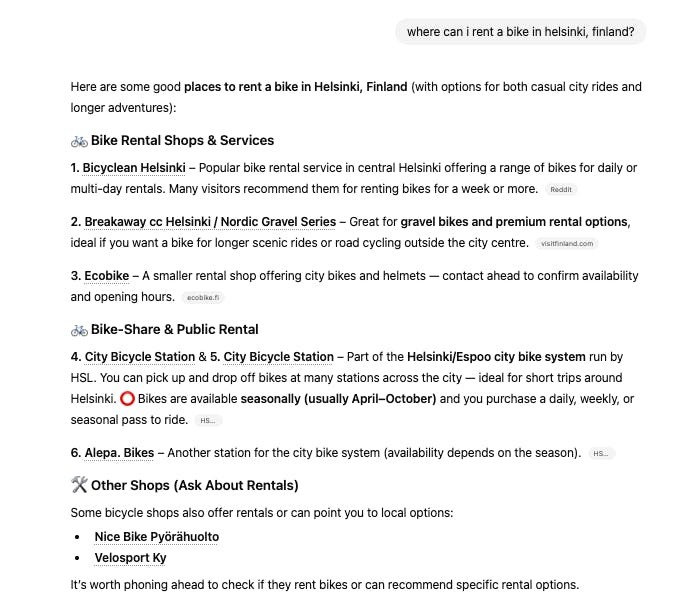
Influencing the LLM itself with optimization would be nearly impossible. But with the introduction of RAG, LLMs now have more similarities with traditional search engines. And, as we know from SEO, search appearance can be optimized for.
Answer Engine Optimization (AEO) means the activity of improving a website’s visibility in answer engines.
Sometimes terms like GEO (Generative Engine Optimization), AIO (AI Optimization), or LLMO (Large Language Model Optimization) are suggested, but AEO has become the most widely used term because it is the most descriptive and specific.
The difference between AEO and SEO is that while traditional SEO focuses on ranking web pages in search results, AEO focuses on being mentioned and cited directly in the answers generated by AI assistants.
The general consensus in marketing and SEO is that many of the best practices for SEO still apply. Basics like a well-structured, fast-loading site, high-quality content, and backlinks continue to matter.
At the same time, there are fundamental differences between how information is presented in AI search and in Google, which means that AEO also requires thinking about content and discoverability differently.
Google search returns a ranked list of links. The core purpose of traditional SEO is to achieve a high placement on the results page for a relevant keyword search so users click the link and land on your site.
This changes with AI search. Answer engines return a single synthesized answer, tailored to the context of the individual search.
In practice, visibility in AI tends to happen in two ways:
- A direct brand mention: the AI assistant recommends your marketplace by name.
- A citation or a link: the answer engine references your site as a source for the information they gave in their answer.
However, the “value” of this visibility isn’t equal to a Google ranking.
On the one hand, users will often have no incentive to click on the source because they have already had their question answered by AI. (However, this might be changing as LLMs seem to be increasingly adding blue links, maps, and direct shopping tips to their answers.)
On the other hand, a direct mention of your marketplace as an answer to a user’s problem can be much more valuable than a Google ranking. In Lenny Rachitsky’s interview, Graphite founder and CEO Ethan Smith stated that LLM traffic converts three to ten times better than traffic from Google.
AI assistants like ChatGPT and Claude are conversational, which invokes trust in the “recommendations” they give.
The conversational approach also leads users to ask much more detailed questions and to provide a lot of context, rather than using short keyword strings. With all that additional data, an AI assistant can also truly be better at recommending the right product for a user’s specific needs than Google.
All this means that while AEO is still SEO at its core, the new technology introduces a shift in emphasis. If Google introduced a heated competition for broad, general, high-volume keywords in an attempt to “grow top-of-the-funnel”, LLMs seem much better at rewarding content that goes into the details and creates new information that enriches their answers.
This can create new advantages for marketplaces, especially niche ones. Their structure and content patterns match what LLMs value most: specificity, expertise, and structured data.
So, before we dive into the practical work of AEO, a few words about why answer engines can bring specific opportunities for marketplace founders.
Answer engines change the discovery game, but not necessarily to the disadvantage of small or new businesses.
In fact, marketplaces, even in their early stages, can have natural advantages that make them well-suited for building AI visibility.
Traditional SEO takes months or even years to pay off. You’re usually competing with well-established sites that have thousands of backlinks and long domain histories. Even if you objectively produced the best article answering the highest-volume query in your niche, a more established site would likely outrank you.
Early evidence suggests that AEO offers a shorter path to visibility. Answer engines seem to rely less purely on backlink-driven authority and more on how directly and clearly your content answers a question. If you can provide concrete, specific information that helps an LLM solve a user’s problem, your brand or content can surface in answers quickly, even before you have a strong backlink profile.
This means small, high-quality sites can be mentioned in the same answers as major brands, provided their content is clear, structured, and genuinely useful (and that they have some signals of authority and trustworthiness—more on this later).
And for an early-stage marketplace, even a few early mentions in the right AI answers can produce leads or bookings that would have taken months to earn through SEO alone.
Marketplaces thrive in niches: focusing on a single category or location and serving it better than any other existing solution. In fact, many founders are finding they can compete with global giants like Airbnb or Turo by narrowing their offering to, say, only sustainable travel alternatives or car rentals in Singapore.
Answer engines are great at matching specific questions to specific solutions. When users ask, “Where can I book sustainable accommodation in Europe?” or “What’s the best way to rent a car in my city?”, a niche marketplace can be exactly the kind of source an LLM wants to cite.
Search engines have long tried to assess topical authority: whether a site consistently demonstrates expertise in a defined domain. Google’s E-E-A-T criteria are an example. While answer engines don’t publish equivalent frameworks, they face the same challenge: when generating an answer, they need to decide which sources are credible for this particular topic.
A niche marketplace can send a clearer signal on topical expertise than a broad platform. Its pages repeatedly reference the same concepts and use cases. Over time, this creates a dense footprint around their key subject area.
More importantly, marketplaces feature a host of first-party data: inventory, availability, pricing, policies, and constraints. This is very different from the notoriously summarized, repackaged SEO content: it’s data that originates directly from your marketplace.
While there’s no explicitly shared information on how AI engines rank content, both Google and AI providers like OpenAI have emphasized the importance of tying answers to reliable, source-originated information. First-party data may give a clear advantage here by making you the original source.
So, in short, in AI search, being clear, consistent, and authoritative about something may matter more than being large, and for marketplaces, this comes naturally.
“Marketplaces have a structural advantage if they do AEO right,” says marketplace investor Colin Gardiner (of Yonder VC).
“They naturally have rich, structured data from listings, reviews, availability, pricing, and so on. The challenge is making that data legible to LLMs.”
Every listing on your marketplace likely comes with data fields like:
- category/service type
- price
- location or availability
- host or seller information
- skills, specialties, or features
- tags or attributes
- customer ratings
That structure appears to align well with how retrieval systems identify and reuse information. While providers don’t disclose their internal weighting, structured and consistently named data is generally easier for search indexes and retrieval systems to interpret.
So, when an AI model tries to answer a detailed query like: “Where can I book a Swedish-language yoga lesson in Helsinki, Finland?”, it benefits from having unambiguous, consistently formatted information such as:
- “Yoga lessons” (service)
- “Helsinki, Finland” (location)
- “Swedish speaking instructor” (qualification)
- “€30 per session” (price)
A marketplace with clearly defined, unified names, categories, and qualifications is a good source for an answer engine to confidently provide a recommendation that matches all these criteria.
An additional benefit could be that marketplaces have two user groups contributing to their information and content: sellers and buyers.
“The two-sided nature (supply and demand) means you have twice the surface area for semantic search. But only if your data architecture is clean and well-marked,” Colin says.
Getting started with Answer Engine Optimization (AEO) means shifting from ranking pages to being cited in AI-generated answers. According to most experts, the core idea is similar to SEO, but with specific twists for AI search.
Tracking AI visibility is much harder than tracking SEO, and answer engines share much less information about their usage than Google does. But if you invest in this channel, you need a way to determine whether the investment was worthwhile.
During the recent year, several AI tracking tools have emerged to help founders and marketers evaluate their visibility (ie, brand mentions and citations) on answer engines. To do that, the tools track these types of signals:
- Mentions: whether your brand appears in an answer
- Citations: whether your site is referenced as a source
- Share of voice: how often you show up compared to competitors for a set of prompts
- Position: where you appear in a list of options
- Sentiment: the tone of the mention
What these tools can’t tell you is true demand: at least currently, they don’t have data on what people actually ask or on the volumes of the tracked prompts. That means you’ll need to rely on your own judgment to determine the key prompts to track in your marketplace.
Still, even if the absolute data isn’t perfect, tracking tools are useful for establishing a baseline, measuring change over time, and monitoring your position against competitors.
AI visibility has high potential for brands, so it’s no surprise that many startups have emerged to help brands optimize for it. That means the space is constantly developing, with new tools and new tracking approaches emerging.
In the current discussion, these are the tools we see mentioned and recommended most often.
- Ahrefs Brand Radar helps track how your brand shows up across AI answers and platforms like YouTube and Reddit, with visibility monitoring and competitive comparisons. The biggest drawback is its hefty price tag: €654/month to track all available platforms, or €179/month per platform.
- Peec AI focuses on AI search visibility across assistants like ChatGPT, Perplexity, Claude, and Gemini, and includes prompt tracking, visibility metrics, and reporting. Pricing starts at €89/month. This is our primary AI tracking tool at Sharetribe.
- Morningscore is a single tool for SEO and GEO tracking. Currently, it appears to include only ChatGPT and AI Overviews in its AI tracking tools. Pricing starts at $49/month.
- RankScale lets you track visibility across lots of platforms, and in addition to the largest players, includes DeepSeek, Mistral, Grok, and Copilot. Pricing starts at $20/month.
- Mangools AI Search Grader is a lightweight, free tool for checking AI visibility. The priced plans, starting at €37.70/month, include more robust AI tracking and SEO tools.
- Trakkr.ai tracks the visibility of your brand across all the major models and gives suggestions and tools on how to improve. There’s a limited free plan, and pricing starts at $79/month.
[Pricing information is current as of: 1/2026.]
Lots of other tools exist, and the landscape evolves fast. So even if you try one of the tools today, it’s worth keeping an eye on the space and testing other tools from time to time.
Graphite CEO Ethan Smith’s practical recommendation for starting to track your marketplace’s AI visibility is to first focus on a limited number (say, 10–30) high-intent prompts you truly think your marketplace should show up for.
Likely, your list will include questions like:
- “Best marketplace for [your niche]”
- “Best place to find/buy/book [your niche]”
- “Where to find/book/buy [your niche] in [your location]
- “Where to sell/list [your niche]” in [your location]
- “Alternatives for [your biggest, most well-known competitor]”
- Prompts that help you understand what AI currently says about you, such as “What is [your brand]?” or “Is [your brand] legit?”—more on this in the next section.)
If you’ve been doing SEO or paid advertising for your marketplace, you likely have a good understanding of your most valuable keywords, which you can translate into question variants to track. Your marketplace categories might also inform you here. And if you can talk to your users and find out which questions led them to you, that information is incredibly valuable.
It’s important to bear in mind that AI answers aren’t static. Even when the prompt stays exactly the same, answers can vary. So even if your marketplace shows up in an answer once, you should run the same query multiple times to understand your true “position”. Some tools do this automatically, but if yours doesn’t, you could do this manually by re-running your tracked prompts each month and logging whether you appear.
Then set up your key competitors, as this will help you measure share of voice.
Check the same set of prompts repeatedly (weekly or monthly) to see development over time.
Once your baseline is established and you have a few weeks or months of data, you can start running experiments. For example, pick a small set of pages or topics you’re planning to include in the experiment (leave others untouched, so you have a “control group”).
Then identify a handful of prompts where you expect to see a lift, make your changes, and track the test group’s prompts against others.
A key challenge in tracking your marketplace AI performance is establishing a clear link to concrete business outcomes.
In SEO, attribution was rather clean: a user searches, clicks a result, and lands on your site. Your analytics tools record where they came from and which page they land on. And your SEO tools record what your top keywords for each page are and whether you’re losing or gaining clicks over time.
This pattern doesn’t exist with AI search. In many cases, even if your brand is mentioned directly or in a citation, the mention won’t lead to a visit. And when it does, that often happens indirectly: the user remembers your marketplace name and returns later by searching for it or typing the URL directly. In this case, your analytics will track the visit as organic or direct, even if discovery really occurred through AI.
Luckily, there’s a simple and relatively reliable way to establish the business impact of AI: ask your users how they found out about you.
If you’ve created an account with Sharetribe, you’ll know that we ask this during onboarding, alongside other questions about your marketplace.
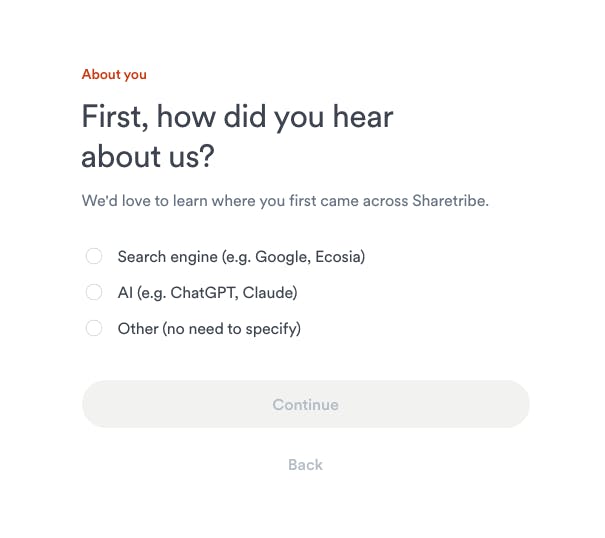
This data point has quickly become one of the most important signals we track. Without it, we’d almost certainly underestimate the importance of AI search for our business. According to our analytics, only about 5% of our total traffic comes from direct links from AI search, whereas answers to “How did you find out about us” reveal that the number of people who create a Sharetribe account and first learned about Sharetribe through AI is significantly higher.
For your marketplace, likely the best place to ask for this information is during sign-up. You capture the most responses and can track the quality of traffic sources throughout the funnel (e.g., are the people who came through AI more or less likely to make a purchase than those who came through organic traffic)? Make sure you’re able to combine the data with information on whether the user is a seller or buyer (if the distinction is relevant for you)—it’s possible AI is better at recommending you to one group than the other.
If asking during account creation isn’t possible, you could also consider a scheduled email or message to your users, for example, after they’ve spent a certain amount of time on your platform, made their first purchase or sale, or when you are asking for feedback anyway. You won’t get as much data as reliably, but it’ll help you understand whether your estimates about the impact of AI on your traffic are in the right ballpark.
A practical tip is to make the question as easy to answer as possible. Fixed questions with a few common options are both easier to answer and to analyze over time. Only ask for the key information you need. For example, Sharetribe only gives you three options: Search engine (eg, Google), AI (eg, ChatGPT), and Other.
If you also engage with your users regularly to ask for feedback, you can use the opportunity to get a bit more detail: which prompt did they use, how did the AI agent describe your marketplace, and if they were recommended other, competing solutions.
Optimizing answer engines doesn’t replace optimizing for search engines.
First of all, many answer engines rely heavily on traditional search infrastructure (especially Google/Bing indexes) when retrieving web results. If your content isn’t present there, it may never enter the retrieval pool.
Second, even when content exists in those indexes, it must also be machine-understandable to be reused.
“Making your information machine-readable has always been important, but it’s table stakes now. You still need a proper SEO site structure,” Colin Gardiner says.
Retrieval systems extract facts, passages, and entities from the pages they retrieve. Pages that are hard to crawl, poorly structured, or ambiguous are less likely to surface as usable evidence.
What does this translate to in practice?
It means the foundational SEO tactics most guides (including ours) have recommended are still very much valid:
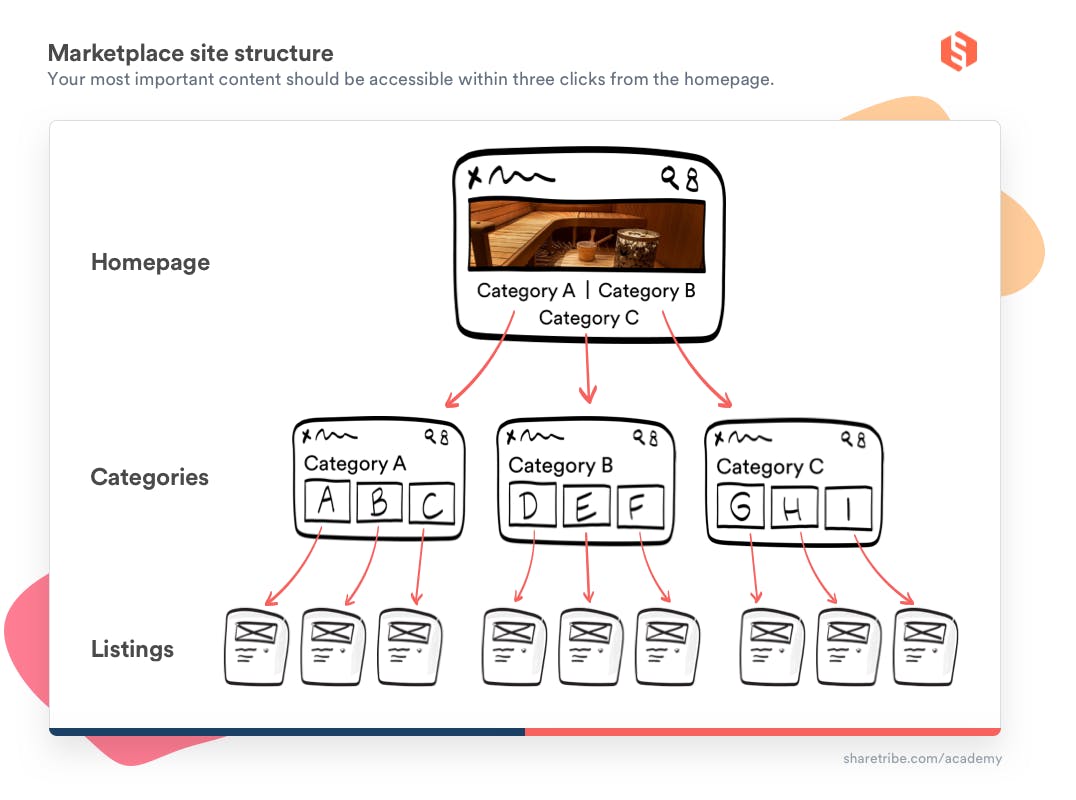
- Make sure your marketplace structure is clean and crawlable
Make sure listings, category pages, and location pages are accessible to search engines. Avoid blocking important inventory behind technical barriers like infinite scroll, complex filters without indexable URLs, or client-side rendering (Google prefers server-side rendering so the whole page is visible to it on the first request). - Build a clear page intent and hierarchy
Each key page type should have a clear role: category pages describe what is offered, location pages describe where, and listing pages describe who or what specifically. This helps both search engines and retrieval systems understand how your marketplace is organized. - Write indexable, descriptive content to core pages
Category and listing pages should contain at least some crawlable text that explains what’s offered, not just UI elements. These descriptions often become the passages that retrieval systems extract. - Create rich listing pages
Ensure listings include extractable facts, like offering type, location, pricing, and availability. They should appear as visible text, not just icons, filters, or other visual UI elements. - Ensure fast-loading pages at scale
Marketplaces often generate thousands of similar pages. Page speed and performance issues multiply quickly and can affect how deeply your inventory is crawled and indexed, which in turn affects what AI systems can retrieve. - Use consistent terminology across listings and categories
Use the same names for the same concepts everywhere. For example, don’t mix “surf lessons,” “surf coaching,” and “surf courses” unless they truly mean different things. Consistency makes it easier for machines to recognize entities and relationships.
In addition to the fundamentals, the community is still debating some specific tactics and their impact on answer engines. Two tactics worth mentioning are:
- Structured data
Many marketplaces have long used schema markup to help search engines interpret key facts like price, location, availability, or ratings. This may be helpful for answer engines as well, which is why AEO guides often recommend it. However, its direct role is debated. A pragmatic middle ground could be to use structured data where it makes sense for your marketplace, but prioritize clear, consistent content first. - AI-specific files (like llms.txt)
Recently, some commenters have proposed AI-specific files such as llms.txt to guide how LLMs access or use website content (similarly to how the robots.txt file is used to guide search engines). So far, there’s little evidence that major answer engines consistently read or honor these files, and some experiments indicate their impact is negligible. However, the llms.txt file is low-cost to implement and unlikely to make things worse in a meaningful way, so that’s why we’ve added one for Sharetribe.com too, just in case.
Suggested next step:
We’ve written a comprehensive guide to marketplace SEO, including detailed articles on technical SEO and keyword strategy. If you’re unsure whether your SEO foundation is set up for success, these resources are a great place to start.
A complicating factor in AEO is that your brand may be visible in AI assistants, but the information they share is inconsistent or even incorrect. That’s why Ahrefs recommends checking what AI assistants already say about your brand and trying to correct the underlying sources as one of the first steps you should take.
With SEO, you have many more opportunities to understand how Google sees your site and guide it to represent information correctly, for example, through the tools in Google Search Console. No similar mechanism exists to influence AI engines, so you’re left with the data you get from AI tracking tools and experimenting with how improvements to your site impact answers.
First, add a handful of prompts to your tracking that illustrate how AI understands your brand. These could be, for example:
- “What is [your brand]?”
- “Is [your brand] legit?”
- “How does [your brand] work?”
(If you’ve used up all the tracked prompts in your current plan, you could also simply run these manually a few times on different AI engines, screenshot and paste into a doc, and repeat weekly or monthly.)
Review the responses manually and look for issues like:
- Wrong category or niche
- Wrong location
- Outdated product positioning or features
- Wrong pricing model
- Confusing you with a competitor or a similarly named company
- If possible, reply to negative or factually incorrect reviews and/or Reddit threads to provide a clarification
If you spot a recurring error, your next step is to figure out where the AI might be getting its information. If the incorrect claim appears consistently across assistants, that might indicate a broader issue.
Unfortunately, there’s no foolproof step-by-step guide for fixing the issue. You’ll need to make a change, wait for an unspecified period, and see if the answers change.
The key is to ensure that your most important pages include clear information about your marketplace.
Your most important pages likely include:
- Your homepage, About page, and key landing pages
- Category and location pages
- Third-party articles, directories, review sites, and community threads
- Old content (on your own or third-party site) that features outdated information.
Tactics that may help include:
- Publishing a clear, factual description of what your marketplace does, who it’s for, and what it’s not.
- Using short, declarative statements of the key facts.
- Ensuring consistent messaging across your key pages.
- Reaching out to the owners of high-impact third-party pages that mention your brand wrong and providing them with an update.
Answer engines seem to be especially good at handling specific, contextual questions. Users tend to ask AI assistants detailed questions that include constraints, preferences, and context. AEO shifts the goal from “ranking for high-volume keywords” to being the best possible answer to a well-defined question.
For marketplaces, this plays to a natural strength, especially for niche marketplaces that are topical experts in a limited field. What remains to be done is to reflect that expertise clearly in content.
What this means in practice:
- Turn category and location pages into answers
Many marketplace category and location pages already align closely with AI queries. Add concise, factual introductions that explain what’s available, who it’s for, and why your marketplace is a good option. This helps the pages function as direct answers, not just navigational hubs. - Optimize for questions, not head topics
Focus on the kinds of questions a potential customer would ask when they’re close to a decision. These often include qualifiers like location, experience level, budget, or use case. Consider structuring content around natural-language questions that an AI assistant could reasonably answer in a paragraph or two. - Be concrete and opinionated where appropriate
Answer engines tend to surface content that clearly explains trade-offs, differences, or recommendations—not the kind of vague overviews SEO has been notorious for. If your marketplace has a point of view (for example, what makes a good provider, or when your platform is a better option than alternatives), state it clearly. - Use formats that map to answers
Formats like FAQs, short explanatory sections, and clearly labeled subsections might make it easier for AI systems to extract and reuse parts of your content.
- Write in short, declarative statements
Clear statements that don’t need analysis or interpretation could be easier for AI systems to quote or summarize. - Keep your content up to date
It seems possible that AI assistants have a strong preference for content that is recent or recently updated, which suggests that frequently updating your key content assets could be a good idea.
Suggested next step:
List the 10–20 questions a potential customer might ask an AI assistant before using a marketplace like yours. Prioritize the ones where your marketplace has a clear, defensible answer, and start there.
Much like search engines, answer engines also care about the quality of their answers and need ways to understand that the products they recommend and sources they cite are of high quality.
For Google, the way to earn this type of authority was through backlinks and E-E-A-T. For answer engines, one important mechanism appears to be mentions on third-party sources that reflect real-world usages or independent evaluations.
“This is where AEO differs from traditional SEO. You need high-value references from reputable sources: news sites, industry publications, Reddit discussions, and social forums where AI can access content. It’s not just about backlinks anymore. It’s about your brand being mentioned in trusted places. LLMs weigh these citations heavily when deciding what to recommend,” Colin Gardiner says.
Also Ahrefs and Graphite have highlighted the growing role of third-party sources, especially community platforms like Reddit, in AI-generated answers.
This can be great news for early and niche marketplaces. Gaining a do-follow backlink from a high-authority site to a brand new marketplace isn’t easy. But even a small, upcoming, highly-focused marketplace can have a lively community of sellers and buyers discussing the platform and its offerings on Reddit or Facebook or leaving great reviews on review sites.
What this means in practice:
- Be present where your users already talk
Communities like Reddit, niche forums, and industry-specific communities often show up in AI answers, especially for comparative or recommendation-style questions. You can build this presence yourself through genuine participation: monitor where you show up, answer questions, share context, and build relationships with the commenters. Be cautious about artificial tactics that look too promotional, and instead be transparent and useful. - Get referenced in explanatory content, not just lists
Being mentioned in an article that explains why a marketplace is useful for a certain problem could often be more valuable than appearing in a generic “top X tools” list. If someone has written about marketplaces within your niche, you can improve their content by offering a context-rich description of your solution. - Engage your audience
If you’ve built strong relationships with your seller and buyer communities, consider reaching out to ask them to leave a review. Your sellers have an incentive to help boost the visibility of your marketplace, so nudging them to mention your platform in their relevant communities could yield great results.
Suggested next step:
Search for questions around the key problem your marketplace solves in AI assistants and note which third-party sources are cited. Those sources indicate where your marketplace would benefit from being mentioned or discussed.
Answer engines are changing how buyers discover solutions. Instead of clicking through a list of links, users increasingly ask detailed questions and expect a tailored recommendation.
For marketplace founders, that shift can be an advantage, even at the early stages and especially if you’re focusing on a small niche.
The core idea of AEO is simple: make it easy for AI systems to retrieve accurate information about your marketplace and confidently recommend it. That starts with SEO fundamentals, but it goes further—toward clearer entity definitions, more question-driven content, and stronger third-party mentions that signal trust.
At the same time, it’s worth repeating the big caveat: AEO is still emerging. Tracking is imperfect, tactics are evolving, and many confident claims in the space aren’t well supported.
The best approach right now is to be pragmatic: set a baseline, run small experiments, and follow high-quality sources that base their recommendations on real data and larger-scale experiments. Even small marketplaces can start building visibility today with tactics that are available to anyone regardless of budget: tightening the SEO foundations, publishing more specific, well-structured answers, and earning real mentions beyond their site.
Recommended further reading:
In writing this article, we’ve leaned on recent discussions from several experts, but these five are the key sources. They’re our current best recommendation for further reading and understanding of how to get started with AEO:
- Kevin Indig (Growth Memo)’s State of AI Search Optimization 2026. Overview of how AI search works, what affects retrieval and citations, and which tactics are still controversial.
- Ahrefs’s Answer Engine Optimization (AEO) and Generative Engine Optimization: Growth Strategies and Metrics For the AI Era. Practical guides to what AEO is, what to focus on as a foundation, and how optimization is evolving as generative answers become more common.
- Graphite’s Ultimate Guide to AEO (Answer Engine Optimization). A clear, opinionated argument for treating AEO as the next major discovery channel and focusing on the small set of prompts that matter most.
- Lenny Rachitsky’s interview with Graphite CEO Ethan Smith on AEO. A founder-friendly conversation with concrete examples—including why LLM-driven traffic can convert very differently from traditional search.
- Ethan Smith was also interviewed on this topic by Mike Williams for the Everything Marketplaces community.
Thank you to Colin Gardiner from Yonder VC for contributing to this article.
No (at least not yet). Google is still a primary discovery channel for many businesses, and it’s likely to remain important for a long time. What has changed is user behavior: more people now use AI assistants for certain types of searches, especially when they have a complex query, and want a quick explanation, a recommendation, or a decision-making shortcut.
For marketplace founders, the practical takeaway isn’t “replace SEO with AEO.” It’s to treat answer engines as an additional discovery channel that can influence purchase decisions even when no click happens.
Yes. SEO is still the foundation for AEO.
When answer engines retrieve information from the web, they often rely on the same underlying infrastructure as traditional search (especially Google and Bing). If your marketplace isn’t crawlable, indexable, and clearly structured, it’s less likely to enter the retrieval pool and less likely to be reused as evidence in an AI answer.
AEO builds on that foundation by increasing the likelihood that your content is selected, summarized, and trusted in AI-generated responses.
No (or at least not as a default strategy).
Most of the “AI content at scale” playbooks are optimized for volume, not usefulness. But answer engines reward content that is specific, accurate, and genuinely helpful, and mass-produced content tends to be generic or redundant.
A better approach is to publish less, but better:
- focus on long-tail questions your buyers actually ask
- make category and location pages answerable
- write clear, factual explanations that can be reused without ambiguity
AI can help this content process, but the subject matter expertise needs to come from you.
Difficult to say. Some changes can affect visibility quickly, while others might take time to be crawled, indexed, and reflected in retrieval results. As AI search providers don’t reveal much of how they rank content, the best way to answer this question is to conduct your own experiments and see what happens.
It can, as answer engines are assumed to place less emphasis on backlink profile as an authority signal than Google did. However, three steps are likely needed first:
- Making sure your inventory pages are crawlable and indexable.
- Adding enough descriptive content for retrieval systems to reuse.
- Earning early third-party mentions (community threads, reviews, niche blogs).
More articles for you...

Marketplace SEO: the complete guide
Get a comprehensive introduction to the world of SEO, tailored specifically to online marketplaces.

Technical SEO for marketplaces
This article introduces the basics of technical SEO and suggests ways to tackle common technical marketplace SEO issues.

Keyword-targeted content marketing for marketplaces
Marketplace content marketing with an SEO mindset.
Start your 14-day free trial
Create a marketplace today!
- Launch quickly, without coding
- Extend infinitely
- Scale to any size
No credit card required