How to build a website like Swimply
Swimply transformed pool rentals by creating a marketplace for private pool access by the hour. Learn how to build a similar platform, from validating your niche to launching a pool rental marketplace that connects homeowners with swimmers.
Published: Mar 15, 2024
Last updated: Mar 19, 2026
Introduction: Why Swimply's success matters to marketplace founders
Swimply has created something remarkable: a $40 million marketplace business built around an asset most people never thought to monetize, their backyard swimming pool. Founded in 2018 by Bunim Laskin, the platform allows pool owners to rent their pools by the hour, creating income streams that can reach $10,000+ annually for active hosts while giving swimmers affordable access to private pools.
The company raised $40 million in Series A funding in 2021, demonstrating investor confidence in the model. By 2024, Swimply operates in over 125 markets across the United States, Australia, and Canada, with thousands of pools available for hourly rental. The average booking generates $45-75 per session, with Swimply taking a commission on each transaction.
What makes Swimply particularly interesting for aspiring marketplace founders is how it identified and solved a clear inefficiency: millions of residential pools sit unused most of the time, while many people lack access to private swimming facilities. The platform didn't create demand for swimming, it created a way to access an underutilized supply.
This guide shows you how to build a marketplace similar to Swimply, whether you're targeting pool rentals specifically or adapting the model for other private space rentals like hot tubs, tennis courts, or outdoor entertainment areas.
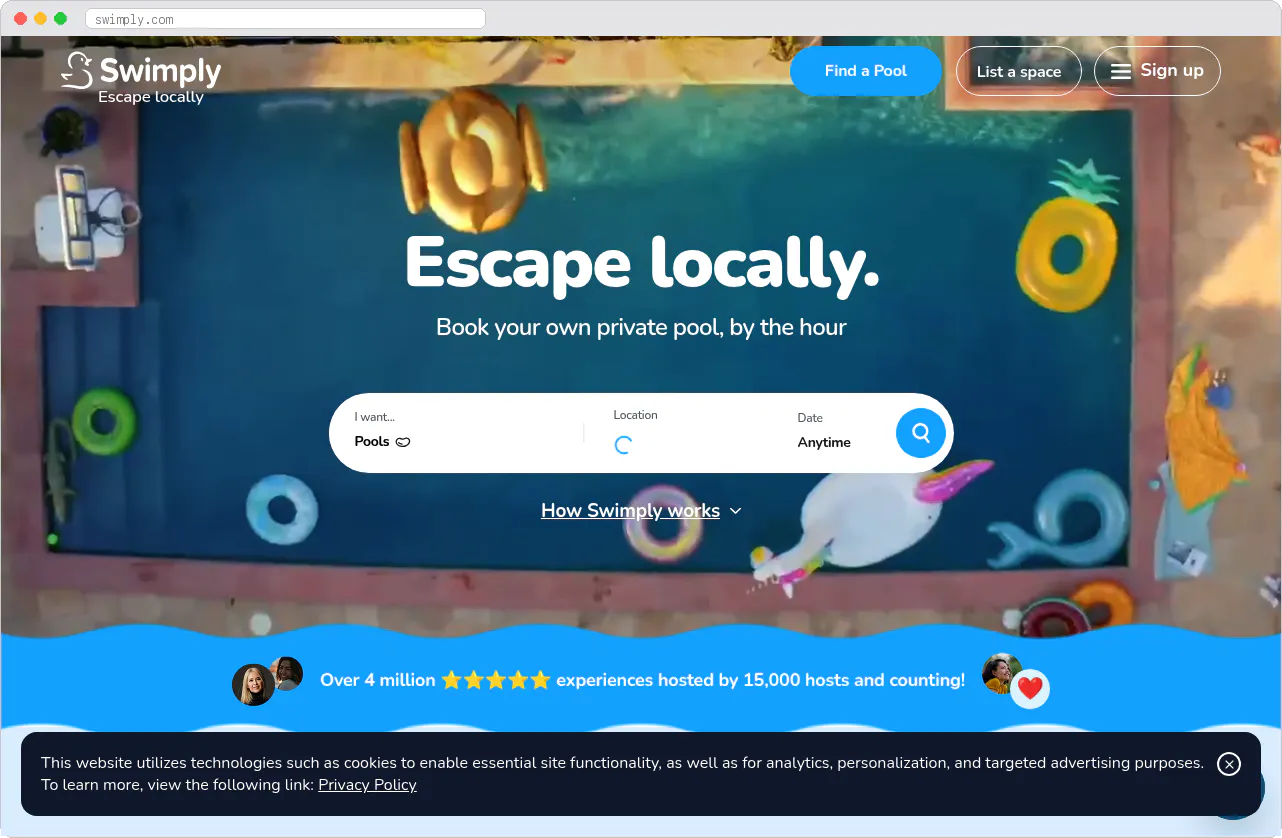
How Swimply works as a marketplace
Swimply operates as a location-based peer-to-peer rental marketplace that connects pool owners with people seeking private pool access. Understanding this model helps clarify what features and business processes you'll need for a similar platform.
For pool owners (hosts)
Pool owners create listings that showcase their pools with high-quality photos, detailed descriptions, and available amenities. They set their own hourly rates (typically ranging from $15-100+ per hour depending on location, pool size, and amenities) and control their availability through integrated calendar management.
The platform handles the entire transaction process. When someone books their pool, hosts receive automatic notifications and can communicate with guests through built-in messaging. Payment processing happens automatically, with funds released to hosts after the rental period ends.
Many successful Swimply hosts treat their listings like a business, investing in pool maintenance, additional amenities like floats or games, and even complementary services. The top-earning hosts on the platform can generate substantial income, some report earning over $20,000 annually from pool rentals.
For swimmers (guests)
Guests search for pools using location-based filters, viewing available options on an integrated map interface. They can filter by specific criteria like pool size, depth, amenities (hot tub, diving board, BBQ area), and price range. Each listing includes detailed photos, host reviews, and clear information about what's included.
The booking process is streamlined: guests select their desired time slot, complete payment through the platform, and receive confirmation with host contact information and specific access instructions. After their swim session, they can leave reviews for the host, building the trust infrastructure that makes the marketplace function.
Swimply's revenue model
Swimply operates on a commission-based model, charging both sides of the transaction. The company typically takes a 10-15% commission from hosts and a service fee of around 10-15% from guests, though exact percentages aren't publicly disclosed and may vary by market or booking value.
This dual-sided commission structure is common among successful marketplaces because it aligns Swimply's revenue with transaction value while distributing platform costs across both user groups. The model also includes additional revenue streams through optional add-on services like liability insurance coverage.
Essential features for a pool rental marketplace
Building a marketplace like Swimply requires specific functionality designed for location-based, time-bound rentals. These features address the unique challenges of connecting strangers around private property access.
Location-based search and mapping
Pool rental inherently depends on location, guests need pools within reasonable driving distance. Your platform needs robust location search functionality that allows users to find pools by address, neighborhood, or proximity to landmarks. Map integration is essential, showing available pools as pins or markers that users can click to view details.
The search system should support multiple location input methods: address entry, current location detection, and map browsing. Distance-based filtering helps users set maximum travel distances, while neighborhood or city-level browsing accommodates different search preferences.
Sharetribe includes built-in location search and mapping functionality powered by Google Maps, allowing guests to search by address or browse pools visually on an interactive map. The system automatically calculates distances and can be configured to show results within specific radius limits.
Availability calendars and booking management
Time-based rentals require sophisticated calendar systems that prevent double-bookings while maximizing pool utilization. Hosts need to set their availability in advance, block off maintenance periods or personal use times, and manage recurring availability patterns (like being available every weekend).
The booking system must handle overlapping time slots intelligently. If someone books a pool from 2-4 PM, the system should automatically make 1-3 PM and 3-5 PM unavailable to prevent conflicts. Many pool rentals also require buffer time between bookings for cleaning and guest transition.
Guests need clear visibility into availability when browsing listings. The calendar interface should show available time slots prominently, with easy selection of start and end times. Integration with the payment system ensures that time slots are only held during the payment process and automatically released if payment fails.
Secure payment processing with delayed payouts
Pool rental marketplaces need payment systems that protect both parties while ensuring smooth transactions. Delayed payout functionality is crucial, guests pay upfront when booking, but hosts receive payment only after the rental period completes successfully.
This delayed payout model protects against no-shows, property damage, or other issues that might arise during the rental. It also provides a window for dispute resolution if problems occur. Most platforms hold payments for 24-48 hours after the rental ends before releasing funds to hosts.
Payment processing for marketplaces involves complex regulations around money transmission and requires integration with specialized platforms like Stripe Connect. These services handle the technical and legal complexities of splitting payments between the platform (commission) and hosts (rental fees).
Sharetribe includes built-in delayed payout functionality through its Stripe Connect integration, automatically handling commission splits while ensuring regulatory compliance across different markets.
Trust and safety features
Private property access requires robust trust infrastructure. Two-way review systems allow hosts and guests to rate each other after rentals, building reputation scores that inform future booking decisions. Identity verification helps ensure that people are who they claim to be before accessing private property.
Many pool marketplaces also implement additional safety measures like requiring photo ID uploads, phone number verification, or even background checks for high-value properties. Clear liability policies and insurance options protect both hosts and guests in case of accidents or property damage.
Messaging systems should facilitate pre-rental communication while maintaining privacy and creating records of all interactions. This helps resolve disputes and provides customer support teams with context when issues arise.
Property and amenity management
Pool listings require detailed property information beyond basic rental details. Hosts need to specify pool dimensions, depth, heating availability, and safety features like fencing or pool covers. Amenity management includes items like floats, games, BBQ areas, changing rooms, and parking availability.
Photo management systems should support multiple high-quality images that showcase the pool, surrounding area, and available amenities. Many successful hosts upload 8-12 photos that give potential guests a complete picture of what to expect.
Listing management tools help hosts keep their information current, update availability, adjust pricing seasonally, and highlight special features or recent improvements.
Steps to build your pool rental marketplace
Creating a successful marketplace like Swimply follows a proven process that starts with market validation and builds toward a scalable platform. Each step builds on the previous one, helping you avoid common pitfalls while maximizing your chances of success.
Step 1: Validate your specific niche
Swimply succeeded by focusing initially on major metropolitan areas with high concentrations of private pools and limited public swimming options. Your validation process should identify similar market conditions or discover underserved segments within the pool rental space.
Start by researching your target market's pool density, seasonal usage patterns, and current alternatives. Cities with many single-family homes, warm climates, and expensive public pool options often provide the best conditions. You might also discover niche opportunities like therapeutic pools, lap swimming facilities, or pools designed for specific activities like diving or water aerobics.
Talk directly with potential hosts and guests in your area. Pool owners often have strong opinions about liability concerns, insurance requirements, and maintenance costs. Potential renters can tell you about current pain points with public pools, gym facilities, or existing rental options.
Consider seasonal factors carefully. Pool rental demand varies dramatically by climate and season, affecting both revenue potential and business sustainability. Northern markets might only support seasonal operation, while year-round warm climates enable consistent revenue streams.
Step 2: Start with focused geographic scope
Even though Swimply now operates nationally, the founders started in Los Angeles and expanded methodically market by market. This focused approach helps you achieve marketplace liquidity, the balance of supply and demand that makes the platform valuable for both sides.
Choose your initial market based on pool density, target customer concentration, and your personal knowledge of the area. Starting in your home city provides advantages in understanding local regulations, building initial relationships, and handling operational challenges personally.
Geographic focus also simplifies marketing and customer acquisition. You can target local Facebook groups, neighborhood apps like Nextdoor, and area-specific advertising rather than spreading your budget across multiple markets ineffectively.
Step 3: Build your minimum viable platform
Your first version should include only the essential features needed to facilitate bookings between pool owners and renters. This typically includes basic listing creation, location search, calendar availability, secure payments, and messaging functionality.
Avoid the temptation to build advanced features like dynamic pricing, automated insurance, or mobile apps initially. These can always be added later based on user feedback and business growth.
The goal at this stage is learning, not perfection. You want to get real users interacting with your platform as quickly as possible so you can understand what works, what doesn't, and what additional features would create the most value.
Sharetribe enables launching a functional pool rental marketplace within 1-2 weeks without coding. The platform includes all essential marketplace features pre-built, allowing you to focus on content, branding, and customer acquisition rather than technical development.
Step 4: Recruit your initial supply
Marketplace success depends on having attractive supply when your first customers arrive. Start by identifying and personally recruiting your initial pool owners before launching to the general public.
Successful approaches include direct outreach to homeowners with visible pools (using tools like Google Earth or neighborhood drives), posting in local homeowner Facebook groups, and using personal networks to find early adopters willing to experiment with the platform.
Offer early hosts special incentives like reduced commission rates, free professional photography, or priority customer support. These early relationships often become your best source of feedback for platform improvements.
Consider starting with friends or family members who own pools. While they might not represent your typical host, they provide safe testing grounds for working out operational bugs and refining your onboarding process.
Step 5: Launch to a limited customer base
Once you have 10-20 quality pool listings, begin marketing to potential renters. Start small to ensure you can provide excellent customer service and handle any issues that arise.
Target marketing toward people already interested in pool access: parents looking for swim options, fitness enthusiasts seeking lap swimming, or event planners organizing pool parties. Local parenting groups, fitness forums, and social media communities often provide concentrated audiences.
Monitor early bookings closely. Personally follow up with both hosts and guests to understand their experience, identify pain points, and gather suggestions for improvement. This direct feedback becomes invaluable for platform development priorities.
Step 6: Achieve problem-solution fit
Problem-solution fit occurs when your marketplace consistently facilitates successful transactions with minimal intervention from you. Signs include repeat bookings, positive reviews, organic word-of-mouth growth, and hosts/guests recommending the platform to others.
Key metrics to track include booking completion rates, repeat usage rates, and net promoter scores from both sides of the marketplace. Low completion rates might indicate trust issues, pricing problems, or feature gaps that prevent successful transactions.
If you're not seeing consistent usage, don't panic. This simply means you need to iterate based on user feedback. Common early-stage issues include pricing mismatches, insufficient trust signals, or missing features that users consider essential.
Step 7: Scale systematically
Once your initial market is working reliably, you can begin expanding to adjacent markets or adding new features. Swimply's expansion strategy focused on similar metropolitan areas with comparable demographics and pool density.
Expansion should be systematic rather than random. Choose new markets based on data about pool ownership rates, target customer concentration, and competitive landscape. Enter each new market with lessons learned from your initial launch, but remain flexible about local variations.
Consider different expansion vectors: geographic (new cities), categorical (new property types like hot tubs or tennis courts), or demographic (targeting specific customer segments like fitness enthusiasts or families).
Swimply competitors and market alternatives
Understanding Swimply's competitive landscape helps identify opportunities for differentiation and reveals different approaches to the private space rental model.
Peerspace represents the broadest alternative to Swimply's focused approach. While Swimply specializes exclusively in pool rentals, Peerspace offers diverse venue types including event spaces, photo studios, meeting rooms, and outdoor areas. Some Peerspace listings include pools, but they're typically part of larger venue packages rather than standalone pool access.
Peerspace's model works well for event organizers, content creators, and businesses needing unique spaces, but it serves a different primary use case than individual pool access. Their pricing tends to be higher per hour ($50-500+) because venues are designed for professional or large group use.
For founders considering this space, Peerspace's success demonstrates demand for private space rentals beyond traditional accommodations, but also shows the complexity of managing diverse property types and use cases on a single platform.
Sniffspot created a niche alternative by focusing specifically on dog owners. The platform allows pet owners to rent private, fenced yards where dogs can play off-leash safely. While not directly competitive with human pool rentals, Sniffspot demonstrates how focusing on a specific user group's needs can create a defensible market position.
Sniffspot's average bookings are shorter (1-2 hours) and less expensive ($5-25/hour) than typical pool rentals, but they serve a recurring need that generates consistent usage. Many Sniffspot hosts report that dog owners become regular customers, visiting weekly or multiple times per week.
This model suggests opportunities for pool marketplace founders to serve specific segments like dog owners (pools where pets are welcome), fitness enthusiasts (pools designed for lap swimming), or therapeutic users (heated pools with accessibility features).
Traditional vacation rental platforms like Airbnb and Vrbo offer indirect competition. While these platforms don't facilitate pool-only rentals, many property listings include private pool access as part of overnight or daily house rentals.
For guests willing to rent an entire property, these platforms can provide pool access along with other amenities. However, the cost structure is completely different, typically $100-500+ per night versus $25-75 for a few hours of pool time. The use cases also differ: vacation rentals serve travelers needing accommodation, while pool rentals serve locals seeking recreational access.
Some vacation rental hosts have experimented with day-use bookings that include pool access without overnight stays, but these remain exceptions rather than systematic offerings.
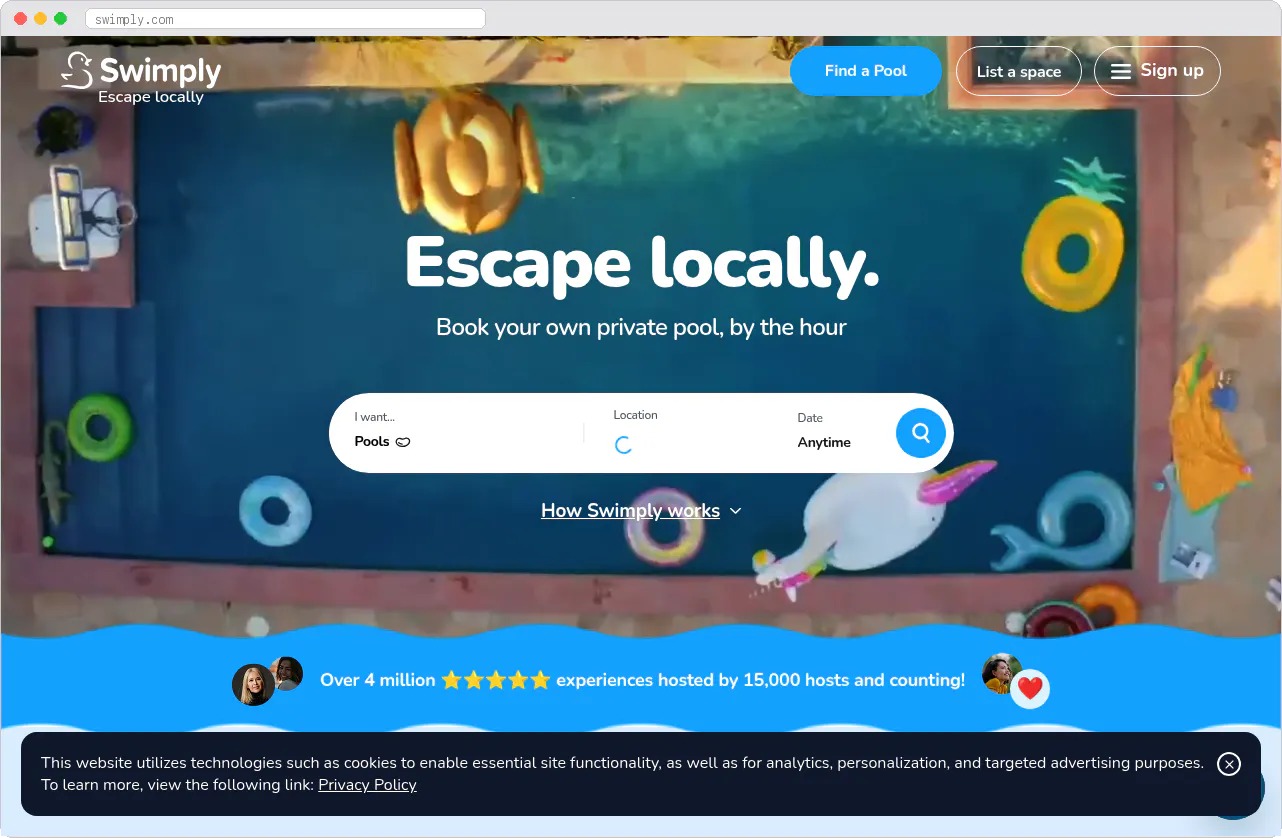
Swimply faces emerging competition from other pool-focused startups. Poolside emerged in select markets offering similar pool rental functionality, though with less geographic coverage and fewer features. Other regional players have launched in specific metropolitan areas, often targeting luxury pools or niche segments like lap swimming.
These direct competitors validate the market opportunity while highlighting the importance of execution, geographic expansion speed, and network effects in marketplace businesses. Swimply's early market entry and rapid scaling created significant advantages in host and guest acquisition.
The broader sharing economy provides context for understanding Swimply's position. Platforms like Turo (car sharing), Getaround (car rentals), and Neighbor (storage space) demonstrate successful models for monetizing underutilized assets. Each serves different use cases but operates on similar principles: connecting asset owners with people needing temporary access.
These parallels suggest opportunities for founders to apply the Swimply model to other underutilized assets like tennis courts, basketball courts, outdoor entertainment areas, or specialized facilities like music studios or art spaces.
Building approaches for a pool rental marketplace
The technical approach you choose affects your time to market, initial costs, long-term scalability, and ability to differentiate your platform. Each option involves different trade-offs between speed, cost, and flexibility.
Custom development from scratch
Building a pool rental marketplace from scratch provides maximum flexibility but requires significant time and financial investment. A basic version with essential features (listings, search, booking, payments) typically requires 6-12 months of development and costs $50,000-150,000 when outsourced to a development agency.
Custom development makes sense for founders with specific technical requirements that existing platforms can't accommodate, substantial funding to invest in development, or experienced technical teams capable of handling complex marketplace functionality.
The main challenges include payment processing complexity (requiring specialized marketplace payment solutions), regulatory compliance across different markets, and ongoing maintenance costs. As your platform scales, you'll need dedicated developers for features, bug fixes, security updates, and infrastructure management.
However, custom development provides complete control over user experience, feature priority, and platform evolution. Successful custom-built marketplaces can implement unique functionality that becomes a competitive advantage.
No-code marketplace platforms
No-code marketplace builders like Sharetribe enable launching functional platforms without programming skills. This approach dramatically reduces time to market (1-2 weeks) and initial costs (under $100/month to start) while providing professional functionality.
Sharetribe includes all essential marketplace features pre-built: user registration and profiles, listing creation and management, location-based search with map integration, availability calendars and booking systems, secure payment processing with commission handling, messaging between users, review and rating systems, and administrative tools for platform management.
The platform handles technical infrastructure, security compliance, and ongoing maintenance, allowing founders to focus on business development, customer acquisition, and market validation rather than technical challenges.
Limitations include reduced flexibility for highly specialized features and dependency on the platform provider's development roadmap. However, Sharetribe's Developer Platform allows custom code additions when specific features become necessary, providing a growth path that maintains the no-code benefits while adding technical flexibility.
Hybrid approaches
Some founders combine no-code platforms with custom development, using marketplace builders for core functionality while developing specialized features separately. This approach can work but often creates integration challenges and increased complexity.
Other hybrid approaches include using general-purpose no-code tools (like Bubble, Webflow, or Airtable) combined with third-party services for payments, messaging, and other specialized functions. While potentially cost-effective, these combinations often require significant configuration time and may lack marketplace-specific optimizations.
Cost considerations for pool rental marketplaces
Understanding the full cost structure helps founders budget appropriately and choose the most suitable development approach for their situation and goals.
No-code marketplace costs (Year 1)
Using a platform like Sharetribe, first-year costs typically include the marketplace subscription ($99-299/month depending on features and transaction volume), domain registration ($10-15 annually), professional photography for initial listings ($500-1,500), basic legal setup including terms of service and privacy policy ($1,000-3,000), and initial marketing budget ($2,000-10,000 depending on market size and competition).
Total first-year budget ranges from $5,000-20,000, with most costs related to content creation and marketing rather than technical development. This approach allows founders to test market demand and achieve initial traction before making larger investments.
Transaction fees (typically 2-4% through payment processors like Stripe) apply as bookings increase, but these align with revenue growth rather than requiring upfront investment.
Custom development costs
Custom development involves higher upfront costs but different ongoing structures. Initial development typically costs $50,000-200,000 depending on feature scope, design complexity, and development team location.
Ongoing costs include hosting and infrastructure ($500-5,000/month depending on scale), maintenance and updates (typically 15-25% of initial development costs annually), payment processing fees (2-4% of transaction volume), legal and compliance costs ($5,000-15,000 annually), and dedicated development resources for new features and improvements.
Custom platforms often require larger marketing budgets to overcome the credibility challenges that established platforms provide automatically.
Revenue potential and unit economics
Successful pool rental marketplaces typically generate revenue through commission structures ranging from 15-25% of total booking value. With average bookings of $45-75 per session, platform revenue per booking ranges from $7-19.
Hosts who actively manage their listings often generate $2,000-10,000+ annually, with top performers in high-demand markets earning significantly more. Guest acquisition costs vary by market but typically range from $15-40 per new customer in established markets.
The key to marketplace profitability is achieving sufficient transaction volume to cover fixed costs while maintaining healthy unit economics. Most successful marketplaces become profitable once they facilitate several hundred bookings per month consistently.
Legal and regulatory considerations
Pool rental marketplaces face unique legal challenges related to property access, liability, insurance, and local regulations that traditional marketplaces don't encounter.
Liability and insurance
Swimming pool access involves inherent risks that require careful legal planning. Most successful platforms require hosts to maintain homeowners insurance that covers short-term guests, though coverage varies significantly by insurance provider and policy type.
Some platforms offer additional liability insurance as an add-on service, typically costing $5-15 per booking but providing coverage for property damage or injury claims. These insurance products often require partnerships with specialized providers who understand marketplace liability scenarios.
Clear terms of service should address responsibility allocation between platform, hosts, and guests for different types of incidents. Many platforms require guests to acknowledge swimming risks and confirm their swimming ability as part of the booking process.
Local regulations and zoning
Residential pool rentals often fall into regulatory gray areas that vary significantly by municipality. Some cities classify short-term pool access as commercial activity requiring business licenses or special permits.
Zoning restrictions in residential areas might limit or prohibit commercial use of private property, even for services like pool rentals. Homeowners associations frequently have rules about guest access that could affect pool rental viability.
Successful platforms typically provide resources helping hosts understand local requirements while maintaining that hosts are responsible for compliance. Some markets may require excluding certain neighborhoods or property types due to local restrictions.
Tax implications
Pool rental income is generally taxable, and hosts need guidance about reporting requirements, deductible expenses, and potential business license needs. Platforms may need to provide tax documentation (like 1099 forms) for hosts earning above certain thresholds.
Sales tax or occupancy tax requirements vary by jurisdiction and may apply to short-term rental activities. Some markets require platforms to collect and remit these taxes automatically.
Marketing and customer acquisition strategies
Pool rental marketplaces require different marketing approaches for hosts and guests, often with seasonal considerations that affect campaign timing and messaging.
Host acquisition strategies
Successful host acquisition often begins with direct outreach to homeowners with visible pools. Google Earth, neighborhood drives, and local aerial photography can help identify potential hosts for personal contact.
Social media marketing in homeowner-focused groups, neighborhood apps like Nextdoor, and local Facebook communities often generate qualified leads. Content marketing around pool maintenance, home monetization, and sharing economy opportunities can attract interested homeowners organically.
Referral programs incentivizing existing hosts to recruit friends and neighbors often prove highly effective, since pool owners frequently know other pool owners in their social circles.
Guest acquisition strategies
Guest acquisition typically focuses on people already seeking pool access through alternative means. Parents researching swimming lessons, fitness enthusiasts looking for lap swimming options, and event planners seeking party venues represent concentrated target markets.
Seasonal marketing campaigns aligned with summer months, school vacations, and holiday periods can maximize marketing efficiency in markets with seasonal demand patterns.
Partnership opportunities include swim instructors, personal trainers, event planners, and local activity-focused businesses that serve complementary customer bases.
Building marketplace liquidity
Marketplace success depends on balanced supply and demand that creates value for both sides. Too much supply without demand leaves hosts disappointed, while insufficient supply drives away potential guests.
Monitoring key metrics like booking completion rates, average time between listing creation and first booking, and repeat usage rates helps identify whether your marketplace has achieved sustainable liquidity.
Geographic density often matters more than total listings. Having 20 pools within a 10-mile radius typically creates more value than having 100 pools scattered across a large metropolitan area.
Next steps for building your pool rental marketplace
Starting a marketplace like Swimply requires systematic execution rather than perfect planning. The most successful founders validate their market opportunity, launch quickly with essential features, and iterate based on real user feedback.
Begin with market research and validation in your target area. Identify pool density, potential host interest, and customer demand through direct conversations rather than surveys or assumptions. Understanding local regulations, insurance requirements, and competitive landscape provides essential foundation knowledge.
Choose your development approach based on your timeline, budget, and technical requirements. No-code platforms like Sharetribe enable testing market demand quickly and cost-effectively, while custom development provides maximum flexibility for founders with specific technical needs and substantial budgets.
Start small with focused geographic scope and limited feature sets. Achieving marketplace liquidity in one neighborhood or city is much easier than trying to serve an entire metropolitan area simultaneously. Essential features matter more than advanced functionality in early stages.
Plan for iterative improvement based on user feedback. Your initial platform will need modifications based on how real hosts and guests actually use it. Build processes for gathering feedback, prioritizing improvements, and implementing changes quickly.
The pool rental marketplace opportunity extends beyond just swimming pools to include hot tubs, tennis courts, outdoor entertainment spaces, and other underutilized residential amenities. Swimply's success demonstrates the viability of connecting property owners with people seeking temporary access to private recreational facilities.
Success in this space comes from understanding local market dynamics, building trust between strangers sharing private property, and creating sustainable value for both hosts and guests. The technical platform serves these business objectives rather than being an end in itself.
Whether you're targeting pool rentals specifically or adapting the model for other private amenities, focus on solving real problems for both sides of your marketplace. Start small, launch quickly, and let user feedback guide your platform's evolution toward product-market fit and sustainable growth.
Frequently asked questions
How much does it cost to build a pool rental app like Swimply?
Costs range from $5,000-20,000 for the first year using no-code platforms like Sharetribe, versus $50,000-200,000 for custom development. No-code approaches enable faster testing and validation with lower risk.
What features does a pool rental marketplace need?
Essential features include location-based search with maps, availability calendars, secure payment processing with delayed payouts, two-way reviews, messaging systems, and liability management tools. These create trust between strangers sharing private property.
How does Swimply make money?
Swimply charges commission fees from both pool owners (hosts) and renters (guests), typically 10-15% each side. This dual-commission model aligns platform revenue with transaction value while distributing costs across both user groups.
Is it legal to rent out my pool by the hour?
Legality varies by location and local regulations. Most areas allow it, but some municipalities classify it as commercial activity requiring permits. Check local zoning laws, HOA restrictions, and insurance coverage before starting.
What are the main competitors to Swimply?
Direct competitors include emerging pool rental startups like Poolside. Indirect competition comes from Peerspace (broader venue rentals), vacation rental platforms with pools, and Sniffspot (dog-focused yard rentals). Each serves different use cases and price points.
How do I attract pool owners to my marketplace?
Start with direct outreach to homeowners with visible pools, post in local homeowner Facebook groups, use neighborhood apps like Nextdoor, and offer early adopter incentives. Personal referrals from existing hosts often prove most effective.
Start your 14-day free trial
Create a marketplace today!
- Launch quickly, without coding
- Extend infinitely
- Scale to any size
No credit card required