How to build a website like Peerspace
Peerspace connects people with unique spaces for events, meetings, and productions. This guide shows you how to build a similar space rental marketplace, from validating your idea to launching and scaling your platform.
Published: Mar 28, 2024
Last updated: Sep 11, 2026
What is Peerspace and how does it work?
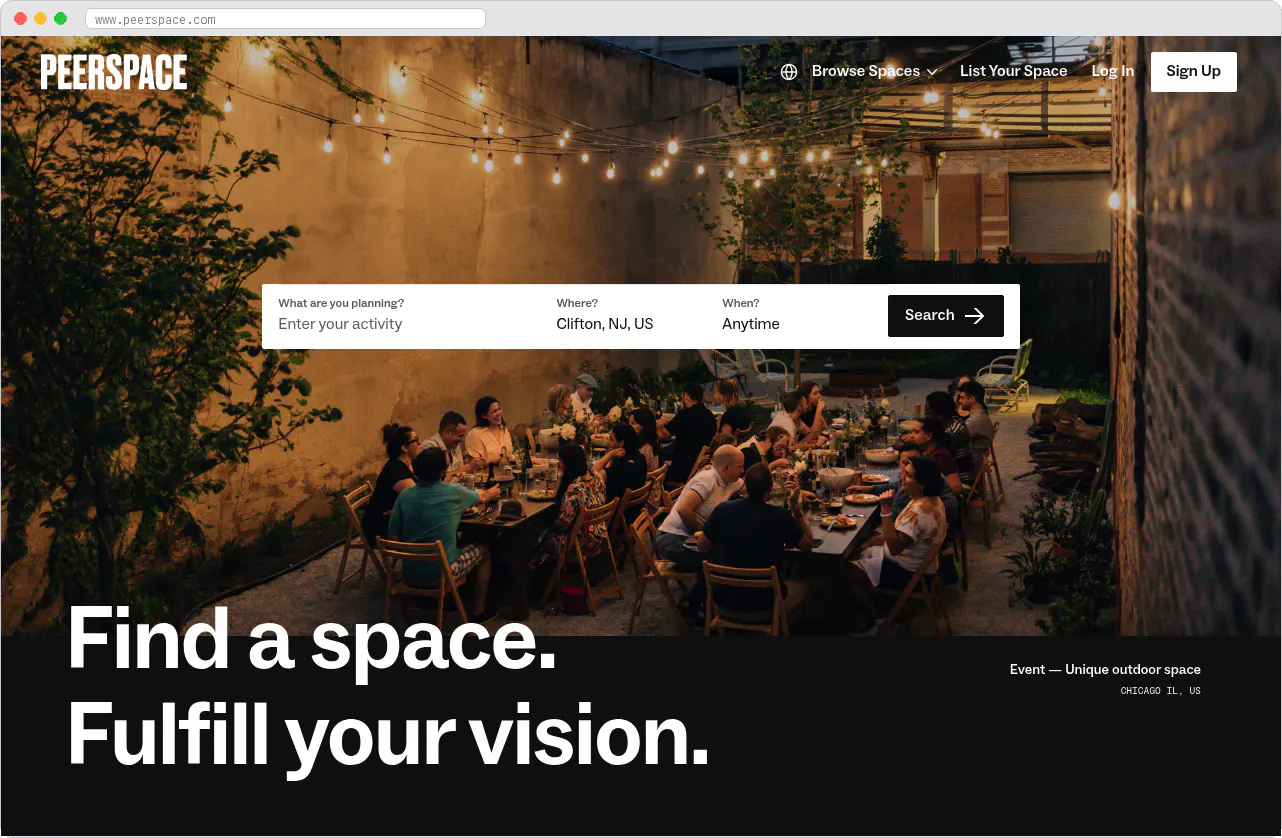
Peerspace connects people who need a space (for photo shoots, meetings, events, or productions) with people who have one to rent out. Rony Chammas founded the company in 2014 after struggling to find affordable meeting spots for student clubs at NYU, then noticing that an empty art gallery made a far better venue than a crowded coffee shop. That observation became a marketplace: hosts list underused venues (lofts, studios, rooftops, warehouses), and guests book them by the hour or day.
The platform has raised more than $40 million in venture funding (CB Insights) and now lists more than 50,000 spaces across cities worldwide (Peerspace). It has processed hundreds of millions of dollars in gross bookings since launch, positioning it as the largest dedicated space rental marketplace in the country. Peerspace's core insight was narrow at first, targeting creative professionals who needed photogenic locations, and it has since broadened into meetings, events, and productions of all kinds.
How Peerspace makes money
Peerspace runs a dual-sided commission model. Hosts pay a 20% service fee on each booking, while guests pay a variable processing fee based on the booking subtotal (Peerspace Support Center). This means a $1,000 booking can generate $270-$330 in combined platform revenue before payment processing costs.
Estimates of Peerspace's annual revenue vary widely and are not independently confirmed, but the business is understood to be driven by transaction volume rather than subscriptions or listing fees. There is no cost to list a space, which keeps the top of the funnel open and shifts all monetization to successful bookings. This is a common structure for rental marketplaces where inventory is finite and trust-sensitive: charge only when a transaction actually happens, so hosts have no reason not to list.
Ancillary revenue is limited but present. Peerspace offers optional damage protection and insurance add-ons on some bookings, and it has experimented with concierge-style services for large productions that need equipment or crew coordination. These remain secondary to the core commission engine.
What makes Peerspace work: key features
Visual-first listings. Space rental is a category where photography decides bookings before anything else does. Peerspace listings lead with professional-quality images, and hosts are implicitly encouraged (sometimes through Peerspace's own photography partners) to invest in shoots that show scale, light, and character rather than just square footage.
Location-based, map-driven search. Guests search by neighborhood, radius, or landmark, then filter by capacity, price, and space type. Because most bookings are tied to a specific event date and location, map browsing matters more here than in most marketplace categories, letting guests compare venues relative to where their attendees are actually coming from.
Hourly and daily availability calendars. Unlike product marketplaces with replenishing inventory, a space can only host one booking per slot. Peerspace's calendar tooling lets hosts block personal-use time, set different rates for peak hours, and manage buffer time between bookings for cleanup or turnover.
Instant book and request-to-book, side by side. Simple, low-risk bookings (a small meeting room for two hours) can confirm instantly. Larger or higher-risk bookings (a 200-person event, an overnight film shoot) go through a request flow so hosts can vet the guest and the use case first.
Escrow-based payment with damage protection. Peerspace collects payment upfront and releases funds to hosts after the booking completes, and hosts get up to $1 million in supplemental general liability coverage plus a separate Property Damage Guarantee covering up to $25,000 per booking (Peerspace). This addresses the single biggest objection hosts have to renting out a space they care about: what happens if something goes wrong.
Two-way reviews. Both hosts and guests rate each other after every booking, which matters in a category where reputational risk runs in both directions. A host with a beautiful loft still needs guests who show up on time, respect house rules, and leave the space clean.
The competitive landscape
Splacer, once a direct competitor to Peerspace for creative and commercial bookings, permanently closed its service in April 2025 (Splacer). It leans into production support such as location scouting and equipment coordination, and enforces stricter listing standards that push toward higher-end commercial venues. That focus narrows its host pool compared to Peerspace's more accessible model, leaving room for a platform that welcomes casual and first-time hosts without demanding production-grade listings from day one.
Giggster narrows further into film and photography specifically, layering in crew coordination, permit help, and shot-list tools that plug directly into a production workflow. That depth is a genuine advantage for filmmakers, but it also means Giggster is a weaker fit for a business meeting, baby shower, or pop-up dinner. A platform built around non-production events (meetings, small gatherings, workshops) sits in the gap Giggster leaves open.

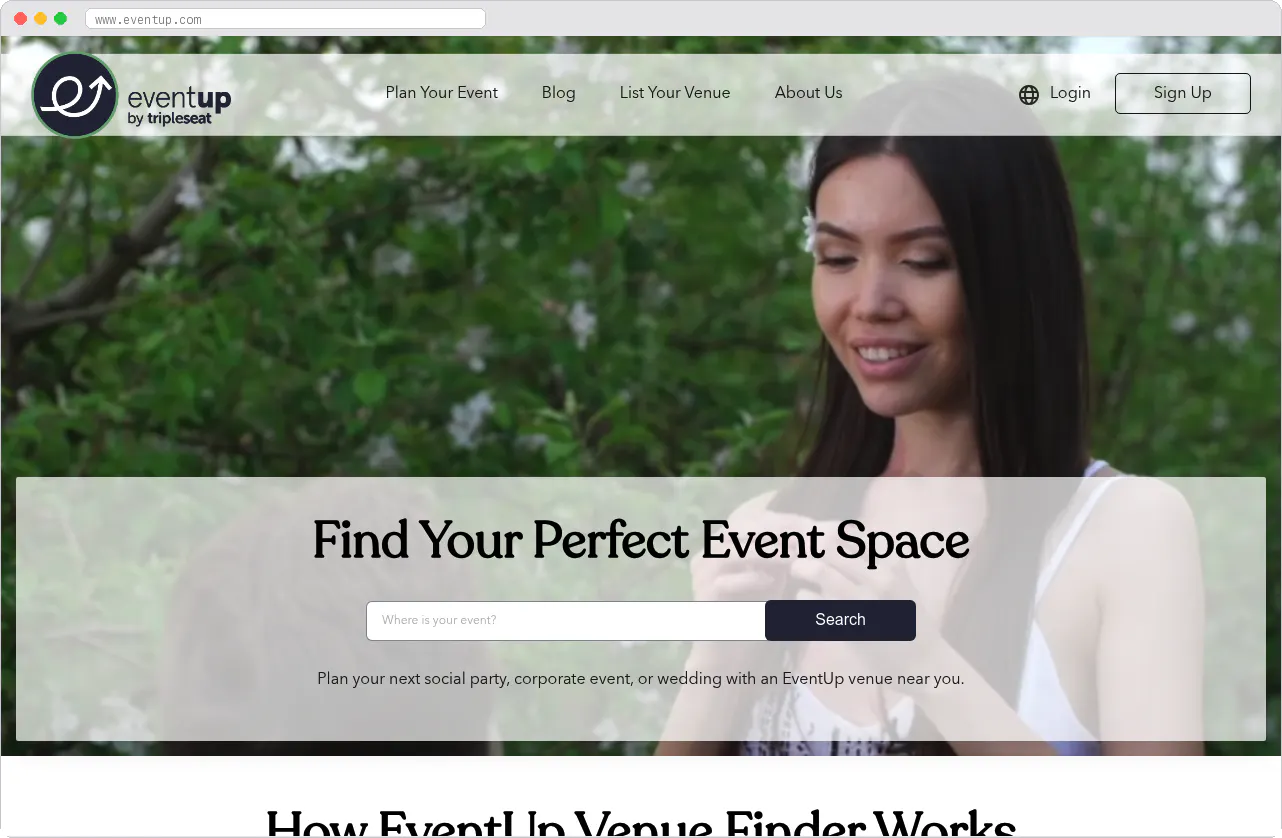
Eventup targets traditional event planning (weddings, corporate parties, galas) with larger venues and longer bookings, competing more with hotels and banquet halls than with lofts and studios. Its model leans on vendor partnerships and lead generation alongside commissions, which adds operational overhead but also monetization beyond the booking itself. It underserves the smaller, shorter, more casual bookings that make up a large share of demand in cities without a heavy event-planning industry.
Airbnb, through its broader listings and past Experiences product, competes at the edges: some hosts list meeting-friendly spaces on Airbnb directly, and guests comparison-shop across platforms for anything that looks like a rentable room. Airbnb's brand recognition and existing user base are hard to match, but it lacks Peerspace's specialized search filters (capacity, event type, equipment) and host tools built specifically for hourly, non-overnight bookings. A platform focused tightly on a use case Airbnb handles poorly (hourly meeting spaces, for example) can win on relevance even against a much bigger competitor.
Local co-working and meeting-room aggregators (think city-specific or niche booking sites) address the same "I need a room for a few hours" need but usually carry generic, corporate inventory rather than the character-driven spaces Peerspace is known for. They compete on convenience and predictability, not aesthetics, which leaves an opening for anyone building a marketplace around visually distinctive, personality-driven spaces in a specific city or niche.
How to build a marketplace like Peerspace
1. Define your niche within the space rental category
Peerspace itself started narrow (creative professionals, a handful of cities) before broadening. A new entrant almost certainly should not try to out-Peerspace Peerspace on breadth. Instead, pick an axis to specialize on: a specific city or region with weak coverage today, a specific space type (backyards for pop-up dinners, industrial kitchens for food content creators, rooftop bars for small events), or a specific user group (wedding photographers, corporate offsites, podcast producers who need a recording-ready room). The narrower the initial focus, the easier it is to build both supply and demand without competing directly with Peerspace's existing inventory.
2. Validate supply and demand before building
Space rental marketplaces live or die on inventory quality, so validate the supply side first. Talk to 15-20 potential hosts in your target niche about their current utilization, what would make them list a space, and what worries them (damage, liability, difficult guests). Talk to an equal number of potential guests about how they currently find spaces, what they pay, and what frustrates them about existing options. If you can't find hosts willing to list before you've built anything, that's a signal worth taking seriously.
3. Choose your development approach
Vibe coding from scratch. AI tools like Cursor, Lovable, and Bolt can produce a working Peerspace-style prototype quickly. For pressure-testing a concept or demonstrating it to early hosts, they're genuinely useful. For launching a platform that handles real money, damage deposits, and disputes between strangers, they're probably not sufficient. What vibe-coded outputs reliably don't produce is the infrastructure underneath: payment escrow, dispute resolution, fraud detection, and compliance. A documented Sharetribe experiment ran 60+ hours to reach demo quality but revealed a critical checkout exploit that would have allowed any user to manipulate transaction prices via a direct API call. Bringing the output to production standard requires significant time, testing, and a clear understanding of how the different components of a web application fit together. A useful prototyping tool, not a cost-effective path to launch.
Custom development from scratch. Hiring developers gives you full control over every workflow. For a Peerspace-type marketplace, use the correct complexity tier: a simple MVP (listings, search, messaging, basic payments) runs $30,000-$80,000 over 8-20 weeks; a production-grade build with reviews, identity verification, escrow, and dispute flow runs $80,000-$200,000 over 16-28 weeks (Codica, RaftLabs). A space rental marketplace sits in the production-grade tier almost by default, since damage deposits, insurance-adjacent features, and dispute flows are not optional extras here, they're core to host trust. The low end of each range assumes offshore teams at $15-40/hr; US or Western Europe teams push toward the top. This path makes sense when you have requirements no existing platform can meet.
Building on a marketplace operating system like Sharetribe. You start at roughly 90% done on the standard marketplace foundation: payments, user accounts, listing management, messaging, transaction flows, fraud detection, and compliance. Your time and budget go toward the features that make a space rental marketplace distinct, like calendar availability, capacity filters, and damage-deposit handling. Three paths within this approach:
- No-code builder. Configure hourly and daily bookings, location-based search with map filters, capacity and amenity fields, and a commission-based transaction flow directly from the Console. This gets a Peerspace-style marketplace live without writing code.
- AI-assisted development. Connect Claude Code, Cursor, or Codex to Sharetribe's open APIs and open-source template to build category-specific features: custom listing fields for equipment and floor plans, automated buffer-time logic between bookings, or integrations with external calendar tools. Because Sharetribe handles the payment infrastructure, AI-assisted development on top of it carries much lower risk than building from scratch.
- Custom code. Build directly on the developer platform for deeper integrations (insurance partner APIs, virtual tour embeds), or hire from Sharetribe's Expert Marketplace.
Most founders start with the no-code builder, then add features via AI or a developer as they learn what their hosts and guests actually need.
4. Solve the cold start problem
Space rental marketplaces face a specific version of the chicken-and-egg problem: guests won't book if there aren't enough good spaces nearby, and hosts won't list if there's no proof guests will show up. Peerspace solved this by starting hyper-local (NYU's neighborhood, then a handful of creative hubs) and by personally recruiting hosts Chammas already knew from his own space-hunting struggles, rather than waiting for hosts to find the platform.
A new entrant can use the same playbook at a smaller scale. Go supply-first: recruit 15-20 excellent listings in one neighborhood or niche before spending a dollar on guest-facing marketing, even if that means manually photographing spaces yourself in the early days. Focus geographically tight rather than city-wide, since a guest searching a specific neighborhood needs to see real options, not one listing lost in a national map. Consider manual matching for the first bookings, personally connecting a guest's request to a host who fits, which builds trust and case studies faster than waiting for search and filters to do the work. Launching small and tight, with 20 great spaces in one area, beats launching broad with 200 mediocre ones spread across a country.
5. Set your commission structure
Most space rental marketplaces charge both sides, commonly 10-20% from hosts and a smaller service fee from guests. Starting slightly below Peerspace's rates (say, 10% from hosts) can help you win listings away from an established competitor, but resist going so low that you can't cover payment processing and support costs. Plan to revisit pricing once you have real transaction volume to analyze.
6. Launch, gather feedback, and iterate
Once you have real supply, open the platform to guests through targeted, narrow campaigns (a local Facebook group, an industry Slack, a partnership with a photography or events community) rather than broad paid acquisition. Track search-to-booking conversion, message response times, and completion rates closely; low conversion usually points to a supply, pricing, or search problem rather than a marketing problem. Respond to early host and guest feedback quickly. It's the fastest way to find product gaps before a bigger competitor notices your niche.
7. Expand geography or vertical once density is proven
Only expand into a new city or space category once your first market has enough listing density that a guest reliably finds 15-20 relevant options. Expanding too early spreads thin supply across more geography, which recreates the cold start problem in every new market simultaneously instead of solving it once and repeating a proven playbook.
Do you need to build everything Peerspace has?
No. Peerspace's $1 million liability coverage, 25,000-listing inventory, and dedicated production support services were built over a decade, not at launch. A first version needs listings, search, messaging, and payment processing that actually works; it does not need insurance underwriting, virtual tour integrations, or a concierge team for film productions. Add those once volume justifies the investment.
The temptation to vibe-code a full clone quickly is understandable, but it misunderstands where the real cost sits. The hard part of a space rental marketplace isn't the listing form, it's the payment escrow, the damage deposit handling, the dispute flow when a guest claims the loft that was in the photos wasn't the loft they got. Building on Sharetribe's foundation means that infrastructure already exists, tested and compliant, so AI tokens (whether yours or a developer's) go toward the calendar logic, the capacity filters, or the amenity fields that actually differentiate your platform, rather than reinventing a payment system that a single overlooked API call could break.
Trust and safety for a Peerspace-type marketplace
Space rental carries physical risk that most marketplace categories don't: strangers get access to a real, valuable property, sometimes unsupervised, sometimes for hours at a time. The specific risks are property damage, guests exceeding stated capacity or using a space for undisclosed purposes (a "meeting" that turns into a large party), payment disputes over damage claims, and, less commonly, safety concerns when hosts and guests meet in person for check-in.
Standard mitigations in this category include identity verification for both hosts and guests, security deposits held separately from the booking fee, clear house rules attached to every listing, and a review system that captures behavior issues (not just space quality) so repeat offenders are visible before they book again. Sharetribe provides payment escrow, structured transaction flows, and optional identity verification out of the box, which covers the payment and account-trust layer. Founders still need to define their own deposit policy, decide whether certain space types require request-to-book instead of instant booking, and build a clear damage-claim process (what evidence is required, how disputes are resolved, what the refund window looks like). None of this needs to be perfect at launch, but it needs to exist before the first booking involving real money changes hands.
Running a marketplace like Peerspace
Day-to-day operations center on host support (helping with pricing, photography, and calendar management), guest support (answering questions before booking, handling access issues during a booking), and dispute resolution when something goes wrong. At Peerspace's scale, this means dedicated trust and safety teams, insurance partnerships, and 24/7 support coverage. At launch, it means you personally answering messages and manually reviewing the first few dozen bookings closely enough to catch problems before they become patterns.
Sharetribe handles the technical side of this automatically: payment processing, transaction state (booked, in progress, completed, disputed), automated notifications, and the underlying data layer that keeps host and guest records straight. What it doesn't do is the human judgment calls, deciding whether a damage claim is legitimate, whether a host's listing photos are misleading, or whether a repeat complainer should be removed. Budget time for that from day one; it scales with bookings, not with code.
Development costs and timeline
Three realistic scenarios:
Vibe coding from scratch: Free or very cheap to start, and a working Peerspace-style prototype is buildable in days with AI tools. What you can't get from here is a production-ready platform: escrowed payments that release correctly, damage-deposit handling that survives a real dispute, identity verification, and a booking calendar that doesn't double-book a space all require work that AI coding tools don't shortcut. A documented Sharetribe experiment logged 60+ hours to reach demo quality and still turned up a critical checkout exploit that would have let any user manipulate prices via a direct API call. A useful proof-of-concept tool, not a cost-effective path to a live business handling real bookings and real deposits.
Custom development from scratch: Cost depends on complexity tier. A simple Peerspace-type MVP (listings, search, messaging, basic payments) runs $30,000-$80,000 over 8-20 weeks. A production-grade build with reviews, identity verification, escrow, and dispute flow, which is the realistic minimum for a space rental marketplace given the damage-deposit and liability concerns involved, runs $80,000-$200,000 over 16-28 weeks (Codica, RaftLabs). The low end of each range assumes offshore teams; US or Western Europe teams push toward the top. Ongoing maintenance typically runs 15-25% of the original build cost per year. Custom development from scratch makes sense when you have requirements (a proprietary insurance partnership, a highly specific booking workflow) that no existing platform can meet.
Building on Sharetribe: Subscription pricing starts at $99/month on the Lite plan, $199/month on Pro, and $299/month on Extend (all billed yearly). This covers the payment infrastructure, user accounts, listing management, messaging, and transaction flows that make up most of what a Peerspace-type marketplace needs on day one. Most founders reach a live MVP in weeks rather than months, then add calendar logic, capacity filters, or deposit workflows through the no-code builder or a scoped AI-assisted or developer project. The transaction engine, the part that would otherwise cost tens of thousands of dollars and months to build safely, is already there.
Why Sharetribe for building a marketplace like Peerspace
Sharetribe's core transaction engine already supports the mechanics a space rental marketplace needs: time-based availability (hourly and daily), commission-based payment splits between host and guest, escrowed payments that release after a booking completes, and structured messaging tied to each transaction. The Console lets you configure capacity fields, amenity lists, and location-based search without writing code, while the open API and open-source template mean an AI coding assistant or a developer can extend those defaults into calendar buffer rules, deposit workflows, or integrations with insurance or photography partners. That combination gets a founder from idea to a live, bookable marketplace without spending the first six months rebuilding payment infrastructure that already exists.
Frequently asked questions
How much does it cost to build a website like Peerspace?
A no-code build on Sharetribe starts at $99-$299 per month, or roughly $1,200-$3,600 in the first year. Custom development for a production-grade space rental platform (reviews, identity verification, escrow, dispute flow) runs $80,000-$200,000 over 16-28 weeks, with ongoing maintenance adding 15-25% of that cost annually. The right choice depends on how much of that infrastructure you need on day one versus what you can add as you grow.
What features does a Peerspace-style marketplace need at launch?
At minimum: visual listing pages with rich photography, location-based search with map filtering, an availability calendar for hourly or daily bookings, escrowed payment processing, and two-way reviews. Virtual tours, equipment add-ons, and concierge services can wait until you have booking volume that justifies them.
How does Peerspace make money?
Peerspace charges hosts a 20% service fee per booking and charges guests a separate processing fee that varies with booking value (Peerspace). It doesn't charge to list a space, which keeps supply open, and monetizes only when a booking actually completes.
What's the biggest challenge in competing with Peerspace?
Supply density in a specific niche or city, not brand recognition. Peerspace's advantage is 25,000-plus existing listings, so a new entrant wins by being the best option in one narrow area (a city, a space type, a user group) rather than trying to match that breadth immediately.
Can I just vibe-code a Peerspace clone with AI tools?
You can get a demo-quality prototype quickly, which is useful for testing an idea with early hosts. It's not sufficient for handling real payments and deposits: a documented 60-hour Sharetribe experiment produced a working-looking clone that still had a checkout exploit allowing price manipulation via API. Building on an existing payment and transaction foundation is faster and safer once you're ready to take real bookings.
How long does it take to launch a space rental marketplace?
With a no-code builder like Sharetribe, most founders reach a live, bookable MVP in a few weeks. Custom development from scratch takes 16-28 weeks for a production-grade build with the trust and safety features space rental requires. The gap comes almost entirely from rebuilding payment, escrow, and verification infrastructure that a marketplace operating system already provides.
Start your 14-day free trial
Create a marketplace today!
- Launch quickly, without coding
- Extend infinitely
- Scale to any size
No credit card required