How to build a website like Mercari
Learn how Mercari became a roughly $3.4 billion marketplace connecting millions of buyers and sellers. This guide walks through Mercari's business model, revenue streams, key features, and practical steps to build your own product marketplace.
Published: Mar 3, 2026
Last updated: Mar 19, 2026
Mercari built a new model for online selling by making it effortless for anyone to list and sell items from their phone. Founded in 2013 by Shintaro Yamada in Japan, the marketplace has grown to facilitate billions in transactions across Japan and the United States, proving that mobile-first design and user-friendly experiences can disrupt established players like eBay and Craigslist.
With over 22 million monthly active users in Japan and millions more in the US, Mercari demonstrates how focusing on simplicity, trust, and mobile optimization can build a thriving product marketplace. The platform processes over $4 billion in gross merchandise value annually, taking a commission on every transaction while providing sellers with shipping labels, buyer protection, and a streamlined selling experience.
Building a marketplace like Mercari requires understanding both the technical infrastructure needed to facilitate peer-to-peer transactions and the business strategies that drive user adoption and retention. This full guide examines Mercari's business model, competitive advantages, must-have features, and provides a roadmap for entrepreneurs looking to create their own product marketplace.
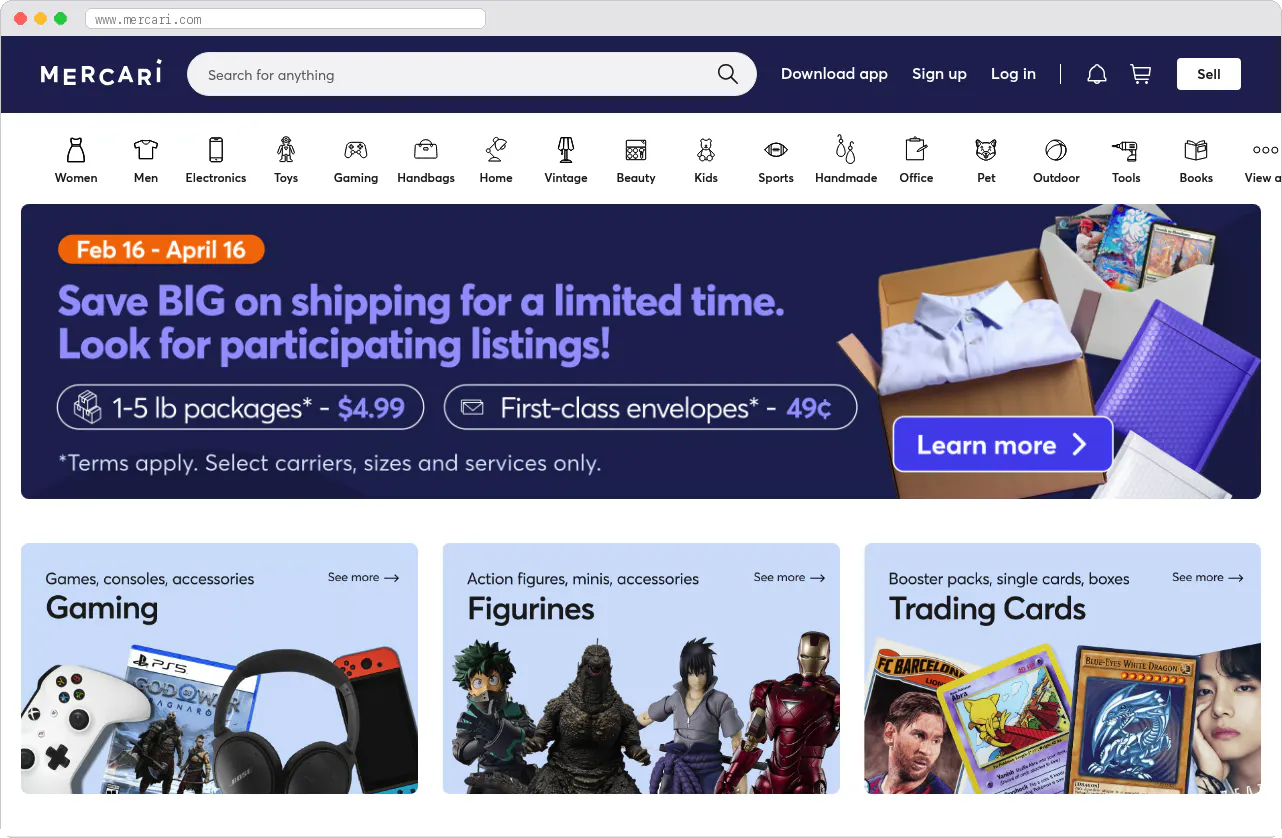
How does Mercari work?
Mercari operates as a two-sided marketplace that connects individual sellers with buyers looking for secondhand or new items. The platform simplifies the traditionally complex process of peer-to-peer selling by handling payments, shipping logistics, and dispute resolution.
The seller experience starts with mobile-first listing creation. Users photograph their items directly in the app, which uses image recognition to suggest categories, titles, and even pricing based on similar sold items. Sellers set their price, write a description, and publish the listing in minutes. Unlike platforms that require detailed product specifications or professional photography, Mercari optimized for casual sellers who want to declutter quickly.
Buyers discover items through search and browsing features that emphasize visual discovery. The mobile interface showcases large product images in a Pinterest-style grid, making it easy to scroll through thousands of items. Search functionality includes filters for price, condition, category, brand, and shipping options. Buyers can also follow specific sellers or save items to wishlists for later purchase.
The transaction flow prioritizes trust and simplicity. When a buyer purchases an item, Mercari immediately charges their payment method but holds the funds in escrow. The seller receives a prepaid shipping label through the app, packages the item, and drops it off at a designated location. Once the buyer receives and approves the item (or after three days of delivery), Mercari releases payment to the seller minus commission fees.
Communication happens entirely within the platform through a messaging system that allows buyers to ask questions, negotiate prices, or request additional photos. This keeps all transaction-related communication traceable and helps Mercari mediate disputes when they arise.
Mobile optimization drives user behavior. Unlike desktop-focused platforms like eBay, Mercari was built mobile-first from day one. The app's camera integration, push notifications for price drops and new messages, and one-tap purchasing create a smooth experience that encourages frequent engagement. Sellers can list items while commuting or watching TV, removing friction that prevented casual selling on other platforms.
The platform succeeds by reducing the complexity and risk traditionally associated with peer-to-peer selling. Sellers don't need to handle payments, create shipping labels, or meet strangers in person. Buyers get purchase protection and a standardized return process. This infrastructure transforms selling unused items from a time-consuming hassle into a simple way to earn money.
How does Mercari make money?
Mercari generates revenue primarily through transaction-based commission fees, supplemented by shipping services, advertising, and premium features. This diversified approach has allowed the company to build a sustainable business model while keeping the platform free for basic use.
Commission fees form the core revenue stream. Mercari charges sellers a 10% commission on the final sale price of each item, calculated after any promotional credits or coupons. For a $50 item, the seller receives $45 after the commission is deducted. This rate is competitive with other marketplace platforms and has remained consistent since launch, providing predictable revenue as transaction volume grows.
Payment processing adds incremental revenue. While the 10% commission includes basic payment processing, Mercari earns additional margin from payment processing services. The company has partnerships with payment providers that generate revenue sharing on each transaction, though these amounts are typically small compared to commission fees.
Shipping services create additional value and revenue. Mercari negotiates volume discounts with shipping carriers and offers prepaid labels to sellers at competitive rates. While shipping fees are passed through to users, Mercari likely earns a small margin on shipping services while providing convenience to sellers. The company also offers shipping protection and insurance options for additional fees.
Promoted listings drive advertising revenue. Sellers can pay to boost their listings' visibility in search results and category browsing. These promoted listings appear at the top of relevant searches and are marked as sponsored content. Pricing typically follows a cost-per-click or cost-per-impression model, allowing sellers to increase exposure for items that might otherwise get lost among millions of listings.
Premium seller features generate subscription revenue. While basic selling is free, Mercari offers premium tools for power sellers, including advanced analytics, bulk listing tools, and professional seller badges. These features help serious sellers optimize their operations and build buyer trust, creating a natural upgrade path for users who want to sell more efficiently.
International expansion multiplies revenue opportunities. Mercari's success in Japan provided the foundation for expanding to the United States and other markets. Each market operates somewhat independently, allowing the company to adapt commission rates, shipping partnerships, and feature sets to local preferences while using the core platform technology.
Cross-selling financial services expands the ecosystem. In Japan, Mercari offers related services like Merpay (a mobile payment service) and credit products that generate additional revenue from the user base. These services increase customer lifetime value and create switching costs that improve retention.
The commission-based model aligns Mercari's incentives with user success. Revenue grows directly with marketplace activity, encouraging the company to invest in features that increase transaction volume and user satisfaction. This model has proven scalable across different markets and product categories, supporting Mercari's growth to over $4 billion in annual gross merchandise value.
What makes Mercari successful?
Mercari's success stems from strategic decisions that differentiated it from existing marketplace platforms and created sustainable competitive advantages in the mobile-first era of commerce.
Mobile-native design eliminated friction for casual sellers. While eBay and other incumbents adapted desktop experiences for mobile, Mercari built specifically for smartphone users from day one. The app's camera integration automatically suggests item categories and pricing, while barcode scanning identifies brand-name products. This reduces listing time from 15-20 minutes on traditional platforms to under 5 minutes on Mercari, considerably expanding the pool of potential sellers.
Simplified pricing and shipping removed complexity barriers. Traditional marketplaces required sellers to choose between auction-style listings, fixed prices, and complex shipping calculations. Mercari standardized on fixed-price listings with automatic shipping cost calculations based on item size and weight. Sellers simply choose from predetermined shipping options, and Mercari generates prepaid labels. This simplification appeals to casual sellers who found other platforms too complicated.
Trust infrastructure addressed the biggest barrier to peer-to-peer commerce. Mercari's escrow payment system holds buyer funds until delivery confirmation, protecting both parties from fraud. The standardized return process gives buyers confidence to purchase from unknown sellers. Two-way rating systems help identify reliable users over time. These features collectively reduced the risk perception that prevented many people from trying online marketplaces.
Data-driven personalization improved discovery and conversion. Mercari uses machine learning to surface relevant items to buyers based on browsing history, purchase patterns, and demographic data. The platform also provides pricing suggestions to sellers based on similar sold items, helping optimize listings for quick sales. This data advantage compounds over time as the platform learns from millions of transactions.
Geographic expansion strategy maximized network effects. Rather than launching globally, Mercari focused on dominating Japan before expanding to the United States. This concentration allowed the company to achieve critical mass in each market, ensuring sufficient inventory and buyers to create liquid marketplaces. The sequential expansion approach also provided operational learnings that improved execution in new markets.
Category expansion followed user behavior patterns. Mercari initially focused on fashion and electronics, categories with high turnover rates and clear condition standards. As the platform gained traction, it expanded into home goods, collectibles, and other categories where users demonstrated demand. This organic growth approach ensured sufficient supply and demand in each new category.
Operational excellence in logistics and customer service built user loyalty. Mercari invested heavily in shipping partnerships, automated customer service systems, and fraud prevention. The platform processes returns, handles payment disputes, and manages shipping issues with minimal user friction. This operational infrastructure creates switching costs and improves the user experience compared to platforms with less smart support systems.
Community features fostered engagement and retention. Features like seller profiles, follower systems, and social sharing encourage users to build reputations and relationships on the platform. Power sellers develop followings that provide built-in marketing for new listings. These community aspects increase engagement and create additional reasons for users to remain active on the platform.
The combination of these factors created a user experience meaningfully better than existing alternatives, driving rapid adoption and strong retention rates. Mercari's focus on simplicity, trust, and mobile optimization proved that there was substantial room for innovation in online marketplaces, even in categories dominated by established players.
Key features of a Mercari-like marketplace
Building a successful product marketplace like Mercari requires implementing core features that facilitate trust, discovery, and transactions between individual buyers and sellers. These features form the foundation of the user experience and determine whether the platform can attract and retain users.
Mobile-optimized listing creation streamlines the selling process. Sellers need camera integration that allows photographing items directly in the app, with automatic image optimization and cropping. Category suggestion based on image recognition helps users classify items correctly. Barcode scanning for branded products can auto-populate titles, descriptions, and suggested pricing. The listing flow should minimize text input and offer smart defaults to reduce time-to-publish.
Visual search and discovery features help buyers find relevant items. Grid-based browsing with large product images appeals to mobile users scrolling through inventory. Advanced filtering by price range, condition, brand, location, and shipping options helps narrow results. Search functionality needs auto-complete, spell correction, and the ability to search by image. Category browsing with subcategories and trending items provides multiple discovery paths.
Secure payment processing with escrow protection builds buyer confidence. The platform needs integration with payment processors that support holding funds until delivery confirmation. Multiple payment methods including credit cards, digital wallets, and bank transfers accommodate different user preferences. Automatic fee calculation and transparent pricing eliminate confusion about final costs. Refund processing for returns and disputes requires automated workflows.
Integrated shipping solutions simplify fulfillment for sellers. Partnership with shipping carriers enables discounted rates and prepaid label generation. Package size and weight estimation based on item categories helps calculate shipping costs automatically. Multiple shipping speed options let buyers choose between cost and convenience. Tracking integration provides status updates to both parties throughout the shipping process.
User verification and trust systems reduce fraud risks. Identity verification using phone numbers, email addresses, and potentially government IDs creates accountability. Two-way rating systems allow buyers and sellers to evaluate each other after transactions. Profile pages display user statistics like response time, number of sales, and overall ratings. Fraud detection algorithms flag suspicious activity patterns.
In-app messaging facilitates communication while maintaining privacy. Messaging systems allow buyers to ask questions about items, negotiate prices, or discuss shipping options. Automated message templates for common questions reduce response time. Photo sharing within messages lets sellers provide additional item details. All communication logs support dispute resolution.
Return and dispute resolution processes protect both parties. Standardized return windows and procedures give buyers recourse for items not as described. Dispute escalation to platform moderators provides neutral resolution when parties disagree. Automated refund processing for approved returns reduces manual overhead. Clear policies set expectations and reduce conflicts.
Social and community features increase engagement. User profiles with seller statistics and item history build trust and recognition. Following systems let buyers track favorite sellers' new listings. Sharing functionality enables users to promote items on social media. Wishlist and saved search features help buyers track items they're interested in purchasing.
Analytics and seller tools help optimize performance. Seller dashboards display listing views, messages received, and sales analytics. Pricing recommendations based on similar sold items help optimize listings. Bulk listing tools for power sellers reduce time spent managing large inventories. Performance metrics help sellers understand what drives sales on the platform.
Admin and moderation tools maintain marketplace quality. Content moderation systems flag inappropriate listings or images. User reporting mechanisms allow community-based quality control. Administrative interfaces for customer service teams enable efficient issue resolution. Automated rules enforcement for prohibited items and policy violations.
These features work together to create a complete marketplace ecosystem that addresses the key challenges of peer-to-peer commerce: trust, convenience, and discoverability. The specific implementation of each feature can vary based on target market, but the core functionality remains consistent across successful product marketplaces.
Competitors and alternatives
Mercari operates in a competitive landscape of established marketplaces and emerging platforms, each with different positioning and strengths. Understanding these alternatives helps identify opportunities for differentiation and innovation.
eBay remains the dominant global marketplace with broader reach and category selection. Founded in 1995, eBay pioneered online auctions and peer-to-peer selling, building a massive user base across multiple countries. The platform offers both auction-style and fixed-price listings, with more complex seller tools and fee structures. eBay's strength lies in rare items, collectibles, and business sellers, while its weakness is the complicated interface that intimidates casual sellers. Commission rates vary by category but typically range from 10-12% plus listing fees, making it similar to Mercari's pricing but with additional complexity.
Facebook Marketplace uses social network effects for local transactions. Launched in 2016, Facebook Marketplace uses the social platform's existing user base to facilitate local buying and selling. Users can see seller profiles, mutual friends, and community connections, creating additional trust signals. The platform excels at local pickup transactions and doesn't charge commission fees, but lacks shipping integration and payment processing. This makes it ideal for large items like furniture but less suitable for small items that require shipping.
Poshmark focuses specifically on fashion and social selling experiences. Founded in 2011, Poshmark built a community-driven marketplace around fashion items, with social features like virtual parties, sharing, and following. The platform handles authentication for luxury items and provides a flat $7.67 shipping rate regardless of package size. Poshmark's 20% commission rate is higher than Mercari's 10%, but the fashion focus and social features attract dedicated fashion sellers. The platform's weakness is limited category expansion and higher fees.
Vinted targets fashion resale with a different revenue model. This European-based platform focuses exclusively on secondhand fashion and charges buyers a protection fee instead of commission from sellers. Vinted's approach removes seller friction but adds buyer costs, creating a different dynamic. The platform has grown rapidly in Europe and offers integrated shipping solutions similar to Mercari. However, its fashion-only focus limits total addressable market compared to general marketplaces.
Depop combines marketplace functionality with social media features for younger demographics. Targeting Gen Z and millennial users, Depop emphasizes visual discovery and social interactions around fashion and vintage items. The platform functions more like Instagram with purchasing capability, encouraging users to curate aesthetically pleasing profiles. Depop's 10% commission rate matches Mercari, but the social focus and younger demographic create a different user experience. The platform's limitation is narrow category focus and smaller overall user base.
OfferUp and Letgo merged to create a local marketplace alternative. These platforms focus on local transactions with in-person pickup, competing more directly with Craigslist than shipping-based marketplaces like Mercari. The combined platform offers both local and shipping options, with features designed for mobile-first discovery. However, the local focus limits inventory selection for buyers and reduces the addressable market for sellers compared to national platforms.
Traditional classified sites like Craigslist maintain notable market share despite outdated interfaces. Craigslist's simple, low-cost model (free for most categories, small fees for job postings and some categories) attracts users who prefer minimal platform intervention. However, the lack of payment processing, shipping integration, and trust features creates opportunities for more advanced platforms to capture market share.
Each competitor has carved out specific niches or geographic markets, but none combines Mercari's mobile-first design, broad category coverage, and integrated logistics in the same way. This suggests opportunities for new marketplaces that improve upon existing solutions or serve underserved segments within the product marketplace ecosystem.
How to build a marketplace like Mercari
Creating a successful product marketplace requires balancing technical development with business strategy, user acquisition, and operational execution. The process involves multiple phases that build upon each other to create a sustainable two-sided business.
Start with market research and competitive analysis to identify your niche. Study existing platforms to understand their strengths, weaknesses, and gaps in service. Mercari succeeded by focusing on mobile-first design when competitors had clunky mobile experiences. Look for underserved geographic markets, product categories, or user demographics that existing platforms don't address well. Conduct user interviews with potential buyers and sellers to validate assumptions about their needs and pain points.
Define your business model and revenue strategy early. Decide whether to charge sellers commission, buyers fees, or both parties. Consider subscription models for power sellers or advertising revenue from promoted listings. Mercari's 10% seller commission proved sustainable, but different markets or categories might support different rates. Factor in payment processing costs, customer acquisition expenses, and operational overhead when setting fee structures.
Design the user experience with mobile users as the primary focus. Create wireframes and prototypes for core user flows: listing creation, search and discovery, purchasing, and communication. Prioritize simplicity over feature completeness in early versions. Test designs with target users to identify friction points before development begins. Plan for both iOS and Android apps, as marketplace success requires broad mobile accessibility.
Build core technical infrastructure that can handle transaction complexity. Implement user authentication, profile management, and basic listing functionality first. Integrate payment processing with escrow capabilities to hold funds until delivery confirmation. Build messaging systems that keep communication on-platform. Develop search functionality with filtering and sorting options. Create admin tools for content moderation and customer service.
Establish shipping and logistics partnerships to enable smooth fulfillment. Negotiate rates with shipping carriers or integrate with existing shipping APIs. Build tools that generate shipping labels, calculate costs, and provide tracking information. Consider offering multiple shipping speeds and package insurance options. Test the entire fulfillment process from label generation to delivery confirmation before launching to users.
Implement trust and safety measures to protect users and reduce fraud. Build user verification systems using phone numbers, email addresses, and potentially identity documents. Create rating and review systems that influence user reputation scores. Develop fraud detection algorithms that flag suspicious activity patterns. Establish dispute resolution processes with clear escalation paths. Plan for content moderation to remove prohibited items and inappropriate behavior.
Launch with a focused supply strategy to build initial inventory. Recruit early sellers through personal networks, social media, and targeted outreach. Consider incentive programs like reduced commission rates or marketing support for early adopters. Focus on specific product categories or geographic areas to build density rather than spreading too thin. Ensure sufficient inventory exists before marketing to buyers to avoid poor first impressions.
Develop a customer acquisition strategy that balances both sides of the marketplace. Plan separate marketing approaches for buyers and sellers, as their motivations and discovery patterns differ. Use content marketing to establish authority in your target categories. Consider partnerships with complementary services or influencers in relevant communities. Track user acquisition costs and lifetime value to ensure sustainable growth economics.
Build operational processes for customer service, returns, and dispute resolution. Create knowledge bases and FAQ sections to reduce support ticket volume. Train customer service teams on platform policies and common issues. Develop escalation procedures for disputes that can't be resolved automatically. Plan for seasonal demand fluctuations and scaling customer support accordingly.
Plan for iterative development based on user feedback and data. Implement analytics to track user behavior, conversion rates, and transaction patterns. Regularly survey users to understand their biggest pain points and feature requests. Prioritize improvements that increase transaction volume or user retention. Test new features with small user groups before rolling out platform-wide changes.
Consider regulatory compliance requirements for your target markets. Understand sales tax collection obligations for marketplace operators. Ensure data privacy compliance with relevant regulations like GDPR or CCPA. Review consumer protection laws that might affect return policies or dispute resolution. Consider insurance requirements for holding user funds or facilitating transactions.
Build financial projections that account for marketplace-specific metrics. Model scenarios for user growth, transaction volume, and revenue per user. Account for the chicken-and-egg problem of needing both buyers and sellers to create a successful marketplace. Plan for higher customer acquisition costs in early stages when network effects haven't developed. Consider how seasonal patterns might affect different product categories on your platform.
Building a marketplace like Mercari requires patience and persistence, as network effects take time to develop and user behavior patterns need to establish themselves. Focus on creating exceptional experiences for early users rather than trying to scale too quickly, as word-of-mouth recommendations are critical for marketplace adoption.
Cost and development considerations
Developing a marketplace like Mercari involves considerable upfront investment and ongoing operational costs that vary sharply based on the chosen development approach and desired feature set. Understanding these costs helps entrepreneurs make informed decisions about funding requirements and technical strategies.
Custom development from scratch provides maximum flexibility but requires substantial investment. Building a full-featured marketplace with native mobile apps, web platform, and backend infrastructure typically costs $200,000-500,000 for initial development. This includes user management, listing creation, search functionality, payment processing, messaging, shipping integration, and admin tools. Development timelines range from 8-18 months depending on team size and complexity requirements. Additional costs include ongoing maintenance, security updates, and feature development that can add $50,000-150,000 annually.
No-code marketplace platforms substantially reduce development time and costs. Modern no-code solutions can launch basic marketplace functionality within 2-8 weeks at costs ranging from $100-1,000 monthly for platform subscriptions. These platforms typically include important features like user profiles, listing management, payment processing, and basic messaging. However, customization options may be limited, and transaction fees often apply in addition to subscription costs. Advanced features like custom mobile apps or complex integrations might require additional development.
Hybrid approaches balance cost, speed, and customization flexibility. Many successful marketplaces start with no-code or low-code platforms for rapid validation, then gradually add custom features as they scale. This approach might cost $10,000-50,000 for initial customization and branding, with ongoing development costs of $20,000-100,000 annually for feature additions. The hybrid model allows entrepreneurs to test market demand without massive upfront investment while preserving the ability to differentiate through custom functionality.
Payment processing and financial infrastructure represent ongoing operational costs. Marketplace payment processing typically costs 2.9-3.5% of transaction volume plus fixed fees per transaction. Escrow services that hold funds until delivery confirmation add additional costs of 0.5-1% of transaction volume. International payment processing and currency conversion can increase these rates. For a marketplace processing $1 million annually in transactions, payment processing costs might range from $35,000-50,000 per year.
Mobile app development requires platform-specific considerations. Native iOS and Android apps provide the best user experience but require separate development efforts, potentially doubling mobile development costs. Cross-platform frameworks like React Native or Flutter can reduce costs by 30-50% while maintaining native-like performance. App store submission, developer account fees, and ongoing app maintenance add $5,000-15,000 annually. App updates for new OS versions and feature additions require ongoing development resources.
Shipping and logistics partnerships involve setup costs and ongoing revenue sharing. Integrating with shipping carriers like UPS, FedEx, or USPS requires API development and testing that might cost $10,000-25,000 initially. Volume-based shipping discounts often require minimum transaction commitments or upfront payments. Third-party logistics providers might charge setup fees of $5,000-20,000 plus ongoing per-shipment fees. International shipping adds complexity and costs for customs documentation and compliance.
Trust and safety infrastructure requires specialized tools and personnel. Identity verification services cost $1-5 per verification, adding up quickly with user growth. Fraud detection and prevention tools range from $500-5,000 monthly depending on transaction volume. Content moderation services cost $0.10-1.00 per review for human moderators. Customer service tools and helpdesk software add $50-200 per agent monthly. These costs scale with user base and transaction volume.
Marketing and user acquisition represent meaningful ongoing expenses. Customer acquisition costs for marketplaces often range from $20-100 per user, depending on the target market and competition. Both buyer and seller acquisition requires separate strategies and budgets. Search engine marketing, social media advertising, and influencer partnerships require ongoing investment. Content marketing and SEO provide lower-cost alternatives but require consistent effort and expertise.
Legal and compliance costs vary by operating jurisdiction and business model. Initial legal setup including terms of service, privacy policies, and business structure might cost $10,000-25,000. Ongoing compliance monitoring, tax preparation, and legal consultation add $5,000-20,000 annually. International expansion multiplies these costs as each jurisdiction has different requirements. Data privacy compliance like GDPR might require additional legal review and technical implementation.
Operational infrastructure scales with marketplace growth but requires upfront planning. Web hosting and database costs might start at $100-500 monthly but can reach thousands of dollars as traffic grows. Content delivery networks (CDNs) for image and video hosting add $50-500 monthly. Monitoring, analytics, and business intelligence tools range from free to several thousand dollars monthly. Backup and disaster recovery systems require additional infrastructure investment.
Seasonal and cyclical considerations affect cash flow and resource planning. Many product categories have seasonal demand patterns that affect transaction volume and revenue. Customer service demands often spike during holidays and sales events. Marketing costs might increase during competitive periods. Building financial models that account for these fluctuations helps ensure adequate cash flow during slower periods.
Entrepreneurs should plan for total first-year costs ranging from $50,000-250,000 depending on their chosen approach, with ongoing annual costs of $100,000-500,000 as the marketplace scales. These estimates exclude founder salaries but include essential technology, operations, and marketing expenses needed to build a competitive marketplace platform.
The key is matching development approach to available resources and business objectives, while maintaining flexibility to scale and customize as the marketplace grows and user needs become clearer through real-world usage data.
Frequently asked questions
How does Mercari make money?
Mercari makes money primarily through a 10% commission fee charged to sellers on each transaction. They also earn revenue from shipping services, promoted listings advertising, and premium seller features.
What is Mercari's business model?
Mercari operates a two-sided marketplace business model connecting individual buyers and sellers. The platform handles payments through escrow, provides shipping labels, and takes a commission on completed transactions.
How much does it cost to build a marketplace like Mercari?
Custom development of a platform this complex typically costs $150,000-500,000+ for the initial build, with $10,000-50,000 monthly in ongoing development. A no-code marketplace platform ($99-399/month) can replicate the core marketplace mechanics at a fraction of the cost, though highly specialized features like real-time tracking or complex algorithms may need custom work later.
What makes Mercari different from eBay?
Mercari focuses on mobile-first design with simplified listing processes, while eBay offers more complex auction features and desktop optimization. Mercari targets casual sellers with streamlined experiences, while eBay serves both individual and business sellers.
How long does it take to build a marketplace like Mercari?
Custom development takes 8-18 months, no-code platforms can launch in 2-8 weeks, and hybrid approaches typically require 2-6 months for initial launch with ongoing feature development.
What are the key features needed for a Mercari-like marketplace?
Key features include mobile-optimized listing creation, visual search and discovery, secure escrow payments, integrated shipping solutions, user verification systems, in-app messaging, and dispute resolution processes.
Start your 14-day free trial
Create a marketplace today!
- Launch quickly, without coding
- Extend infinitely
- Scale to any size
No credit card required