How to build a marketplace for handmade crafts
Building a handmade crafts marketplace connects artisans with customers seeking unique, personalized products. This guide covers the complete process from validating your niche to launching and scaling your platform.
Published: Dec 21, 2023
Last updated: Mar 19, 2026
What is a handmade crafts marketplace?
A handmade crafts marketplace is a two-sided platform that connects independent artisans and crafters with customers seeking unique, personally made products. Unlike mass-market retailers, these marketplaces specialize in items that are individually crafted by hand, including jewelry, home decor, clothing, pottery, woodwork, textiles, and artistic creations.
The business model typically operates on commission-based revenue, where the marketplace takes a percentage of each transaction between buyers and sellers. Most successful platforms charge between 3-6% from sellers, with some adding payment processing fees or optional premium listing services.
What distinguishes handmade marketplaces from traditional e-commerce platforms is their emphasis on storytelling, customization, and direct artist-customer relationships. Buyers aren't just purchasing products, they're supporting individual creators and often commissioning personalized pieces that reflect their specific tastes and needs.
The Etsy success story
Etsy remains the dominant example of a successful handmade crafts marketplace. Founded in 2005 by Rob Kalin, Chris Maguire, and Haim Schoppik in Brooklyn, Etsy started as a simple platform for artists to sell their creations online when few alternatives existed for independent makers.
The founders identified a clear problem: talented artisans struggled to reach customers beyond their immediate geographic area, while consumers had limited access to unique, handcrafted alternatives to mass-produced goods. Traditional retail channels either weren't accessible to individual creators or diluted their brand identity.
Etsy's early growth came from building community around the maker movement. The platform emphasized the stories behind products, allowing sellers to share their creative process and personal brand. This narrative-driven approach helped justify premium pricing compared to manufactured alternatives.
By 2023, Etsy had grown to over 96 million active buyers and 7.5 million active sellers, generating an estimated $13.2 billion in gross merchandise sales. The platform's success demonstrates the substantial market demand for authentic, handcrafted products and the viable business opportunity in connecting makers with customers globally.
The key to Etsy's dominance has been its focus on three core elements: ease of use for sellers, discovery tools for buyers, and trust mechanisms that facilitate transactions between strangers. However, as Etsy has scaled, many sellers have expressed concerns about increased competition, rising fees, and reduced organic visibility, creating opportunities for niche competitors.
Competitors and alternatives in the handmade marketplace space
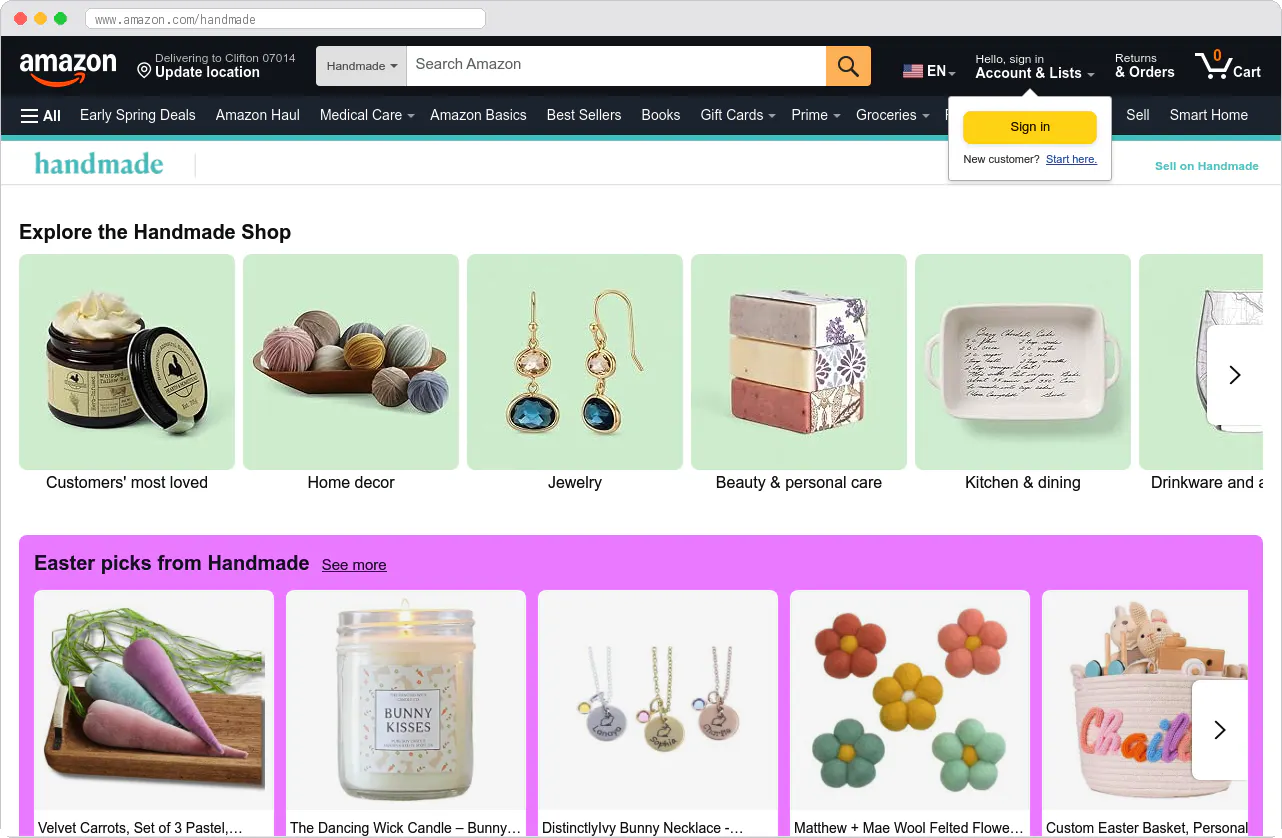
Amazon Handmade
Launched in 2015, Amazon Handmade uses Amazon's massive customer base and logistics network to compete directly with Etsy. The platform offers handmade products across categories like jewelry, home decor, and artwork. Amazon's key advantage is its Prime shipping program and established customer trust, but it charges higher fees (15% referral fee) and has stricter approval processes for sellers. The platform works best for established artisans who can handle higher volume orders and want access to Amazon's enormous customer base.
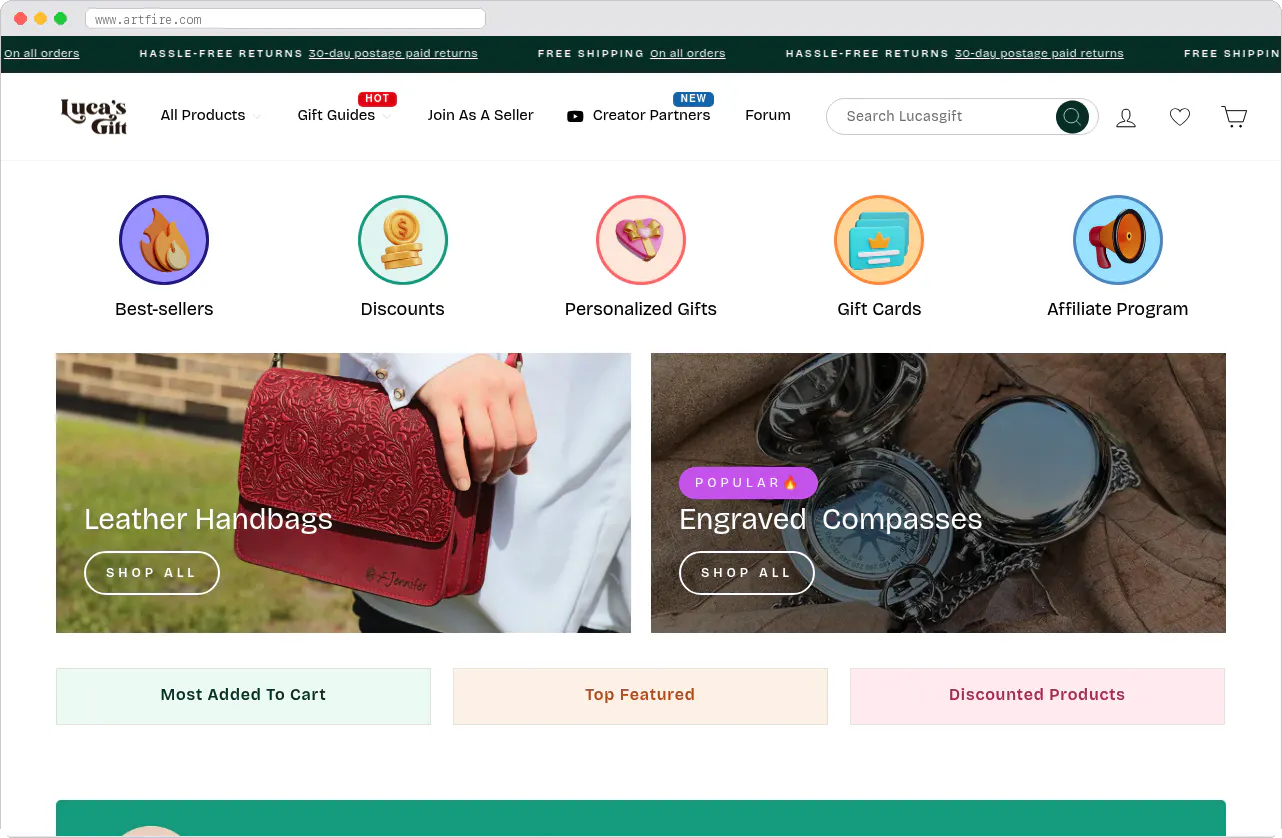
ArtFire
ArtFire positions itself as an alternative to Etsy with lower fees and more seller-friendly policies. Founded in 2008, the platform charges flat monthly fees instead of per-transaction commissions, which can be more cost-effective for high-volume sellers. However, ArtFire has significantly less buyer traffic than Etsy or Amazon, making it harder for new sellers to gain visibility. The platform works best for sellers who already have established customer bases and want to reduce their per-sale costs.
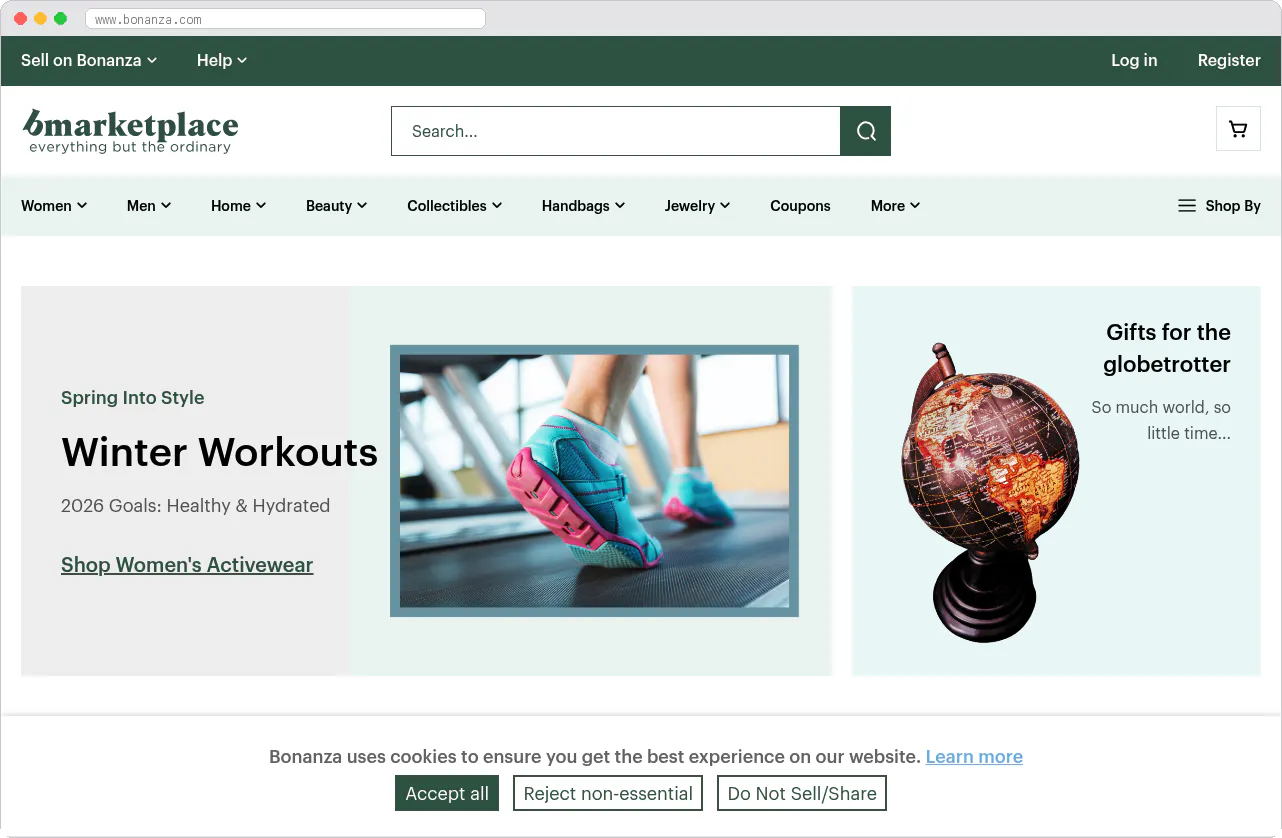
Bonanza
Bonanza operates as a general marketplace but has a strong handmade category. The platform offers more advertising and promotion tools than many competitors and integrates with other selling channels like eBay and Amazon. Bonanza charges lower final value fees than most alternatives but has less focused branding around handmade goods, potentially making it harder for craft sellers to stand out.
Facebook Marketplace and Instagram Shopping
Social media platforms have become significant competitors for handmade sellers, particularly for items that photograph well. These platforms offer direct access to customers and powerful targeting tools, but lack the specialized features that dedicated craft marketplaces provide, such as customization requests, detailed shipping calculations, and seller verification systems.
Local and niche competitors
Many successful handmade marketplaces focus on specific niches or geographic regions. Examples include Folksy (UK-focused), Aftcra (American-made products), and Zibbet (which emphasizes seller control). These platforms often offer more personalized service and lower competition but have smaller customer bases.
Essential features for a handmade crafts marketplace
Handmade crafts marketplaces require specialized functionality that differs significantly from traditional e-commerce platforms. The unique nature of handcrafted products, often one-of-a-kind, customizable, and made-to-order, creates specific technical and business requirements.
Product showcase and storytelling tools
Handmade products sell on emotion and narrative as much as functionality. Successful craft marketplaces provide robust tools for sellers to tell their stories, explain their creative process, and showcase their workspace or inspiration. This includes support for multiple high-resolution images, video content, detailed product descriptions, and artist biography sections. The platform should also support variable pricing for customizations, size options, and material choices.
Sellers need the ability to mark items as one-of-a-kind, made-to-order, or available in limited quantities. The listing system should accommodate longer processing times typical of handmade items, with clear communication about production timelines and shipping estimates.
Advanced search and discovery
Buyers on handmade platforms often browse by style, occasion, or material rather than specific product names. The search functionality needs sophisticated filtering options including color, price range, shipping location, processing time, and the ability to find items available for customization. Visual search capabilities, where users can upload photos to find similar items, have become increasingly important.
The platform should also provide curated collections, trending items, and personalized recommendations based on browsing history and purchase patterns. Many successful marketplaces feature seasonal or themed collections that help buyers discover appropriate products for holidays, weddings, or special occasions.
Customization and communication tools
Unlike mass-produced items, handmade products often involve collaboration between buyer and seller. The platform needs robust messaging systems that support image sharing, so buyers can share inspiration photos or sellers can send progress updates. Order management should accommodate custom requests, design consultations, and approval processes before production begins.
Integrated tools for managing custom orders, including the ability to send quotes, collect additional payments for upgrades, and track approval status, are essential for smooth operations. Some platforms also provide built-in contract templates for complex custom work.
Trust and verification systems
Handmade marketplaces face unique trust challenges since buyers often purchase items before they're made and may never see the actual product before ordering. Comprehensive review systems that allow detailed feedback about quality, communication, and shipping are crucial. The platform should support photo reviews where buyers can share images of received items.
Seller verification processes, including business license verification where applicable, help establish credibility. Many successful platforms also offer buyer protection programs that cover situations where items don't match descriptions or fail to arrive.
Flexible payment and fee structures
Handmade sellers often work with smaller margins than traditional retailers and appreciate transparent, predictable fee structures. The platform should support partial payments for custom orders, with the ability to collect deposits upfront and final payments upon completion.
Integration with multiple payment processors helps accommodate international transactions and various payment preferences. Some platforms also offer seller financing or payment advancement programs to help artisans with cash flow during busy seasons.
Inventory management for unique items
Traditional inventory management doesn't work well for handmade products. The system needs to handle one-of-a-kind items, materials-based inventory (where sellers track raw materials rather than finished products), and made-to-order items with varying production times.
Integration with shipping calculators that account for item fragility, custom packaging, and insurance requirements helps sellers price shipping accurately while protecting their products during transit.
Building your handmade crafts marketplace: step-by-step approach
Validate your niche opportunity
The handmade market is vast, but success often comes from focusing on specific niches, geographic regions, or underserved communities. Research existing platforms to identify gaps in their offerings. Perhaps you notice that jewelry dominates most platforms while woodworking or fiber arts receive less attention. Or maybe you see an opportunity to serve a specific demographic, like eco-conscious consumers or buyers seeking culturally specific crafts.
Interview potential sellers and buyers to understand their frustrations with existing platforms. Common complaints about large marketplaces include high fees, poor discoverability, lack of customer support, and difficulty standing out among millions of listings. Your marketplace might succeed by solving these specific problems for a focused audience.
Validate demand by exploring social media groups, local craft fairs, and online forums where your target artisans and customers already gather. Look for evidence of active buying and selling, complaints about current solutions, and enthusiasm for alternatives.
Choose your business model and pricing strategy
Most handmade marketplaces use commission-based revenue models, but the specific structure varies significantly. Etsy charges both listing fees ($0.20 per item) and transaction fees (6.5% of the sale price), plus payment processing fees. Amazon Handmade charges a flat 15% referral fee with no listing fees. Some smaller platforms use monthly subscription models or hybrid approaches.
Consider your target sellers' volume and price points when designing your fee structure. High-volume sellers might prefer subscription models that reduce per-transaction costs, while occasional sellers might prefer pay-as-you-go pricing. Transparency is crucial, hidden fees or complex pricing structures can drive away potential sellers.
You might also explore additional revenue streams like promoted listings, seller tools and analytics, or premium customer support. Some platforms generate revenue through educational content, selling craft supplies, or offering fulfillment services.
Start with focused scope and geography
Even though handmade products can theoretically sell globally, starting with a specific geographic region or cultural niche often works better. Local focus allows you to attend craft fairs, build relationships with artisans in person, and understand regional preferences and regulations.
Consider starting with artisans in your immediate area or those creating products that reflect specific cultural traditions or regional materials. This approach makes it easier to provide personalized support during the early stages and helps establish a strong foundational community before expanding.
Build your minimum viable platform
Your MVP should focus on the core transaction flow: sellers can create listings with photos and descriptions, buyers can search and purchase items, and payments are processed securely with appropriate commission collection. Additional features like messaging, reviews, and advanced customization tools can be added iteratively based on user feedback.
For a handmade marketplace, the MVP must handle variable product attributes (size, color, material options) and longer processing times typical of made-to-order items. Basic seller profiles and simple communication tools are also essential from day one, as handmade purchases often involve questions about customization or shipping.
Recruit your initial seller community
Successful handmade marketplaces often start by recruiting a small group of high-quality sellers who can create an attractive initial inventory. Look for artisans who already have some business experience, produce consistently high-quality work, and understand the importance of good product photography and customer communication.
Local craft fairs, maker spaces, art schools, and social media groups focused on specific crafts are excellent sources for initial sellers. Consider offering incentives like reduced fees for early adopters or featured placement on your platform.
Provide hands-on support during the onboarding process. Many talented artisans struggle with product photography, writing compelling descriptions, or pricing their work appropriately. Offering guidance in these areas can significantly improve the quality of your initial listings.
Launch and iterate based on user feedback
Launch with a small, focused group of sellers and invite friends, family, and craft enthusiasts to test the platform. Pay close attention to where users encounter friction in the buying and selling process. Common issues include confusing checkout flows, unclear shipping information, or difficulty finding specific types of products.
Gather feedback through surveys, user interviews, and direct observation of how people use your platform. Handmade marketplaces often require more iteration than traditional e-commerce sites because the products and seller needs are more varied and complex.
Prioritize improvements that affect the core transaction flow first, then add features that improve seller productivity and buyer discovery. As you grow, sellers will likely request advanced features like bulk listing tools, integrated shipping labels, and detailed analytics.
Development approaches for handmade crafts marketplaces
Custom development from scratch
Building a handmade marketplace from scratch provides complete control over features and user experience but requires significant time and financial investment. A basic marketplace with essential features typically costs $40,000-$120,000 and takes 6-12 months to develop, depending on complexity and team size.
Custom development makes sense if you have specific requirements that existing platforms can't accommodate, substantial funding, and a technical team capable of ongoing maintenance and updates. However, most successful marketplace founders recommend starting with a faster approach and moving to custom development only after validating product-market fit.
The technical complexity of marketplace development is substantial. You need to handle user authentication, payment processing with commission splits, search functionality, image optimization, seller dashboards, buyer reviews, and administrative tools. Each of these systems requires careful design and ongoing maintenance.
No-code marketplace builders
Platforms like Sharetribe allow you to launch a fully functional handmade marketplace without coding. This approach dramatically reduces both time to market (typically 1-2 weeks) and initial costs (usually under $99-399/month). The trade-off is less customization flexibility, though modern no-code platforms offer significant design and feature customization options.
For handmade marketplaces, no-code builders work particularly well because the core functionality needed, product listings, search, payments, messaging, is standard across most platforms. You can launch quickly, validate your concept with real users, and invest in custom development only after proving market demand.
Sharetribe specifically includes features that work well for handmade marketplaces, including support for product variants, custom fields for seller profiles, integrated messaging, and commission-based payments through Stripe Connect. The platform also handles complex technical requirements like PCI compliance and international tax calculations.
Hybrid approaches
Many successful marketplaces start with no-code solutions and gradually add custom features as they grow. This approach provides the speed benefits of no-code tools while allowing unlimited customization as business needs evolve.
With Sharetribe's developer platform, you can begin with the no-code marketplace and later add custom designs, unique features, or third-party integrations. This path often provides the best balance of speed, cost-effectiveness, and long-term flexibility.
Cost considerations for different development approaches
No-code marketplace with Sharetribe
Launching a handmade crafts marketplace with Sharetribe involves predictable monthly costs rather than large upfront investments. The Sharetribe Pro plan costs $239/month and includes unlimited listings, transactions, and users. Additional costs include domain registration ($10-15/year), custom design work ($1,000-5,000 if desired), and marketing expenses.
This approach allows you to start with a total first-year budget under $5,000, making it accessible for individual entrepreneurs or small teams. Transaction fees through Stripe (2.9% + 30¢ per transaction) are separate but only apply when you're actually generating revenue.
The low barrier to entry makes this approach ideal for testing market demand before making larger investments. If your marketplace gains traction, you can reinvest early revenue into custom features or marketing rather than using startup capital for basic functionality.
Custom development estimates
A fully custom handmade marketplace typically requires:
- User authentication and profile management: $8,000-12,000
- Product listing and catalog system: $15,000-25,000
- Search and filtering functionality: $10,000-15,000
- Payment processing with commission handling: $12,000-20,000
- Messaging and communication tools: $6,000-10,000
- Review and rating systems: $5,000-8,000
- Administrative dashboard: $8,000-12,000
- Mobile responsiveness and optimization: $10,000-15,000
These estimates assume working with experienced developers and include basic functionality only. Advanced features like AI-powered recommendations, advanced analytics, or mobile apps require additional investment.
Ongoing costs for custom platforms include hosting ($200-1,000/month depending on traffic), maintenance and updates ($2,000-5,000/month), security monitoring, and payment processing fees.
Scaling and growth strategies
Building seller community and retention
Handmade marketplaces succeed or fail based on seller satisfaction and retention. Unlike product marketplaces where inventory is largely standardized, craft marketplaces depend on individual creators who can easily move to competitors or sell elsewhere.
Successful platforms invest heavily in seller education, providing resources on product photography, pricing strategies, customer service, and business development. Some offer live workshops, one-on-one consultations, or partnerships with business development organizations.
Seller community features like forums, local meetups, or collaborative promotions help create platform loyalty beyond just transactional relationships. When sellers feel connected to your platform and other artisans, they're less likely to leave for competitors.
Buyer acquisition and marketing
Handmade marketplaces often succeed through content marketing that showcases the stories behind products and creators. Blog posts about artisan techniques, seasonal gift guides, and behind-the-scenes content perform well on social media and search engines.
Partnerships with interior designers, wedding planners, and gift-focused bloggers can provide targeted customer acquisition. Many handmade products work well for special occasions, making influencer partnerships and seasonal campaigns particularly effective.
Email marketing remains highly effective for handmade marketplaces because buyers often browse for inspiration rather than searching for specific items. Regular newsletters featuring new artisans, seasonal collections, or customization ideas can drive repeat visits and purchases.
Geographic and category expansion
Once you've established success in your initial market, expansion typically happens along two dimensions: geographic reach and product categories. Geographic expansion is often easier because it uses the same platform features and seller tools you've already developed.
Category expansion requires more consideration because different craft types have varying requirements. Expanding from jewelry to furniture, for example, introduces complex shipping calculations, different customization needs, and new quality control challenges.
Successful expansion usually involves recruiting experienced sellers in new categories rather than encouraging existing sellers to diversify. This approach maintains quality while using your platform's existing features and reputation.
Why Sharetribe works well for handmade marketplaces
Speed to market advantage
The handmade market moves quickly, with trends and seasonal demands creating time-sensitive opportunities. Sharetribe enables you to launch a professional marketplace in days rather than months, allowing you to capitalize on market timing and start learning from real users immediately.
This speed advantage is particularly valuable for handmade marketplaces because much of your success depends on building relationships with artisans and understanding buyer preferences, activities that can only happen once your platform is live and functional.
Built-in features for craft businesses
Sharetribe includes several features that work particularly well for handmade marketplaces without requiring custom development. The platform supports product variants (size, color, material options), custom fields for detailed product descriptions, and seller profiles that can showcase brand stories and workshop photos.
The integrated messaging system handles the communication-heavy nature of handmade sales, where buyers often have questions about customization, materials, or shipping. Commission-based payments through Stripe Connect automatically handle the complex fee calculations and international tax requirements common in craft marketplaces.
Flexibility for future growth
While Sharetribe provides all essential marketplace functionality out of the box, the platform is designed to accommodate custom features as your business grows. You can add unique functionality, integrate with specialized craft industry tools, or develop mobile apps while keeping the proven core platform.
This flexibility means you're not locked into a solution that might limit your growth, but you also don't need to invest in custom development before proving your concept works in the market.
The Sharetribe Expert Network includes developers and designers experienced with marketplace businesses who can help implement custom features when you're ready to expand beyond the standard platform capabilities.
Next steps for launching your handmade crafts marketplace
Building a successful handmade crafts marketplace requires balancing the creative, community-focused nature of the industry with solid business fundamentals and technical execution. The most important factor is starting quickly enough to begin learning from real artisans and buyers, then iterating based on their feedback rather than assumptions about what they want.
Focus first on recruiting a small group of high-quality sellers who can create an attractive initial inventory and provide feedback on your platform. Prioritize user experience and trust-building features over advanced functionality in the early stages. Most successful craft marketplaces succeed by solving specific problems for focused communities rather than trying to compete directly with established giants like Etsy.
Whether you choose no-code tools like Sharetribe or pursue custom development, remember that the technology is just the foundation. Your marketplace's success will ultimately depend on the relationships you build with creators and customers, the community you foster, and your ability to evolve based on their changing needs.
Frequently asked questions
How much does it cost to build a handmade crafts marketplace?
Costs vary by approach: Total first-year costs with a no-code marketplace platform typically run $2,000-5,000. Most founders start with no-code to validate demand before investing in custom features.
What features are essential for a handmade marketplace?
Core features include product showcase tools with multiple images, seller profiles for storytelling, customization request systems, secure payments with commission handling, messaging between buyers and sellers, and review systems that build trust.
How do I compete with Etsy as a new handmade marketplace?
Focus on specific niches, geographic regions, or underserved communities rather than competing broadly. Success often comes from solving specific problems Etsy doesn't address, like lower fees, better seller support, or specialized features for particular craft types.
What commission should I charge on a handmade marketplace?
Most platforms charge 3-6% commission from sellers, with some adding listing fees or payment processing costs. Consider your target sellers' volume and margins when setting fees, transparency and competitive pricing help attract quality artisans.
How long does it take to launch a handmade crafts marketplace?
Timeline depends on your approach: no-code platforms like Sharetribe enable launch in 1-2 weeks, while custom development typically takes 6-12 months. Most successful founders prioritize speed to start learning from real users quickly.
Do I need technical skills to start a handmade marketplace?
No coding skills required with no-code platforms like Sharetribe. You can launch a fully functional marketplace and add custom features later as you grow. Focus your time on recruiting sellers and building community rather than technical development.
Start your 14-day free trial
Create a marketplace today!
- Launch quickly, without coding
- Extend infinitely
- Scale to any size
No credit card required