How to build a website like Craigslist: business model and development guide
Learn how Craigslist's simple classified ad model generates hundreds of millions in revenue, and discover the step-by-step process to build your own local marketplace platform.
Published: Mar 5, 2026
Last updated: Mar 19, 2026
Craigslist generates hundreds of millions in annual revenue with one of the internet's most deliberately bare-bones designs. Founded in 1995 by Craig Newmark as an email list for San Francisco events, it has become America's dominant classified advertising platform with over 20 billion page views monthly.
The platform's success lies not in flashy features, but in solving a fundamental problem: connecting local buyers and sellers efficiently. While most tech companies chase growth through complexity, Craigslist has thrived by keeping things simple, hyperlocal, and largely free.
For marketplace founders, Craigslist represents a fascinating case study. Its business model proves that you don't need venture capital, complex algorithms, or mobile apps to build a billion-dollar platform. You need to solve real problems for real people in their local communities.
How does Craigslist work?
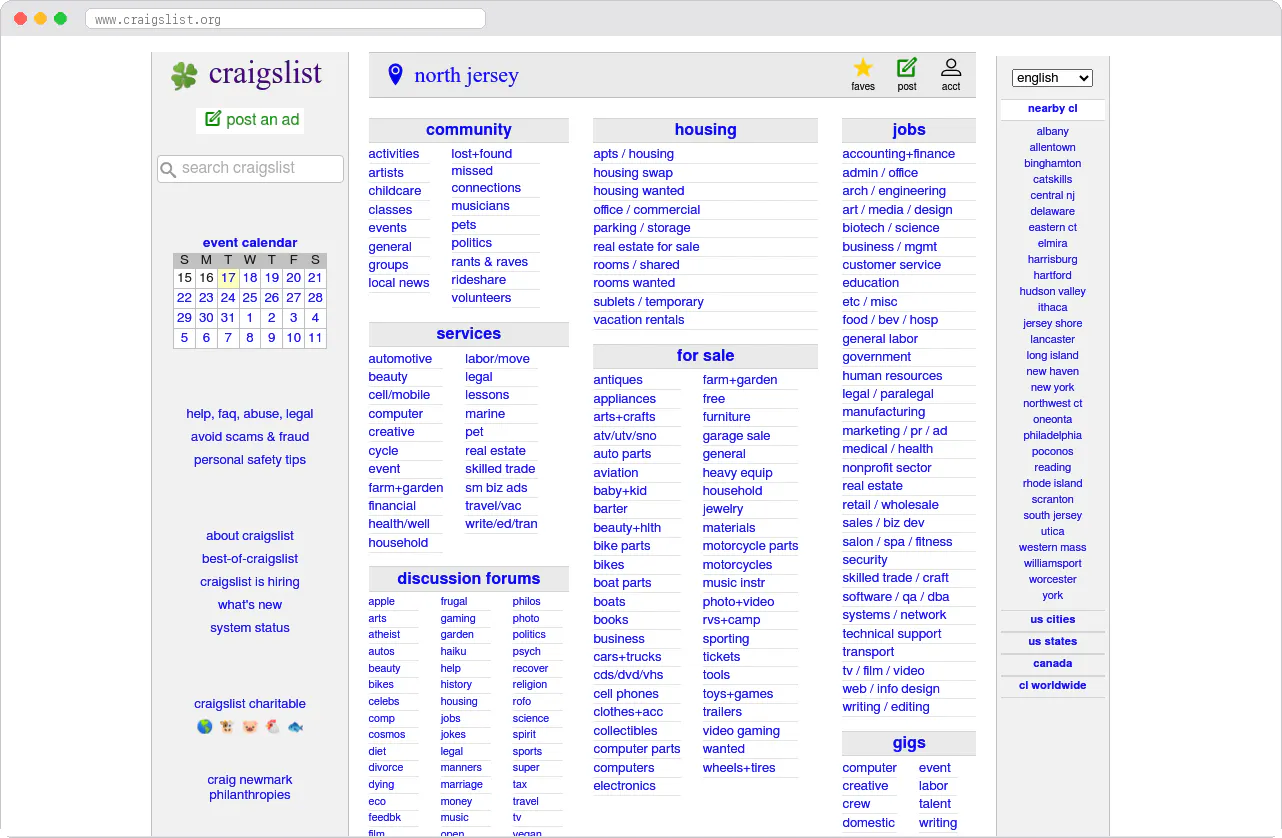
Craigslist operates as a two-sided classified advertising marketplace connecting local buyers and sellers across hundreds of geographic markets. The platform facilitates discovery and initial contact, but users handle transactions independently.
The user journey is deliberately simple:
- Sellers post free classified ads in category-specific sections (housing, jobs, for sale, services, personals, community)
- Buyers browse listings by location and category, using basic search and filtering
- Communication happens through anonymous email relay to protect privacy
- Transactions occur offline, Craigslist doesn't process payments or facilitate shipping
Geographic structure drives the business model. Craigslist operates separate sites for over 700 cities worldwide, with each market functioning as an independent classified section. This hyperlocal approach means a Los Angeles user sees only Los Angeles listings by default, creating focused local marketplaces.
Category organization reflects real-world needs. The platform divides listings into intuitive sections: housing (rentals, sales), jobs (by industry), for sale items (by type), services (skilled trades, creative), community (rideshares, activities), and discussion forums. This structure hasn't changed meaningfully since the early 2000s because it works.
The transaction model is hands-off by design. Unlike modern marketplaces that facilitate payments and shipping, Craigslist connects people who complete deals in person with cash. This creates a local focus, most transactions happen within driving distance, and eliminates the complexity of payment processing, dispute resolution, and shipping logistics.
This approach has trade-offs. Users get maximum flexibility and no transaction fees, but they also bear all the risk of meeting strangers and verifying product quality. The platform's reputation depends on community self-regulation rather than centralized oversight.
How does Craigslist make money?
Craigslist's revenue model defies conventional marketplace wisdom by charging fees for only a tiny fraction of listings while keeping most services completely free. The company generates an estimated several hundred million dollars annually through three primary revenue streams.
Job posting fees generate the majority of revenue. Employers pay $75 to post job listings in major metropolitan areas like San Francisco, Los Angeles, New York, and other large cities. Smaller markets charge $25 per job posting. Given that job postings represent millions of listings annually across hundreds of markets, this fee structure generates hundreds of millions in revenue.
The job posting fee serves multiple purposes beyond revenue generation. It filters out low-quality or spam job posts, ensures employers are serious about hiring, and helps manage the volume of listings in competitive job markets. Most legitimate employers consider $75 reasonable for reaching thousands of local job seekers.
Apartment rental listings in select markets provide additional revenue. In New York City, landlords and brokers pay $5 per apartment rental listing. This fee applies only to NYC due to the city's competitive rental market and high broker activity. Other markets keep housing listings free, but NYC's $5 fee likely generates millions annually given the city's rental volume.
Classified ads in specific categories require payment in some markets. Certain categories like therapeutic services charge fees in select cities, though these represent a small portion of overall revenue compared to job postings.
The freemium model creates powerful network effects. By keeping most listings free, Craigslist attracts massive inventory that draws buyers, who in turn attract more sellers. Free listings in categories like for sale items, housing (outside NYC), services, and community posts subsidize the platform's operations while paid job postings provide profitability.
Revenue per employee is extraordinarily high. With estimated annual revenue of several hundred million dollars and fewer than 50 employees, Craigslist generates millions per employee. This efficiency stems from minimal customer support, no payment processing, automated systems, and deliberately simple technology infrastructure.
The model works because Craigslist dominates local classified advertising in most US markets. Employers pay job posting fees because they can't find equivalent local reach elsewhere. The platform's network effects and first-mover advantage in local markets create pricing power that newer competitors struggle to challenge.
What makes Craigslist successful?
Craigslist's billion-dollar success stems from strategic decisions that prioritize utility over growth, community over profit maximization, and simplicity over feature complexity. These choices have created sustainable competitive advantages that persist decades after launch.
Hyperlocal focus creates defensible market positions. By organizing around geographic markets rather than national categories, Craigslist built dominant positions in individual cities. A furniture seller in Austin posts to Austin Craigslist because that's where Austin buyers look. This local network effect makes it extremely difficult for competitors to gain traction, they need critical mass of both buyers and sellers in each specific market.
The free-first model eliminates barriers to supply. Most users post listings without paying anything, creating massive inventory that attracts buyers. Unlike competitors that charge listing fees or require subscriptions, Craigslist's free model ensures continuous content creation. Sellers choose Craigslist because it costs nothing to try, and success rates are high due to large buyer audiences.
Minimal technology overhead enables profitability at low prices. The platform's famously basic design isn't accidental, it's strategically chosen to minimize development, hosting, and maintenance costs. Simple HTML pages load quickly, require minimal server resources, and rarely break. This technological restraint allows Craigslist to operate profitably while keeping most services free and paid services cheap.
Trust through transparency rather than verification systems. Instead of building complex identity verification, rating systems, or payment processing, Craigslist publishes detailed safety guidelines and encourages users to meet in public places. This approach puts responsibility on users while avoiding the costs and complexity of centralized trust systems.
Community self-regulation scales without staffing. Each market has volunteer moderators from the local community who flag inappropriate content and manage discussion forums. This distributed moderation model allows the platform to serve hundreds of markets without proportional increases in staff.
Resistance to feature creep maintains simplicity. While competitors add mobile apps, social features, and algorithmic feeds, Craigslist has deliberately avoided complexity. Founder Craig Newmark has consistently prioritized user needs over investor demands or industry trends. This discipline prevents the feature bloat that often makes platforms harder to use over time.
First-mover advantage in pre-internet classifieds transition. Craigslist launched in 1995 when newspaper classified ads were still dominant. By the time competitors emerged, Craigslist had already established network effects in major markets. Late-arriving competitors faced the chicken-and-egg problem of needing both buyers and sellers to create value.
Economic efficiency appeals to price-sensitive users. Many Craigslist users are individuals selling personal items, small businesses with limited marketing budgets, or people seeking bargains. The platform's low-cost model attracts users who might not pay for premium marketplace features, creating a large addressable market that competitors struggle to serve profitably.
Key features of a Craigslist-like marketplace
Building a classified marketplace similar to Craigslist requires specific functionality that supports local discovery, simple posting, and direct user communication. The feature set balances ease of use with enough organization to help users find what they need.
Geographic market organization is fundamental. Users need to select their city or region when accessing the platform, with listings automatically filtered to their local area. The system should support multiple markets with separate inventories, URLs (like chicago.yoursite.com), and potentially different pricing or policies per market.
Effective geographic features include:
- Automatic location detection based on IP address
- Manual market selection with thorough city coverage
- Distance-based search within markets (5 miles, 25 miles, etc.)
- Cross-market search capabilities for mobile users or specific items
Category-based listing organization helps users navigate large inventories. The platform needs clear, intuitive categories that match how people think about products and services. Categories should be broad enough to avoid confusion but specific enough to help buyers find relevant listings quickly.
Successful category structures typically include:
- For sale (vehicles, electronics, furniture, clothing, etc.)
- Housing (rentals, sales, shared housing, temporary)
- Jobs (by industry, skill level, or employment type)
- Services (home improvement, creative, professional, personal)
- Community (rideshares, activities, missed connections, general)
Simple listing creation tools encourage posting. The posting process should be streamlined to minimize friction while capturing essential information. Users need to add titles, descriptions, prices, contact information, and photos without encountering complex workflows.
Key posting features include:
- Quick category and subcategory selection
- Rich text editors for descriptions with formatting options
- Multiple photo upload with automatic resizing
- Optional fields for specific categories (mileage for cars, square footage for apartments)
- Preview functionality before publishing
- Easy editing and renewal options for active listings
Search and filtering functionality helps buyers find specific items. Beyond basic keyword search, users need ways to narrow down large result sets by price, date posted, location, and category-specific attributes.
Essential search features include:
- Keyword search across titles and descriptions
- Price range filtering with min/max inputs
- Date posted sorting (newest first, oldest first)
- Location radius selection
- Category-specific filters (bedrooms for housing, mileage for vehicles)
- Save search functionality with email alerts
Anonymous communication protects user privacy. Like Craigslist, successful classified platforms often use email relay systems that allow buyers and sellers to communicate without revealing personal email addresses until they choose to do so.
Communication features should include:
- Anonymous email forwarding through the platform
- Optional phone number masking
- Spam detection and filtering
- User blocking and reporting capabilities
- Message threading to maintain conversation history
Content moderation and safety tools maintain platform quality. While keeping moderation minimal, the platform needs basic tools to handle spam, inappropriate content, and user reports.
Moderation capabilities include:
- User reporting systems for inappropriate listings or behavior
- Automated spam detection for common patterns
- Community flagging with threshold-based removal
- Basic content filters for prohibited items or services
- User account management and suspension capabilities
Mobile-responsive design accommodates modern usage patterns. While Craigslist famously lacks a mobile app, modern classified platforms need mobile-optimized experiences since many users browse and post from phones.
Mobile considerations include:
- Responsive design that works on all screen sizes
- Touch-friendly navigation and search interfaces
- Mobile-optimized photo uploading and viewing
- Location-based search using GPS capabilities
- Simplified posting flows for smaller screens
Competitors and alternatives
Craigslist faces competition from specialized platforms that target specific categories or geographic markets, each offering different approaches to classified advertising and local commerce.
Facebook Marketplace has emerged as Craigslist's most major competitor. Launched in 2016, Facebook Marketplace uses the social network's massive user base and real identity verification to create trust in local transactions. Unlike Craigslist's anonymous approach, Facebook shows seller profiles, mutual friends, and seller ratings.
Facebook's advantages include built-in payment processing through Facebook Pay, integration with Facebook Groups for community-specific selling, and refined search algorithms. However, Facebook Marketplace focuses primarily on physical goods rather than services, jobs, or housing, leaving substantial portions of Craigslist's market unaddressed.
OfferUp targets mobile-first local commerce with a more modern interface. The app emphasizes photo-heavy listings, in-app messaging, and user verification through phone numbers and government IDs. OfferUp also offers promoted listings and featured placement for sellers willing to pay for visibility.
OfferUp's shipping option allows nationwide sales for certain categories, expanding beyond Craigslist's local-only model. However, the platform generates revenue through promoted listings and transaction fees, making it more expensive for sellers than Craigslist's mostly-free model.
Mercari focuses on nationwide shipping for used goods sales. Rather than local pickup, Mercari facilitates shipping transactions with built-in payment processing and buyer protection. The platform charges sellers a 10% transaction fee plus payment processing fees.
Mercari's model works well for small, shippable items but doesn't address local services, housing rentals, or items that buyers prefer to inspect before purchasing. The transaction fees also make it less attractive for low-value items where Craigslist's free model provides better economics.
Nextdoor serves hyperlocal community needs with a verified neighborhood focus. The platform requires address verification and creates private networks for specific neighborhoods. Users can buy and sell items, recommend services, and discuss community issues.
Nextdoor's verified community model creates higher trust but limits market size to immediate neighborhoods rather than entire metropolitan areas. The platform works well for community-specific needs but lacks the inventory scale that makes Craigslist effective for finding specific items.
Specialized vertical marketplaces target specific categories. Platforms like Zillow (housing), Indeed (jobs), and AutoTrader (vehicles) focus on single categories with specialized features and professional listings.
These vertical platforms often provide better tools and search capabilities for their specific categories but lack Craigslist's detailed local marketplace approach. Users often need multiple platforms to replicate Craigslist's category coverage.
Regional competitors exist in specific geographic markets. Platforms like Kijiji (owned by eBay) serve Canadian markets, while various local classified sites compete in specific US metros or international markets.
Most regional competitors struggle to achieve Craigslist's scale and network effects, often resulting in lower listing volumes and buyer traffic. However, some succeed by offering better local customer service or features tailored to regional preferences.
The competitive landscape shows that while many platforms have attempted to improve on Craigslist's model, none have fully replicated its combination of complete categories, local focus, and economic efficiency. Successful competitors typically focus on specific niches rather than directly competing across all categories.
How to build a marketplace like Craigslist
Building a classified marketplace requires careful planning around market selection, feature priorities, and growth strategy. The development process involves both technical implementation and business model decisions that determine long-term viability.
Start with full market research and validation. Before building anything, identify specific geographic markets or categories where existing solutions leave gaps. Craigslist dominates most major US markets, so opportunities likely exist in underserved regions, specialized categories, or markets where local preferences aren't being met.
Conduct validation research by:
- Analyzing search volume for classified terms in target markets
- Surveying potential users about current solutions and pain points
- Studying competitor pricing and feature gaps
- Identifying local business needs that aren't being addressed
- Testing demand through simple landing pages or MVP approaches
Choose your initial scope carefully to avoid spreading resources too thin. Rather than launching in multiple markets simultaneously, focus on dominating one geographic area or category where you can achieve meaningful market share.
Successful scope strategies include:
- Single metropolitan area with thorough categories
- Specific category (like services) across multiple similar markets
- Underserved geographic region with limited competition
- Niche community (college towns, military bases, expat communities)
Design the platform architecture for scalability and simplicity. Craigslist's success partly stems from technological restraint that keeps costs low and performance high. Plan your technical architecture to handle growth without unnecessary complexity.
Key technical decisions include:
- Database structure that supports multiple markets and categories
- Image hosting and optimization for photo-heavy listings
- Search functionality that scales with inventory growth
- Email systems for anonymous communication and notifications
- Content moderation workflows for handling user reports
- Mobile-responsive design that works across devices
Implement essential marketplace features in phases. Launch with core functionality that enables basic buying and selling, then add features based on user feedback and business needs.
Phase 1 (MVP) should include:
- User registration and profile creation
- Listing creation with photos and descriptions
- Category-based browsing and basic search
- Anonymous email communication between users
- Basic content moderation and reporting tools
Phase 2 features might add:
- Advanced search filters and saved searches
- Email alerts for new listings matching user criteria
- User ratings and feedback systems
- Promoted listing options for revenue generation
- Enhanced mobile experience
Develop a content acquisition strategy before launch. Empty marketplaces don't attract users, so plan how to generate initial inventory and traffic.
Content strategies include:
- Recruiting local businesses to post service listings
- Encouraging personal network participation in beta testing
- Offering free promotional listings to early adopters
- Creating valuable content about local buying and selling
- Partnering with local organizations or events for visibility
Plan revenue generation from the beginning. While keeping most services free like Craigslist, identify categories or features where users will pay for value.
Revenue model options include:
- Job posting fees in competitive markets
- Promoted listings for better visibility
- Professional service provider subscriptions
- Category-specific listing fees (real estate, automotive)
- Local business advertising opportunities
Build moderation and safety systems before problems arise. Classified platforms attract spam, scams, and inappropriate content, so implement prevention and response systems early.
Safety considerations include:
- Automated spam detection for common patterns
- User reporting and flagging systems
- Content review workflows for reported listings
- Safety guidelines and resources for users
- Account suspension and banning capabilities
- Legal compliance for content and commerce regulations
Focus on local community building and user retention. Unlike national marketplaces, local classified success depends on community engagement and repeat usage.
Community building strategies include:
- Local customer service and support
- Community forums or discussion areas
- Partnerships with local businesses and organizations
- Events or meetups for platform users
- Local content and resources relevant to your market
Plan for growth through geographic expansion or category depth. Once you achieve success in your initial market, decide whether to expand to new cities or deepen your offering in existing markets.
Expansion considerations include:
- Resource requirements for new market entry
- Local competition and market conditions
- Operational complexity of managing multiple markets
- Technology scalability for increased inventory and traffic
- Revenue potential in new versus existing markets
Cost and development considerations
Building a classified marketplace involves notable upfront investment and ongoing operational costs that vary considerably based on your technical approach, market scope, and feature complexity. Understanding these costs helps founders choose realistic development paths and budget appropriately.
Custom development from scratch requires substantial investment and technical expertise. Building a full-featured classified platform involves complex functionality like multi-market management, search systems, image handling, email communications, and content moderation.
Custom development costs typically include:
- Backend development: $40,000-80,000 for core marketplace functionality
- Frontend development: $25,000-50,000 for responsive web interface
- Mobile app development: $30,000-60,000 if native apps are required
- Third-party integrations: $10,000-25,000 for email, payments, and analytics
- Quality assurance and testing: $15,000-30,000 for detailed testing
- Project management and design: $20,000-40,000 for oversight and UX design
Total custom development costs typically range from $150,000 to $300,000 for a full-featured platform, with 6-12 months development time. These estimates assume experienced development teams and don't include ongoing maintenance, hosting, or feature additions.
No-code and low-code platforms offer faster, more affordable alternatives. Modern no-code tools can create functional classified marketplaces without traditional programming, though with some limitations in customization and advanced features.
No-code development costs include:
- Platform subscriptions: $100-500 per month for marketplace-capable tools
- Custom design and branding: $2,000-10,000 for professional appearance
- Third-party service integrations: $500-2,000 for email, analytics, and payments
- Setup and configuration: $5,000-15,000 if outsourcing to specialists
- Ongoing maintenance and updates: $1,000-3,000 per month
No-code marketplace platforms cost $99-399 per month in subscription fees, with total first-year costs of $2,000-5,000 including domain and setup. However, transaction fees, subscription costs, and limited customization options may create long-term constraints as the business grows.
Hybrid approaches combine no-code foundations with custom development. This strategy uses no-code tools for rapid prototyping and validation, then adds custom features as the business proves viability and generates revenue for additional investment.
Hybrid development costs include:
- Initial no-code prototype: $2,000-5,000 first year ($99-399/month platform)
- Custom feature development: $20,000-60,000 for unique functionality
- Platform migration costs: $5,000-25,000 if moving from no-code to custom development
- Ongoing development resources: $5,000-15,000 per month for improvements
Hybrid approaches balance speed to market with long-term flexibility, though they may require rebuilding certain components during scaling.
Operational costs continue long after launch and increase with platform growth. Beyond development expenses, classified marketplaces require ongoing investment in hosting, customer support, content moderation, and marketing.
Ongoing operational costs include:
- Hosting and infrastructure: $500-5,000 per month depending on traffic and data storage
- Customer support: $2,000-8,000 per month for responsive user assistance
- Content moderation: $1,000-5,000 per month for spam and inappropriate content management
- Marketing and user acquisition: $3,000-15,000 per month for growth initiatives
- Legal and compliance: $2,000-10,000 per month for terms, privacy, and regulatory compliance
- Payment processing: 2.9% + $0.30 per transaction for standard processing
Geographic expansion multiplies operational complexity and costs. Each new market requires localized content, customer support, marketing efforts, and potentially different legal compliance requirements.
Expansion cost considerations include:
- Market research and validation: $2,000-5,000 per new market
- Localized marketing launch: $5,000-15,000 per market
- Local customer support coverage: $1,000-3,000 per month per market
- Legal compliance research: $1,000-5,000 per new jurisdiction
- Technology localization: $2,000-8,000 for multi-language or currency support
Revenue timeline affects funding and cash flow planning. Unlike e-commerce platforms that can generate transaction revenue immediately, classified marketplaces often require considerable user acquisition before implementing sustainable revenue models.
Typical revenue development timeline:
- Months 1-6: Focus on user acquisition with minimal or no revenue
- Months 6-18: Implement basic revenue features like promoted listings
- Months 18-36: Add complete monetization across categories
- Years 3+: Achieve sustainable profitability with diversified revenue streams
Technology maintenance becomes growing more important at scale. As the platform grows, technical debt, security requirements, and performance optimization require dedicated development resources.
Maintenance cost factors include:
- Security updates and vulnerability patches
- Database optimization for growing inventories
- Server scaling for increased traffic loads
- Feature updates based on user feedback
- Integration maintenance with third-party services
- Backup and disaster recovery systems
Successful classified marketplace founders typically budget 20-30% of initial development costs annually for ongoing maintenance and improvements. This investment ensures the platform remains competitive, secure, and capable of supporting business growth.
Frequently asked questions
How does Craigslist make money?
Craigslist generates an estimated several hundred million dollars annually primarily through job posting fees ($75 in major cities, $25 in smaller markets) and apartment rental listing fees in New York City ($5 per listing). Most other categories remain free to attract massive inventory and maintain network effects.
What is the Craigslist business model?
Craigslist operates as a local classified advertising marketplace using a freemium model. It keeps most listings free to build inventory and network effects, while charging fees for job postings and select categories in specific markets. The platform doesn't process payments or facilitate shipping.
How much does it cost to build a Craigslist clone?
The full platform would cost $200,000-500,000+ to build from scratch. But you don't need to replicate every feature from day one. A no-code marketplace platform at $99-399/month lets you launch core functionality for a few thousand dollars in year one, then invest in custom development as revenue supports it.
Why is Craigslist so successful despite its basic design?
Craigslist succeeds through hyperlocal focus, network effects in individual markets, minimal costs enabling free listings, and deliberate simplicity that prioritizes utility over features. Its first-mover advantage and community-based approach created defensible positions in local markets.
What are the main competitors to Craigslist?
Facebook Marketplace is the primary competitor, using social verification and mobile-first design. Other competitors include OfferUp (mobile-focused local commerce), Mercari (nationwide shipping), and specialized platforms like Indeed (jobs) and Zillow (housing) that target specific categories.
Can you still build a successful classified marketplace today?
Yes, opportunities exist in underserved geographic markets, specialized categories, or niche communities where existing platforms don't meet local needs. Success requires focusing on specific markets rather than competing directly with Craigslist across all categories and locations.
Start your 14-day free trial
Create a marketplace today!
- Launch quickly, without coding
- Extend infinitely
- Scale to any size
No credit card required