How to build a website like Handy
Handy proved that the on-demand home services market has massive potential, growing to millions of bookings. This comprehensive guide shows you how to build a similar marketplace, validate your niche, and compete with established platforms.
Published: Mar 15, 2024
Last updated: Mar 19, 2026
What Handy is and why it matters
Handy transformed how people find and book home services by creating an on-demand marketplace that connects homeowners with vetted service professionals. Founded in 2012 by Oisin Hanrahan and Umang Dua in New York City, Handy started with a simple premise: most people need help with home tasks but struggle to find reliable, trustworthy professionals.
The founders recognized that traditional methods of finding handymen and cleaners, word of mouth, classified ads, or random internet searches, were unreliable and time-consuming. Customers had no way to verify quality beforehand, and service providers struggled to find consistent work without expensive marketing.
Handy's solution was elegant: create a trusted platform where customers could book vetted professionals with transparent pricing and ratings. The platform handled everything from discovery and booking to payments and customer support, removing friction for both sides of the marketplace.
By 2018, Handy was facilitating millions of home service bookings annually and had raised over $110 million in funding. The company was acquired by ANGI Homeservices (now Angi) in 2018 for approximately $500 million, validating the massive potential in the on-demand home services market.
Today, the home services market continues to grow rapidly, driven by busy lifestyles, an aging housing stock, and increased comfort with on-demand platforms. This creates significant opportunities for entrepreneurs who can serve specific niches or improve on existing solutions.
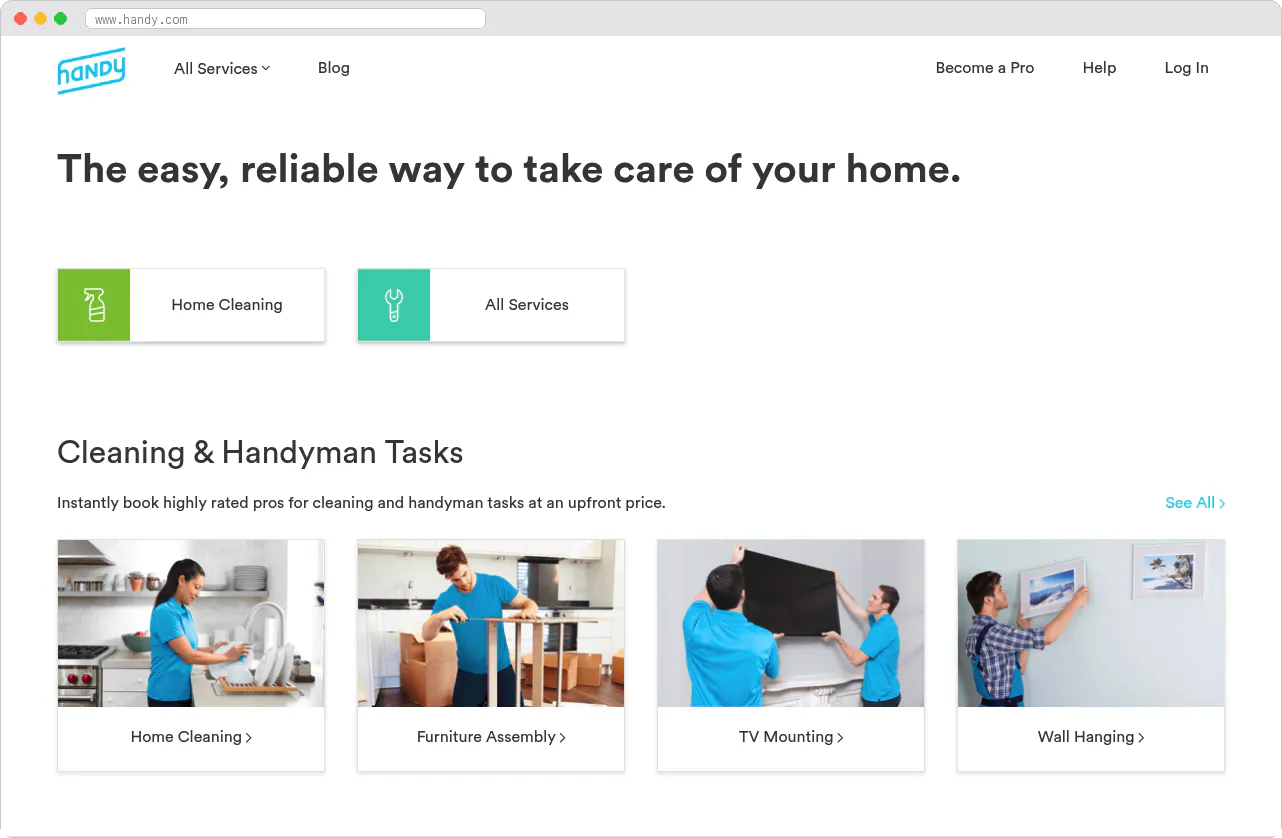
How Handy works as a marketplace
Handy operates as a two-sided marketplace connecting homeowners (demand) with service professionals (supply) for cleaning, handyman services, and home repairs. The platform's success stems from solving core problems for both user groups while maintaining high service quality.
For customers, Handy eliminates the traditional hassles of finding home service providers. Instead of calling multiple contractors, waiting for quotes, or worrying about reliability, customers can browse available professionals, see ratings and reviews, view transparent pricing, and book services instantly. The platform handles payment processing, scheduling, and provides customer support if issues arise.
Customers begin by selecting their service type, house cleaning, furniture assembly, TV mounting, or general handyman work. They then specify their location, preferred date and time, and any special requirements. The platform shows available professionals with their ratings, reviews, and pricing. After booking, customers receive confirmation details and can track their service provider's arrival.
For service professionals, Handy provides a steady stream of customers without the need for expensive marketing or business development. Professionals create profiles highlighting their skills, experience, and availability. They set their service areas and rates, though Handy provides pricing guidance based on local market conditions.
The platform's matching algorithm considers factors like location, availability, customer preferences, and professional ratings to suggest optimal matches. This helps ensure customers get quality service while professionals receive jobs that fit their skills and schedule.
Handy's business model centers on commission fees, typically taking 15-20% of each transaction. This aligns the platform's interests with successful service delivery. Handy only makes money when customers are satisfied enough to complete transactions.
The platform also generates revenue through additional services like background checks for professionals, priority listing features, and partnership programs with retailers and real estate companies.
Essential features for a home services marketplace
Building a marketplace like Handy requires specific functionality that addresses the unique challenges of connecting customers with local service providers. Unlike product marketplaces where items can be shipped anywhere, home services are inherently local and require different trust mechanisms.
Professional profiles and verification
Service professionals need comprehensive profiles that build customer confidence. These profiles should include detailed service descriptions, pricing information, photos of previous work, customer reviews, and credentials or certifications. Most importantly, the platform should implement background check systems and identity verification to ensure customer safety.
Handy's success partly stems from its rigorous vetting process. Professionals must pass background checks, provide references, and sometimes complete skills assessments before joining the platform. This creates trust with customers who are inviting strangers into their homes.
Location-based search and matching
Customers need to find professionals who serve their specific area, making location-based search essential. The platform should allow filtering by distance, neighborhood, or zip code. Advanced matching algorithms can consider factors like professional ratings, availability, pricing, and customer preferences to suggest the best options.
Effective location functionality also includes service area management for professionals, allowing them to specify exactly where they're willing to work and how far they'll travel for different job sizes.
Scheduling and availability management
Unlike product purchases, home services require coordination between customer and professional schedules. The platform needs robust scheduling tools that show professional availability, allow customers to book specific time slots, and handle rescheduling requests.
Professionals should be able to set their working hours, block out unavailable times, and manage multiple bookings efficiently. Automated reminders and confirmations help reduce no-shows and miscommunications.
Instant booking and pricing
Handy's competitive advantage includes transparent, upfront pricing and instant booking capabilities. Customers can see exact costs before booking, eliminating the friction of waiting for quotes. This requires the platform to have standardized pricing models for common services while allowing customization for complex jobs.
The booking flow should be streamlined, customers should be able to go from browsing to confirmed booking in just a few clicks.
Secure payment processing with escrow
Home services marketplaces need sophisticated payment systems that protect both parties. Customers typically pay upfront when booking, but funds should be held in escrow until service completion. This protects customers from poor service while ensuring professionals get paid for completed work.
The payment system should also handle various scenarios like partial refunds, tips, and additional charges for extra work discovered during the job.
Two-way reviews and ratings
Trust is critical when inviting service providers into your home. Comprehensive review systems allow customers to rate professionals on factors like punctuality, quality, cleanliness, and communication. Equally important, professionals should be able to rate customers, helping identify difficult clients and encouraging mutual respect.
Reviews should be detailed enough to be useful while being moderated to prevent fake or inappropriate content.
Communication tools
Customers and professionals need to communicate about job details, access instructions, and any issues that arise. Built-in messaging systems keep communications within the platform while protecting user privacy. Features should include photo sharing for showing problem areas or completed work, and notification systems for important updates.
Insurance and guarantee programs
Home services carry inherent risks, professionals might damage property, or customers might be unsatisfied with work quality. Platforms need insurance programs that cover property damage and guarantee policies that protect customer satisfaction. These programs reduce friction for both sides while differentiating the platform from informal alternatives.
Mobile optimization
Many customers and professionals will access the platform via mobile devices, especially for last-minute bookings or on-the-job communications. The platform must work smoothly across devices, with mobile apps potentially offering features like GPS tracking, push notifications, and photo uploads.
Successful Handy competitors and what they do differently
Understanding Handy's competitive landscape helps founders identify opportunities to differentiate their own platforms. Each major competitor has found success by focusing on specific market segments or offering unique value propositions.
TaskRabbit: The broader task marketplace
TaskRabbit predates Handy and takes a broader approach to the task marketplace. While Handy focuses primarily on cleaning and handyman services, TaskRabbit includes everything from furniture assembly and moving help to waiting in line and personal shopping.
TaskRabbit's strength lies in its flexibility, customers can post almost any task, and "Taskers" can bid on jobs or set hourly rates. This model works well for unique or complex requests that don't fit standard service categories. However, the bidding process can be slower than Handy's instant booking model.
TaskRabbit's geographic expansion has been more measured than Handy's, focusing on major metropolitan areas where demand for diverse services is highest. This concentrated approach has helped them build strong market density in their operating areas.
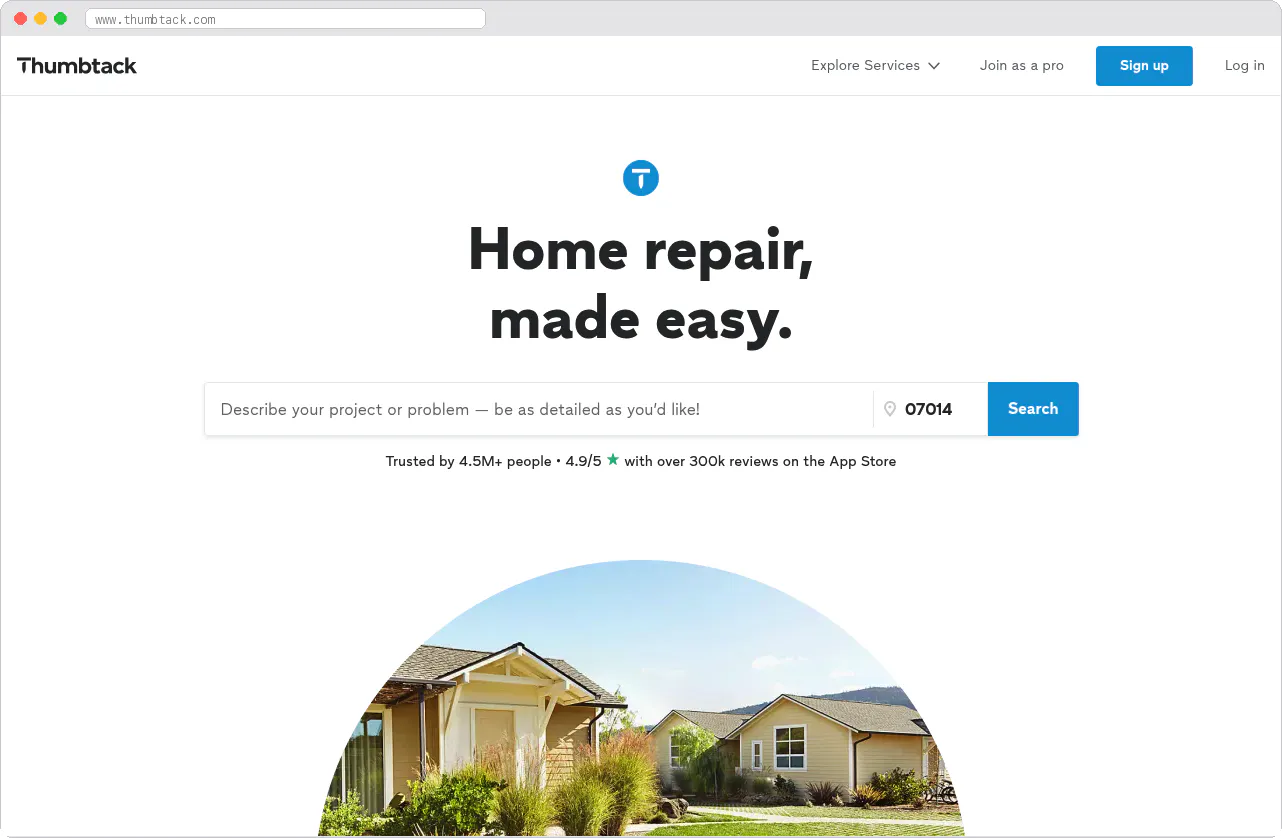
Thumbtack: The lead generation approach
Thumbtack operates more like a lead generation platform than a traditional marketplace. Instead of facilitating direct bookings, Thumbtack helps customers find professionals and get quotes, but transactions typically happen off-platform.
Professionals on Thumbtack pay for leads rather than transaction commissions. When customers submit requests, relevant professionals can send quotes, and the customer chooses who to hire. This model appeals to professionals who prefer to handle their own customer relationships and pricing.
Thumbtack covers a much broader range of services than Handy, including major home renovations, wedding planning, and business services. This breadth attracts customers looking for specialized professionals but can make the platform feel less focused than Handy's streamlined approach.
HomeAdvisor: The established player
HomeAdvisor (now part of Angi) represents the traditional approach to connecting homeowners with contractors. Founded in 1999 as ServiceMagic, HomeAdvisor has evolved from a simple lead generation service into a more comprehensive platform.
HomeAdvisor's strength lies in its coverage of major home improvement projects, kitchen remodels, roofing, HVAC installation, that require licensed contractors and significant investment. Their screening process includes license verification and customer complaint monitoring.
The platform uses a hybrid model combining lead generation with some instant booking features. Professionals pay for leads, but HomeAdvisor also offers "Instant Booking" for certain services, competing more directly with Handy's model.
Angi (formerly Angie's List): The review-focused platform
Angi built its reputation as a review platform where members could find and rate local service providers. The platform has evolved to include booking and payment features, but reviews remain its core differentiator.
Angi's strength is its comprehensive review database, built over two decades. Customers can find detailed feedback about local professionals across virtually every home service category. However, the platform's membership model and review focus can make it feel less modern than on-demand alternatives like Handy.
Urban Company: The international approach
Urban Company (formerly UrbanClap) demonstrates how home services platforms can expand beyond traditional categories. Operating primarily in India and other Asian markets, Urban Company includes beauty services, fitness training, and wellness services alongside traditional home maintenance.
Urban Company's model includes both marketplace-style independent professionals and company-employed service providers. This hybrid approach gives them more control over service quality but requires greater operational complexity.
Niche platforms and local competitors
Many successful home services platforms focus on specific niches or geographic areas. Platforms like Washio (on-demand laundry), Handy competitor Hello Alfred (recurring home services), and countless local cleaning or handyman services demonstrate that specialization can be a winning strategy.
These specialized platforms often provide superior service within their focus areas, building strong customer loyalty and word-of-mouth growth.
How to build your own home services marketplace
Creating a successful alternative to Handy requires a systematic approach that balances rapid market entry with building sustainable competitive advantages. Based on our experience working with marketplace founders, here's the proven path from idea to thriving platform.
Step 1: Identify your specific niche and market opportunity
Handy succeeded by focusing initially on basic cleaning and handyman services in major cities. Your opportunity lies in finding underserved segments or geographic areas where existing platforms haven't fully met customer needs.
Start by researching your local market. What services do homeowners struggle to find reliable providers for? Are there seasonal services, specialized trades, or demographic segments that existing platforms ignore? Maybe it's elderly customers who need more personalized service, busy professionals who want premium experiences, or specific services like holiday decorating or garage organization.
The most successful marketplace founders we work with often identify opportunities through personal experience. They've struggled to find good service providers themselves and realized others share the same frustration.
Step 2: Validate demand and supply in your target market
Before building anything, confirm that both sides of your marketplace exist and are underserved. On the demand side, survey potential customers about their current pain points. How do they find service providers now? What frustrations do they experience? Would they pay a premium for a better experience?
On the supply side, talk to service professionals about their challenges. How do they currently find customers? What percentage of their time is spent on marketing versus actual work? Would they pay a commission for a steady stream of qualified leads?
This validation phase should also include competitive analysis. Sign up for existing platforms as both a customer and service provider. Experience their onboarding, booking flows, and communication systems firsthand. Identify specific areas where you can provide superior value.
Step 3: Build your minimum viable platform (MVP)
Your first version should focus on core functionality that proves your concept works. Based on successful marketplace launches we've supported, your MVP needs profile creation for service providers, location-based search for customers, basic booking functionality, secure payment processing with commission capability, and simple communication tools.
Start with one service category in one geographic area. Handy began with house cleaning in New York City before expanding to handyman services and other markets. This focus helps you achieve marketplace liquidity, the balance between supply and demand that makes your platform valuable to both sides.
Building an MVP quickly is crucial because it lets you start learning from real users. Every month you spend building features in isolation is a month you're not getting feedback from actual customers and service providers.
Step 4: Recruit initial supply before demand
Marketplaces typically need supply before demand. Customers won't use a platform with no available service providers, but service providers are often willing to join platforms that promise future customers.
Find your initial service providers through local networking, online communities, and direct outreach. Visit hardware stores, advertise in trade publications, or attend local business meetups. Many platforms have succeeded by manually recruiting their first 20-50 high-quality service providers.
Ensure your initial providers represent the quality level you want for your platform. These early users will generate your first reviews and referrals, setting the tone for your entire marketplace.
Step 5: Launch to customers with focused marketing
Once you have solid supply coverage, begin customer acquisition. Start with your immediate network, friends, family, neighbors, who need the services you offer. Their feedback and initial reviews create social proof for future customers.
Local marketing works especially well for home services platforms. Partner with real estate agents, interior designers, or property managers who regularly refer service providers. Consider content marketing that addresses common homeowner questions and positions your platform as the solution.
Paid advertising can work but requires careful targeting. Home services customers often search for help when they have immediate needs, making search engine marketing effective for capturing high-intent users.
Step 6: Achieve operational efficiency and trust
As bookings increase, focus on building systems that ensure consistent service quality and customer satisfaction. Develop standardized onboarding processes for service providers, create quality control checklists, implement customer feedback loops, and establish clear policies for handling disputes.
Trust-building features become critical as you scale. Background checks, insurance programs, satisfaction guarantees, and responsive customer support differentiate professional platforms from informal alternatives like Facebook groups or Craigslist.
Step 7: Expand strategically
Successful expansion typically happens along three dimensions: geographic areas, service categories, or customer segments. Handy expanded geographically first, then added service categories, and eventually launched business-focused services.
Expand into new areas only after achieving strong marketplace liquidity in your initial market. A platform with great supply and demand in one city is more valuable than thin coverage across multiple markets.
Technology approaches for building your platform
Your technology choices significantly impact development speed, costs, and long-term scalability. Each approach offers different trade-offs between speed, cost, customization, and technical requirements.
No-code marketplace builders
No-code platforms like Sharetribe enable non-technical founders to launch professional marketplaces quickly. You can build a fully functional home services platform, with profiles, booking, payments, and communication, in days rather than months.
The main advantage is speed to market. You can validate your concept and start generating revenue while competitors are still planning development. No-code platforms also handle complex technical requirements like payment processing, security, and infrastructure scaling.
Limitations include reduced customization flexibility and potential dependence on the platform provider. However, platforms like Sharetribe address this by allowing custom development on top of the no-code foundation, giving you the best of both worlds.
Custom development
Custom development offers unlimited flexibility but requires significant time and budget. A basic home services marketplace typically costs $40,000-$120,000 to build properly, with additional ongoing costs for maintenance, security updates, and hosting.
Development timelines typically extend 6-12 months for a full-featured platform. This lengthy process means you're not learning from real users during the most critical early stages of your business.
Custom development makes sense for founders with specific technical requirements, significant funding, or unique functionality that existing platforms can't support.
Hybrid approaches
Many successful platforms combine no-code tools for rapid prototyping with custom development for unique features. You might launch with a no-code platform to validate your concept, then add custom features as you identify specific competitive advantages.
This approach minimizes upfront investment while preserving long-term flexibility.
Building trust and safety in home services
Home services marketplaces face unique trust challenges because customers are inviting strangers into their private spaces. Your platform's approach to safety and trust often determines its success more than any specific feature.
Comprehensive vetting processes
Professional service providers should undergo thorough screening before joining your platform. This includes background checks, identity verification, reference checks from previous customers, and skills assessments for technical services.
Handy's rigorous vetting process has been key to building customer confidence. They require background checks, personal references, and sometimes in-person interviews. While this creates barriers for service providers, it significantly increases customer trust.
Insurance and bonding programs
Partner with insurance providers to offer coverage for property damage or theft during service visits. Some platforms self-insure by building reserves from commission revenues, while others purchase traditional commercial policies.
Clearly communicate insurance coverage to customers during the booking process. Knowing they're protected encourages customers to try new service providers and book higher-value services.
Dispute resolution systems
Develop clear policies and procedures for handling customer complaints, service quality issues, and payment disputes. Quick, fair resolution builds trust with both customers and service providers.
Consider offering satisfaction guarantees for certain service types. Handy offers re-cleaning services if customers aren't satisfied with initial cleaning quality.
Emergency support systems
Provide 24/7 customer support for urgent issues during service visits. Customers need to know they can get help if problems arise, especially during evening or weekend appointments.
Monetization strategies beyond commissions
While commission fees provide the primary revenue stream for most home services marketplaces, successful platforms often develop additional revenue sources that improve unit economics and customer value.
Subscription models for frequent users
Offer subscription plans for customers who book services regularly. A monthly cleaning subscription with guaranteed availability and preferential pricing can increase customer lifetime value while providing predictable revenue.
Premium service tiers
Create premium service options with features like same-day booking, extended guarantees, or access to top-rated professionals. Customers often pay more for convenience and peace of mind.
Professional tools and services
Offer additional services to your supply-side users, such as business insurance, accounting software, scheduling tools, or marketing services. These B2B revenue streams can be highly profitable and increase professional retention.
Partnership revenue
Partner with complementary businesses like home improvement retailers, real estate companies, or property management firms. Revenue sharing arrangements for referred customers can provide significant additional income.
Why Sharetribe works for home services marketplaces
Sharetribe specifically addresses the challenges of building and scaling home services marketplaces. Our platform includes built-in features that address the unique requirements of connecting customers with local service providers.
Location-based functionality
Our platform includes sophisticated location search and filtering capabilities designed for local services. Service providers can specify their coverage areas, and customers can easily find providers serving their location.
Flexible booking and scheduling
The platform supports various booking models, from instant booking for standard services to request-based systems for custom work. Built-in availability management helps professionals optimize their schedules.
Trust and safety features
Sharetribe includes comprehensive review systems, secure messaging, identity verification tools, and customizable onboarding flows that help you build trust between customers and service providers.
Payment processing with commission support
Integrated Stripe Connect handles complex payment scenarios including commission collection, escrow-style fund holding, and automatic payouts to service providers. This eliminates the technical and legal complexity of building payment systems from scratch.
Scalability without technical overhead
As your marketplace grows, Sharetribe handles infrastructure scaling, security updates, and performance optimization. This lets you focus on growing your business rather than managing technical systems.
Customization capabilities
While you can launch quickly with no-code tools, Sharetribe's API allows unlimited customization as your needs evolve. Add custom features, integrate third-party services, or build mobile apps without rebuilding your core platform.
The combination of rapid launch capabilities with long-term scalability makes Sharetribe ideal for home services entrepreneurs who want to validate their concepts quickly while preserving future flexibility.
Getting started with your home services marketplace
The home services market continues growing as consumers increasingly value convenience and professional quality. Platforms like Handy have proven the model works, but significant opportunities remain for entrepreneurs who can serve specific niches, geographic areas, or customer segments better than existing solutions.
Success in this market requires balancing rapid market entry with building sustainable competitive advantages. The faster you can launch and start learning from real users, the better positioned you'll be to build something customers truly want.
Whether you choose to build custom software, use no-code tools, or combine approaches, the key is starting with clear assumptions about your target market and validating those assumptions as quickly as possible.
The technology to build a marketplace like Handy is more accessible than ever. The challenge lies in understanding your market, building trust with users, and executing consistently as you scale. With the right approach and tools, there's never been a better time to enter the home services marketplace space.
Frequently asked questions
How much does it cost to build a website like Handy?
Costs vary by approach. No-code platforms like Sharetribe start around $100/month, custom development typically costs $40,000-$120,000, and hybrid approaches fall in between. The key is balancing speed to market with long-term scalability needs.
What features does a home services marketplace need?
Essential features include professional profiles with verification, location-based search, booking and scheduling tools, secure payment processing with escrow, two-way reviews, and communication systems. Trust and safety features are critical for home services.
How do home services marketplaces make money?
Primary revenue comes from commission fees (typically 15-20% per transaction). Additional revenue streams include subscription plans, premium service tiers, professional tools and services, and partnership revenue sharing.
How long does it take to build a marketplace like Handy?
Timeline depends on approach: no-code platforms like Sharetribe enable launch in 1-2 weeks, custom development takes 6-12 months, and hybrid approaches fall in between. Faster launch means quicker validation and learning.
What makes Handy successful compared to competitors?
Handy succeeded through rigorous professional vetting, transparent upfront pricing, instant booking capabilities, and focus on common services like cleaning and basic handyman work. Their streamlined user experience differentiated them from complex bidding platforms.
Do I need technical skills to build a home services marketplace?
No. No-code platforms like Sharetribe let you build fully functional marketplaces without programming. You can launch quickly to validate your concept, then add custom features later as needed.
Start your 14-day free trial
Create a marketplace today!
- Launch quickly, without coding
- Extend infinitely
- Scale to any size
No credit card required