How to build a website like Taskrabbit
Taskrabbit revolutionized on-demand services by connecting people with local freelancers for everyday tasks. Learn how to build your own service marketplace with the right features, business model, and strategy to compete in the gig economy.
Published: Aug 9, 2024
Last updated: Mar 19, 2026
How does Taskrabbit work?
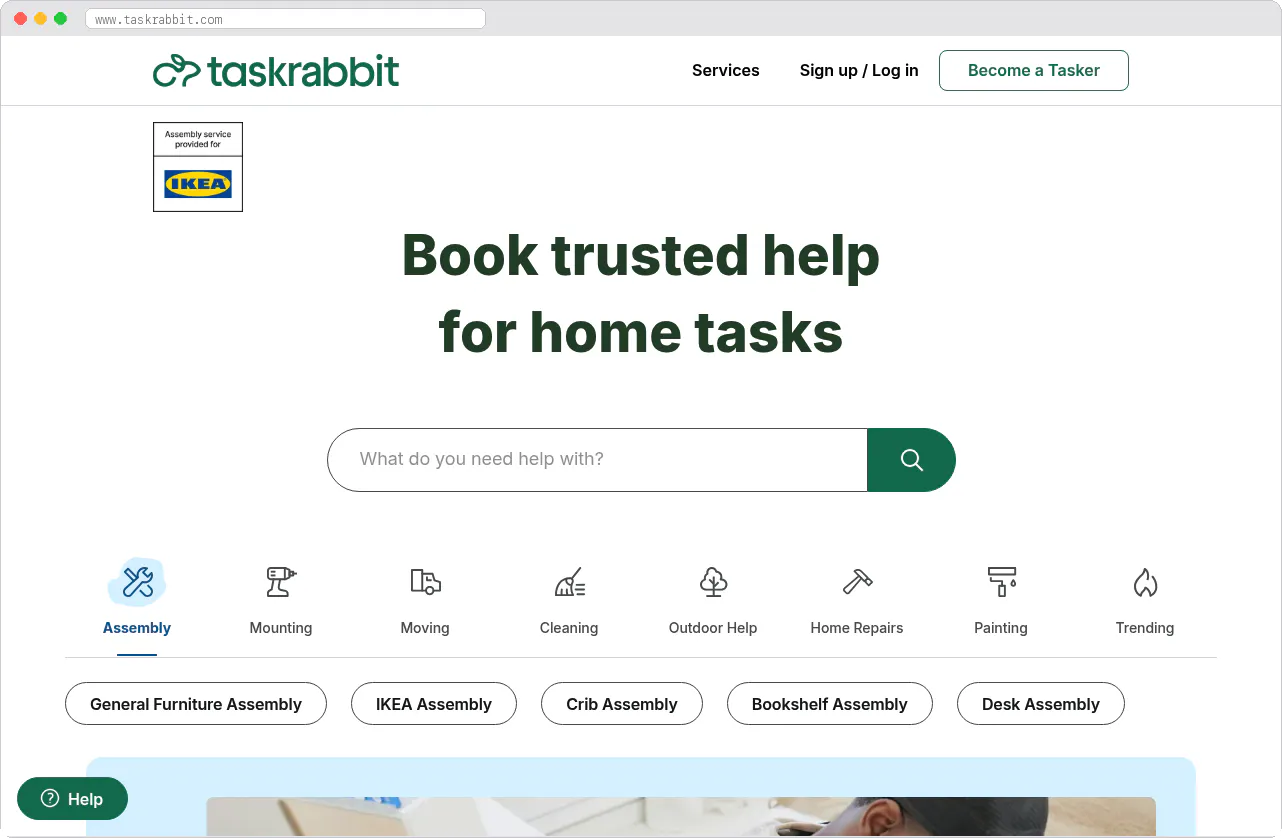
Taskrabbit transformed the local services industry by creating a trusted platform where busy homeowners connect with skilled freelancers for everyday tasks. Founded in 2008 by Leah Busque, the company started when Busque ran out of dog food and wished there was an easy way to hire someone for the errand. Today, Taskrabbit operates in over 60 cities across the United States, Canada, and the United Kingdom, facilitating millions of tasks annually.
The platform operates as a two-sided marketplace connecting two distinct user groups. Customers post tasks ranging from furniture assembly and home repairs to moving help and personal errands. Taskers (the service providers) browse available jobs, submit bids or accept posted rates, and complete the work. Unlike traditional contractor services, Taskrabbit focuses on smaller, immediate tasks that typically take a few hours rather than multi-day projects.
Taskrabbit generates revenue through a commission-based model, taking approximately 15-30% of each transaction depending on the task category and location. This structure aligns the platform's incentives with successful job completion while keeping barriers to entry low for both sides of the marketplace.
What sets Taskrabbit apart from classified sites like Craigslist is the integrated trust and payment infrastructure. All Taskers undergo background checks and identity verification. The platform handles payments automatically, holding funds until job completion and providing insurance coverage for certain types of work. This reduces friction and increases safety for both parties.
What makes Taskrabbit successful?
Taskrabbit's success stems from solving real pain points in the local services market. Before the platform existed, finding reliable help for small tasks required extensive searching, vetting, and coordination. Traditional contractors often weren't interested in small jobs, and finding trustworthy individuals through classified ads was time-consuming and risky.
The company's acquisition by IKEA in 2017 for an undisclosed amount (estimated at $50-100 million) validated the business model and provided strategic advantages. IKEA integrated Taskrabbit's services directly into their shopping experience, allowing customers to book furniture assembly while purchasing items online or in-store.
Taskrabbit's success also reflects broader economic trends. The gig economy has created a large pool of people seeking flexible work opportunities, while busy professionals increasingly value time over money. The platform captures value from both trends by making it easy for skilled workers to monetize their time and for time-constrained customers to outsource tasks.
The company's focus on trust and safety has been crucial to its growth. Beyond background checks, Taskrabbit maintains a two-sided review system where both customers and Taskers rate each other. This creates accountability and helps maintain service quality across the platform.
Essential features for a Taskrabbit-like marketplace
Building a service marketplace requires specific functionality that differs significantly from product-selling platforms. The core features must handle the unique challenges of coordinating real-world services between strangers.
Task posting and categorization forms the foundation of any service marketplace. Users need an intuitive way to describe their needs, set budgets, specify timing, and provide relevant details. Effective categorization helps Taskers find relevant opportunities quickly while ensuring customers connect with appropriately skilled providers.
Taskrabbit's categories include furniture assembly, mounting and installation, moving help, home repairs, cleaning, delivery, and personal assistant tasks. Each category has customized fields capturing task-specific requirements. For example, moving tasks ask about the size of the move, stairs involved, and packing needs, while assembly tasks request item details and complexity.
Location-based matching is critical for service marketplaces since providers and customers must be in the same geographic area. The platform needs sophisticated location search that considers travel time, service areas, and local market dynamics. Unlike product marketplaces where shipping enables global transactions, service platforms are inherently local.
Bidding and pricing systems must accommodate different pricing models. Some tasks work well with fixed rates (like furniture assembly), while others require custom quotes (like home repairs). The platform should support both posted rates and bidding mechanisms, allowing market forces to determine fair pricing while preventing races to the bottom that could compromise service quality.
Scheduling and availability management becomes complex when dealing with real-world services. Taskers need tools to manage their calendars, set availability windows, and handle last-minute changes. Customers need flexibility to request specific time slots while understanding provider availability constraints.
Real-time messaging facilitates coordination between booking and completion. Service providers often need to ask clarifying questions, confirm details, or coordinate access. Unlike product purchases where communication needs are minimal, services require ongoing dialogue to ensure successful completion.
Payment processing with escrow functionality protects both parties while enabling the commission business model. Funds should be collected upfront but released only after job completion and customer satisfaction. This requires sophisticated payment splitting, dispute handling, and refund capabilities.
Trust and safety features must address the unique risks of in-person services. Background checks, identity verification, insurance coverage, and emergency protocols become essential rather than optional. The platform needs clear policies for handling disputes, property damage, and safety incidents.
Two-sided review systems maintain service quality and help users make informed decisions. Both customers and providers should rate each other, creating mutual accountability. The review system must prevent gaming while encouraging honest feedback that improves marketplace quality over time.
Mobile optimization is particularly important for service marketplaces since many Taskers work on-the-go and customers often need immediate assistance. The mobile experience should support job browsing, booking, messaging, and payment processing smoothly.
Building your service marketplace: a step-by-step approach
Start by validating your specific niche. While Taskrabbit covers general household tasks, successful competitors often focus on specialized verticals. Thumbtack serves professional services like event planning and tutoring. Handy specializes in home cleaning and repairs. Your opportunity might lie in serving a specific demographic, geographic market, or service category that existing platforms don't address well.
Research involves talking to potential customers about their current pain points and providers about their business challenges. How do people currently find help for the services you're considering? What frustrations exist with current solutions? Are providers struggling to find customers or dealing with pricing pressure?
Design your business model carefully. Commission rates vary significantly across service categories. Simple tasks with standardized pricing can support lower commission rates, while complex services requiring custom quotes may justify higher fees. Consider whether you'll charge customers, providers, or both sides of the transaction.
Taskrabbit's model evolved over time. Initially, the platform used an auction-style bidding system where customers posted tasks and providers bid for jobs. In 2014, they switched to a model where providers set hourly rates and customers book directly. This change reduced friction but required sophisticated matching algorithms to connect customers with appropriate providers.
Build your minimum viable platform (MVP) focusing on core functionality. Your first version should handle task posting, provider profiles, basic matching, messaging, and payment processing. Advanced features like automated scheduling, insurance integration, and mobile apps can wait until you've validated the basic concept.
Recruit your initial supply of service providers before launching to customers. This chicken-and-egg challenge is common to all marketplaces but particularly acute for services where customers expect immediate availability. Start by identifying existing service providers in your target market and understanding what would motivate them to join your platform.
Taskrabbit's founders initially recruited providers through Craigslist and local community groups. They offered promotional rates and personal support to early adopters. Some successful service marketplaces start by becoming providers themselves to understand the market dynamics firsthand.
Launch to a small, focused customer base. Rather than trying to serve everyone, concentrate on a specific demographic or use case where you can deliver exceptional value. This allows you to refine your service delivery and build positive reviews before expanding.
Iterate based on real-world usage. Service marketplaces face unique operational challenges that only emerge with live transactions. How do you handle no-shows? What happens when tasks take longer than expected? How do you resolve quality disputes? Your policies and features must evolve based on actual platform usage.
Service marketplace competitors and alternatives
Understanding the competitive landscape helps identify opportunities and positioning for your service marketplace. Each major player has chosen different trade-offs in terms of services offered, pricing models, and target markets.
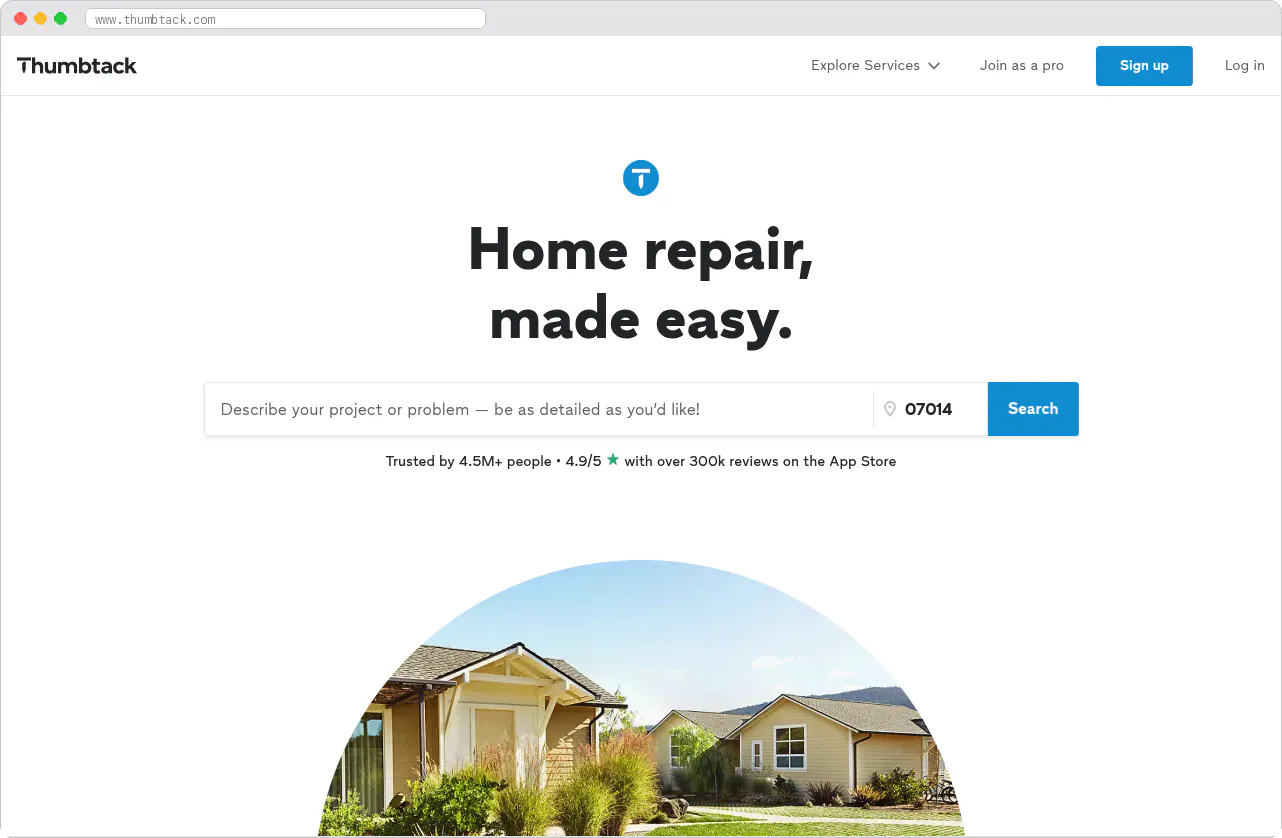
Thumbtack operates as a lead generation platform rather than a full-service marketplace like Taskrabbit. Instead of handling payments and bookings, Thumbtack connects customers with service providers who then handle transactions directly. Providers pay for leads rather than commissions on completed jobs.
This model allows Thumbtack to offer a broader range of professional services including photographers, tutors, personal trainers, and event planners. However, it provides less transaction security and requires customers to coordinate directly with providers for scheduling and payment.
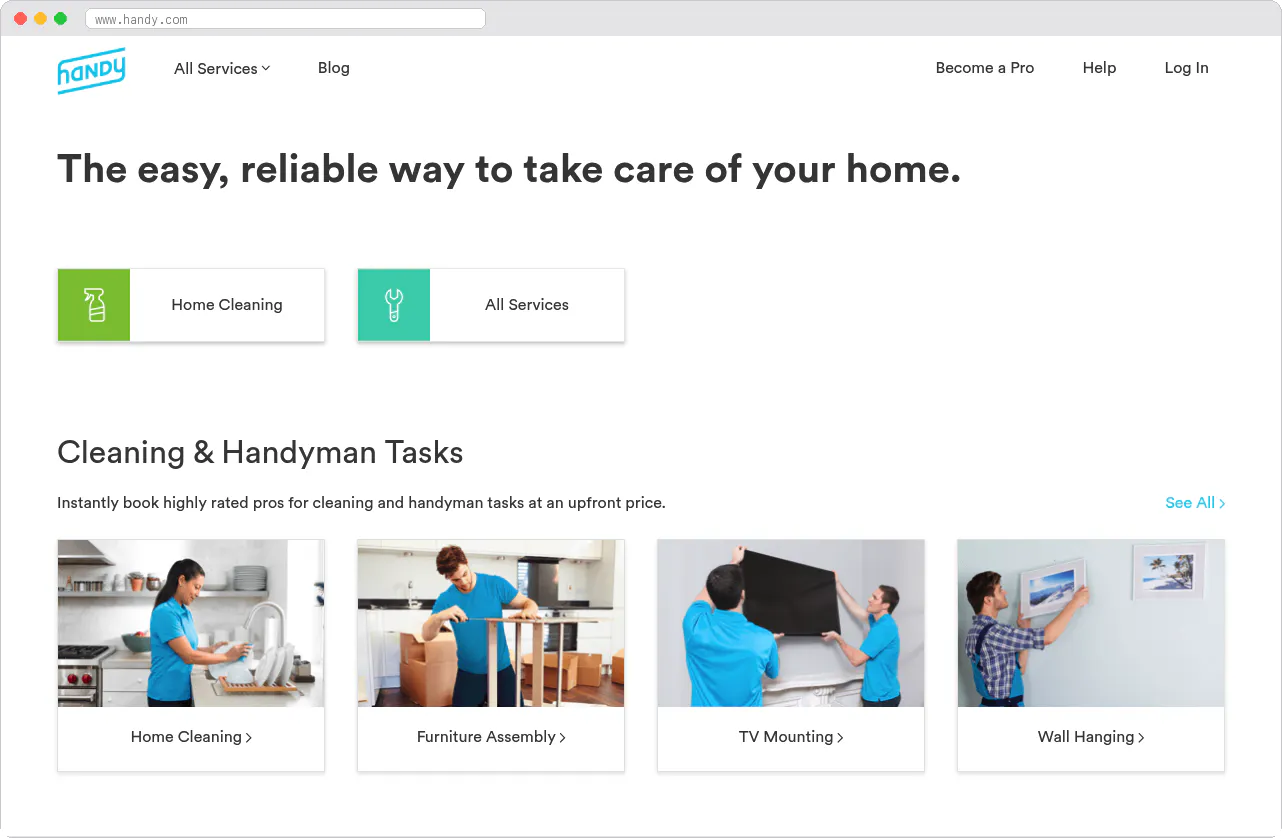
Handy focuses specifically on home cleaning and handyman services, offering more standardization than Taskrabbit's general approach. All providers are employees rather than independent contractors, giving Handy more control over service quality but higher operational costs.
The employee model allows Handy to offer consistent pricing, guaranteed service quality, and insurance coverage. However, it limits geographic expansion speed and increases the capital required to scale since the company must hire and manage providers directly.
Amazon Home Services uses Amazon's massive customer base and logistics infrastructure to compete in the local services market. The platform offers installation services for products purchased on Amazon, creating natural demand for services.
Amazon's advantages include customer trust, integrated e-commerce, and operational expertise. However, the platform focuses primarily on installation and assembly rather than the broader range of services offered by dedicated marketplaces.
Angi (formerly Angie's List) targets larger home improvement projects rather than the immediate, smaller tasks that Taskrabbit serves. Providers typically are licensed contractors rather than individuals offering labor-based services.
Angi's focus on substantial home projects means higher transaction values but longer sales cycles and more complex project management requirements. The platform serves customers planning renovations rather than those needing immediate task assistance.
Local competitors often succeed by focusing on specific geographic markets or service categories. Regional players can offer better local market knowledge, customer service, and provider relationships than national platforms.
Technical approaches for building a service marketplace
The technical complexity of service marketplaces requires careful consideration of development approaches. Your choice impacts time to market, ongoing costs, scalability, and feature flexibility.
Custom development provides maximum control but requires significant investment. Building a service marketplace from scratch typically costs $100,000-$500,000 and takes 12-18 months for a full-featured platform. This includes user management, payment processing, messaging, mobile apps, and administrative tools.
Custom development makes sense for well-funded teams with specific technical requirements or unique business models. However, the opportunity cost is significant since you'll spend months building standard marketplace features rather than validating your specific market opportunity.
No-code marketplace platforms like Sharetribe enable rapid deployment without technical expertise. You can launch a functional service marketplace in days rather than months, allowing faster market validation and iteration.
Sharetribe includes built-in features essential for service marketplaces: location-based search, scheduling tools, payment processing with commission handling, messaging systems, and mobile-responsive design. The platform handles technical infrastructure, security, and compliance requirements automatically.
The trade-off is less customization flexibility compared to custom development. However, Sharetribe's Developer Platform allows adding custom features as your business grows, providing a growth path from no-code launch to fully customized platform.
Hybrid approaches combine no-code tools for core functionality with custom development for unique features. This can work well for specialized service categories requiring industry-specific workflows or integrations.
For example, a marketplace serving professional services might use standard marketplace features for basic functionality while adding custom tools for project management, invoicing, or regulatory compliance.
Cost considerations for service marketplaces
Service marketplaces face different cost structures than product-selling platforms due to the operational complexity of coordinating real-world services.
Initial development costs vary dramatically based on your technical approach. A no-code solution like Sharetribe costs under $99-399/month to launch and operate, while custom development requires five or six-figure investments before generating any revenue.
Ongoing operational costs include customer support, provider onboarding, quality assurance, and safety compliance. Service marketplaces typically require more hands-on operational work than digital-only platforms.
Taskrabbit employs substantial customer support and provider operations teams to handle scheduling conflicts, quality issues, property damage claims, and safety incidents. These operational costs scale with transaction volume and service complexity.
Customer acquisition costs tend to be high for service marketplaces since customers often need education about the platform and may have safety concerns about inviting strangers into their homes. Successful platforms typically spend 30-50% of revenue on marketing and customer acquisition.
Provider acquisition and retention costs include background checks, onboarding, training, and incentive programs. High-quality providers are crucial for marketplace success but may require ongoing support and incentives to remain active.
Insurance and liability costs protect the platform and users but add operational complexity. Some service categories require specialized insurance coverage, licensing verification, or safety protocols that increase per-transaction costs.
Why Sharetribe works for service marketplaces
Building a service marketplace presents unique challenges that generic website builders or e-commerce platforms can't address effectively. Sharetribe was designed specifically for two-sided marketplaces, with features that handle the complexity of coordinating services between users.
Speed to market is crucial for marketplace businesses since success depends on network effects between providers and customers. Sharetribe enables launching a functional service marketplace in days rather than months, allowing faster market validation and iteration.
The platform includes pre-built features essential for service businesses: location-based search, availability management, booking workflows, payment processing with commission handling, and two-sided messaging. These features would take months to develop from scratch but are available immediately with Sharetribe.
Commission-based payments require sophisticated payment splitting that most payment processors don't support natively. Sharetribe integrates with Stripe Connect to handle marketplace payments automatically, including commission collection, escrow functionality, and provider payouts.
Scalability without technical complexity allows focusing on business growth rather than infrastructure management. Whether your marketplace has 10 users or 10,000, Sharetribe handles hosting, security, backups, and performance optimization automatically.
Flexibility for customization means you're not locked into a rigid platform as your business evolves. Sharetribe's Developer Platform allows adding custom features, integrations, and designs while maintaining the core marketplace functionality.
Many successful service marketplaces started with Sharetribe's no-code platform and added custom features as they grew. This approach minimizes initial investment while preserving options for future customization.
Growing your service marketplace
Launching your platform is just the beginning. Service marketplaces face unique growth challenges due to the local nature of services and the need to balance supply and demand in each market.
Geographic expansion must be carefully managed since services are inherently local. Unlike digital marketplaces where adding inventory serves all customers, service platforms need adequate provider density in each geographic market before customers will find the platform useful.
Successful expansion often follows a hub-and-spoke model, starting in dense urban areas with high task demand and sufficient provider populations. Suburban and rural markets typically require different service categories and pricing structures.
Quality control becomes increasingly important as you scale. Automated systems can handle basic verification, but service quality requires ongoing monitoring, customer feedback analysis, and provider coaching. Many platforms use a combination of algorithmic screening and human oversight to maintain standards.
Operational efficiency improvements are crucial for long-term profitability. Successful platforms automate routine tasks like provider onboarding, customer support, and payment processing while maintaining human oversight for complex issues.
Market differentiation often emerges through specialization rather than trying to compete directly with established platforms. Successful competitors focus on underserved demographics, service categories, or geographic markets where they can offer superior value.
Building a service marketplace requires patience and persistence. Unlike digital products where growth can be exponential, service platforms must build trust and operational capabilities gradually. However, successful service marketplaces often develop strong network effects and customer loyalty that create sustainable competitive advantages.
Next steps for building your service marketplace
Start by researching your specific market opportunity. Talk to potential customers about their current frustrations and providers about their business challenges. Validate that there's sufficient demand and supply in your target market before investing in platform development.
Choose your initial service category and geographic focus carefully. It's better to dominate a small market than to struggle for traction in a large one. You can expand once you've proven the model works in your initial market.
Build your MVP quickly using a platform like Sharetribe that handles marketplace complexity automatically. Focus your limited time and resources on understanding your users rather than building standard marketplace features.
The service marketplace opportunity remains substantial despite existing competition. By focusing on specific niches, providing superior user experience, and building strong operational capabilities, new platforms can still find success in this growing market.
Frequently asked questions
How much does it cost to build a website like Taskrabbit?
Costs vary dramatically by approach. No-code platforms like Sharetribe start under $99-399/month, while custom development typically costs $100,000-$500,000 and takes 12-18 months to complete.
What features does a service marketplace need?
Essential features include task posting, location-based search, scheduling tools, real-time messaging, escrow payments, background checks, two-sided reviews, and mobile optimization. Trust and safety features are particularly important for in-person services.
How does Taskrabbit make money?
Taskrabbit uses a commission-based model, taking 15-30% of each transaction depending on the task category and location. They collect payment from customers upfront and pay providers after job completion minus their commission.
What makes Taskrabbit successful compared to competitors?
Taskrabbit succeeded by focusing on small, immediate tasks rather than large projects, implementing strong trust and safety measures, and building an integrated platform that handles payments and booking automatically rather than just connecting users.
How do I compete with established service marketplaces?
Focus on specific niches, demographics, or geographic markets underserved by existing platforms. Provide superior user experience, specialized features for your target market, and build strong local provider relationships.
Do I need technical skills to build a service marketplace?
No, platforms like Sharetribe allow launching fully functional service marketplaces without coding. You can start with no-code tools and add custom features later as your business grows and requirements become more specific.
Start your 14-day free trial
Create a marketplace today!
- Launch quickly, without coding
- Extend infinitely
- Scale to any size
No credit card required