How to build a website like Urban Company
Urban Company transformed India's home services market by connecting verified professionals with customers through quality-focused technology. This comprehensive guide shows you how to build, launch, and scale a similar service marketplace.
Published: Aug 9, 2024
Last updated: Mar 19, 2026
How Urban Company revolutionized home services
Urban Company (formerly UrbanClap) stands as India's largest on-demand home services marketplace, processing over 20 million service requests annually and operating across 35+ cities in India, Australia, Singapore, and the UAE. Founded in 2014 by Abhiraj Bhal, Varun Khaitan, and Raghav Chandra, the platform connects customers with verified service professionals for everything from beauty treatments and home cleaning to appliance repairs and carpentry.
What sets Urban Company apart from traditional service directories is its commitment to quality control and standardization. Unlike platforms that simply connect customers with independent service providers, Urban Company directly trains, certifies, and monitors its professionals. The company has invested heavily in creating standardized service protocols, conducting background checks, and providing ongoing skills training to over 40,000 professionals on its platform.
The marketplace has raised over $800 million in funding across multiple rounds, with investors including Tiger Global, Prosus Ventures, and Steadview Capital. In 2021, the company achieved unicorn status with a $2.1 billion valuation, reflecting its dominant position in the fragmented home services market.
Urban Company's success stems from solving two critical problems that plague traditional home services: trust and consistency. Customers struggle to find reliable professionals, while skilled service providers lack access to steady work and professional development. By creating a platform that vets professionals, standardizes service delivery, and handles payments and scheduling, Urban Company created value for both sides of the marketplace.
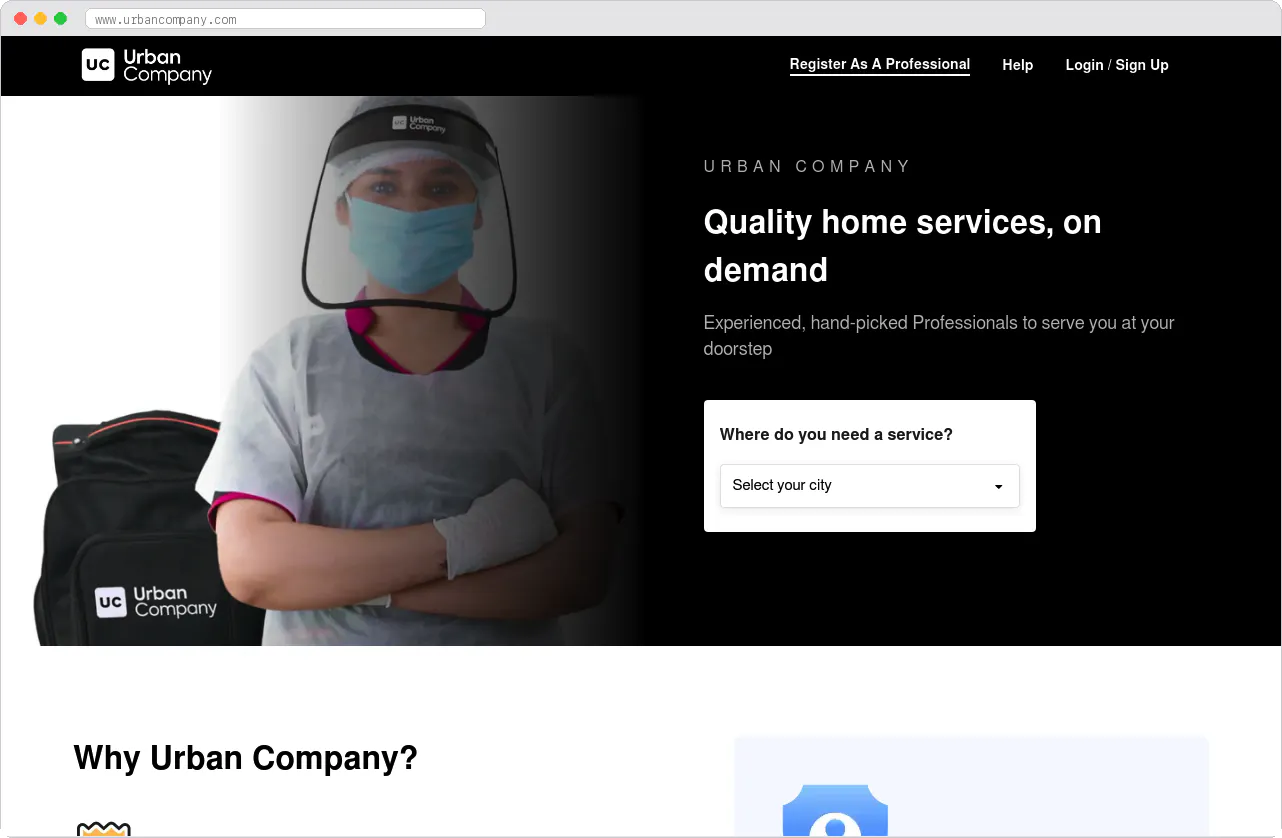
How Urban Company works
Urban Company operates as a managed marketplace, meaning it takes more control over the service experience than typical peer-to-peer platforms. This approach creates a different dynamic from platforms like TaskRabbit or Thumbtack, where customers choose from multiple provider proposals.
For customers, Urban Company offers a streamlined booking experience. Users select a service category (such as salon services, cleaning, or repairs), choose specific services from a standardized menu, pick a time slot, and receive a fixed price quote. The platform handles scheduling, sends a verified professional to the customer's location, and processes payment after service completion. Customers can rate their experience and request the same professional for future bookings.
For service professionals, Urban Company provides access to a steady stream of customers, professional training, and business support tools. Unlike traditional freelancing, professionals don't need to market themselves or negotiate prices. The platform assigns jobs based on availability, location, and customer preferences. Urban Company provides uniforms, equipment, and standardized pricing, creating a more employee-like experience while maintaining the flexibility of independent contracting.
The platform handles all customer interactions, from initial booking to payment processing and dispute resolution. This reduces the administrative burden on professionals while ensuring consistent service quality across the platform.
Urban Company's business model and revenue
Urban Company generates revenue through a commission-based model, typically charging service professionals 15-30% of each transaction. Unlike platforms that charge customers booking fees, Urban Company's commission comes entirely from the service provider side, making the platform free for customers to use.
The company also generates revenue through subscription services for professionals, including premium tools for managing their schedule and customer relationships. Additionally, Urban Company offers insurance products and financing options for professionals looking to purchase equipment or expand their services.
What makes Urban Company's model particularly interesting is its focus on repeat transactions and customer lifetime value. The platform reports that over 60% of customers book multiple services, and many become regular users who book services monthly or quarterly. This recurring usage pattern creates predictable revenue streams and higher customer lifetime value compared to one-off service marketplaces.
The managed marketplace approach allows Urban Company to maintain higher service standards but requires significant investment in training, quality control, and customer support. This trade-off between control and scalability is a key strategic decision that differentiates Urban Company from lighter-weight marketplace models.
Essential features for an Urban Company-like marketplace
Building a service marketplace similar to Urban Company requires specific functionality to handle the complexities of on-demand service delivery. These features go beyond basic marketplace functionality to address scheduling, service standardization, and quality control.
Service catalog and pricing management forms the backbone of the platform. Unlike product marketplaces where sellers set their own prices, service marketplaces often benefit from standardized pricing to build customer trust and streamline operations. Your platform needs robust tools for managing service categories, defining service packages, and setting transparent pricing across different markets and service types.
Advanced scheduling and availability management handles the complexity of time-based services. Service providers need to set their availability, manage multiple appointments, and handle last-minute changes. The platform must prevent double-booking while allowing for buffer time between appointments and travel time between customer locations.
Location-based matching and routing ensures efficient service delivery. The system needs to match customers with nearby professionals, optimize routes for professionals handling multiple appointments, and account for travel time in scheduling. Geographic coverage management helps you expand market by market while maintaining service quality.
Professional verification and onboarding builds the trust that service marketplaces require. This includes identity verification, background checks, skills assessment, and training completion tracking. The platform needs tools to manage professional certifications, insurance requirements, and ongoing compliance monitoring.
Real-time tracking and communication keeps customers informed throughout the service process. Customers want to know when their professional is en route, receive updates on service progress, and have direct communication channels for questions or changes. This requires integration with mapping services and robust messaging functionality.
Quality assurance and feedback systems maintain service standards across the platform. Beyond simple ratings, service marketplaces need detailed feedback forms, photo documentation of completed work, and tools for handling disputes or service guarantees. The platform should flag quality issues and provide tools for addressing them quickly.
Payment processing with escrow functionality protects both customers and professionals. Customers pay upfront when booking, but payment to professionals is released only after service completion and any applicable guarantee period. This requires integration with payment processors that support marketplace functionality and delayed payouts.
Professional tools and mobile apps enable service providers to manage their business effectively. Professionals need mobile apps to receive job notifications, navigate to customer locations, process payments, and manage their schedule. Desktop tools help with longer-term planning and performance analytics.
Urban Company's competitive landscape
The on-demand services market includes both direct competitors and platforms addressing adjacent needs. Understanding this landscape helps identify opportunities for differentiation and market positioning.
TaskRabbit operates primarily in the US and UK, focusing on handyman tasks and personal assistance rather than Urban Company's emphasis on professional services like beauty and wellness. TaskRabbit uses a bidding model where customers post tasks and receive proposals from multiple providers, giving customers more choice but creating less standardization. The platform generates revenue through service fees charged to customers rather than commissions from service providers.
Thumbtack serves the US market with a lead generation model where professionals pay for customer contacts rather than per-transaction commissions. Customers receive multiple quotes for services, creating more price competition among providers. Thumbtack covers a broader range of services including event planning, tutoring, and professional services that Urban Company doesn't address.
Handy (now part of IAC) focuses specifically on home cleaning and handyman services in major US and UK cities. The platform employs a more standardized approach similar to Urban Company, with fixed pricing and direct professional management. However, Handy's service range remains narrower, concentrating on home maintenance rather than expanding into beauty, wellness, and lifestyle services.
Housejoy competes directly with Urban Company in the Indian market, offering similar home services with a focus on cleaning, repairs, and beauty services. While Housejoy positions itself as a premium option with higher service standards, it operates in fewer cities and has not achieved Urban Company's scale or funding levels.
Local competitors vary by market but often include specialized platforms for specific service categories. For example, beauty service apps like StyleSeat or home cleaning platforms like Helpling focus on single categories rather than Urban Company's multi-category approach.
The competitive landscape shows two main strategic approaches: broad multi-category platforms like Urban Company versus specialized single-category solutions. Multi-category platforms benefit from cross-selling opportunities and higher customer lifetime value, while specialized platforms can develop deeper expertise and more tailored solutions for specific service types.
Step-by-step guide to building a service marketplace
Creating a successful service marketplace like Urban Company requires balancing technology development with business model validation and market-building activities. The process involves ten key stages that build upon each other.
1. Identify your service marketplace opportunity
Urban Company succeeded by identifying a massive, fragmented market with poor service quality and limited trust between customers and providers. Your marketplace opportunity should address similar inefficiencies in service delivery.
Start by researching underserved service categories in your target market. Look for services where customers struggle to find reliable providers, face inconsistent pricing, or lack quality guarantees. Consider both geographic and demographic gaps that existing platforms don't address effectively.
Analyze the supply side to understand service provider challenges. Interview professionals who offer services independently to learn about their customer acquisition costs, scheduling difficulties, payment delays, and other operational challenges. The best marketplace opportunities solve meaningful problems for both customers and service providers.
Consider the regulatory environment for your chosen service categories. Some services like healthcare, childcare, or financial services face licensing requirements that affect how you can operate your marketplace. Understanding these constraints early helps you design a compliant business model.
2. Choose your business model and pricing strategy
Urban Company's commission-based model works well for services with high transaction values and repeat usage, but other models might better suit your specific market opportunity.
Commission models work best when you can provide significant value to service providers through customer acquisition, payment processing, and business support tools. The commission rate depends on your service categories, local market dynamics, and the value you provide to professionals.
Subscription models can work for service marketplaces where providers benefit from consistent lead flow and professional tools, even without guaranteed transactions. This approach reduces friction for customers while providing predictable revenue for the platform.
Lead generation models, where professionals pay for customer contacts, work well in markets with high-value, infrequent transactions like home renovation or major repairs. This model requires strong customer acquisition capabilities since professionals only pay for leads, not completed transactions.
Consider hybrid approaches that combine multiple revenue streams. For example, you might charge professionals a subscription fee for platform access while also taking commissions on transactions above a certain threshold.
3. Start with a focused geographic and service scope
Urban Company began in Delhi NCR before expanding to other Indian cities, allowing them to perfect their operational model in a concentrated market. This focused approach applies even more strongly to new marketplace entrants.
Choose a single city or metropolitan area where you can achieve meaningful scale before expanding. Service marketplaces require local market knowledge, regulatory compliance, and on-ground operational capabilities that are difficult to manage across multiple markets simultaneously.
Select 2-3 service categories for your initial launch rather than trying to replicate Urban Company's full service range immediately. Focus on services with high demand frequency, standardizable delivery processes, and reasonable training requirements for service providers.
Consider seasonal and cultural factors that affect service demand in your target market. For example, home cleaning services might have consistent year-round demand, while pest control or appliance repair might be more seasonal or event-driven.
4. Validate demand and supply assumptions
Before building your platform, validate that sufficient demand and supply exist for your chosen services in your target market. This validation phase prevents costly mistakes and helps refine your value proposition.
Conduct customer interviews to understand how people currently find and book services in your categories. Ask about their pain points with existing solutions, willingness to try new platforms, and price sensitivity. Test different value propositions to see what resonates most strongly.
Interview potential service providers to understand their business challenges and interest in joining a new platform. Ask about their current customer acquisition methods, pricing strategies, and what features would convince them to join your marketplace.
Run small-scale tests to validate demand before building your full platform. You might create simple landing pages advertising services in your target categories, then manually connect inquiring customers with providers you've pre-screened. This approach tests real demand while building your initial supply base.
5. Build your minimum viable marketplace
Your first version should include essential functionality for service discovery, booking, and payment processing while avoiding complex features you can add later.
The core user flows must work reliably: customers can browse services, check availability, book appointments, and pay for completed services. Service providers can manage their availability, receive booking notifications, and get paid after service completion.
Prioritize mobile-responsive design since many customers will browse and book services from their phones. Service providers also need mobile access for managing schedules and receiving job notifications.
Integrate with reliable payment processing from day one, even if other features remain basic. Payment handling affects trust, regulatory compliance, and your ability to collect commissions. Choose payment providers with specific marketplace functionality rather than trying to build payment splitting manually.
Implement basic review and rating functionality to start building trust and quality feedback loops. Even simple 5-star ratings with text comments provide valuable social proof and help you identify service quality issues.
6. Recruit and onboard your first service providers
Service marketplaces typically need to build supply before generating demand, since customers won't book from empty categories. Focus on recruiting a small number of high-quality providers rather than maximizing provider count.
Identify professionals currently offering services through other channels: social media, classifieds, existing platforms, or traditional advertising. Reach out with a clear value proposition about how your platform will help them grow their business.
Develop a streamlined onboarding process that verifies provider credentials without creating excessive friction. This might include identity verification, reference checks, skills demonstrations, or portfolio reviews, depending on your service categories.
Consider providing initial marketing support or subsidized services to help providers build their platform reputation. Some marketplaces offer guaranteed minimum earnings or reduced commission rates for early providers who meet quality standards.
Create provider guidelines and training materials that establish service standards from the beginning. Clear expectations about punctuality, professional presentation, and customer communication help maintain quality as you scale.
7. Launch to your initial customer base
With supply established, begin attracting customers through targeted marketing that emphasizes the unique value your platform provides compared to existing alternatives.
Start with your personal networks and ask early service providers to promote the platform to their existing customers. Word-of-mouth referrals from trusted providers can be particularly powerful for service marketplaces where trust is paramount.
Use targeted local advertising through social media, search engines, or traditional local media. Focus on specific service needs rather than generic marketplace messaging. For example, advertise "reliable home cleaning in [your city]" rather than "book any service."
Consider launch promotions that reduce risk for first-time customers, such as satisfaction guarantees, first-service discounts, or free rebooking if customers aren't satisfied with their initial experience.
Monitor your early transactions closely to identify and address operational issues before they become larger problems. Be prepared to handle customer service inquiries personally and use these interactions to refine your service delivery process.
8. Achieve operational efficiency and quality control
As transaction volume grows, focus on systematizing operations and maintaining service quality without manual intervention for every booking.
Develop automated quality monitoring that flags potential issues based on customer feedback, provider behavior, or booking patterns. This might include automatic follow-up messages after services, review requests, or alerts when providers receive low ratings.
Create standardized processes for handling common issues like cancellations, no-shows, or customer complaints. Clear policies and efficient resolution procedures protect both customers and providers while reducing your operational overhead.
Implement performance tracking for service providers that identifies top performers and those needing additional support. Consider creating tiered provider programs that offer better visibility or higher commission rates to providers who consistently deliver excellent service.
Refine your pricing strategy based on actual demand patterns and provider feedback. You might need to adjust pricing for different service types, peak vs. off-peak hours, or geographic areas within your market.
9. Expand your service offerings and geographic reach
Once you've achieved reliable operations in your initial market and service categories, carefully expand to capture more customer value and market opportunity.
Add new service categories that complement your existing offerings and appeal to the same customer base. For example, if you start with home cleaning, you might add organizing services or minor home repairs that appeal to the same customers.
Expand to new geographic areas that are adjacent to your existing market and have similar demographics and service demand patterns. Avoid jumping to completely different markets where your operational knowledge and provider network don't transfer.
Consider vertical expansion into adjacent business models, such as offering subscription services for regular customers or professional development programs for your highest-performing providers.
Monitor unit economics carefully during expansion to ensure that growth improves rather than hurts your overall business metrics. Some expansion opportunities might increase revenue but decrease profitability if they require disproportionate customer acquisition costs or operational complexity.
10. Scale operations and technology
Successful service marketplaces eventually require sophisticated technology and operational capabilities to maintain quality and efficiency at scale.
Invest in advanced features like predictive scheduling that optimizes provider routes and reduces travel time, dynamic pricing that balances supply and demand, or automated quality assurance that identifies service issues before customers complain.
Develop professional development programs that help your top service providers build their skills and grow their income through your platform. This creates a competitive moat and reduces provider churn to competing platforms.
Consider adding complementary revenue streams such as insurance products for customers, equipment financing for providers, or premium subscription tiers that offer priority booking or other enhanced features.
Build organizational capabilities in areas like customer support, provider relations, and local market management that can be replicated as you enter new markets or service categories.
Development approaches and cost considerations
Building a service marketplace involves significantly more complexity than a simple product marketplace due to scheduling, real-time coordination, and service quality management requirements.
Custom development gives you complete control over features and user experience but requires substantial time and budget investment. A basic service marketplace with essential features typically costs $50,000-150,000 to develop, with ongoing maintenance and feature development adding $10,000-25,000 monthly. This approach makes sense if you have unique requirements that existing platforms can't support or if you're targeting a very large market opportunity that justifies the investment.
No-code marketplace platforms like Sharetribe allow you to launch much faster and validate your business model before investing in custom development. You can build a functional service marketplace in 1-2 weeks and launch for under $99-399/month, including payment processing and hosting. This approach works well for testing market demand and iterating on your business model before committing to larger technology investments.
Hybrid approaches combine no-code platforms with custom development for unique features. You might launch with Sharetribe's standard functionality, then add custom mobile apps, advanced scheduling features, or specialized provider tools as your business grows and revenue justifies additional development costs.
When evaluating development approaches, consider not just initial costs but ongoing operational requirements. Custom platforms require dedicated development resources for maintenance, security updates, and new feature development. No-code platforms handle these operational aspects while limiting your customization options.
The right approach depends on your specific market opportunity, technical capabilities, and funding situation. Many successful marketplace founders start with no-code solutions to validate their business model, then invest in custom development once they've proven market demand and achieved sustainable unit economics.
How Sharetribe enables service marketplace success
Sharetribe's platform includes specific functionality for service marketplaces that addresses the unique challenges of time-based, location-dependent services.
Built-in scheduling and availability management handles the complexity of time-based bookings without custom development. Service providers can set their availability, customers can book specific time slots, and the system prevents double-booking automatically. This eliminates one of the most challenging technical aspects of service marketplace development.
Flexible pricing and commission structures support various business models from simple commissions to complex pricing based on service duration, location, or provider experience level. The platform handles payment splitting and delayed payouts through integrated Stripe Connect functionality.
Location-based search and matching helps customers find nearby service providers while allowing you to manage geographic coverage as you expand market by market. The mapping integration works globally while supporting local customization for different markets.
Professional verification and onboarding tools streamline provider recruitment with customizable application forms, document upload, and approval workflows. You can implement multi-step verification processes without custom development.
Mobile-responsive design ensures your marketplace works well on all devices, which is crucial for service marketplaces where customers often book from mobile devices and providers need mobile access for job management.
Extensibility for custom features allows you to add specialized functionality as your business grows. Many successful Sharetribe customers start with standard features then add custom mobile apps, advanced analytics, or specialized professional tools through our developer platform.
The platform's flexibility means you can start with a simple implementation and add complexity over time as your business model evolves and your market develops. This iterative approach reduces initial risk while preserving your ability to build sophisticated features when they become necessary for competitive differentiation.
Key success factors for service marketplaces
Urban Company's success provides several important lessons for founders building similar service marketplaces, though the specific tactics must be adapted to different markets and service categories.
Quality control and standardization prove more important for services than products because service quality is harder for customers to evaluate before purchase. Investing in provider training, service standards, and quality monitoring systems creates competitive advantages that are difficult for new entrants to replicate quickly.
Trust-building mechanisms like identity verification, insurance coverage, and satisfaction guarantees reduce customer risk and increase willingness to try your platform. Since services involve strangers coming to customers' homes or handling personal tasks, trust barriers are higher than for product marketplaces.
Operational excellence in areas like scheduling reliability, customer communication, and dispute resolution directly affects customer retention and word-of-mouth marketing. Service marketplace customers have higher expectations for responsiveness and problem resolution than product marketplace customers.
Provider relationship management affects both service quality and provider retention. Successful service marketplaces invest in provider success through training, business tools, performance feedback, and income stability programs that create switching costs for moving to competing platforms.
Local market knowledge becomes crucial for service marketplaces since services are inherently local and customer preferences vary significantly between markets. Understanding local regulations, cultural norms, and competitive dynamics affects everything from service offerings to marketing messages.
These success factors require ongoing investment and attention rather than one-time implementation. Service marketplaces that excel in these areas create sustainable competitive advantages that become stronger over time as they accumulate more customer and provider relationships.
Frequently asked questions
How much does it cost to build a website like Urban Company?
Costs vary by approach. A no-code solution like Sharetribe costs under $99-399/month to start. Custom development typically requires $50,000-150,000 upfront plus $10,000-25,000 monthly for maintenance. Most founders start with no-code to validate their market before investing in custom development.
What features does a service marketplace like Urban Company need?
Essential features include scheduling and availability management, location-based search, professional verification, real-time communication, payment processing with escrow, quality assurance systems, and mobile apps for both customers and service providers.
How does Urban Company make money?
Urban Company charges service professionals a 15-30% commission on each transaction. They also generate revenue through professional subscription services, insurance products, and equipment financing for service providers.
How long does it take to launch a service marketplace?
Timeline depends on your approach. With Sharetribe, you can launch in 1-2 weeks. Custom development typically takes 6+ months. However, building the business (recruiting providers, validating demand) often takes longer than building the technology.
What makes Urban Company different from TaskRabbit or Thumbtack?
Urban Company uses a managed marketplace model with standardized pricing and direct professional training, while TaskRabbit and Thumbtack use bidding models where customers choose from multiple provider proposals. Urban Company also focuses heavily on beauty and wellness services alongside home services.
Do I need to verify service providers like Urban Company does?
Yes, professional verification is crucial for service marketplaces since customers invite strangers into their homes. This includes identity verification, background checks, skills assessment, and ongoing quality monitoring to maintain trust and safety standards.
Start your 14-day free trial
Create a marketplace today!
- Launch quickly, without coding
- Extend infinitely
- Scale to any size
No credit card required