How to build a website like Chairish
Chairish transformed furniture resale by connecting design enthusiasts with curated vintage and pre-owned pieces. Learn how to build your own furniture marketplace with this comprehensive guide, from validating your niche to launching and scaling your platform.
Published: Nov 27, 2023
Last updated: Mar 19, 2026
How Chairish transformed the furniture marketplace
Chairish revolutionized online furniture retail by solving a fundamental problem: design enthusiasts wanted unique, high-quality vintage and pre-owned furniture, but had nowhere reliable to find it. Founded in 2013 by Gregg Brockway and Anna Brockway, the San Francisco-based marketplace grew from a simple idea into a platform that processes millions in gross merchandise value annually.
The founders identified a significant gap in the market. Traditional furniture retail focused on mass-produced items, while vintage and antique shopping meant scouring flea markets, estate sales, and dusty consignment shops with no guarantee of quality or authenticity. Professional interior designers and affluent homeowners wanted access to curated, unique pieces but lacked the time and expertise to hunt them down.
Chairish's breakthrough came from applying rigorous curation standards to the chaotic world of secondhand furniture. Unlike platforms like Craigslist or Facebook Marketplace, where anyone can list anything, Chairish implemented a vetting process. Every item submitted goes through quality review, with professional photography and detailed condition reports. This approach transformed furniture resale from a sketchy, buyer-beware experience into a premium shopping destination.
Today, Chairish operates as a consignment marketplace with over 12,000 sellers and has raised more than $50 million in funding. The platform specializes in mid-century modern, antique, and contemporary designer furniture, art, and home decor, with most items priced between $200 and $5,000. What started as a solution for finding unique furniture pieces evolved into a comprehensive design marketplace serving both individual collectors and professional interior designers.
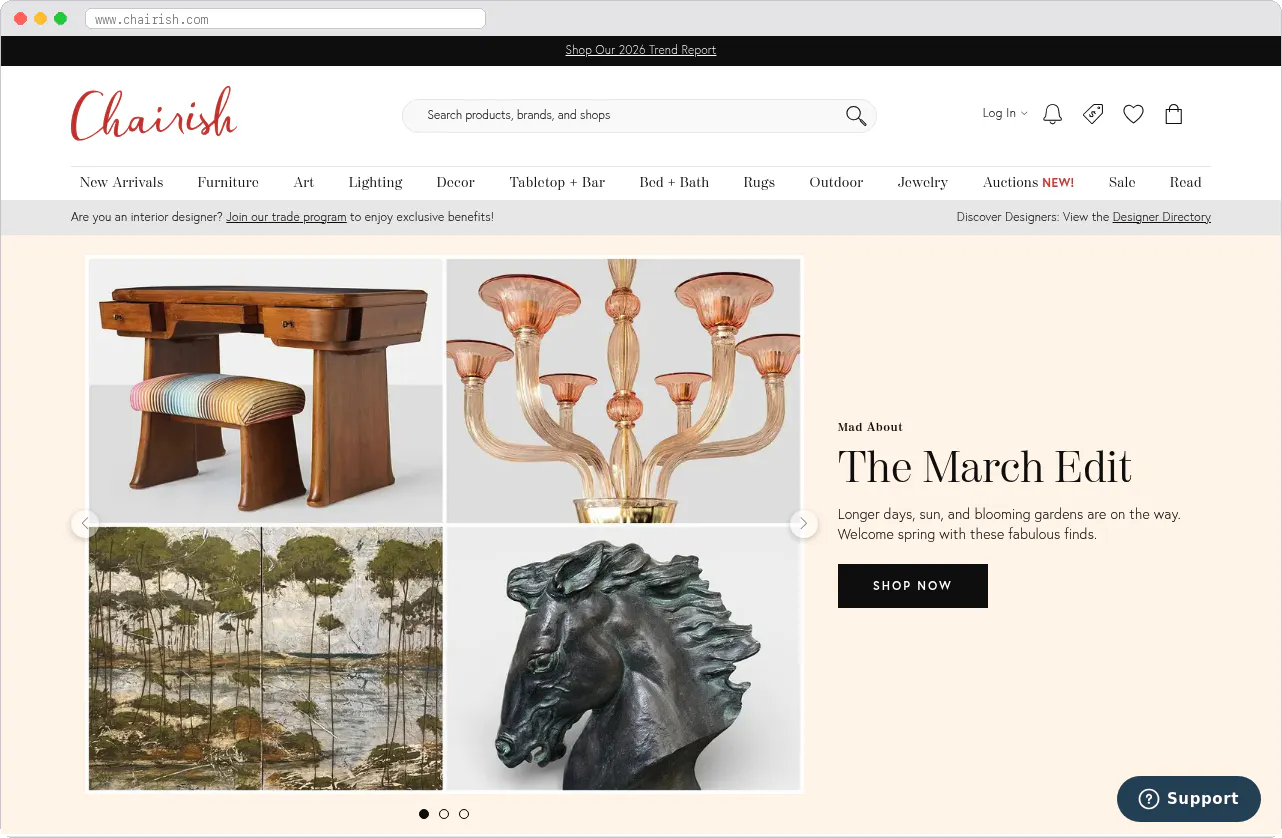
How Chairish's marketplace model works
Chairish operates as a curated consignment marketplace that bridges the gap between furniture sellers and design-conscious buyers. The platform's success stems from its ability to solve trust and quality problems that plague traditional secondhand furniture sales.
For sellers, Chairish offers a white-glove consignment experience. Sellers submit photos and descriptions of their pieces, which Chairish then reviews for quality and market appeal. Accepted items receive professional photography and detailed descriptions written by Chairish's team. The platform handles all aspects of the sale, including pricing recommendations, customer service, payment processing, and shipping coordination. When an item sells, Chairish takes a commission ranging from 20% to 40%, depending on the sale price and seller tier.
The seller experience removes most traditional barriers to furniture resale. Instead of dealing with unreliable buyers, lowball offers, or pickup coordination, sellers simply ship approved items to Chairish's warehouses or work with local white-glove pickup services. This model appeals particularly to busy professionals, estate administrators, and anyone looking to declutter high-value furniture without the hassles of traditional selling.
For buyers, Chairish functions as a curated discovery platform. The marketplace combines the treasure-hunt appeal of vintage shopping with the reliability and convenience of modern e-commerce. Buyers can search by style period, designer, material, color, and dozens of other filters to find exactly what they need. Each listing includes multiple high-resolution photos, detailed measurements, condition reports, and provenance information when available.
The buyer experience emphasizes trust and transparency. Professional photography shows items from multiple angles, including close-ups of any wear or damage. Detailed descriptions cover construction details, materials, and historical context. Customer reviews and seller ratings provide additional confidence. White-glove delivery services handle logistics for large items, while smaller pieces ship via traditional carriers with tracking and insurance.
Chairish's revenue model and monetization
Chairish generates revenue primarily through commission fees on successfully completed transactions. The commission structure operates on a sliding scale, with higher-value items generating lower percentage commissions. For items under $2,500, Chairish typically takes 20-30% commission. For higher-value pieces, the commission drops to 15-20%. This structure incentivizes sellers to list valuable pieces while keeping the platform accessible for mid-range items.
The platform also generates revenue through premium services. White-glove delivery and pickup services include additional fees beyond standard shipping costs. Professional photography and styling services are available for sellers who want enhanced listings. The platform offers priority placement and featured listing options for sellers willing to pay additional marketing fees.
Subscription revenue forms another income stream. Chairish offers trade professionals a "Trade Program" with volume discounts, exclusive access to certain items, and expedited customer service for a monthly fee. This program targets interior designers, decorators, and other professionals who make frequent, high-value purchases.
Advertising and sponsored content provide supplementary revenue. The platform partners with furniture brands and design services for sponsored listings and editorial content. Chairish's blog and editorial section features sponsored design articles and product placements, using the platform's reputation as a tastemaker in the design community.
Essential features for building a furniture marketplace like Chairish
Building a successful furniture marketplace requires specific functionality tailored to the unique challenges of selling large, expensive, visual products online. Unlike product marketplaces that sell standardized items, furniture marketplaces must handle significant variability in size, condition, authenticity, and shipping requirements.
Advanced search and discovery features
Furniture buyers approach shopping differently than typical e-commerce customers. They often browse by room, style period, designer, or specific dimensions rather than brand or model. A Chairish-like platform needs sophisticated filtering options that reflect how people actually shop for furniture.
Search functionality must handle both specific queries ("Eames lounge chair") and exploratory browsing ("mid-century modern living room"). Visual search capabilities become particularly valuable, allowing users to upload photos and find similar pieces. Style tags, period classifications, and designer attributions require careful taxonomy development and consistent application across listings.
Dimension search proves critical for furniture marketplaces. Buyers need to filter by exact measurements, not just small/medium/large categories. The platform should allow searches like "dining tables 72-84 inches long" or "sofas under 80 inches wide." Room-specific browsing helps customers visualize how pieces fit their spaces and discover complementary items.
High-quality visual presentation
Furniture is an intensely visual product category where image quality directly impacts conversion rates. Professional photography becomes essential rather than optional. Listings need multiple angles, detail shots of construction and materials, and images that accurately represent color and condition.
Zoom functionality allows buyers to examine wood grain, fabric texture, and craftsmanship details that influence purchasing decisions. 360-degree product views help buyers understand proportions and visualize pieces in their spaces. Some platforms experiment with augmented reality features that let buyers virtually place furniture in their rooms using smartphone cameras.
Condition documentation requires particular attention in the vintage and pre-owned furniture market. Photos must clearly show any wear, damage, or restoration work. Standardized condition reports help buyers understand exactly what they're purchasing and reduce return rates.
Detailed product information architecture
Furniture listings require significantly more descriptive information than typical marketplace products. Beyond basic dimensions and materials, buyers need construction details, designer attribution, provenance information, and historical context.
Standardized fields help sellers provide complete information while maintaining consistency across listings. Material specifications, construction methods, and design period classifications need structured data entry rather than free-form text descriptions. This structure enables better search functionality while ensuring buyers receive the information they need for confident purchasing decisions.
Authenticity verification becomes crucial for designer and vintage pieces. The platform needs systems for documenting provenance, identifying reproductions, and flagging questionable attributions. This might involve expert review processes, documentation requirements, or partnerships with authentication services.
Specialized shipping and logistics
Furniture shipping presents unique challenges that standard e-commerce platforms aren't designed to handle. Large, heavy, fragile items require specialized carriers, custom packaging, and white-glove delivery services that include setup and assembly.
Shipping cost calculation becomes complex when dealing with oversized items. The platform needs integration with furniture-specific carriers who can provide accurate quotes based on dimensions, weight, delivery location, and service level. Some items require freight shipping, others need white-glove service, and smaller pieces can ship via standard carriers.
Delivery coordination requires more sophisticated logistics than typical e-commerce. Buyers need scheduling flexibility for large deliveries, and sellers need reliable pickup services. The platform should facilitate communication between all parties and provide tracking throughout the delivery process.
Trust and authentication systems
The high-value, unique nature of furniture marketplace transactions demands robust trust and authentication systems. Buyers spending thousands of dollars on vintage pieces need confidence in both seller reliability and item authenticity.
Seller verification goes beyond basic account creation. Successful furniture marketplaces often implement dealer networks, professional seller tiers, or invitation-only selling privileges. This curation helps maintain quality standards while reducing fraud risk.
Item authentication for designer and vintage pieces requires specialized expertise. Some platforms employ in-house experts, while others partner with authentication services or rely on seller credentials. Clear policies about authenticity disputes and return procedures help protect buyers while encouraging seller participation.
Building your furniture marketplace: a step-by-step approach
Creating a successful furniture marketplace like Chairish requires careful planning and execution across multiple dimensions. The furniture market's unique characteristics, high transaction values, shipping complexity, and authentication challenges, demand a more sophisticated approach than typical product marketplaces.
Step 1: Define your niche and target market
The furniture market is vast and segmented, making niche focus essential for new entrants. Chairish succeeded by targeting design-conscious consumers interested in vintage and pre-owned pieces, rather than competing directly with mass-market retailers like Wayfair or West Elm.
Consider specializing by furniture category, style period, price range, or geographic market. Some successful niches include mid-century modern furniture, antique pieces from specific periods, designer consignment, or locally-focused marketplaces that eliminate shipping challenges. A well-defined niche allows for targeted marketing, specialized expertise development, and clearer value propositions.
Market research should identify your target audience's current shopping behavior, pain points, and unmet needs. Interview potential buyers about their furniture shopping experiences, price sensitivity, and feature preferences. Survey potential sellers about their motivations, barriers to selling, and service expectations. This research informs product development and go-to-market strategy.
Step 2: Develop your business model and pricing strategy
Furniture marketplaces typically operate on commission-based models, but the specific structure significantly impacts both user acquisition and profitability. Chairish's tiered commission structure (higher commissions for lower-value items) reflects the reality that expensive pieces generate more profit margin while still providing attractive returns to sellers.
Consider alternative revenue models beyond pure commission. Subscription programs for professional buyers, premium listing fees for enhanced visibility, authentication services, and shipping partnerships can diversify revenue while adding value for users. Some platforms experiment with inventory purchasing for high-demand items, though this requires significant capital and market expertise.
Pricing strategy affects competitive positioning and user behavior. Lower commissions attract more sellers but require higher transaction volumes for profitability. Higher commissions enable better services but may drive sellers to competitors. Test different structures with early users to find the right balance for your market.
Step 3: Build essential marketplace functionality
Furniture marketplace development requires sophisticated features from day one, unlike simpler marketplaces that can launch with basic functionality. The high-value, complex nature of furniture transactions demands robust systems for product presentation, search, and trust.
Start with core marketplace functionality: user registration and profiles, listing creation and management, search and filtering, messaging between buyers and sellers, and basic payment processing. These features enable transactions but represent only the foundation for a furniture marketplace.
Add furniture-specific functionality early in development: detailed measurement fields, condition reporting systems, multiple image upload with zoom capabilities, style and period categorization, and shipping cost calculation tools. These features differentiate your platform from generic marketplaces and address furniture buyers' specific needs.
Step 4: Implement quality control and curation systems
Curation distinguishes successful furniture marketplaces from classified ad platforms. Chairish's growth came largely from buyers' trust in the platform's quality standards and authenticity verification. Implementing effective curation requires clear policies, consistent enforcement, and scalable review processes.
Develop listing guidelines that specify acceptable items, condition standards, photography requirements, and description completeness. Create review workflows that balance quality control with seller convenience. Consider implementing seller tiers or invitation-only programs to maintain standards while scaling supply.
Authentication policies become crucial for vintage and designer pieces. Decide whether to rely on seller representations, implement expert review processes, or partner with authentication services. Clear authenticity dispute resolution procedures protect buyers while encouraging seller participation.
Step 5: Launch with curated supply
Furniture marketplaces succeed when buyers find desirable items immediately upon visiting. Unlike marketplaces where empty categories are acceptable during early growth, furniture buyers expect robust inventory across their areas of interest. This requires careful supply-side launch planning.
Recruit initial sellers through targeted outreach to antique dealers, consignment shops, interior designers, and furniture enthusiasts. Estate sale companies represent particularly valuable early partners, as they handle high-quality inventory with motivated selling timelines. Local partnerships can provide immediate inventory while testing platform functionality.
Consider seeding inventory through direct acquisition for particularly attractive pieces. Some successful platforms purchase inventory for resale during early growth phases, though this requires capital and market expertise. This approach ensures quality control while providing immediate buying opportunities for early customers.
Competing in the furniture marketplace landscape
The online furniture marketplace space includes established players with different strategies, target audiences, and competitive advantages. Understanding these alternatives helps founders identify opportunities for differentiation and avoid head-to-head competition with well-funded incumbents.
Direct competitors to Chairish
1stDibs represents the luxury end of the vintage furniture market. Founded in 2001, the platform focuses on high-end antiques, fine art, and designer pieces with typical price points ranging from $1,000 to $50,000 or more. Unlike Chairish's broader appeal, 1stDibs targets serious collectors, museums, and wealthy individuals. The platform's seller network consists primarily of established antique dealers and galleries rather than individual consigners. This positioning creates opportunities for platforms targeting more accessible price points or broader style ranges.
Viyet attempted to compete directly with Chairish before shutting down in 2020. The platform offered similar curation and white-glove services but struggled to achieve sufficient scale and differentiation. Viyet's failure illustrates the challenges of competing without clear positioning advantages or unique value propositions. The platform's demise also demonstrates the importance of efficient operations and sustainable unit economics in the furniture marketplace space.
AptDeco focuses on local furniture marketplaces in major metropolitan areas. Rather than competing nationally, AptDeco operates city-specific platforms in New York, Los Angeles, and other major markets. This geographic focus enables faster delivery, lower shipping costs, and in-person inspection opportunities. The local approach represents a viable alternative for founders who prefer geographic depth over national breadth.
Broader marketplace alternatives
Facebook Marketplace has become a significant force in local furniture sales. The platform's massive user base and zero listing fees attract many furniture sellers, particularly for lower-value items. However, Facebook Marketplace lacks curation, professional photography, authentication, or quality guarantees. This creates opportunities for curated platforms to serve buyers willing to pay premiums for reliability and quality assurance.
eBay serves the vintage furniture market through both auction and fixed-price listings. The platform's established user base and payment systems provide significant advantages, but eBay lacks furniture-specific features like detailed dimension search, style categorization, or specialized shipping options. Many furniture sellers use eBay despite its limitations rather than because of its strengths.
Etsy attracts furniture makers and vintage sellers through its handmade and vintage positioning. The platform works well for smaller, shippable pieces but struggles with large furniture due to shipping complexity and limited specialized features. Etsy's fee structure and search algorithm changes have also frustrated many furniture sellers, creating opportunities for dedicated furniture platforms.
Mass-market furniture retailers
Wayfair dominates online furniture retail through massive inventory and competitive pricing. However, Wayfair focuses primarily on new, mass-produced furniture rather than unique or vintage pieces. The platform's scale advantages are formidable for new furniture sales but less relevant for curated vintage marketplaces. Wayfair's customer service and quality control challenges also create differentiation opportunities for smaller, more curated platforms.
Overstock, World Market, and similar retailers compete on price and convenience for new furniture. These platforms don't directly compete with vintage-focused marketplaces but do compete for customers' furniture budgets. Understanding price sensitivity and value propositions helps furniture marketplace founders position their offerings appropriately.
Development approaches for furniture marketplace platforms
Building a furniture marketplace requires balancing sophisticated functionality with development speed and cost constraints. The complexity of furniture-specific features makes platform choice particularly important for founders without extensive technical backgrounds.
Custom development from scratch
Custom development provides maximum flexibility for furniture-specific features but requires significant time and capital investment. A basic furniture marketplace with essential functionality typically requires 6-12 months of development work and budgets starting around $100,000 for professional development.
The complexity stems from furniture marketplaces' unique requirements: sophisticated search and filtering systems, complex shipping cost calculations, multi-image upload and management, detailed product specification fields, and integration with specialized logistics providers. These features require custom development even when starting with general e-commerce platforms.
Custom development makes sense for well-funded startups with specific technical requirements or unique business model innovations. However, the opportunity cost of extended development timelines often outweighs the flexibility benefits for most furniture marketplace founders.
No-code and low-code solutions
No-code platforms like Bubble, Webflow, or Airtable can create basic marketplace functionality without programming skills. However, furniture marketplaces' complexity quickly exceeds most no-code platforms' capabilities. Sophisticated search features, shipping integrations, and payment processing often require custom development or third-party integrations.
No-code approaches work well for validating concepts, creating prototypes, or serving very specific local niches. They become problematic when scaling to larger user bases or adding furniture-specific functionality that generic platforms don't support.
The maintenance burden of complex no-code setups often exceeds founders' expectations. As feature requirements grow, the platform becomes increasingly difficult to modify or maintain without technical expertise.
Dedicated marketplace software solutions
Specialized marketplace software like Sharetribe addresses many furniture marketplace challenges through purpose-built features and integrations. These platforms include essential marketplace functionality while supporting customization for industry-specific needs.
Sharetribe enables furniture marketplace creation through built-in features like multi-image listings, detailed product specifications, location-based search, integrated payments with commission handling, and shipping cost calculation tools. The platform supports custom development for unique features while maintaining core marketplace functionality.
This approach allows faster time-to-market than custom development while providing more flexibility and scalability than no-code solutions. Founders can launch basic functionality quickly, then add custom features based on user feedback and market learning.
The trade-off involves less control over underlying architecture compared to custom development. However, most furniture marketplace founders benefit more from speed-to-market and proven functionality than from architectural control.
Costs and timeline considerations
Furniture marketplace development costs vary significantly based on approach, feature requirements, and quality expectations. Understanding realistic budgets and timelines helps founders choose appropriate development strategies.
Custom development budgets
Professional custom development for a furniture marketplace typically requires $50,000 to $100,000 for initial launch functionality. This budget includes user management, listing creation, search and filtering, payment processing, basic admin tools, and mobile-responsive design.
Furniture-specific features add significant complexity and cost. Advanced search with dimension filtering, multi-image management systems, shipping cost calculation, and logistics integrations can easily double development costs. Sophisticated curation tools, authentication features, and white-glove service coordination require additional investment.
Ongoing maintenance, hosting, and third-party service costs typically run $2,000 to $5,000 monthly for established platforms. These costs increase with user growth, transaction volume, and feature complexity.
Sharetribe development costs
Sharetribe enables furniture marketplace creation starting at $99 monthly for hosted solutions with basic customization capabilities. This includes essential marketplace functionality, payment processing, hosting, and maintenance.
Custom development on Sharetribe typically costs $10,000 to $50,000 for furniture-specific features like advanced search, specialized product fields, or logistics integrations. This represents significant savings compared to building from scratch while maintaining professional functionality and scalability.
The hosted nature of Sharetribe eliminates many ongoing technical costs, though transaction fees and third-party service costs still apply. This model provides predictable costs and eliminates the need for dedicated technical staff during early growth phases.
Timeline expectations
Custom development timelines for furniture marketplaces typically range from 6 to 18 months depending on feature complexity and team size. The sophisticated functionality required for furniture sales makes rapid development challenging even with experienced teams.
Sharetribe-based development can launch basic functionality within 2-4 weeks, with custom features typically requiring 4-12 weeks additional development. This dramatic timeline reduction allows faster market entry and earlier user feedback.
The iterative approach enabled by faster development often produces better final products than extended custom development cycles. Early user feedback informs feature prioritization and prevents building unnecessary functionality.
Launching and growing your furniture marketplace
Successful furniture marketplace launch requires careful coordination of supply acquisition, marketing, and operational systems. The high-value nature of furniture transactions makes trust and reliability essential from day one.
Supply-side launch strategy
Furniture marketplaces need substantial, high-quality inventory before attracting buyers. Unlike digital marketplaces where empty categories are temporarily acceptable, furniture buyers expect robust selection across their areas of interest.
Target initial sellers through existing furniture industry relationships: antique dealers, consignment shops, interior designers, estate sale companies, and furniture restoration specialists. These professional sellers provide reliable inventory and understand online selling requirements.
Offer attractive launch incentives like reduced commissions, free professional photography, or priority placement to encourage initial seller participation. However, avoid permanently unsustainable pricing that creates expectations for ongoing subsidies.
Consider geographic concentration for initial launch. Local focus reduces shipping complexity while enabling in-person seller relationships and buyer services. Chairish's San Francisco focus during early growth provided operational advantages that supported later national expansion.
Building buyer demand
Furniture marketplace marketing requires balancing broad awareness with targeted acquisition of high-value customers. The considered nature of furniture purchases means long sales cycles and multiple touchpoints before conversion.
Content marketing works particularly well for furniture marketplaces. Design inspiration, style guides, room makeover features, and furniture care tips attract engaged audiences while showcasing inventory. This approach builds brand authority while supporting SEO objectives.
Social media marketing, particularly visual platforms like Instagram and Pinterest, effectively showcases furniture inventory while building brand awareness. User-generated content from satisfied customers provides authentic social proof.
Paid advertising requires careful targeting due to furniture purchases' infrequent nature and high consideration requirements. Focus on high-intent keywords and demographics likely to purchase unique furniture rather than broad awareness campaigns.
Operational excellence requirements
Furniture marketplace operations involve more complexity than typical e-commerce platforms. Large, fragile, expensive items require specialized handling throughout the entire customer journey.
Shipping and logistics partnerships become crucial competitive advantages. Relationships with white-glove delivery services, specialized furniture carriers, and local logistics providers enable superior customer experiences while managing costs.
Customer service requirements exceed typical marketplace standards. Furniture buyers have many questions about dimensions, materials, condition, and compatibility. Sellers need support with photography, descriptions, and logistics coordination.
Quality control processes must scale with platform growth while maintaining standards. Develop systematic approaches to listing review, seller verification, and dispute resolution that work efficiently at volume.
Why Sharetribe works for furniture marketplaces
Sharetribe addresses many furniture marketplace challenges through purpose-built features and proven marketplace functionality. The platform's flexibility supports both rapid launch and long-term customization as businesses grow.
Built-in furniture marketplace features
Sharetribe includes essential furniture marketplace functionality without custom development: multi-image product listings with zoom capabilities, detailed product specification fields, location-based search and filtering, integrated payment processing with commission handling, and mobile-responsive design optimized for visual products.
The platform's search and filtering capabilities support furniture-specific needs like dimension ranges, material types, style categories, and price ranges. Custom fields enable detailed product specifications while maintaining structured data for better search functionality.
Transaction management handles the complexity of furniture sales including delayed payments, commission calculations, and dispute resolution. These features are essential for furniture marketplaces but complex to build and maintain independently.
Customization capabilities for unique features
While Sharetribe provides essential marketplace functionality, most successful furniture platforms need unique features for competitive differentiation. The platform's API-first architecture supports custom development without rebuilding core functionality.
Common furniture marketplace customizations include advanced search interfaces, authentication and appraisal tools, specialized logistics integrations, white-glove service coordination, and custom seller onboarding workflows. These features can be built on Sharetribe's foundation rather than from scratch.
The platform's network of Expert developers provides access to specialists familiar with furniture marketplace requirements. This reduces the risk and cost of custom development while ensuring compatibility with core platform functionality.
Operational advantages
Sharetribe's hosted infrastructure eliminates many operational burdens that distract founders from business development. The platform handles hosting, security, backups, updates, and basic maintenance, allowing founders to focus on user acquisition and market development.
Payment processing integration through Stripe Connect handles the complexity of marketplace transactions including commission splits, delayed payouts, and tax reporting. These features are essential for furniture marketplaces but technically complex to implement independently.
The platform's scalability supports growth from initial launch through substantial transaction volumes without requiring infrastructure changes or migrations. This eliminates technical scaling concerns while providing predictable cost structures.
Furniture marketplaces demand sophisticated functionality from day one, making platform choice particularly important for founder success. Sharetribe's combination of built-in features, customization capabilities, and operational support addresses these requirements while enabling rapid market entry and iterative improvement based on user feedback.
Frequently asked questions
How much does it cost to build a website like Chairish?
Building a furniture marketplace like Chairish costs $40,000-$120,000 for custom development, while using Sharetribe starts at $99/month with custom features typically costing $10,000-$50,000. The complexity of furniture-specific features like shipping calculators and authentication systems drives higher development costs than typical marketplaces.
What makes Chairish different from other furniture marketplaces?
Chairish differentiates itself through rigorous curation, professional photography, and white-glove consignment services. Unlike platforms like Facebook Marketplace or eBay, Chairish vets every item and provides detailed condition reports, making it a premium destination for vintage and designer furniture.
How does Chairish make money?
Chairish generates revenue through commission fees (20-40% depending on item value), premium services like white-glove delivery, professional photography, subscription programs for trade professionals, and advertising partnerships. The tiered commission structure encourages higher-value listings while maintaining accessibility.
What features are essential for a furniture marketplace?
Essential features include sophisticated search with dimension filtering, multi-image listings with zoom capabilities, detailed product specifications, shipping cost calculators, authentication systems, and specialized logistics integrations. Furniture marketplaces need more complex functionality than typical product marketplaces due to shipping challenges and authentication requirements.
Who are Chairish's main competitors?
Chairish competes with 1stDibs (luxury antiques), AptDeco (local markets), Facebook Marketplace (general furniture), and eBay (vintage items). Each platform serves different price points and audiences, with Chairish positioned between luxury platforms like 1stDibs and mass-market options like Facebook Marketplace.
How long does it take to build a furniture marketplace?
Custom development typically takes 6-18 months, while using Sharetribe can launch basic functionality in 2-4 weeks with custom features requiring 4-12 additional weeks. The faster timeline with marketplace software allows earlier user feedback and iterative improvement based on real market needs.
Start your 14-day free trial
Create a marketplace today!
- Launch quickly, without coding
- Extend infinitely
- Scale to any size
No credit card required