Marketplace mobile app: why, when, and how to build one
Offering a marketplace mobile app might feel like “table stakes” in 2026—but it isn’t. This article helps you decide if building one is the right call for your marketplace, and when is the best time to make the investment.
Published on
Last updated on


If you’re building a marketplace today, the question of a mobile app has likely come up. It’s easy to assume that because “everything has moved to mobile,” your marketplace should, too.
In reality, a marketplace mobile app can be the most impactful optimization a marketplace can make—or an expensive distraction.
Native apps take longer to build and cost more to maintain than web apps, which slows down iteration. For some marketplaces, that investment pays off many times over. For others, it adds complexity without meaningfully improving the bottom line. Which scenario is likelier in your situation depends on your marketplace concept, unique value proposition, target audience, and business lifecycle stage.
This article is written for marketplace founders at the idea, MVP, or early growth stage who want to make this decision deliberately. We’ll look at two different situations where this decision comes up:
- When marketplace founders should (and shouldn’t) choose a mobile-first approach from day one
- When founders with an existing, web-based business should (and shouldn’t) add a mobile app to their offering.
We’ll also walk through three different ways to build a marketplace mobile app that balance speed to market with flexibility and customizability.
- A mobile app isn’t a default requirement for marketplaces—even in 2026. For most concepts, starting web-first is still the safest and most flexible choice.
- A mobile-first approach makes sense when your core value depends on speed, frequency, or in-the-moment use, or when your users are primarily on mobile.
- Don't launch both a web app and a native mobile app from day one. Doing it usually slows learning and increases complexity without improving outcomes.
- Adding a mobile app tends to be most effective after you’ve validated your marketplace and reached initial liquidity, when conversion, retention, or re-engagement become the main bottlenecks.
- If you’re building with Sharetribe, you can choose between multiple mobile app approaches that balance speed, cost, and flexibility. For example, you can start with a wrapper to validate demand quickly and affordably without coding, and move toward more custom solutions like a mobile app template or full custom-development on top of Sharetribe's backend only if and when mobile proves to be a meaningful growth lever.
Mobile apps have clear advantages. They’re always within reach, load fast, and can use phone-native capabilities like the camera, location, and push notifications. It’s also true that over 60% of global internet traffic now occurs on mobile devices, creating real potential to reach more users effectively.
However, none of this means mobile first is the best strategy for all marketplaces. General benefits and traffic share say little about how your specific target users interact with your marketplace, what they’re trying to accomplish, and what interface best supports your unique value proposition.
So, when do the benefits of mobile align with what a marketplace is trying to achieve? There are several situations where a mobile-first strategy tends to work well:
- When your users are on the go
- One of your key value propositions is the ability to add images fast
- Your users have a high-frequency use case
- You rely on a mobile app as your main growth channel
- Your target users use the internet mostly on mobile
I’ll discuss these situations in more detail next.
In the following section, we’ll do the reverse and examine the situations where mobile first is usually the wrong call.
A mobile-first approach makes the most sense when users interact with the marketplace while on the move, away from a desk, or in time-constrained situations. In these cases, the core value of the marketplace depends on speed, immediacy, and extremely low UX friction—and a mobile interface is well-suited to deliver that value.
This is why on-demand marketplaces like Uber work almost exclusively through mobile apps. The need for a ride is immediate and time-sensitive, and often arises while the user is already on the go. And obviously, the drivers on the supply side aren’t wired to a desktop setup either, so they also need a mobile interface.
The same logic applies to marketplaces where:
- Users act while commuting, traveling, or standing somewhere
- Decisions are fast, simple, and relatively low-stakes
- Any added friction can realistically cost you a transaction
If you’re building an Uber competitor or a marketplace with a closely similar usage context, starting with a mobile interface is likely the right call.
A mobile-first approach can also make sense when a core part of your value proposition is how quickly sellers can create listings, especially if that process starts with taking photos.
Peer-to-peer second-hand fashion marketplaces are a well-known example. On platforms like Depop and Vinted, the key value proposition for customers is selection. To keep that selection abundant and fresh, supply creation needs to be as frictionless as possible. Ideally, sellers can easily list items the moment they decide to part with them, for example, while cleaning out their closet.
A mobile app is usually the easiest way to achieve this (though the flow can work pretty smoothly with a web app on mobile too, as we’ve frequently seen in Sharetribe-powered marketplaces).
The same logic sometimes appears in marketplaces focused on local goods, casual resale, and community-based exchanges—think OfferUp or Wallapop.
The shopping experience on these platforms also fits a mobile context well. Often, the customer interface is designed like a feed, with a social element like following your favorite sellers. Listings tend to be of relatively low value, so purchase decisions are often spontaneous and low-stakes.
Not all marketplaces in the same market category work like this, however. For example, Vestiaire Collective and Grailed operate in the same broad second-hand fashion market as Vinted and thrive on the browser.
Both also offer mobile apps today, but both were originally launched web-first and continue to offer equally polished user experiences on both interfaces.
These marketplaces focus on premium, luxury, or designer items. Their listings are of high value, which means buyers are more deliberate and require trust, authentication, and detailed information. As a result, these platforms continue to rely on web experiences that support longer sessions and careful comparison.
If your idea is closer to how users interact with Grailed or Vestiaire Collective, a web-first approach, followed by an app once you’ve validated your concept, could be a good idea. But if the emphasis on speed, spontaneity, and in-the-moment supply creation, a mobile-first approach can be a stronger fit.
If you expect your users to return to your marketplace weekly, daily, or multiple times per day, a mobile-first approach is a strong fit. When usage is regular, users will have a low tolerance for any friction, so the speed and convenience of mobile interfaces with saved logins, preferences, and push notifications can add significant value.
For example, ordering food or groceries is a repetitive task that can repeat multiple times per week, so marketplaces like Uber Eats, DoorDash, and Delivery Hero prioritize the mobile user experience. The same pattern could apply, for example, to high-frequency local services, short-term rentals, or marketplaces where users regularly monitor availability or prices.
Again, there’s a contrasting example in the same broad category: corporate catering marketplaces like ezCater are often web-first. Their orders are less frequent but high-value and require more planning and coordination, so the convenience offered by a mobile app is less important.
If you expect your users to primarily discover your marketplace through another app, it can make sense to also offer a mobile interface rather than sending users to a browser.
For example, social apps like Instagram are key growth channels for many fashion, health and wellness, and lifestyle marketplaces—though again, this depends more on your unique value proposition than market category.
If you know your target audience primarily uses smartphones, a mobile-first approach is probably the default.
This is common with younger audiences, but also in geographic markets like Sub-Saharan Africa or South or Southeast Asia, where smartphones are the main way people access the internet.
Despite the growing importance of mobile traffic in e-commerce, launching with a native mobile app isn’t the default choice for most marketplaces. Even today, most marketplaces start web first, and either remain that way or add a mobile app later.
This is especially true in situations where:
- You don't have a clear reason to go mobile first (web first is still the default)
- The advantages of a desptop UI benefit your users
- Your concept involves buying and selling digital files
- Your growth strategy relies on SEO or AEO
So the reason for going web first isn’t necessarily a lack of mobile usage. Most website and marketplace builders, including Sharetribe, offer interfaces that work just as well in mobile browsers as on desktops. So, a significant portion of users of “web-first” marketplaces might actually be accessing them through smartphones or tablets.
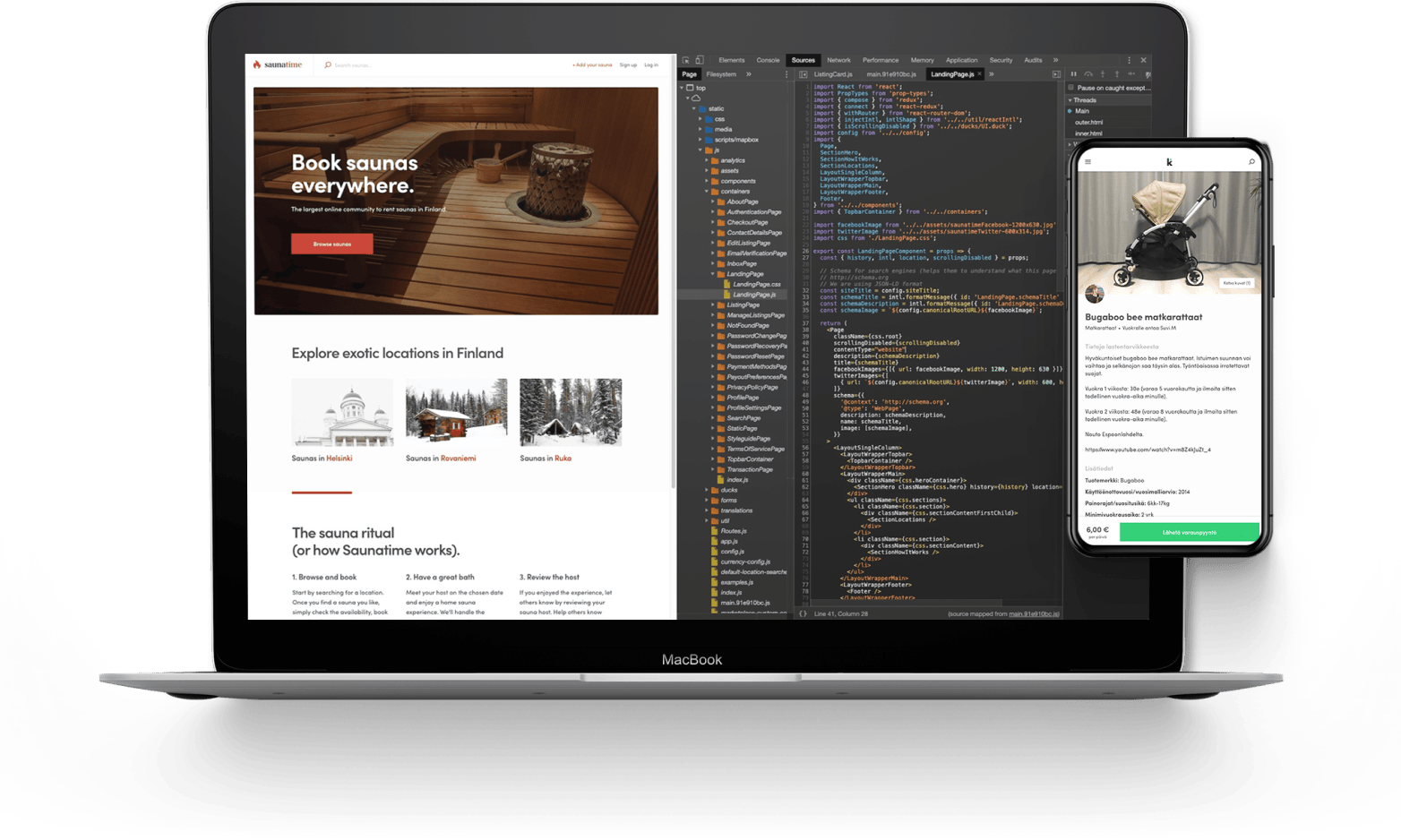
Instead, as we outlined in the previous chapter, the deciding factor is your value proposition and whether a mobile app or a web-based interface delivers it better. In this section, I’ll look at common situations where the balance tips in favor of a web app.
Even in 2026, the default strategy for launching a marketplace is to build a web app.
Starting with a website is the safest, cheapest, and most flexible choice. It’ll be faster and more affordable to launch and simpler to maintain. Crucially, it’ll also be much easier to iterate on because you only need to update one app and can publish changes immediately without waiting for Apple’s or Google Play’s review cycles.
These advantages matter a great deal in the early stages, when you’re still validating your marketplace concept and learning how users actually behave. In most cases, they’re worth more than the small UX improvements of a native app, especially if your website already works really well on a mobile browser.
This is why many marketplaces invest in a native mobile app only after they’ve reached product-market fit and identified clear areas where an app would improve their growth.
For many marketplaces, a website simply does a better job of supporting what your users are trying to accomplish. It often provides a nicer experience for tasks like:
- typing long descriptions or detailed requirements
- comparing multiple listings side by side or going back and forth between listings
- reviewing specifications, documents, or pricing carefully
- engaging in a transaction over multiple sessions
These are often required on marketplaces where purchases are high-value or otherwise high-stakes, such as the professional services marketplace Upwork, real-estate marketplace Zillow, and most B2B marketplaces regardless of category or marketplace type.
Another clear case where a web-first approach usually works well is on marketplaces focusing on digital assets like files, templates, datasets, documents, or other downloadable content.
For this type of marketplace, both the seller and buyer experience usually work better on desktop: tasks like uploading or downloading files, controlling versions, managing folders, previewing content, and moving the files to other tools are all easier and more reliable to perform in a browser.
If you’re planning to grow your audience through search engine optimization (SEO) or answer engine optimization (AEO), a website is a better foundation.
Growth through these channels relies on web-accessible content: listings, categories, user reviews, and other information-rich pages that can be crawled and indexed. In answer engines, in particular, listing and review content, not just blogs, could play a big role in discovery.
Native mobile apps don’t contribute meaningfully to SEO and are largely invisible to AI systems. If your users are likely to search for specific items, services, or categories online, starting mobile first could cut you off from a major growth channel.
In two-sided marketplaces, buyers and sellers might have very different needs and usage patterns. As a result, you might conclude that you need a web-first interface on one side and a mobile app on the other.
This could be the case for marketplaces like Airbnb or Etsy, where supply-side tasks are complex and infrequent, whereas buyers prefer to browse and message on mobile.
In this case, it’s usually best to default to a web interface first and add a mobile app for one or both user groups once you’ve learned more about how each user group behaves.
What you should not do is build and launch both a website and a mobile app simultaneously. More on this next.
In our experience, it’s almost never a good idea to launch a marketplace with both a web app and a native mobile app at the same time. Building and maintaining two interfaces from day one increases costs and complexity, slows your launch, and slows your learning.
However, once a marketplace is live and growing on the web, many founders start wondering whether adding a native mobile app is the right next step.
Next, let's look at the benefits a mobile app can bring to an existing marketplace, and the drawbacks to consider when making the decision.
In the right circumstances, adding a mobile app can be one of the highest-leverage investments a marketplace makes. Mobile apps can bring two clear benefits to your marketplace: improved conversions and improved discoverability.
Some users prefer the web, others prefer mobile. If a big portion of your audience is in the latter group, adding a mobile app can significantly improve conversions. One Sharetribe customer added a mobile app after being web-only for several years and saw a significant increase in bookings immediately afterward.
You can ask your audience if a mobile app would improve their experience. Sometimes, they may proactively tell you. You might also see usage patterns that suggest a mobile interface could improve the experience, such as:
- Strong repeat usage
- Transaction flows where responses and reactions are immediate
- Clear re-engagement opportunities where push notifications would help
A mobile app can also improve discoverability. Especially for consumer-facing marketplaces, the Apple App Store and Google Play Store can serve as complementary channels for user acquisition.
Despite the potential benefits, many founders choose not to add a mobile app to their marketplace or decide to postpone the decision. Their reasons typically fall into three categories:
- Cost
- Complexity
- Core value proposition
First, building a mobile app is a significant investment in time and money. The exact scope depends heavily on your tech stack: whether your marketplace is powered by an API or not, how much customization you need, and which platforms you want to support. Second, in addition to building the app, you’ll also need to maintain it: every new feature needs to be supported in web and mobile, which could double the work for future improvements.
The good news is that founders today have more options for building a mobile marketplace app that let them balance speed, cost, and customizability (more on this in the final section of this article).
The second challenge is the added complexity. Depending on your market and audience, you’ll probably want to support both major platforms, iOS and Android. Beyond building the apps themselves, you’ll need to plan for ongoing maintenance and updates. Every change to your marketplace will need to be implemented across multiple interfaces, and for the apps, pushed through the review and approval processes of both app stores.
Finally, and most importantly, some founders conclude they simply don’t need a mobile app to deliver their core value. After analyzing user behavior and market potential, they may find that the key actions on their marketplace work better on the web, or that their audience doesn’t show a strong preference for native apps.
Or they might conclude that, in their case, even their most optimistic estimates of the potential conversion and discoverability gains don’t outweigh the costs of building and maintaining a mobile app.
As a rule of thumb, it’s almost never a good idea to release both a marketplace website and a native mobile app during your initial launch. If you do, it likely means you’ve waited too long to launch.
Most web-based marketplaces add a mobile app as optimization after their core marketplaceconcept has been validated and they’ve reached initial liquidity—meaning they’ve reached problem-solution fit. At that point, the focus shifts to reaching product-market fit: increasing liquidity, purchase rate, and retention, and finding scalable user acquisition channels. Depending on your audience and value proposition, a mobile app can support all these goals.
That said, there are cases where the question needs to be addressed sooner. If, after launching your marketplace website, you quickly see clear signals that a mobile app would serve your audience much better, it makes sense to prioritize building it earlier. For example, you might discover that your audience is far more mobile-leaning than you initially assumed. This happened to a Sharetribe customer who, after launching their web app, quickly pivoted to mobile and eventually abandoned the web version because their success was clearly driven by mobile.
There’s also one important exception to the “don’t launch both first” rule: wrapper-based apps. If you use a lightweight wrapper to turn our existing marketplace website into a mobile app, the overhead of supporting both interfaces can be fairly low. Sharetribe has a pre-built integration with Twinr that lets you launch a native app version of your marketplace entirely without coding and manage both interfaces from the same place.
The wrapper approach can make sense when web remains your primary interface, but you also expect a meaningful share of users to engage with the native app (or want to validate demand for an app). Even then, it’s probably the best idea to do a soft “product launch” with just the web version, and have both interfaces ready by the time you start a bigger “marketing launch”.
Finally, let’s look at the reverse scenario: you chose a mobile-first approach for your initial launch and are now considering adding a web interface to support growth.
Usually, the same logic that applies to adding a mobile app to a web-first marketplace also applies here. Adding a website can be a great growth optimization tactic when your concept has been validated, and you’ve reached initial liquidity.
In some cases, the added growth potential is minimal. Marketplaces like Uber are fundamentally app-centric and will never need a fully functional marketplace website.
For most marketplaces, however, a website can support growth in several ways.
First, the web continues to be critical for discoverability. Discovery through Google and AI engines relies almost entirely on web-based content. It seems that having a well-structured marketplace website with rich listing, pricing, and review information can be particularly impactful for visibility in AI answers.
Second, if you already have a lightweight website (but not a marketplace web app) to build your brand and early SEO and AEO, adding the ability to sign up and book also through the web interface can improve conversions. Instead of sending visitors to an app store, you can guide them through the account creation and listing or buying process immediately.
Finally, if your mobile app was built on top of Sharetribe, adding a fully functional web interface requires minimal effort. In such a situation, the cost-benefit calculation tilts even more heavily in favor of adding a web app, even if the majority of your users would still primarily engage with your marketplace through the mobile app.
Today, there are many ways to build a mobile marketplace app.
Broadly speaking, the three best options are:
- Use a no-code wrapper to turn a web app into a mobile app
- Use a marketplace mobile app template
- Code a mobile app from scratch (entirely, or on top of an API).
Their key difference is how much you trade off speed for flexibility and customizability, and I’ll discuss the trade-offs of each approach next. Getting a high-level sense of your options early is a good idea, as they may affect your decision to build or postpone. Building an app from scratch only makes sense if you expect it to significantly contribute to your growth, whereas a wrapper-based approach can be so lightweight that achieving ROI is much easier.
(There are other ways to get a mobile marketplace app off the ground, including using general-purpose no-code tools or app builders or experimenting with AI-assisted “vibe coding.” These approaches can be useful for early experiments, especially in the mobile-first scenario. However, they tend to shift complexity into areas like security, payments, scalability, and long-term maintenance, so we can’t really recommend them to power a serious marketplace business.)
If you already have a marketplace website and want to turn it into a mobile app, a no-code wrapper is the fastest, lowest-risk option.
A mobile app wrapper converts your existing marketplace website into a mobile app by packaging it into a native shell that can be distributed through the Apple App Store and the Google Play Store.
From a user’s perspective, the result behaves just like a regular mobile app. But from a development perspective, the setup is much simpler to build, maintain, and update. You can continue to build and maintain your marketplace as a web app, and updates are automatically reflected in the mobile apps. Depending on the wrapper, you can also add selected native capabilities, such as push notifications.
The wrapper approach is a strong fit if:
- your marketplace website already works great in mobile browsers
- you want to test whether having an app improves conversion or retention
- you expect some users to look for you in app stores, but the largest part of your audience is well served by the web experience
For Sharetribe customers, this approach is supported through a pre-built integration with Twinr. It lets you launch a mobile app version of your marketplace entirely without coding and continue to manage your marketplace on both web and mobile from the same admin interface, Sharetribe Console. Sharetribe customers also get a lifetime 25% discount on all Twinr plans.
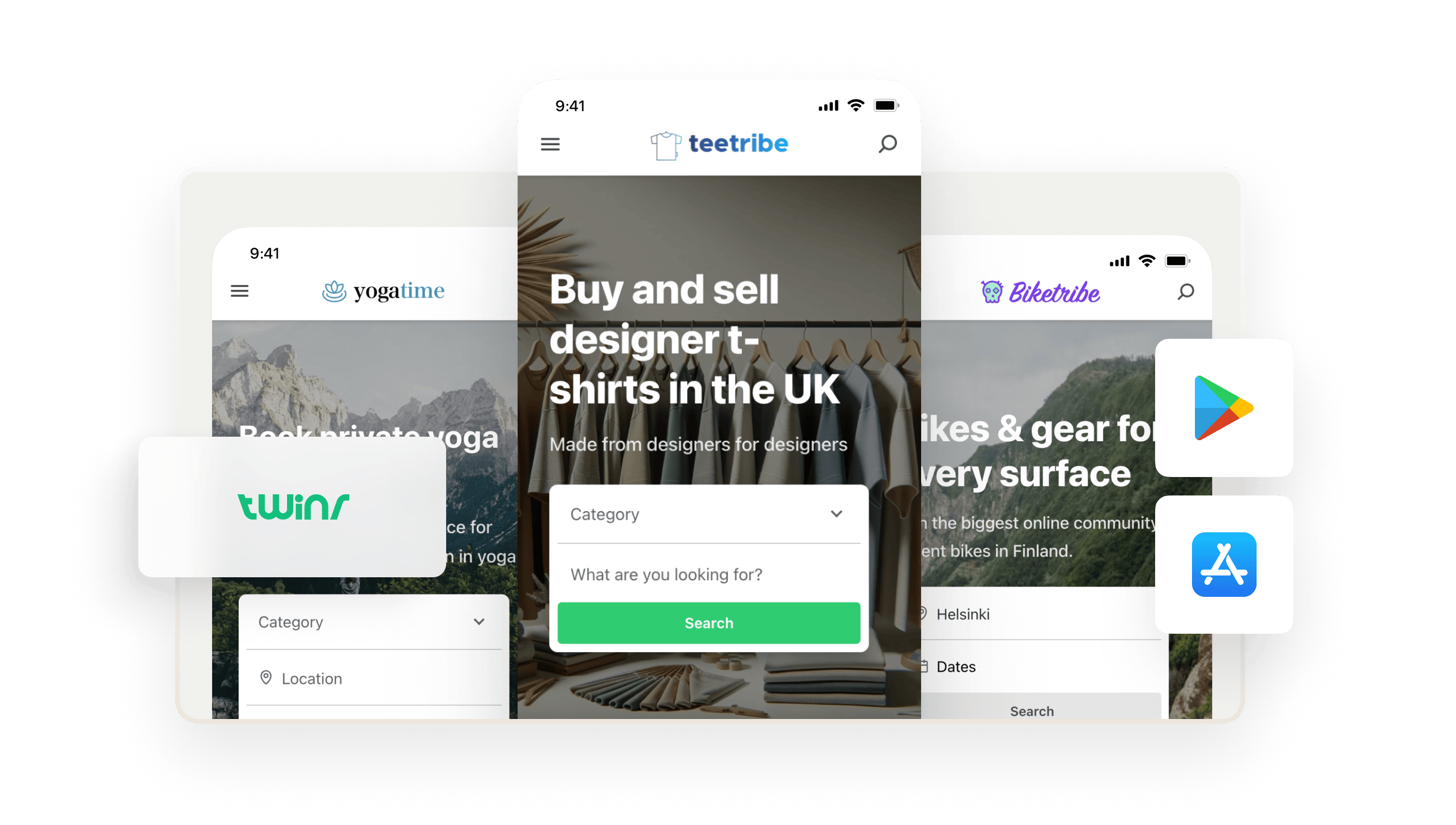
The main trade-off of the wrapper approach is limited customizability. If your app needs deep native interactions (such as real-time location tracking or biometric authentication) or highly customized mobile-only UI features, a wrapper might eventually become restrictive.
That said, reaching that point usually means you’ve validated the value of having a mobile app. At that stage, investing in a more custom solution is easier to justify and prioritize.
If you already know that a mobile app will be a core part of your marketplace experience and the wrapper approach doesn’t suffice, a customizable marketplace mobile app template can offer a strong balance between speed and flexibility.
With this approach, you don’t build the entire marketplace logic for mobile from scratch. Instead, you rely on Sharetribe as the backend for core functionality—users, listings, transactions, payments, and trust features—and use a pre-built native app template for the mobile interface.
On top of this setup, you can freely add your special sauce: designs, features, and workflows that reflect your unique value proposition. This lets you launch a native iOS or Android app much faster than a full custom build, and still get significantly more control than with the wrapper approach.
This option is a good fit if:
- you need mobile-specific features and workflows that differ from your web experience
- mobile is a core part of how users interact with your marketplace
- you have a clear idea of what your mobile app needs to do
Sharetribe supports this path through our partner, Journeyhorizon, which offers a native mobile app template built specifically for Sharetribe-powered marketplaces.
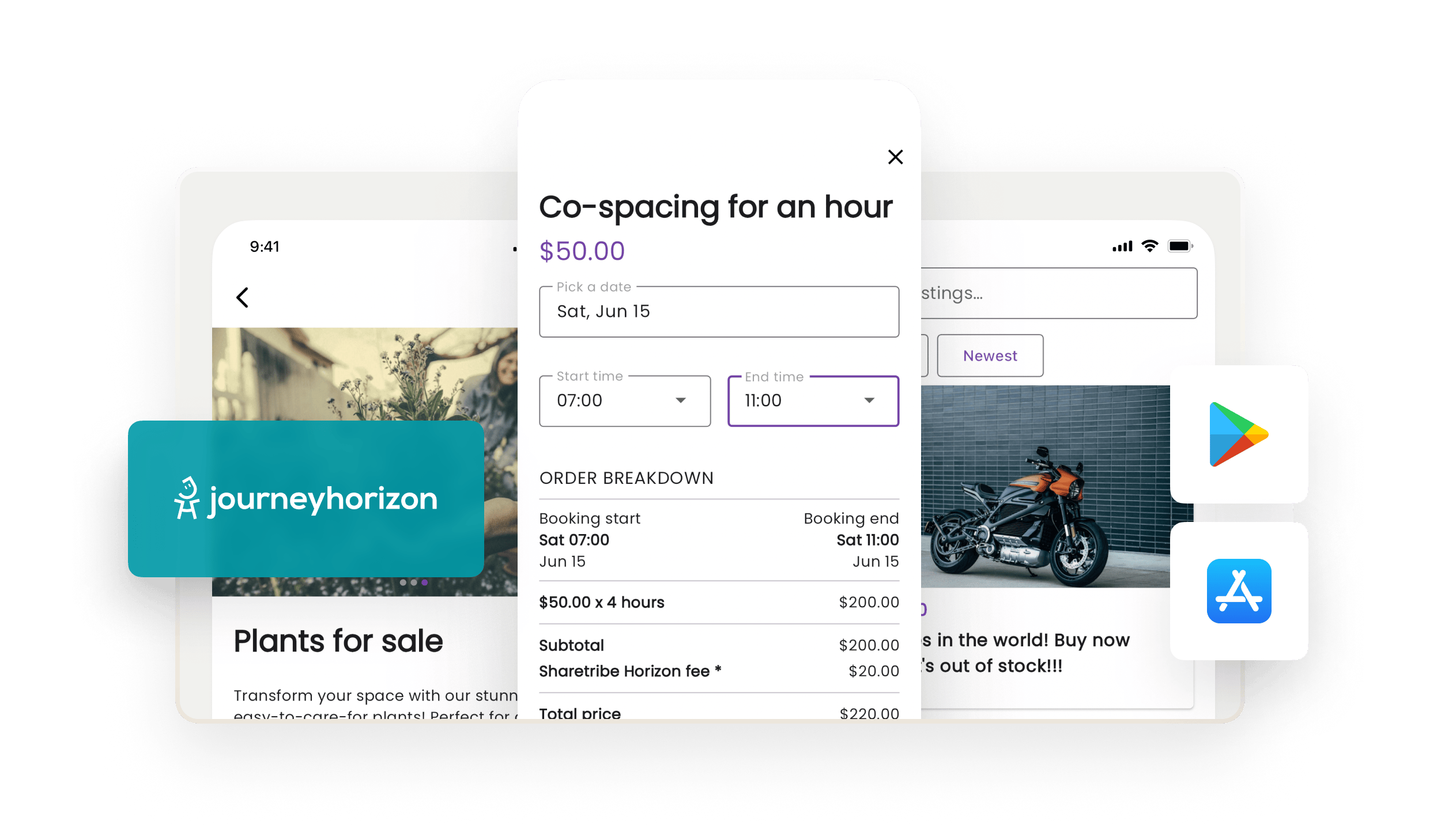
Compared to a wrapper, this approach requires more upfront investment. In return, you get a more native-feeling app and a stronger foundation if mobile becomes an important long-term growth channel for your marketplace. At the same time, it’s still less costly and risky than coding a fully custom app from scratch.
For maximum control and flexibility, there’s always the option to code a mobile marketplace app entirely from scratch. The trade-off is high cost, risk, and commitment.
However, Sharetribe can make this approach faster and more affordable. You can use Sharetribe as a headless backend and get all the marketplace essentials out of the box, and then build your fully custom mobile apps on top. Significant engineering effort is still required, but you can focus it on your unique mobile experience rather than building core marketplace fundamentals like users, listings, or availability management.
This approach is the best fit if:
- your marketplace relies on deep native interactions, real-time location tracking or biometric authentication
- your mobile UX is completely unique and central to your value proposition
- your marketplace workflows are complex or unusual
- your scale makes even small UX improvements very impactful
The trade-offs are significant with this approach: custom development is the slowest and most expensive, and the hardest to reverse. For that reason, a fully custom mobile app usually makes sense only after your marketplace model is well validated and you clearly understand the role of mobile in your growth strategy.
The main exception to this is if your entire concept is unique and the only way to test is to develop the custom features you need from the very first version. In that case, custom development might be your only option. Even then, using Sharetribe for the underlying marketplace logic and focusing your development effort on what’s truly unique can save months of work.
Some marketplaces benefit enormously from a mobile app, especially when usage is frequent, time-sensitive, or otherwise tied to mobile-native behavior. Others are better off on the web, where the experience is better suited for slower-paced processes that involve detail, comparison, and careful deliberation.
For most concepts, web-first is still the default, even in 2026. Web apps are easier to build and maintain, faster to iterate, and easier to discover—and all of this tends to matter much more in the early days than minor UX improvements.
You can also reach mobile users if your marketplace website works well in mobile browsers (as with Sharetribe, which offers a fully responsive marketplace website out of the box).
Whatever you do, don’t launch both a web app and a mobile app as the first thing your users see. Instead, choose which interface best serves your unique value proposition, validate your concept, and build initial liquidity. Then add another interface to support reaching the next stage.
How you build your app matters just as much as whether you build one at all. If you’re building your marketplace with Sharetribe, you have three strong options: turn your existing marketplace website into a native app using the pre-built integration with Twinr, launch a custom app quickly with the help of our partner Journeyhorizon’s marketplace mobile app template, or code an entirely custom frontend on top of Sharetribe’s backend.
Across all three options, you benefit from the same foundation: a marketplace backend that handles all the essential marketplace functionality out of the box, and a battle-tested infrastructure that keeps your marketplace fast, secure, and reliable at every scale.
It likely depends on your value proposition and whether you need an app to deliver it.
Good investors care most about traction, liquidity, and evidence of demand, not which interface you use to drive those dynamics. A web-first marketplace with strong growth and retention is usually more compelling than a marketplace with multiple interfaces but weak fundamentals.
That said, in categories where mobile usage is clearly core to the value proposition, such as on-demand, location-based, or high-frequency marketplaces, investors may expect to see a credible mobile strategy. Even then, that doesn’t always mean a fully custom app from day one. Showing that you understand when and why a mobile app matters is often enough.
Yes, and many successful marketplaces do, especially early on.
A well-designed mobile-responsive web app can support browsing, messaging, and transactions surprisingly well. For marketplaces where usage is infrequent, deliberate, or search-driven, a mobile web experience is often sufficient and far easier to iterate on.
Native mobile apps tend to become valuable when you want to improve repeat usage, re-engagement, or speed of interaction, not simply because users are on mobile devices.
It depends heavily on how you build it and how custom it needs to be. At a high level:
- Wrapper-based apps are the most affordable and fastest to launch (for example, with Twinr, you can turn a Sharetribe-powered marketplace website into a mobile marketplace app for just over $50/month)
- Template-based native apps require more upfront investment but offer greater flexibility (for example, Journeyhorizon's mobile app template starts from $199/month + a setup fee of $249)
- Fully custom apps are the most expensive and time-consuming, but offer maximum control (a budget of $10k–$20k is likely required for building a mobile app from scratch on top of Sharetribe's APIs. If you're not using Sharetribe and are also building the backend from scratch, the minimum budget will likely be at least $30–$50k, depending on the features you need.)
Beyond initial build costs, it’s important to account for ongoing maintenance, updates, and platform requirements. For many marketplaces, these long-term costs matter more than the first launch price.
It can in the right circumstances. Mobile apps tend to improve conversions when:
- users return frequently
- actions are time-sensitive or reactive
- push notifications help re-engage users at the right moment
- a meaningful share of your audience strongly prefers native apps
If your marketplace is primarily used for research, comparison, or infrequent purchases, a mobile app may not significantly outperform a well-designed web experience.
Definitely, and they do in many marketplaces.
Buyers and sellers often have very different needs. Sellers may prefer web interfaces for tasks like managing listings, pricing, or availability, while buyers may prefer mobile for browsing, messaging, or repeat interactions. With Sharetribe, you can connect both your website and mobile apps to the same backend and sync data seamlessly between the different interfaces.
More articles for you...

Marketplace SEO: the complete guide
Get a comprehensive introduction to the world of SEO, tailored specifically to online marketplaces.

The marketplace search engine: How to help your customers find what they’re looking for
Your success depends on demand finding its way to supply. Here’s how to make it happen.

AEO for marketplaces
AI can be a growth advantage for marketplaces. Learn how you can optimize your marketplace to appear in answer engines (AEO).
Start your 14-day free trial
Create a marketplace today!
- Launch quickly, without coding
- Extend infinitely
- Scale to any size
No credit card required