How to build a website like Instacart: complete guide to grocery delivery marketplaces
Instacart revolutionized grocery shopping by pairing customers with personal shoppers for same-day delivery. Learn how their three-sided marketplace model works, how they generate billions in revenue, and how to build a similar grocery delivery platform from scratch.
Published: Feb 23, 2026
Last updated: Mar 19, 2026
Instacart redefined grocery shopping by creating the first successful on-demand grocery delivery marketplace. Founded in 2012 by Apoorva Mehta, the platform links customers who want groceries delivered with personal shoppers who fulfill orders from local stores. By 2024, Instacart processes over $30 billion in gross merchandise value annually and operates across 14,000+ retail partner locations in North America.
The company's success stems from solving a fundamental problem: grocery shopping is time-consuming, but people need fresh food regularly. Unlike restaurant delivery services that partner with prepared food establishments, Instacart created a marketplace that turns any grocery store into a delivery-enabled business without requiring stores to build their own delivery infrastructure.
Building a marketplace like Instacart involves more complexity than typical two-sided platforms. It's actually a three-sided marketplace connecting customers, personal shoppers, and retail partners. This guide breaks down how Instacart's business model works, what makes it successful, and how you can build a similar grocery delivery marketplace.
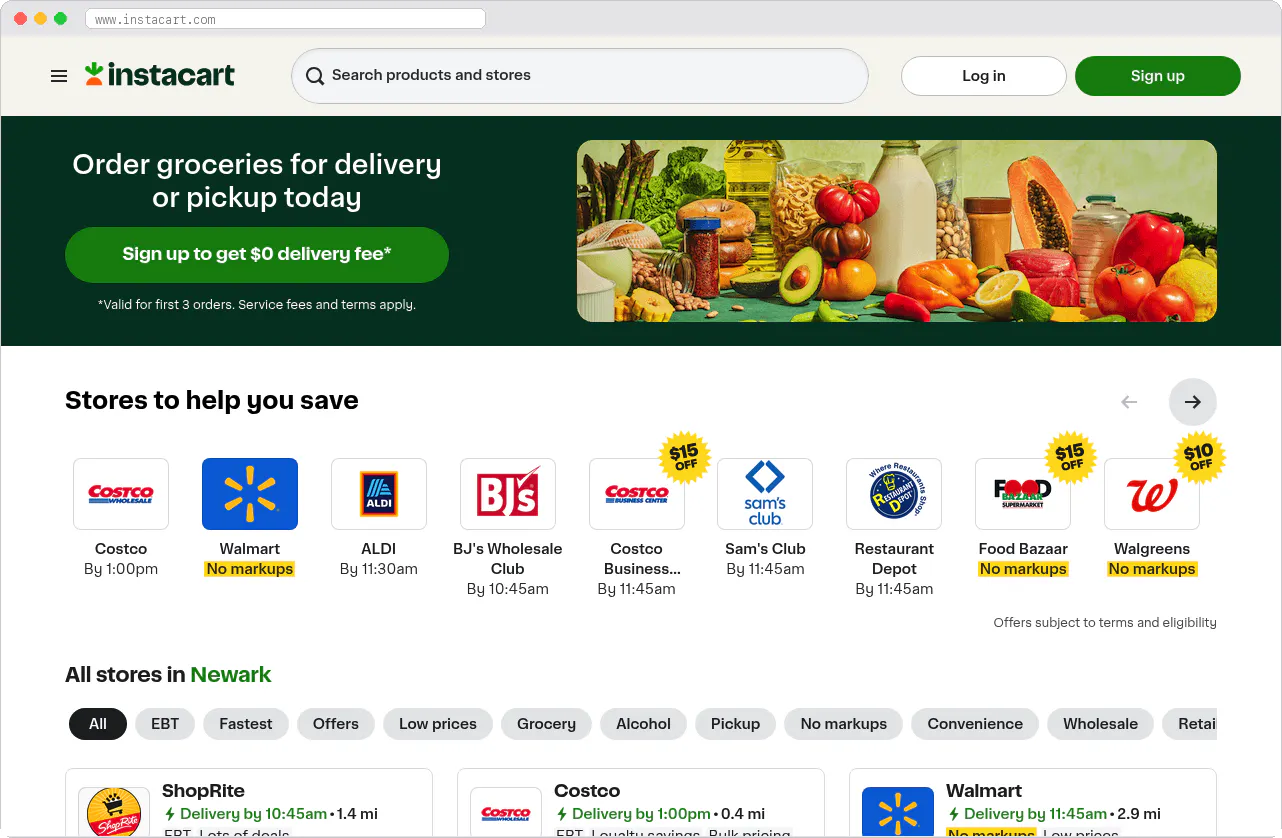
How does Instacart work?
Instacart operates as a three-sided marketplace that connects customers seeking grocery delivery, personal shoppers who fulfill orders, and retail partners who supply the products. This model creates value for all three parties while generating multiple revenue streams for the platform.
The customer experience
Customers browse products from local grocery stores through Instacart's website or mobile app. They can shop from multiple retailers including Costco, Kroger, Safeway, and specialty stores like Petco or Sephora. The platform displays real-time inventory, pricing, and delivery windows based on shopper availability and store hours.
When placing an order, customers select a delivery window (as soon as 30 minutes or scheduled up to a week in advance) and can communicate specific preferences like ripeness for produce or substitution preferences. They pay upfront through the platform, including product costs, delivery fees, service fees, and optional tips for shoppers.
The personal shopper side
Personal shoppers (called "Full Service Shoppers") are independent contractors who use the Instacart Shopper app to accept and fulfill orders. They receive batch assignments that may include multiple orders from the same store to maximize efficiency. The app provides optimized shopping lists, store maps, and navigation between locations.
Shoppers earn money through a combination of base pay (determined by factors like mileage, order complexity, and time), customer tips, and promotional bonuses during peak periods. They communicate with customers through the app's messaging system to confirm substitutions, report out-of-stock items, and provide delivery updates.
The retail partner integration
Instacart partners with grocery stores and retailers to offer their inventory through the platform. Retail partners provide product catalogs, pricing, and inventory data that Instacart synchronizes in real-time. Stores benefit from increased sales volume and customer reach without investing in delivery infrastructure.
The integration varies by retailer. Some partners like Costco have exclusive arrangements, while others work with multiple delivery platforms. Retail partners typically receive a portion of the service fees and may pay additional fees for premium placement or advertising within the platform.
Transaction flow and logistics
When a customer places an order, Instacart's algorithm assigns it to an available shopper based on location, order complexity, and shopper ratings. The shopper receives payment authorization and shops the order, scanning items to verify accuracy and communicating with the customer about any issues.
After completing the shop, the shopper delivers items to the customer's specified location. Payment processing happens automatically, with funds distributed to shoppers (minus Instacart's commission), retail partners receive payment for products sold, and Instacart retains its service fees and commission.
How does Instacart make money?
Instacart generates revenue through multiple streams that use its position as a marketplace facilitator. The company's business model centers on taking a percentage of every transaction while charging additional fees for premium services.
Service fees and delivery charges
Instacart charges customers several types of fees on each order. The standard delivery fee ranges from $3.99 to $7.99 depending on order size, timing, and demand. Service fees typically range from 5% to 10% of the order subtotal. During peak periods or in high-demand areas, the platform implements surge pricing that can increase these fees meaningfully.
The company also charges a small order fee (usually $2) for orders below a minimum threshold, encouraging larger basket sizes. These fees provide Instacart with immediate revenue on every transaction, regardless of the underlying product margins.
Instacart+ subscription revenue
The Instacart+ membership program costs $99 annually or $9.99 monthly and provides unlimited free delivery on orders over $35. Members also receive reduced service fees and exclusive promotions. This subscription model creates predictable recurring revenue while increasing customer lifetime value and order frequency.
By 2023, Instacart+ had attracted millions of subscribers who place orders more frequently and spend more per order than non-members. The subscription model helps offset customer acquisition costs and creates a loyal user base less sensitive to competitors' promotional pricing.
Retail partner revenue sharing
Instacart negotiates revenue-sharing agreements with retail partners, typically receiving 15-20% of the gross merchandise value from orders. This commission covers the platform's role in customer acquisition, order fulfillment coordination, and technology services.
Some retail partners pay higher rates for exclusive partnerships or premium placement within the app. For example, retailers can pay for priority positioning in search results or featured placement on the platform's homepage.
Advertising and promotional revenue
The platform generates substantial revenue from advertising, with retail partners and consumer brands paying for promoted placement. Instacart offers various advertising products including sponsored product listings, banner advertisements, and featured store placement.
Brands can also pay for sampling programs, coupon distribution, and targeted promotional campaigns based on customer shopping history and preferences. This advertising revenue has become more important as Instacart has built detailed customer data and shopping analytics.
Revenue scale and growth
Instacart went public in 2023 with annual revenues exceeding $3 billion. The company processes over $30 billion in gross merchandise value annually, with average order values ranging from $35-100 depending on the market and customer type. The platform's take rate (total revenue as a percentage of GMV) typically ranges from 8-12%, though this varies based on the mix of fees, commissions, and advertising revenue.
What makes Instacart successful?
Instacart's success results from several strategic advantages that competitors have struggled to replicate. The company built strong network effects, solved complex operational challenges, and established partnerships that create considerable barriers to entry.
Three-sided network effects
Instacart benefits from powerful network effects across all three sides of its marketplace. More customers attract more shoppers seeking earning opportunities, while more shoppers enable faster delivery times that attract more customers. Meanwhile, more customers and faster delivery capabilities make the platform more attractive to retail partners.
This creates a self-reinforcing cycle where growth on one side of the marketplace strengthens the entire ecosystem. Competitors must achieve critical mass across all three sides simultaneously, making it extremely difficult to compete in markets where Instacart is already established.
Operational complexity as a moat
Grocery delivery involves numerous operational challenges that Instacart has solved through years of iteration. The platform must coordinate real-time inventory across thousands of stores, optimize shopper routes for efficiency, handle perishable goods with varying quality standards, and manage complex substitution logic when items are unavailable.
Instacart's algorithms consider factors like store layout, shopper experience levels, traffic patterns, and historical demand to optimize order assignment and routing. This operational sophistication becomes a meaningful competitive advantage as the complexity scales with market size.
Strategic retail partnerships
Instacart has established exclusive or preferred partnerships with major grocery chains that limit competitors' access to key inventory sources. These partnerships often include revenue guarantees, marketing support, and integration commitments that make switching costs high for both Instacart and its retail partners.
The company also invested heavily in retailer-specific integrations, customizing its platform to work with each partner's existing systems, pricing structures, and inventory management processes. This creates operational dependencies that strengthen partnership relationships.
Data advantages and personalization
Instacart collects detailed data on customer shopping patterns, preferences, and behaviors that enables complex personalization and predictive analytics. The platform can predict when customers need to reorder specific items, suggest complementary products, and optimize inventory positioning based on local demand patterns.
This data also creates value for retail partners and consumer brands through analytics services and targeted advertising opportunities. The data network effects become stronger as more customers use the platform, creating insights that improve the experience for all users.
Geographic density and unit economics
Instacart achieved profitability by focusing on geographic density rather than broad expansion. The company concentrated on building strong market positions in specific metropolitan areas before expanding to new regions. This density approach improves unit economics by enabling shorter delivery distances, higher shopper utilization rates, and better inventory availability.
The platform's ability to batch multiple orders for the same shopper during a single store visit markedly improves economics compared to single-order deliveries. This operational efficiency becomes more pronounced in markets with high customer density.
Key features of an Instacart-like marketplace
Building a successful grocery delivery marketplace requires specific functionality that differs substantially from typical e-commerce or service platforms. The complexity stems from managing perishable inventory, real-time coordination between multiple parties, and variable logistics requirements.
Multi-store inventory management
A grocery delivery platform must aggregate and display inventory from multiple retail partners in real-time. This requires refined catalog management systems that can handle product variations, pricing differences, and availability across different stores and locations.
The system needs to account for product variations (different brands, sizes, and qualities of the same item), dynamic pricing that changes throughout the day, and real-time stock levels that update as shoppers fulfill orders. Integration with retail partners' point-of-sale systems enables automatic inventory updates and prevents overselling.
Intelligent order batching and routing
Efficient grocery delivery depends on optimizing how orders are grouped and routed to shoppers. The platform must consider factors like store locations, delivery addresses, order size and complexity, shopper capacity, and time windows to create efficient batches.
Advanced routing algorithms account for store layouts, parking availability, traffic patterns, and delivery preferences to minimize total fulfillment time. The system should also handle dynamic re-routing when orders are modified or cancelled during the shopping process.
Real-time communication and substitutions
Grocery shopping involves numerous decisions about product quality, substitutions, and special requests that require communication between shoppers and customers. The platform needs strong messaging functionality with photo sharing, barcode scanning, and structured substitution workflows.
Customers should be able to pre-approve substitution preferences, view photos of available alternatives, and communicate specific requirements for items like produce ripeness or meat cuts. The system must also handle time-sensitive communications when customers aren't immediately available to respond.
Quality control and rating systems
Grocery delivery success depends heavily on product quality, order accuracy, and delivery timeliness. The platform needs thorough rating systems that evaluate shoppers on multiple dimensions including product selection quality, communication, and delivery performance.
Customers should be able to rate individual items, report quality issues, and provide feedback on specific aspects of the shopping experience. This data feeds back into shopper training, quality improvement processes, and algorithmic assignment decisions.
Payment processing and fund distribution
Instacart-like platforms must handle complex payment flows that account for product costs, various fees, tips, and refunds across multiple parties. The system needs to process payments at order time but distribute funds to shoppers and retailers after successful delivery.
The platform must also handle refunds for damaged items, pricing adjustments for substitutions, and dynamic tip modifications. Integration with payment processors that support marketplace models is key for managing these complex financial flows.
Mobile-first shopper tools
Personal shoppers rely primarily on mobile apps that must function reliably in various store environments with potentially poor connectivity. The shopper app needs offline capabilities, optimized store navigation, barcode scanning, and efficient order management interfaces.
The app should provide guided shopping experiences with store maps, product location information, and step-by-step fulfillment workflows. Integration with store loyalty programs and payment systems can streamline the checkout process for shoppers.
Analytics and business intelligence
Successful grocery marketplaces generate extensive data that can be analyzed to improve operations, predict demand, and optimize pricing. The platform needs reliable analytics capabilities for tracking key metrics like order completion rates, shopper efficiency, customer satisfaction, and market penetration.
Retail partners and brands also value access to aggregated shopping data that provides insights into consumer behavior, product performance, and market trends. These analytics capabilities can become additional revenue streams through data licensing or advertising optimization services.
Competitors and alternatives
The grocery delivery market has attracted numerous competitors, each with different approaches to solving the same fundamental customer need. Understanding these alternatives provides insight into different business models and competitive strategies.
Amazon Fresh and Whole Foods delivery
Amazon operates its own grocery delivery service through Amazon Fresh and Whole Foods delivery, using its existing logistics infrastructure and Prime membership program. Unlike Instacart's marketplace model, Amazon controls the entire supply chain from warehouses to delivery drivers.
Amazon's approach offers more predictable inventory and faster delivery times in areas with fulfillment centers, but requires notably more capital investment and operational complexity. The company can offer competitive pricing by eliminating marketplace commissions, but has struggled to achieve profitability in grocery delivery due to high operational costs.
Amazon's integration with Prime creates powerful customer acquisition advantages, but the company has been selective about geographic expansion due to the challenging unit economics of grocery delivery.
DoorDash and Uber Eats grocery expansion
Originally focused on restaurant delivery, both DoorDash and Uber Eats have expanded into grocery delivery by partnering with local stores and chains. Their approach uses existing driver networks and customer bases but adapts restaurant delivery logistics to grocery fulfillment.
These platforms typically focus on convenience stores, pharmacies, and smaller grocery retailers rather than large supermarkets. Orders are generally fulfilled by store employees rather than dedicated shoppers, limiting the personal shopping experience but reducing operational complexity.
The expansion into grocery allows these companies to increase order frequency and average order values from existing customers, but they face challenges in handling the complexity of large grocery orders and perishable goods.
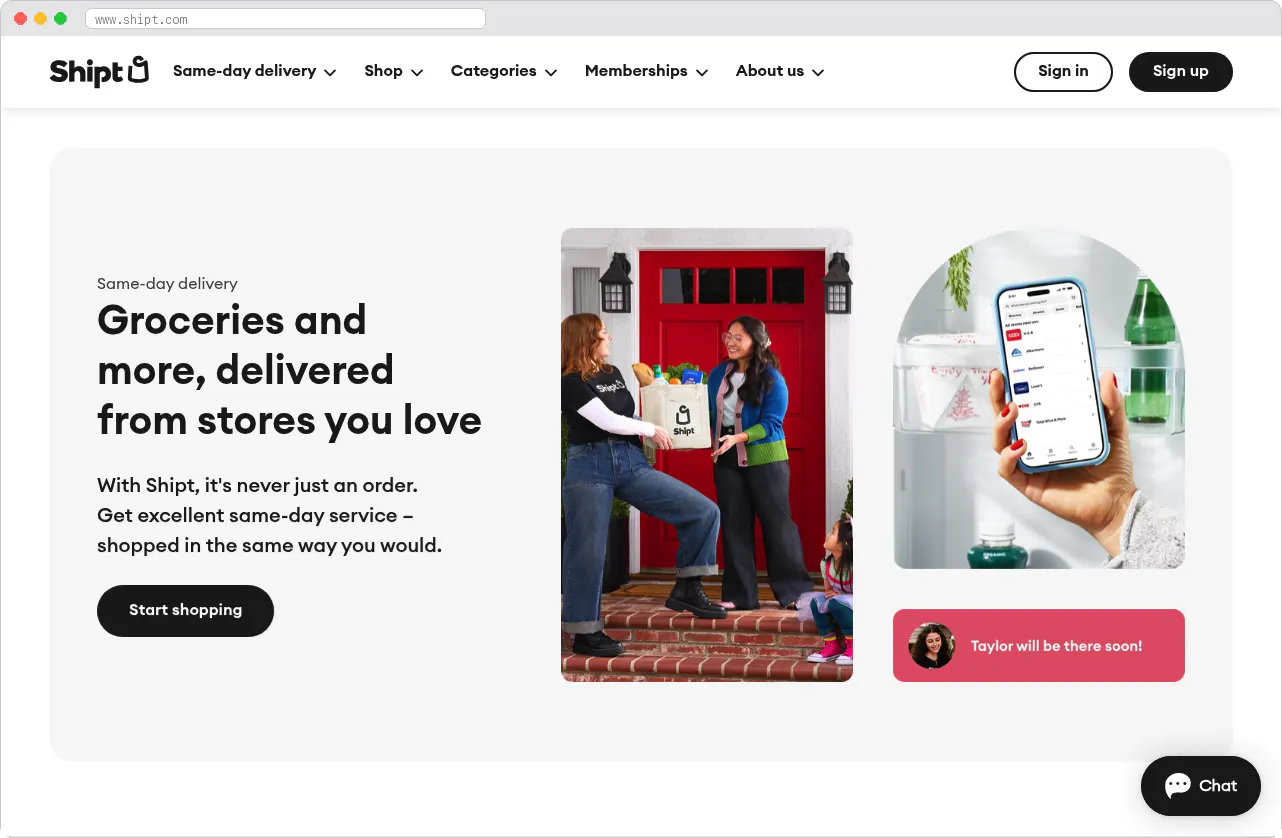
Shipt (owned by Target)
Shipt operates a similar personal shopper model to Instacart but focuses primarily on Target stores along with other retail partners. The platform was acquired by Target in 2017, giving it exclusive access to Target's inventory and customer base.
Shipt's integration with Target provides advantages in inventory accuracy and pricing consistency, but limits the platform's ability to offer selection across multiple retailers. The company has expanded partnerships with other chains but remains primarily focused on Target's ecosystem.
The Target ownership provides financial stability and customer acquisition advantages through Target Circle integration, but potentially limits the platform's appeal to customers who prefer shopping across multiple stores.
Regional and specialized competitors
Many regional players have emerged focusing on specific markets or customer segments. For example, FreshDirect operates its own fulfillment centers in New York and surrounding areas, while services like Thrive Market focus on organic and specialty products with a membership model.
These specialized competitors often provide superior customer experiences in their specific niches but lack the scale advantages and geographic reach of larger platforms. They typically succeed by focusing on underserved customer segments or geographic markets where larger competitors have limited presence.
Traditional grocery chains with delivery
Many established grocery chains have developed their own delivery services, either through internal operations or partnerships with third-party logistics providers. Examples include Kroger's delivery service and Walmart's grocery delivery program.
These retailers have advantages in inventory control, customer relationships, and operational integration, but often struggle with the technology platform development and logistics optimization that specialized delivery companies have mastered. Many eventually partner with or acquire technology platforms rather than building detailed solutions internally.
How to build a marketplace like Instacart
Creating a successful grocery delivery marketplace requires careful planning across multiple dimensions including market validation, technology development, operational setup, and partnership development. The complexity of the three-sided marketplace model makes thorough preparation essential.
Market research and validation
Begin by identifying underserved markets or customer segments where existing solutions have gaps. Instacart succeeded initially by focusing on San Francisco, where high income levels and limited parking made grocery delivery particularly valuable. Look for markets with similar characteristics: high population density, major commuting times, or demographics that value convenience services.
Conduct extensive customer research to understand shopping behaviors, pain points with existing options, and willingness to pay for delivery services. Survey potential customers about their grocery shopping frequency, typical order sizes, preferred delivery windows, and price sensitivity.
Simultaneously research the supply side by talking to potential shoppers about their interest in flexible earning opportunities and current gig work experiences. Understand what motivates them, their availability patterns, and their expectations for compensation and working conditions.
Retail partner development
Securing retail partnerships is often the most challenging aspect of launching a grocery delivery marketplace. Start by approaching smaller, independent grocery stores that may be more willing to experiment with new platforms. These partnerships can provide proof of concept before approaching larger chains.
Develop partnership proposals that clearly articulate the value proposition for retailers: increased sales volume, access to new customers, and enhanced competitive positioning without substantial upfront investment. Be prepared to offer flexible terms initially to prove the platform's value.
Consider starting with a limited number of retail partners to simplify operations and focus on perfecting the integration process. Successful partnerships with initial retailers become case studies for attracting additional partners.
Technology development priorities
Given the complexity of grocery delivery platforms, prioritize core features that enable basic marketplace functionality before building advanced optimization features. Essential first-version capabilities include user registration and profiles, basic product catalog display, simple order placement and payment processing, and basic communication tools.
Invest heavily in mobile app development since both customers and shoppers rely primarily on mobile interfaces. Ensure the shopper app works reliably in store environments with poor connectivity and provides efficient order management workflows.
Plan for integration complexity early by building flexible API architectures that can accommodate different retail partners' systems and data formats. Many startups underestimate the time required for retail system integrations.
Operational model design
Decide whether to focus on independent contractor shoppers (like Instacart) or employ shoppers directly. The contractor model offers more flexibility and lower fixed costs but requires careful compliance with labor regulations. Employee models provide more control over service quality but involve higher operational complexity.
Develop complete onboarding and training programs for shoppers, including product selection guidelines, customer communication protocols, and quality standards. Consider creating different shopper tiers based on experience and performance ratings.
Establish clear policies for handling common issues like out-of-stock items, product quality problems, delivery delays, and customer complaints. These operational procedures greatly impact customer satisfaction and repeat usage.
Geographic launch strategy
Start with a single metropolitan area where you can achieve density quickly rather than spreading resources across multiple markets. Focus on neighborhoods with favorable demographics and logistics characteristics: higher income levels, apartment buildings with easy delivery access, and proximity to multiple grocery stores.
Within your initial market, prioritize building supply density (shoppers) before investing heavily in customer acquisition. A platform with insufficient shoppers cannot provide reliable delivery times, leading to poor customer experiences and low retention rates.
Once you achieve sustainable unit economics and customer satisfaction in your initial market, expand to adjacent areas or similar metropolitan markets rather than jumping to completely different regions.
Customer acquisition and retention
Grocery delivery has high customer acquisition costs, so focus on strategies that encourage repeat usage rather than one-time trials. Develop referral programs, subscription models, and loyalty rewards that increase customer lifetime value.
Partner with retail partners on promotional campaigns that benefit both parties. Co-marketing initiatives can reduce customer acquisition costs while strengthening retailer relationships.
Invest in customer service capabilities that can handle complex issues like product quality problems, delivery issues, and billing questions. Superior customer service becomes a notable competitive differentiator in marketplace businesses.
Unit economics optimization
Carefully track key metrics including customer acquisition cost, average order value, order frequency, shopper utilization rates, and contribution margins. Grocery delivery typically has thin margins that require operational efficiency to achieve profitability.
Experiment with pricing strategies including delivery fees, service fees, and minimum order requirements to optimize the balance between customer acquisition and unit economics. Consider dynamic pricing during peak demand periods.
Focus on increasing order frequency and average order values through personalized recommendations, subscription services, and promotional strategies. Higher-frequency customers typically have better unit economics due to reduced acquisition costs.
Cost and development considerations
Building a grocery delivery marketplace involves considerable upfront investment and ongoing operational costs that vary depending on your chosen development approach and market scope. Understanding these costs helps in planning realistic budgets and funding requirements.
Custom development approach
Developing a grocery delivery platform from scratch typically requires 12-18 months and costs $200,000-500,000 for initial development. This includes building customer-facing web and mobile apps, shopper mobile applications, retailer integration systems, order management platforms, and payment processing infrastructure.
The complexity of grocery marketplaces drives higher development costs compared to simpler e-commerce platforms. Real-time inventory synchronization, complex routing algorithms, multi-party payment flows, and mobile app optimization for in-store use all require specialized development expertise.
Custom development provides maximum flexibility but requires ongoing maintenance costs of $20,000-50,000 monthly for server infrastructure, security updates, feature enhancements, and technical support. You'll also need to hire specialized developers familiar with marketplace architectures and mobile app development.
No-code and hybrid approaches
No-code marketplace platforms bring costs down to $99-399 per month in subscription fees, with no large upfront investment needed. Most no-code solutions aren't designed for the complexity of three-sided marketplaces with real-time inventory management.
A hybrid approach combining no-code tools for basic functionality with custom development for specialized features typically costs $75,000-150,000 initially. This approach can accelerate time to market while providing flexibility for unique requirements.
However, grocery delivery requires features like real-time GPS tracking, barcode scanning, complex substitution logic, and multi-store inventory management that are difficult to implement without meaningful custom development.
Third-party service integration costs
Grocery delivery platforms require numerous third-party services that add to operational costs. Payment processing typically costs 2.9% + $0.30 per transaction, plus additional fees for marketplace payment splitting. SMS and push notification services cost $0.01-0.05 per message.
Mapping and routing services like Google Maps charge based on API usage, typically costing $200-1,000 monthly depending on order volume. Background check services for shopper onboarding cost $10-25 per check.
Customer support tools, analytics platforms, and marketing automation services add another $500-2,000 monthly in recurring costs depending on user volume and feature requirements.
Operational cost considerations
Beyond technology development, grocery delivery marketplaces have major ongoing operational costs. Customer acquisition costs typically range from $20-50 per customer in competitive markets, requiring substantial marketing budgets.
Legal and compliance costs include business registration, insurance policies, terms of service development, and ongoing regulatory compliance. Budget $10,000-25,000 initially plus ongoing legal consultation costs.
Customer support becomes particularly important for grocery delivery due to the complexity of orders and time-sensitive nature of perishable goods. Plan for dedicated customer service staff or outsourced support services costing $3,000-8,000 monthly.
Scaling cost implications
As the platform grows, infrastructure costs scale with transaction volume but often benefit from economies of scale. However, geographic expansion requires market-specific investments in shopper recruitment, retailer partnership development, and local marketing.
Each new market typically requires $25,000-100,000 in expansion costs including local partnerships, regulatory compliance, marketing launch, and operational setup. Successful markets become profitable within 6-12 months, but initial expansion requires substantial capital.
Technology costs also scale with complexity as you add features like advanced analytics, machine learning optimization, and advanced fraud detection. Plan for increasing development costs as the platform matures and competitive pressures drive feature expansion.
Return on investment timeline
Most successful grocery delivery marketplaces require 2-4 years to achieve profitability due to high customer acquisition costs and complex operational requirements. Initial investors should expect notable cash requirements during the growth phase.
Unit economics typically improve over time as customer order frequency increases, operational efficiency improves, and market density enables better shopper utilization. However, expansion into new markets temporarily reduces profitability until those markets mature.
Successful platforms that achieve market leadership positions can generate attractive returns, but the path to profitability requires substantial patience and capital investment compared to simpler marketplace models.
Frequently asked questions
How does Instacart make money?
Instacart generates revenue through delivery fees ($3.99-$7.99), service fees (5-10% of order value), Instacart+ subscriptions ($99/year), commission from retail partners (15-20% of sales), and advertising revenue from brands and retailers.
What is Instacart's business model?
Instacart operates a three-sided marketplace connecting customers, personal shoppers, and retail partners. Customers order groceries, shoppers fulfill orders from partner stores, and Instacart facilitates payments while taking commissions and fees.
How much does it cost to build an app like Instacart?
Building from scratch costs $200,000-500,000+ and takes 12-18 months. No-code marketplace platforms ($99-399/month) let you launch the core marketplace model in weeks for under $5,000 in the first year. You won't replicate every feature of a billion-dollar platform, but you can validate whether the business model works in your market.
What features does an Instacart clone need?
Important features include real-time inventory management, order batching and routing, shopper-customer communication, multi-store catalogs, payment processing with fund distribution, mobile shopper apps, and quality rating systems.
Who are Instacart's main competitors?
Major competitors include Amazon Fresh, DoorDash grocery delivery, Uber Eats, Shipt (owned by Target), and regional services like FreshDirect. Each uses different approaches from marketplace models to direct fulfillment.
How long does it take to launch a grocery delivery marketplace?
Custom development requires 12-18 months minimum. No-code approaches can launch basic versions in 2-3 months, but grocery delivery complexity typically requires considerable custom development for full functionality.
Start your 14-day free trial
Create a marketplace today!
- Launch quickly, without coding
- Extend infinitely
- Scale to any size
No credit card required