How to build a website like Grubhub
Learn how to build a food delivery marketplace like Grubhub, from understanding their business model to launching your own platform. Includes feature requirements, costs, and step-by-step guidance.
Published: Mar 1, 2026
Last updated: Mar 19, 2026
Grubhub changed food delivery by matching hungry customers with local restaurants through a smooth digital platform. Founded in 2004 by Matt Maloney and Mike Evans in Chicago, what started as a solution for ordering takeout online has grown into a multi-billion dollar marketplace processing millions of orders annually.
Today, building a food delivery marketplace like Grubhub is more accessible than ever, thanks to modern development tools and established business model patterns. However, success requires understanding both the technical requirements and the complex three-sided dynamics between customers, restaurants, and delivery drivers.
This guide walks through Grubhub's business model, key features, and the practical steps to build your own food delivery marketplace.
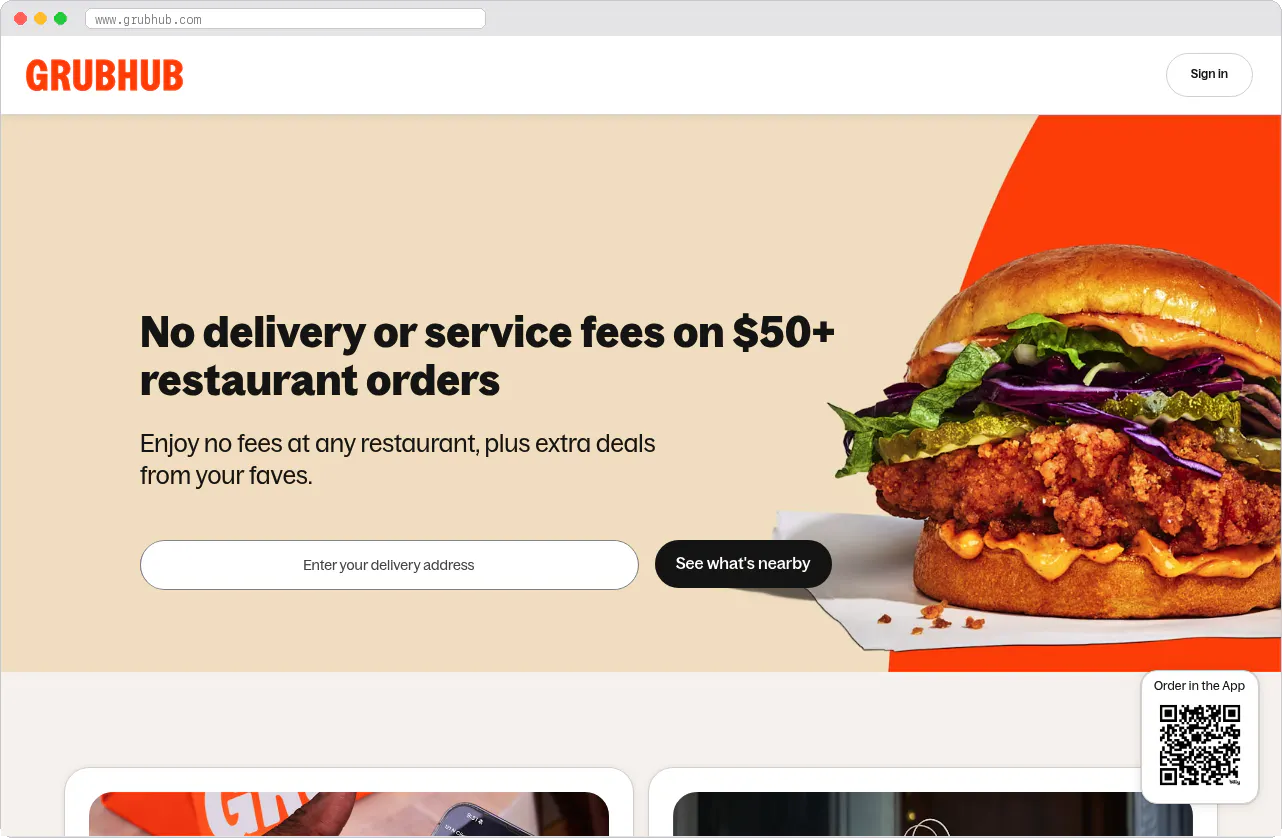
How does Grubhub work?
Grubhub operates as a three-sided marketplace connecting customers, restaurants, and delivery drivers (though some orders are picked up directly by customers). This model creates value for all participants while generating revenue through multiple streams.
The customer experience begins with browsing restaurants by location, cuisine type, or delivery time. Customers can filter by ratings, delivery fees, minimum order amounts, and estimated delivery times. After selecting items from a restaurant's menu, they proceed through checkout, pay online, and track their order in real-time until delivery.
Restaurants use Grubhub to expand their customer reach beyond walk-in traffic. They create digital storefronts with their full menus, set availability hours, manage inventory, and receive orders through Grubhub's restaurant dashboard or point-of-sale integration. Restaurants can either handle delivery themselves or rely on Grubhub's driver network.
Delivery drivers work as independent contractors, accepting delivery requests through a driver app. They can see order details, pickup locations, delivery addresses, and expected earnings before accepting. The app provides navigation and allows drivers to communicate with customers about delivery status.
The transaction flow follows this pattern: Customer places order → Restaurant receives and prepares order → Driver picks up and delivers (or customer picks up) → Payment is processed and distributed among all parties → Reviews and ratings are collected.
This three-sided model creates network effects where more customers attract more restaurants, more restaurants attract more customers, and sufficient order volume supports a reliable driver network.
How does Grubhub make money?
The Grubhub business model generates revenue through multiple channels, creating a diversified income stream that has proven highly scalable.
Commission fees represent the primary revenue source. Grubhub typically charges restaurants 15-30% commission on each order, with rates varying based on services provided. Restaurants using Grubhub's delivery service pay higher commissions than those handling their own delivery. This commission covers platform access, payment processing, customer acquisition, and (when applicable) delivery logistics.
Delivery fees are charged directly to customers, usually ranging from $1.99 to $4.99 depending on distance, demand, and restaurant policies. During peak times or bad weather, dynamic pricing may increase these fees. Some delivery fees go to drivers, while Grubhub retains a portion.
Service fees add another customer-facing charge, typically $1-3 per order. These fees help cover operational costs like customer support, platform maintenance, and marketing.
Grubhub+ is the company's subscription service, offering unlimited free delivery and exclusive discounts for $9.99 monthly. Subscription revenue provides predictable income while increasing customer lifetime value and order frequency.
Advertising revenue comes from restaurants paying for prominent placement in search results and promotional features. Restaurants can bid for top positions when customers search for specific cuisines or browse in their area.
Small order fees are charged when orders fall below restaurant minimums, encouraging larger order sizes while maintaining profitability on smaller transactions.
Grubhub's 2023 revenue was approximately $2.1 billion, demonstrating the scalability of this multi-revenue model. The company processes over 1 million orders daily across its network.
What makes Grubhub successful?
Grubhub's success stems from strategic decisions made during its early years and continuous adaptation to market changes.
First-mover advantage in online ordering gave Grubhub a important head start. When founded in 2004, most restaurants still relied on phone orders. Grubhub's founders recognized that consumers wanted the convenience of online ordering with transparent pricing and estimated delivery times. This early positioning allowed them to establish relationships with restaurants before competitors emerged.
Focus on suburban and mid-tier markets differentiated Grubhub from competitors initially targeting dense urban areas. While others fought for Manhattan and San Francisco, Grubhub expanded into smaller cities and suburban markets where they faced less competition and could build market dominance more easily.
Restaurant-first approach prioritized solving restaurant problems rather than just customer convenience. Grubhub's early platform included features restaurants actually needed: menu management, order tracking, customer data insights, and integration with existing POS systems. This focus created strong restaurant loyalty and reduced churn.
Technology infrastructure built for scale has allowed Grubhub to handle massive order volumes efficiently. Their platform manages complex logistics including real-time inventory updates, dynamic delivery time estimates, driver dispatch algorithms, and payment processing across thousands of simultaneous transactions.
Network effects create competitive moats. More customers attract more restaurants, which attracts more customers. Dense restaurant selection in each market improves customer experience while spreading customer acquisition costs across more transactions. This flywheel effect makes it difficult for new competitors to gain traction.
Data-driven optimization helps Grubhub continuously improve operations. They analyze customer preferences, restaurant performance, delivery times, and driver efficiency to optimize everything from search algorithms to delivery routes. This data advantage compounds over time.
Strategic acquisitions expanded Grubhub's market reach and capabilities. Key acquisitions included smooth (2013), which strengthened their position in New York, and various regional competitors that provided immediate market presence.
Key features of a Grubhub-like marketplace
Building a successful food delivery marketplace requires carefully designed features that serve all three user groups while enabling efficient operations.
Customer-facing features form the primary interaction layer:
- Location-based restaurant discovery with accurate delivery radius calculations and real-time availability. Customers enter their address and see only restaurants that can deliver to their location within reasonable timeframes.
- Advanced search and filtering allows customers to find restaurants by cuisine type, ratings, delivery time, price range, dietary restrictions, and promotional offers. Smart search algorithms can surface relevant results even with partial or misspelled queries.
- Real-time menu management displays current availability, pricing, and customization options. Menus must update instantly when restaurants mark items unavailable or adjust pricing.
- Shopping cart and checkout supports menu customization, special instructions, tip calculation, and multiple payment methods. The checkout process should be streamlined to reduce abandonment rates.
- Order tracking provides real-time updates from order confirmation through delivery. Customers can see when their order is being prepared, when the driver picks it up, and estimated delivery time with GPS tracking.
- Rating and review system allows customers to rate restaurants, food quality, and delivery experience. Reviews help other customers make informed decisions while providing feedback to restaurants.
Restaurant management features enable efficient order processing:
- Restaurant dashboard centralizes order management, menu editing, hours of operation, and performance analytics. Restaurant staff need to quickly view incoming orders, modify availability, and track daily sales.
- Menu builder with categories, item descriptions, pricing, photos, and customization options. Restaurants should be able to easily add seasonal items, adjust prices, and mark items as unavailable.
- Order management system displays incoming orders with preparation time estimates, special instructions, and customer contact information. Integration with existing POS systems streamlines operations for larger restaurants.
- Analytics and reporting show sales trends, popular items, customer ratings, and performance metrics. This data helps restaurants optimize their offerings and operations.
- Promotional tools let restaurants create discounts, featured items, and special offers to attract customers and increase order values.
Driver features support efficient delivery operations:
- Driver mobile app shows available delivery opportunities with pickup location, delivery address, estimated time, and payout. Drivers need to quickly evaluate and accept suitable orders.
- Navigation and route optimization provides turn-by-turn directions with traffic-aware routing. Multiple delivery optimization can increase driver earnings and reduce delivery times.
- Earnings tracking shows completed deliveries, tips received, and payment schedules. Transparent earnings information builds driver trust and satisfaction.
- Communication tools allow drivers to contact customers about delivery issues, access instructions, and update delivery status.
Administrative features enable platform management:
- Multi-sided user management handles customer accounts, restaurant onboarding, and driver verification. Admin tools should support bulk operations and detailed user analytics.
- Payment processing and disbursement manages complex money flows between customers, restaurants, drivers, and the platform. This includes commission calculation, tax handling, and payout scheduling.
- Geographic and logistics management defines delivery zones, calculates fees, and optimizes driver dispatch algorithms. These tools directly impact operational efficiency and customer satisfaction.
- Content moderation reviews restaurant listings, customer reviews, and reported issues. Maintaining platform quality requires efficient moderation workflows.
Technical infrastructure requirements support all user-facing features:
- Real-time notifications keep all parties informed of order status changes, new opportunities, and important updates across web and mobile platforms.
- Mobile-responsive design ensures excellent user experience across devices, with dedicated mobile apps for customers and drivers where needed.
- API integrations connect with payment processors, mapping services, SMS providers, and restaurant POS systems. Third-party integrations reduce development complexity while improving functionality.
- Scalable architecture handles traffic spikes during peak meal times without performance degradation. Load balancing and database optimization become key as order volume grows.
Competitors and alternatives
The food delivery marketplace has evolved into a competitive landscape with several major players, each taking different strategic approaches.
DoorDash emerged as Grubhub's primary competitor and eventually became the market leader in the United States. DoorDash differentiated itself through aggressive expansion into suburban and rural markets that other platforms initially ignored. Their "logistics-first" approach emphasized building a reliable delivery network rather than just connecting existing restaurants with customers. DoorDash also introduced innovations like "DashPass" subscription service and expanded beyond restaurant delivery into grocery and convenience items. Their marketplace model is nearly identical to Grubhub's, but they've achieved greater market penetration through targeted geographic expansion and driver incentives.
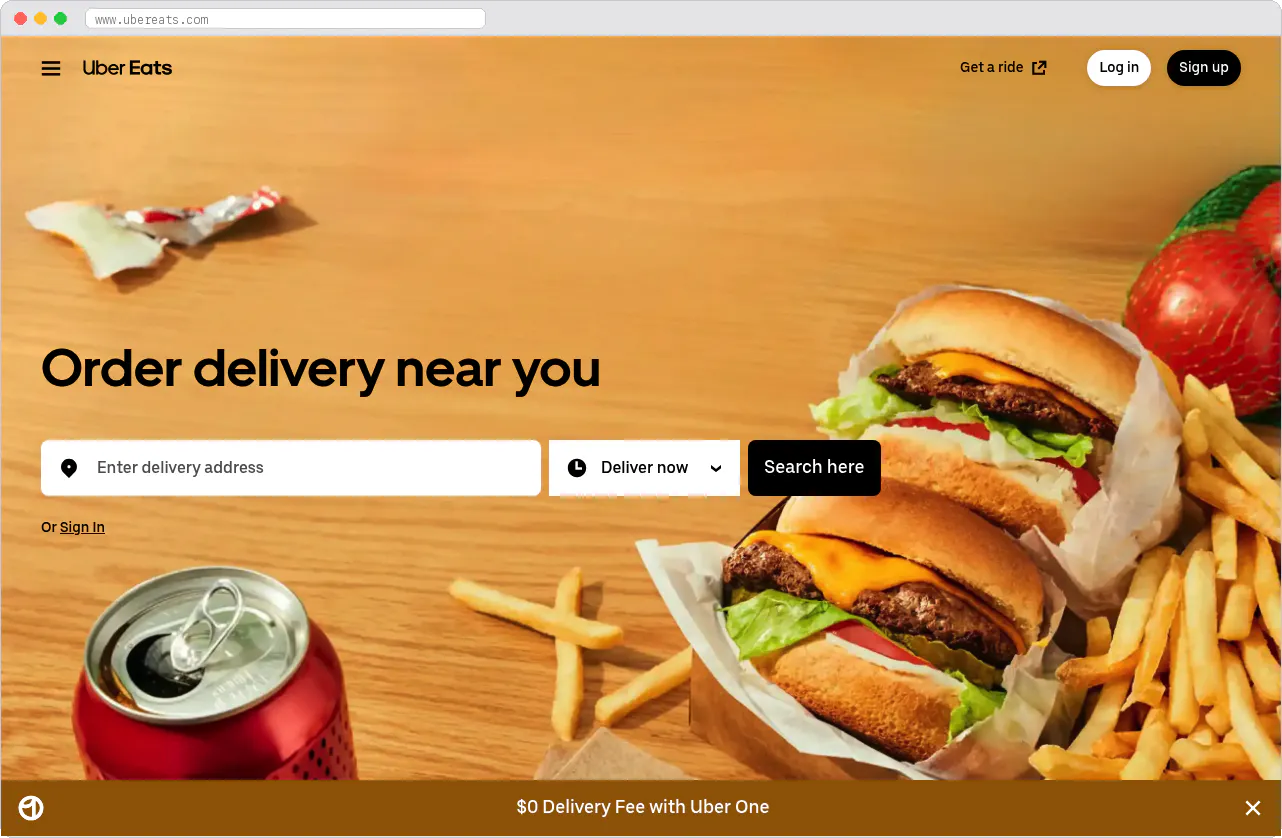
Uber Eats uses Uber's existing driver network and brand recognition to compete in food delivery. Their advantage lies in driver supply, since existing Uber drivers can easily switch between ride-sharing and food delivery based on demand. Uber Eats also benefits from Uber's technology infrastructure and international presence. However, their restaurant relationships are generally less developed than Grubhub's, and they've struggled with profitability in many markets. Their business model mirrors other delivery platforms but with lower customer acquisition costs due to cross-promotion with ride-sharing services.
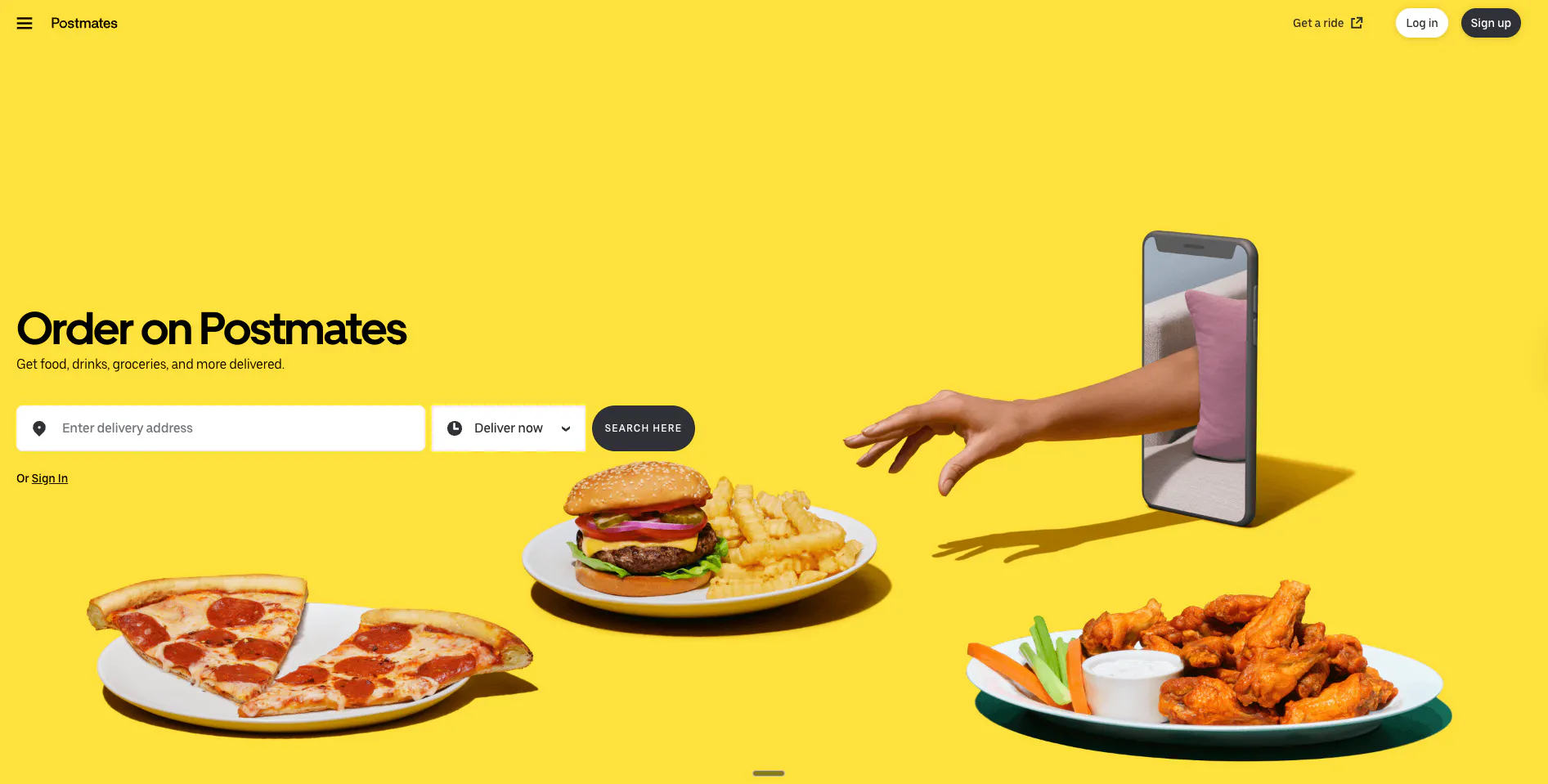
Postmates (now owned by Uber) built its platform around on-demand delivery from any restaurant, even those without existing delivery partnerships. Their "order anything" approach included restaurants that didn't typically offer delivery, with Postmates drivers placing orders in person. This model provided wider restaurant selection but often resulted in longer wait times and higher operational costs. Postmates also expanded into non-restaurant delivery like groceries and alcohol before being acquired.
Amazon's restaurant delivery services operate within their broader e-commerce ecosystem, using Prime membership and logistics capabilities. Amazon has tested various approaches including Amazon Restaurants (now discontinued) and partnerships with other delivery platforms. Their advantage lies in existing customer relationships and fulfillment infrastructure, but they've struggled to compete with specialized food delivery platforms that better understand restaurant operations and customer expectations.
Regional and niche competitors continue to emerge, often focusing on specific geographic areas or cuisine types. Some platforms specialize in healthy food, local restaurants, or specific dietary restrictions. These niche players can often provide better service within their focus areas but struggle to achieve the scale necessary for broad market penetration.
Each competitor faces the same fundamental challenges: achieving liquidity (sufficient restaurants and customers), maintaining unit economics, and building sustainable competitive advantages. Success often depends on execution quality, market timing, and the ability to efficiently balance supply and demand in specific geographic markets.
How to build a marketplace like Grubhub
Building a successful food delivery marketplace requires a systematic approach that addresses both technical development and business strategy. The process involves validating your concept, building core functionality, and scaling operations while managing complex three-sided marketplace dynamics.
Market research and validation should precede any technical development. Identify underserved geographic markets or customer segments where existing platforms have gaps. This might include suburban areas with limited delivery options, specific cuisine types, or restaurants frustrated with current platform terms. Talk directly with potential restaurant partners and customers to understand their specific pain points and willingness to try alternatives.
Successful food delivery marketplaces often start by focusing on specific niches rather than competing directly with established players. Consider targeting healthy food options, local farm-to-table restaurants, specific ethnic cuisines, or geographic areas ignored by major platforms. This focused approach allows you to build strong relationships and operational expertise before expanding.
Business model decisions shape your entire platform architecture. Determine your commission structure, delivery fee model, and additional revenue streams early in the planning process. Research local regulations around food delivery, driver employment classification, and sales tax collection. Some regions have implemented commission caps or specific requirements for delivery platforms that affect profitability.
Decide whether you'll handle delivery logistics yourself or allow restaurants to manage their own delivery. Building a driver network requires meaningful operational complexity but provides better customer experience and higher revenue potential. Restaurant-only delivery simplifies operations but limits your market to establishments with existing delivery capabilities.
Technical architecture planning requires understanding the complexity of three-sided marketplace dynamics. Your platform must handle real-time inventory updates from restaurants, dynamic delivery time calculations, driver dispatch optimization, and complex payment flows. Plan for peak load handling during meal rushes and consider how you'll scale geographically.
Choose between custom development, no-code platforms, or hybrid approaches based on your technical skills, budget, and timeline requirements. Custom development provides maximum flexibility but requires major time and resources. No-code platforms enable faster launch but may limit customization options as you scale.
Restaurant onboarding strategy often determines early success or failure. Develop relationships with restaurant owners and managers before launching your platform. Offer compelling value propositions like lower commission rates, better customer service, or marketing support. Create streamlined onboarding processes that minimize restaurant effort while ensuring menu accuracy and quality standards.
Consider starting with restaurants that already offer delivery but want additional distribution channels. These establishments understand delivery operations and can provide immediate supply for your marketplace. As you build customer demand, you can expand to restaurants new to delivery.
Customer acquisition in food delivery is expensive and competitive. Develop cost-effective strategies like local partnerships, social media marketing, and referral programs. Consider launching with promotional offers to attract initial customers, but ensure unit economics remain viable long-term.
Focus on geographic density rather than broad coverage. It's better to have full restaurant selection in a small area than sparse coverage across multiple markets. Dense coverage improves customer experience while reducing delivery logistics costs.
Driver recruitment and management presents ongoing challenges if you choose to handle delivery logistics. Develop competitive compensation structures, efficient onboarding processes, and tools that help drivers maximize their earnings. Consider partnerships with existing gig economy workers who already have transportation and experience with app-based work.
Implement driver verification processes, insurance requirements, and performance monitoring systems. Maintain adequate driver supply during peak hours while managing costs during slower periods.
Operational systems must handle the complexity of food delivery logistics. Develop processes for order management, customer service, restaurant support, and driver coordination. Create escalation procedures for common issues like late deliveries, order errors, and payment disputes.
Implement quality control measures including restaurant vetting, menu accuracy verification, and customer satisfaction monitoring. Poor experiences in food delivery spread quickly and can damage your platform's reputation permanently.
Legal and regulatory compliance varies considerably by location. Research requirements for business licensing, food handler permits, driver background checks, and sales tax collection. Some jurisdictions require specific insurance coverage or impose commission limits on delivery platforms.
Consult legal experts familiar with marketplace businesses and local regulations. Ensure your terms of service, privacy policies, and user agreements comply with applicable laws while protecting your business interests.
Performance monitoring and optimization should begin immediately after launch. Track key metrics including order volume, customer acquisition costs, restaurant satisfaction, delivery times, and unit economics. Use this data to identify improvement opportunities and make informed business decisions.
Implement A/B testing for user experience improvements, pricing strategies, and operational changes. Food delivery marketplaces generate substantial data that can drive optimization across all aspects of the business.
Geographic expansion requires careful planning and sufficient resources. Validate your business model thoroughly in your initial market before expanding. Develop standardized processes for market entry, restaurant recruitment, and customer acquisition that can be replicated efficiently.
Consider partnerships with local restaurant associations, food bloggers, or community organizations to accelerate expansion into new markets.
Cost and development considerations
Building a food delivery marketplace involves substantial upfront investment and ongoing operational costs. Understanding realistic budget requirements helps you plan appropriately and choose the right development approach.
Custom development costs for a full-featured food delivery platform typically range from $150,000 to $500,000 for initial development, depending on feature complexity and development team location. This includes customer web and mobile applications, restaurant management dashboard, driver mobile app, administrative backend, and basic operational tools.
Additional costs include payment processing integration ($10,000-25,000), mapping and navigation services ($5,000-15,000), real-time notification systems ($8,000-20,000), and third-party integrations for SMS, email, and analytics ($15,000-30,000). These estimates assume working with experienced developers familiar with marketplace architecture.
Ongoing development costs for feature additions, platform maintenance, and scaling support typically run $20,000-50,000 monthly for actively growing platforms. This includes bug fixes, performance optimization, new feature development, and security updates.
No-code and low-code solutions can considerably reduce initial development costs and time to market. These platforms provide pre-built marketplace functionality that can be customized for food delivery use cases. Subscription costs typically run $99-399 per month, with no large upfront fees for the platform itself.
No-code approaches allow faster testing and iteration but may require platform changes or custom development as your business scales. Consider the long-term implications of platform dependence when choosing this approach.
Infrastructure and operational costs scale with your platform usage and geographic coverage:
- Hosting and cloud services: $500-5,000 monthly depending on traffic volume and geographic distribution. Food delivery platforms require reliable performance during peak meal times.
- Payment processing: 2.9% + $0.30 per transaction for most providers, plus additional fees for international payments and complex marketplace disbursement.
- Third-party services: Mapping APIs ($200-2,000 monthly), SMS notifications ($100-1,000 monthly), email services ($50-500 monthly), and analytics tools ($100-1,000 monthly).
- Customer support: $3,000-15,000 monthly for staffing phone, chat, and email support during extended hours. Food delivery requires responsive customer service to handle time-sensitive issues.
- Legal and compliance: $2,000-10,000 monthly for ongoing legal support, contract reviews, and regulatory compliance across multiple jurisdictions.
Marketing and customer acquisition costs represent notable ongoing expenses. Food delivery platforms typically spend $15-50 per customer acquisition, with costs varying by market competitiveness and customer lifetime value. Restaurant acquisition costs range from $200-1,000 per restaurant depending on market conditions and onboarding incentives.
Plan for promotional spending including customer discounts, restaurant onboarding incentives, and driver recruitment bonuses. Initial market launch often requires $50,000-200,000 in promotional spending to achieve sufficient marketplace liquidity.
Working capital requirements include holding customer payments, managing driver payouts, and covering operational expenses during growth phases. Food delivery marketplaces typically need 30-90 days of operating expenses in working capital to handle payment timing differences and seasonal fluctuations.
Break-even considerations depend on achieving sufficient order volume to cover fixed costs while maintaining positive unit economics. Most successful food delivery platforms require 1,000-5,000 orders per month in each market to reach operational break-even, assuming average order values of $25-35 and commission rates of 15-25%.
Factor in customer acquisition payback periods of 6-18 months when planning cash flow requirements. Successful platforms often require 12-24 months to achieve consistent profitability in new markets.
Development timeline estimates vary notably by approach:
- Custom development: 8-18 months for full-featured platform with all three user interfaces and operational tools
- No-code platforms: 2-8 weeks for basic functionality, 2-6 months for full customization and launch
- Hybrid approach: 3-8 months combining no-code foundation with custom feature development
Consider opportunity costs when evaluating development approaches. Faster time to market allows earlier validation and revenue generation, which may offset higher platform costs in no-code solutions.
Budget for post-launch development including feature enhancements, performance optimization, and geographic expansion capabilities. Successful marketplaces continuously evolve their platforms based on user feedback and market opportunities.
Frequently asked questions
How does Grubhub's business model work?
Grubhub operates a three-sided marketplace connecting customers, restaurants, and delivery drivers. They generate revenue through restaurant commissions (15-30%), customer delivery fees ($1.99-4.99), service fees, subscription revenue from Grubhub+, and restaurant advertising.
How much does it cost to build a Grubhub clone?
Custom development of a platform this complex typically costs $150,000-500,000+ for the initial build, with $10,000-50,000 monthly in ongoing development. A no-code marketplace platform ($99-399/month) can replicate the core marketplace mechanics at a fraction of the cost, though highly specialized features like real-time tracking or complex algorithms may need custom work later.
What features are essential for a food delivery marketplace?
Must-have features include location-based restaurant discovery, real-time menu management, order tracking, payment processing, restaurant dashboard, driver dispatch system, rating/review system, and administrative tools for managing all three user groups.
How long does it take to build a food delivery app like Grubhub?
Development timelines range from 2-8 weeks using no-code platforms to 8-18 months for custom development. Hybrid approaches typically take 3-8 months, balancing speed and customization needs.
What makes food delivery marketplaces successful?
Success factors include achieving marketplace liquidity (balanced supply and demand), efficient logistics operations, strong restaurant relationships, competitive unit economics, and geographic density rather than broad coverage. Network effects and operational excellence are vital.
How do food delivery platforms compete with Grubhub and DoorDash?
New platforms typically succeed by focusing on underserved niches like specific cuisines, geographic areas, or customer segments. They may offer lower commission rates, better restaurant support, or specialized features that established players don't provide.
Start your 14-day free trial
Create a marketplace today!
- Launch quickly, without coding
- Extend infinitely
- Scale to any size
No credit card required