How to build a website like Fatllama (2026 guide)
Fatllama revolutionized peer-to-peer rentals by letting users rent everyday items from neighbors. This guide shows you how to build and launch your own rental marketplace, from validating your idea to scaling your platform.
Published: Aug 9, 2024
Last updated: Sep 11, 2026
What is Fatllama and how does it work?
Fatllama (styled Fat Llama) is a UK peer-to-peer rental marketplace that lets people rent out items they own but rarely use, such as cameras, power tools, camping gear, and party equipment, to people who need them temporarily. Founded in London in 2016 by Chaz Englander and Owen Turner, the platform built its reputation on solving a simple mismatch: a huge amount of household and professional equipment sits idle most of the time, while other people need occasional access to exactly those items.
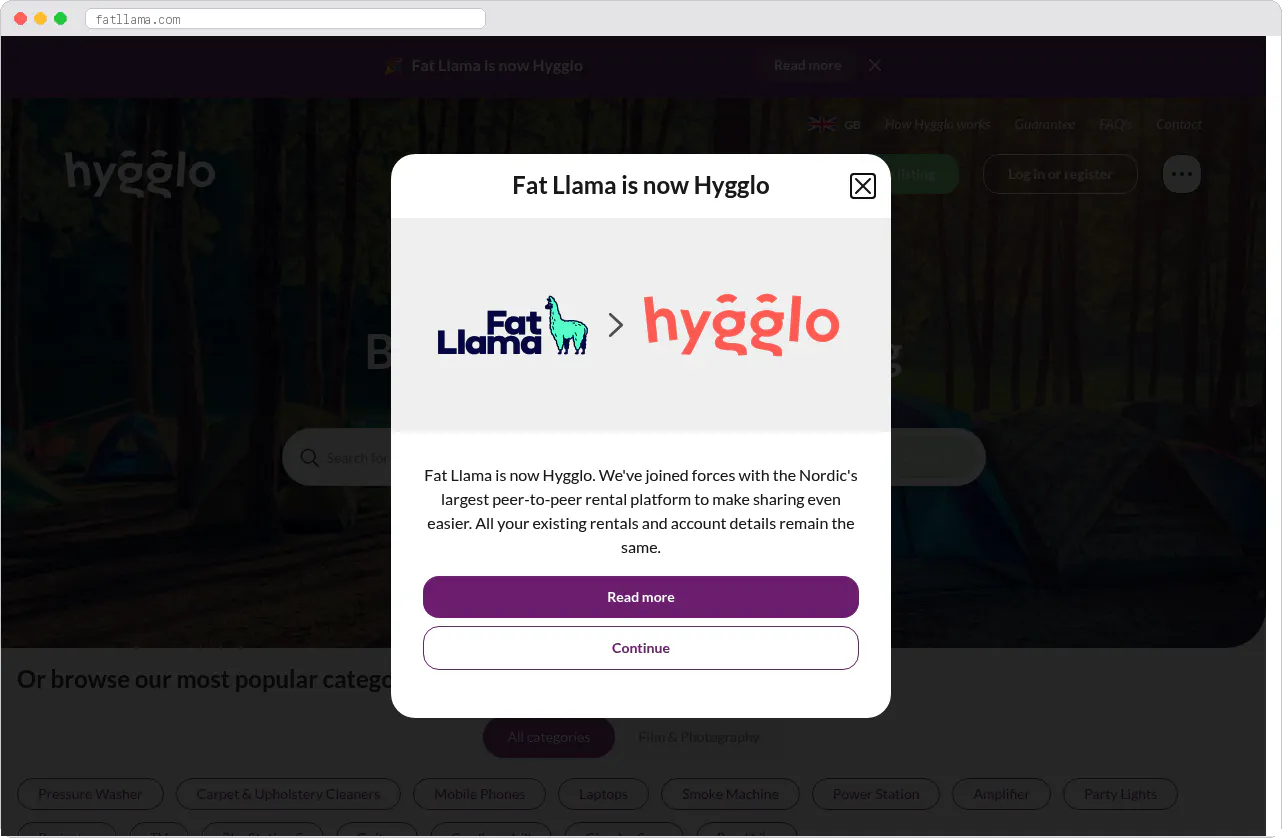
At its peak, Fat Llama built a UK peer-to-peer rental marketplace with a broad base of registered users and listings spanning dozens of categories, but Hygglo acquired the company in 2022 and retired the Fat Llama brand in November 2025 (circld.com). The company raised venture funding to expand this model and, like many peer-to-peer rental startups, has gone through periods of retrenchment as it worked to make unit economics sustainable. If you're researching Fatllama as a model to build from, verify its current operating status and scale directly, since peer-to-peer rental marketplaces are capital-intensive and several well-funded players in this space have scaled back or shut down entirely.
What hasn't changed is the underlying mechanic, and it's worth understanding closely because it's the part worth replicating. Lenders list items with photos, descriptions, and rental pricing. Renters search by location and category, message the owner to confirm details, and pay upfront through the platform. Funds sit in escrow until the item is returned in the agreed condition, at which point the lender gets paid out. That structure, not the brand, is the reusable part.
How Fatllama makes money
Fatllama no longer exists as an independent brand: it merged into Hygglo in November 2025, whose core revenue still comes from transaction commissions, now around 20% from lenders and 10% from renters (up to 25% for higher-risk categories like cameras), split between a service fee charged to renters and a commission taken from the lender's payout (Hygglo). This model only generates revenue when a rental actually completes, which keeps the platform's incentives aligned with getting matches right rather than just listing volume.
A second, less visible revenue lever is insurance. Fatllama built coverage into its platform for items up to a set value ceiling, protecting against theft, accidental damage, and malicious destruction. This coverage, typically underwritten through a third-party insurer, is what makes lending a $2,000 camera to a stranger feel reasonable rather than reckless. Insurance isn't free to provide, so it shapes commission structure. Higher-value categories usually carry higher effective take rates to cover the added risk and claims processing.
The commercial logic depends heavily on transaction density. A marketplace that takes 20% of a rental only works if enough rentals happen per lender to make listing worthwhile, and enough listings exist near each renter to make browsing worthwhile. This is why geography matters so much in this model: a platform with 10,000 listings spread across an entire country generates far less liquidity than one with 1,000 listings concentrated in a single city.
What makes Fatllama work: key features
Location-based discovery. Unlike e-commerce, rental transactions require the renter and the item to be physically close enough for pickup and return. Fatllama's search ranks results by distance first, shows exact or approximate pickup locations, and uses map-based browsing so users can judge convenience before messaging an owner.
Identity verification and trust signals. Lending a $1,500 drill press to a stranger requires more reassurance than buying a used book from one. Fatllama asks lenders and renters to verify identity with government ID, and it surfaces behavioral signals like response time, completed rental count, and review history directly on listings and profiles.
Availability calendars. Rental inventory isn't consumed the way products are; it cycles between "available" and "booked" continuously. Fatllama's calendar tools let lenders block dates, manage overlapping requests, and avoid the double-bookings that would otherwise wreck user trust quickly.
In-platform messaging. Renters and lenders need to coordinate pickup times, confirm item condition, and clarify usage rules before a transaction is final. Keeping that conversation inside the platform, rather than pushed to text or email, protects both the paper trail needed for disputes and the platform's ability to earn its commission.
Escrow-based payments. Renters pay when they book, but Fatllama doesn't release funds to the lender until the item comes back in the agreed condition. This single mechanism does more to make strangers comfortable transacting than almost any other feature on the platform.
Two-sided reviews. Both lenders and renters rate each other after a transaction, covering communication, punctuality, and item condition accuracy. Reputation accumulated this way becomes the main filter renters use to choose between similar listings.
The competitive landscape
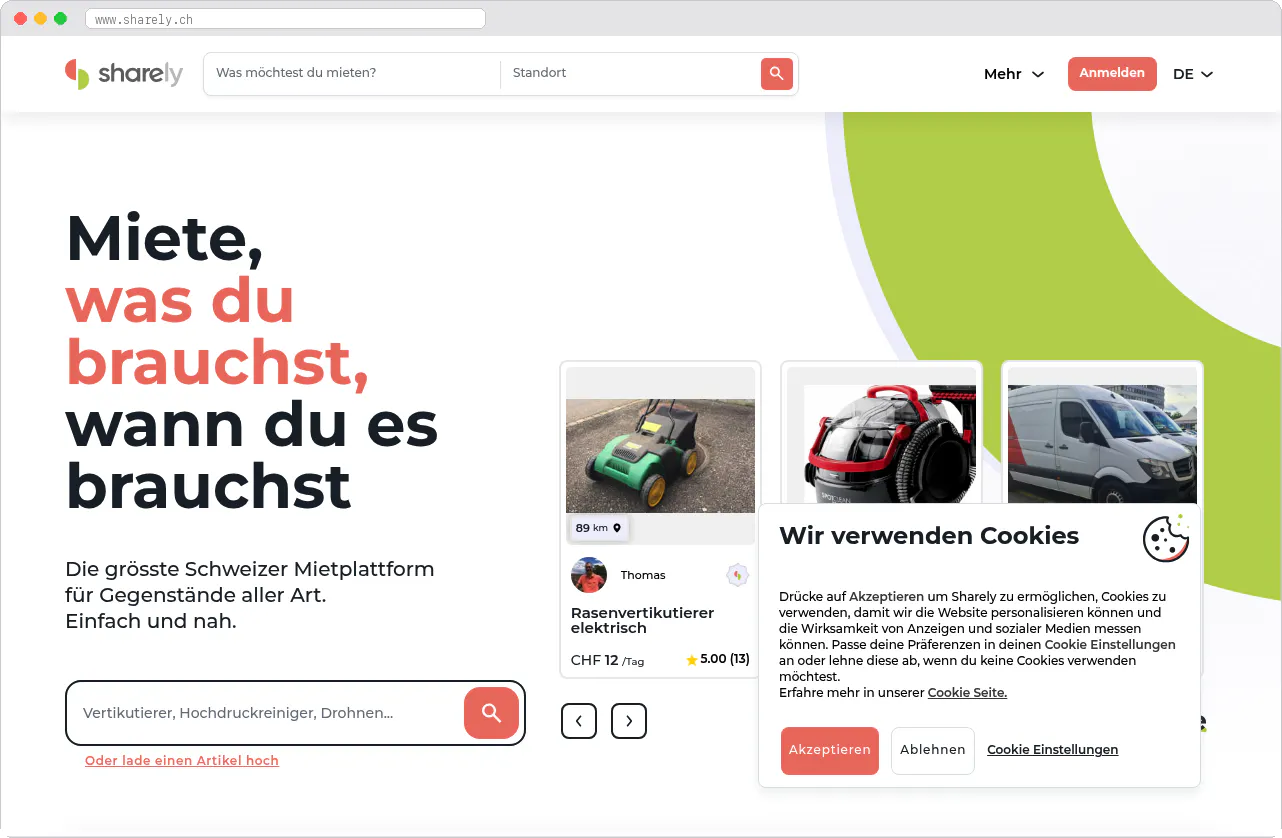
Sharely operates a near-identical model to Fatllama in Germany and Austria: broad-category peer-to-peer rentals with local pickup. It launched after observing Fatllama's early growing pains, so it shipped with more mature fraud detection and a smoother onboarding flow from day one, plus community features like interest-based groups and local meetups. Its limitation is the same one every general-category rental platform faces: it depends on hyperlocal density, and outside dense German-speaking cities, liquidity thins out fast. The opening for a new entrant is clear: pick a metro area or category Sharely hasn't saturated and go deep rather than wide.
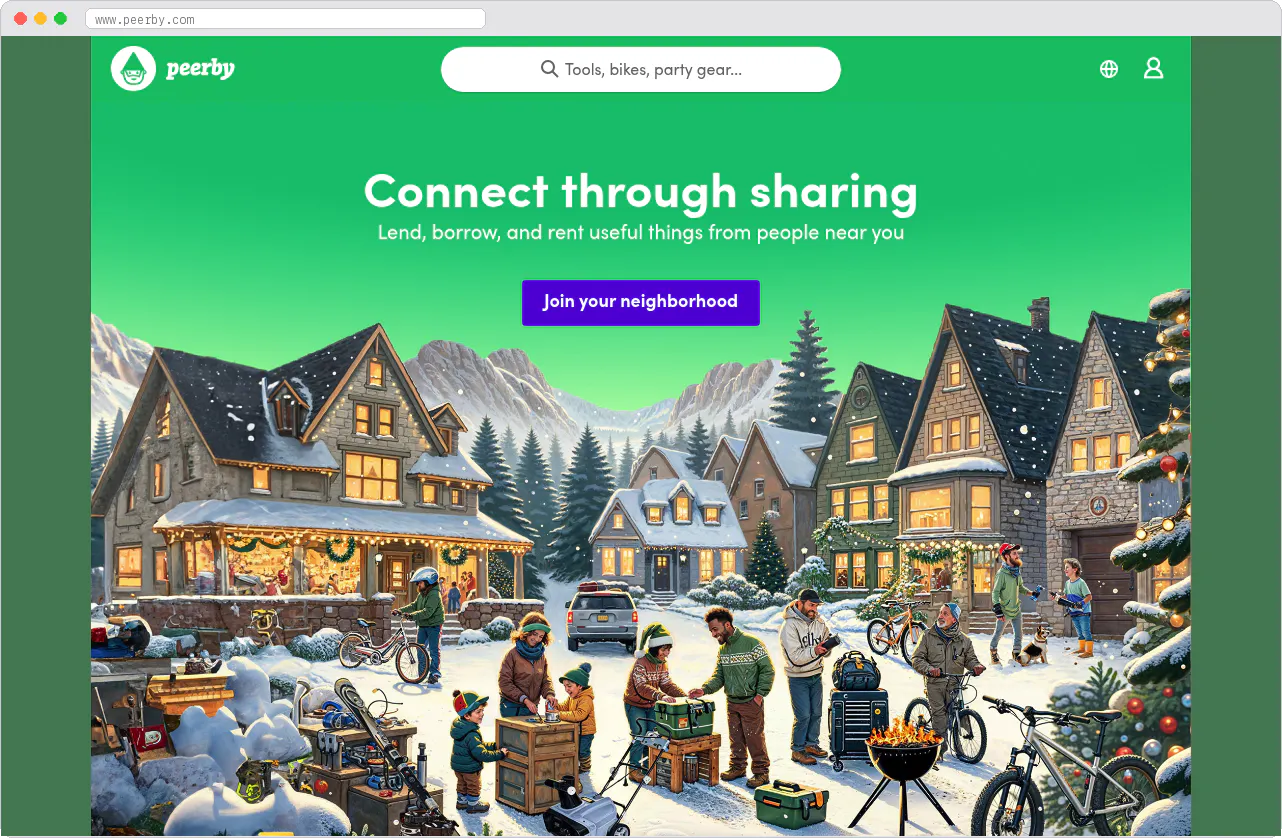
Peerby takes a different angle, focused on the Netherlands, by facilitating free item borrowing between neighbors rather than paid rentals. This removes a lot of transactional friction (no pricing negotiation, no payment risk) and leans into reciprocity and community goodwill instead. The tradeoff is monetization: a platform that doesn't touch money has a much harder time building a defensible business model, which limits how much Peerby can invest in growth or safety infrastructure. That gap is exactly where a paid, commission-based competitor can win over users who want money for their time and inconvenience, not just goodwill.
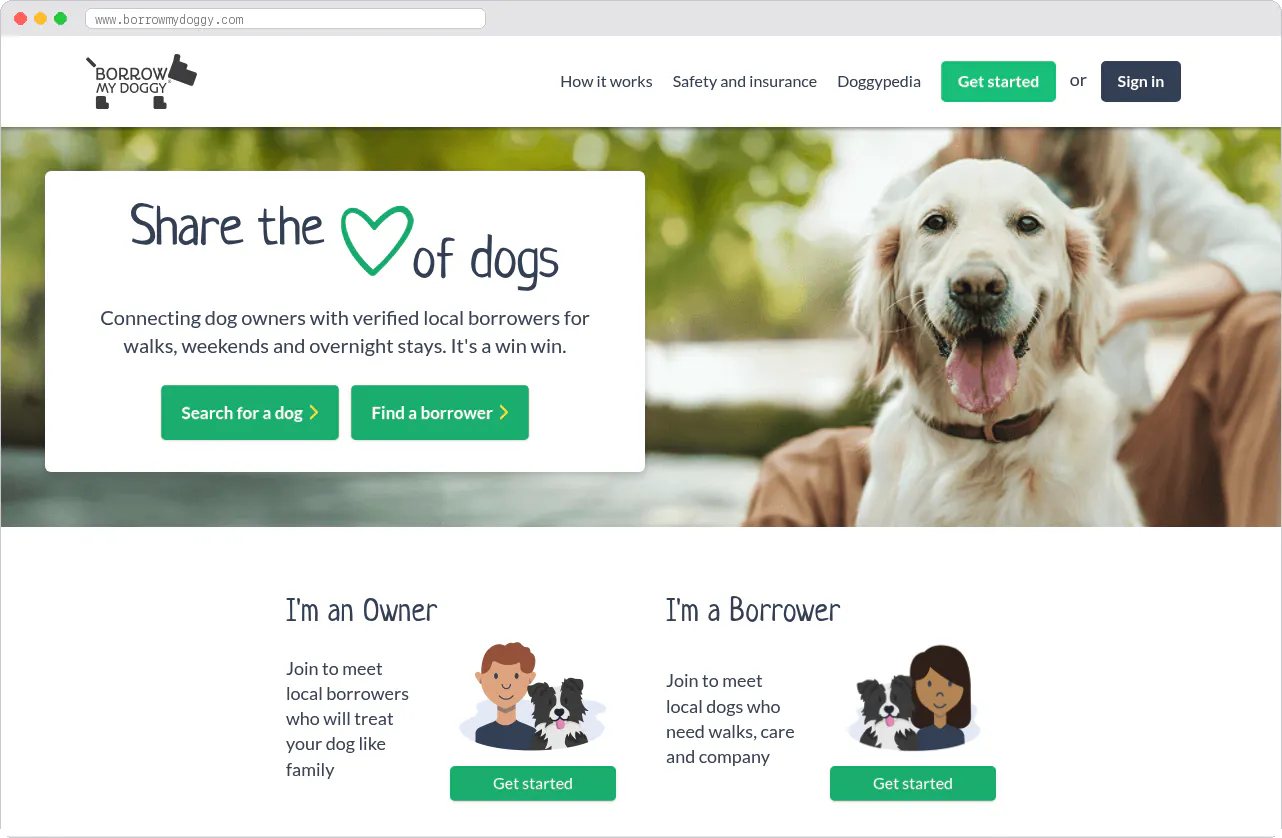
BorrowMyDoggy shows the payoff of narrow vertical focus instead of broad category coverage. Rather than renting objects, it connects dog owners with people who want part-time canine companionship, and it builds features specific to that need: vaccination records, emergency contact protocols, and detailed care instructions. It proves that a defensible rental-adjacent marketplace doesn't need Fatllama's category breadth to succeed. It also shows the ceiling of vertical focus: BorrowMyDoggy will never compete for the camera-and-power-tool renter, which leaves that market open to anyone willing to serve it well.
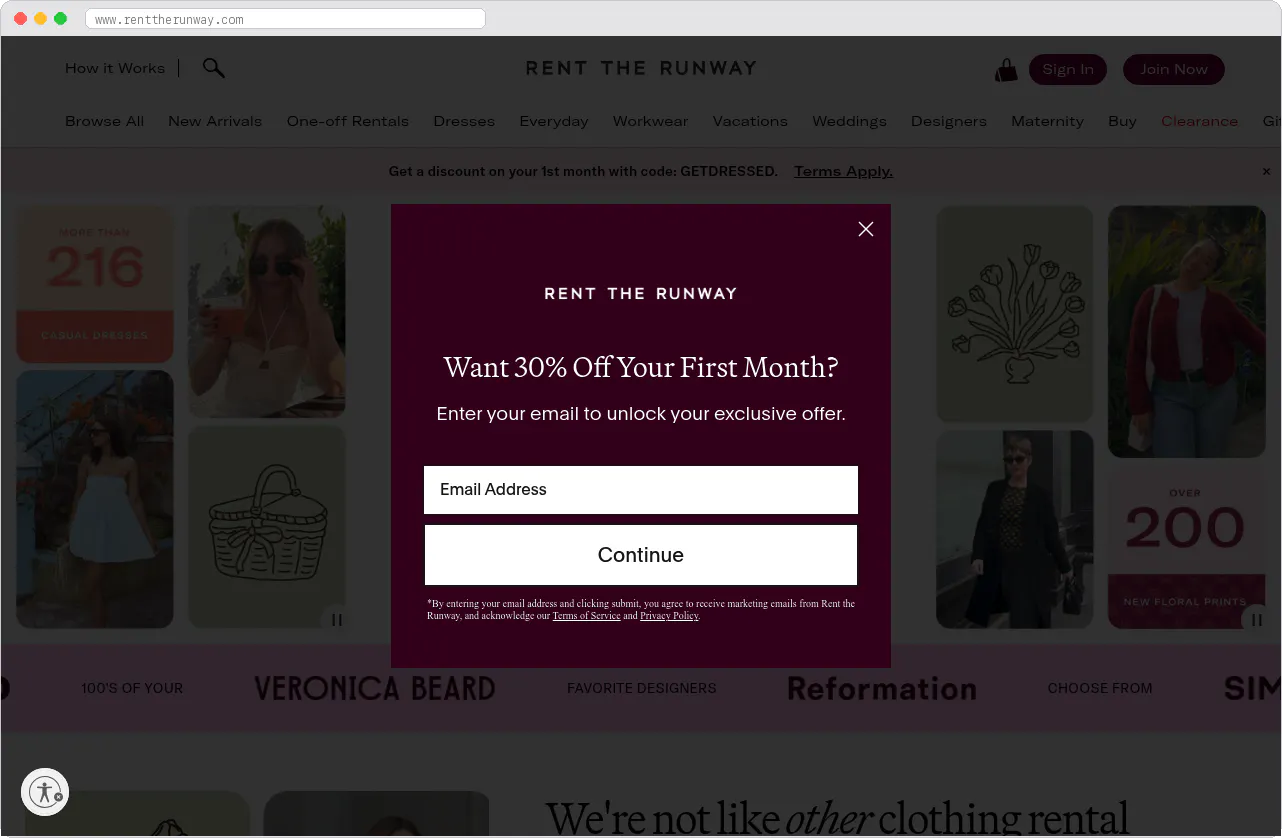
Rent the Runway solves a related buyer need (temporary access instead of ownership) with a fundamentally different operational model: it owns the inventory rather than facilitating peer-to-peer transactions. That gives it control over quality, cleaning, and availability that no peer-to-peer platform can match, at the cost of massive capital requirements for inventory and logistics. It's a strong model for occasion-driven categories like formalwear where guaranteed availability matters more than price, but it's not a template a bootstrapped founder can replicate without serious funding.
SnapGoods tried to build a US equivalent to Fatllama and eventually shut the model down after struggling to reach transaction density and manage trust at scale. Its failure is instructive rather than incidental: peer-to-peer rental marketplaces need real operational support (dispute handling, condition verification, logistics coaching for new users), not just a listings-and-payments platform, to get past the early trust barrier. A new entrant that budgets time and money for hands-on operations in the first cohort of users starts from a stronger position than SnapGoods did.
Beyond these, regional and category-specific players like KitSplit (film and photo equipment rental) demonstrate that a focused niche can sustain a healthy business even while a larger, broader competitor exists in the same country. Category focus tends to produce better unit economics per user acquired, because marketing, trust features, and supply recruitment can all be tailored to one type of item and one type of user.
How to build a marketplace like Fatllama
1. Define your niche within Fatllama's category
Fatllama's category breadth (tools, cameras, party supplies, camping gear, and more, all in one place) took years and significant capital to reach. Trying to match that breadth on day one is the single most common reason new rental marketplaces stall before reaching liquidity. Pick a slice instead: a single city, a single item category, or a single user community (students, photographers, new parents, tradespeople) where you can plausibly become the obvious choice within months, not years.
2. Validate demand and supply before writing a spec
Rental marketplaces live or die on local transaction density, so validate both sides before building anything. Talk to potential lenders about what sits unused in their homes and garages, and what would make them comfortable lending it to a stranger. Talk to potential renters about what they currently do instead (buy new, borrow from a friend, go without) and what it would take to change that behavior. A landing page measuring signup interest, combined with direct interviews in your target neighborhood or community, tells you more in two weeks than a built product tells you in two months.
3. Map the transaction flow and trust requirements
Before choosing a build path, write down exactly what has to happen for a rental to succeed: listing creation, search, booking request, payment hold, pickup coordination, return confirmation, payout, and review. For each step, decide what level of trust infrastructure you need at launch. A $30 tent rental between two verified university students needs less friction than a $2,000 camera rental between strangers in a city. This map becomes your feature list, and it will directly shape how much development work you actually need.
4. Choose your development approach
Vibe coding from scratch. AI tools like Cursor, Lovable, and Bolt can produce a working Fatllama-style prototype quickly, complete with listings, a search page, and a checkout flow that looks convincing in a demo. For pressure-testing a concept or showing early users what you have in mind, that's genuinely useful. For launching a platform that holds strangers' money in escrow, it's probably not sufficient. What vibe-coded outputs reliably don't produce is the infrastructure underneath: payment escrow, dispute resolution, fraud detection, and compliance. A documented Sharetribe experiment ran 60+ hours to reach demo quality but revealed a critical checkout exploit that would have let any user manipulate transaction prices via a direct API call. Bringing that output to production standard takes significant additional time and a clear understanding of how the pieces of a real web application fit together. Treat it as a prototyping tool, not a launch path.
Custom development from scratch. Hiring developers, who will likely lean on AI tools themselves, gives you full control over the product. A Fatllama-style marketplace with reviews, identity verification, escrow payments, and dispute handling sits in the production-grade tier: $80,000 to $200,000 over 16 to 28 weeks (Codica, RaftLabs). It lands there because peer-to-peer rentals between strangers require more trust and safety infrastructure than a simple listings site, but generally don't need the real-time logistics or geo-matching that push costs into six figures beyond that. The low end of that range assumes an offshore team; a US or Western European team pushes you toward the top. This path makes sense when you have specific requirements, like a proprietary matching algorithm or a novel insurance product, that no existing platform can support.
Building on a marketplace operating system like Sharetribe. You start at roughly 90% done on the standard marketplace foundation: payments, user accounts, listing management, messaging, transaction flows, fraud detection, and compliance. Your time and budget go toward the features that make your rental marketplace distinct, not the plumbing every marketplace needs.
- No-code builder. Configure listings with photos and item condition fields, set up availability calendars, enable location-based search, and connect Stripe Connect for escrow-style payments, all from the Console without writing code. This gets a functioning rental marketplace live in days rather than months.
- AI-assisted development. Connect Claude Code, Cursor, or Codex to Sharetribe's open APIs and open-source template to build category-specific features: a security deposit calculator, a condition-verification photo step at pickup and return, or a custom insurance quote flow. Because Sharetribe already handles the payment infrastructure, AI-assisted development on top of it carries much lower risk than building the whole system from scratch.
- Custom code. Build directly on the developer platform for deeper integrations (an insurance provider's API, a custom fraud model), or hire a specialist from Sharetribe's Expert Marketplace.
Most founders start with the no-code builder to get live and start learning, then add AI-assisted or custom features once real usage tells them what actually matters.
5. Solve the cold start problem
Rental marketplaces face a specific version of the classic chicken-and-egg problem: an empty listings page won't attract renters, but lenders won't list items without evidence that renters exist. Fatllama solved this in its early days by concentrating entirely on London, where housing costs and small apartments already created strong demand for temporary access over ownership, and by personally recruiting early lenders in high-interest categories like photography and tools.
You can apply the same logic at a smaller scale. Go supply-first: recruit 20 to 50 quality lenders in your chosen niche or neighborhood before you spend a dollar on demand marketing, even offering to help them shoot photos or write descriptions. Go geographically tight: launch in one neighborhood, campus, or small city rather than an entire region, so the handful of listings you have actually look dense to a visitor. Consider manual matching in the earliest days: if a renter asks for something you don't have listed yet, go find someone willing to lend it, even if that means doing the matching yourself over text message. A marketplace that looks fully stocked in one zip code beats one that looks sparse across an entire country.
6. Build and launch your MVP
Launch with only the features required to complete a real rental transaction: registration, listing creation, search, messaging, and payment with escrow. Skip insurance integration, mobile apps, and pricing algorithms until you've proven the core loop works. Recruit your first renters directly from people who showed interest during validation, rather than through broad advertising, and treat their early feedback as more valuable than any dashboard metric. Launch quietly, expect friction, and plan to personally handle disputes and coordination questions in the first weeks; this manual involvement is what most successful rental marketplaces did before automating anything.
7. Iterate toward liquidity and repeat usage
Track listing-to-booking conversion, repeat rental rate, and how many lenders list a second item after their first successful rental. These numbers tell you more about product-market fit than raw signup counts. Address friction as it appears: pickup coordination confusion, disagreements over item condition, or renters unclear on pricing. Each of these, left unresolved, quietly erodes the trust your whole model depends on.
8. Scale to new categories or geographies
Once your first market shows consistent transactions and organic repeat usage, expand deliberately. Fatllama expanded city by city across the UK, carrying its operational playbook into each new market rather than trying to launch nationally at once. Add new item categories based on what users are already asking for in messages and support tickets, not based on what seems theoretically popular, and invest in operational scaling (support tooling, fraud monitoring, automated reminders) before volume outpaces your ability to handle it manually.
Do you need to build everything Fatllama has?
No. Fatllama's current feature set, insurance underwriting relationships, sophisticated fraud models, and broad category coverage, was built over roughly a decade with venture funding behind it. Launching with a fraction of that is not just acceptable, it's the correct strategy: a focused MVP that handles listings, search, messaging, and escrow payments well will outperform a feature-bloated platform that does everything poorly.
The "I'll just vibe-code a clone" instinct is understandable given how capable AI coding tools have become, but it misunderstands where the real cost sits. The visible parts of a rental marketplace (listing pages, search, a booking button) are the easy part to reproduce with AI. The hard part is the invisible infrastructure: holding customer money safely, releasing it correctly after a completed transaction, preventing manipulation of prices or payouts, and handling the inevitable dispute. Building on Sharetribe's foundation gets you that infrastructure already tested and running, so your AI tokens and developer hours go toward the one or two features that actually differentiate your marketplace, rather than reinventing an escrow system that a security researcher could break in an afternoon.
Trust and safety for a Fatllama-type marketplace
Peer-to-peer rental introduces trust risks that don't exist in simple e-commerce: item damage during the rental period, non-return of the item, misrepresentation of condition in the listing, and disputes over what counts as "normal wear" versus damage. Because both parties are individuals rather than a business and a customer, there's no built-in accountability structure the way there is with a retailer, which is why identity verification and reputation systems carry so much weight in this category.
Standard practice includes government ID verification for both lenders and renters (especially for higher-value items), two-way reviews after every transaction, and security deposits held separately from the rental fee for expensive equipment. Insurance coverage, whether built in-house or via a third-party underwriter, is what ultimately makes high-value lending viable; without it, most owners simply won't list their $3,000 camera or their power tools.
Sharetribe provides the foundation for most of this out of the box: escrow-style payments through Stripe Connect that hold funds until a transaction completes, user accounts that support identity verification steps, and transaction flows you can customize to require confirmation at pickup and return. What you'll need to add yourself is category-specific: an insurance partnership if you're renting high-value items, a security deposit workflow if your default flow doesn't cover it, and clear written policies for what happens when an item comes back damaged.
Running a marketplace like Fatllama
Day-to-day operations for a peer-to-peer rental marketplace involve reviewing new listings for quality and policy compliance, responding to disputes about item condition or late returns, monitoring for fraudulent accounts, and processing insurance claims when something goes wrong. At meaningful scale, Fatllama runs dedicated trust and safety, customer support, and payments operations teams to handle this volume, none of which you need to replicate on day one.
Sharetribe automates the parts of this that are structural rather than judgment-based: payment collection and payout timing, transaction state transitions (requested, accepted, completed, disputed), automated receipts, and the underlying security and infrastructure that keeps the platform running. What you handle personally in the early months is judgment: deciding how to resolve a disputed rental, deciding whether a listing meets your quality bar, and deciding when a user should be removed. That manual involvement is normal at your stage and gets progressively automated as patterns repeat.
Development costs and timeline
Three realistic scenarios:
Vibe coding from scratch: Free or very cheap to start. A working Fatllama-style prototype, with a homepage, listings, and a mocked-up checkout, is buildable in a weekend with AI tools. What you can't get from here is a production-ready platform: escrow payments that actually hold and release funds correctly, identity verification, dispute handling, and protection against price manipulation all require work that AI coding tools don't shortcut. A documented Sharetribe experiment logged 60+ hours to reach demo quality and still turned up a critical checkout exploit. Treat this path as a proof-of-concept exercise, not a way to launch a live business handling real money.
Custom development from scratch: A Fatllama-style rental marketplace, with reviews, identity verification, escrow payments, and dispute flow, sits in the production-grade tier: $80,000 to $200,000 over 16 to 28 weeks (Codica, RaftLabs). It lands in this tier because peer-to-peer rental between strangers demands meaningfully more trust infrastructure than a basic listings-and-payments site, though it doesn't typically require the real-time logistics that push costs higher still. The low end assumes an offshore team; a US or Western European team pushes you toward the top of the range. Ongoing maintenance typically runs 15% to 25% of the original build cost per year on top of hosting. This path makes sense if you need proprietary features, like a custom insurance product or matching algorithm, that no existing platform supports.
Building on Sharetribe: Before you launch, the Sharetribe Build plan costs just $39/month. To open to real users, you need the Live plan, which costs $199/month billed yearly ($259/month billed monthly). Both plans include 1 million usage credits per month. Sharetribe covers the transaction engine, escrow-style payments, listing and search infrastructure, messaging, and the security and compliance work that would otherwise consume most of a custom development budget. Most founders reach a live MVP in weeks rather than months, and any category-specific features (a security deposit flow, an insurance quote step) get added afterward via the no-code builder, AI-assisted development, or a developer, scoped narrowly because the hard infrastructure is already built and tested.
Why Sharetribe for building a marketplace like Fatllama
Sharetribe's transaction engine is built around the exact mechanics a rental marketplace needs: time-based bookings, availability calendars, and escrow-style payments that hold funds until a rental completes. Location-based search and map filtering address the geographic density problem that determines whether a rental marketplace works at all. Two-sided reviews and optional identity verification are built into the user account structure rather than bolted on. And because the payment and compliance layer is already handled through Stripe Connect, your development effort, whether that's no-code configuration, AI-assisted feature work, or custom code, goes toward what makes your rental niche distinct: a security deposit calculator, an insurance quote flow, or a category-specific listing form, rather than reinventing the infrastructure Fatllama spent years building.
Frequently asked questions
How much does it cost to build a website like Fatllama?
It depends on your approach. A no-code build on Sharetribe starts around $39/month on the Build plan ($199/month billed yearly on the Live plan once you go live) plus setup time, custom development for a production-grade rental marketplace runs $80,000 to $200,000, and a vibe-coded prototype is nearly free but isn't safe to launch with real payments. Most founders start with the no-code route to validate demand before committing to a larger build.
What is Fatllama and is it still operating?
Fatllama is a UK peer-to-peer rental marketplace connecting people who own idle items with people who want to rent them temporarily. Fat Llama was folded into Hygglo, which acquired it in 2022, and the Fat Llama brand was fully retired on November 24, 2025, so any figures under that name no longer reflect current operations (Hygglo). The underlying model, local rental with escrow payments and identity verification, remains relevant regardless of any single company's status.
How does Fatllama make money?
Fatllama, now rebranded as Hygglo after a November 2025 merger, earns commission on completed rentals, currently a 20% lender commission plus a 10% renter fee for most items, plus revenue tied to insurance coverage on higher-value items (Hygglo). It doesn't earn anything from listings that never convert, which keeps its incentives aligned with successful matches rather than volume.
Can I build a rental marketplace without coding?
Yes. A marketplace operating system like Sharetribe includes availability calendars, location-based search, messaging, and escrow-style payments configurable through the no-code builder. You can launch a functioning rental marketplace in days and add AI-assisted or custom features later as you learn what your users need.
What's the hardest part of building a marketplace like Fatllama?
Reaching liquidity is the hardest part, meaning enough quality supply in one area to make browsing worthwhile, and enough renter demand to keep lenders active. This is a local problem, not a global one; a rental marketplace lives or dies on density within a single city or category, not total user count.
Who are Fatllama's main competitors?
Sharely runs a similar model in Germany and Austria, Peerby facilitates free borrowing in the Netherlands, BorrowMyDoggy specializes in pet care rather than objects, and Rent the Runway owns its own inventory rather than operating peer-to-peer. Each represents a different strategic choice: category breadth, monetization model, vertical focus, or inventory ownership, and each leaves room for a focused new entrant.
Start your 14-day free trial
Create a marketplace today!
- Launch quickly, without coding
- Extend infinitely
- Scale to any size
No credit card required