How to build a website like ClassPass
Learn how to create a fitness marketplace like ClassPass, from understanding their booking credit model to building essential features like class scheduling and studio partnerships. This guide covers the complete process from idea validation to launch.
Published: Mar 15, 2024
Last updated: Sep 11, 2026
What is ClassPass and how does it work?
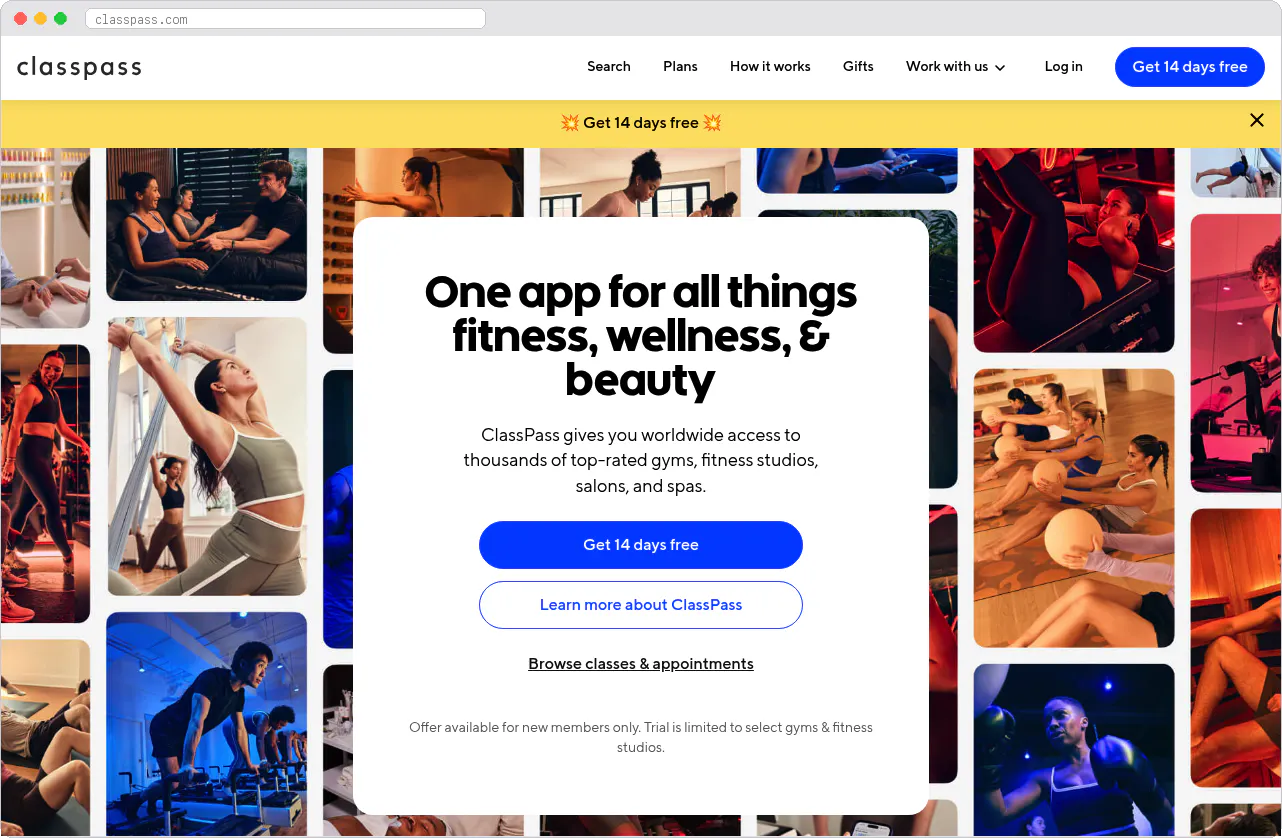
ClassPass is a fitness and wellness marketplace that gives members access to thousands of studios, gyms, and spas through a single credit-based subscription. Founded by Payal Kadakia in 2013, the company started as a class search engine called Classtivity before pivoting to the credit model that made it a household name. ClassPass now operates in over 2,500 cities across 31 countries and has processed more than 248 million bookings since launch (ClassPass).
The core mechanic is straightforward: members subscribe monthly and receive a set number of credits, which they spend on classes priced according to demand, studio tier, and time of day. Mindbody acquired ClassPass in 2021 for roughly $500 million, folding the consumer marketplace into a broader fitness and wellness software company that also serves studios directly. That acquisition matters for anyone studying ClassPass today: the platform you see now sits inside a business that also sells studio management software, which shapes some of its partner relationships and data advantages.
How ClassPass makes money
ClassPass earns on the spread between what members pay in subscription fees and what it pays studios per booking. A member on a $99/month plan receives around 48 credits, and a popular class at a boutique studio could cost 8 to 12 credits, while ClassPass pays the studio a discounted per-visit rate, often well below the studio's standard drop-in price (ClassPass pricing). The gap between subscription revenue and total studio payouts is ClassPass's gross margin, and it depends heavily on keeping utilization high without members over-consuming relative to what they pay.
The company also monetizes through ClassPass for studios, a SaaS layer sold to fitness businesses for marketing and booking tools, and through partnerships that place ClassPass credits inside corporate wellness and gym membership bundles. A newer wrinkle is dynamic, demand-based pricing: credit costs shift based on time of day, studio popularity, and even real-time booking patterns, similar to how ride-hailing apps price trips. This lets ClassPass extract more value from high-demand slots while discounting off-peak inventory to keep studios' calendars full.
Because ClassPass sets studio payouts below retail price, studios accept a lower margin per ClassPass visitor in exchange for discovery and fill-rate. This only works at ClassPass's scale, where the volume of new customers offsets the lower per-visit revenue. A new entrant needs to reckon with this tension directly: studios will only tolerate discounted rates if the customer acquisition value is real and provable.
What makes ClassPass work: key features
Credit-based dynamic pricing. Rather than a flat per-class fee, ClassPass prices every class in credits that fluctuate with demand, studio tier, and booking timing. This is the single hardest feature to replicate and the one most responsible for ClassPass's ability to balance supply and demand across a large network.
Real-time availability and capacity management. Every class has a fixed capacity and a specific start time, so the platform needs live inventory tracking to prevent overbooking, alongside automated waitlists that promote users when spots free up.
Location-based discovery. Members browse by neighborhood, commute route, or current location, with map views that show studios within walking or driving distance. Fitness is a proximity-driven category, so search that ignores geography doesn't work.
Cancellation and no-show policies. Studios set cancellation windows (commonly 12 hours) and ClassPass enforces credit forfeiture or penalty fees for late cancellations and no-shows, protecting studios from lost revenue on reserved but unused spots.
Studio management integrations. ClassPass connects to studio software like Mindbody, Glofox, and Zen Planner so studios don't have to manually sync two separate calendars, reducing the operational burden that would otherwise stop studios from joining.
Two-sided ratings. Members rate classes and instructors, while studios can flag chronic no-shows or problematic members, creating accountability on both sides of the transaction.
Digital and hybrid content. Since 2020, ClassPass has layered on-demand video and livestream classes onto its in-person network, letting members use credits even when they can't get to a physical studio.
The competitive landscape
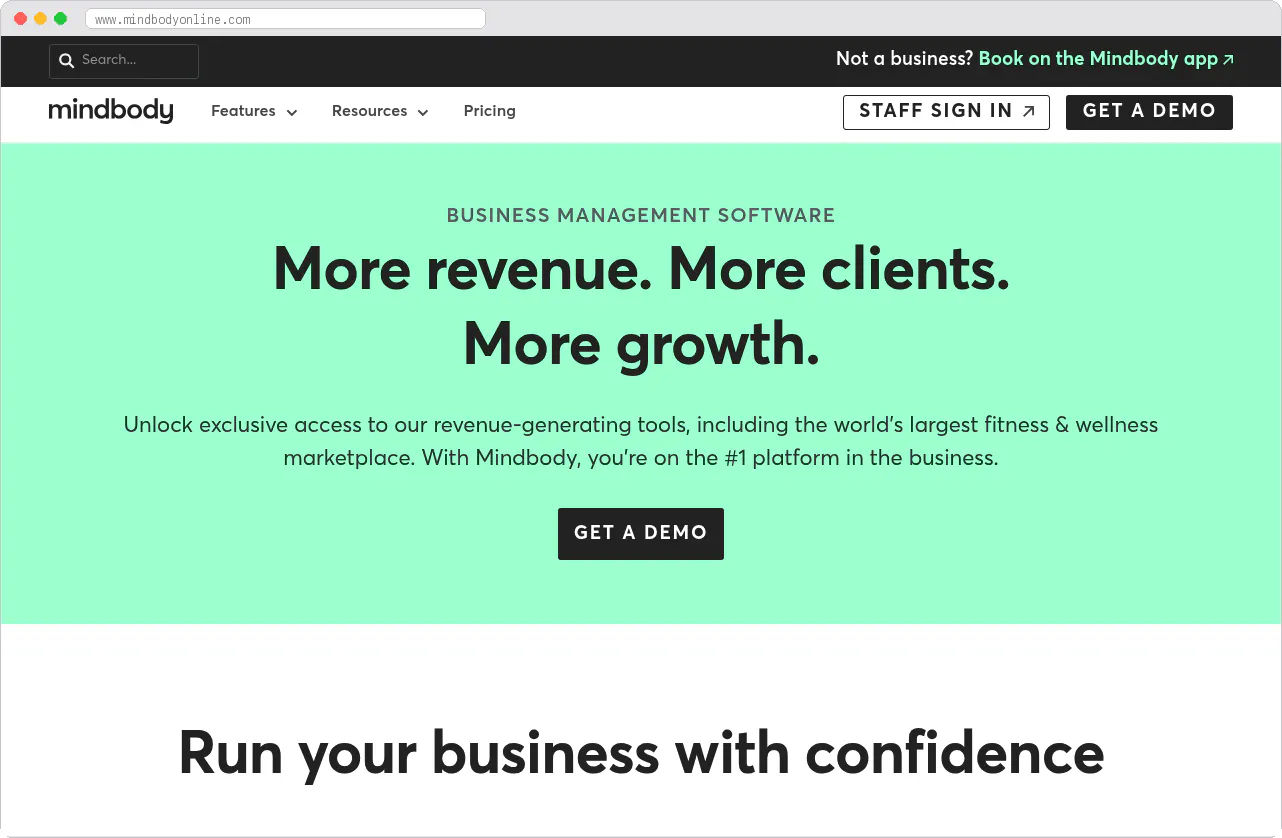
Mindbody, ClassPass's own parent company, competes at the software layer more than the marketplace layer. It sells scheduling and payment tools directly to studios and has a consumer-facing app for discovery and booking, but studios keep control of their own pricing rather than plugging into a shared credit economy. This gives studios more autonomy but less of the "one membership, many studios" simplicity that makes ClassPass appealing to consumers. The opening here is a marketplace that standardizes pricing and access the way ClassPass does, but for a niche or region Mindbody's tools don't optimize for.
FitReserve narrows the field to premium, curated studios rather than broad citywide coverage, and offers tiers with unlimited access to select partners instead of a hard credit cap. It works well for users who want fewer, higher-quality options and are willing to pay more for them, but its smaller network means less geographic coverage and fewer class time options than ClassPass. A founder targeting an affluent, quality-over-quantity segment in a specific city could use this same curated-network model as a wedge.
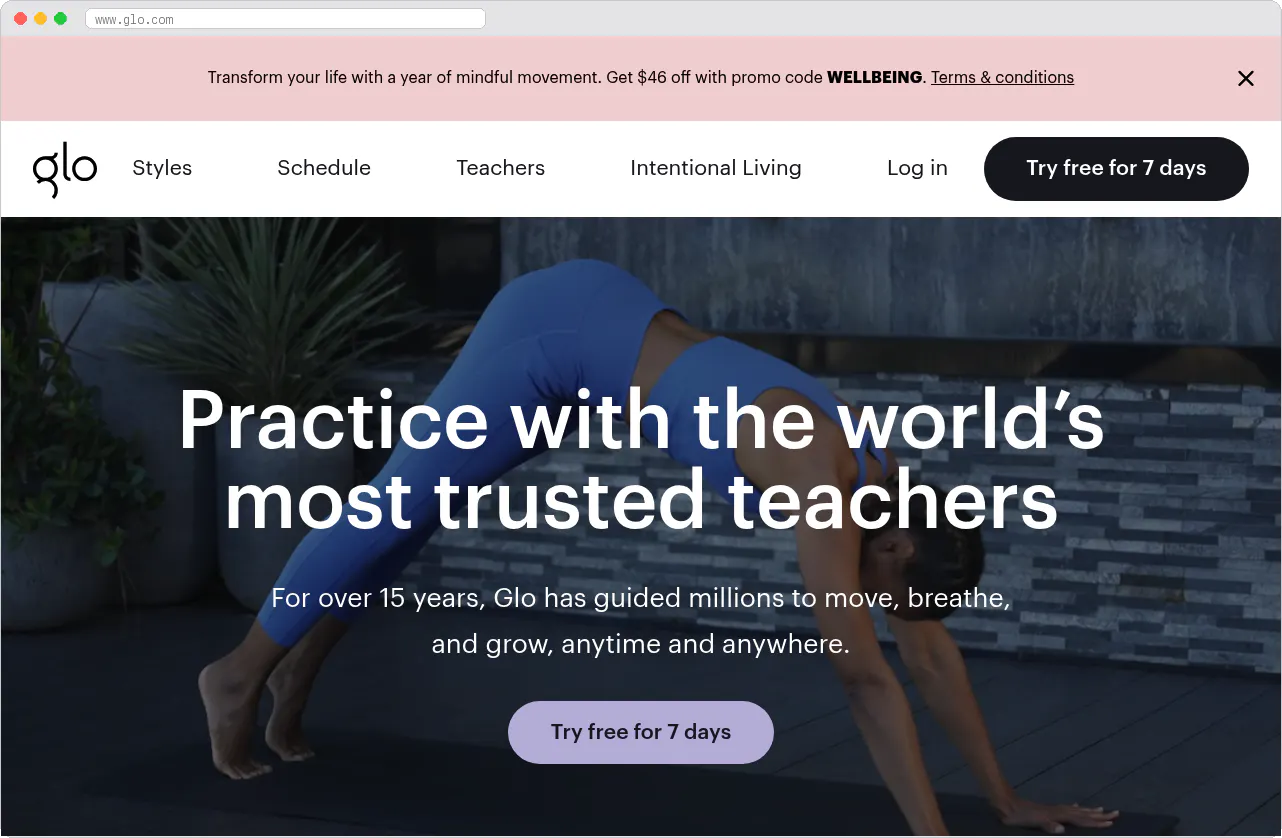
Glo.com skips physical studios entirely and focuses on on-demand yoga, pilates, and meditation video content with well-known instructors. It captures the home-fitness audience that ClassPass only partially serves through its added digital library, and it doesn't have to manage studio relationships, scheduling logistics, or capacity limits at all. The gap it leaves is anyone who wants in-person community and accountability, which video-only platforms structurally can't deliver.
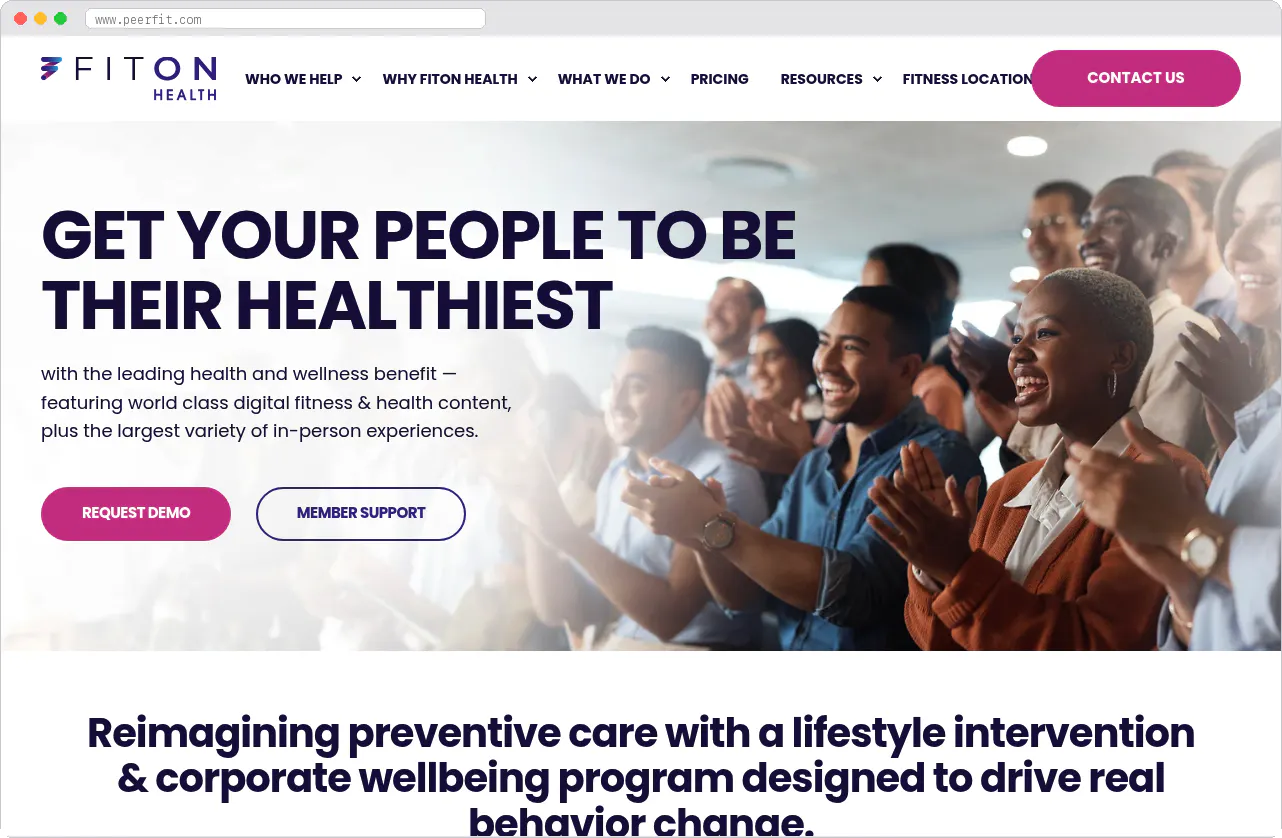
Peerfit sells into companies as an employee wellness benefit rather than to consumers directly, making it a B2B2C model layered on top of the same kind of studio network ClassPass built. This lets it tap into employer wellness budgets that individual consumers can't access, but it depends on HR buying cycles and benefits administrators rather than organic consumer demand, which slows growth and requires enterprise sales capability most fitness marketplace founders don't have. A leaner, product-led version of this model, sold to small and mid-size employers who can't afford a full Peerfit contract, remains largely unaddressed.
Gympass (now Wellhub) operates similarly to Peerfit at larger scale, bundling gym, studio, and wellness app access into corporate benefits packages across many countries. It has significant scale and brand recognition in the corporate wellness space, but like Peerfit, its sales motion and pricing structure are built for large enterprise HR budgets, leaving small businesses and solo consumers underserved. Regional or vertical-specific competitors (yoga-only networks, martial arts booking apps, boutique cycling collectives) continue to pop up precisely because ClassPass's broad, generalist network doesn't serve every niche well.
How to build a marketplace like ClassPass
1. Define your niche within ClassPass's category
You are not rebuilding ClassPass. The fitness aggregation space is now crowded with well-funded, entrenched players, so your opening is a gap ClassPass and its direct competitors leave open: a specific city or neighborhood ClassPass under-serves, a fitness modality it treats as an afterthought (climbing gyms, martial arts, recovery and cryotherapy, prenatal fitness), or a business model variant like unlimited-access-per-studio instead of credits. Talk to studio owners and prospective members before writing a line of code or configuring a single listing, and pressure-test whether the gap is real or just underrepresented for a reason.
2. Validate unit economics before building anything
ClassPass's credit system took years of data and negotiating leverage to tune correctly. Before you replicate any of it, model your numbers on paper: what will you charge members, what will you pay studios per visit, and does the spread actually cover your payment processing, support, and marketing costs? Run this model with real conversations with five to ten studios in your target market to see what payout they would actually accept, because studios that feel underpaid will quietly stop offering their best time slots.
3. Choose your development approach
Vibe coding from scratch. AI tools like Cursor, Lovable, and Bolt can produce a working ClassPass-style prototype quickly, complete with a class list, a booking button, and a slick landing page. For pressure-testing a concept or demonstrating it to early studio partners, that's genuinely useful. For launching a platform that handles real money and real bookings between strangers, it's probably not sufficient. What vibe-coded outputs reliably don't produce is the infrastructure underneath: payment escrow, dispute resolution, fraud detection, and compliance. A documented Sharetribe experiment ran 60+ hours to reach demo quality but revealed a critical checkout exploit that would have allowed any user to manipulate transaction prices via a direct API call. Bringing the output to production standard requires significant time, testing, and a clear understanding of how the different components of a web application fit together. A useful prototyping tool, not a cost-effective path to launch.
Custom development from scratch. Hiring developers, who will likely use AI heavily themselves, gives you full control over every detail. A ClassPass-type marketplace typically lands in the production-grade tier rather than a simple MVP, because credit systems, studio integrations, cancellation policies, and dispute handling all need to work correctly before real money changes hands: expect $80,000–$200,000 over 16–28 weeks (Codica, RaftLabs). A simpler version, without dynamic credit pricing or third-party studio software integrations, could fall into the $30,000–$80,000 range instead. The low end of either range assumes offshore teams at $15–40/hr; US or Western European teams push toward the top. This path makes sense when your credit or pricing logic is genuinely novel and no existing platform can support it.
Building on a marketplace operating system like Sharetribe. You start at roughly 90% done on the standard marketplace foundation: payments, user accounts, listing management, messaging, transaction flows, fraud detection, and compliance. Your time and budget go toward ClassPass-specific features instead of rebuilding plumbing. Three paths within this approach:
- No-code builder. Configure studio listings, class-based booking with fixed time slots and capacity, and a straightforward per-class or subscription pricing model directly from the Console. This gets most founders to a live, bookable marketplace without writing code.
- AI-assisted development. Connect Claude Code, Cursor, or Codex to Sharetribe's open APIs and open-source template to build a custom credit ledger, dynamic pricing logic, or a studio-software integration. Because Sharetribe already handles the payment infrastructure, AI-assisted development on top of it carries much lower risk than building from scratch, since you're extending a tested foundation rather than inventing one.
- Custom code. Build directly on the developer platform for deeper studio-system integrations, or hire a specialist from Sharetribe's Expert Marketplace who has already built booking-heavy marketplaces.
Most founders start with the no-code builder, launch with simple per-class pricing, then add credit-style dynamic pricing or studio integrations via AI or a developer once they understand what their studios and members actually need.
4. Solve the cold start problem
Fitness marketplaces face a sharp version of the chicken-and-egg problem: members won't subscribe without enough studios and class variety, and studios won't hand over discounted slots without a guaranteed flow of new customers. ClassPass solved this early by launching dense in a single city (New York), personally recruiting boutique studios one at a time, and initially offering members unlimited classes for a flat fee to prove demand before introducing credits. That flat-fee period was expensive and unsustainable long-term, but it generated the usage data ClassPass needed to design its credit system.
A new entrant should go narrower still. Pick one neighborhood or one fitness modality (yoga studios, climbing gyms, boxing) and get five to fifteen quality partners fully onboarded before opening to members at all. Offer early studio partners meaningfully better terms (lower commission, guaranteed minimum bookings, or free premium placement) in exchange for locking in inventory. On the demand side, manually recruit your first fifty to one hundred members through local fitness communities, gyms' existing class waitlists, or partnerships with corporate HR contacts, rather than relying on paid ads before you have supply worth advertising. Launching small and tight, where members can actually find a great class nearby every time they open the app, builds trust faster than launching broad and thin.
5. Build the credit or pricing model that fits your market
Decide early whether you need ClassPass's full dynamic credit system or something simpler. A flat per-class commission model is easier to build, easier for studios to understand, and perfectly viable for a launch. Save dynamic, demand-based credit pricing for once you have enough booking volume and data to tune it without guessing.
6. Onboard studios with white-glove support
Studios are busy, skeptical of new platforms, and often already juggling Mindbody or Glofox. Personally help your first cohort set up their schedules, photograph their space, and understand payout timing, because a bad first impression with a studio owner spreads fast in local fitness communities.
7. Launch, measure, and iterate
Track class utilization rate, member repeat-booking percentage, and studio churn from day one. These three numbers tell you whether your marketplace is actually solving the variety problem or just accumulating inactive signups.
Do you need to build everything ClassPass has?
No. ClassPass took over a decade, hundreds of millions in funding, and an acquisition by a software incumbent to build its current feature set, including dynamic credit pricing, deep integrations with a dozen studio management systems, corporate wellness partnerships, and an on-demand video library. None of that is necessary at launch. What you actually need is reliable booking, honest listings, working payments, and a small number of studios your early members genuinely like.
If your instinct is to vibe-code a ClassPass clone quickly with AI tools, consider what you're actually saving. Starting on Sharetribe's foundation is faster even with AI tools in the mix, because the payment processing, booking logic, user accounts, and compliance work are already built and tested. Your AI tokens and developer hours go toward the two or three features that actually differentiate your marketplace (a niche studio integration, a custom pricing model, a unique discovery experience) rather than reinventing checkout security that a vibe-coded prototype has already been shown to get wrong.
Trust and safety for a ClassPass-type marketplace
Fitness marketplaces carry specific trust risks: physical safety at unfamiliar studios, payment disputes over cancellations and no-shows, and the risk of members booking and not showing up, which costs studios real revenue. Studios also worry about liability if something goes wrong during a class booked through a third party, so clear terms of service and insurance requirements for supply-side partners matter from day one.
Standard practice in this space includes verified studio onboarding (business registration, insurance documentation, in-person or video verification of the physical space), transparent cancellation policies enforced automatically rather than manually, and a review system that surfaces both class quality and member reliability. Sharetribe provides payment escrow through Stripe Connect, structured transaction flows that can enforce cancellation windows and automatic payouts, and user accounts that support optional identity verification out of the box. What founders need to add is category-specific policy: your cancellation window, your no-show penalty structure, and your studio vetting checklist, since these are business decisions Sharetribe can enforce technically but can't decide for you.
Running a marketplace like ClassPass
Day-to-day operations for a fitness marketplace include studio relationship management, member support for booking issues, monitoring class utilization to catch underperforming partners early, and periodically renegotiating payout terms as studios grow more or less dependent on your traffic. ClassPass at scale runs dedicated studio success teams, a large customer support operation, and continuous A/B testing on credit pricing, none of which you need to replicate as a small marketplace.
Sharetribe automatically handles payment processing and payouts, booking confirmations, capacity enforcement, and the technical infrastructure behind messaging and notifications. That leaves you to focus on the parts that actually require human judgment: which studios to onboard, how to price your offering, and how to keep your early members coming back every week.
Development costs and timeline
Three realistic scenarios:
Vibe coding from scratch: Free or very cheap to start, and a working ClassPass-style prototype is buildable quickly with AI tools like Cursor or Lovable. What you can't get from here is a production-ready platform: real-time capacity locking to prevent double-booking, secure payment escrow, studio payout automation, and cancellation policy enforcement all require work that AI coding tools don't shortcut. A documented Sharetribe experiment logged 60+ hours to reach demo quality and found a critical checkout exploit that would have let any user manipulate prices. A useful proof-of-concept tool, not a cost-effective path to a live business.
Custom development from scratch: Cost depends on complexity tier. A simple ClassPass-type MVP, with basic class listings and per-booking payments but no credit system, runs $30,000–$80,000 over 8–20 weeks. A production-grade build with dynamic pricing, studio software integrations, cancellation policy enforcement, and dispute handling runs $80,000–$200,000 over 16–28 weeks (Codica, RaftLabs). The low end of each range assumes offshore teams at $15–40/hr; US or Western European teams push toward the top. Ongoing maintenance typically runs 15–25% of the original build cost per year. This path makes sense when your pricing model or studio integrations require something no existing platform supports.
Building on Sharetribe: Subscription pricing starts at $99/month on the Lite plan, $199/month on Pro, and $299/month on Extend (all billed yearly). This covers payment processing, booking and capacity management, user accounts, messaging, search, and the compliance infrastructure a fitness marketplace needs to operate legally and securely. Most founders reach a live MVP in weeks rather than months. Custom features like a bespoke credit system or a studio-software integration can be added later via AI tools or a developer, scoped narrowly because the transaction engine is already built and tested.
Why Sharetribe for building a marketplace like ClassPass
Sharetribe's booking engine handles the fixed-time, limited-capacity structure that fitness classes require, including recurring schedules and automatic capacity enforcement, which maps directly onto how ClassPass-style class booking works. Its integration with Stripe Connect supports marketplace payment flows where money moves between members, your platform, and studios, covering the core mechanic behind ClassPass's credit-and-payout model even before you build any custom pricing logic. Location-based search and map views address the proximity-driven discovery that fitness marketplaces depend on, and the open API and developer platform mean that once you've validated demand with the no-code builder, you can extend into dynamic pricing or studio integrations without starting over.
Frequently asked questions
How much does it cost to build a website like ClassPass?
It depends on your approach. Custom development for a production-grade fitness marketplace with dynamic pricing and studio integrations runs $80,000–$200,000 and takes 16–28 weeks (Codica). Building on Sharetribe starts at $99/month, letting you launch a working booking marketplace in weeks and add complexity as you grow.
What business model does ClassPass use?
ClassPass uses a credit-based subscription model. Members pay a monthly fee for a set number of credits, spend those credits on classes priced by demand and studio tier, and ClassPass keeps the difference between subscription revenue and what it pays studios per booking.
Can I build a fitness marketplace without technical skills?
Yes. A marketplace operating system like Sharetribe includes no-code tools that let non-technical founders configure class listings, booking calendars, payments, and location-based search directly from a dashboard. You can launch a working platform without hiring a developer, then bring in AI tools or a specialist later for custom features.
What are the main alternatives to ClassPass?
Mindbody offers studio management software with a consumer booking layer, FitReserve curates a smaller premium studio network, Glo.com focuses only on on-demand video classes, and Peerfit and Gympass sell fitness access as a corporate benefit rather than a direct consumer subscription. Each addresses a different slice of the variety-and-flexibility problem ClassPass pioneered.
How do I get fitness studios to join a new marketplace?
Start with in-person outreach rather than cold outreach or ads. Visit studios, learn what classes go unfilled and when, and offer early partners better terms like lower commission or guaranteed minimum bookings in exchange for their best time slots. Studios need to see real new customers within the first few weeks or they'll deprioritize your platform.
Do I need a credit system like ClassPass to launch?
No. A simple per-class or per-booking commission model is easier to build and easier for studios and members to understand at launch. Dynamic credit pricing requires booking volume and data to tune correctly, so most successful fitness marketplaces add it only after they've validated demand with a simpler pricing model.
Start your 14-day free trial
Create a marketplace today!
- Launch quickly, without coding
- Extend infinitely
- Scale to any size
No credit card required