How to build a therapy marketplace
The therapy marketplace industry reached approximately $4.2 billion in 2023, with platforms like BetterHelp serving over 4 million users. This guide shows you how to build a therapy marketplace, from understanding the unique compliance requirements to launching your platform and competing with established players.
Published: Dec 19, 2023
Last updated: Sep 11, 2026
What is a therapy marketplace?
A therapy marketplace is a platform that connects licensed mental health professionals with clients seeking counseling, matches them based on specialization and preferences, and handles scheduling, payment, and often the video or messaging infrastructure for the session itself. It's a two-sided marketplace layered on top of one of the most heavily regulated professional services in the country.
The category differs from a general telehealth platform in an important way: therapy marketplaces are built around ongoing relationships, not one-off consultations. A client typically works with the same therapist over weeks or months, which means the matching decision matters more than it does in, say, a marketplace for one-time home repairs. It also differs from a therapist directory like Psychology Today, which helps clients find a provider but doesn't touch the transaction, scheduling, or session delivery.
The opportunity is real. Telehealth adoption for behavioral health has stayed structurally higher than pre-2020 levels, and mental health stigma has declined enough that a large share of new therapy clients now start their search online rather than through a physician referral (AHA). That's created room not just for BetterHelp-scale generalists but for smaller, focused platforms serving specific populations, specialties, or price points that the giants don't serve well.
How the business model works
Most therapy marketplaces earn money through a commission on session fees, a client-facing subscription, or a combination of both. BetterHelp uses a subscription model, charging clients a flat monthly fee for a bundle of weekly live sessions plus unlimited messaging, and pays therapists a per-session rate from that pool. Talkspace splits its business between a direct-to-consumer subscription and an insurance-based, per-session model, and its volume keeps shifting toward payer reimbursement, with 2025 revenue up 22% year over year on 38% payer growth even as consumer revenue fell 40% (MobiHealthNews).
A commission-based marketplace charging per completed session typically targets a 15-30% take rate, similar to other professional services marketplaces, though the number shifts depending on whether the platform is also providing malpractice coverage, client acquisition, or EHR-adjacent tools. Platforms that accept insurance billing often earn a smaller per-session cut but make up for it in volume, since insurance-covered therapy removes the biggest barrier to client conversion: out-of-pocket cost. A blended model, subscription for cash-pay clients plus commission for insurance-billed sessions, is increasingly common because it hedges against clients dropping off when a subscription price increase hits.
Secondary revenue streams include employer or EAP (Employee Assistance Program) contracts sold in bulk, premium features like expedited matching or specialist add-ons, and white-label licensing of the matching and scheduling infrastructure to health systems. None of these replace the core transaction revenue, but they smooth out the seasonality and marketing-spend dependency that plagues consumer-subscription mental health platforms.
The competitive landscape
BetterHelp dominates the category by scale. Founded in 2013, BetterHelp has grown to serve millions of clients through a network of tens of thousands of licensed therapists, generating roughly $1 billion in annual revenue (Fierce Healthcare). Its intake questionnaire runs to more than 80 questions, its matching happens in minutes, and it has spent $242 million on podcast ads since 2023, making it the top podcast advertiser of all time (Bloomberg). Where it falls short is depth: therapists earn relatively modest per-session rates for a high-volume, high-turnover client base, and critics have pointed out that the platform's incentives favor client retention over clinical outcomes. That gap, between "accessible and fast" and "clinically deep and specialized," is exactly where smaller competitors position themselves.
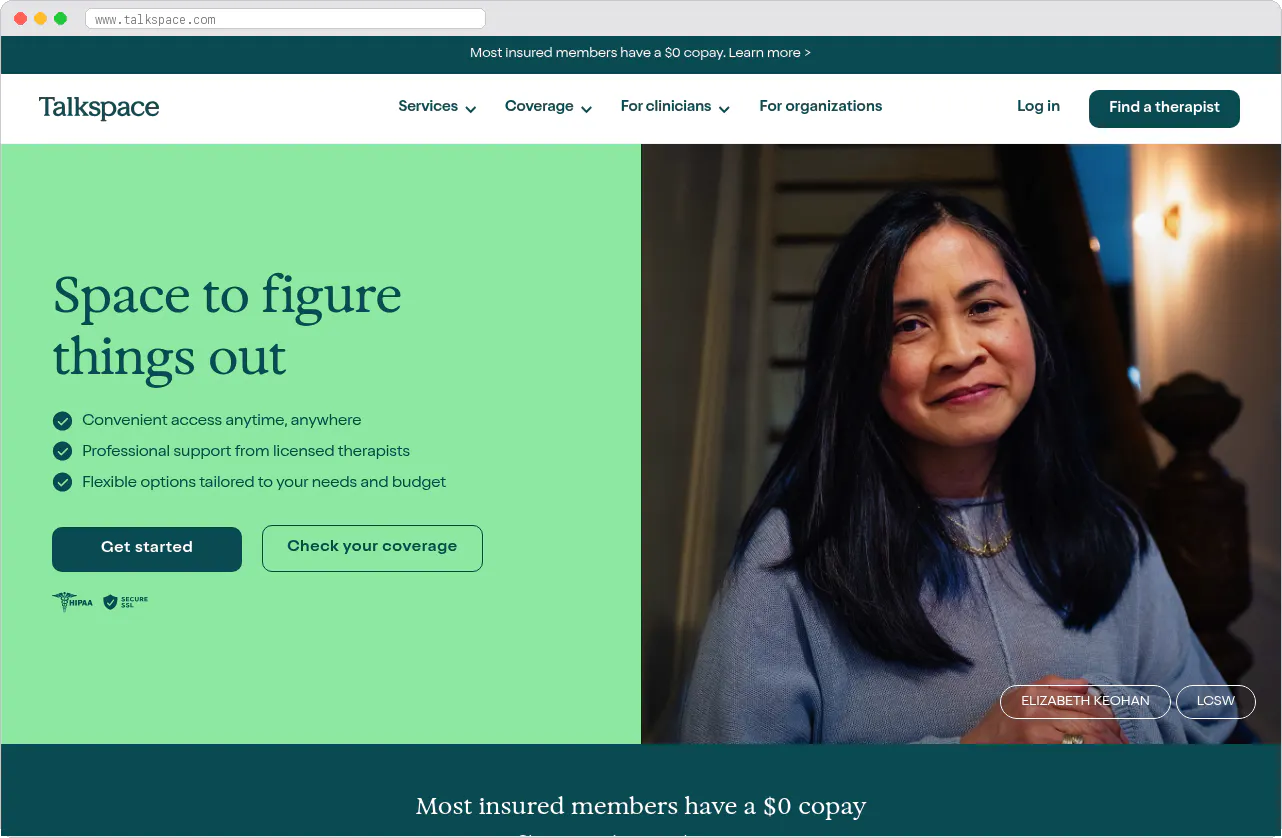
Talkspace built its identity around asynchronous, text-first therapy, letting clients message a therapist throughout the week instead of booking live video calls. That appeals to clients who want flexibility or find live video sessions intimidating. It went public in 2021, grew to serve more than 200 million insured lives, and was acquired by Universal Health Services in 2026 after leaning heavily on insurance reimbursement as a growth lever (Healthcare Dive). It has also faced real financial and leadership turbulence, which shows how difficult it is to keep unit economics healthy in a subscription-plus-insurance hybrid model.
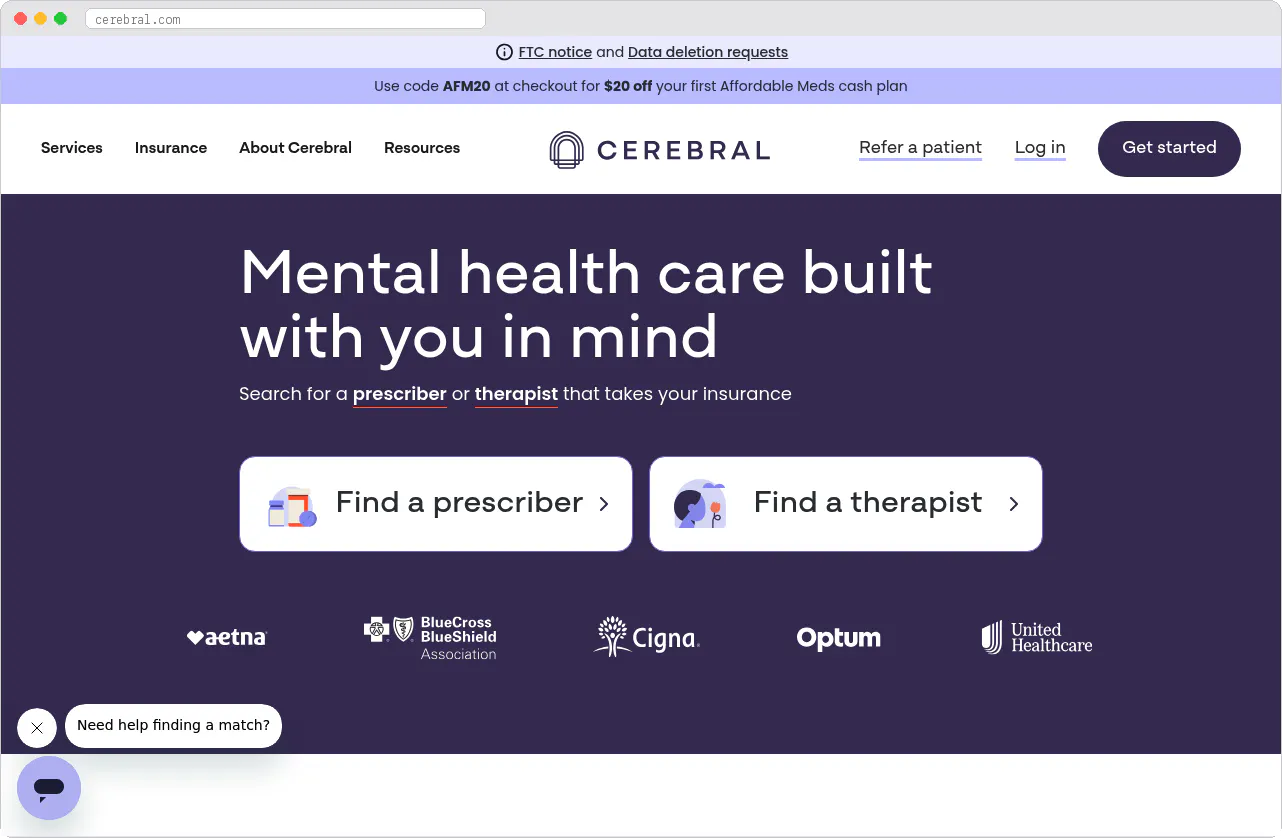
Cerebral launched in 2020 with a broader pitch: therapy bundled with psychiatric medication management. It raised over $460 million before regulatory scrutiny over its prescribing practices for controlled substances forced a leadership shakeup and a retreat from parts of its original model (Behavioral Health Business). The lesson for founders isn't "avoid medication management," it's that combining prescribing with a fast-growth marketplace model invites regulatory attention that a therapy-only platform doesn't face to the same degree.
MDLIVE and Amwell take the telehealth-platform route, bundling therapy alongside general urgent care and primary care visits. This works well for health systems and insurers that want one vendor for all virtual care, and it means these platforms integrate deeply with existing healthcare billing infrastructure. It also means therapy is a smaller, less specialized part of a much bigger product, so the matching experience and therapist selection tend to be thinner than on a dedicated mental health marketplace.

Psychology Today occupies a different lane entirely. It's a directory, not a transactional marketplace: therapists pay to list a profile, clients browse and contact them directly, and no booking or payment happens on the platform. Founded in 1991, it remains the default place many therapists build their online presence, which means a lot of independent practitioners maintain a Psychology Today listing and a profile on a transactional platform at the same time. That split creates an opening for marketplaces that offer directory-level searchability with the booking and payment infrastructure Psychology Today doesn't provide.

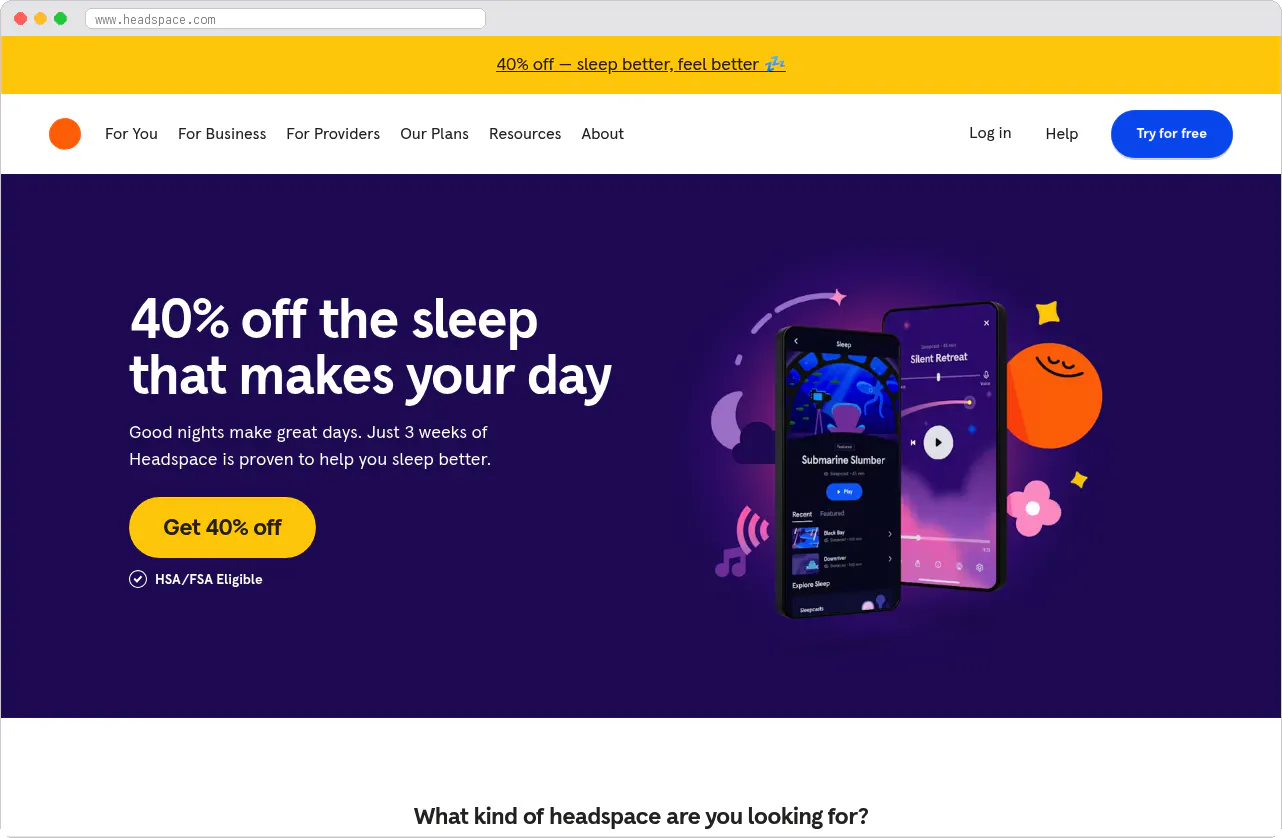
Headspace Health, formed when Headspace acquired Ginger in 2022, bundles self-guided meditation and wellness content with access to licensed coaches and therapists, sold primarily through employer benefits programs. It's a strong fit for companies buying mental health benefits at scale, but it's a business-to-business distribution model more than a direct consumer marketplace, which leaves the direct-to-consumer, self-pay segment mostly to BetterHelp and Talkspace.
Beyond these, a growing set of specialized platforms serve niches the generalists underserve: Inclusive Therapists for clients seeking providers from specific cultural or identity backgrounds, Open Path for reduced-fee sliding-scale therapy, and Pride Counseling for LGBTQ+ clients. These platforms prove the thesis that a therapy marketplace doesn't need BetterHelp's scale to be viable. It needs a client base that the big platforms' one-size-fits-all matching doesn't serve well.
Essential features for therapy marketplaces
Therapist license verification. Every therapist on your platform needs an active, verifiable license in the state or states where they intend to practice. This isn't optional or a nice-to-have trust signal, it's a legal requirement, and it needs to be re-checked periodically since licenses expire and lapse. Many platforms start with manual verification against state licensing board databases and automate it later as volume grows.
Geographic and jurisdiction enforcement. A therapist licensed only in Ohio legally cannot see a client physically located in Florida during a session, even briefly. Your matching and booking system needs to check client location against therapist licensure at the point of booking, not just at signup, since clients travel and licenses change.
HIPAA-compliant messaging and video. Standard consumer messaging or video tools generally don't meet healthcare data protection requirements. You need encrypted transmission and storage, audit logs of who accessed what data and when, and signed business associate agreements with every vendor that touches protected health information, including your hosting provider and any analytics tools.
Specialization-based matching. Clients don't search for "a therapist," they search for someone who treats anxiety, works with couples, understands a specific cultural background, or practices a particular modality like CBT or EMDR. A matching system built on rich, structured therapist attributes, not just a search bar, is what separates a usable therapy marketplace from a static directory.
Flexible, recurring scheduling. Therapy is a recurring relationship, typically weekly or biweekly sessions over months. Your booking system needs to handle standing appointments, time zone differences, cancellation policies with appropriate notice windows, and automated reminders, since no-shows are a persistent problem in behavioral health.
Crisis escalation protocols. A client in an active mental health crisis needs a clear path to emergency resources that doesn't depend on their scheduled therapist being available. This means visible crisis hotline information, and in more clinically involved platforms, risk-screening tools and an escalation workflow that connects to human intervention, not just a disclaimer buried in the terms of service.
Insurance eligibility and billing support. If you plan to accept insurance, even optionally, you need eligibility verification before a session is booked, since mental health coverage varies enormously by plan, and a claims submission path for reimbursement. Many platforms outsource this to a specialized behavioral health billing service rather than building it in-house from day one.
Session documentation and progress tracking. Therapists need a place to keep clinical notes and treatment plans, and many platforms add standardized screening tools like the PHQ-9 for depression or GAD-7 for anxiety so both therapist and client can see measurable progress over time. This also becomes valuable documentation if insurance claims are ever questioned.
Regulatory complexity: the structural issue this niche can't skip
Therapy marketplaces face a licensing constraint that almost no other marketplace category deals with: your supply side is legally restricted to serving demand within specific state borders. A therapist licensed in California cannot see a client sitting in Texas, full stop, regardless of what your platform's terms of service say. Some states participate in interstate compacts, like PSYPACT for psychologists, that ease cross-state practice for participating providers, but PSYPACT still excludes major markets like California and New York, so you can't assume it solves the problem for your whole therapist base (PSYPACT).
HIPAA compliance touches nearly every technical decision you make, from which video vendor you integrate to how you store intake forms. You'll need a signed business associate agreement with every third-party service that could touch protected health information, a documented data retention and deletion policy, and encryption both in transit and at rest. This is also an area where hiring a healthcare compliance attorney before you write a line of code is cheaper than retrofitting compliance after a data incident.
State-by-state variation adds friction on top of licensing. Some states regulate telehealth-specific consent requirements, others restrict what counts as a valid first session (some require an initial in-person or synchronous video visit before ongoing text-based therapy is allowed), and insurance parity laws, which require insurers to cover telehealth mental health visits like in-person visits, aren't uniform. None of this makes a therapy marketplace un-buildable. It does mean your compliance research needs to happen before your feature roadmap, not alongside it.
How to build a therapy marketplace
1. Define your niche and geography
Decide early whether you're building a broad, BetterHelp-style generalist platform or a focused one serving a specific population (couples, teens, a cultural community, a particular therapeutic approach) in a defined set of states. Starting narrow on geography is often a compliance decision as much as a marketing one: fewer states means fewer licensing regimes to research and enforce at launch.
2. Validate demand with both sides
Talk to therapists about what frustrates them in their current client acquisition and administrative workload, and talk to potential clients about what stopped them from starting therapy before. Many therapists are drowning in no-shows, insurance paperwork, and inconsistent referral flow, three problems a well-designed marketplace can directly solve. Many clients are put off by not knowing how to pick a therapist, not by a lack of therapists existing.
3. Choose your development approach
Vibe coding from scratch. AI tools like Cursor, Lovable, and Bolt can produce a working therapy-matching prototype quickly, complete with a browsable therapist directory and a mock booking flow. For pressure-testing a niche idea with a handful of therapist interviews, that's genuinely useful. For launching a platform that will handle real payment, real protected health information, and real crisis situations, it's not sufficient on its own. What vibe-coded outputs reliably don't produce is the infrastructure underneath: payment escrow, encrypted PHI handling, license verification workflows, and audit logging. A documented Sharetribe experiment ran 60+ hours to reach demo quality but revealed a critical checkout exploit that would have let any user manipulate transaction prices through a direct API call. In a therapy context, that same class of gap could mean unverified therapists taking bookings or unencrypted health data sitting in a database. A useful prototyping tool, not a cost-effective path to launch.
Custom development from scratch. Hiring developers, who will likely lean heavily on AI tools themselves, gives you full control over compliance architecture and clinical workflow design. For a therapy marketplace, plan for the production-grade complexity tier, not the simplest one: you need reviews, identity and license verification, escrow-style payment holds, and a dispute flow at minimum, which runs $80,000-$200,000 and 16-28 weeks of development (Codica, RaftLabs). HIPAA-compliant video, insurance eligibility checks, and clinical documentation tools push most builds to the higher end of that range. The low end assumes offshore teams billing $15-40/hour; a US or Western European team, which many founders prefer for a healthcare product given liability exposure, pushes costs toward the top. Custom development makes sense when you need deep EHR integration or a clinical workflow no existing platform supports.
Building on a marketplace operating system like Sharetribe. You start at roughly 90% done on the standard marketplace foundation: payments, user accounts, listing management, messaging, transaction flows, fraud detection, and compliance groundwork. Your time and budget go toward therapy-specific features instead of rebuilding the basics. Three paths within this approach, which most founders combine:
- No-code builder. Configure therapist profiles with custom fields for specialization, license state, and therapeutic approach, set up recurring booking with your own cancellation policy, and launch a searchable, filterable directory with integrated payment, all from the Console without writing code. Gets most founders to a live marketplace in one to four weeks.
- AI-assisted development. Connect Claude Code, Cursor, or Codex to Sharetribe's open APIs and open-source template to build a more sophisticated matching algorithm, add license-verification checks at booking time, or integrate a HIPAA-compliant video vendor. Because Sharetribe already handles the payment and transaction infrastructure, AI-assisted development on top of it carries much lower risk than building from scratch.
- Custom code. Build directly on the developer platform for deeper EHR or insurance-billing integrations, or hire a specialist from Sharetribe's Expert Marketplace.
Most founders start with the no-code builder, launch, and add features through AI tools or a developer once they know exactly what their therapists and clients need.
4. Solve the cold start problem
A therapy marketplace's cold start problem is unusually asymmetric: clients are trusting a stranger with deeply personal information, so they won't sign up for a platform that looks empty or unproven, while therapists are relatively easy to recruit if you can show them a credible client-acquisition story. The fix is to build supply first, deliberately.
Recruit 20-30 therapists across a handful of specializations before you open the platform to clients at all, reaching out directly through professional associations, LinkedIn, and local networking events rather than waiting for inbound interest. Focus your first cohort of clients on your own network, friends, family, or referrals from the therapists you've onboarded, since a single bad early match can do outsized reputational damage in a tight-knit professional community. Launching in one or two states with a specific specialization beats launching nationally and thin; a client searching for "couples therapist who takes my insurance in Ohio" needs to find three good options, not a directory of 500 therapists spread across the country with almost none matching their actual need.
5. Build compliance into your launch checklist
Don't treat HIPAA compliance, license verification, and crisis protocols as post-launch cleanup. Have business associate agreements signed with every vendor before you process a single real client's data, and have a documented, tested crisis-escalation procedure before your first session happens, not after an incident forces you to write one.
6. Recruit therapists before clients, and onboard them properly
Build a thorough onboarding flow that verifies each therapist's license against the relevant state board, walks them through writing an effective profile, and sets clear expectations about commission, cancellation policy, and client communication norms. Early therapist incentives, like reduced commission for the first cohort, help offset the risk of joining an unproven platform.
7. Launch carefully, then scale by proving outcomes
Bring clients on slowly and monitor every early match closely, since word-of-mouth in mental health communities travels fast in both directions. Once your model is working in one or two states with one or two specializations, scale by adding states (which means adding license verification work for each new jurisdiction) and specializations, not by broadening your marketing spend before your matching quality is proven.
Trust and safety for therapy marketplaces
The trust risks in this category go beyond typical marketplace fraud. A client shares clinical, sometimes crisis-level, personal information with someone they've never met, so the core risk isn't just "is this provider real," it's "is this provider licensed, in good standing, and safe to be alone in a video call with my most vulnerable moments." License verification and periodic re-verification are non-negotiable, and many platforms also check for malpractice insurance and any disciplinary history with the relevant state board.
Payment risk is real but more manageable: clients pay upfront for subscriptions or sessions, and therapists need reliable, on-time payout, which is a solved problem for most marketplace infrastructure. Dispute risk shows up differently than in a goods marketplace, though: a "bad session" is subjective and clinical, not a defective product, so your dispute-resolution flow needs a path for switching therapists quickly rather than a refund-and-return process.
Sharetribe provides payment escrow-style transaction flows, user accounts, and optional identity verification out of the box, which covers the standard marketplace trust layer. What you need to add yourself, and what no marketplace platform provides pre-built, is the healthcare-specific layer: license verification against state boards, HIPAA-compliant data handling agreements with your vendors, and a crisis-escalation protocol connected to real emergency resources. These require legal and clinical input, not just engineering.
Running your therapy marketplace
Once you're live, the operational load shifts from building features to managing a two-sided relationship where both sides carry real professional and personal stakes. License renewals need periodic re-checking so you're never carrying an expired-license therapist on your platform. Insurance eligibility rules and payer requirements shift periodically, so if you support insurance billing, someone needs to own keeping that current.
Sharetribe automates the marketplace mechanics that don't need a human: payment collection and payout splits, booking confirmations and reminders, and messaging notifications all run without manual intervention. AI agents built on top of the platform's data can help flag license expirations coming up in the next 30 days, surface unusually long response times from a therapist that might signal disengagement, or draft first-pass responses to common client questions about billing or scheduling, freeing your team to focus on the judgment calls, like handling a client complaint or approving a new therapist's application, that shouldn't be automated.
Development costs and timeline
Three realistic scenarios:
Vibe coding from scratch. Free or very cheap to start, and a working therapy-matching prototype is buildable in a few days with AI tools. What you can't get from here is a production-ready platform: HIPAA-compliant data handling, license verification tied to state boards, encrypted PHI storage, and a tested crisis-escalation path all require work that AI coding tools don't shortcut. A documented Sharetribe experiment logged 60+ hours to reach demo quality and still surfaced a critical payment vulnerability. A useful proof-of-concept tool, not a cost-effective path to a live therapy business.
Custom development from scratch. This niche sits squarely in the production-grade complexity tier because of licensing verification, HIPAA compliance, and the need for a real dispute-and-rematch flow. Expect $80,000-$200,000 and 16-28 weeks for a platform that handles reviews, identity and license verification, escrow-style payment holds, and dispute resolution (Codica, RaftLabs). Adding deep insurance-billing integration or EHR connectivity pushes costs toward or past the top of that range. The low end assumes an offshore team; a US-based team building a healthcare product, where liability exposure is higher, will land closer to $150,000-$200,000. Ongoing maintenance typically runs 15-25% of the original build cost per year, and healthcare compliance monitoring adds to that baseline. Makes sense when your clinical model or EHR integration needs are genuinely unique.
Building on Sharetribe. Subscription pricing starts at $99/month on the Lite plan, $199/month on Pro, and $299/month on Extend, all billed yearly. This covers the transaction engine, user accounts, listing and search infrastructure, messaging, and payment processing you'd otherwise spend months building, leaving your budget for the therapy-specific layer: license verification workflow, HIPAA-compliant video integration, and matching logic. Most founders reach a live marketplace in one to four weeks. Custom features added through AI-assisted development or a developer stay narrowly scoped because the core marketplace mechanics are already solved.
Why Sharetribe works for therapy marketplaces
Sharetribe's marketplace operating system gives therapy marketplace founders a foundation built for exactly the mechanics this category needs: user accounts that support rich, structured therapist profiles, a transaction engine that handles recurring bookings and commission splits through Stripe Connect, and messaging infrastructure that can be configured to meet the encryption and access-control standards a HIPAA-conscious platform requires. None of this needs to be built from scratch, which is where most of a custom therapy marketplace's budget and timeline usually goes.
The open API architecture and open-source template mean the healthcare-specific layer, license verification checks, crisis-escalation triggers, insurance eligibility calls, can be built by an AI coding tool connected to Sharetribe or a developer working on the platform, without touching the parts of the system that already work. That's the practical advantage of starting at 90% done: your engineering effort, and your compliance attorney's time, go toward what actually makes your therapy marketplace defensible, not toward reimplementing booking and payments that every marketplace needs.
Frequently asked questions
How much does it cost to build a therapy marketplace?
Custom development for a production-grade therapy marketplace, with license verification, escrow-style payments, and dispute resolution, runs $80,000-$200,000 and takes 16-28 weeks. Building on Sharetribe starts at $99/month on the Lite plan and can reach launch in one to four weeks, with custom compliance features added on top. Vibe-coded prototypes are nearly free but aren't production-ready for handling real client payments or protected health information.
Do therapy marketplaces need HIPAA compliance?
Yes. Any platform that handles protected health information, including intake forms, session notes, and messaging between therapist and client, must be HIPAA compliant, which requires encrypted data storage and transmission, audit logging, and signed business associate agreements with every vendor touching that data. Non-compliance exposes the platform to significant legal and financial risk.
Can therapists see clients in a different state on an online platform?
No, generally not. A therapist can only provide services to a client physically located in a state where that therapist holds an active license, and marketplaces must enforce this through geolocation or address verification. Interstate compacts like PSYPACT ease this for some professions and states, but coverage isn't universal (California and New York, for example, are not full participating members), so most platforms still need state-by-state licensing checks (PSYPACT).
What business model do most therapy marketplaces use?
Most combine a client-facing subscription or per-session fee with a commission taken from therapist earnings, typically in the 15-30% range. Some platforms add insurance billing, which reduces cash-pay client fees but adds claims-processing complexity, and others sell bulk access to employers through EAP contracts.
How do therapy marketplaces compete with BetterHelp?
Direct competition on scale and marketing spend rarely works for a new entrant, since BetterHelp spends heavily on advertising and has years of brand recognition. Successful competitors instead focus on underserved niches, specific specializations, cultural communities, or therapy approaches that a generalist platform's matching algorithm doesn't serve well.
What features does a therapy marketplace MVP need?
At minimum, an MVP needs therapist license verification, specialization-based client matching, HIPAA-compliant messaging or video, recurring appointment scheduling, and compliant payment processing with commission splits. Insurance billing and deep clinical documentation tools can typically wait until after you've validated demand.
Start your 14-day free trial
Create a marketplace today!
- Launch quickly, without coding
- Extend infinitely
- Scale to any size
No credit card required