How to build a website like Practo: complete guide to healthcare marketplace success
Practo transformed healthcare booking with a two-sided marketplace bringing together patients and doctors. Learn how to build a similar healthcare platform, from validating your concept to scaling across markets.
Published: Mar 4, 2026
Last updated: Mar 19, 2026
Practo redefined healthcare access in India by creating a smooth bridge between patients seeking medical care and healthcare providers looking to expand their reach. Founded in 2008 by Shashank ND and Abhinav Lal in Bangalore, Practo has grown from a simple doctor discovery platform to a full healthcare ecosystem serving over 30 million patients and 100,000+ healthcare providers across India and Southeast Asia.
The platform's success demonstrates the big opportunity in digitizing traditional service industries, particularly in emerging markets where fragmented healthcare systems create friction for both patients and providers. Practo's journey from startup to unicorn valuation offers valuable lessons for entrepreneurs looking to build similar service marketplaces.
How does Practo work?
Practo operates as a two-sided healthcare marketplace that connects patients with doctors, clinics, hospitals, and diagnostic centers. The platform serves two distinct user groups with complementary needs.
On the demand side, patients use Practo to search for healthcare providers based on location, specialty, availability, and ratings. They can view detailed profiles including doctor qualifications, experience, patient reviews, and consultation fees. Patients book appointments directly through the platform, receive reminders, and can access their medical records and prescriptions digitally.
On the supply side, healthcare providers use Practo to manage their online presence, appointment scheduling, patient communications, and practice management. Doctors can showcase their credentials, specializations, and availability while reaching patients beyond their traditional referral networks.
The transaction flow typically follows this pattern: a patient searches for a specific medical service or doctor, browses available options with ratings and reviews, selects a provider and available time slot, books the appointment through Practo's system, receives confirmation and reminders, attends the appointment, and leaves feedback afterward.
Practo also facilitates telemedicine consultations, allowing patients to consult with doctors remotely through video calls. This became particularly valuable during the COVID-19 pandemic when in-person visits were restricted.
The platform extends beyond appointment booking to include diagnostic test bookings, medicine delivery through partnerships with pharmacies, and health content through Practo's health feed feature. This thorough approach creates multiple touchpoints with users and increases platform stickiness.
How does Practo make money?
Practo employs a diversified revenue model that capitalizes on multiple aspects of the healthcare journey. The company generates revenue through several streams, creating a reliable business model that doesn't rely on a single source of income.
Commission on bookings forms the primary revenue stream. Practo charges healthcare providers a commission on each appointment booked through the platform. While exact percentages aren't publicly disclosed, industry estimates suggest commissions range from 10-20% of the consultation fee, varying by provider type and booking volume.
Subscription fees represent another sizable revenue source. Healthcare providers pay monthly or annual subscription fees to access premium features like advanced practice management tools, patient communication systems, and enhanced visibility in search results. These SaaS-style subscriptions provide predictable recurring revenue and typically range from basic plans for individual practitioners to enterprise solutions for large hospital networks.
Advertising revenue comes from healthcare providers paying for promoted listings and featured placement in search results. Similar to Google Ads, providers can bid for better visibility when patients search for relevant services. This performance-based advertising model allows Practo to monetize high-intent searches.
Partnership commissions generate revenue through integrations with pharmacies, diagnostic labs, and insurance companies. When patients order medicines or book lab tests through Practo's platform, the company earns a percentage of the transaction value from partner organizations.
Telemedicine consultation fees became growing more important, especially post-pandemic. Practo charges both a platform fee and takes a percentage of the consultation fee for virtual appointments conducted through their platform.
By FY2024, Practo reported annual revenues of approximately $29 million, with the company reaching adjusted EBITDA profitability in Q4 FY2024. The diversified revenue model helps cushion against seasonal fluctuations in any single revenue stream.
What makes Practo successful?
Practo's success stems from several strategic advantages that created sustainable competitive moats in the healthcare marketplace space.
Network effects drive the platform's growth. As more doctors join Practo, the platform becomes more valuable to patients who have greater choice and availability. Simultaneously, as the patient base grows, doctors are incentivized to join to access this demand. This two-sided network effect creates a virtuous cycle that becomes difficult for competitors to replicate.
Trust and credibility infrastructure addresses the fundamental challenge in healthcare marketplaces. Practo implemented rigorous doctor verification processes, requiring medical license validation, credential checks, and continuous monitoring. The platform's review system allows patients to share experiences while preventing fake reviews through verified booking requirements. This trust infrastructure became a key differentiator in a market where patients were initially skeptical about finding doctors online.
Thorough practice management solutions transformed Practo from a simple booking platform into an essential business tool for healthcare providers. The platform offers appointment scheduling, patient record management, payment processing, and automated reminders. By becoming deeply embedded in providers' daily workflows, Practo created high switching costs and improved customer retention.
Geographic focus and local adaptation allowed Practo to dominate specific markets rather than spreading too thin globally. The company focused intensively on tier-1 Indian cities initially, understanding local healthcare ecosystems, regulatory requirements, and cultural preferences. This deep local knowledge helped Practo optimize for Indian healthcare delivery patterns and patient behaviors.
Technology infrastructure designed for scale enabled Practo to handle millions of users and thousands of concurrent bookings without performance issues. The platform invested heavily in mobile-first design, recognizing that most Indian users would access healthcare services through smartphones. Offline-online integration allowed the platform to work even with poor internet connectivity.
Strategic partnerships expanded Practo's reach and capabilities without requiring massive capital investment. Partnerships with diagnostic labs, pharmacies, and insurance companies created a more complete healthcare ecosystem while generating additional revenue streams.
Key features of a Practo-like marketplace
Building a successful healthcare marketplace requires specific functionality that addresses the unique requirements of medical service delivery and patient care.
Advanced search and filtering capabilities form the foundation of user experience. Patients need to search by medical specialty, location, insurance acceptance, language spoken, gender preferences, and availability windows. The search algorithm should prioritize relevant results based on proximity, availability, ratings, and match with patient needs. Filters for specific conditions, treatment types, and appointment urgency help patients find appropriate care quickly.
Detailed provider profiles build trust and help patients make informed decisions. Doctor profiles should include verified credentials, medical school and residency information, years of experience, specializations, languages spoken, clinic locations, consultation fees, and availability schedules. Patient reviews and ratings provide social proof, while response time to patient queries indicates accessibility.
Intelligent appointment scheduling handles the complexity of healthcare provider calendars. The system must account for different appointment types, duration requirements, emergency slots, recurring appointments, and provider preferences. Integration with providers' existing calendars prevents double bookings, while automated reminders reduce no-shows.
Secure messaging and telemedicine enable patient-provider communication while maintaining privacy compliance. HIPAA-compliant messaging allows patients to ask follow-up questions, share test results, and receive care instructions. Video consultation capabilities became essential, requiring stable connectivity, recording options for medical records, and prescription sharing functionality.
Digital health records and prescription management create continuity of care across multiple providers. Patients can store test results, prescription history, and treatment notes in a centralized, secure location. Providers can access relevant medical history with patient consent, improving care quality and reducing redundant testing.
Payment processing and insurance integration handle the complexity of healthcare payments. The system should support multiple payment methods, process insurance claims, handle copayments, and manage billing for different service types. Integration with major insurance providers streamlines the reimbursement process for patients.
Review and rating systems maintain quality while protecting patient privacy. Reviews should be verified through actual bookings, allow detailed feedback on different aspects of care, and provide providers opportunity to respond professionally. Moderation systems prevent inappropriate content while maintaining authentic patient experiences.
Administrative dashboards give healthcare providers complete practice management tools. Features should include appointment calendars, patient communications, revenue tracking, review management, and performance analytics. Integration capabilities allow providers to connect with existing practice management software.
Competitors and alternatives
The healthcare marketplace space includes several meaningful players, each with distinct approaches and market positioning.
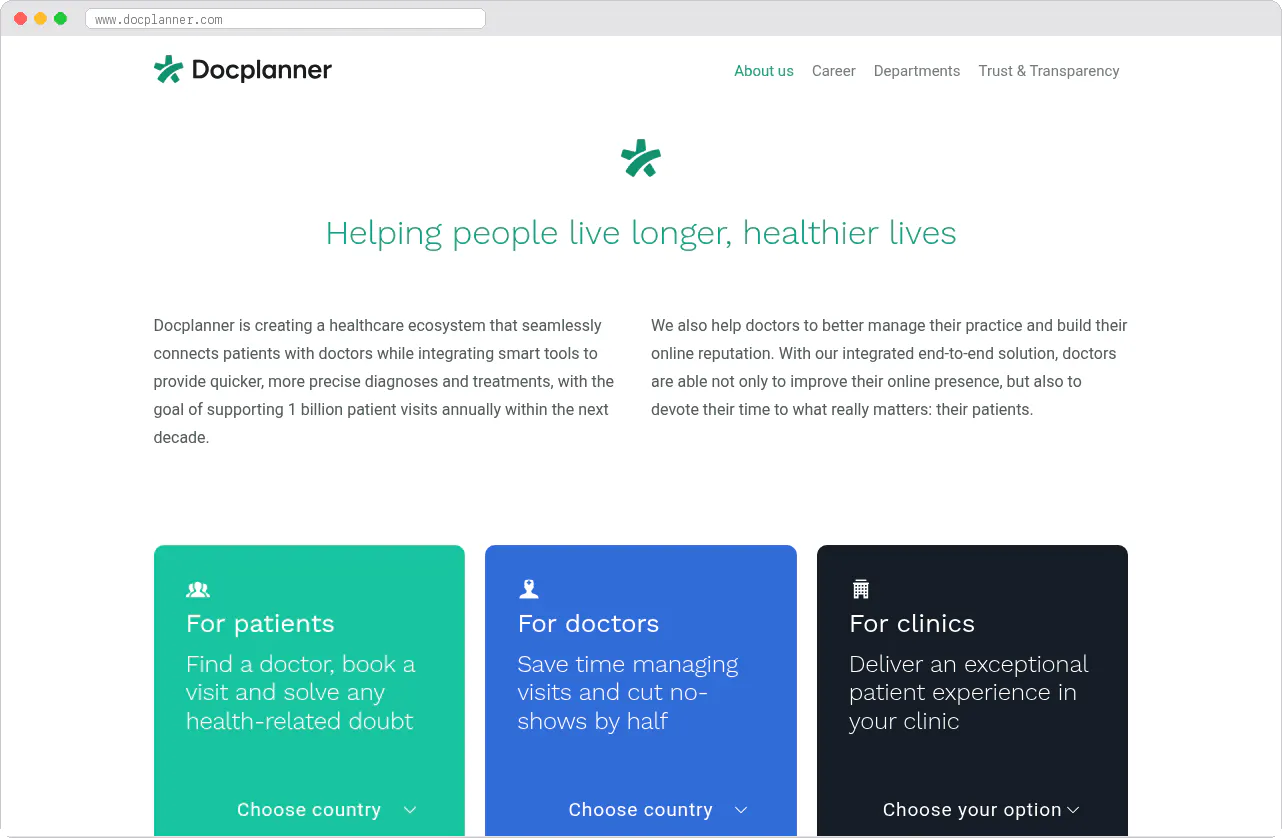
Docplanner operates across multiple European and Latin American markets, making it one of the largest healthcare booking platforms globally. Unlike Practo's full healthcare ecosystem approach, Docplanner focuses primarily on appointment booking and practice management. The platform serves over 90 million patients and 2 million healthcare professionals across 13 countries. Docplanner's strength lies in its international expansion strategy and strong presence in established healthcare systems, while Practo dominates in emerging markets with fragmented healthcare infrastructure.
Zocdoc pioneered online healthcare booking in the United States, focusing specifically on appointment scheduling with insurance verification. Zocdoc's business model relies heavily on subscription fees from providers rather than commissions, reflecting the different healthcare economics in the US market. The platform emphasizes insurance compatibility and same-day appointments, addressing specific pain points in American healthcare. However, Zocdoc hasn't expanded internationally as aggressively as Practo or Docplanner.
Veraclinic targets Southeast Asian markets, competing directly with Practo's international expansion. The platform focuses on medical tourism and cross-border healthcare, connecting patients with providers across different countries. Veraclinic's approach emphasizes price transparency and medical travel facilitation, serving patients seeking affordable healthcare options in neighboring countries.
1mg started as an online pharmacy in India but expanded into healthcare consultations and diagnostic bookings, creating direct competition with Practo's detailed approach. 1mg's strength lies in its medicine delivery network and integration between consultations and pharmacy services. The platform uses its pharmaceutical supply chain to create a more smooth healthcare experience, though its doctor network remains smaller than Practo's.
Apollo's digital platforms represent the hospital chain's digital transformation efforts, competing with Practo by using an established healthcare brand and physical infrastructure. Apollo's advantage lies in its owned hospital network and ability to provide continuity from online booking to in-person care. However, the platform primarily serves Apollo's own facilities rather than aggregating independent providers like Practo.
Each competitor has carved out specific advantages, but none have replicated Practo's combination of market penetration, feature comprehensiveness, and emerging market focus.
How to build a marketplace like Practo
Creating a successful healthcare marketplace requires a systematic approach that addresses both technical challenges and market dynamics unique to the healthcare industry.
Start with intensive market research and regulatory compliance. Healthcare marketplaces face complex regulatory requirements that vary substantially by geography. Research medical licensing requirements, patient privacy laws, telemedicine regulations, and prescription handling rules in your target market. In India, this includes understanding Medical Council regulations and Digital Information Security in Healthcare Act requirements. Consult healthcare lawyers early to ensure compliance frameworks are built into your platform architecture.
Validate demand through targeted patient and provider interviews. Healthcare purchasing decisions differ considerably from other services due to trust, urgency, and complexity factors. Interview potential patients about their current healthcare discovery process, booking frustrations, and technology comfort levels. Simultaneously, speak with healthcare providers about their patient acquisition challenges, scheduling inefficiencies, and technology adoption concerns. Focus on specific medical specialties initially rather than trying to serve all healthcare needs.
Choose your initial market focus carefully. Successful healthcare marketplaces typically start with a specific geographic area and medical specialty before expanding. Consider factors like healthcare provider density, patient technology adoption, existing digital health infrastructure, and regulatory complexity. Urban areas with high smartphone penetration and fragmented healthcare systems often provide the best starting conditions.
Build trust infrastructure before launching. Healthcare marketplaces live or die by trust, making verification and safety systems critical from day one. Implement solid doctor credential verification, requiring medical license validation, malpractice insurance confirmation, and ongoing monitoring. Create clear patient privacy policies, secure data handling procedures, and transparent review systems. Consider partnering with medical associations or established healthcare organizations to build credibility.
Solve the chicken-and-egg problem strategically. Healthcare providers are typically easier to onboard initially since they're seeking new patient acquisition channels. Start by recruiting a small number of high-quality providers in target specialties, possibly offering reduced fees or enhanced features during the early stage. Focus on providers who are already technology-forward and willing to experiment with digital patient acquisition.
Design for mobile-first usage patterns. Healthcare decisions often happen urgently and outside traditional desktop browsing times. Ensure your platform works smoothly on smartphones with good performance even on slower internet connections. Consider offline functionality for key features like viewing appointment confirmations or accessing basic provider information.
Implement proper medical communication standards. Healthcare conversations require different privacy and documentation standards than typical marketplace communications. Build HIPAA-compliant messaging systems, secure file sharing for medical documents, and proper consent management for information sharing between patients and providers.
Plan for payment complexity from the beginning. Healthcare payments involve insurance verification, copayment processing, claim submissions, and various provider payment preferences. Research payment processing solutions that understand healthcare transactions and can handle the complexity of medical billing and insurance integration.
Focus on quality metrics beyond typical marketplace KPIs. Healthcare marketplaces need to track medical outcome indicators, patient satisfaction with care quality, provider response times to urgent requests, and treatment follow-through rates. These healthcare-specific metrics often matter more than traditional transaction volume or revenue per user.
Prepare for rapid scaling challenges. Successful healthcare marketplaces can grow very quickly once they achieve initial traction, but scaling healthcare requires maintaining quality and trust at larger volumes. Build systems for provider onboarding at scale, automated credential verification, and quality monitoring across growing provider networks.
Cost and development considerations
Building a healthcare marketplace involves higher complexity and costs compared to typical service marketplaces due to regulatory compliance, security requirements, and integration needs.
Custom development approach typically requires $200,000 to $500,000 for a thorough healthcare marketplace with must-have features. Healthcare platforms need specialized functionality like HIPAA compliance, medical record integration, telemedicine capabilities, and insurance processing that generic marketplace solutions don't provide. Development timelines usually extend 12-18 months due to regulatory review, security implementations, and extensive testing requirements.
Key cost factors include:
- HIPAA-compliant infrastructure and data handling: $50,000-$100,000
- Telemedicine video consultation functionality: $30,000-$75,000
- Insurance verification and payment processing integration: $40,000-$80,000
- Medical credential verification systems: $20,000-$40,000
- Mobile applications with offline capabilities: $60,000-$120,000
Hybrid development approach combines pre-built marketplace foundations with healthcare-specific customizations, typically costing $100,000 to $250,000. This approach uses marketplace software as a base platform and adds healthcare-specific features through custom development. Timeline reduces to 6-9 months while maintaining necessary healthcare functionality.
**No-code marketplace platforms cost $99-399 per month in subscription fees, with total first-year costs of $2,000-5,000 including domain and setup. Some marketplace builders offer healthcare-specific templates and compliance features, though these may not meet all regulatory requirements for medical marketplaces.
Ongoing operational costs deserve special consideration in healthcare marketplaces:
- Compliance and security monitoring: $5,000-$15,000 monthly for security audits, compliance tracking, and data protection measures
- Customer support: Healthcare marketplaces require knowledgeable support staff who understand medical terminology and urgency levels, typically $10,000-$25,000 monthly
- Legal and regulatory: Ongoing legal consultation for regulatory changes and compliance updates, approximately $3,000-$8,000 monthly
- Insurance and liability coverage: Professional liability and cyber security insurance specifically for healthcare platforms, $2,000-$10,000 monthly depending on user volume
Third-party integration costs can considerably impact budgets:
- EMR (Electronic Medical Record) integrations: $20,000-$100,000 per major system
- Insurance verification APIs: $0.50-$2.00 per verification transaction
- Medical credential verification services: $15-$50 per provider verification
- Telemedicine infrastructure licensing: $0.10-$0.50 per consultation minute
Regulatory and compliance costs often surprise healthcare marketplace founders:
- Legal consultation for healthcare regulations: $25,000-$75,000 initially
- Privacy compliance audits: $10,000-$30,000 annually
- Medical malpractice insurance consultation: $5,000-$15,000
- Regulatory filing fees and licensing: Varies notably by jurisdiction
Budget at least 30-40% above initial estimates for healthcare marketplaces due to compliance requirements, security needs, and integration complexity that often exceed original projections. The regulatory nature of healthcare means unexpected costs frequently arise during development and early operations.
Consider phased development approaches that allow revenue generation before full feature completion. Many successful healthcare marketplaces started with basic appointment booking and added telemedicine, medical records, and insurance integration as revenue grew to fund additional development.
Frequently asked questions
What is Practo's business model and how does it make money?
Practo operates a two-sided healthcare marketplace connecting patients with healthcare providers. The company generates revenue through booking commissions (10-20% of consultation fees), subscription fees from providers for practice management tools, advertising from featured listings, partnership commissions from pharmacy and lab integrations, and telemedicine consultation fees.
How much does it cost to build a healthcare marketplace like Practo?
Building a healthcare marketplace requires $100,000-$500,000 depending on approach. Custom development costs $200,000-$500,000 with 12-18 month timelines. Hybrid approaches cost $100,000-$250,000 with 6-9 month development. Additional ongoing costs include compliance monitoring, specialized customer support, and regulatory consultation.
What are the key features needed for a Practo clone?
Important features include advanced provider search and filtering, detailed verified provider profiles, intelligent appointment scheduling, HIPAA-compliant messaging and telemedicine, digital health records management, insurance integration and payment processing, verified review systems, and provider administrative dashboards with practice management tools.
Who are Practo's main competitors in the healthcare marketplace space?
Practo's main competitors include Docplanner (Europe/Latin America focused), Zocdoc (US market leader), Veraclinic (Southeast Asia), 1mg (India pharmacy-turned-healthcare), and Apollo's digital platforms. Each competitor has different geographic focus and feature specializations compared to Practo's complete emerging market approach.
What makes healthcare marketplaces different from other service marketplaces?
Healthcare marketplaces require specialized compliance with medical regulations like HIPAA, verified provider credentialing, secure medical communication systems, insurance integration, and higher trust infrastructure. They also need different success metrics focusing on care quality and patient outcomes rather than just transaction volume.
How do I validate a healthcare marketplace idea before building?
Start with intensive market research on local healthcare regulations and compliance requirements. Interview both patients about healthcare discovery frustrations and providers about patient acquisition challenges. Focus on specific medical specialties and geographic areas initially. Partner with medical associations early for credibility and understand insurance requirements in your target market.
Start your 14-day free trial
Create a marketplace today!
- Launch quickly, without coding
- Extend infinitely
- Scale to any size
No credit card required