How to build a website like Verbling
Verbling connects language learners with professional teachers for live video lessons, generating $25+ million in revenue. This guide shows you how to build a similar language learning marketplace, from validating your niche to launching and scaling your platform.
Published: Mar 22, 2024
Last updated: Sep 11, 2026
What is Verbling and how does it work?
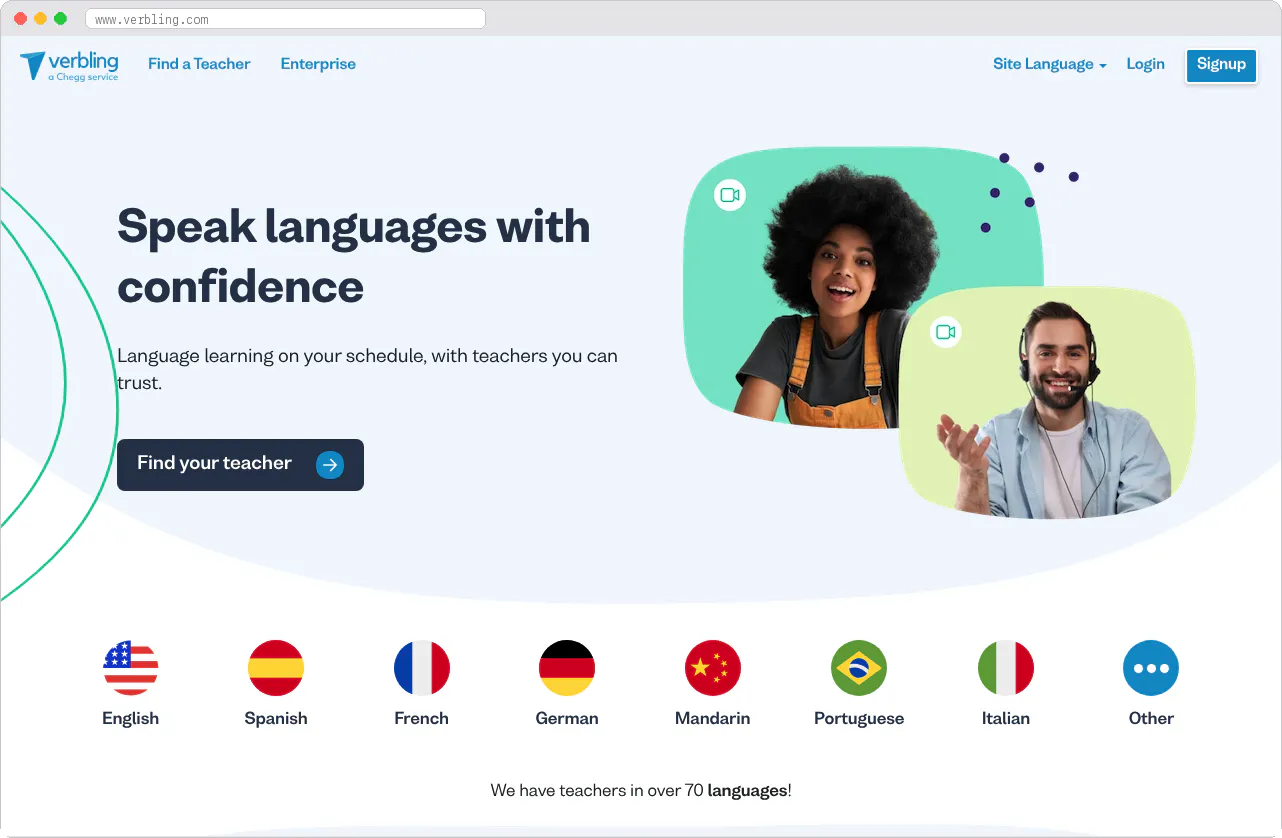
Verbling is an online marketplace that connects language learners with professional teachers for live, one-on-one video lessons. Founded in 2011 by Mikael Bernstein, Gustav Rydstedt, and Jake Jolis in San Francisco, the platform operates at significant scale and offers lessons in more than 70 languages (Verbling). Verbling was acquired by education company Livemocha's successor entities over the years and now operates as one of the more established names in the paid tutoring space, alongside italki and Preply.
The transaction flow is straightforward. Students browse teacher profiles, watch introduction videos, read reviews, and book a trial lesson (typically $10 to $15) before committing to a regular teacher. Teachers set their own hourly rates, generally $10 to $50 depending on language and experience, and manage their own availability calendars. Every lesson runs through Verbling's built-in video classroom, which includes screen sharing, an interactive whiteboard, and recording, so the platform owns the full learning experience rather than routing users to a third-party video tool.
How Verbling makes money
Verbling runs on a commission model. The platform takes a flat 15% commission on each lesson payment, regardless of how many lessons an individual teacher has completed (Verbling Support). Students pay upfront when they book, Verbling holds the funds, and the money is released to the teacher once the lesson is marked complete. This is a fairly standard "hold, then release" escrow pattern for service marketplaces where the buyer needs assurance the service will actually happen before their money moves.
Commission-based marketplaces built around recurring service relationships benefit from a compounding effect: a student who sticks with one teacher for six months generates six months of transaction volume from a single acquisition event. That's part of why language learning marketplaces can sustain relatively high commission rates without pushing users toward off-platform payment, since the platform's video classroom, scheduling, and payment convenience are worth continuing to pay for.
Beyond commission, platforms in this category typically add secondary revenue through lesson packages sold at a discount (which improve cash flow and lock in future bookings) and occasionally premium features for teachers, like boosted search placement or advanced scheduling tools. None of this is publicly broken out by Verbling in detail, so treat the commission figure as the core, verifiable mechanic and everything else as a plausible layer on top.
What makes Verbling work: key features
Integrated video classroom. Lessons happen inside Verbling's own video tool, not Zoom or Google Meet. That means screen sharing, a shared whiteboard, file sharing, and recording all live inside the same booking flow. Owning this experience, rather than handing students off to a third-party link, is what lets Verbling control lesson quality and capture usage data.
Teacher credentialing. Verbling requires teachers to show teaching experience or relevant qualifications before they can list. This is the single biggest differentiator from language-exchange or casual-tutor platforms, and it's why Verbling can sustain higher price points than apps built around informal conversation practice.
Trial lesson mechanic. Nearly every booking starts with a cheap trial lesson. This lowers the risk of a first purchase, gives students a low-stakes way to evaluate teacher fit, and gives Verbling a clean, trackable conversion metric (trial-to-repeat booking rate) that indicates whether a teacher-student match is likely to stick.
Escrowed, commission-based payments. Payment is collected before the lesson and released after, with the commission deducted automatically. Neither party has to invoice, chase payment, or negotiate refunds manually.
Two-sided reviews. Students rate teachers publicly, which drives search ranking and booking decisions; some marketplaces in this category also let teachers flag no-show or difficult students. Review integrity is what keeps a two-sided rating system useful rather than gameable.
Time-zone-aware scheduling. Because teachers and students are frequently on different continents, calendar tooling has to translate availability into each user's local time and support recurring weekly bookings, not just one-off appointments.
The competitive landscape
italki is Verbling's closest direct competitor and, by most measures, the larger platform. It supports both certified professional teachers and informal "community tutors," which lets it serve budget learners and premium learners on the same marketplace. That flexibility is also its weak point: quality varies a lot between a $6/hour community tutor and a $40/hour certified teacher, and new users sometimes struggle to tell which tier they're browsing. The opening this creates is a platform that commits fully to one tier of quality rather than blending both, which is exactly the positioning Verbling has taken.
Preply has expanded well beyond languages into math, music, and general academic tutoring, which broadens its addressable market to parents shopping for kids' tutoring, not just adult language learners. Preply also runs a more guided, algorithm-driven matching flow (it suggests teachers based on stated goals) rather than a pure browse-and-book model. The tradeoff is a less personal discovery experience and a marketplace that reads more like a lead-generation funnel than a curated teacher directory. That leaves room for platforms that lean into curated, human-feeling discovery instead of algorithmic matching.
Lingoda sells structured, small-group classes (three to five students) on a subscription, with a fixed curriculum that can lead to recognized certifications. This works well for learners who want classroom structure and a defined outcome, like exam prep, but it's a poor fit for anyone who wants personalized, one-on-one attention or flexible pacing. A one-on-one marketplace like Verbling's format directly serves the learners Lingoda's rigid format underserves.
Tandem isn't a paid-instruction marketplace at all. It's a language exchange app where users trade teaching their native languages for free. It captures a large volume of casual learners who aren't willing to pay for lessons, and it monetizes through premium features rather than transaction commission. It's not really competing for Verbling's paying customers, but it does compete for early-stage attention, since many learners try free exchange before deciding they need structured, paid instruction.
Cambly focuses narrowly on English conversation practice with native speakers, using an instant "drop-in" model instead of scheduled bookings. Its tutors don't need formal qualifications, which keeps supply abundant and prices low, but it also means Cambly isn't a fit for learners who want a structured curriculum or a credentialed teacher. This narrow, low-friction model shows there's real demand for on-demand, no-scheduling practice, an angle a Verbling-style platform doesn't currently serve.
Across all five, the pattern is that no single platform serves every combination of price point, structure, and credential level well. A new entrant's opening is almost always a specific combination: a specific language pair, a specific learning outcome, or a specific format (group, on-demand, or subscription) that the incumbents handle as an afterthought rather than a core feature.
How to build a marketplace like Verbling
1. Define your niche within language learning's category
You are not trying to out-build italki's teacher count or Preply's marketing budget. Pick a specific wedge: a language pair that's underserved (Verbling itself started narrow before expanding to 70+ languages), a learning outcome (business fluency, exam certification, accent reduction), a demographic (corporate teams, heritage-language learners, retirees), or a format (group micro-classes, async feedback plus live lessons). The narrower the initial wedge, the easier it is to recruit the right first teachers and speak directly to the right first students.
2. Validate demand and teacher supply before building
Talk to actual language learners in the communities where they already gather (language-learning subreddits, Discord servers, Facebook groups) about what frustrates them with existing options. Separately, talk to teachers currently on italki or Preply about their commission rates, payout speed, and student quality. If you can't find at least a handful of teachers who'd genuinely switch platforms for a better deal, the marketplace doesn't have a supply-side reason to exist yet.
3. Choose your development approach
Vibe coding from scratch. AI tools like Cursor, Lovable, and Bolt can produce a working Verbling-style prototype in a weekend: teacher profiles, a booking calendar, a basic video call embed. For pressure-testing a concept or showing early users a clickable demo, that's genuinely useful. For launching a platform that holds real payments between strangers before a video lesson even happens, it's probably not sufficient. What these outputs reliably don't produce is the infrastructure underneath: payment escrow that actually holds funds correctly, dispute resolution when a lesson doesn't happen, fraud detection, and compliance with payment regulations. A documented Sharetribe experiment ran 60+ hours to reach demo quality but revealed a critical checkout exploit that would have let any user manipulate transaction prices via a direct API call. Bringing that output to production standard takes significant additional time and a clear understanding of how the pieces fit together. Useful for prototyping, not a cost-effective path to launch.
Custom development from scratch. Hiring developers gives you full control over every detail, including a fully custom video classroom. A Verbling-type marketplace, with teacher credential verification, escrow, reviews, and dispute handling, sits in the production-grade tier: $80,000 to $200,000 over 16 to 28 weeks (Codica, RaftLabs). It lands there specifically because of teacher verification workflows, two-sided review moderation, and payment holds tied to lesson completion, not just a basic booking calendar. The low end of that range assumes offshore development teams at $15 to $40 an hour; a US or Western European team pushes you toward the top or past it. This route makes sense only if you have a specific technical requirement, like a proprietary teaching methodology or AI-driven lesson feedback tool, that no existing platform can support.
Building on a marketplace operating system like Sharetribe. You start at roughly 90% done on the standard marketplace foundation: payments, user accounts, listing management, messaging, transaction flows, fraud detection, and compliance. Your time and budget go toward the features that make your language-learning marketplace distinct, not the plumbing every marketplace needs anyway.
- No-code builder. Configure teacher profiles, lesson-length pricing, availability calendars, and a commission-based payment flow directly in the Sharetribe Console, no code required. This gets a founder to a live, bookable marketplace in weeks.
- AI-assisted development. Connect Claude Code, Cursor, or Codex to Sharetribe's open APIs and open-source template to build the parts that are unique to your positioning, like a custom video classroom integration, a teacher-matching quiz, or curriculum tracking. Because Sharetribe already handles payment infrastructure, this AI-assisted work carries much lower risk than building the whole payment and escrow layer from scratch.
- Custom code. Build directly on the developer platform for deeper integrations (a proprietary video tool, an LMS connection), or hire a specialist from Sharetribe's Expert Marketplace.
Most founders start with the no-code builder, launch, and add AI-built or developer-built features once real teachers and students tell them what's missing.
4. Solve the cold start problem
Language learning marketplaces face a classic two-sided cold start: students won't book on a platform with no credible teachers, and skilled teachers won't invest time building a profile on a platform with no students. Verbling solved this in its early days by hand-recruiting a small number of highly qualified teachers before opening the doors to students, which meant the platform's very first impression was already a premium one.
Three tactics work well for a new entrant. First, go supply-first: manually recruit 15 to 20 excellent teachers in your chosen niche before doing any student marketing, and personally onboard each one so their profile actually converts. Second, seed a specific community: if your wedge is business Spanish for tech employees, go find those exact learners in the exact Slack groups or LinkedIn communities where they already ask for recommendations. Third, do manual matching in the early days rather than relying on search and filters. If a student messages you looking for a teacher, personally connect them with the right one instead of waiting for your matching algorithm to be good enough. Launching small and tight, one language pair, one clear audience, beats launching broad with mediocre coverage of everything, because thin coverage produces bad first impressions on both sides.
5. Build the minimum viable booking flow
At minimum, you need teacher profiles with an introduction video, a searchable and filterable teacher directory, a booking calendar with time-zone conversion, integrated or embedded video calling, escrowed commission-based payments, and a two-sided review system. Resist the urge to build lesson packages, subscriptions, or a custom video whiteboard before you've proven that a single trial-to-regular-booking flow actually converts.
6. Launch and iterate on liquidity, not features
Once teachers and a first batch of students are live, the metric that matters most is liquidity: the rate at which students actually find and book a teacher, and the rate at which teachers get booked at all. Track trial-to-repeat-booking conversion, teacher utilization, and time-to-first-lesson for new signups. If liquidity is weak, the fix is almost never a new feature; it's usually better matching, more targeted teacher recruitment, or narrower positioning, not a longer feature list.
Do you need to build everything Verbling has?
No. Verbling's built-in video classroom, recording, and interactive whiteboard were built over more than a decade, and none of it needs to exist on day one. Most students will happily take a first lesson over a well-integrated Zoom or Google Meet embed if the booking, payment, and teacher-quality experience around it is solid. Build the marketplace mechanics first (listings, booking, payment, reviews) and add proprietary classroom tooling later, once you have real usage data telling you it's worth the investment.
The "I'll just vibe-code a clone" instinct is understandable but usually backwards. Even with a capable AI coding tool, you're starting from zero on payment escrow, refund logic, dispute handling, and fraud protection, the exact pieces most likely to break in a way that costs you real money or user trust. Starting on Sharetribe's foundation means that work is already done, tested, and compliant, so the AI tokens and developer hours you do spend go toward the features that actually differentiate your marketplace, like a teacher-matching quiz or a specialized curriculum tracker, instead of rebuilding a payment system from scratch.
Trust and safety for a language learning marketplace
The core trust risks in this category are teacher credential fraud (someone claiming qualifications they don't have), payment disputes (a lesson that didn't happen or wasn't as described), and no-shows on either side. Because lessons happen live over video with real money attached, both sides need confidence the transaction will resolve fairly even when something goes wrong.
Standard practice in this space includes some form of teacher vetting before listing approval (credential upload, a short video interview, or reference checks), a trial lesson mechanic that limits a student's exposure before committing, and a clear no-show and cancellation policy that's enforced consistently. Sharetribe provides the underlying pieces out of the box: escrowed payments that hold funds until a lesson is confirmed complete, structured transaction flows that can require both parties to confirm before money changes hands, and optional identity verification on user accounts. What founders need to add themselves is the actual credentialing policy (what qualifies someone to teach on your platform) and a documented process for handling disputes when a lesson goes wrong, since that policy is specific to your positioning and not something a generic platform can decide for you.
Running a marketplace like Verbling
Day-to-day operations for a marketplace like this center on teacher quality control, dispute handling, and payout management. At scale, Verbling manages thousands of teacher profiles, ongoing credential re-verification, review moderation, and customer support across many time zones and languages, none of which you need to replicate on day one with a few dozen teachers.
Sharetribe automatically handles the mechanical side: payment collection and payout splitting through Stripe, booking calendar logic, automated transaction notifications, and the underlying hosting and security infrastructure. That leaves you free to focus on the parts that actually require human judgment early on, like personally vetting your first teachers and manually resolving the occasional disputed lesson, rather than building and maintaining the plumbing yourself.
Development costs and timeline
Three realistic scenarios:
Vibe coding from scratch: Free or very cheap to start. A working Verbling-style prototype, teacher profiles, a booking calendar, an embedded video call, is buildable in a weekend with AI tools. What you can't get from here is a production-ready platform: correct payment escrow, refund and dispute logic, teacher credential verification workflows, and fraud protection all require work that AI coding tools don't shortcut. A documented Sharetribe experiment logged 60+ hours to reach demo quality and still found a critical payment vulnerability. A useful proof-of-concept tool, not a cost-effective path to a live business handling real money.
Custom development from scratch: A Verbling-type marketplace, with teacher credentialing, escrow, two-sided reviews, and dispute handling, falls in the production-grade tier: $80,000 to $200,000 over 16 to 28 weeks (Codica, RaftLabs). A stripped-down version without verification or dispute flows could land in the simple-MVP tier of $30,000 to $80,000 over 8 to 20 weeks, but that's a meaningfully thinner product. The low end of either range assumes offshore development teams; a US or Western European team pushes costs toward or past the top. Ongoing maintenance typically runs 15% to 25% of the original build cost per year on top of hosting. This route makes sense when you have a genuinely novel requirement, like a proprietary AI feedback tool, that no existing platform supports.
Building on Sharetribe: Subscription pricing starts at $99/month on the Lite plan, $199/month on Pro, and $299/month on Extend, all billed yearly. This covers the entire marketplace foundation, teacher profiles, booking calendars, escrowed commission-based payments, messaging, and reviews, that would otherwise sit in the $80,000-plus custom-build range. Most founders reach a live MVP in a matter of weeks rather than months, and any custom features (a proprietary video classroom, a curriculum tracker) get added later, scoped narrowly, because the transaction engine is already built and tested.
Why Sharetribe for building a marketplace like Verbling
Sharetribe's built-in booking management directly maps to Verbling's core mechanic: teachers set availability, students book in their own local time zone, and the calendar handles recurring weekly lessons automatically. Commission-based payments through Stripe Connect replicate Verbling's escrow model out of the box: students pay upfront, funds are held, and teachers get paid after the lesson minus your platform's commission, all without custom payment engineering. The built-in messaging system supports the pre-lesson coordination that keeps teacher-student relationships going between bookings, and native review functionality gives you the two-sided trust signal that lets students choose confidently. Because all of this is already built, tested, and compliant, your actual work is deciding on your niche, recruiting your first teachers, and building the one or two features that make your marketplace different from italki, Preply, or Verbling itself.
Frequently asked questions
How much does it cost to build a marketplace like Verbling?
It depends on your approach. A no-code foundation on Sharetribe starts at $99 a month, putting your first year in the low thousands of dollars. A custom-built, production-grade platform with credentialing, escrow, and dispute handling runs $80,000 to $200,000 and takes four to seven months with an agency or dev team.
How does Verbling make money?
Verbling takes a flat 15% commission on each lesson payment, so a teacher who charges $20 keeps $17 (Verbling Support). Students pay upfront, Verbling holds the funds, and the teacher is paid after the lesson is completed.
Should I recruit teachers or students first?
Recruit teachers first. A handful of excellent, credentialed teachers give a new platform credibility and something worth booking, while students who arrive to an empty or low-quality teacher directory won't come back. Aim for 15 to 20 qualified teachers in your niche before spending on student acquisition.
What is Verbling's biggest competitor?
italki is Verbling's closest direct competitor, offering a larger and more varied teacher base across professional and community tutors, but with more variance in lesson quality. Preply is a close second, competing more on algorithmic matching and cross-subject tutoring than on Verbling's premium, credentialed-teacher positioning.
Can I build a language learning marketplace without coding?
Yes. Sharetribe's no-code builder lets you configure teacher profiles, booking calendars, commission-based payments, and messaging without writing code, which is enough to launch a functioning marketplace. Video calling is typically added through an embedded third-party tool like Zoom until you have the volume to justify a custom classroom.
How long does it take to launch a marketplace like Verbling?
With a no-code builder like Sharetribe, a functioning MVP typically takes a few weeks to launch. Custom development from scratch for a production-grade platform with credentialing and escrow generally takes four to seven months.
Start your 14-day free trial
Create a marketplace today!
- Launch quickly, without coding
- Extend infinitely
- Scale to any size
No credit card required