How to build a marketplace website like StockX
StockX revolutionized sneaker and streetwear trading with its stock market-inspired marketplace model. Learn how their authentication system, commission structure, and bid-ask model work, plus how to build your own product authentication marketplace.
Published: Mar 2, 2026
Last updated: Mar 19, 2026
How does StockX work?
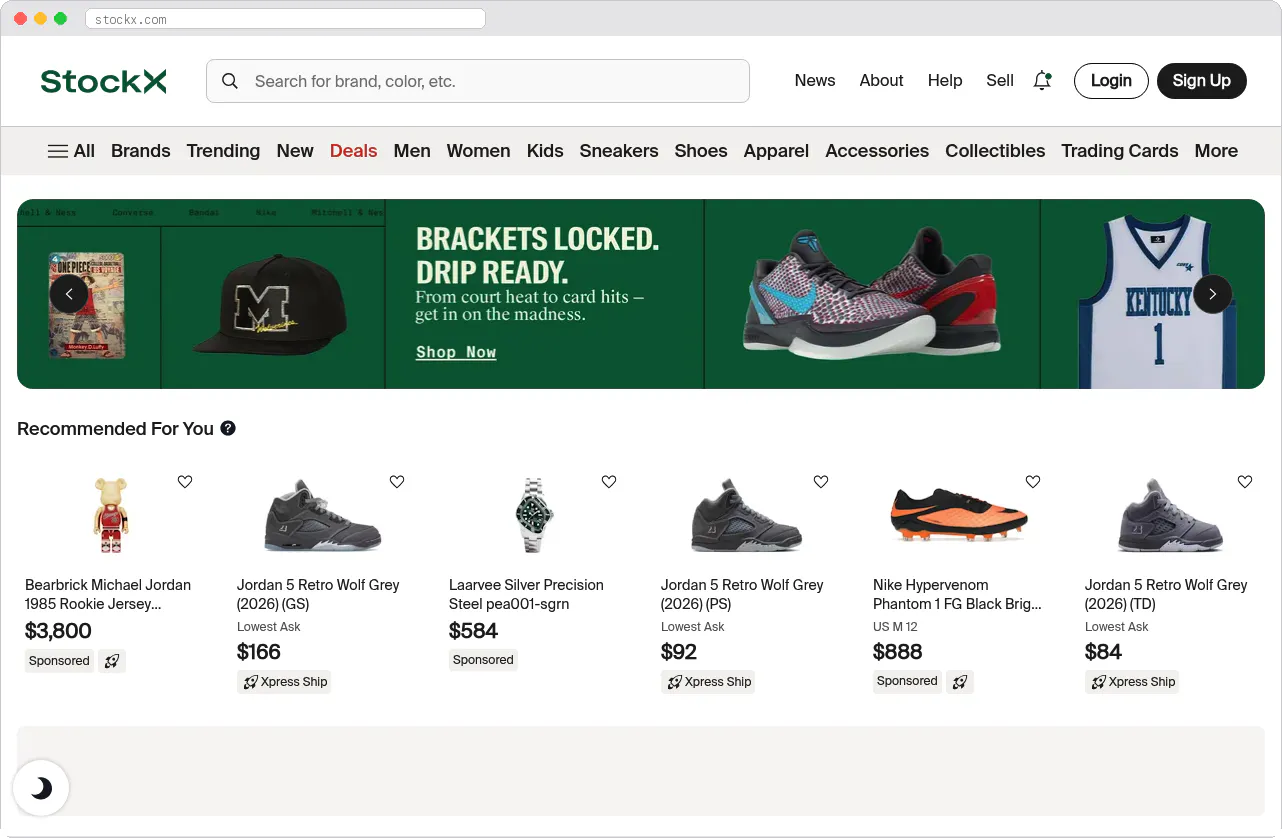
StockX operates as a two-sided marketplace that applies stock market principles to physical products, primarily sneakers, streetwear, electronics, and collectibles. Founded in 2016 by Josh Luber, Greg Schwartz, and Dan Gilbert in Detroit, the platform reimagined how people buy and sell limited-edition consumer goods.
Where conventional e-commerce marketplaces where sellers list items at fixed prices, StockX uses a bid-ask system similar to financial markets. Buyers place bids for products they want, while sellers set asking prices for items they're willing to sell. When a bid matches an ask, a transaction occurs, but the item doesn't go directly to the buyer.
Instead, sellers ship their items to StockX's authentication facilities. Every product undergoes a rigorous verification process by trained authenticators who check for authenticity, condition, and quality. Only after authentication does StockX forward the item to the buyer. This creates a three-way transaction: seller to StockX to buyer.
The platform displays real-time market data for each product, including current highest bid, lowest ask, recent sales history, and price trends over time. This transparency helps users make informed buying and selling decisions based on actual market conditions rather than arbitrary pricing.
Transaction flow on StockX:
- Listing phase: Sellers place asks (minimum prices they'll accept) for items they own
- Bidding phase: Buyers place bids (maximum prices they'll pay) for items they want
- Matching: When a bid meets or exceeds an ask, a sale is automatically executed
- Authentication: Seller ships item to StockX facility for verification
- Quality check: StockX authenticates and grades the item's condition
- Final delivery: If authentic, StockX ships to buyer; if not, item returns to seller
- Payment: Seller receives payment minus fees only after successful authentication
This model creates trust in a market historically plagued by counterfeits. The authentication barrier means buyers can purchase with confidence, while sellers gain access to a global marketplace of verified buyers.
How does StockX make money?
StockX employs a multi-revenue model centered on transaction fees, with additional income from premium services and strategic partnerships. The company has raised over $500 million in funding and was valued at approximately $3.8 billion in 2021, indicating substantial revenue generation.
Primary revenue streams:
- Seller fees: StockX charges sellers a commission ranging from 8.5% to 12.5% of the sale price, depending on seller level and product category. New sellers typically pay around 10% commission, while high-volume sellers can negotiate lower rates
- Buyer fees: Processing fees of 2.9% plus $0.30 are charged to buyers for payment processing
- Authentication fees: Built into the commission structure, this covers the cost of verification facilities and staff
- Premium memberships: StockX offers subscription tiers that reduce fees for frequent sellers
- Storage services: The company provides inventory storage for sellers who want to hold items at StockX facilities
Secondary revenue streams:
- Advertising and promotions: Brands pay for featured placements and promotional campaigns
- Data licensing: Market insights and trend data are valuable to brands, retailers, and investors
- International expansion: Currency conversion fees and regional partnerships
- Drop-offs and consignment: Some locations offer in-person authentication services
StockX reportedly processes over $2 billion in gross merchandise value annually, suggesting hundreds of millions in commission revenue. The authentication model allows them to charge premium fees because they're providing a service (verification) rather than just a platform.
The bid-ask system also creates additional value. Unlike fixed-price marketplaces where items might sit unsold, StockX's dynamic pricing ensures transactions happen when both parties find acceptable terms. This velocity benefits StockX through higher transaction volume.
What makes StockX successful?
StockX's success stems from solving fundamental problems in the secondary market for limited-edition goods through strategic innovations that create competitive moats.
Authentication as a core differentiator
The counterfeit problem in sneakers and streetwear was massive before StockX. Fake Air Jordans and Supreme items flooded marketplaces like eBay, making buyers hesitant to pay premium prices. StockX built authentication into their business model from day one, not as an add-on service.
Their authentication centers employ specialists trained to identify even smart counterfeits. This expertise becomes more valuable as counterfeiters become more advanced, creating a defensible moat that's difficult for competitors to replicate quickly.
Stock market psychology applied to physical goods
The bid-ask interface creates psychological engagement similar to stock trading. Users check price movements, set alerts, and track "portfolios" of items they own. This gamification increases user engagement and repeat usage.
Real-time market data also creates transparency that didn't exist before. Instead of wondering "what's a fair price," users can see actual transaction history and current market sentiment.
Network effects and liquidity
As more sellers join StockX, buyers have more selection and competitive pricing. As more buyers join, sellers have access to more demand and potentially higher prices. This two-sided network effect makes the platform more valuable as it grows.
Liquidity, the ease of buying or selling, improves with scale. Popular items on StockX often have multiple bids and asks, creating tight spreads and immediate transaction opportunities.
Supply chain and operational excellence
StockX invested heavily in logistics infrastructure, opening authentication centers globally to reduce shipping times and costs. Fast, reliable authentication and shipping create a better user experience than competitors who rely on peer-to-peer shipping.
Brand positioning and cultural relevance
StockX positioned itself within sneaker and streetwear culture rather than as a generic marketplace. Their marketing focuses on "deadstock" culture (unworn sneakers), limited drops, and the investment aspect of collectible goods.
This cultural alignment helped them become the default platform for serious collectors and resellers, creating brand loyalty that transcends just features or pricing.
Data advantage
By processing thousands of transactions daily, StockX accumulates valuable market data about pricing trends, demand patterns, and product performance. This data helps them optimize their own operations and creates additional revenue through insights and partnerships.
Key features of a StockX-like marketplace
Building a marketplace similar to StockX requires specific functionality designed around authentication, dynamic pricing, and trust between strangers trading high-value items.
Bid-ask order system
The core feature is a matching engine that pairs buyer bids with seller asks. This requires real-time price discovery, order queuing, and automatic transaction execution when prices align. The system must handle multiple bids per product, price priority ordering, and time-based bid expiration.
Users need clear interfaces to place and manage their orders, with real-time updates on their bid/ask positions relative to market activity.
Authentication workflow management
A complex workflow system manages the authentication process from seller shipment through final delivery. This includes:
- Shipping label generation and tracking integration
- Intake processing at authentication facilities
- Authenticator assignment and quality control
- Pass/fail decision workflows
- Photography and documentation of authenticated items
- Return shipping for failed authentications
- Final delivery coordination to buyers
Real-time market data and analytics
Users expect full market information including current highest bid, lowest ask, recent transaction history, price charts over time, and trading volume data. Advanced users want features like price alerts, portfolio tracking, and market trend analysis.
Product catalog with detailed specifications
Authentication requires precise product information. Your catalog needs detailed specifications, multiple product images, release information, retail prices, and variation tracking (sizes, colorways, conditions). Product pages must clearly show all market activity for that specific item.
Trust and verification systems
Beyond product authentication, user verification builds platform trust. This includes identity verification for sellers, buyer payment method verification, fraud detection systems, and reputation scoring based on transaction history.
Multi-party payment processing
The platform must hold buyer payments in escrow during authentication, release payment to sellers only after successful verification, handle commission calculations automatically, and manage refunds for failed authentications. International transactions require currency conversion and compliance with various payment regulations.
Inventory and logistics management
Back-end systems track items through the authentication pipeline, manage inventory at multiple facilities, coordinate with shipping partners, and provide tracking information to both buyers and sellers throughout the process.
Mobile-optimized experience
Many users access the platform primarily through mobile devices. The mobile experience needs full functionality for browsing, bidding, selling, and tracking orders, with push notifications for market updates and transaction status changes.
Competitors and alternatives
StockX operates in a competitive landscape with several players targeting different aspects of the authenticated resale market.
GOAT (Greatest of All Time)
GOAT is StockX's closest competitor, focusing primarily on sneakers with some expansion into apparel. Founded in 2015, GOAT uses a different model where sellers can list items at fixed prices rather than just using bid-ask dynamics. They also offer both new and used items, with detailed condition descriptions for pre-owned products.
GOAT's authentication process is similar to StockX, but they emphasize their "gently used" category, allowing sellers to list worn items with detailed condition reports. This expands their addressable market beyond just deadstock items.
Their mobile app focuses heavily on social features, allowing users to follow other collectors and see curated feeds of new releases and trending items.
Flight Club
Flight Club, which was acquired by GOAT in 2018, operates as a consignment-based marketplace. Sellers send items to Flight Club, which then lists them at fixed prices on behalf of the seller. This model appeals to sellers who prefer not to manage listings themselves but typically results in higher prices due to the consignment markup.
Flight Club also operates physical retail locations, creating an omnichannel experience that combines online marketplace dynamics with in-person shopping and authentication.
Vestiaire Collective targets luxury fashion and designer items rather than focusing on sneakers and streetwear. Their authentication process covers high-end clothing, handbags, and accessories from brands like Chanel, Louis Vuitton, and Hermès.
Their model includes both professional sellers (boutiques and consignment shops) and individual users. The platform emphasizes sustainability and circular fashion, appealing to environmentally conscious luxury consumers.
Grailed
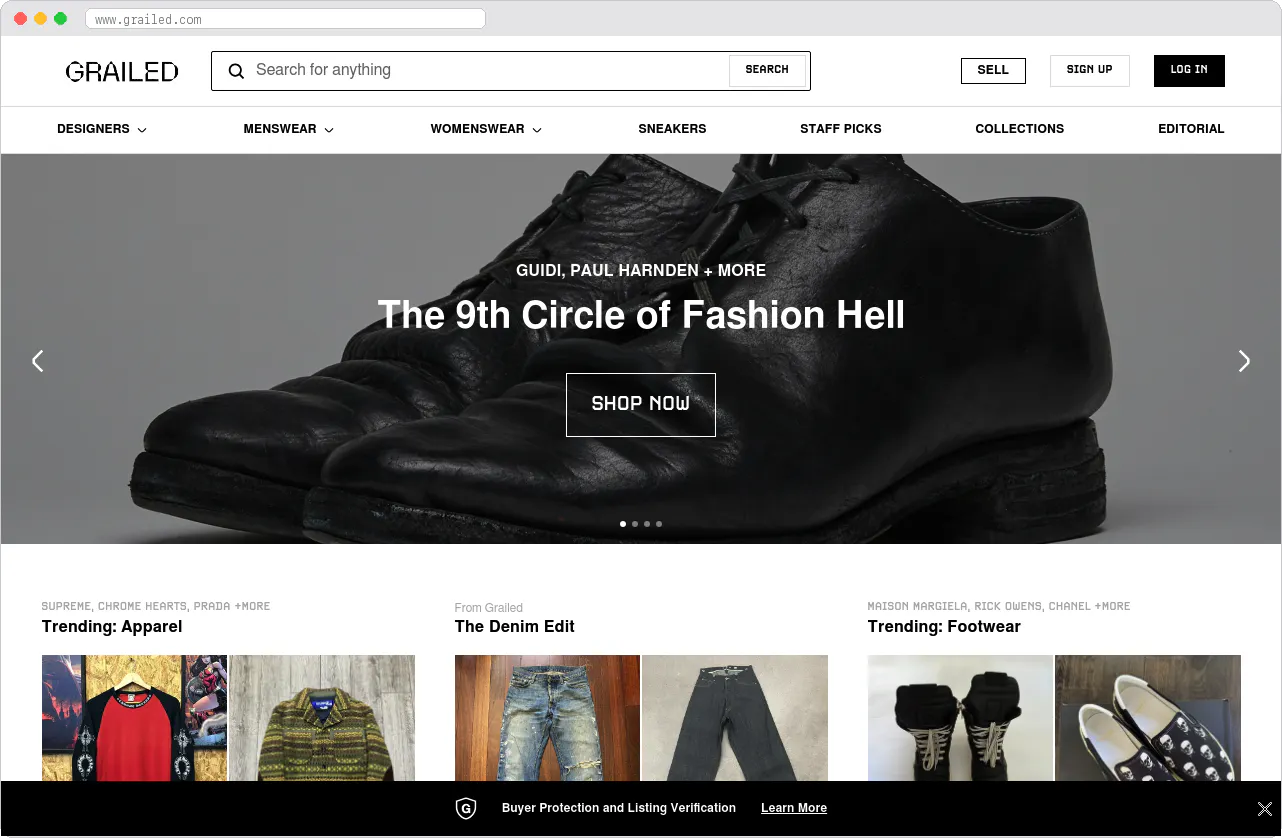
Grailed focuses on men's fashion and streetwear but uses a more traditional classified-style model. Sellers list items at fixed prices, and buyers can make offers. While they've added authentication services for high-value items, it's not mandatory for all transactions.
Grailed built a strong community aspect with user profiles, following systems, and editorial content about fashion trends and collecting.
The RealReal
The RealReal operates primarily as a luxury consignment business with both online and physical locations. They authenticate items before listing them and handle the entire selling process for consigners. This full-service approach appeals to sellers who want minimal involvement but typically results in lower payouts compared to direct selling.
Competitive differentiation strategies:
Each platform differentiates through product focus (sneakers vs. luxury fashion), transaction model (bid-ask vs. fixed price vs. consignment), authentication approach (mandatory vs. optional), and community features (social vs. purely transactional).
StockX's advantage lies in their stock market-inspired interface, thorough market data, and strong brand positioning within sneaker culture. However, competitors have found success by serving different customer segments or offering alternative transaction models.
How to build a marketplace like StockX
Building a successful authentication marketplace requires careful planning across technology, operations, and business strategy. Here's a step-by-step approach based on lessons from StockX and similar platforms.
Step 1: Define your niche and validate demand
StockX succeeded by focusing initially on sneakers before expanding to other categories. Choose a specific product category where authentication adds major value, typically limited-edition, high-value items with active secondary markets.
Research your target market's current pain points. Do counterfeits create trust issues? Is pricing transparent? Are current marketplaces serving this audience well? Validate that users would pay fees for authentication services.
Step 2: Develop authentication expertise
Authentication is your core value proposition, so invest in building real expertise before launching. This means:
- Hiring or consulting with authenticators who have deep product knowledge
- Developing detailed authentication guidelines and checklists
- Creating training materials and quality control processes
- Building relationships with brands, manufacturers, and industry experts
- Testing your authentication accuracy with known authentic and counterfeit items
Consider starting with a single product line to develop expertise before expanding.
Step 3: Choose your business model variations
While StockX uses pure bid-ask dynamics, you have several model options:
- Pure auction/bid-ask: Users only place bids and asks, transactions happen when they match
- Hybrid model: Allow both auctions and fixed-price listings
- Consignment model: Take possession of items and handle the entire selling process
- Authentication-on-demand: Optional authentication service for peer-to-peer transactions
Each model has different operational requirements and revenue implications.
Step 4: Build core marketplace functionality
Start with key features before adding advanced functionality:
- User registration and verification
- Product catalog with detailed specifications
- Basic bid/ask or listing functionality
- Order management and payment processing
- Simple messaging system for user communication
Step 5: Establish authentication operations
Authentication requires physical infrastructure and processes:
- Secure facility for receiving and processing items
- Authentication equipment and tools
- Staff hiring and training programs
- Photography setup for documenting items
- Shipping and receiving processes
- Quality control and error handling procedures
Start with a single location to prove your model before expanding geographically.
Step 6: Launch with limited scope
Begin with a small user base and limited product categories. This allows you to:
- Test and refine authentication processes
- Identify operational bottlenecks
- Gather user feedback on the interface and experience
- Build initial inventory and transaction volume
- Develop case studies and success stories
Step 7: Build trust and credibility
Authentication marketplaces live or die on trust. Focus on:
- Transparent authentication processes
- Clear error and return policies
- Responsive customer service
- User education about authentication criteria
- Building relationships within your product community
Step 8: Scale operations and expand
Once your model works in limited scope:
- Add more product categories based on user demand
- Open additional authentication facilities to reduce shipping times
- Expand geographically to new markets
- Add advanced features like market analytics and mobile apps
- Consider partnerships with brands, retailers, or complementary services
Common pitfalls to avoid:
- Underestimating authentication complexity: Building real authentication expertise takes time and investment
- Scaling too quickly: Rapid growth can overwhelm authentication operations and damage trust
- Ignoring unit economics: Authentication adds costs that must be covered by higher fees or volume
- Weak fraud detection: Bad actors will test your systems, invest in security early
- Poor user experience: Complex authentication workflows can confuse users if not designed well
Cost and development considerations
Building an authentication marketplace involves higher costs than typical marketplaces due to physical infrastructure requirements and specialized expertise.
Custom development approach
Technology costs:
- Initial development: $150,000 - $400,000
- Advanced features (real-time bidding, analytics): $50,000 - $150,000
- Mobile applications: $75,000 - $200,000
- Ongoing development and maintenance: $10,000 - $25,000 monthly
Operational costs:
- Authentication facility setup: $25,000 - $100,000
- Staff hiring and training: $50,000 - $150,000 annually per authenticator
- Shipping and logistics partnerships: $2,000 - $5,000 monthly base costs
- Insurance and security: $5,000 - $15,000 annually
- Photography and documentation equipment: $10,000 - $25,000
Hybrid approach (marketplace builder + custom features)
Technology costs:
- Marketplace platform subscription: $200 - $2,000 monthly
- Custom development for authentication workflows: $75,000 - $200,000
- Mobile app development: $50,000 - $150,000
- Third-party integrations (payments, shipping): $5,000 - $20,000
No-code/low-code approach
Technology costs:
- Marketplace platform: $100 - $1,000 monthly
- Workflow automation tools: $50 - $500 monthly
- Payment processing setup: $1,000 - $5,000
- Custom integrations: $10,000 - $50,000
This approach works for initial validation but may require migration to custom systems as you scale.
Ongoing operational expenses (all approaches):
- Payment processing: 2.9% + $0.30 per transaction
- Shipping costs: $5 - $25 per authentication (varies by geography)
- Staff costs: $40,000 - $80,000 per authenticator annually
- Facility costs: $5,000 - $20,000 monthly depending on location and size
- Insurance: $10,000 - $50,000 annually
- Marketing and user acquisition: $50,000 - $500,000+ annually
Revenue requirements for sustainability:
To cover a basic operation with one authentication facility and 2-3 staff members, you need approximately:
- Monthly gross merchandise value: $500,000 - $1,000,000
- Monthly transactions: 1,000 - 2,500 (depending on average order value)
- Break-even timeline: 12 - 24 months with adequate funding
Funding considerations:
Authentication marketplaces typically require substantial upfront investment before reaching profitability. StockX raised over $500 million across multiple funding rounds. Consider:
- Initial capital needs: $500,000 - $2,000,000 for first 12-18 months
- Working capital for inventory float during authentication
- Geographic expansion costs
- Technology development and maintenance
- Competition for talent in authentication and marketplace expertise
The authentication model creates higher barriers to entry but also stronger competitive moats once established. Success requires balancing operational complexity with user experience while building the trust necessary for high-value transactions.
Frequently asked questions
How does StockX make money from their marketplace?
StockX makes money primarily through seller fees of 8.5-12.5% per transaction, buyer processing fees of 2.9% + $0.30, and premium subscription services. They process over $2 billion in annual gross merchandise value.
What makes StockX's business model successful?
StockX succeeds through mandatory authentication of all items, a stock market-inspired bid-ask system that creates price transparency, and strong network effects as more users improve liquidity for everyone.
How much does it cost to build a marketplace like StockX?
Building a StockX-like marketplace costs $150,000-$400,000 for custom development plus $100,000+ for authentication facilities and staff. Ongoing costs include $10,000-$25,000 monthly for technology and $50,000+ per authenticator annually.
What are StockX's main competitors?
StockX's main competitors include GOAT (focuses on both new and used sneakers), Vestiaire Collective (luxury fashion), Grailed (men's streetwear), and The RealReal (luxury consignment with physical locations).
How does StockX's authentication process work?
Sellers ship items to StockX facilities where trained authenticators verify authenticity, condition, and quality. Only after passing authentication does StockX forward items to buyers and release payment to sellers.
What features does a StockX-like marketplace need?
Core features include a bid-ask matching system, authentication workflow management, real-time market data, detailed product catalogs, multi-party payment processing, and mobile-optimized interfaces for trading on the go.
Start your 14-day free trial
Create a marketplace today!
- Launch quickly, without coding
- Extend infinitely
- Scale to any size
No credit card required