How to build a pop-up retail marketplace like Storefront
Pop-up retail marketplaces connect brands with temporary retail spaces, generating millions in bookings annually. Learn how to build a platform that matches retailers with landlords, handles complex booking logistics, and scales globally.
Published: Dec 19, 2023
Last updated: Mar 19, 2026
How pop-up retail marketplaces work
Pop-up retail marketplaces solve a fundamental problem in commercial real estate: the mismatch between brands seeking temporary retail space and landlords with vacant or underutilized properties. These platforms function as booking engines for short-term retail, connecting everyone from established brands testing new markets to emerging designers needing affordable showcase space.
The business model centers on commission-based revenue. Marketplaces typically charge landlords a service fee ranging from 10-15% of the booking value, while some also charge brands a smaller booking fee. Unlike traditional real estate brokers who charge months of rent as commission, pop-up marketplaces focus on high-volume, short-duration transactions.
Storefront, the category leader, demonstrates the model's potential. Founded in 2013 by Erik Eliason and Tom Klein, the platform has facilitated over $2 billion in pop-up retail bookings across 15+ cities globally. The company identified that 30% of retail real estate sits vacant at any given time, while brands increasingly need flexible retail solutions for product launches, seasonal campaigns, and market testing.
What makes these marketplaces successful is their ability to standardize what was traditionally a complex, relationship-driven process. Before platforms like Storefront existed, securing temporary retail space required extensive networking, lengthy negotiations, and often personal guarantees. Pop-up marketplaces digitize this entire process, offering instant booking for spaces ranging from a few days to several months.
The timing coincided with broader retail trends. E-commerce brands needed physical touchpoints to build customer relationships, while traditional retailers sought flexibility to test new locations without long-term lease commitments. Meanwhile, landlords faced increasing vacancy rates and pressure to generate revenue from unused space.
Essential features for pop-up retail marketplaces
Building a successful pop-up retail marketplace requires specialized functionality that goes far beyond basic rental platforms. The complexity stems from managing both sides of the transaction, brands with sophisticated campaign needs and landlords with valuable real estate assets.
Advanced property listing and discovery
Property listings must capture details that matter specifically for retail activation. Unlike residential rentals where photos and basic amenities suffice, pop-up spaces need comprehensive documentation of retail-specific features. Successful listings include floor plans with exact dimensions, electrical capacity for lighting and equipment, HVAC capabilities, parking availability, and permitted uses under local zoning laws.
The search functionality requires sophisticated filtering beyond location and price. Brands filter by space type (street-level storefront, gallery, warehouse), duration availability, foot traffic data, demographic information about the surrounding area, and compatibility with specific industries. For example, food brands need spaces with proper ventilation and health department approvals, while fashion brands prioritize high-visibility locations with strong natural light.
Storefront's platform excels here by providing neighborhood analytics, including foot traffic patterns, competitor proximity, and seasonal trends. This data helps brands make informed decisions about location selection, moving beyond gut feelings to data-driven choices.
Complex booking and availability management
Pop-up bookings involve more complexity than simple calendar availability. Landlords often have specific requirements around setup and breakdown time, meaning a three-day pop-up might require five days of space unavailability. The platform needs to handle buffer periods, cleaning time between tenants, and coordination with existing long-term tenants.
Availability management also requires handling partial bookings and space sharing. Some landlords offer spaces during specific hours or allow multiple small brands to share larger spaces. The booking system must manage these scenarios while preventing double-bookings and ensuring proper access coordination.
Payment timing adds another layer of complexity. Unlike vacation rentals where payment at booking works fine, pop-up retail often involves deposits, milestone payments, and final settlements after the activation period. Successful platforms automate these payment schedules while providing clear financial tracking for both parties.
Brand verification and landlord protection
Pop-up retail marketplaces face unique trust challenges. Landlords risk property damage from inexperienced retailers, while brands invest significant money in spaces they've never physically visited. Robust verification systems become essential for marketplace success.
Brand verification typically includes business license validation, insurance requirement enforcement, and reference checking from previous pop-up activations. Some platforms require brands to submit detailed activation plans, including expected foot traffic, planned modifications to the space, and marketing strategies that might affect the surrounding area.
Landlord verification focuses on property ownership confirmation, proper permitting, and compliance with local business regulations. Platforms often require professional photography and detailed space documentation to ensure listings accurately represent what brands will receive.
Appear Here, Storefront's main competitor, implemented a tiered verification system where brands earn higher trust scores through successful activations, gaining access to premium spaces and better booking terms over time.
Insurance and liability management
Pop-up retail involves significant liability exposure for both parties. Brands bring valuable inventory and equipment into spaces, while landlords face potential property damage and liability for customer injuries during activations. Successful marketplaces don't just facilitate introductions, they provide comprehensive insurance solutions.
Most platforms offer marketplace-specific insurance products covering general liability, property damage, and inventory protection. Some partner with specialized insurers to offer coverage that activates automatically with each booking, removing the friction of traditional commercial insurance procurement.
The insurance integration needs to be smooth within the booking flow. Brands shouldn't need to research carriers or compare policies separately. The marketplace handles underwriting based on the specific activation details, providing instant coverage confirmation as part of the booking process.
Real-time communication and project management
Pop-up activations require extensive coordination between brands and landlords. Unlike vacation rentals where communication is minimal after booking, pop-up retail involves ongoing collaboration around space modifications, delivery coordination, utility setup, and marketing alignment.
Successful platforms provide dedicated project management tools within their messaging systems. This includes shared task lists, timeline management, vendor coordination, and documentation storage for permits and approvals. Both parties need visibility into activation progress and the ability to escalate issues quickly.
The communication tools must also handle multi-party conversations when activations involve multiple stakeholders. Large brands often work with agencies, contractors, and corporate teams, while landlords might involve property managers, building engineers, and legal teams.
Pop-up retail marketplace competitors and alternatives
The pop-up retail marketplace space features several distinct approaches, each targeting different segments of the temporary retail market. Understanding these competitors helps founders identify opportunities and positioning strategies.
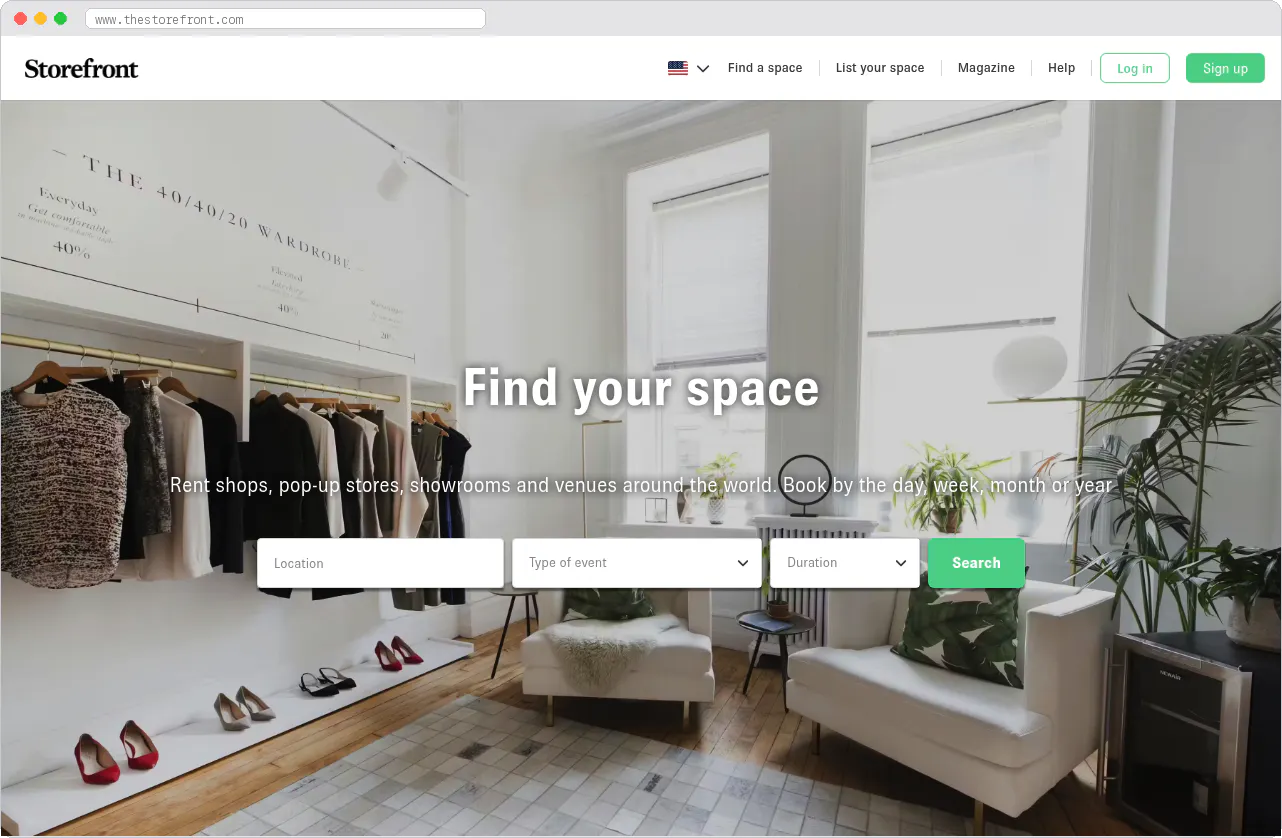
Storefront
Storefront dominates the premium pop-up marketplace segment, focusing on established brands and high-value retail spaces in major metropolitan areas. The platform emphasizes curated supply, working directly with landlords to onboard only spaces that meet strict quality standards for retail activation.
Storefront's strength lies in its full-service approach. Beyond space booking, they provide activation support including permit assistance, vendor recommendations, and post-event analytics. This makes them attractive to large brands willing to pay premium pricing for comprehensive service.
The platform generates revenue through landlord service fees typically ranging from 12-15% of booking value, plus additional charges for premium services. They've successfully scaled to over 15 cities globally while maintaining quality control through local market expertise.
However, Storefront's premium positioning creates opportunities for competitors. Their minimum booking values and extensive verification requirements exclude smaller brands and emerging retailers who need affordable access to temporary retail space.
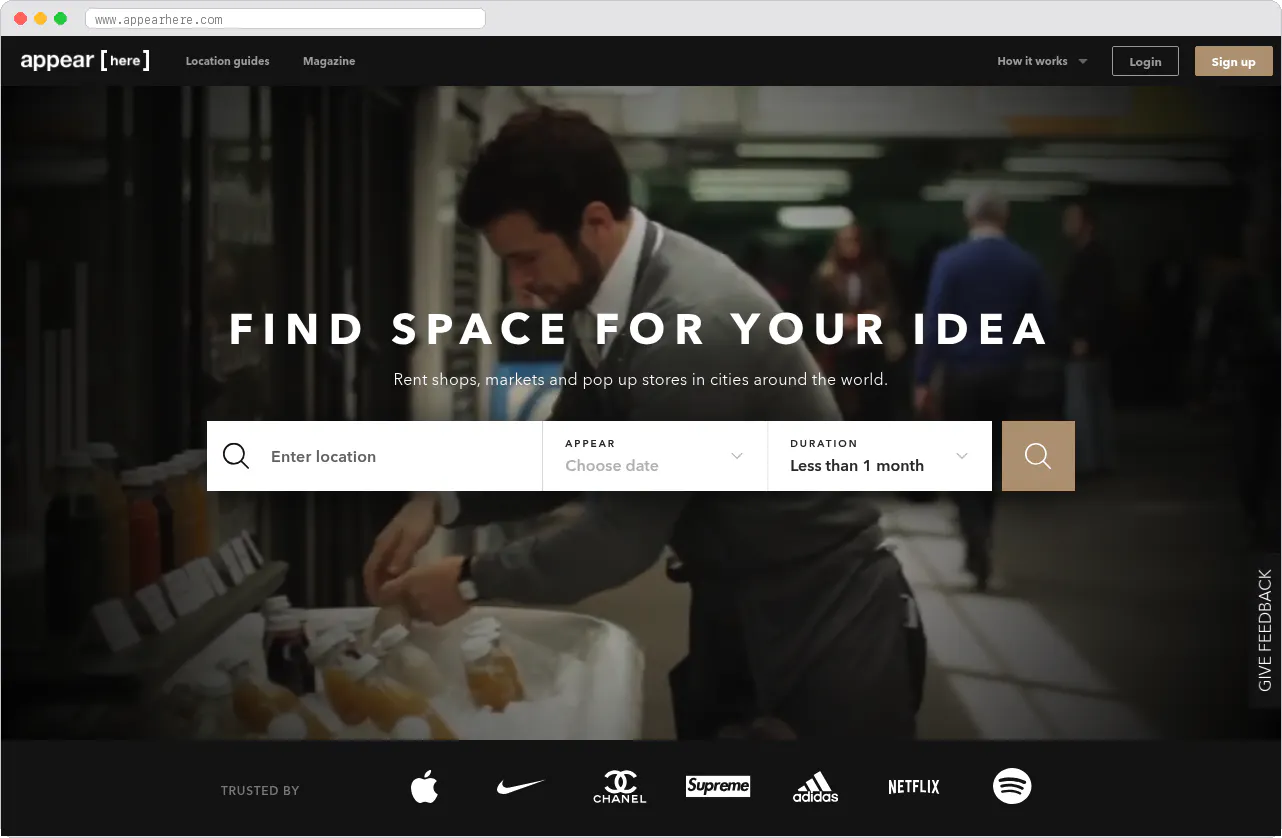
Appear Here
Appear Here takes a more accessible approach, lowering barriers to entry while maintaining marketplace quality. Founded in London, they've expanded across Europe with a model that accommodates both established brands and emerging retailers.
Their key differentiation lies in flexible booking terms and lower minimum commitments. While Storefront typically requires bookings of several weeks or months, Appear Here enables activations as short as a few days. This makes them attractive to brands testing concepts or running limited-time campaigns.
Appear Here also pioneered the "marketplace within a marketplace" concept, allowing multiple small brands to share larger spaces during coordinated events. This approach maximizes space utilization while reducing individual brand costs.
The platform uses a hybrid revenue model, charging both landlords and brands smaller fees rather than concentrating commission on one side. This approach reduces marketplace leakage since neither party bears the full fee burden.
Splacer
Splacer focuses on the broader "space-as-a-service" market, treating pop-up retail as one use case among many including events, meetings, and content creation. This diversified approach provides more inventory options but less specialized functionality for retail activations.
Their strength lies in inventory diversity and geographic coverage. Splacer's marketplace includes everything from traditional retail storefronts to unconventional spaces like rooftops, warehouses, and private homes that could work for certain retail concepts.
The platform appeals to creative brands seeking unique activation environments rather than traditional retail settings. Their booking process emphasizes flexibility and quick turnaround, making them attractive for last-minute campaigns and experimental concepts.
However, Splacer's broad focus means less specialized support for retail-specific needs like permitting, insurance, and activation logistics. Brands using Splacer typically handle these requirements independently.
Traditional real estate brokers
Despite marketplace growth, traditional commercial real estate brokers remain significant competitors, particularly for larger activations and longer-term pop-ups. Brokers offer personalized service and deep local market knowledge that standardized platforms can't match.
Brokers excel when activations require extensive customization, complex negotiations, or integration with long-term real estate strategies. They also provide valuable relationships with landlords who might not list spaces publicly on marketplaces.
The key disadvantage is efficiency and cost. Broker-mediated transactions typically take weeks or months to complete and involve commission structures designed for long-term leases rather than short-term activations.
Marketplaces compete by offering speed, transparency, and cost-effectiveness that brokers can't match for standardized short-term needs.
8 steps to build a pop-up retail marketplace
Building a successful pop-up retail marketplace requires a methodical approach that balances speed to market with the specialized functionality this industry demands. The following steps are based on successful marketplace launches and reflect the unique challenges of the pop-up retail space.
1. Define your niche within pop-up retail
The pop-up retail market encompasses diverse segments, from luxury fashion activations in Manhattan to food truck coordination at festivals. Successful marketplace founders start by identifying a specific niche rather than attempting to serve all pop-up needs immediately.
Examine the gap between existing platforms. Storefront serves premium brands in major cities, while Appear Here focuses on accessible options in secondary markets. Opportunities exist in underserved segments like food and beverage pop-ups (which have unique permitting requirements), outdoor retail activations, or specialized industries like beauty and wellness.
Geographic focus proves equally important. Rather than launching globally, successful founders target specific metropolitan areas where they can build dense supply and demand networks. This allows for hands-on relationship building with landlords and brands while developing local market expertise.
Consider user personas carefully. B2B marketplaces require different functionality than B2C platforms. Are you serving individual entrepreneurs testing retail concepts, or established brands running coordinated campaigns across multiple markets? Your niche definition should align with your team's expertise and network.
2. Validate demand through direct outreach
Pop-up retail marketplaces face a classic chicken-and-egg problem, but demand validation should focus on the brand side first. Brands actively seek pop-up opportunities and are more willing to try new platforms, while landlords typically wait for proven demand before listing premium spaces.
Start by identifying brands in your target segment through social media, industry events, and online communities. E-commerce brands frequently post about seeking pop-up opportunities on platforms like LinkedIn and industry-specific Facebook groups. Reach out directly to understand their current processes, pain points, and willingness to use a new platform.
Create a simple landing page describing your planned marketplace and collect email addresses from interested brands. This validates demand while building a launch audience. Include specific questions about booking frequency, budget ranges, preferred locations, and current booking methods.
Conduct in-depth interviews with 20-30 potential users to understand their specific needs. Ask about booking timelines (how far in advance they plan activations), decision-making processes, budget allocation, and success metrics. These insights shape feature priorities and business model decisions.
Don't neglect landlord validation, but approach it differently. Property owners are typically more conservative about new platforms, so focus on understanding their pain points with current tenant acquisition methods rather than asking them to commit to an unproven marketplace.
3. Build relationships with initial supply
Pop-up retail marketplaces succeed or fail based on space quality and availability. Unlike vacation rentals where individual property owners list independently, pop-up retail often requires building relationships with commercial property managers, retail landlords, and property development companies.
Start by mapping commercial real estate ownership in your target market. Many cities have public databases showing property ownership, which helps identify landlords with multiple properties suitable for pop-up retail. Focus on landlords with street-level retail space in areas with good foot traffic and brand alignment.
Approach landlords with a clear value proposition beyond just another revenue stream. Emphasize how pop-up activations can help market vacant spaces to long-term tenants, test market demand for different retail concepts, and maintain property visibility during vacancy periods.
Develop a landlord onboarding process that makes listing creation simple and comprehensive. This includes professional photography services, space measurement verification, and permit/zoning confirmation. Many landlords lack experience marketing to brands, so provide guidance on creating compelling listings.
Consider starting with a few high-quality spaces rather than maximizing inventory quantity. Brands judge marketplace quality based on their first booking experience, so ensuring early listings meet high standards protects your platform's reputation.
4. Create your minimum viable platform
Your initial platform should focus on core booking functionality while avoiding complex features that delay launch. The goal is validating your business model with real transactions, not building every feature you might eventually need.
Prioritize essential booking flow features: space discovery, availability checking, secure payment processing, and basic communication tools. Skip advanced features like integrated insurance, permit management, or analytics dashboards until you've validated demand for core functionality.
Design should emphasize trust and professionalism since you're facilitating high-value transactions between businesses. Include clear terms of service, transparent fee structures, and professional photography standards. B2B marketplaces require more detailed legal frameworks than consumer platforms.
Implement basic verification for both sides. Require business license information from brands and property ownership verification from landlords. This protects your platform's reputation while building trust between users.
Plan for manual processes initially. Customer support can handle complex booking coordination while you learn which features need automation. This approach reduces development costs while providing valuable user experience insights.
5. Price competitively while building trust
Pop-up retail marketplace pricing must balance attracting users with generating sustainable revenue. Most successful platforms charge landlords service fees ranging from 8-15% of booking value, with some charging additional fees to brands for premium services.
Start with lower fees to encourage early adoption, particularly on the supply side. Landlords often hesitate to try new platforms, so reducing their financial risk helps overcome initial resistance. You can gradually increase fees as your marketplace demonstrates value.
Be transparent about fee structures from day one. B2B users expect clear pricing information and will abandon platforms that aren't upfront about costs. Include fee calculations in booking confirmations and provide detailed invoicing.
Consider offering free additional services initially to build loyalty and differentiate from competitors. This might include basic insurance coordination, permit research assistance, or post-activation analytics. These services can become revenue streams once you've established market position.
Avoid complex fee structures that confuse users or create pricing disputes. Simple percentage-based fees on booking values work better than complicated formulas based on space size, duration, or brand size.
6. Launch with focused marketing
Pop-up retail marketplace marketing should target both sides of your marketplace, but brand acquisition typically drives initial growth since brands actively seek new opportunities while landlords respond to demonstrated demand.
Content marketing proves especially effective for reaching brands planning pop-up activations. Create resources about permit requirements, activation best practices, and market analysis for your target cities. This positions your platform as an industry expert while attracting organic search traffic.
Industry events provide concentrated access to your target audience. Attend retail conferences, pop-up showcases, and commercial real estate events where both brands and landlords gather. Sponsor relevant events or host your own networking sessions to build relationships.
Partner with complementary service providers like pop-up agencies, retail consultants, and event production companies. These partnerships provide referral sources while adding credibility to your platform.
Use social proof aggressively. Case studies of successful activations, landlord testimonials, and brand success stories build trust with potential users. Include specific metrics like booking conversion rates and repeat usage statistics.
7. Optimize based on user feedback
Pop-up retail involves complex logistics that reveal themselves only through real bookings. Early user feedback will highlight features you didn't anticipate needing and processes that require refinement.
Track booking completion rates and identify where users abandon the process. Common issues include incomplete property information, unclear fee structures, or missing verification steps. Address these systematically based on user behavior data.
Monitor customer support inquiries for patterns indicating missing platform features. If multiple users ask about insurance options, permit requirements, or vendor recommendations, these represent opportunities for platform development.
Implement feedback collection at multiple touchpoints: post-booking, post-activation, and during regular user surveys. B2B users are typically willing to provide detailed feedback if you make it easy and demonstrate responsiveness to their suggestions.
Prioritize features that reduce manual coordination between brands and landlords. Early platforms often require extensive customer support to coordinate bookings, but successful automation of these processes improves unit economics and user experience.
8. Scale strategically across markets
Pop-up retail marketplaces benefit from network effects within specific geographic markets, making strategic expansion more important than rapid geographic coverage. Focus on achieving market leadership in initial cities before expanding to new locations.
Expansion success depends on local market knowledge and relationships that can't be replicated remotely. Plan to establish local presence in new markets through partnerships, regional team members, or extensive travel during launch phases.
Develop a replicable playbook based on your initial market success. This includes landlord outreach strategies, brand acquisition tactics, local partnership development, and market-specific feature adaptations.
Consider expansion triggers like minimum booking volume, landlord density, or brand repeat usage rates. Expanding too quickly can dilute your team's focus and reduce service quality in existing markets.
International expansion requires additional complexity around payment processing, legal compliance, and local business practices. Domestic expansion typically provides better return on investment during early growth phases.
Cost considerations for building a pop-up retail marketplace
Building a pop-up retail marketplace requires balancing speed to market with the sophisticated functionality this industry demands. Cost considerations span initial development, ongoing operations, and scaling investments.
Custom development approach
Custom development for a pop-up retail marketplace typically ranges from $50,000 to $100,000 for initial launch functionality. This includes core booking features, payment processing, user management, and basic administrative tools. The wide range reflects complexity choices around features like integrated insurance, permit management, or advanced analytics.
Development costs increase significantly when including specialized features like automated insurance quoting, property verification services, or integration with commercial real estate databases. These features differentiate successful platforms but require substantial upfront investment.
Ongoing development costs for custom platforms include server hosting ($500-2,000 monthly), payment processing fees (typically 2.9% + $0.30 per transaction), security compliance, and feature updates. B2B marketplaces face higher hosting costs due to data storage requirements and uptime expectations.
Custom development timelines typically range from 4-8 months for initial launch, depending on feature complexity and team size. This timeline includes backend development, frontend design, payment integration, and testing phases.
No-code and hybrid approaches
No-code marketplace builders like Sharetribe enable much faster launch timelines while providing specialized marketplace functionality. Initial costs range from $79-299 monthly for platform access, with transaction fees ranging from 3.5-5% depending on plan selection.
Sharetribe includes built-in features essential for pop-up retail marketplaces: availability management, secure payment processing with commission handling, user verification systems, and messaging tools. This eliminates months of custom development while providing proven marketplace functionality.
The hybrid approach allows launching quickly with no-code tools, then adding custom features as your business validates specific needs. This approach reduces upfront risk while maintaining scalability options.
Transaction fees for no-code platforms are typically higher than custom payment processing but include marketplace-specific functionality like commission splitting, delayed payouts, and dispute management that would require significant custom development.
Operational cost considerations
Pop-up retail marketplaces incur unique operational costs beyond typical marketplace expenses. Insurance coordination, permit research, and property verification require either internal staff time or third-party service costs.
Customer support needs are higher than consumer marketplaces due to booking complexity and transaction values. Budget for dedicated support staff or outsourced support services capable of handling business-to-business inquiries.
Marketing costs typically focus on content creation, industry event participation, and relationship building rather than paid advertising. Budget $2,000-5,000 monthly for marketing during early growth phases.
Legal compliance requires ongoing investment in terms of service updates, local regulation monitoring, and contract template maintenance. Pop-up retail involves complex liability and property use agreements requiring legal expertise.
How Sharetribe enables pop-up retail marketplaces
Pop-up retail marketplaces require sophisticated booking functionality, secure payment processing, and trust-building features that Sharetribe provides out-of-the-box. Rather than spending months building marketplace basics, founders can focus on industry-specific features and relationship building.
Built-in booking and availability management
Sharetribe's calendar system handles the complex availability scenarios common in pop-up retail. Landlords can block out setup and breakdown periods around bookings, set different pricing for peak seasons, and manage partial availability for spaces that allow multiple simultaneous uses.
The booking flow includes custom field collection for retail-specific information like expected foot traffic, planned space modifications, and insurance requirements. This information helps landlords make informed decisions while providing brands a structured way to communicate their activation plans.
Automatic confirmation and payment collection reduce the manual coordination that often delays pop-up bookings. Brands can secure spaces immediately upon landlord approval rather than waiting for contracts and payment processing.
Commission-based payments with delayed payouts
Sharetribe's integration with Stripe Connect enables sophisticated payment scenarios essential for pop-up retail. The platform can collect deposits at booking, hold funds during activations, and release final payments after successful completion.
Commission handling is built into the payment flow, automatically deducting marketplace fees and distributing remaining funds to landlords. This eliminates the accounting complexity of managing commission payments separately.
The payment system supports multiple currencies and international transactions, enabling expansion into global markets without rebuilding payment infrastructure.
Trust and verification systems
Sharetribe's user verification features help build the trust essential for high-value B2B transactions. Landlords can require identity verification, business license uploads, and insurance documentation before approving bookings.
The two-way review system allows both brands and landlords to build reputation over time, helping users make informed decisions about future transactions. Reviews can include custom fields specific to pop-up retail like space accuracy, activation support, and neighborhood quality.
Messaging tools facilitate the extensive coordination required for pop-up activations while maintaining transaction history for dispute resolution and relationship building.
Scalability and customization options
Sharetribe's Developer Platform allows adding custom features as your marketplace grows. Early customizations might include integration with commercial real estate databases, automated insurance quoting, or permit research tools.
The API-first architecture enables building mobile apps, third-party integrations, or specialized tools for power users without rebuilding core marketplace functionality.
As transaction volume grows, Sharetribe's infrastructure scales automatically without requiring server management or performance optimization from your team.
This approach lets founders validate their pop-up retail marketplace concept quickly while maintaining long-term scalability and customization options. Rather than choosing between speed and sophistication, Sharetribe enables both through its hybrid no-code and developer platform approach.
Frequently asked questions
How much does it cost to build a pop-up retail marketplace?
Custom development typically costs $50,000-$80,000 with 4-8 month timelines. No-code platforms like Sharetribe enable launch for $79-299/month plus transaction fees, allowing validation before major investment.
What features are essential for a pop-up retail marketplace?
Core features include sophisticated property listings with retail-specific details, complex booking management with setup periods, secure payment processing with delayed payouts, verification systems for both brands and landlords, and integrated communication tools.
How do pop-up retail marketplaces make money?
Most charge landlords service fees of 8-15% per booking, with some charging additional fees to brands for premium services. Revenue models focus on transaction volume rather than subscription fees.
Who are the main competitors to Storefront?
Key competitors include Appear Here (more accessible pricing), Splacer (broader space categories), and traditional commercial real estate brokers. Each serves different market segments within pop-up retail.
Should I start with landlords or brands first?
Start with brand-side demand validation since brands actively seek pop-up opportunities while landlords typically wait for proven demand. Build initial supply relationships after confirming brand interest.
How long does it take to launch a pop-up retail marketplace?
No-code platforms enable launch in 2-4 weeks, while custom development requires 4-8 months minimum. Factor in additional time for building landlord relationships and initial supply acquisition.
Start your 14-day free trial
Create a marketplace today!
- Launch quickly, without coding
- Extend infinitely
- Scale to any size
No credit card required