How to build a website like JustAnswer
JustAnswer connects users with verified experts to get professional advice on demand. Learn how to build a similar expert marketplace, including essential features, business models, and the fastest way to launch.
Published: Nov 25, 2023
Last updated: Sep 18, 2026
What is JustAnswer and how does it work?
JustAnswer connects people with verified professionals, doctors, lawyers, mechanics, veterinarians, and dozens of other specialists, who answer questions for a fee. Founded in 2003 by Andy Kurtzig in San Francisco, the platform now provides about four million solutions a year and continues to generate strong subscription revenue (JustAnswer). It remains one of the longest-running examples of a paid, on-demand expertise marketplace still operating at scale.
The core insight behind JustAnswer is that most professional questions do not need a full consultation. A renter does not need to hire a lawyer for $250 an hour to understand one clause in a lease; a pet owner does not need an emergency vet visit to know whether a symptom is urgent. JustAnswer sells the answer, not the appointment, typically for $20 to $50, with premium or ongoing cases costing more. That pricing gap between "free but unreliable" (a forum post) and "expensive but certain" (a booked consultation) is the space the entire category lives in.
Users post a question, pick a category, and often see multiple experts respond; they can pick based on credentials and prior ratings. Experts, many of whom already have full-time practices, treat JustAnswer as flexible, in-between-clients income. The platform runs verification, payment processing, and dispute handling in the background so both sides can transact with strangers they'd otherwise have no reason to trust.

How JustAnswer makes money
JustAnswer runs on commission plus subscription, not commission alone. The company takes a cut of each question fee, commonly reported in the 20-50% range depending on category and expert tier, with the expert keeping the remainder (JustAnswer Expert Agreement). Straightforward per-question pricing (roughly $5-$20 for a basic question, more for follow-ups or urgent categories) captures one-time users.
The subscription layer is where the retention economics improve. Many categories offer a monthly membership that unlocks unlimited questions for a flat fee, appealing to small business owners with recurring legal or tax questions, or pet owners who ask several vet-adjacent questions a year. Subscriptions smooth revenue and reduce the marginal cost of repeat engagement, since a subscriber who asks five questions in a month is far more valuable than five separate one-off buyers acquired through paid search.
A third layer comes from premium add-ons: phone or video consultations, priority response times, and extended follow-up windows. These upsells raise average transaction value without requiring new expert acquisition, since the same expert base can offer tiered service levels. The combination, transactional commission plus recurring subscription plus upsells, is a template worth studying regardless of which category you enter, because it diversifies revenue away from any single pricing lever.
What makes JustAnswer work: key features
Credential verification at the account level. Every expert on JustAnswer goes through license and background checks before they can answer questions, and the platform states experts' credentials directly on their profile. This is the entire basis for premium pricing: users are not paying for an opinion, they're paying for a verified professional's opinion.
Multiple experts can respond to one question. Rather than routing a question to a single assigned expert, JustAnswer often lets several respond, and the user picks based on who answers first, most clearly, or with the strongest track record. This creates light competitive pressure among experts to be responsive and thorough.
Pay-upfront, escrow-style payment. Users pay before receiving a full answer, and funds are only released to the expert after the exchange is deemed satisfactory. This protects experts from working for free and gives users leverage to request clarification before finalizing payment.
Follow-up and clarification built into the flow. Advice questions are rarely one-and-done; users often need a second message once they've read the first answer. JustAnswer's threaded question format supports that back-and-forth instead of treating each question as a single isolated transaction.
Category-specific routing. With dozens of expert categories (legal, medical, veterinary, automotive, tech, home improvement, and more), the platform relies on structured categorization to get the right question in front of the right expert quickly, which matters more here than in most marketplaces because response speed is part of the value proposition.
Ratings tied to specific answer quality. Reviews focus on whether the answer was accurate, complete, and timely, not just a generic star rating, because "the plumber didn't answer my question well" and "the plumber was rude" are different problems that need different fixes.
The competitive landscape
Experts123 targets business-to-business consultations rather than personal advice, connecting companies with industry specialists for project-based work. It commands higher per-engagement pricing because the inquiries are commercial, but it has never reached JustAnswer's consumer scale or brand recognition. The opening this creates: a platform that combines JustAnswer's instant-answer speed with Experts123's B2B focus, for founders, freelancers, or small business owners who need quick professional input without booking a full consulting engagement.

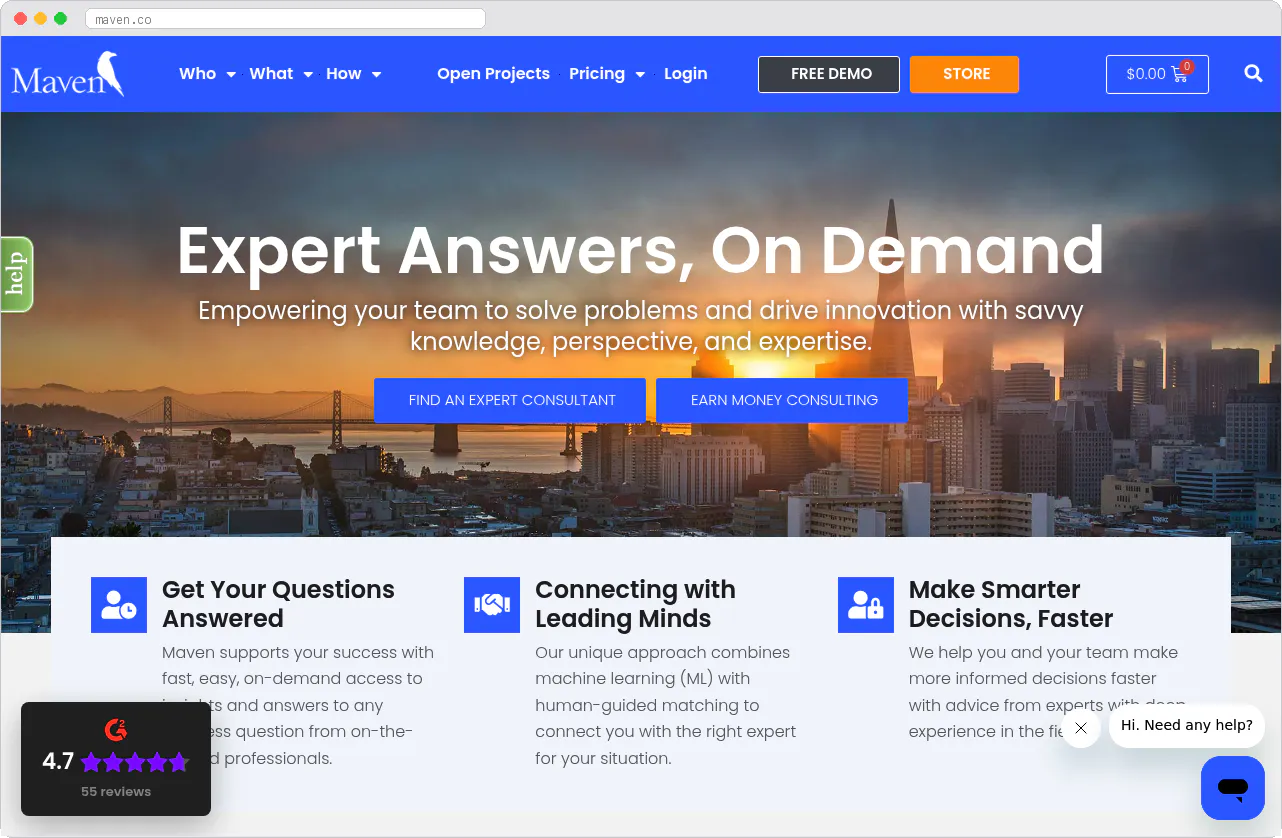
Maven positions itself around live video calls with experts rather than text-based Q&A, and it vets experts more rigorously, resulting in a smaller, higher-priced expert pool. It serves users who want a real conversation, not just an answer, and it competes more with coaching and mentorship markets than with quick-question marketplaces. The gap Maven leaves open is speed and price: not everyone wants or can afford a scheduled video call for a question that could be answered in three sentences.
Clarity focuses narrowly on startup and business advice through per-minute phone consultations with founders, investors, and operators. Its niche focus produces a more relevant expert pool for entrepreneurship questions specifically, but that same focus means it has nothing to offer outside business topics. A generalist competitor covering legal, medical, or technical questions doesn't threaten Clarity directly, but a rival focused on the same startup-advice niche would.
Quora and community forums like Reddit's r/legaladvice or r/personalfinance are the free alternative. They have far more scale and topical coverage than any paid platform, and many genuine professionals answer for free, out of reputation-building or habit. What they don't offer is any credential guarantee or accountability: an answer might come from a licensed attorney or from someone with strong opinions and no license at all. That uncertainty is exactly what paid, verified platforms like JustAnswer sell against.
LinkedIn has become an informal expert-access channel; users message professionals directly or post questions in groups. It offers no payment facilitation and no guaranteed response, but it does offer something JustAnswer can't: an ongoing professional relationship rather than a one-time transaction. That's a real trade-off, not a weakness, and it explains why LinkedIn competes for attention rather than for the same transaction.
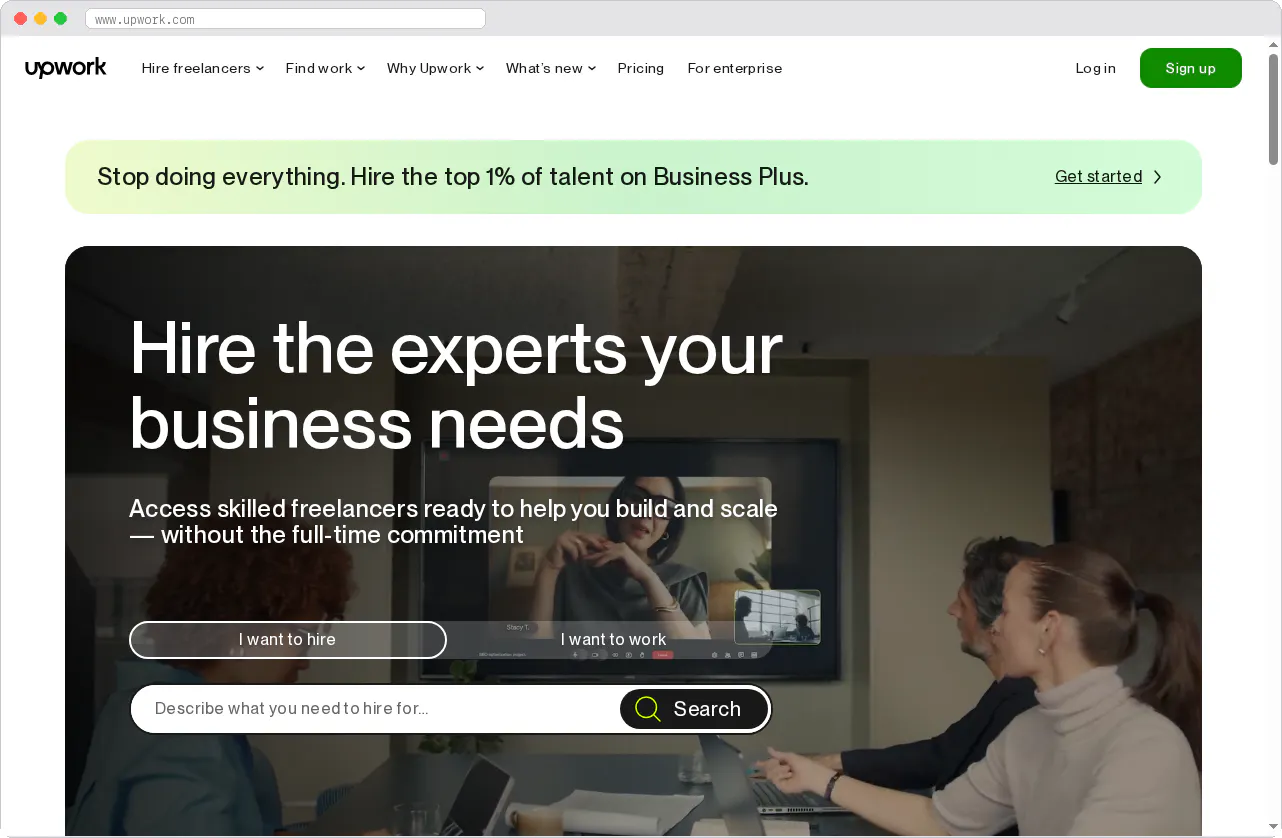
Upwork and Fiverr compete downstream: a JustAnswer-style quick question can escalate into a document review or ongoing consulting arrangement that gets fulfilled on a freelance platform instead. Both offer larger, more price-competitive global talent pools for actual project work, but neither is built for the "answer my question in the next hour" use case that defines the JustAnswer category.
Across all of these, the recurring opening is specialization. JustAnswer's breadth (dozens of categories under one brand) is also its weakness: expert quality and category depth vary, and no single brand can be the best-known name in law, medicine, auto repair, and pet care simultaneously. A new entrant that goes deep in one category, with better-vetted experts and content specific to that niche, has room to compete on trust and relevance even against JustAnswer's traffic advantage.
How to build a marketplace like JustAnswer
1. Define your niche within JustAnswer's category
You are not rebuilding a 20-category generalist platform on day one. Pick one vertical where you can recruit real depth of expertise and where users have a recurring, specific need: startup legal questions, small-animal veterinary triage, HVAC troubleshooting, or immigration paperwork questions are all narrower, more defensible starting points than "expert advice, generally." Narrow focus lets you build a reputation for one thing before you try to be known for everything.
2. Validate demand before recruiting anyone
Talk to 15-20 people in your target audience about how they currently get answers to the kind of question you're targeting. Are they paying a lawyer or accountant for something that could be answered in ten minutes? Are they posting in Facebook groups and getting inconsistent advice? If nobody currently pays for a workaround, a paid marketplace is a hard sell regardless of execution quality.
3. Choose your development approach
Vibe coding from scratch. AI tools like Cursor, Lovable, and Bolt can produce a working JustAnswer-style prototype quickly, complete with a question form, a payment button, and a basic expert list. For pressure-testing a concept or demonstrating it to early experts, that's genuinely useful. For launching a platform that handles real payments between strangers, it's probably not sufficient. What vibe-coded outputs reliably don't produce is the infrastructure underneath: payment escrow, dispute resolution, fraud detection, and compliance. A documented Sharetribe experiment ran 60+ hours to reach demo quality but revealed a critical checkout exploit that would have allowed price manipulation via direct API call. Bringing the output to production standard requires significant time, testing, and a clear understanding of how the different components of a web application fit together. A useful prototyping tool, not a cost-effective path to launch.
Custom development from scratch. Hiring developers gives you full control over the question flow, expert verification workflow, and payment logic. An expert advice marketplace typically lands in the production-grade tier, because credential verification, escrow payments, ratings, and dispute handling are not optional extras, they're the entire trust proposition. That places realistic costs at $80,000-$200,000 over 16-28 weeks (Codica, RaftLabs). The low end assumes an offshore team; a US or Western European team pushes toward the top. This makes sense once you have requirements no existing platform can meet, such as integrating with a specific professional licensing database or building a proprietary AI-assisted routing engine.
Building on a marketplace operating system like Sharetribe. You start at roughly 90% done on the standard marketplace foundation: payments, user accounts, listing management, messaging, transaction flows, fraud detection, and compliance. Your time and budget go toward the features that make an expert advice marketplace distinct. Three paths within this approach:
- No-code builder. Configure question categories, pricing tiers, expert profiles, and a booking-style flow for consultations directly from the Console, without writing code. This gets most founders to a live, transacting marketplace in weeks.
- AI-assisted development. Connect Claude Code, Cursor, or Codex to Sharetribe's open APIs and open-source template to build category-specific features, like a credential-upload verification step, a follow-up question thread, or automated routing based on expertise tags. Because Sharetribe already handles the payment infrastructure, AI-assisted development on top of it carries much lower risk than building from scratch.
- Custom code. Build directly on the developer platform for deeper integrations (professional licensing lookups, industry-specific document review tools), or hire from Sharetribe's Expert Marketplace.
Most founders start with the no-code builder, then add features via AI or a developer as they learn what their users actually need.
4. Solve the cold start problem
The chicken-and-egg problem here is sharper than in most marketplaces: users won't pay for access to a platform with no experts available, and experts won't spend unpaid time waiting for questions from a platform with no users. JustAnswer solved this early by recruiting experts directly, offering flexible, no-commitment participation so professionals could try answering a few questions with minimal downside, and it built demand through search-driven content that answered common questions and funneled readers toward paid follow-up.
For a new entrant, three tactics work well. First, go supply-first: recruit 10-20 credentialed experts in your niche before you spend a dollar on user acquisition, even if you have to offer reduced commission or a small guaranteed payment for the first few weeks. Second, seed demand through a tight geographic or community channel, a local business association, a professional forum, or a niche subreddit, rather than broad paid ads that will convert poorly with an empty expert bench. Third, consider manually matching the first dozen questions yourself, personally reaching out to an expert when a question comes in, so early users get a fast, good answer even before your routing system is automated. Launching small and tight, one niche, one channel, a handful of experts, beats launching broad and thin, because a user who gets a great answer on day one becomes your best source of word-of-mouth.
5. Set pricing and expert compensation
Decide upfront whether you charge per question, offer subscription access, or both. A simple per-question fee ($15-$40 depending on complexity) is easiest to explain to new users; a subscription unlocking unlimited questions makes more sense once you have repeat-need users like small business owners. Set your commission rate (JustAnswer's 20-50% range is a reasonable benchmark) and be transparent with experts about it before they list, since undisclosed fee structures are the fastest way to lose expert trust.
6. Launch with narrow, high-intent marketing
Target users actively searching for an answer to a specific problem, not generic brand awareness. Long-tail SEO content ("can I break my lease if the landlord ignores repairs" or "is this rash something to worry about") captures people mid-question, ready to pay for a fast, credible answer. Partnerships with adjacent, non-competing businesses, an accounting firm referring legal questions, a vet clinic referring non-emergency triage questions, can supply warmer traffic than paid ads.
7. Build the reputation loop
Once experts start answering, make ratings visible and specific (accuracy, timeliness, clarity) rather than a single star score. Encourage users to leave detailed feedback and surface your best-rated experts prominently, since expert reputation is the main thing differentiating your platform from a free forum. This loop is what eventually lets you raise prices and be selective about which experts you keep.
Do you need to build everything JustAnswer has?
No. JustAnswer's 20+ expert categories, its own mobile apps, and its large in-house content and SEO operation were built over more than two decades, not at launch. At launch, you need one working category, verified experts, a clean question-and-answer flow, and reliable payment processing. Everything else, additional categories, video consultation, a mobile app, is a scaling decision you make once your first category proves it can retain paying users.
The instinct to "just vibe-code a clone" is understandable given how fast AI tools can produce a convincing demo, but it skips the part of the platform that actually carries risk: money moving between strangers. Starting on a marketplace operating system like Sharetribe is faster even with AI tools in the mix, because the payment escrow, user accounts, and compliance groundwork are already built and tested. Your AI coding budget then goes toward the parts that make your platform distinct, like a specialized credential-verification step or a niche-specific routing system, rather than toward reinventing checkout logic that a vibe-coded prototype got wrong the first time.
Trust and safety for a JustAnswer-type marketplace
The core trust risk in expert advice marketplaces is credential fraud: someone claiming to be a licensed doctor, lawyer, or mechanic without the qualifications to back it up. Because users can't verify credentials themselves before paying, your verification process has to do that work for them, checking license numbers against public registries, requesting proof of certification, and re-verifying periodically rather than once at signup. A second risk is liability: advice that's wrong or harmful, particularly in medical, legal, or financial categories, can expose both the expert and the platform to real consequences, which is why content moderation and clear terms-of-service disclaimers (this is informational guidance, not a substitute for an in-person licensed relationship) matter more here than in most marketplace categories.
Sharetribe provides payment escrow (funds held until a transaction is marked complete), user accounts with optional identity verification, secure in-platform messaging, and configurable transaction flows out of the box. What you need to add is category-specific: a credential-upload and license-verification step during expert onboarding, a review structure that captures accuracy and completeness rather than generic satisfaction, and a moderation policy (with human review for flagged answers) tailored to the liability profile of your specific niche. A legal-advice marketplace needs stricter disclaimers and moderation than one covering appliance repair questions, so build your trust and safety investment proportional to the real-world stakes of a wrong answer in your category.
Running a marketplace like JustAnswer
Once live, your daily operations center on three things: keeping experts responsive, monitoring answer quality, and handling the occasional dispute. JustAnswer at scale runs dedicated teams for expert recruitment, content moderation across dozens of categories, and customer support, none of which you need to replicate on day one with a handful of experts in one niche. Your early job is closer to community management: checking in with experts, reading through answers for quality, and personally resolving the first disputes so you understand where your policies need clarification.
Sharetribe handles the parts that would otherwise consume your engineering time: payment processing and payouts, server infrastructure, security updates, and the underlying compliance work for handling money across a marketplace. That leaves your actual operating hours free for the parts that are still manual at small scale, expert quality control and user support, which is exactly where a young marketplace's differentiation gets built.
Development costs and timeline
Three realistic scenarios:
Vibe coding from scratch: Free or very cheap to start. A working JustAnswer-style prototype, a question form, a basic expert directory, a payment button, is buildable in a weekend with AI coding tools. What you can't get from here is a production-ready platform: credential verification workflows, escrow that correctly holds and releases funds, dispute handling, and fraud protection against manipulated pricing or fake expert accounts all require work that AI coding tools don't shortcut. A documented Sharetribe experiment logged 60+ hours to reach demo quality and found critical payment vulnerabilities. A useful proof-of-concept tool, not a cost-effective path to a live business.
Custom development from scratch: Cost depends on complexity tier, and an expert advice marketplace with credential verification, escrow, ratings, and dispute flow sits in the production-grade tier: $80,000-$200,000 over 16-28 weeks (Codica, RaftLabs). The low end assumes offshore teams; US or Western European teams push toward the top of that range. This is the right investment when you have requirements no existing platform can meet, like a proprietary AI-based question-routing engine or a deep integration with a professional licensing authority. Ongoing maintenance typically runs 15-25% of the original build cost per year, on top of hosting.
Building on Sharetribe: Before you launch, the Sharetribe Build plan costs just $39/month. To open to real users, you need the Live plan, which costs $199/month billed yearly ($259/month billed monthly). Both plans include 1 million usage credits per month. Sharetribe covers the transaction engine, payments and payouts, user accounts, messaging, listing management, and the compliance groundwork an expert advice marketplace needs, so your build time goes toward category-specific features like credential verification steps and follow-up question threads rather than payment plumbing. Most founders reach a live MVP in weeks rather than months, and custom features added via AI tools or a developer stay narrowly scoped because the core transaction engine is already built and tested.
Why Sharetribe for building a marketplace like JustAnswer
Sharetribe's flexible transaction types support both fixed-price, one-time questions and ongoing, time-based consultations, which maps directly onto how expert advice marketplaces actually charge for service. Built-in secure messaging keeps the entire question-and-answer thread on-platform, which matters both for quality control and for preventing users and experts from moving transactions off-platform to avoid commission. Payment escrow releases funds to experts only after a question is marked resolved, mirroring the pay-upfront, deliver-then-release model that gives users confidence to pay before they see a full answer.
The Console lets you configure category structures, pricing tiers, and commission rates without engineering time, so you can test whether your chosen niche (legal, veterinary, technical, or otherwise) has real paying demand before investing in custom verification workflows. As you learn what your specific niche requires, whether that's an integration with a licensing database or a specialized document-upload flow for legal review, you add those features through AI-assisted development or a developer on top of a foundation that's already handling payments and compliance correctly.
Frequently asked questions
How much does it cost to build a website like JustAnswer?
It depends on your approach. A Sharetribe subscription starts at $39/month on the Build plan ($199/month billed yearly on the Live plan once you go live) and gets a niche expert advice marketplace live in weeks. Custom development for a production-grade platform with verification, escrow, and dispute handling runs $80,000-$200,000 over 16-28 weeks (Codica). Vibe-coded prototypes are nearly free but aren't safe to launch with real payments.
How does JustAnswer make money?
JustAnswer takes a commission, typically reported in the 20-50% range, on each paid question, with the expert keeping the rest (Wallet Hacks). It supplements that with subscription plans for unlimited questions in certain categories and premium add-ons like phone consultations and priority response.
What features do I need for an expert advice marketplace?
You need credential verification for experts, secure messaging that supports follow-up questions, escrow-based payment that releases funds after satisfactory answers, and a rating system that captures accuracy and timeliness specifically, not just generic satisfaction. Content moderation is also essential given the liability involved in professional advice categories.
Can I compete with JustAnswer in 2026?
Yes, most realistically by going narrow. JustAnswer's breadth across dozens of categories is also a weakness, since expert depth and quality vary category to category. A platform focused on one vertical, with better-vetted experts and content specific to that niche, can win on trust and relevance even without JustAnswer's traffic.
Is vibe coding a viable way to launch an expert advice marketplace?
It's useful for a demo or pitch, but not for a live platform handling real payments. A documented 60-hour Sharetribe experiment produced a working-looking prototype that still had a checkout exploit letting users manipulate transaction prices directly through the API. Payment escrow, credential verification, and dispute handling need to be built correctly before you take real money from real users.
What's the biggest challenge in launching a JustAnswer-style marketplace?
The cold start problem: users won't pay without experts available, and experts won't wait around without paying users. Most successful entrants solve this by recruiting a small group of credentialed experts first, often with reduced commission or guaranteed minimum pay for the first few weeks, before spending anything on user acquisition.
Start your 14-day free trial
Create a marketplace today!
- Launch quickly, without coding
- Extend infinitely
- Scale to any size
No credit card required