How to build a website like Outschool
Outschool revolutionized children's education by creating a marketplace where independent teachers offer live online classes. This guide shows you how to build your own educational marketplace using their proven business model.
Published: Nov 27, 2023
Last updated: Sep 18, 2026
What is Outschool and how does it work?
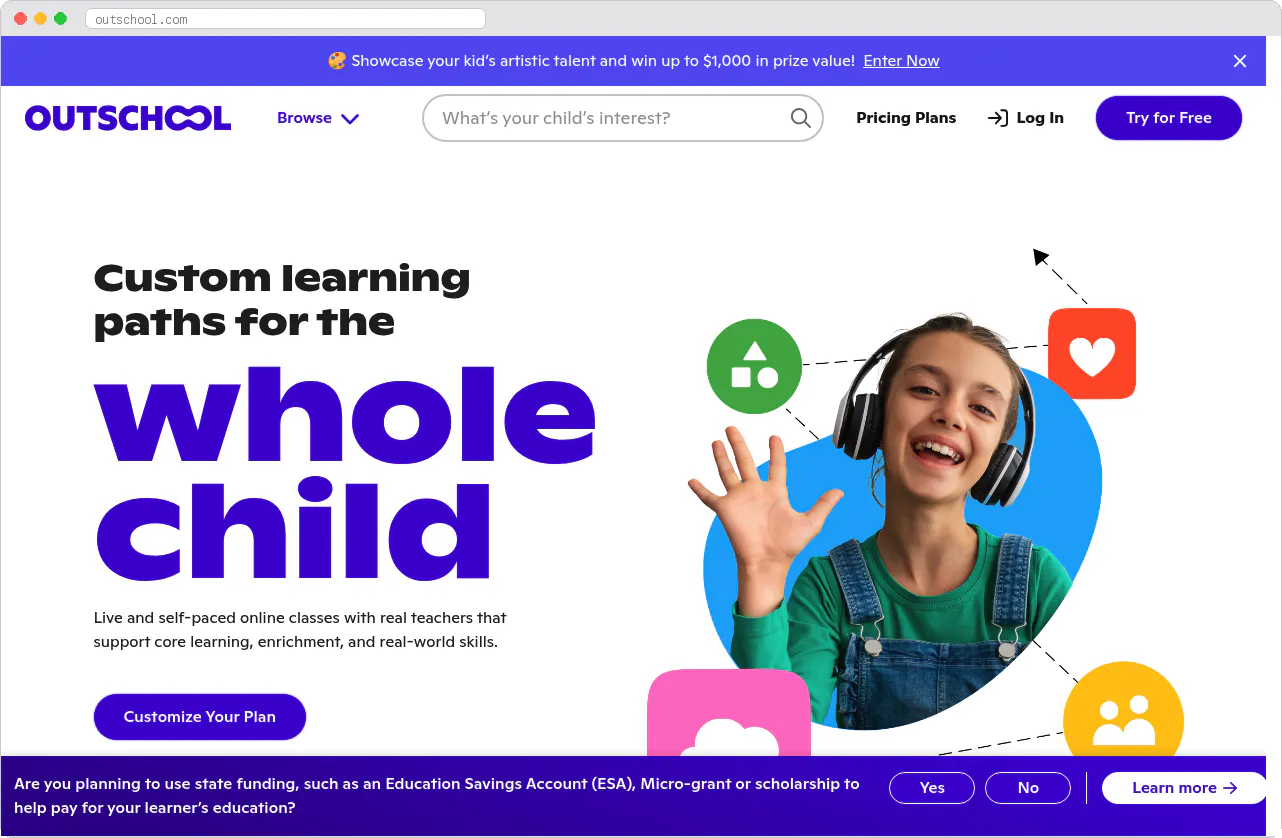
Outschool connects children ages 3 to 18 with independent teachers who run live, interactive online classes, covering everything from Minecraft coding to marine biology to test prep. Founded in 2015 by Amir Nathoo, the company built its marketplace around a simple bet: traditional schools can't offer the breadth of subjects that passionate, independent educators can deliver one small class at a time. Parents search a catalog of live classes, book a seat, and their child joins a Zoom session at the scheduled time. Teachers set their own curriculum, pricing, and schedule.
The platform's growth accelerated sharply during the COVID-19 pandemic, when Outschool became a lifeline for parents managing remote learning. Bookings reportedly grew from about $6 million in 2019 to more than $100 million in 2020, and the company raised a $75 million Series C in April 2021 at a $1.3 billion valuation, then a $110 million Series D that October at a $3 billion valuation (TechCrunch). By the mid-2020s, Outschool had facilitated millions of enrollments across tens of thousands of teachers, most of them independent contractors rather than employees. The business proved that a marketplace model, not a curriculum company, could scale live, personalized education to a global audience.
How Outschool makes money
Outschool operates on a commission model, taking approximately 30% of each class transaction (Outschool Support). That cut is high relative to product marketplaces, but it reflects what Outschool actually does for teachers: it acquires families, runs payment processing, handles background checks and safety infrastructure, provides customer support, and absorbs the risk of no-shows and disputes. Teachers keep the rest and set their own prices, typically $10 to $50 per session depending on subject, group size, and session length.
Beyond core commissions, Outschool has layered in supplementary revenue: promoted placement for teachers who want more visibility in search results, and partnerships with schools and districts looking to supplement in-classroom instruction with outside specialists. It has also experimented with subscription-style credit packages that let families pre-purchase class credits at a discount, which improves cash flow and locks in repeat usage.
The unit economics work because education is a higher-ticket, recurring service compared to many marketplace categories. A family that enrolls a child in a weekly art class or ongoing math tutoring generates recurring revenue for months, not a single transaction. That recurring pattern, combined with a 30% take rate, is what let Outschool absorb the customer acquisition costs and trust-and-safety overhead that a marketplace serving children requires.
What makes Outschool work: key features
Structured class listings built for parents, not just for search. Every listing specifies age range, group size, schedule, prerequisites, and learning objectives, because parents are shopping on behalf of a child with specific needs, not browsing for themselves. This level of structured detail is what makes filtering by age, subject, and format actually useful.
Recurring and one-time scheduling in the same system. Outschool supports drop-in single sessions, multi-week courses, and ongoing weekly groups, all inside one booking flow. A calendar system that only handles one of these patterns doesn't fit how independent teachers actually structure their offerings.
Delayed payouts that protect families from no-shows. Teacher payments are held until after a class is delivered. This single mechanism does a lot of trust-building work: it removes the incentive for a teacher to take payment and skip the class, and it gives Outschool leverage to resolve disputes before money changes hands irreversibly.
Built-in video classroom integration. Outschool integrates directly with Zoom, auto-generating meeting links, enforcing waiting rooms, and applying safety settings appropriate for sessions involving minors. Building or maintaining a custom video product would be a significant distraction from the core marketplace.
Teacher verification layered with community reviews. Background checks and credential checks establish a baseline, but Outschool also lets teachers build reputation through parent reviews, which matters because teaching quality and rapport with children are hard to certify upfront.
Two-sided reputation and repeat relationships. Families can follow favorite teachers and rebook them across multiple classes, which turns single transactions into ongoing relationships and reduces the platform's dependence on constant new-teacher acquisition.
The competitive landscape
Udemy and Coursera dominate the pre-recorded, self-paced course model. Udemy lets anyone upload and sell a course, similar in spirit to Outschool's open marketplace for supply, but it targets adult learners consuming content asynchronously. Coursera partners with universities for credentialed programs. Both scale far more cheaply than live classes because one video serves unlimited students. Where they fall short for Outschool's audience is accountability and interaction: a 6-year-old rarely finishes a pre-recorded course independently. That gap is exactly what live, small-group instruction fills, and it's an opening for any founder targeting age groups or subjects where engagement, not just content delivery, is the product.
Khan Academy offers free, curriculum-aligned content as a nonprofit, which makes it a default reference point for parents rather than a commercial competitor. It's excellent for core academic subjects taught to a standard curriculum, but it doesn't offer live interaction, teacher choice, or niche subjects like chess strategy or fantasy writing workshops. Its nonprofit structure means it will never compete on breadth of specialized, teacher-led offerings, which leaves that entire market open to marketplaces like Outschool.
Skillshare focuses on creative skills for adult learners through a subscription library of live and recorded classes. Its subscription model is a real point of differentiation from Outschool's pay-per-class approach, and it works because adult learners tolerate a browse-and-sample content relationship that wouldn't suit a parent booking a specific class for a child. Skillshare's adult focus, though, means it ignores the enrichment and homeschool-support market entirely, a market Outschool built its early growth on.
Preply operates a tutoring marketplace focused specifically on language learning, connecting students with vetted tutors for one-on-one sessions. Its narrow focus lets it build language-specific tools: proficiency assessments, structured curricula, progress tracking. That specialization is a strength for language learners but a ceiling for Preply, since it can't easily expand into unrelated subjects without diluting the product. A founder targeting a single vertical (say, coding tutoring, or music lessons) can borrow this playbook: go deep in one subject rather than broad across all of them.
MasterClass and LinkedIn Learning target professional and celebrity-driven adult learning through subscription access to polished, produced content from recognized experts. They compete for the same discretionary "invest in learning" household budget that families spend on Outschool, but their content model requires expensive production and marquee names, which limits how many niche subjects they can realistically cover. Independent, live-taught marketplaces don't need celebrity instructors to succeed, which is a structural advantage for any founder building a smaller, more specialized alternative.
How to build a marketplace like Outschool
1. Define your niche within Outschool's category
Outschool's strength is broad subject coverage for kids 3 to 18, which also means it's shallow in specific areas: neurodivergent-friendly instruction, advanced STEM for gifted students, heritage language classes for diaspora families, or adult upskilling in a live-cohort format. Pick a niche where you can credibly claim to serve a specific audience better than a generalist platform can. A tighter niche also makes your first 20 teachers and first 100 families much easier to find and recruit.
2. Validate demand and supply before building anything
Talk to real parents in homeschooling groups, special-interest forums, or local parent networks about what they currently struggle to find and what they'd pay for it. Separately, talk to potential teachers, retired educators, subject-matter experts, or working professionals who might teach part time, about their pricing expectations and their hesitations around running an independent teaching business. If you can't find at least a dozen teachers willing to commit to your first cohort and a few dozen families interested in enrolling, the niche needs rethinking before you write a line of code or configure a listing.
3. Choose your development approach
Vibe coding from scratch. AI tools like Cursor, Lovable, and Bolt can produce a working Outschool-style prototype quickly, complete with class listings, a booking flow, and a payment form. For pressure-testing a concept or demonstrating it to early teachers and parents, that's genuinely useful. For launching a platform that handles real payments and involves children, it's probably not sufficient. What vibe-coded outputs reliably don't produce is the infrastructure underneath: payment escrow, dispute resolution, fraud detection, and compliance. A documented Sharetribe experiment ran 60+ hours to reach demo quality but revealed a critical checkout exploit that would have allowed price manipulation via a direct API call. Bringing that kind of output to production standard requires significant additional time and a clear understanding of how the pieces of a web application fit together. Useful as a prototyping tool, not a cost-effective path to launch, especially where child safety and payments intersect.
Custom development from scratch. Hiring developers, who will likely use AI tools heavily themselves, gives you full control over the platform. For an Outschool-type marketplace, the relevant tier is production-grade: you need scheduling with time zone handling, video integration, background-check workflows, delayed payouts, review systems, and dispute resolution for issues involving children. That combination puts a serious build at $80,000–$200,000 over 16–28 weeks (Codica, RaftLabs). The low end of that range assumes offshore development teams at $15–40/hour; a US or Western European team pushes you toward the top. Custom development makes sense once you have requirements, like a proprietary learning-progress engine or a district integration, that no existing platform can meet.
Building on a marketplace operating system like Sharetribe. You start at roughly 90% done on the standard marketplace foundation: payments, user accounts, listing management, messaging, transaction flows, fraud detection, and compliance. Your time and budget go toward the features that make an education marketplace like yours distinct. Three paths within this approach:
- No-code builder. Configure class listings, age and subject filters, booking flows, and commission rules from the Console without writing code. This gets most education marketplace founders to a live, bookable platform in weeks.
- AI-assisted development. Connect Claude Code, Cursor, or Codex to Sharetribe's open APIs and open-source template to build things like custom availability rules for recurring class cohorts, or a teacher-application and credential-review workflow. Because Sharetribe handles the payment infrastructure, AI-assisted development on top of it carries much lower risk than building from scratch.
- Custom code. Build directly on the developer platform for deeper integrations (a learning management system, a custom video classroom, district billing), or hire from Sharetribe's Expert Marketplace.
Most founders start with the no-code builder, then add features through AI or a developer as they learn what their teachers and families actually need.
4. Solve the cold start problem
An education marketplace has a specific version of the chicken-and-egg problem: parents won't browse a catalog with five classes in it, and good teachers won't invest time building curricula for a platform with no families. Outschool solved this by recruiting teachers first, offering them access to a growing pool of homeschooling families who were already underserved by traditional school schedules, and by keeping its early catalog tight around a few popular subject areas rather than trying to cover everything at once.
Three tactics work well for a new entrant. First, go supply-first: recruit 15 to 20 strong teachers in your niche before opening to families, so day-one browsers see a credible catalog, not an empty shelf. Second, seed a specific community, a homeschool co-op, a language-heritage group, a gifted-education forum, rather than marketing broadly, because niche communities spread word of mouth faster than an anonymous general audience. Third, consider manually matching your first families to teachers by hand, even over email or a phone call, to guarantee a good first experience while your booking flow and reputation system are still thin. Launching small and tight, one subject, one age band, one time zone, beats launching broad and thin, because early trust is built through consistently good experiences, not catalog size.
5. Recruit and onboard your first teachers
Look for teachers in the exact communities you identified during validation: independent tutors, former classroom teachers, subject-matter hobbyists with a teaching itch. Make the pitch concrete: access to families they couldn't reach on their own, handled payments and scheduling, and platform marketing support. Offer your first cohort a reduced commission or promotional placement in exchange for launch-quality feedback. Give them templates and guidance for structuring a class, many excellent subject experts have never designed a curriculum or run a live online session before.
6. Launch to a focused first audience
Market to the specific parent community you validated in step 2, not a general "parents everywhere" audience. Content marketing works well here: guides on choosing enrichment activities, profiles of your early teachers, and honest previews of what a class actually looks like. Referral incentives, credit toward a future class for a successful referral, tend to perform well because parents already talk to each other about what their kids are enrolled in.
7. Build feedback loops and fix operational friction fast
Once real classes start running, you'll learn things no amount of planning predicts: families wanting makeup sessions, teachers wanting to adjust group sizes mid-course, disputes over whether a class matched its description. Treat the first few months as an operations sprint, not a feature-building sprint. The goal is a platform both sides prefer to the alternative, which usually means fixing friction, not adding features.
8. Expand deliberately
Add new subjects or age bands only once you see organic demand signals, teachers proposing adjacent classes, families requesting subjects you don't yet offer. Expanding by request keeps your catalog quality high and avoids the trap of spreading thin across categories where you have no reputation.
Do you need to build everything Outschool has?
No. Outschool's current feature set, sophisticated recommendation algorithms, district partnerships, a large in-house trust and safety team, was built over a decade with hundreds of millions in funding. At launch, you need four things: a way for teachers to list classes with clear structure, a way for families to discover and book them, payment processing with delayed payouts, and baseline safety measures (background checks, clear conduct policies, a reporting mechanism). Everything else, promoted listings, advanced analytics, corporate partnerships, is worth building only once your core loop is working.
The temptation to "just vibe-code a clone" deserves a direct answer: even with capable AI tools, starting from zero means spending your early weeks re-solving problems Sharetribe has already solved, secure payment flows, refund logic, user account architecture, transaction state management, rather than spending that time on what would actually differentiate your marketplace. Starting on a foundation where payments and compliance already work means your AI tokens and developer hours go toward the class-scheduling quirk, the credential-verification flow, or the parent dashboard that makes your platform distinct, not toward reinventing checkout security.
Trust and safety for an Outschool-type marketplace
The central risk in an education marketplace serving minors is different in kind from most marketplaces: you're not just protecting against payment fraud, you're protecting children in one-on-one or small-group interactions with adults they've never met. That requires background checks (criminal history, and often reference checks from prior teaching roles), verification of relevant credentials or experience, and clear, enforced policies restricting private communication between teachers and children outside the platform's supervised channels.
Standard practice in this space includes waiting rooms so teachers can verify who's joining a session before it starts, disclosed and compliant recording policies, easily accessible reporting tools for parents, and ongoing performance monitoring rather than a one-time verification check. Reviews should let parents rate teaching quality and age-appropriateness specifically, not just generic satisfaction.
Sharetribe provides the foundation this depends on: secure payment processing with delayed payouts (so a teacher isn't paid until after a class is verified delivered), configurable user accounts that support identity verification workflows, and transaction flows that can hold funds pending resolution of a dispute. What you need to add on top is category-specific: a background-check integration or manual review workflow, communication policies enforced through your platform's messaging restrictions, and a documented escalation process for safety concerns. This is not optional infrastructure to defer until later. It's foundational to whether parents trust your platform with their children at all.
Running a marketplace like Outschool
Outschool manages a trust and safety operation at scale: background-check pipelines processing thousands of teacher applications, a support team trained specifically on educational and child-safety issues, and continuous monitoring across a catalog of tens of thousands of live classes. You won't need to replicate any of that on day one. Early on, a small, careful team reviewing every new teacher application by hand and personally checking in after each family's first class will outperform any automated system you could build.
Sharetribe handles the recurring operational load automatically: payment processing and payouts, booking and calendar logic, messaging between teachers and families, and the transaction state machine that tracks a class from booking through delivery through payout. That leaves your team free to focus on the parts that actually require human judgment early on, teacher quality control, family support, and resolving the inevitable edge cases that no policy fully anticipates.
Development costs and timeline
Three realistic scenarios:
Vibe coding from scratch: Free or very cheap to start. A working Outschool-style prototype, listings, a booking form, a payment button, is buildable in a weekend with AI coding tools. What you can't get from here is a production-ready platform: verified payment escrow, background-check workflows, dispute handling, and communication safeguards for interactions involving children all require work that AI coding tools don't shortcut. A documented Sharetribe experiment logged 60+ hours to reach demo quality and still surfaced a critical payment vulnerability. A useful proof-of-concept tool, not a cost-effective path to a live business handling children's classes and real money.
Custom development from scratch: Cost depends on complexity tier. An Outschool-type marketplace is production-grade, not a simple MVP, because it needs scheduling, video integration, verification, reviews, and dispute flows all working together. That puts the realistic range at $80,000–$200,000 over 16–28 weeks (Codica, RaftLabs). The low end assumes offshore development teams; a US or Western European team pushes you toward the top of the range or beyond. Ongoing maintenance typically runs 15–25% of the original build cost per year. This route makes sense once you have specific requirements, a proprietary curriculum engine, a district-billing integration, that no existing platform can support.
Building on Sharetribe: Before you launch, the Sharetribe Build plan costs just $39/month. To open to real users, you need the Live plan, which costs $199/month billed yearly ($259/month billed monthly). Both plans include 1 million usage credits per month. Sharetribe covers the transaction engine, payment processing with delayed payouts, listings, messaging, and user accounts an education marketplace needs from day one. Most founders reach a live MVP in weeks rather than months, then add scheduling refinements, verification workflows, or a teacher-application system through AI tools or a developer as they learn what their specific niche actually requires.
Why Sharetribe for building a marketplace like Outschool
Sharetribe's booking and calendar system supports the exact patterns an education marketplace needs: recurring weekly sessions, one-time workshops, and time-zone-aware scheduling, all inside the same platform. Its payment infrastructure includes delayed payouts by default, which directly solves the no-show and quality-assurance problem that makes families hesitant to book with an unknown teacher. Configurable user accounts support the verification and approval workflows you'll need for teachers working with minors, without forcing you to build that logic from scratch. And because the whole system is built on open APIs, you can extend it as you grow, adding a credential-review flow, a parent dashboard, or a custom video integration, without touching the underlying transaction and payment engine that already works.
Frequently asked questions
How much does it cost to build a marketplace like Outschool?
With Sharetribe, you can build for $39/month and launch for $199/month billed yearly ($259/month billed monthly), plus your time, reaching a working MVP in weeks. Custom development for a production-grade education marketplace with verification, scheduling, and dispute handling typically costs $80,000 to $200,000 and takes 16 to 28 weeks (Codica, RaftLabs). Most founders start on a marketplace operating system and add custom features once they've validated demand.
How does Outschool make money?
Outschool takes a 30% commission on each class transaction, covering payment processing, teacher marketing, customer support, and safety verification (Outschool Support). It also generates revenue from promoted teacher listings and, increasingly, partnerships with schools and districts. The commission model aligns Outschool's incentives with successful class delivery, since it only earns money when a class actually happens.
What safety measures does an education marketplace need?
At minimum: background checks and credential verification for teachers, waiting rooms and disclosed recording policies for video sessions, restricted or supervised communication between teachers and children, and an accessible reporting mechanism for parents. These aren't optional additions, they're the foundation of parent trust in a platform that puts children in contact with unfamiliar adults. Ongoing monitoring, not just one-time screening, matters as the teacher pool grows.
Can I compete with Outschool in 2026?
Yes, by focusing on a niche Outschool serves shallowly: a specific age band, subject, teaching philosophy, or community it hasn't specialized in. Outschool's breadth is also its limitation, it can't build deep, specialized tooling for every audience simultaneously. A founder who goes narrow and builds real teacher and family trust in that niche has a real opening, especially in categories like language heritage instruction, neurodivergent-friendly classes, or advanced STEM cohorts.
How long does it take to launch an education marketplace?
With Sharetribe's no-code builder, a functioning MVP is realistic in two to four weeks. Custom development takes 16 to 28 weeks for a platform with the scheduling, verification, and dispute-handling features an education marketplace needs. In either case, launching the platform is the easy part, recruiting your first teachers and earning parent trust typically takes several additional months of hands-on work.
Do I need video conferencing built into my platform?
No. Most successful education marketplaces, including Outschool, integrate with Zoom rather than building a custom video product. Integration is more reliable, cheaper to maintain, and lets you focus engineering effort on scheduling, verification, and discovery, the parts of the platform that actually differentiate you.
Start your 14-day free trial
Create a marketplace today!
- Launch quickly, without coding
- Extend infinitely
- Scale to any size
No credit card required