How to build a website like EatWith
EatWith revolutionized food experiences by connecting travelers with local hosts for authentic dining in homes worldwide. Learn how to build a similar culinary marketplace, from validating your niche to launching and scaling your platform.
Published: Aug 9, 2024
Last updated: Mar 19, 2026
What is EatWith and how it revolutionized culinary marketplaces
EatWith transformed how people experience food while traveling by creating the world's largest community marketplace for culinary experiences. Founded in 2012 by Shemer Schwarz and Guy Michlin in Tel Aviv, the platform connects food lovers with local hosts who offer authentic dining experiences in their homes, from intimate dinners to hands-on cooking classes.
The concept emerged from Schwarz's own travel experiences, where he discovered that the most memorable moments happened around dining tables in local homes rather than in restaurants. This insight led to a marketplace that has facilitated over 500,000 experiences across 130+ countries, with more than 25,000 active hosts offering everything from traditional Moroccan tagines in Marrakech to pasta-making classes in Rome.
EatWith's success lies in solving a fundamental problem for both travelers and locals. Travelers struggle to find authentic cultural experiences beyond tourist traps, while passionate home cooks and professional chefs lack platforms to monetize their culinary skills and cultural knowledge. The platform bridges this gap by creating a trusted environment where strangers can share meals and stories.
What sets EatWith apart from traditional dining or cooking classes is its focus on cultural immersion and personal connection. Guests don't just eat food, they participate in family traditions, learn regional cooking techniques, and gain insider perspectives on local culture. This experiential approach has attracted investment from notable firms including Greylock Partners and has established EatWith as the leading platform in the social dining space.
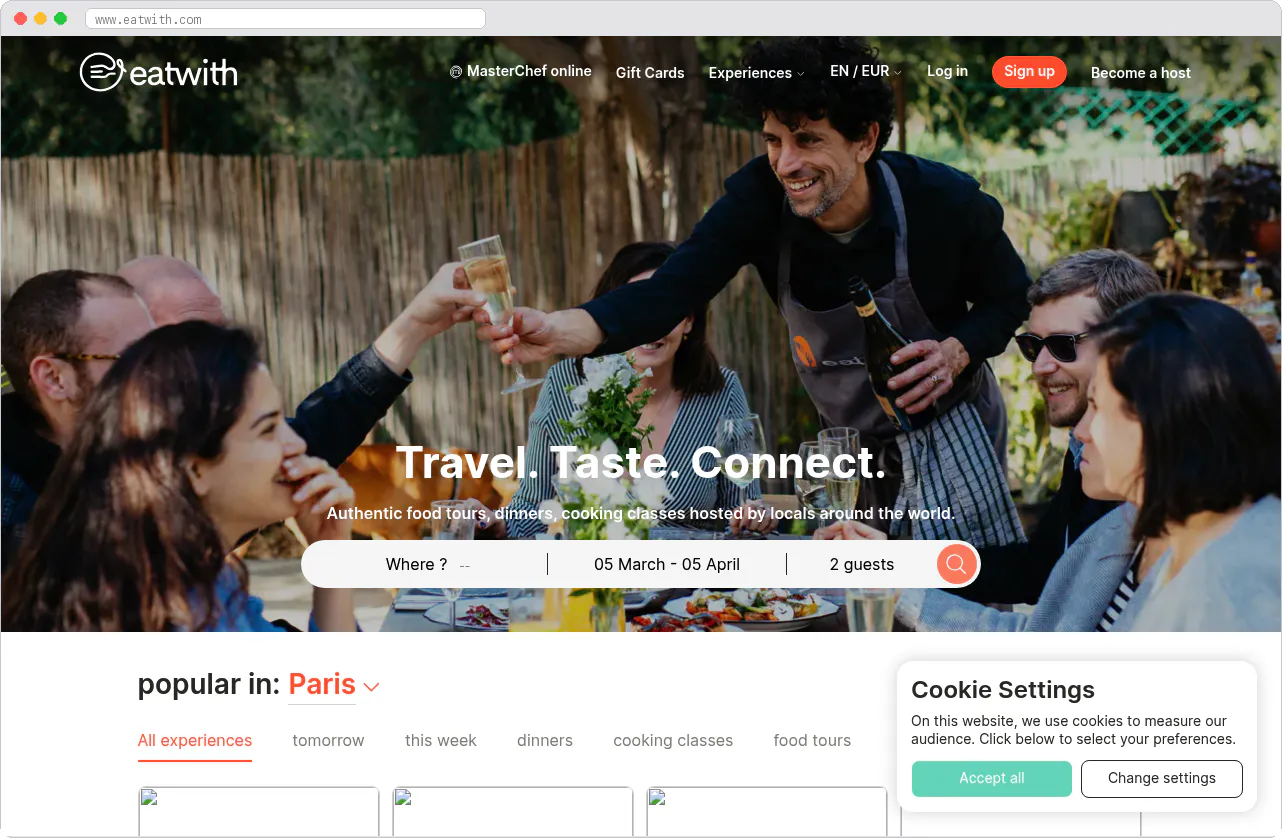
How does EatWith work for hosts and guests?
EatWith operates as a two-sided marketplace where hosts create and manage culinary experiences while guests discover and book these unique dining opportunities. The platform handles all the complex marketplace dynamics, from payments to communication, allowing both sides to focus on what they do best.
For hosts, EatWith provides a complete business infrastructure. Local chefs, home cooks, and culinary enthusiasts can create detailed experience listings that showcase their unique offerings. A host might offer a traditional Italian dinner experience in their Roman apartment, complete with market visits, hands-on pasta making, and multi-course meals paired with local wines. They set their own pricing, manage their calendars, and communicate directly with guests through the platform's messaging system.
The host onboarding process includes profile verification, kitchen inspections in some markets, and quality assessments to maintain platform standards. Successful hosts often develop loyal followings, with some earning thousands of dollars monthly by hosting multiple experiences per week. The platform supports various experience types, from intimate dinners for two to larger group cooking classes accommodating up to 20 participants.
Guests use EatWith to discover experiences they couldn't find anywhere else. The search functionality allows filtering by location, cuisine type, experience format (dinner, cooking class, food tour), group size, and dietary restrictions. Each listing includes detailed descriptions, professional photos, host backgrounds, and authentic reviews from previous guests.
The booking process mirrors other successful marketplaces like Airbnb. Guests can message hosts with questions, check real-time availability, and complete secure payments through the platform. Many experiences sell out quickly, especially those featuring renowned local chefs or unique cultural elements like traditional tea ceremonies or seasonal harvest dinners.
EatWith's business model and revenue streams
EatWith generates revenue through a commission-based model, taking a percentage of each booking fee while providing value-added services to both hosts and guests. The platform typically charges guests a service fee of 5-15% depending on the booking value, while hosts pay a smaller commission on successful bookings.
This model aligns EatWith's interests with user success. The platform only earns money when transactions occur, incentivizing continuous improvements to user experience, trust mechanisms, and marketplace liquidity. Higher-quality experiences command premium prices, creating a natural quality feedback loop that benefits all participants.
Beyond transaction fees, EatWith has explored additional revenue streams including premium host services, professional photography packages, and partnerships with tourism boards and travel companies. Some markets feature sponsored experiences or promotional placements, though these remain secondary to the core commission model.
The unit economics work because culinary experiences typically command higher prices than simple accommodation or transportation services. A cooking class in Paris might cost $80-150 per person, while a multi-course dinner with wine pairings could reach $200+ per guest. These higher average order values make the commission model sustainable even with significant customer acquisition costs.
Essential features for building a culinary experience marketplace
Building a marketplace similar to EatWith requires specific functionality designed around the unique characteristics of food experiences and cultural exchange. Unlike product marketplaces or simple service bookings, culinary experiences demand features that handle complex scheduling, dietary restrictions, group dynamics, and safety considerations.
Experience listings and rich media
Food is inherently visual and emotional, making high-quality imagery and storytelling crucial for marketplace success. Hosts need tools to create compelling experience listings that go beyond basic descriptions. This includes space for detailed narratives about their culinary background, cultural traditions, and what makes their offering unique.
The listing system must accommodate various experience formats. A traditional dinner experience requires different information than a hands-on cooking class or market tour. Essential fields include maximum group size, duration, included elements (meals, drinks, recipes), difficulty level for cooking classes, and detailed dietary accommodation options.
Photo galleries should support multiple images showing the host, their kitchen or dining space, sample dishes, and the overall experience atmosphere. Many successful hosts also include short video introductions that help potential guests connect with their personality and cooking style before booking.
Advanced scheduling and capacity management
Unlike rental properties with simple availability calendars, culinary experiences involve complex scheduling considerations. Hosts might offer different experiences on different days, accommodate varying group sizes, or have seasonal menus that change throughout the year.
The scheduling system needs to handle recurring experiences (like weekly pasta classes) as well as one-off special events (harvest dinners, holiday celebrations). Capacity management becomes critical when hosts offer experiences that scale with group size, a cooking class for four requires different preparation than one for twelve participants.
Real-time availability synchronization prevents overbooking while allowing hosts to easily block dates for personal commitments or special preparations. Some experiences require advance notice for shopping and preparation, necessitating minimum booking windows that vary by experience type.
Messaging and cultural bridge-building
Culinary experiences are inherently social and cultural, requiring robust communication tools that go beyond transactional messaging. Guests often have specific dietary restrictions, cultural questions, or transportation needs that require detailed discussion before booking.
The messaging system should facilitate these conversations while maintaining appropriate boundaries and safety measures. Features like automated translation help bridge language barriers in international markets, while message templates help hosts efficiently handle common questions about ingredients, accessibility, or cultural customs.
Post-experience communication channels allow guests to request recipes, share photos, or maintain connections with hosts, extending the value beyond the single transaction and encouraging repeat bookings or referrals.
Trust and safety infrastructure
Sharing meals in private homes requires exceptional trust mechanisms beyond typical marketplace safety features. Guests need confidence that hosts maintain proper hygiene standards, can accommodate dietary restrictions safely, and provide the cultural authenticity they're seeking.
Verification processes should include identity confirmation, kitchen standards assessment, and cultural authenticity validation. Some markets benefit from health department partnerships or third-party kitchen inspections, though implementation varies by local regulations and cultural norms.
Review systems must capture both the culinary quality and cultural authenticity of experiences. The most helpful reviews describe specific dishes, cultural insights gained, host hospitality, and overall atmosphere, helping future guests make informed decisions while providing hosts with actionable feedback.
Payment processing with delayed payouts
Culinary experiences often involve significant advance preparation and ingredient costs, making payment timing crucial for host cash flow. However, guest protection requires holding funds until experience completion, similar to other experience marketplaces.
The payment system should support various currencies and local payment methods while handling complex scenarios like partial refunds for dietary modifications, group booking changes, or weather-related cancellations for outdoor experiences.
Commission calculation becomes more complex when experiences include multiple pricing tiers (with or without wine pairings, different menu options, add-on experiences like market tours) requiring flexible fee structures that maintain transparency for both hosts and guests.
Understanding the competitive landscape
The culinary experience marketplace space includes several established players, each with different approaches to connecting food lovers with unique dining opportunities. Understanding these alternatives helps founders identify opportunities for differentiation and market positioning.
Airbnb Experiences
Airbnb's expansion into experiences represents the most significant competitive threat to specialized culinary marketplaces. Leveraging their massive user base and brand recognition, Airbnb Experiences includes thousands of food-related offerings from cooking classes to food tours and private dinners.
Airbnb's advantage lies in cross-selling to their accommodation guests and offering bundled travel experiences. A traveler booking an apartment in Barcelona can easily discover and book a paella cooking class from the same platform, creating smooth trip planning.
However, Airbnb's broad focus means less specialized features for culinary experiences specifically. Their review system, search filters, and host tools are designed for general experiences rather than the specific needs of food-focused interactions. This creates opportunities for specialized platforms to serve culinary hosts and guests more effectively.
VizEat (acquired by EatWith)
VizEat operated as EatWith's primary competitor before being acquired in 2019, creating the largest social dining platform globally. Founded in France, VizEat brought strong European market presence and a slightly different cultural approach to home dining experiences.
The acquisition eliminated direct competition while combining complementary geographic strengths. VizEat's French origins provided deeper understanding of European dining customs and regulatory environments, while EatWith's broader international presence offered global scaling expertise.
This consolidation demonstrates both the potential for success in this market and the challenges of achieving sustainable differentiation against well-funded competitors with similar value propositions.
Cozymeal
Cozymeal focuses more heavily on cooking classes and team-building culinary experiences rather than intimate home dining. Their platform caters to corporate groups, birthday parties, and structured learning experiences with professional chef instructors.
This positioning creates different unit economics and marketing approaches. Corporate bookings typically involve larger groups and higher per-experience revenue, but require different sales processes and customer service approaches than individual travelers seeking authentic cultural experiences.
Cozymeal's emphasis on professional instruction over cultural immersion appeals to customers prioritizing skill development over cultural exchange, representing a different market segment within the broader culinary experience space.
La Belle Assiette (Yhangry)
La Belle Assiette, which rebranded to Yhangry, takes a private chef approach rather than home dining experiences. Professional chefs come to customers' homes to prepare and serve restaurant-quality meals for special occasions or regular dining.
This model requires different operational complexity, focusing on chef logistics, menu planning, and service delivery rather than cultural exchange and home hospitality. The higher price points (typically $50-100+ per person) target affluent customers seeking convenience and luxury rather than cultural authenticity.
The private chef model also faces different regulatory challenges around food safety, insurance, and professional licensing, creating higher barriers to entry but potentially more defensible market positions.
Local and niche competitors
Many cities feature local platforms serving specific cultural communities or geographic regions. These might include platforms focused on specific cuisines (like Jewish cooking experiences or regional specialties), immigrant community dining, or hyperlocal neighborhood dinner clubs.
While these platforms typically have smaller scale, they often achieve stronger community engagement and cultural authenticity within their niches. Understanding successful local players provides insights into community-building tactics and authentic cultural positioning that can inform broader platform strategies.
Step-by-step guide to building your culinary experience marketplace
Step 1: Identify your unique positioning
The culinary experience space offers numerous opportunities for differentiation, but success requires clear focus on specific user needs or market segments that existing platforms serve inadequately.
Consider geographic specialization first. While EatWith operates globally, many cities and regions remain underserved or dominated by generic tourism offerings. A platform focused exclusively on Southern Italian cooking experiences, Nordic cuisine, or Southeast Asian street food could achieve deeper cultural authenticity and stronger host communities than broad-based competitors.
Alternatively, focus on specific experience formats. The market includes opportunities for platforms specializing in multi-day culinary retreats, professional chef development programs, family-friendly cooking experiences, or dietary-specific communities like vegan or gluten-free dining.
Demographic targeting also creates differentiation opportunities. Platforms serving business travelers, solo female travelers, multi-generational families, or culinary professionals each require different features, safety considerations, and community building approaches.
Step 2: Validate demand in your target market
Culinary experiences represent discretionary spending that varies significantly by market, season, and economic conditions. Thorough market validation prevents costly mistakes in platform development and go-to-market strategy.
Start by researching existing demand indicators in your target geographic area. Look at restaurant reservation patterns, cooking class enrollment, food tour bookings, and cultural tourism statistics. High-performing restaurants with long wait lists often indicate pent-up demand for unique dining experiences that home hosts could fulfill.
Conduct direct customer research through surveys, focus groups, and one-on-one interviews with both potential hosts and guests. Ask specific questions about current pain points in finding authentic food experiences, willingness to pay for home dining, and concerns about safety or cultural barriers.
Test demand with manual processes before building technology. Create simple landing pages describing your concept, collect email addresses from interested users, and manually match a few hosts with guests to validate the core value proposition. This lean validation approach costs almost nothing while providing crucial insights about pricing, demand patterns, and operational requirements.
Step 3: Build your minimum viable platform
Your initial platform needs core marketplace functionality without unnecessary complexity that slows launch or increases costs. Focus on features that enable basic transactions while establishing trust between hosts and guests.
The MVP should support host onboarding with profile creation, experience listing, photo uploads, and calendar management. Basic search and filtering allow guests to find experiences by location, cuisine type, and dates. Secure messaging enables host-guest communication, while integrated payments handle bookings and commissions.
Design for mobile from the beginning, as food photography and location-based discovery work better on mobile devices. Many users will browse experiences while walking through neighborhoods or planning weekend activities, making mobile optimization crucial for marketplace liquidity.
Implement basic trust features including user verification, review systems, and clear cancellation policies. While comprehensive safety infrastructure comes later, initial trust mechanisms are essential for early user adoption and positive experiences that fuel word-of-mouth growth.
Step 4: Recruit your initial host community
Successful marketplaces typically launch with supply-side focus, ensuring excellent experiences are available before driving guest demand. The quality of your initial host community determines early user experiences and long-term platform reputation.
Target passionate home cooks and culinary professionals who already have some audience or reputation. Local food bloggers, cooking class instructors, restaurant chefs looking for side income, and immigrants eager to share their cultural traditions often make excellent early hosts.
Attend local food festivals, farmers markets, and cultural events to identify potential hosts in person. Many successful hosts appreciate face-to-face recruitment that allows them to ask questions and build confidence in the platform before investing time in creating listings.
Offer incentives for early hosts including waived commissions for first bookings, professional photography assistance, or featured placement on the platform. These investments in host success typically generate positive returns through higher-quality experiences and stronger community advocacy.
Provide comprehensive host support including listing optimization guidance, pricing recommendations, and operational best practices. Many excellent cooks lack marketing skills, so platform support for creating compelling listings often determines host success and guest satisfaction.
Step 5: Drive initial guest demand
With quality experiences available, focus on attracting guests who appreciate unique culinary experiences and are willing to try new platforms. Early guest acquisition often costs more than later growth, but these users provide crucial feedback and reviews that enable organic growth.
Content marketing works particularly well for culinary marketplaces because food naturally generates engaging, shareable content. Create blog posts, social media content, and video series featuring your hosts, their stories, and their signature dishes. This content builds platform awareness while showcasing the authentic experiences available.
Partner with local tourism boards, hotels, and travel bloggers to reach visitors seeking authentic cultural experiences. Many destinations actively promote cultural tourism initiatives that align perfectly with home dining platforms.
Use food-focused social media channels including Instagram food accounts, Facebook foodie groups, and local dining communities. Share compelling photos and stories from successful experiences while maintaining user privacy and building platform credibility.
Consider strategic partnerships with complementary services like language learning platforms, cultural tour companies, or specialty food retailers. These partnerships can provide warm referrals from users already interested in cultural exchange experiences.
Step 6: Optimize for marketplace liquidity
Marketplace success depends on achieving liquidity, the likelihood that hosts get bookings and guests find appealing experiences. Monitor key metrics including booking rates, repeat usage, and user satisfaction scores to identify optimization opportunities.
Geographic density matters enormously for location-based marketplaces. Focus initial growth on specific neighborhoods or cities rather than spreading thinly across broad regions. Deep local presence makes the platform valuable for residents while providing visitors with multiple options in their chosen destinations.
Seasonal demand patterns require careful host community management. Many destinations experience tourism fluctuations that affect booking patterns, requiring hosts to adjust pricing, experience formats, or seasonal offerings. Platform guidance helps hosts maximize earnings throughout the year while maintaining consistent guest options.
Price optimization involves both marketplace-level strategies and individual host coaching. Analyze successful pricing patterns across different experience types, group sizes, and market conditions. Share these insights with hosts while maintaining their pricing autonomy.
Step 7: Scale and expand strategically
Once you achieve marketplace liquidity in your initial market, expansion opportunities include new geographic markets, additional experience categories, and complementary services that increase user lifetime value.
Geographic expansion works best when you can replicate your initial success formula while adapting to local cultural and regulatory differences. Each new city requires local host recruitment, cultural understanding, and often different marketing approaches.
Product expansion might include related services like specialty ingredient delivery, cooking equipment rental, or follow-up virtual cooking classes that maintain host-guest relationships beyond single experiences.
Consider acquisition opportunities for complementary businesses or local competitors. The EatWith-VizEat merger demonstrates how consolidation can create stronger market positions while eliminating direct competition.
Cost considerations for building a culinary experience marketplace
Building a culinary experience marketplace involves different cost structures than product-based marketplaces, with unique considerations around food safety, cultural authenticity, and experience quality that affect both development and operational expenses.
Development and launch costs
Custom development of a full-featured culinary experience marketplace typically ranges from $50,000 to $100,000 depending on feature complexity, design requirements, and development team location. This includes user registration and profiles, experience listing and search, calendar management, messaging, payment processing, review systems, and basic admin tools.
Additional costs include professional photography for initial host experiences ($100-300 per host), legal consultation for terms of service and liability issues ($5,000-15,000), and initial marketing campaigns ($10,000-50,000). Food-focused platforms often require higher design standards and more compelling visual content than typical service marketplaces.
Using marketplace software like Sharetribe significantly reduces these costs while accelerating time to market. A Sharetribe-powered culinary marketplace can launch for under $5,000 in initial costs, with monthly software fees ranging from $79 to $399 depending on features and transaction volume.
Ongoing operational costs
Culinary marketplaces typically require more hands-on community management than automated marketplaces. Host support, quality assurance, and safety oversight often require dedicated staff, especially as the platform scales across multiple markets with different cultural and regulatory requirements.
Payment processing costs vary by region but typically range from 2.9% to 4.5% per transaction including marketplace commission splitting. International payments for cross-border bookings may incur additional fees, particularly important for platforms serving tourists.
Insurance and liability considerations create ongoing expenses that vary significantly by market. Some regions require specific coverage for food service activities, while others rely on general platform liability insurance. Legal consultation helps navigate these requirements efficiently.
Revenue potential and unit economics
Culinary experiences typically command higher prices than simple accommodation or transportation services, creating favorable unit economics for successful platforms. Average order values range from $50-300 per person depending on experience type and market positioning.
Commission rates of 8-15% on successful bookings provide sustainable revenue streams while remaining attractive to hosts. Higher-end experiences can support higher commission rates, while basic home dinners require lower fees to maintain host participation.
Successful hosts often generate $500-3,000 monthly revenue through regular bookings, creating strong incentives for quality experience delivery and platform loyalty. Top-performing hosts in major markets can earn significantly more through premium experiences and repeat customers.
Why Sharetribe works well for culinary experience marketplaces
Building a culinary experience marketplace with Sharetribe offers several advantages specifically relevant to the unique requirements and challenges of food-focused platforms.
Rapid validation and iteration
Sharetribe enables launching a functional culinary marketplace within days rather than months, crucial for testing market demand and refining value propositions based on real user feedback. This speed advantage is particularly valuable in competitive markets where early mover advantages can determine long-term success.
The platform includes built-in features essential for experience marketplaces including calendar management, booking systems, messaging, and review functionality. These components work together smoothly without requiring custom integration work or complex third-party tool coordination.
As you learn about your specific market needs, Sharetribe's flexible architecture supports customization and feature additions without requiring complete platform rebuilds. This evolutionary approach reduces risk while maintaining development momentum.
Transaction complexity handling
Culinary experiences involve complex transaction scenarios including group bookings, dietary modifications, weather-dependent cancellations, and seasonal menu changes. Sharetribe's transaction engine handles these complexities while maintaining clear payment flows and commission structures.
The platform's integration with Stripe Connect manages marketplace payment splitting automatically, ensuring hosts receive payments promptly while platform commissions are calculated correctly. This automation reduces administrative overhead while maintaining financial transparency.
Delayed payout functionality holds guest payments until after experience completion, providing protection for both parties while maintaining cash flow for hosts who incur ingredient and preparation costs before events.
Trust and safety infrastructure
Culinary experiences require robust trust mechanisms beyond typical marketplace safety features. Sharetribe provides user verification, secure messaging, and comprehensive review systems that help build confidence between strangers sharing intimate dining experiences.
The platform's admin tools enable quality oversight including experience approval workflows, host verification processes, and dispute resolution systems. These capabilities help maintain platform standards while scaling community size.
Customizable user profiles and experience listings allow showcasing cultural authenticity and culinary expertise that help guests make informed booking decisions while giving hosts space to tell their unique stories.
Scalability and expansion support
As successful culinary marketplaces grow beyond initial markets, Sharetribe's infrastructure scales automatically without requiring additional technical management or hosting considerations. This reliability is crucial for maintaining user experience quality during rapid growth periods.
Multi-language and multi-currency support facilitate international expansion while maintaining localized user experiences. These features are particularly important for platforms serving tourists or operating across cultural boundaries.
The platform's API and customization capabilities enable adding unique features as competitive differentiation becomes necessary, ensuring long-term platform evolution without abandoning proven marketplace fundamentals.
Building community and cultural authenticity
Success in culinary experience marketplaces depends heavily on fostering genuine community connections and cultural authenticity that create value beyond simple transaction facilitation.
Cultural authenticity requires careful balance between accessibility for newcomers and respect for traditional cooking methods and cultural contexts. Successful platforms provide hosts with guidance on sharing cultural context while maintaining their authentic voice and personal cooking style.
Community building extends beyond individual transactions to creating lasting connections between hosts, guests, and the broader food community. Features like host spotlights, seasonal recipe sharing, and cultural celebration events help build platform identity while encouraging user engagement and retention.
Quality standards must maintain safety and consistency without eliminating the personal touches and cultural variations that make home dining experiences special. Clear guidelines combined with flexible enforcement help hosts understand expectations while maintaining creative freedom.
Conclusion and next steps
Building a successful culinary experience marketplace requires understanding both the technical challenges of marketplace development and the cultural nuances of food sharing across different communities. The most successful platforms combine efficient technology with deep appreciation for the human connections that make shared meals meaningful.
Start by validating your specific market opportunity through direct customer research and manual testing before investing heavily in technology development. Focus on building a strong initial host community that delivers exceptional experiences, then drive targeted guest demand through content marketing and strategic partnerships.
Whether you choose custom development, no-code tools, or marketplace software like Sharetribe, prioritize speed to market and iterative improvement based on real user feedback. The culinary experience space offers significant opportunities for differentiation, but success requires consistent execution and deep understanding of local food cultures and dining customs.
Remember that your greatest competitive advantage lies not in technology features but in the quality of experiences your platform facilitates and the strength of community connections you help create around shared appreciation for food and culture.
Frequently asked questions
How much does it cost to build a website like EatWith?
Custom development typically costs $40,000-$90,000 plus ongoing operational expenses. Using marketplace software like Sharetribe reduces initial costs to under $5,000 with monthly fees from $79-$399, allowing faster launch and validation.
What features are essential for a culinary experience marketplace?
Core features include experience listings with rich media, advanced scheduling and capacity management, secure messaging for dietary discussions, trust and safety infrastructure, and payment processing with delayed payouts to protect both hosts and guests.
How do I find hosts for my food experience marketplace?
Target passionate home cooks, food bloggers, cooking instructors, and immigrants eager to share their culture. Recruit at food festivals, farmers markets, and cultural events. Offer incentives like waived commissions and professional photography support.
What makes EatWith different from Airbnb Experiences?
EatWith specializes exclusively in culinary experiences with food-specific features, deeper cultural authenticity, and community focused on dining. Airbnb Experiences is broader but less specialized for the unique needs of culinary hosts and guests.
How do culinary experience marketplaces make money?
Most use commission-based models, typically charging 8-15% on bookings. Higher average order values ($50-300 per person) make this sustainable while guest service fees of 5-15% provide additional revenue streams.
What are the main challenges in building a food experience marketplace?
Key challenges include ensuring food safety and hygiene standards, building trust between strangers, managing complex dietary restrictions, handling seasonal demand fluctuations, and maintaining cultural authenticity while scaling.
Start your 14-day free trial
Create a marketplace today!
- Launch quickly, without coding
- Extend infinitely
- Scale to any size
No credit card required