How to build a website like Boatsetter
Boatsetter connects boat owners with renters through peer-to-peer marketplace technology. This guide shows you how to build a similar boat rental platform, from validating your niche to launching your MVP and scaling your business.
Published: Nov 16, 2023
Last updated: Sep 11, 2026
What is Boatsetter and how does it work?
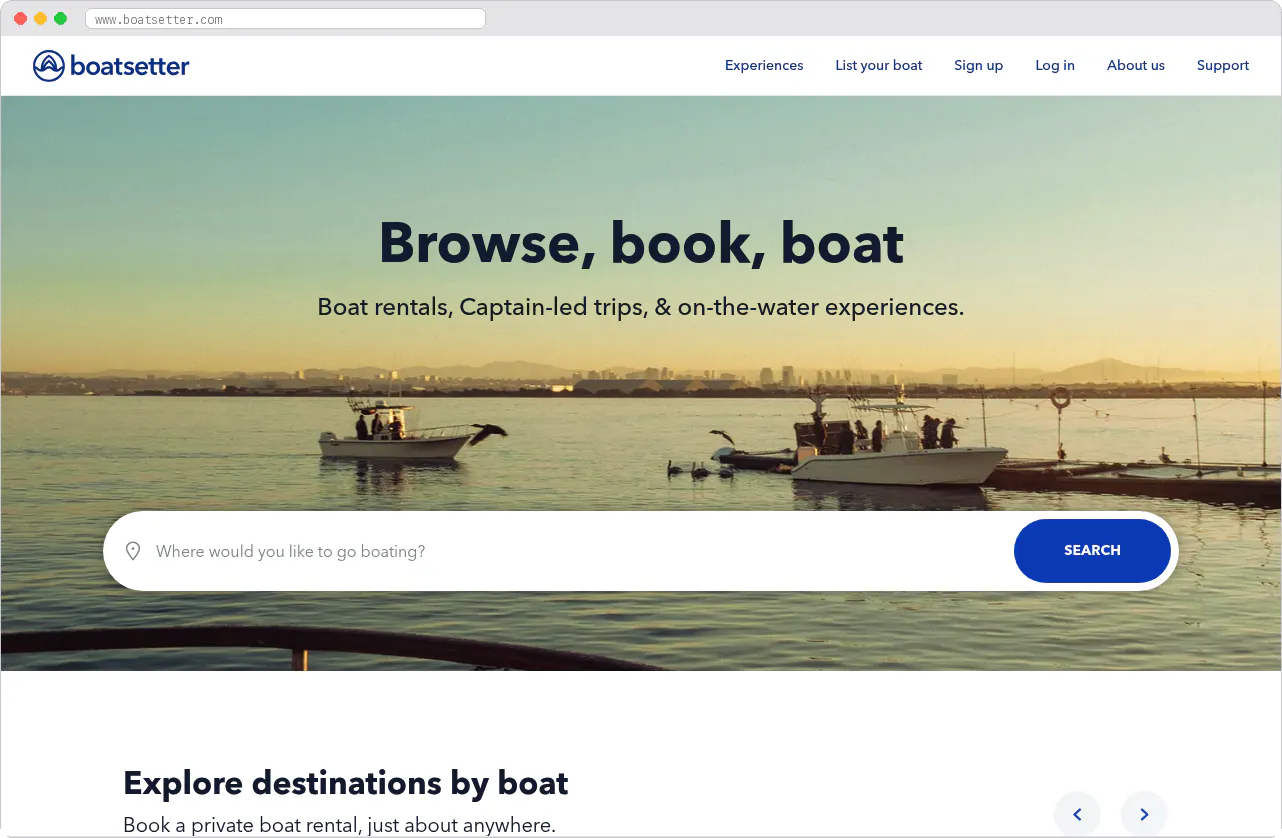
Boatsetter is a peer-to-peer boat rental marketplace that connects private boat owners and licensed charter captains with people who want to rent watercraft by the day, half day, or hour. Founded in 2012 by Jaclyn Baumgarten in Fort Lauderdale, Florida, the company built its business around a simple statistic: the average recreational boat is used only around 20 to 30 days per year, leaving a large, expensive asset class sitting idle most of the time (Motor & Keel, citing the U.S. Coast Guard's National Recreational Boating Safety Survey).
The platform now lists more than 50,000 boats in over 700 locations across the United States, the Caribbean, and parts of Europe, and more than one million boaters and boat owners have used it since its 2014 launch (Boatsetter). Boatsetter merged with rival Boatbound in 2017, consolidating much of the early US peer-to-peer boat rental market under one brand, and it gained mainstream visibility after a 2016 Shark Tank appearance that brought in investment from Mark Cuban and Kevin O'Leary. That exposure helped normalize the idea of renting a stranger's boat, which was a much harder sell than renting a stranger's apartment or car.
How Boatsetter makes money
Boatsetter earns revenue primarily through commission on completed bookings, charging both sides of the transaction. Renters pay a reservation fee added at checkout, and owners pay a service fee deducted from their payout, with owners typically keeping between 65% and 88.5% of the rental price depending on their boat and insurance plan (Boatsetter). This dual-sided fee structure mirrors Airbnb's model and lets Boatsetter advertise competitive headline prices to owners while still capturing meaningful margin from renters.
Insurance is a second, less visible revenue and retention lever. Boatsetter requires every rental booked through the platform to include on-water liability coverage, sold through partnerships with marine insurers, which both protects the marketplace from catastrophic claims and creates a recurring cost renters have no choice but to pay through the platform. Additional revenue comes from optional add-ons such as fuel packages, water sports equipment, and "Boatsetter Captain" bookings, where the platform connects renters with licensed captains for an extra fee, expanding the addressable market to people with no boating experience at all.
The captain-required segment matters more than it looks. A large share of Boatsetter's inventory legally requires a licensed captain for rentals below a certain size or in certain jurisdictions, which turns a chunk of "peer-to-peer rental" bookings into something closer to a hybrid charter marketplace, with different insurance, screening, and payout mechanics than a pure self-drive rental.
What makes Boatsetter work: key features
Location- and waterway-based search. Boat rentals are useless without knowing the specific marina, launch point, or body of water a boat departs from. Boatsetter's search lets renters filter by destination, boat type, and capacity, and displays results on a map anchored to actual departure points rather than a generic city radius.
Captain-optional and captain-required listings. Every listing specifies whether the renter can operate the boat independently, whether a captain is required by law or owner preference, or whether captain service is offered as an add-on. This single distinction reshapes pricing, insurance requirements, and the renter screening flow for each booking.
Built-in on-water insurance. Every confirmed booking includes liability coverage sourced through Boatsetter's marine insurance partners, bundled into the price rather than sold as an opt-in add-on. This removes the single biggest objection boat owners raise about peer-to-peer rental: what happens if something goes wrong.
Renter experience verification. Before confirming self-drive bookings, Boatsetter collects information on the renter's boating experience, and owners can require proof of a boating license or completion of a safety course where local law demands it. This screening step exists because the liability profile of an inexperienced renter operating a 30-foot boat is very different from a renter booking a captained charter.
Flexible, weather-aware cancellation policies. Because storms and rough water can make a scheduled rental unsafe or illegal to run, Boatsetter builds weather-related cancellation windows into its policies, letting renters cancel free of charge close to the booking date if conditions turn dangerous.
Owner-controlled availability and approval. Owners set their own calendars, block dates for maintenance or personal use, and can require manual approval of each booking request rather than instant confirmation, giving them a final check on who takes their boat out.
The competitive landscape
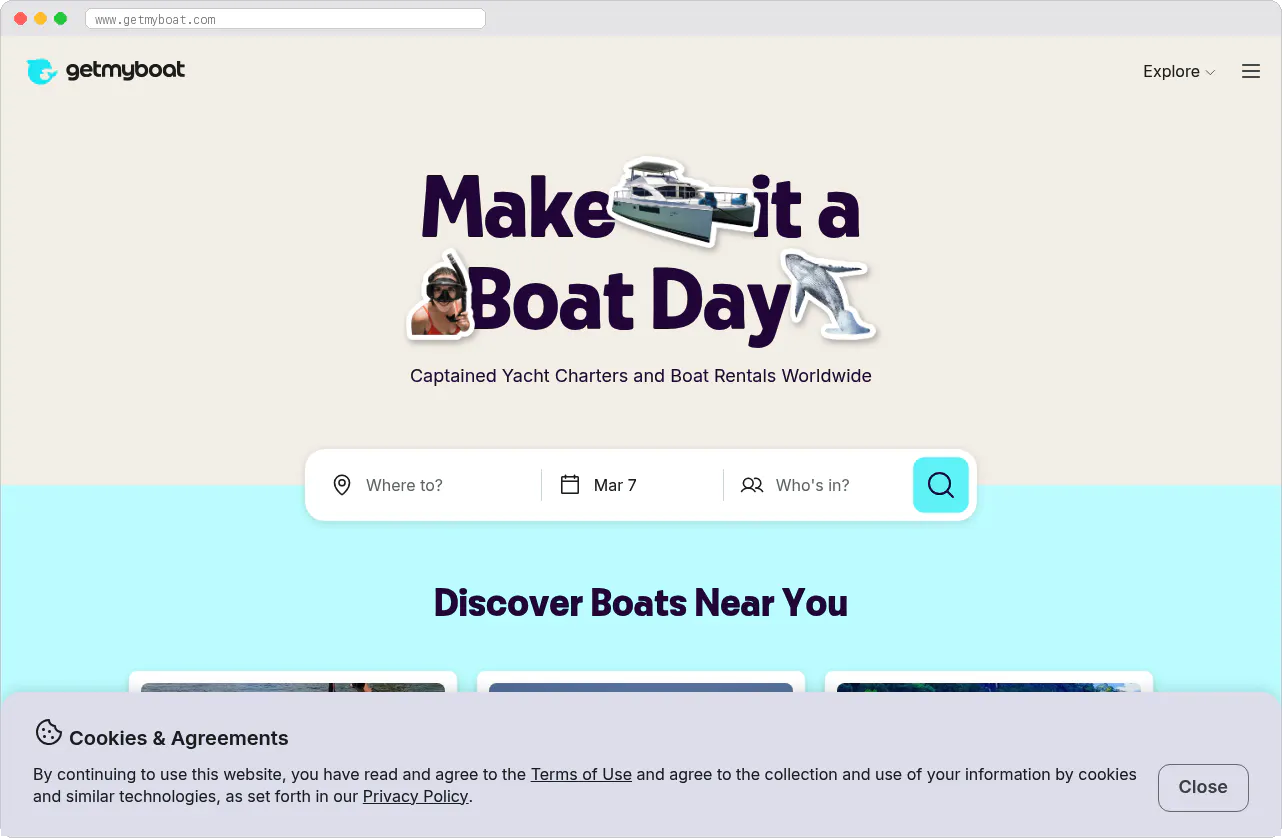
GetMyBoat is the largest boat rental marketplace by geographic reach, with listings in roughly 184 countries compared to Boatsetter's mostly US and Caribbean footprint (Getmyboat). It lists everything from jet skis to houseboats to crewed superyachts, and it mixes peer-to-peer owners with professional charter operators in the same search results. That breadth is a strength for global reach but a weakness for curation: renters comparing a $150 pontoon rental against a $15,000 crewed yacht charter in the same results list can find the experience less focused than Boatsetter's more recreational-boating-centered catalog. The opening this creates is a platform that narrows back down to one clear use case, like day-boating in a specific region, and out-curates the generalists on that use case.
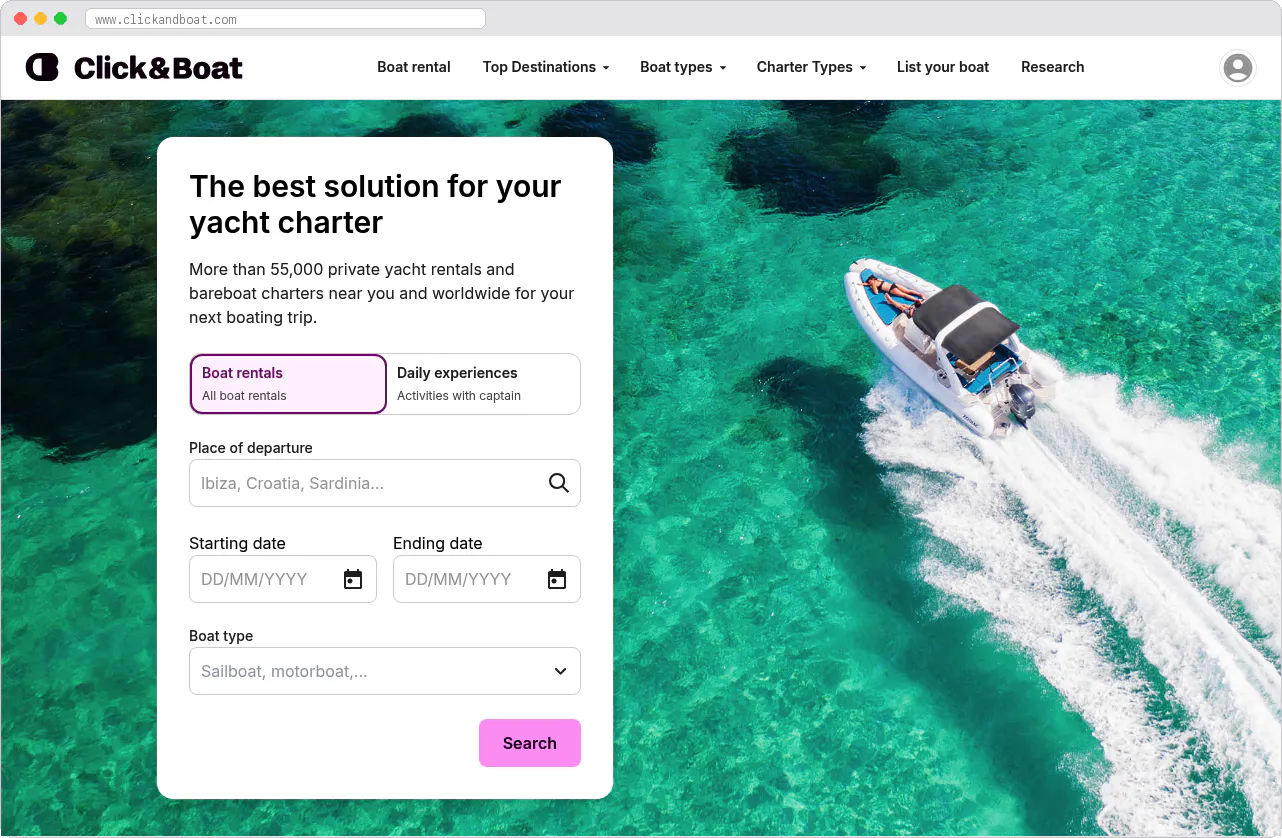
Click&Boat, based in France, leans heavily into the European charter and yacht vacation market, with strong inventory in the Mediterranean and along the Atlantic coast. It has built relationships with European marinas and charter operators that give it local credibility Boatsetter has never prioritized building in Europe. Its focus on multi-day charter bookings rather than day rentals means it competes less directly with Boatsetter's day-boating use case and more with traditional yacht charter brokers, leaving day-rental demand in continental Europe relatively underserved.
Sailo positions itself at the premium end, emphasizing luxury yachts, professional captains, and concierge-style service over simple access to a boat. That positioning supports higher commissions per booking but shrinks the addressable market to experience-buyers rather than boat enthusiasts looking for affordable water time, which is most of Boatsetter's actual demand. A new entrant targeting budget-conscious, first-time renters has room that Sailo has deliberately vacated.
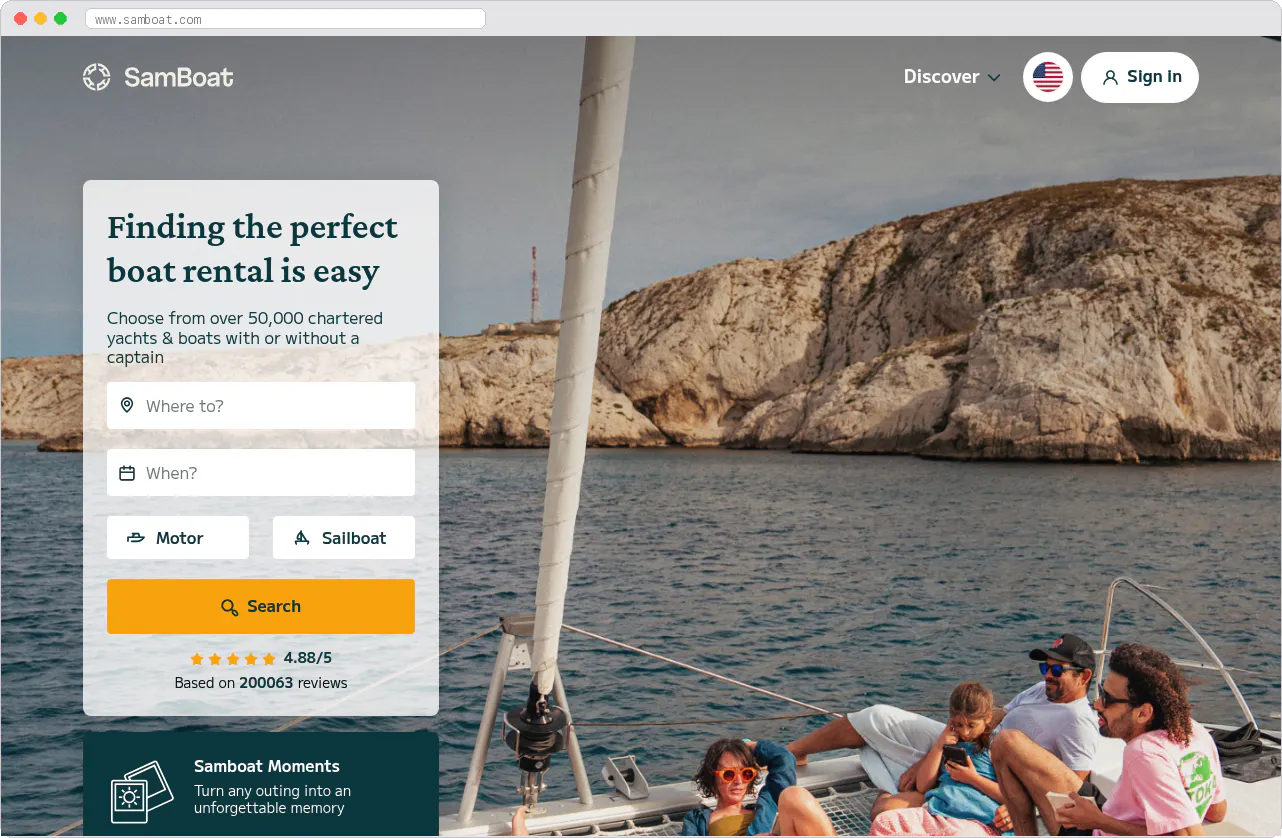
SamBoat operates a Boatsetter-like peer-to-peer model but adapted to European boating culture, regulation, and insurance frameworks, with a heavier tilt toward sailing and coastal cruising than the lake and river recreation common in the US. It shows that Boatsetter's exact model can be replicated regionally without direct competition, since European renters searching in French or Spanish rarely land on Boatsetter at all.
Boat clubs and traditional charter companies are the adjacent alternative that quietly takes share from all of the above. A boat club membership offers guaranteed, insured access to a rotating fleet without the peer-to-peer trust problem, and it appeals to renters who book often enough that a membership fee beats per-trip marketplace commissions. Any new entrant needs a clear answer to "why not just join a boat club" for its target renter segment, especially in markets where clubs already have a strong local presence.
How to build a marketplace like Boatsetter
1. Define your niche within Boatsetter's category
Boatsetter and GetMyBoat already cover general recreational boat rental across most major US coastal and lake markets, so a direct clone competing on breadth will lose. The more defensible path is a specific angle: pontoon and party boat rentals on a cluster of inland lakes, fishing charter bookings in a specific coastal region, jet ski and small watercraft rental for a beach town, or captained sunset cruise bookings in a tourist destination. Pick a niche narrow enough that you can personally know most of the boat owners in it within your first few months.
2. Validate demand and owner willingness before building anything
Talk to at least 15 to 20 boat owners in your target market about whether they'd rent out their boat, and listen for the objections that come up repeatedly: insurance, vessel damage, and renter competence are the usual three. Separately, talk to potential renters about how they currently access boats and what they'd pay for an alternative. If boat owners are lukewarm and renters have cheap existing options like a nearby boat club, the niche isn't ready yet.
3. Choose your development approach
Vibe coding from scratch. AI tools like Cursor, Lovable, and Bolt can produce a working Boatsetter-style prototype quickly, complete with listings, a map, and a booking form. For pressure-testing a concept or demonstrating it to early boat owners, that's genuinely useful. For launching a platform that holds renter payments and pays out owners after a boat rental involving real liability, it's probably not sufficient. What vibe-coded outputs reliably don't produce is the infrastructure underneath: payment escrow, dispute resolution, fraud detection, and compliance. A documented Sharetribe experiment ran 60+ hours to reach demo quality but revealed a critical checkout exploit that would have allowed any user to manipulate transaction prices via a direct API call. Bringing the output to production standard requires significant time, testing, and a clear understanding of how the different components of a web application fit together. A useful prototyping tool, not a cost-effective path to launch.
Custom development from scratch. Hiring developers, who will likely use AI heavily themselves, gives you full control over every workflow. A Boatsetter-type marketplace with reviews, renter experience verification, insurance integration, and a dispute flow sits in the production-grade tier: $80,000 to $200,000 over 16 to 28 weeks (Codica, RaftLabs). It lands there rather than the simple-MVP tier because on-water insurance integration and licensed-captain workflows add real complexity beyond basic listings and booking. The low end of that range assumes an offshore team billing $15 to $40 an hour; a US or Western European team pushes it toward the top. This path makes sense if you need a proprietary insurance underwriting integration or a captain-dispatch system no existing platform supports.
Building on a marketplace operating system like Sharetribe. You start at roughly 90% done on the standard marketplace foundation: payments, user accounts, listing management, messaging, transaction flows, fraud detection, and compliance. Your time and budget go toward the features that make a boat rental marketplace distinct. Three paths within this approach:
- No-code builder. Configure boat listings with custom fields for length, capacity, and captain requirements, set up location-based search with a map view, and build owner-approval booking flows, all from the Console without writing code. This gets most founders to a live, bookable marketplace in weeks.
- AI-assisted development. Connect Claude Code, Cursor, or Codex to Sharetribe's open APIs and open-source template to build boat-specific features like weather-aware cancellation logic, captain-add-on pricing, or renter experience questionnaires. Because Sharetribe already handles the payment infrastructure, AI-assisted development on top of it carries much lower risk than building from scratch.
- Custom code. Build directly on the developer platform for deeper integrations, such as connecting to a marine insurance provider's API, or hire from Sharetribe's Expert Marketplace for specialized work.
Most founders start with the no-code builder, launch, and then add features via AI or a developer once they know which parts of the boat rental experience their actual users care about.
4. Solve the cold start problem
A boat rental marketplace with no boats is worthless to renters, and a marketplace with no bookings is worthless to owners considering listing. Boatsetter solved this early by concentrating entirely on South Florida, a market with dense marina infrastructure, high boat ownership, and a near-year-round season, before expanding anywhere else. That geographic tightness let a small early team personally recruit boat owners and manually vet early listings.
For a new entrant, three tactics work well. First, go supply-first in a single tight geography: personally recruit 15 to 30 boat owners in one lake, marina, or coastal stretch before spending a dollar on renter-facing marketing, because renters forgive a small selection more easily than owners forgive an empty booking calendar. Second, recruit through existing boating communities, boat clubs whose members already own vessels, sailing schools, or fishing tournaments, rather than cold outreach, since referred owners trust the platform faster. Third, consider manually matching your first bookings yourself, texting an owner directly when a renter inquires, rather than building a fully self-serve flow before you understand the friction points. Launching in one lake or one marina and getting it dense beats launching across an entire state with thin coverage everywhere.
5. Handle insurance and legal requirements before your first booking
Do not launch without a functioning insurance solution. Contact marine insurance brokers who work with sharing-economy platforms early in your planning, since standard recreational boat policies typically exclude commercial or rental use, and your owners will not list without coverage that fills that gap. Consult a maritime attorney about state-specific boating regulations, licensing requirements for renters, and liability exposure, because these rules vary significantly between, say, Florida and a landlocked lake state.
6. Recruit and onboard your first boat owners
Start with owners who already have some comfort with commercial use of their boat: sailing instructors, boat club members, or owners who have done informal rentals to friends already. Offer hands-on help with listing photography and pricing for your first 10 to 20 owners, since listing quality drives renter trust more in boating than in almost any other rental category.
7. Generate initial renter demand
Target the segments most likely to convert early: tourists at a waterfront destination, local fishing enthusiasts, and groups looking for a one-off celebration on the water. Partner with hotels, tourism boards, and vacation rental hosts in your target area, since a visitor already planning a trip is often a lower-effort sale than a local deciding to try something new. Boating-specific Facebook groups and forums for your target lake or coastline are also worth direct outreach.
8. Build trust systems and launch
Put reviews, identity verification, and a clear safety and cancellation policy in place before your public launch, not after. Run a soft launch with your recruited owners and a handful of friendly early renters to catch operational gaps, then expand marketing once bookings are completing smoothly.
Do you need to build everything Boatsetter has?
No. Boatsetter has spent over a decade building insurance partnerships across dozens of states, a captain-matching network, and weather-data integrations that automate cancellation decisions. None of that is required to launch. What's essential at day one is a working booking flow, secure payments, basic owner and renter verification, and one solid insurance partnership for your specific launch market. Everything else, from captain dispatch to automated weather cancellations, is worth adding once you have real bookings proving people want the core product.
The instinct to "just vibe-code a Boatsetter clone" is understandable given how capable AI coding tools have become, but it misjudges where the actual difficulty lies. The hard part of a boat rental marketplace isn't the listing page or the search bar, both of which AI tools handle well. It's the payment splitting between renter, owner, and insurance provider, the escrow logic that holds funds until a rental completes safely, and the compliance work around collecting the right renter information before a booking is confirmed. Starting on Sharetribe's foundation means that infrastructure already exists, so your AI tokens or developer hours go toward the boat-specific logic, like captain-requirement rules or weather cancellation windows, rather than rebuilding a payment system from zero.
Trust and safety for a Boatsetter-type marketplace
Physical safety is the defining trust risk in boat rental, unlike most peer-to-peer marketplaces where the worst case is a bad transaction. A renter operating an unfamiliar boat without adequate experience is a genuine safety hazard to themselves, passengers, and other people on the water, which is why experience verification and, in some cases, mandatory captains, are not optional nice-to-haves but core product requirements. Identity verification matters too, both for renters (to confirm they are who they claim to be and hold any required license) and for owners (to confirm they legitimately own and can insure the vessel they're listing).
Payment and liability disputes are the second major risk category. A renter who damages a boat, or an owner who misrepresents a vessel's condition, creates a dispute that needs a clear resolution process backed by insurance, not just a marketplace's goodwill. Sharetribe provides secure payments with delayed payouts through Stripe, configurable transaction flows that can require manual approval before a booking is confirmed, and user accounts that support identity verification steps. What founders need to add on top is the boating-specific layer: experience questionnaires, license verification where required by law, and a signed insurance partnership that actually covers on-water use, since no generic marketplace platform can supply marine insurance for you.
Running a marketplace like Boatsetter
Day-to-day operations for a boat rental marketplace involve more active coordination than a typical goods marketplace. Expect higher customer service volume than average, driven by weather-related rescheduling, pre-rental questions about boat handling, and post-rental damage or dispute claims. Seasonal demand swings are also sharper than most categories: a lake market might do 80% of its annual bookings in a four-month window, which affects everything from staffing to marketing budget pacing.
Sharetribe handles the transaction mechanics automatically: payment collection, commission splitting, payout timing, and booking calendar updates when a reservation is confirmed or canceled. You won't need to build or maintain that infrastructure yourself. What you will need to manage directly, at least early on, is insurance claims coordination, renter and owner support during disputes, and marketing that adapts to your market's specific boating season.
Development costs and timeline
Three realistic scenarios:
Vibe coding from scratch: Free or very cheap to start, and a working Boatsetter-style prototype is buildable in a weekend with AI tools. What you can't get from here is a production-ready platform: escrow that safely holds renter payments until a rental completes, insurance-partner integration, renter experience verification, and dispute handling all require work that AI coding tools don't shortcut. A documented Sharetribe experiment logged 60+ hours to reach demo quality and still uncovered a critical payment vulnerability that would have let any user manipulate prices directly through the API. A useful proof-of-concept tool, not a cost-effective path to a live business.
Custom development from scratch: Cost depends on complexity tier. A basic Boatsetter-style MVP with listings, search, and simple payments runs $30,000 to $80,000 over 8 to 20 weeks. A production-grade build that adds reviews, renter identity and experience verification, escrow, and a dispute flow, which is closer to what a real launch needs, runs $80,000 to $200,000 over 16 to 28 weeks (Codica, RaftLabs). The insurance integration and captain-workflow requirements are what push a boat rental marketplace toward the higher tier rather than the simple-MVP range. The low end assumes an offshore team; US or Western European developers push costs toward the top. Ongoing maintenance typically runs 15% to 25% of the original build cost per year, on top of hosting. This path makes sense when you need a proprietary insurance or captain-dispatch integration no existing platform supports.
Building on Sharetribe: Before you launch, the Sharetribe Build plan costs just $39/month. To open to real users, you need the Live plan, which costs $199/month billed yearly ($259/month billed monthly). Both plans include 1 million usage credits per month. Sharetribe covers the marketplace foundation, payments, listings, search, messaging, and booking management, that a boat rental marketplace needs from day one, leaving your budget free for the insurance partnership and marine-specific customization that actually differentiate your platform. Most founders reach a live MVP in weeks rather than months, and features added later via AI tools or a developer are scoped narrowly because the transaction engine is already built.
Why Sharetribe for building a marketplace like Boatsetter
Sharetribe's calendar-based availability system fits boat rentals directly, letting owners block dates for maintenance, personal use, or seasonal storage while renters see accurate real-time availability. Location-based search with map display handles the marina- and waterway-specific search behavior that boat renters need, and custom listing fields let you capture boat-specific details like length, capacity, and captain requirements without custom code. Delayed payouts through Stripe Connect support the kind of "pay after the rental completes safely" structure that boat rental marketplaces typically want, and the built-in transaction flow can be configured to require owner approval before a booking is confirmed, giving owners the final say that boat rental in particular tends to demand.
Frequently asked questions
How much does it cost to build a boat rental marketplace like Boatsetter?
It depends on your approach. A Sharetribe-based marketplace starts at $39/month on the Build plan ($199/month billed yearly on the Live plan once you go live) plus setup and marketing costs, typically reaching a live MVP within a few weeks. Custom development for a production-grade platform with insurance integration and verification runs $80,000 to $200,000 over 16 to 28 weeks, according to Codica and RaftLabs.
What insurance do I need to run a boat rental marketplace?
You need on-water liability coverage that specifically permits commercial or peer-to-peer rental use, since standard recreational boat policies typically exclude this. Partner with a marine insurance broker experienced in sharing-economy platforms early in your planning, since owners won't list their boats without confirmed coverage.
Can I compete with Boatsetter and GetMyBoat as a new platform?
Yes, by focusing on a geographic area or boat category the larger platforms serve thinly, rather than competing on breadth. Deep local relationships with boat owners and marinas in one region typically beat trying to match an established platform's national inventory from day one.
Do renters need a boating license to use a peer-to-peer boat rental marketplace?
Requirements vary by state and country, and some jurisdictions require a boating safety certificate for self-drive rentals above a certain boat size. Many marketplaces, including Boatsetter, address this by offering captain-included bookings as an alternative for renters without qualifications, letting less experienced customers still book a trip.
How do boat rental marketplaces handle weather cancellations?
Most platforms build a cancellation window, often within 24 hours of departure, that allows free cancellation if weather makes the trip unsafe. This requires monitoring conditions and having a clear, published policy so both owners and renters know what happens before a storm forces a cancellation.
Is vibe coding a viable way to launch a boat rental marketplace?
It's useful for a demo or investor pitch but not for a live platform handling real bookings and payments. A documented Sharetribe test found that even a 60-hour AI-built prototype had a critical checkout vulnerability, which is a serious risk when real money and physical safety are involved.
Start your 14-day free trial
Create a marketplace today!
- Launch quickly, without coding
- Extend infinitely
- Scale to any size
No credit card required