How to build a website like Urbansitter
Urbansitter connects parents with trusted babysitters through social networks and community recommendations. This guide shows you how to build a similar childcare marketplace, from validating your idea to launching and scaling your platform.
Published: Mar 15, 2024
Last updated: Sep 11, 2026
What is Urbansitter and how does it work?
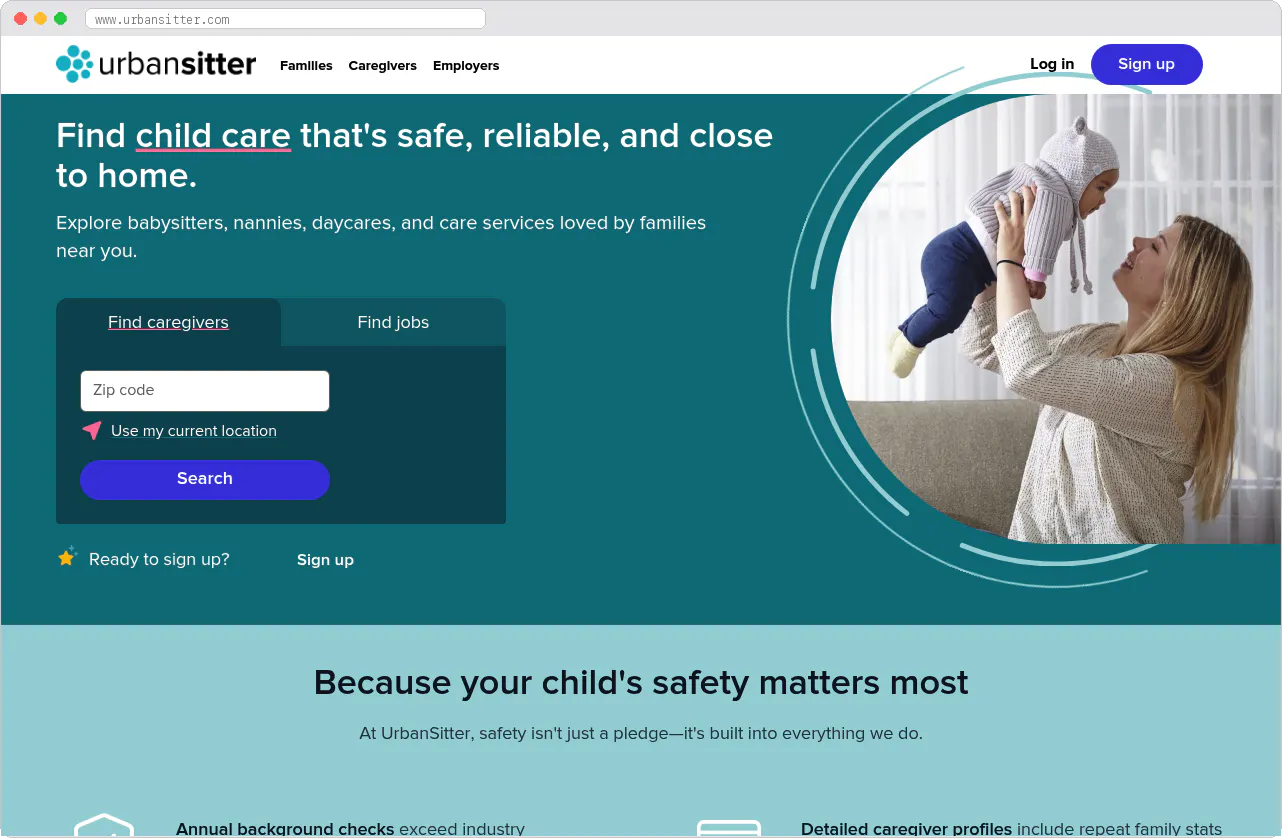
Urbansitter is a childcare marketplace that connects parents with babysitters and nannies through social network signals rather than anonymous listings. Lynn Perkins founded the company in San Francisco in 2011, building on the observation that parents already found babysitters through word of mouth, just inefficiently. The platform digitized that trust network instead of replacing it with faceless reviews.
UrbanSitter has facilitated millions of bookings across the United States and raised more than $40 million in venture funding, and it remains an independent company today, having itself acquired the babysitting app Sitter in 2019 (PitchBook). The acquisition gave Urbansitter distribution through Bright Horizons' employer-sponsored benefits programs, a channel most childcare marketplaces never access. Today it operates as both a consumer app and a backup-care benefit offered through corporate partners.
How Urbansitter makes money
Urbansitter runs a dual-sided revenue model: a parent-paid subscription plus a transaction fee layered on top. Parents pay a recurring membership, currently $19.95 per month (or less if billed annually), to unlock messaging, booking, and payment tools (The Bump). Without an active subscription, parents can browse limited profile information but can't contact sitters or book through the platform.
On top of the subscription, Urbansitter takes a service fee on completed bookings, which scales with transaction volume rather than staying flat. This means revenue grows both from user acquisition (more subscribers) and from usage (more bookings per subscriber), a combination that smooths out the seasonality inherent in childcare demand. Summer break, school closures, and holiday travel all spike booking volume, and the transaction fee captures that upside without requiring a pricing change.
The corporate backup-care channel, expanded significantly after the Bright Horizons acquisition, adds a third revenue stream: B2B contracts where employers pre-pay for a pool of subsidized childcare hours their employees can draw on. This enterprise layer is largely inaccessible to new entrants without an established, verified sitter network, which is exactly why most new childcare marketplaces should target consumers directly rather than trying to replicate it.
What makes Urbansitter work: key features
Social proof through mutual connections. The single feature that differentiates Urbansitter from a directory is showing parents how a sitter connects to people they already know: a friend who used the same sitter, a neighbor in a shared parenting group, a mutual Facebook connection. This turns cold trust (a stranger's star rating) into warm trust (someone I know vouched for this person), which matters enormously when the transaction involves your children.
Detailed, filterable sitter profiles. Profiles go beyond a bio and a photo. They include age-group experience, special-needs experience, languages, certifications like CPR, and additional skills such as tutoring or driving. Parents filter on these attributes directly, which shortens the search from "browse everyone" to "see only sitters who match my specific requirements."
Flexible calendar-based booking. The platform supports both one-off babysitting requests and recurring nanny arrangements inside the same booking flow. Sitters set availability windows, parents request specific dates and times, and the system prevents double-booking automatically.
Two-way reviews. Parents review sitters on reliability and rapport with children; sitters can also evaluate families. This symmetry matters in childcare more than in most marketplace categories, because a bad match creates real risk and disruption for both sides, not just a bad experience.
Automatic, deducted payments. Cards are charged after a job is completed, and funds move to sitters minus the platform's fee, removing the awkwardness of cash handoffs and post-hoc invoicing that defined pre-marketplace babysitting.
The competitive landscape
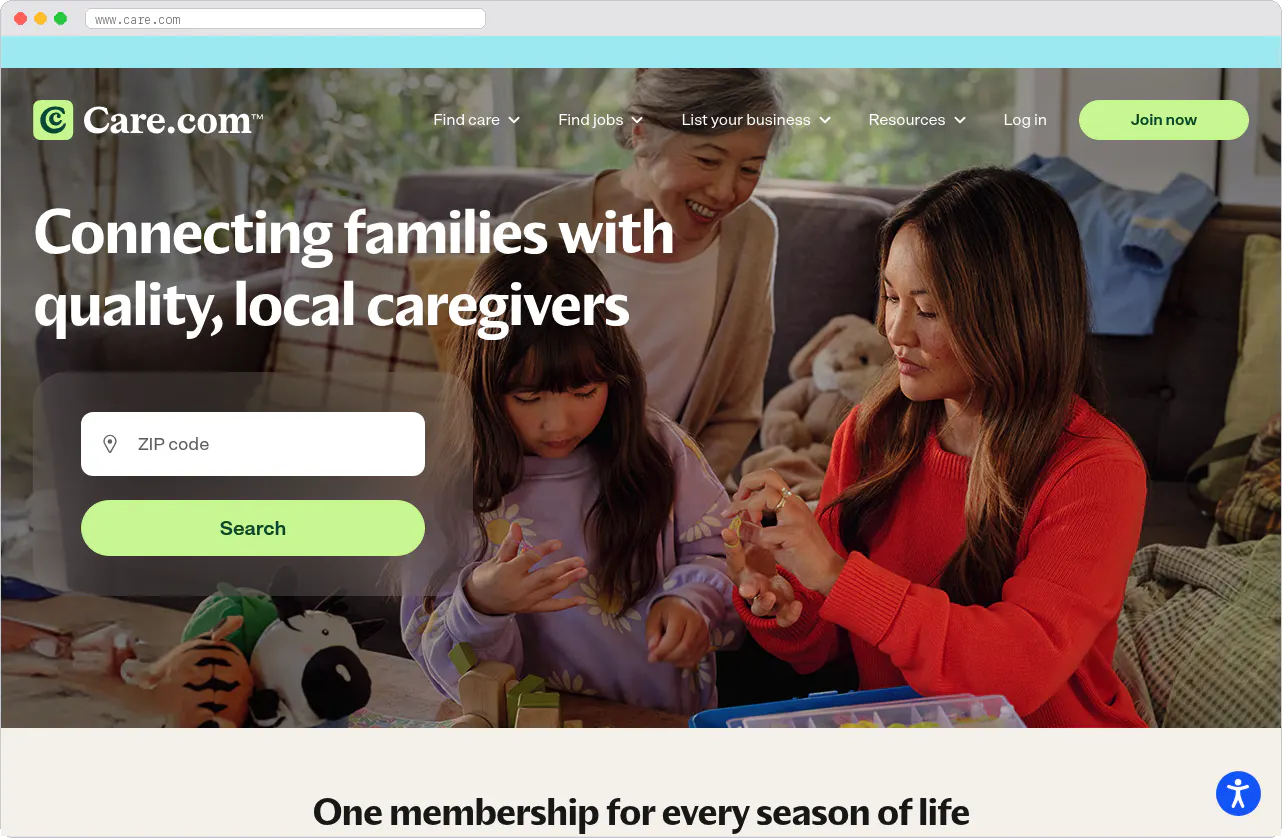
Care.com is the largest player in the broader caregiving space, covering childcare, senior care, pet care, and housekeeping under one platform. Its scale gives it the deepest caregiver database in the industry and comprehensive screening options, including background checks and reference verification as paid add-ons. Where it falls short is focus: users searching specifically for a babysitter wade through a platform built for many care categories at once, and the sheer size of the caregiver pool can make it harder to identify standout providers. This creates an opening for platforms that go narrow and deep on childcare alone, with curation over volume.
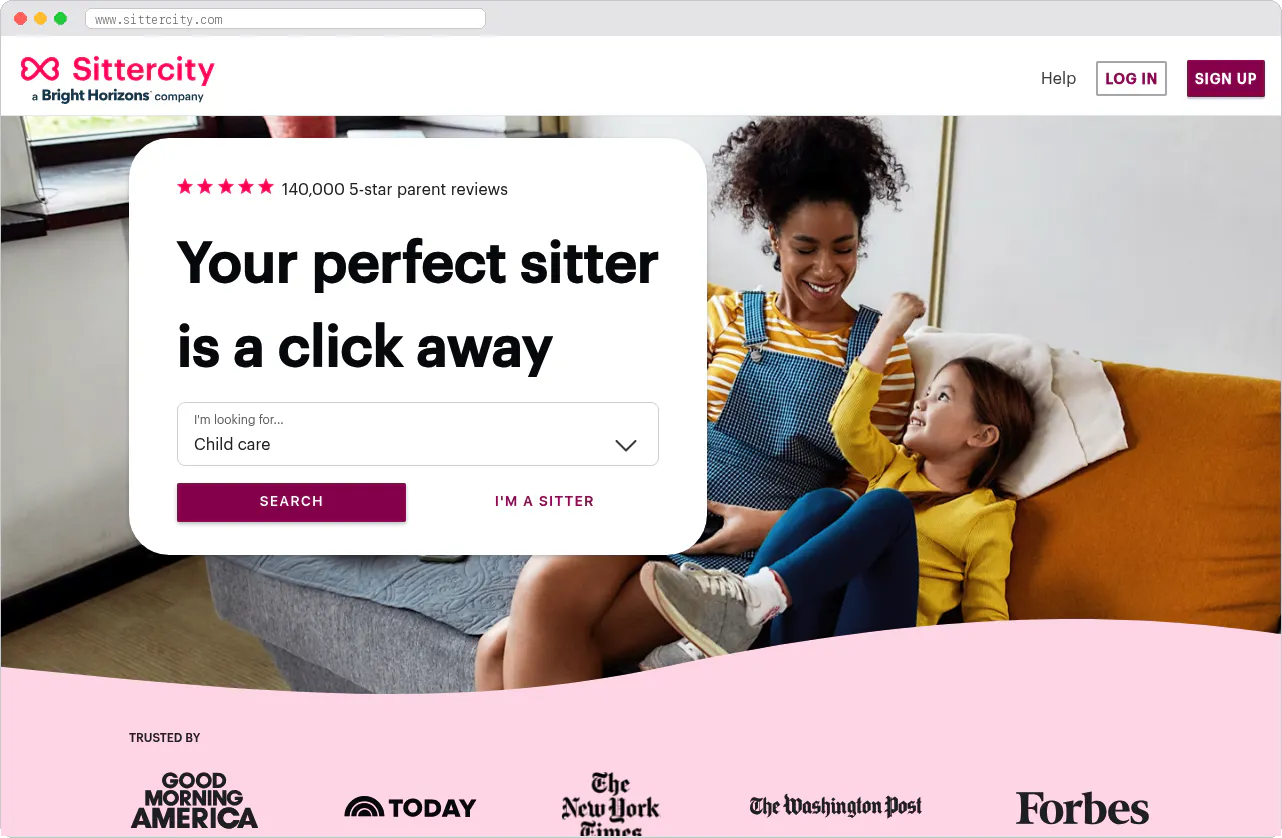
Sittercity has operated as a childcare-only platform since 2001, longer than almost any competitor, and built its trust model on formal screening: a four-step verification process and safety certifications rather than social graphs. It reaches suburban and smaller-city markets that social-network-based discovery struggles to serve, since those markets often lack the dense friend-of-a-friend connections Urbansitter relies on. Its weakness is that the experience can feel transactional and dated compared to newer, more mobile-first competitors, leaving room for a platform that combines formal verification with a smoother, app-native booking experience.
Bambino pushes the social-trust model further than Urbansitter by requiring sitters to be recommended by existing users before they can join. That creates a tighter, more trusted network, but it also caps growth speed and makes it hard for both new sitters and parents in thinly populated areas to get started. The gap it leaves open is geographic: any market where Bambino doesn't yet have a critical mass of connected users is effectively unserved by its own model.
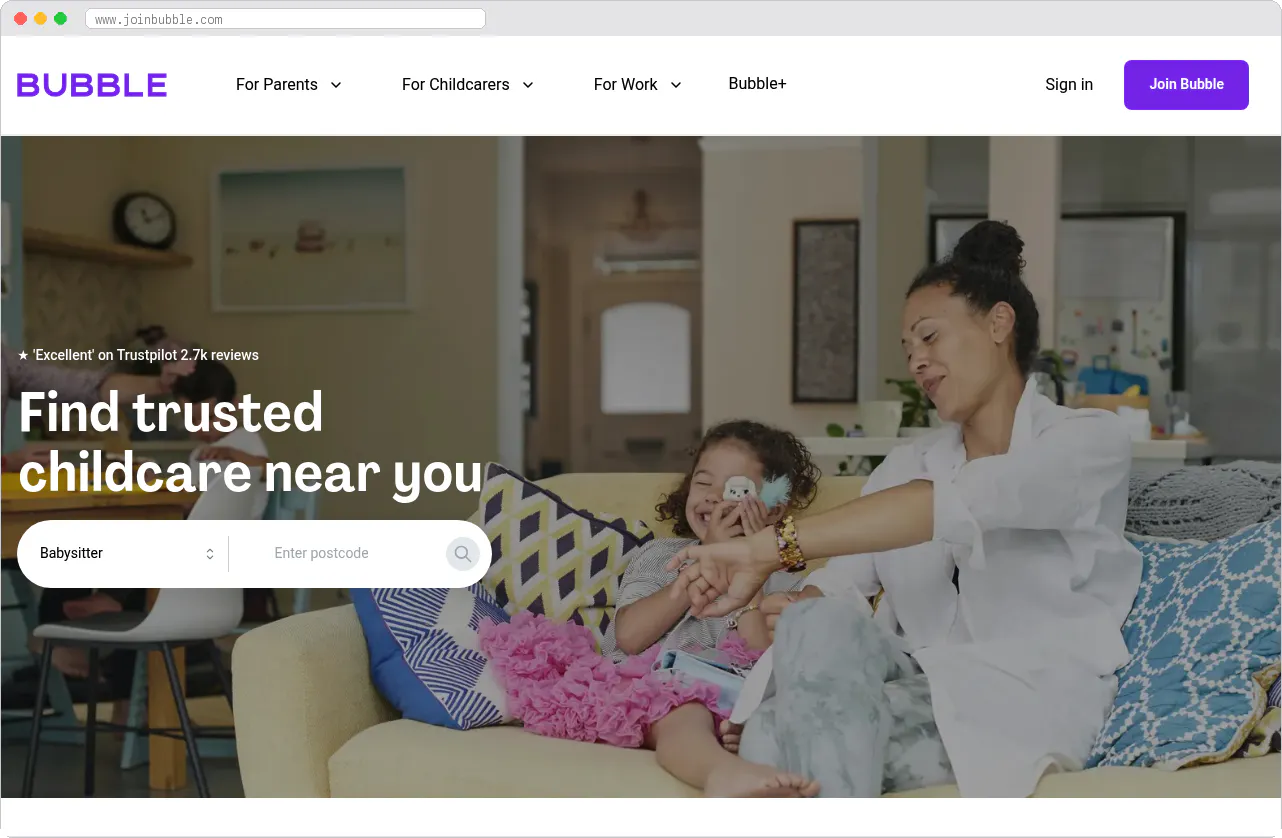
Bubble, based in the UK, optimizes specifically for urgent, last-minute bookings rather than planned ones, and leans on platform-level verification and insurance instead of social proof. It demonstrates that regulatory and cultural context (UK childcare norms differ from US ones) shapes what a childcare marketplace needs to prioritize. Its narrow focus on urgency means it's a weaker fit for families building an ongoing relationship with a regular nanny, which is where competitors with recurring-booking tools have an advantage.
Helpr skips the general babysitting market entirely and sells backup, same-day childcare to corporate clients whose employees need emergency coverage. This B2B angle lets it charge premium rates and avoid competing head-on with consumer apps, but it also means Helpr does nothing for the much larger group of parents looking for a regular sitter or nanny. Any consumer-facing entrant competes in a space Helpr has deliberately left open.
Beyond named competitors, informal channels like neighborhood Facebook groups, Nextdoor, and school parent listservs quietly capture a huge share of childcare arrangements without any platform at all. That's not a competitor so much as evidence of demand: parents are already trusting semi-structured social networks for childcare, which is precisely the behavior a well-built marketplace can formalize and monetize.
How to build a marketplace like Urbansitter
1. Define your niche within Urbansitter's category
Urbansitter and its major competitors already cover general babysitting and nanny placement at national scale. Competing head-on with the same feature set is a losing proposition. Instead, find the specific gap: a metro area none of the incumbents serve well, a caregiver type they underserve (special-needs childcare, bilingual sitters, overnight or newborn care specialists), or a community they don't reach (a specific cultural or religious community that prefers caregivers who share their background and language). The narrower and more specific your starting point, the easier your first hundred bookings will be.
2. Validate demand before building anything
Talk to parents in your target area or community about how they currently find childcare and what frustrates them about it. Many rely on Facebook groups, school listservs, or word of mouth, which tells you the underlying need is real even if no one has built a dedicated tool for it yet. Run a manual matching test: collect a handful of parent requests and sitter profiles by hand, make introductions yourself, and see whether people actually book and pay. If you can't get ten manual matches to happen, a platform won't fix that.
3. Choose your development approach
Vibe coding from scratch. AI tools like Cursor, Lovable, and Bolt can produce a working Urbansitter-style prototype quickly, complete with profiles, search, and a booking calendar. For pressure-testing a concept or demonstrating it to early sitters and parents, that's genuinely useful. For launching a platform that processes real payments for childcare, on-demand AI-generated code isn't enough on its own. What vibe-coded outputs reliably don't produce is the infrastructure underneath: payment escrow, dispute resolution, fraud detection, and compliance. A documented Sharetribe experiment ran 60+ hours to reach demo quality but revealed a critical checkout exploit that would have let any user manipulate transaction prices via a direct API call. In a category involving payments tied to childcare, that kind of gap isn't a minor bug to fix later. A useful prototyping tool, not a cost-effective path to launch.
Custom development from scratch. Hiring developers, who will likely use AI heavily themselves, gives you full control over features and design. For an Urbansitter-type marketplace, the right complexity tier depends on scope: a simple MVP with listings, search, messaging, and basic payments runs $30,000–$80,000 over 8–20 weeks, while a production-grade build with identity verification, background-check integration, escrow, and dispute handling runs $80,000–$200,000 over 16–28 weeks (Codica, RaftLabs). Childcare marketplaces almost always need to sit in the second tier, because background checks, insurance considerations, and dispute flows aren't optional extras in this category, they're baseline trust requirements. The low end of each range assumes offshore teams at $15–40/hr; a US or Western European team pushes costs toward the top. This path makes sense once you know exactly which trust or matching mechanics your market needs that no existing platform offers.
Building on a marketplace operating system like Sharetribe. You start at roughly 90% done on the standard marketplace foundation: payments, user accounts, listing management, messaging, transaction flows, fraud detection, and compliance. Your time and budget go toward the features that make your childcare marketplace distinct. Three paths within this approach:
- No-code builder. Configure sitter and parent profiles, location-based search, calendar availability, and commission-based payments directly from the Console, no code required. This gets most founders to a live, bookable marketplace within weeks.
- AI-assisted development. Connect Claude Code, Cursor, or Codex to Sharetribe's open APIs and open-source template to build category-specific features, like a social-connection display, a special-needs experience filter, or a background-check integration. Because Sharetribe handles the payment infrastructure underneath, AI-assisted development on top of it carries much lower risk than building from scratch.
- Custom code. Build directly on the developer platform for deeper integrations (background-check APIs, insurance partners, corporate benefits systems), or hire from Sharetribe's Expert Marketplace.
Most founders start with the no-code builder, then add features via AI or a developer as they learn what their specific parents and sitters actually need.
4. Solve the cold start problem
Childcare marketplaces face an acute version of the chicken-and-egg problem: parents won't sign up for a platform with no available sitters nearby, and sitters won't invest time building a profile on a platform with no bookings. Urbansitter solved this early by leaning on existing social graphs, recruiting sitters who already had relationships with families in specific San Francisco neighborhoods, so the very first users had social proof baked in from day one.
New entrants can apply the same logic at smaller scale. Recruit supply first: reach out directly to experienced sitters and nannies through parenting groups, college job boards, and community organizations, and get real profiles live before you spend a dollar on parent-facing marketing. Focus on one neighborhood, school district, or community rather than an entire city; density beats breadth, since a parent only cares whether there's a good sitter near them, not how many total sitters exist on the platform nationally. Consider manual matching in the earliest weeks, personally connecting the first parents and sitters by hand rather than waiting for search and filters to do the work; it doesn't scale, but it proves the model works before you automate it.
5. Build trust signals into the launch, not after it
Whatever your differentiator (social proof, formal certification, community vetting), decide before launch which trust mechanism you're leading with and build your onboarding around it. If it's social proof, ask early sitters and parents to connect their networks from day one. If it's formal verification, get background-check integration working before you onboard your first ten sitters, not after a complaint forces the issue.
6. Launch to a tight geographic or community cohort
Pick a single zip code, school district, or community group for your initial launch rather than opening broadly. A tight cohort lets word of mouth do real work: parents in the same school pickup line talking about a sitter they found through your platform is worth more than any ad spend. Expand to adjacent neighborhoods only once your first cohort has real booking density and repeat usage.
7. Layer in community and referral mechanics as you scale
Once you have consistent bookings in your initial market, add features that reinforce the community effect: neighborhood-based sitter groups, referral credits for parents who bring in other parents, and partnerships with local schools or community centers that lend your platform credibility. These compound the trust advantage you built during the cold-start phase instead of relying purely on paid acquisition going forward.
Do you need to build everything Urbansitter has?
No. Urbansitter's current feature set, corporate benefit integrations, deep social graph mapping, national sitter database, is the product of more than a decade of iteration and $50 million in funding, not a checklist for launch. At MVP stage, you need profiles, location search, messaging, calendar booking, and basic payment processing. Everything else, insurance partnerships, employer benefit contracts, advanced matching algorithms, can wait until you have enough transaction volume to justify building it.
The temptation to vibe-code your own version from scratch deserves a direct answer: it's usually slower, not faster, than building on an existing foundation. An AI coding tool can generate screens and a database quickly, but it can't generate battle-tested payment escrow, PCI compliance, or fraud detection in an afternoon, and childcare payments are exactly the kind of transaction where a checkout vulnerability is unacceptable. Starting on Sharetribe means your AI tokens and developer hours go toward your social-proof feature or your background-check integration, not toward re-solving problems that a marketplace operating system already solved.
Trust and safety for a childcare-type marketplace
Childcare carries higher trust stakes than almost any other marketplace category, because the transaction involves unsupervised access to someone's children, not just an item or a service performed on a schedule with witnesses present. The specific risks include identity fraud (someone posing as a different, more qualified sitter), inadequate background screening, payment disputes over hours worked, and, most seriously, the physical safety of children in a sitter's care.
Standard practice in this category includes government-ID verification, third-party background check integration (services like Checkr are common), reference verification, and certification checks for CPR or early childhood education credentials. Two-way reviews that capture both competence and personality fit are also standard, since a technically qualified sitter who doesn't connect with a specific family is still a bad match.
Sharetribe provides the transaction backbone out of the box: secure payment processing with funds held until a booking completes, user accounts that support identity verification, structured messaging, and dispute-relevant transaction history. What founders need to add on top is category-specific: a background-check API integration, clear policies on what verification level is required before a sitter can accept bookings, and a documented process for handling safety complaints. None of this is optional in childcare; treat it as a launch requirement, not a phase-two feature.
Running a marketplace like Urbansitter
Day-to-day operations for a childcare marketplace involve reviewing new sitter applications, moderating profile content, responding to disputes over hours or no-shows, and monitoring for suspicious behavior like sitters trying to move payment off-platform to avoid fees. At meaningful scale, Urbansitter also manages corporate benefit contracts and a much larger verification pipeline, neither of which a new entrant needs to replicate in year one.
Sharetribe automates the parts that would otherwise consume the most operational time: payment collection and payout, calendar conflict prevention, automated notifications for booking requests and confirmations, and the underlying transaction record that makes dispute resolution possible. That leaves founders free to spend their time on the things software can't do, like personally vetting your first fifty sitters and building the local relationships that make a cold start work.
Development costs and timeline
Three realistic scenarios:
Vibe coding from scratch: Free or very cheap to start. A working Urbansitter-style prototype, profiles, search, a calendar, is buildable in days with AI tools. What you can't get from here is a production-ready platform: PCI-compliant payment handling, background-check integration, dispute workflows, and safeguards against the kind of price-manipulation exploit that surfaces when payment logic is generated without security review all require real work that AI tools don't shortcut. A documented Sharetribe experiment logged 60+ hours to reach demo quality and still found a critical checkout vulnerability. A useful proof-of-concept tool, not a cost-effective path to a live childcare business.
Custom development from scratch: Cost depends on complexity tier. A simple Urbansitter-type MVP with basic listings, search, and messaging runs $30,000–$80,000 over 8–20 weeks. A production-grade build with reviews, identity verification, background checks, escrow, and dispute flow, the tier that fits childcare, runs $80,000–$200,000 over 16–28 weeks (Codica, RaftLabs). The low end assumes offshore teams; US or Western European teams push toward the top. Ongoing maintenance typically runs 15–25% of the original build cost per year on top of hosting. This path makes sense when your trust model or matching mechanic genuinely doesn't exist elsewhere.
Building on Sharetribe: Before you launch, the Sharetribe Build plan costs just $39/month. To open to real users, you need the Live plan, which costs $199/month billed yearly ($259/month billed monthly). Both plans include 1 million usage credits per month. Sharetribe covers the payment processing, user accounts, listing and calendar management, messaging, and compliance infrastructure a childcare marketplace needs on day one. Most founders reach a live MVP in weeks rather than months, then add background-check integrations or social-proof features via AI tools or a developer once they've validated demand.
Why Sharetribe for building a marketplace like Urbansitter
Sharetribe's core transaction engine maps directly onto what a childcare marketplace needs: calendar-based booking with automatic double-booking prevention, commission-based payment processing that holds funds until a job completes, and structured messaging between parents and sitters. User accounts support identity verification, which you can extend with a background-check API as you formalize your trust model. The developer platform means you're not locked into a rigid template: you can build a social-connection display, a special-needs filter, or a corporate benefits integration on top of the existing foundation instead of building the whole system from zero. That combination, a working transaction backbone plus room to differentiate, is what lets a solo founder or small team compete on trust and community fit rather than trying to out-engineer platforms with a decade's head start.
Frequently asked questions
How much does it cost to build a childcare marketplace like Urbansitter?
It depends on your build path. A no-code build on Sharetribe starts at $39/month on the Build plan ($199/month billed yearly on the Live plan once you go live), letting most founders launch within weeks for a few thousand dollars in the first year. Custom development for a production-grade platform with background checks and dispute handling runs $80,000–$200,000 over 16–28 weeks (Codica).
What are the most important features for a childcare marketplace?
Identity and background-check verification, calendar-based booking, secure messaging, location-based search with detailed filters, automatic payment processing, and two-way reviews are the core set. Trust and safety features carry more weight in childcare than in most other marketplace categories, so treat verification as a launch requirement rather than an add-on.
How does Urbansitter make money?
Urbansitter combines a monthly parent subscription, currently around $19.95, with a per-booking service fee (The Bump). This dual model creates recurring revenue from subscriptions while transaction fees scale with actual booking volume, which helps smooth seasonal demand swings.
Should I recruit sitters or parents first when launching?
Recruit sitters first. Parents won't sign up for a platform with no available, verified caregivers nearby, so building supply before demand is standard practice for childcare marketplaces, and it's how Urbansitter itself approached early growth in San Francisco.
Can I just vibe-code a competitor to Urbansitter?
You can prototype one quickly, but you shouldn't launch it that way. A documented Sharetribe experiment showed that AI-generated marketplace code can reach demo quality in about 60 hours while still containing a critical payment exploit, which is a serious risk in a category involving children and money. Building on an existing payment and compliance foundation gets you to a safer launch faster than fixing security gaps after the fact.
What makes Urbansitter different from Care.com or Sittercity?
Urbansitter leads with social proof, showing parents how a sitter connects to their existing friends and community, while Care.com and Sittercity lean more heavily on formal screening and large caregiver databases. That difference in trust strategy is also the clearest opportunity for a new entrant: pick a trust model that fits your specific community rather than copying either approach wholesale.
Start your 14-day free trial
Create a marketplace today!
- Launch quickly, without coding
- Extend infinitely
- Scale to any size
No credit card required