How to build a website like Grab: complete guide to multi-service marketplaces
Learn how Grab transformed from a ride-hailing app into Southeast Asia's super-app with multiple services. Inside: Grab's business model, key features, and how to build your own multi-service marketplace platform.
Published: Mar 1, 2026
Last updated: Mar 19, 2026
Grab started as a simple taxi-booking app in Malaysia in 2012. Today, it's Southeast Asia's leading super-app, serving over 187 million registered users across food delivery, ride-hailing, financial services, and logistics. The company processes billions of transactions annually and has become the region's most valuable startup, valued at approximately over $40 billion.
What makes Grab particularly interesting for marketplace founders is how it evolved from a single-service platform into a complete ecosystem. Rather than just competing with Uber on ride-hailing, Grab expanded strategically into adjacent services, creating multiple revenue streams and deeper user engagement.
This transformation didn't happen overnight. Grab's founders, Anthony Tan and Tan Hooi Ling, spent years understanding Southeast Asian markets, adapting to local preferences, and building trust in regions where digital payments were still emerging. Their approach offers valuable lessons for anyone looking to build a multi-service marketplace.
If you're considering building a Grab clone or a similar multi-service platform, this guide will walk you through Grab's business model, key features, competitive landscape, and practical steps to create your own marketplace.
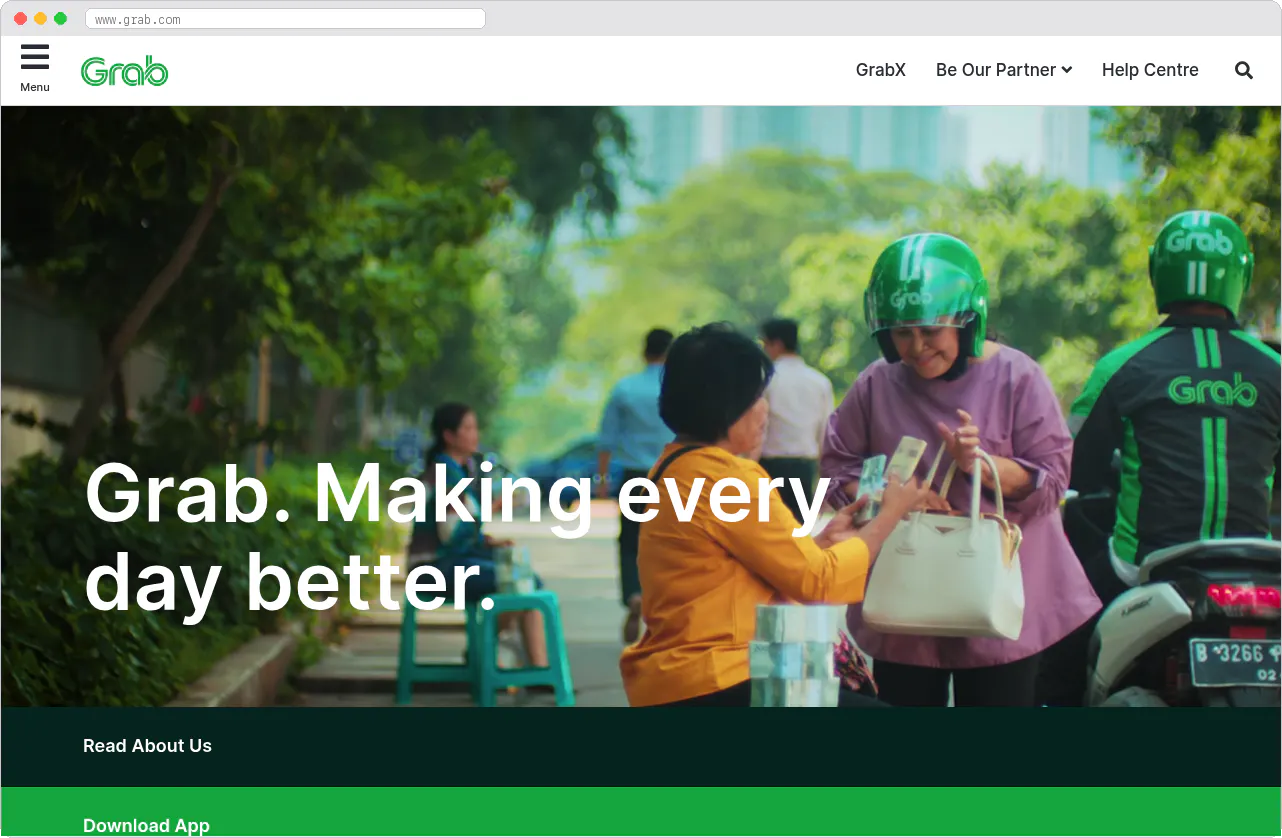
How does Grab work?
Grab operates as a multi-sided marketplace that connects service providers with consumers across several categories. The platform's core structure revolves around three main participants: consumers who need services, service providers who deliver them, and Grab as the facilitating platform.
The ride-hailing foundation
Grab's original model connected passengers with drivers through a mobile app. Passengers request rides by specifying pickup and destination points, while drivers receive ride requests based on their location and availability. The app handles route optimization, fare calculation, and payment processing automatically.
While standard taxi dispatching, Grab introduced dynamic pricing during peak hours and provided real-time tracking for both passengers and drivers. The platform also implemented driver and passenger ratings, creating accountability on both sides of the transaction.
Expansion into food delivery
GrabFood follows a similar two-sided model but connects hungry customers with restaurants and delivery drivers. Customers browse restaurant menus, place orders through the app, and track delivery progress in real-time. Restaurants receive orders digitally and prepare food for Grab's delivery network.
The food delivery service uses Grab's existing driver network, allowing drivers to switch between ride-hailing and food delivery based on demand patterns. This cross-utilization improves driver earnings and platform efficiency.
Financial services integration
GrabPay started as a payment method within Grab's ecosystem but expanded into a broader financial services platform. Users can store money in digital wallets, pay for services across Grab's platform, and more and more use GrabPay at external merchants.
The financial services arm includes lending products for drivers and merchants, insurance offerings, and investment products in some markets. This creates additional touchpoints with users and generates revenue beyond transaction commissions.
Logistics and delivery services
GrabExpress and other logistics services extend the platform's utility beyond personal transportation and food. Users can send packages, documents, and other items through Grab's delivery network. Businesses use these services for last-mile delivery and logistics needs.
The logistics services use the same driver network but require different operational considerations like package verification, delivery confirmation, and handling various item types.
How does Grab make money?
Grab's revenue model combines multiple streams across its service categories, creating a diversified business that's less dependent on any single service line.
Commission-based revenue
The primary revenue source comes from commissions on transactions across all services. For ride-hailing, Grab typically takes 20-25% commission from drivers' earnings. This percentage varies by market, with newer markets often having lower rates to encourage driver adoption.
Food delivery commissions work differently, with Grab charging restaurants typically 15-30% per order plus delivery fees paid by customers. The exact percentage depends on the restaurant's agreement, order volume, and local market conditions.
Logistics and delivery services generate revenue through delivery fees and commissions, similar to the ride-hailing model but adapted for package delivery requirements.
Transaction fees and payment processing
GrabPay generates revenue through payment processing fees when users pay for services or transfer money. While Grab often absorbs these costs to encourage adoption, the company monetizes payment volume through merchant fees and interchange revenue.
The financial services division also earns money through lending products, with interest rates and fees generating additional income from drivers and merchants who need working capital.
Advertising and promotional revenue
Grab's platform serves as an advertising channel for restaurants, businesses, and brands wanting to reach its large user base. Restaurants pay for premium placement in food delivery listings, while other businesses advertise through the app's various touchpoints.
Promotional campaigns, sponsored listings, and targeted advertising contribute meaningfully to overall revenue, particularly as Grab's user base provides valuable data for targeted marketing.
Subscription and premium services
Grab offers subscription services like GrabUnlimited, which provides users with benefits across multiple service categories for a monthly fee. These subscriptions create predictable recurring revenue and increase user engagement across the platform.
Premium services include priority booking, reduced fees, and exclusive access to certain features, generating additional revenue from power users willing to pay for enhanced experiences.
Revenue scale and growth
Grab's gross merchandise value (GMV) exceeded $20 billion in 2023, with the company taking a percentage of this total transaction volume. The food delivery segment has become particularly important, often generating higher commissions than ride-hailing and seeing faster growth rates.
The company's revenue growth strategy focuses on increasing transaction frequency, expanding service categories, and deepening engagement through financial services rather than simply acquiring new users.
What makes Grab successful?
Grab's success in Southeast Asia stems from several strategic decisions and execution advantages that created sustainable competitive moats.
Local market adaptation
Unlike global competitors who applied one-size-fits-all approaches, Grab adapted to local preferences and infrastructure limitations. In markets where credit card penetration was low, Grab maintained cash payment options long after competitors went cashless. The company also adjusted its driver onboarding process to accommodate varying documentation requirements across different countries.
Grab's localization extended to language support, customer service approaches, and even vehicle types. In some markets, the platform supports motorcycle taxis and tricycles that are more suitable for local road conditions and traffic patterns.
Network effects and ecosystem building
The transition from single-service to multi-service platform created powerful network effects. Drivers who initially joined for ride-hailing could earn additional income through food delivery and logistics. Users who downloaded the app for transportation discovered the convenience of food ordering and digital payments.
This ecosystem approach increased switching costs for users and providers while improving unit economics through cross-service utilization. A driver completing a passenger drop-off might immediately receive a food delivery request from the same area, maximizing time utilization and earnings.
Financial inclusion strategy
GrabPay's success partially stems from addressing financial inclusion gaps in Southeast Asian markets. Many users gained their first digital wallet experience through Grab, creating strong user loyalty and providing the company with valuable payment data.
The financial services strategy goes beyond convenience, offering lending and insurance products that traditional banks often don't provide to gig economy workers and small merchants.
Strategic partnerships and acquisitions
Grab's growth was accelerated through strategic partnerships with local businesses and government entities. The company worked with regulators to establish favorable frameworks for ride-hailing and digital payments, while partnering with established retailers to expand GrabPay acceptance.
Key acquisitions, including Uber's Southeast Asian operations in 2018, consolidated market position and eliminated notable competition. These deals provided immediate scale and market share rather than requiring organic growth.
Data-driven operations
Grab uses its platform data to optimize operations and improve service quality. Dynamic pricing algorithms adjust rates based on supply and demand patterns, while predictive analytics help position drivers in high-demand areas.
The company uses transaction data and user behavior insights to inform expansion decisions, new service launches, and partnership opportunities. This data advantage becomes more valuable as the platform grows and collects more full user information.
Focus on driver economics
Recognizing that driver satisfaction directly impacts service quality and availability, Grab invested heavily in driver support and earning opportunities. The platform provides training programs, vehicle financing assistance, and multiple earning streams to improve driver retention.
Driver loyalty programs, performance bonuses, and transparent earnings reporting help maintain a stable service provider base, which is vital for marketplace reliability and growth.
Key features of a Grab-like marketplace
Building a successful multi-service marketplace like Grab requires several key features that work together to create a smooth user experience across different service categories.
Unified user authentication and profiles
Users need a single account that works across all services, with profile information, payment methods, and preferences accessible throughout the platform. The system should support both consumers and service providers, with appropriate interfaces and functionality for each user type.
Profile verification features become critical for trust-building, especially in markets where digital transactions are newer. This includes phone number verification, government ID checking, and potentially facial recognition for drivers.
Real-time location and mapping
Location services form the backbone of most Grab services, requiring accurate GPS tracking, mapping integration, and real-time location sharing. The system needs to handle location requests for pickups, deliveries, and service provider positioning.
Mapping features should include route optimization, traffic-aware navigation, and the ability to handle complex delivery scenarios like apartment buildings or gated communities. Offline mapping capabilities can be important in areas with inconsistent internet connectivity.
Dynamic pricing and fare calculation
The platform needs advanced algorithms to calculate service prices based on distance, time, demand levels, and local market conditions. Dynamic pricing helps balance supply and demand while maximizing platform efficiency.
Transparency in pricing becomes necessary for user trust, requiring clear breakdowns of base fares, surge multipliers, taxes, and fees. The system should also handle different pricing models across service categories.
Multi-service booking and scheduling
Users should be able to book different services through a unified interface, with the platform handling service-specific requirements automatically. This includes immediate ride requests, scheduled food deliveries, and package pickup arrangements.
The booking system needs to manage complex scenarios like multi-stop rides, group orders, or delivery windows while maintaining simplicity for users.
Integrated payment processing
A thorough payment system supporting multiple methods becomes important for user adoption and transaction completion. This includes digital wallets, credit cards, bank transfers, and cash payments where appropriate.
Payment processing must handle split payments for group orders, automatic fare calculation, tips, and refunds while maintaining security and regulatory compliance across different markets.
Real-time tracking and communication
Users need visibility into service progress through real-time tracking and status updates. This includes driver location sharing, delivery progress updates, and estimated arrival times.
Communication features should enable secure messaging and calling between users and service providers without exposing personal contact information. Automated notifications keep users informed of important status changes.
Rating and review systems
Two-way rating systems help maintain service quality and build trust between platform participants. The system should collect ratings and reviews after each transaction and use this feedback to inform matching algorithms and service provider performance.
Review aggregation and display features help users make informed decisions while providing service providers with feedback for improvement.
Service provider tools and dashboards
Drivers and other service providers need dedicated interfaces for managing their availability, viewing earnings, accessing support, and optimizing their performance. This includes features for switching between service types and managing multiple active requests.
Analytics and reporting tools help service providers understand their performance trends and identify opportunities for increased earnings.
Admin and operations management
Platform operators need detailed tools for monitoring system health, managing disputes, overseeing service quality, and analyzing business metrics. This includes features for fraud detection, customer support, and regulatory reporting.
Operational dashboards should provide real-time insights into supply and demand patterns, service performance, and financial metrics across all service categories.
Multi-language and currency support
For platforms targeting multiple markets, internationalization features become essential. This includes language localization, currency conversion, local payment method support, and region-specific compliance features.
Cultural adaptation might also require different user interface approaches or feature priorities based on local preferences and usage patterns.
Competitors and alternatives
The multi-service marketplace space includes several considerable players, each with different approaches and regional focuses that offer lessons for new entrants.
Uber
Uber pioneered ride-hailing globally and expanded into food delivery with Uber Eats, freight services with Uber Freight, and other logistics offerings. Unlike Grab's regional focus, Uber operates globally but has struggled in some Asian markets where local adaptation was key.
Uber's approach emphasizes technology and standardization across markets, which provides operational efficiency but sometimes misses local nuances. The company's financial services offerings are more limited than Grab's, focusing primarily on payment processing rather than complete financial inclusion.
Uber's business model relies heavily on commission revenue from rides and deliveries, with advertising becoming important. The company has been more aggressive with autonomous vehicle development and other futuristic transportation concepts.
Gojek
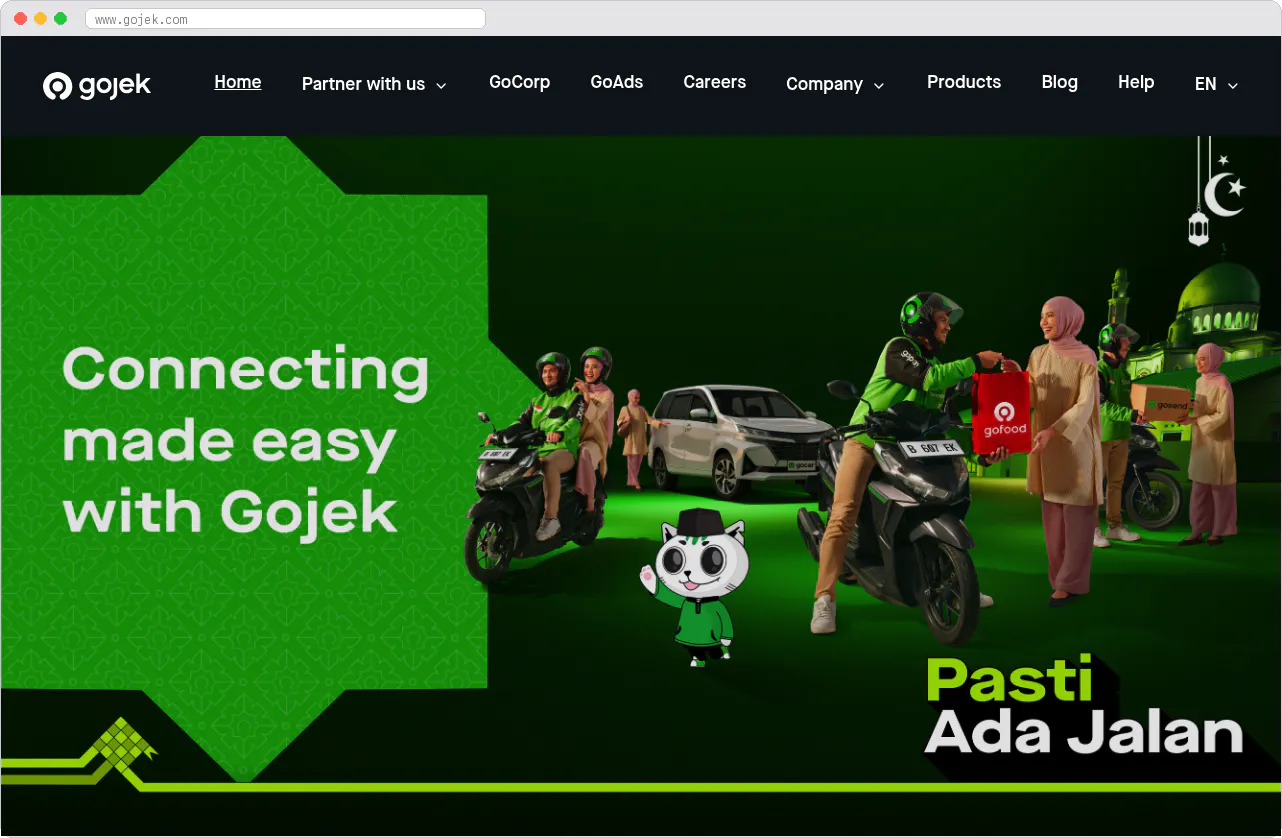
Indonesia's Gojek represents Grab's closest competitor in terms of business model and market approach. Like Grab, Gojek started with ride-hailing and expanded into a full super-app covering food delivery, digital payments, and various on-demand services.
Gojek's differentiation comes through its focus on motorcycle-based services, which suit Indonesian traffic conditions and infrastructure. The platform includes unique services like GoMassage, GoClean, and other hyperlocal offerings that demonstrate deep market understanding.
The company's financial services arm, GoPay, competes directly with GrabPay and has achieved meaningful adoption in Indonesia. Gojek's approach shows how local market focus can create competitive advantages against global players.
DiDi Chuxing
China's DiDi dominates the Chinese market and has expanded internationally with varying success. DiDi's scale in China is enormous, handling over 10 billion rides annually and providing insights into operating massive marketplace platforms.
DiDi's business model includes traditional ride-hailing but also encompasses bike-sharing, freight, and financial services. The company's approach to driver and passenger safety, including extensive use of AI for risk detection, represents industry leadership in platform safety.
DiDi's expansion strategy has focused on markets where Uber and other global players have less established presence, demonstrating the importance of competitive timing and market selection.
Ola
India's Ola competes primarily in ride-hailing but has expanded into food delivery, financial services, and electric vehicle initiatives. The company's approach to the Indian market includes support for multiple languages, cash payments, and integration with local transportation modes like auto-rickshaws.
Ola's electric vehicle focus, including manufacturing, represents a different strategic direction from pure marketplace plays. This vertical integration approach aims to control more of the value chain while supporting India's environmental goals.
The company's international expansion has been selective, focusing on markets with similar characteristics to India rather than pursuing global scale.
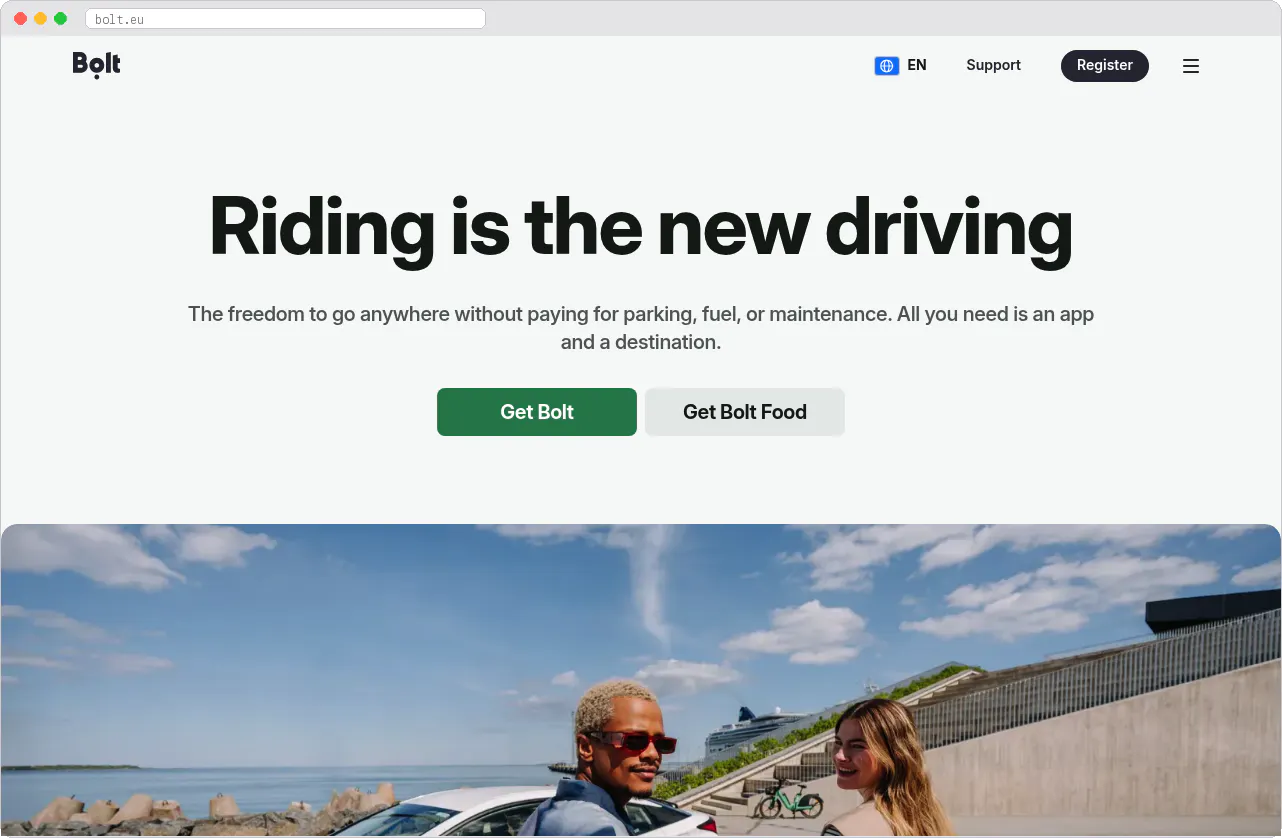
Bolt
European company Bolt (formerly Taxify) operates ride-hailing, food delivery, and micro-mobility services across Europe, Africa, and some Asian markets. Bolt's approach emphasizes lower commission rates for drivers and competitive pricing for passengers.
The company's expansion strategy focuses on markets where established players haven't achieved dominant positions, often entering with aggressive pricing and driver-friendly policies. Bolt's food delivery service integrates with its ride-hailing platform but hasn't achieved the same multi-service depth as Grab or Gojek.
Bolt's business model demonstrates how regional players can compete with global giants through focused execution and market-specific strategies.
How to build a marketplace like Grab
Creating a successful multi-service marketplace requires careful planning, phased execution, and deep understanding of your target markets. The process involves both technical development and business strategy decisions that will determine long-term success.
Phase 1: Market research and validation
Begin with thorough market research to understand local transportation patterns, payment preferences, regulatory requirements, and competitive landscape. This research should identify specific pain points that existing solutions don't address adequately.
Validate your assumptions through direct engagement with potential users and service providers. Conduct surveys, interviews, and pilot programs to understand willingness to pay, preferred features, and adoption barriers.
Analyze regulatory requirements for ride-hailing, payment processing, and data handling in your target markets. Some regions have specific licensing requirements or operational restrictions that will impact your business model and feature set.
Phase 2: Start with a single service
Follow Grab's example by launching with one core service rather than attempting to build a full super-app immediately. Ride-hailing often works well as a starting point because it demonstrates clear value and creates a foundation for expansion.
Focus on achieving strong unit economics and user satisfaction in your initial service before expanding. This means optimizing driver onboarding, improving matching algorithms, and building trust through reliable service delivery.
Establish key performance metrics for your initial service, including user acquisition costs, retention rates, transaction frequency, and service provider satisfaction. These metrics will guide expansion decisions and platform improvements.
Phase 3: Build essential technical infrastructure
Develop core platform capabilities including user management, real-time location services, payment processing, and communication tools. The technical architecture should be designed for scalability and multi-service expansion from the beginning.
Implement solid security measures for payment processing, personal data protection, and fraud prevention. Security breaches can destroy user trust and create major legal liabilities, especially when handling financial transactions.
Create detailed analytics and monitoring systems to track platform performance, user behavior, and business metrics. Data-driven decision making becomes vital as the platform grows and serves more diverse use cases.
Phase 4: Expand strategically
Once your initial service achieves product-market fit, identify complementary services that use your existing user base and infrastructure. Food delivery often represents a natural expansion for ride-hailing platforms because it uses the same driver network.
Plan service expansion based on user demand, competitive gaps, and operational synergies. Each new service should strengthen the overall platform rather than diluting focus or resources.
Develop service-specific features while maintaining platform consistency. Users should have a unified experience across services while accessing functionality tailored to each service category.
Phase 5: Build financial services capabilities
Introduce digital wallet functionality to improve user experience and capture additional value from transactions. Financial services can become large revenue drivers while increasing user switching costs.
Consider partnerships with established financial institutions to accelerate capability development and ensure regulatory compliance. Building financial services from scratch requires substantial expertise and regulatory approval.
Expand financial offerings based on user needs and market opportunities. This might include lending products for drivers, insurance offerings, or investment services depending on your market characteristics.
Phase 6: Scale and optimize
Implement advanced features like machine learning for demand prediction, route optimization, and personalized user experiences. These capabilities become more valuable as platform data volume increases.
Expand geographically based on market research and competitive analysis. International expansion requires adaptation to local regulations, payment methods, and cultural preferences.
Build partnerships with local businesses, government entities, and other platforms to accelerate growth and improve market position. Strategic partnerships can provide market access, regulatory support, and operational capabilities.
Common pitfalls to avoid
Don't expand too quickly into new services or markets before achieving strong performance in existing areas. Platform businesses require network effects and user density to succeed, which takes time to develop.
Avoid neglecting service provider experience in favor of user acquisition. Sustainable marketplace growth requires balanced focus on both supply and demand sides of the platform.
Don't underestimate regulatory complexity, especially for financial services and transportation. Regulatory violations can result in notable fines, operational restrictions, or market exclusion.
Avoid building custom solutions for problems that established services solve well. Focus development resources on core platform capabilities and competitive differentiators rather than recreating standard functionality.
Cost and development considerations
Building a Grab-like marketplace requires sizable investment in technology, operations, and market development. Understanding cost structures and development approaches helps inform realistic planning and funding requirements.
Custom development approach
Building a multi-service marketplace from scratch typically requires $200,000 to $500,000 in initial development costs, depending on feature complexity and development team rates. This includes mobile applications for users and service providers, backend infrastructure, payment processing integration, and administrative tools.
Ongoing development costs often exceed initial build expenses as the platform grows and requires new features, security updates, and performance improvements. Annual development costs can range from $100,000 to $300,000 for established platforms.
Custom development provides maximum flexibility and control but requires considerable technical expertise and time investment. Development timelines typically span 8-18 months for initial launch, with ongoing iteration and improvement.
Technology infrastructure costs
Cloud hosting and infrastructure costs scale with platform usage, starting around $1,000-5,000 monthly for early-stage platforms and growing markedly with user adoption. Major platforms can spend hundreds of thousands monthly on infrastructure.
Third-party service costs include payment processing fees (typically 2.9% + $0.30 per transaction), mapping and location services, SMS and communication tools, and various APIs for specialized functionality.
Security and compliance requirements add ongoing costs for SSL certificates, security auditing, data protection compliance, and regulatory reporting tools.
No-code and hybrid approaches
No-code marketplace platforms bring costs down to $99-399 per month in subscription fees, with no large upfront investment needed. These solutions work well for market validation and early-stage development.
Hybrid approaches combine no-code foundations with custom development for unique features, offering faster time-to-market while maintaining some flexibility. Costs typically range from $50,000 to $150,000 for initial implementation.
No-code solutions often have ongoing subscription costs ranging from hundreds to thousands of dollars monthly, plus transaction fees that can impact long-term profitability.
Operational and marketing costs
User acquisition costs vary substantially by market but typically range from $10-50 per new user for ride-hailing services and $5-20 for food delivery. These costs increase in competitive markets and decrease as brand recognition grows.
Service provider acquisition and retention requires dedicated resources including recruitment teams, onboarding programs, and ongoing support. Driver acquisition costs can range from $100-500 per new driver depending on market conditions.
Customer support operations become critical as transaction volume grows, requiring dedicated staff, support tools, and multilingual capabilities for international markets.
Revenue timeline and break-even considerations
Marketplace platforms typically require 12-24 months to achieve meaningful revenue and 2-4 years to reach profitability, depending on market conditions and competition intensity.
Initial revenue growth often follows a J-curve pattern with slow early progress followed by rapid acceleration as network effects strengthen and user adoption increases.
Break-even timing depends heavily on user acquisition costs, transaction frequency, and commission rates. Platforms serving higher-frequency use cases like food delivery often achieve profitability faster than those focused on occasional services.
Funding requirements
Most successful marketplace platforms require external funding to achieve scale, with early-stage funding rounds typically ranging from $500,000 to $5 million for market validation and initial growth.
Growth-stage funding requirements can reach tens or hundreds of millions of dollars for platforms pursuing rapid geographic expansion or competing against well-funded competitors.
Funding should account for extended time-to-profitability and competitive pressures that may require aggressive pricing or user acquisition spending.
Frequently asked questions
How does Grab's business model work?
Grab operates a multi-sided marketplace connecting users with service providers across ride-hailing, food delivery, and logistics. The company generates revenue through commissions (20-25% from drivers, 15-30% from restaurants), payment processing fees, advertising, and financial services.
How much does it cost to build a marketplace like Grab?
The full platform would cost $200,000-500,000+ to build from scratch. But you don't need to replicate every feature from day one. A no-code marketplace platform at $99-399/month lets you launch core functionality for a few thousand dollars in year one, then invest in custom development as revenue supports it.
What makes Grab successful compared to competitors like Uber?
Grab's success stems from local market adaptation (supporting cash payments, local languages), building a super-app ecosystem across multiple services, and focusing on financial inclusion. This created stronger network effects and user loyalty than single-service competitors.
How long does it take to build a Grab clone?
Custom development takes 8-18 months for initial launch, while no-code solutions can be ready in 2-6 months. However, achieving meaningful traction typically requires 12-24 months, and reaching profitability often takes 2-4 years depending on market conditions.
What are the key features needed for a multi-service marketplace?
Core features include unified user profiles, real-time location tracking, dynamic pricing algorithms, integrated payment processing, multi-service booking, real-time communication, rating systems, and complete admin tools for managing operations across different service categories.
Should I start with multiple services or focus on one like Grab did?
Start with a single service like ride-hailing or food delivery to achieve product-market fit first. Grab began with ride-hailing in 2012 and gradually expanded to other services. This approach allows you to perfect operations and build user trust before adding complexity.
Start your 14-day free trial
Create a marketplace today!
- Launch quickly, without coding
- Extend infinitely
- Scale to any size
No credit card required