How to build a website like Upwork
In this guide, you'll learn what makes the Upwork model work, how to validate your idea, what features your platform needs, how to build and launch an MVP, and how to grow it sustainably.

Upwork has become the dominant name in global freelance marketplaces. Launched in 2015, it focuses on knowledge work like software development, writing, design, marketing, etc. In 2024, it reported 770 million dollars of revenue, with over 800,000 active clients.
Even in a market this large, there is still remarkable opportunity for more focused, niche marketplaces. Plenty of smaller platforms—often built to serve a narrow set of skills, a particular industry, or a defined community—have found success by solving more specific hiring and work-matching problems.
If you’re thinking of building a website like Upwork—but with your own twist—this guide walks you through the full process. You’ll learn what makes the Upwork model work, how to validate your idea, what features your platform needs, how to build and launch an MVP, and how to grow it sustainably.
Upwork is a freelance website, a job platform, and most importantly, a fully fledged two-sided freelance service marketplace. Its value comes from connecting customers who need work done with freelancers who can do it—while reducing risk and friction for both sides.
To build a website like Upwork, you must understand how a two-sided freelance marketplace works—how customers and freelancers find each other, negotiate projects, collaborate, and complete secure payments on-platform.
Successful freelance marketplaces solve clear problems for both customers and freelancers.
For customers, the biggest problems include:
- Finding trustworthy, skilled freelancers.
- Ensuring project delivery and fair pricing.
- Paying safely with recourse if something goes wrong.
For freelancers, the biggest problems include:
- Getting consistent, relevant work.
- Being paid reliably and on time.
- Managing their business, payments, invoices, and so on.
If your marketplace doesn’t address these problems for both sides, it will struggle to generate liquidity, meaning few projects get posted and even fewer get completed. Marketplace liquidity is the likelihood that a transaction will happen on your marketplace, and it’s arguably the most important metric for any marketplace.
Before launching, you need to validate that your marketplace solves a real problem for real users. Many founders begin with a personal insight or problem—something they struggle with at work, a challenge they’ve observe in their industry, or a hobby-related need that others might share. This is a strong starting point, but it’s rarely enough on its own. Validation helps you understand whether others experience the same problem, how urgent it is, and whether they would change their behavior to solve it.
You can find real traction when you focus on a niche where customers have difficulty hiring and freelancers have difficulty getting discovered. Starting too broad makes it nearly impossible to match the scale or reach of established platforms. Upwork succeeds because of enormous volume; a new marketplace can rarely compete with that, so it should compete on focus.
Target a specific location, audience, or category that Upwork or other existing platforms don’t serve especially well. If you can identify a niche that’s large enough to support a viable business but focused enough that you can build meaningful liquidity early on, you’re already half way.
In our experience with early-stage founders, the most common mistake is trying to go too broad immediately. The marketplaces that survive start narrow, solve one segment exceptionally well, and expand only after they’ve perfected their offering for the initial niche.
User interviews are the clearest way to validate whether your idea addresses a real need. You don’t need to have hundreds of conversations—just enough to understand the range of problems people face and how they currently solve them.
Start by speaking with people in your existing networks:
- Former colleagues
- Fellow practitioners in your field
- People in industry Slack or Discord groups
- Members of relevant subreddits, social media, Facebook groups
- People local meetups and events
Ask them to describe their most recent experience hiring or being hired for freelance work. These conversations reveal how they search for talent, what slows down the process, and what frustrates them about existing solutions.
- “Tell me about the last time you hired someone for this task—what was difficult?”
- “How did you evaluate freelancers?”
- “What made you hesitate or consider alternatives?”
- “What do you wish customers understood better?”
- “What wastes the most time in outreach or negotiation?”
- “What makes a platform feel trustworthy—or not worth using?”
Your goal isn’t to collect a specific number of matching answers. It’s to understand the biggest pain points, what people do to work around them today, and whether those pain points matter enough to justify switching to a new platform.
A validated idea naturally begins to reveal the advantages your marketplace could offer. Your unique value proposition doesn’t need to solve everything; it only needs to solve the most meaningful problem or problems better than the existing options. That alone can be enough to attract early customers and supply.
Depending on your niche, your competitive advantage might be:
- Faster hiring: Shorter time from search to agreement
- Better matching: More relevant candidates or clearer filtering
- Pre-vetted specialist talent: A curated layer general platforms don’t provide
- Stronger project scoping: Clearer briefs or standardized deliverable formats
- Dispute support or guarantees: Added trust for high-stakes work
- Specialized search or categorization: Tailored to how the niche actually hires
- More transparent or competitive pricing: Especially if large platforms take high fees or force rigid pricing models.
This clarity helps you prioritize the smallest set of features required for your MVP and makes sure you focus on real value rather than building a clone of an existing platform.
Next, let's look at what kind of transaction flow your marketplace will most likely need, at minimum.
Upwork supports two transaction process types. Each serves a different type of customer behavior and supports a different way for freelancers to offer their services to customers. Understanding these processes will help you choose the right one to launch with—and determine if it makes sense to support both.
In this flow, customers start by describing what they need in a listing. Sometimes they only have a rough idea; other times their specifications are extremely clear and they simply want multiple offers. This process works well when:
- Customers want to compare several approaches or prices.
- The work could be completed in different ways depending on the freelancer.
- Freelancers benefit from tailoring their scope or method for each client.
- Customers prefer choosing among people who proactively pitch them.
The flow is straightforward:
- The customer posts a project.
- Freelancers submit proposals.
- The customer and freelancers negotiate.
- The customer chooses a freelancer and hires them.
In this flow, freelancers start by defining what they offer. These listings might describe a specific service (like “podcast editing”), a customizable offering (“monthly bookkeeping support”), or a broader profile of competencies and skills. This process is useful when:
- Customers want to browse options and contact specific providers directly.
- Freelancers prefer to share about their services in advance rather than craft proposals to customers.
- The freelancer’s offering is repeatable, but still flexible in scope or pricing.
- Customers find it easier to initiate contact than to write a project brief.
The steps are similar:
- The freelancer creates a service listing.
- A customer requests a quote or start a conversation.
- The freelancer confirms scope and price. The parties can also negotiate.
- The customer hires the freelancer.
In practice, many customers and freelancers shift between these two approaches depending on the task. Because of this, many marketplaces benefit from supporting both transaction processes: the option to create project listings for customers who want multiple proposals, and service listings for providers who want customers to reach out to them.
Some niches work better with just one of the flows. If the work is highly standardized—such as background checks, fixed-format product photography, or basic transcription—a regular marketplace flow keeps the experience simple and predictable.
A reverse flow, on the other hand, makes sense for high-value, high-stakes projects, where comparing different approaches and pricing structures is standard practice. In these cases, customers may expect to evaluate multiple proposals before choosing a provider.
Choosing one flow can strengthen your marketplace’s focus, while supporting both allows you to serve a broader range of project types and user preferences. Sharetribe supports either approach through configurable transaction flows in our no-code builder.
Following the initial point of contact between a freelancer and customer (whether in a regular or reverse flow), an Upwork-style project usually follows a predictable workflow:
- A customer and freelancer connect (via proposal or quote request).
- They negotiate scope and terms. This step may include updates to the quote and project details, counter offer, or simply messaging back and forth.
- The customer accepts the freelancer’s offer and pays.
- The customer and provider communicate when necessary. All communication stays on-platform.
- The customer approves the final work.
- Payment is released.
- Both parties leave reviews.
Once you’ve mapped the complete flow from first contact to reviews, you have a clear idea of how transactions will happen on your marketplace and you’re in a good position to start setting up your platform.
To function like Upwork, your marketplace must support discovery, scoping, negotiation, collaboration, payments, and trust-building. Sharetribe provides every building block you need to enable these flows without coding, and you can extend anything with code later.
Your marketplace can offer one or both of the core freelance transaction flows we discussed in the last section:
- Regular flow: Freelancers create service listings, and customers request quotes.
- Works well for structured or repeatable services.
- Reverse flow: Customers post project listings, and freelancers submit proposals.
- Ideal for projects that require comparison, negotiation, or custom scoping.
How Sharetribe helps:
Add one or both with listing types, which define the types of listing that can be created and how transactions—with negotiation—happen.
Customers need a simple way to find relevant freelancers, and freelancers need efficient ways to find the right projects. So, your marketplace will likely need:
- Clear categories and subcategories
- Freelancer profiles
- Project listings with structured requirements
- Search fields and filters
How Sharetribe helps: Sharetribe offers built-in user and listing creation. You can use categories and listing fields to shape both browsing and listing creation. Listing fields also power search filters, which help users narrow down their search to relevant results.
Proposals and negotiation are central to Upwork’s model. Your platform should support the following flows:
- Freelancers submit proposals
- Customers accept, reject, or request changes.
- Both parties can negotiate scope and price.
How Sharetribe helps: Listing types define your negotiation steps. You can modify the negotiation flow (regular or reverse), choose the negotiation option such as counter offers, and support the entire transaction flow from initial offer to offer acceptance and order delivery—all through no-code transaction flow configuration.
Even a simple freelance marketplace benefits from the option to review work before accepting it. The default negotiation flow after a customer chooses an offer should go as follows:
- Agreement → messaging → delivery → (optional) revision → approval → payout
How Sharetribe helps: The default price negotiation flow supports all these steps out of the box. You can also modify the transaction process with code if your process should work differently.
Customers and freelancers must feel safe transacting through:
- Secure card payments
- Delayed payouts
- Commissions
- Refund or dispute handling
How Sharetribe helps: Sharetribe’s Stripe integration handles secure payments and payouts. Commission payments are calculated automatically based on the percentages you set in Sharetribe Console.
To keep collaboration on-platform and reduce risk, your marketplace needs:
- Direct messaging
- Ratings and reviews
- Optional identity verification
How Sharetribe helps: Messaging and reviews are built in. For verification or additional trust workflows, connect third-party tools via Sharetribe’s integration with Zapier.
Sharetribe Console is the hub where you set up and manage your entire marketplace:
- No-code setup: Listing types and transaction flows, categories and listing fields, commission settings, and much more!
- Create and update content pages
- User, listing, transactions, and review management
You can control every aspect of your marketplace without engineering work.
Once your marketplace setup is in place, you can invite your first users and learn how they interact:
- Do customers find freelancers that match their needs?
- Do proposals or quote requests lead to successful agreements?
- Where do users drop off or get confused?
- Does communication stay on-platform?
- How long does a typical project take to complete?
Your early users help reveal friction points and opportunities for improvement.
Your early users reveal the friction points and opportunities that matter most. At this stage, your goal isn’t growth—it’s consistently facilitating successful transactions. That’s the clearest indicator that your marketplace is solving a real problem.
As you validate your marketplace and work toward problem-solution fit, you can grow sustainably by making small, targeted improvements: refining search filters, adjusting pricing or negotiation steps, improving onboarding, or tightening your listing requirements.
If your marketplace operates on Sharetribe, you can adjust your listing types, fields, pricing, communication settings, or transaction flows in minutes—allowing you to refine your marketplace rapidly based on real behavior. If something you need isn’t available no code, you can also customize your marketplace with code, even to add just one feature. Your Sharetribe marketplace is infinitely extensible. This lets you start fast and evolve your marketplace as your needs grow—without rebuilding your platform from scratch. Learn more about customizing Sharetribe with code.
Only once you see repeat transactions, strong retention, and organic referrals—the hallmarks of marketplace product–market fit—should you start investing in acquisition at a broader scale.
The most successful freelance marketplaces don’t try to replicate Upwork. They focus on a narrower problem, build workflows tailored to that niche, and expand only after proving traction.
Dribbble began as a community where designers shared work in progress and built their professional identity. Because portfolios were central from the start, it evolved into a place where companies could evaluate design skill at a glance. Later, Dribbble pivoted to a marketplace model, starting to facilitate transactions on-platform. Listen to a podcast episode where Sharetribe’s CMO Sjoerd chats with Dribble CEO Constantine Anastasakis about the pivot.
Catalant applies a similar model to business consulting and strategy work. It connects enterprises with vetted experts for specialized, high-value projects where quality and fit matter more than price competition. Their structured scoping and matching flows reflect the complexity of enterprise engagement.
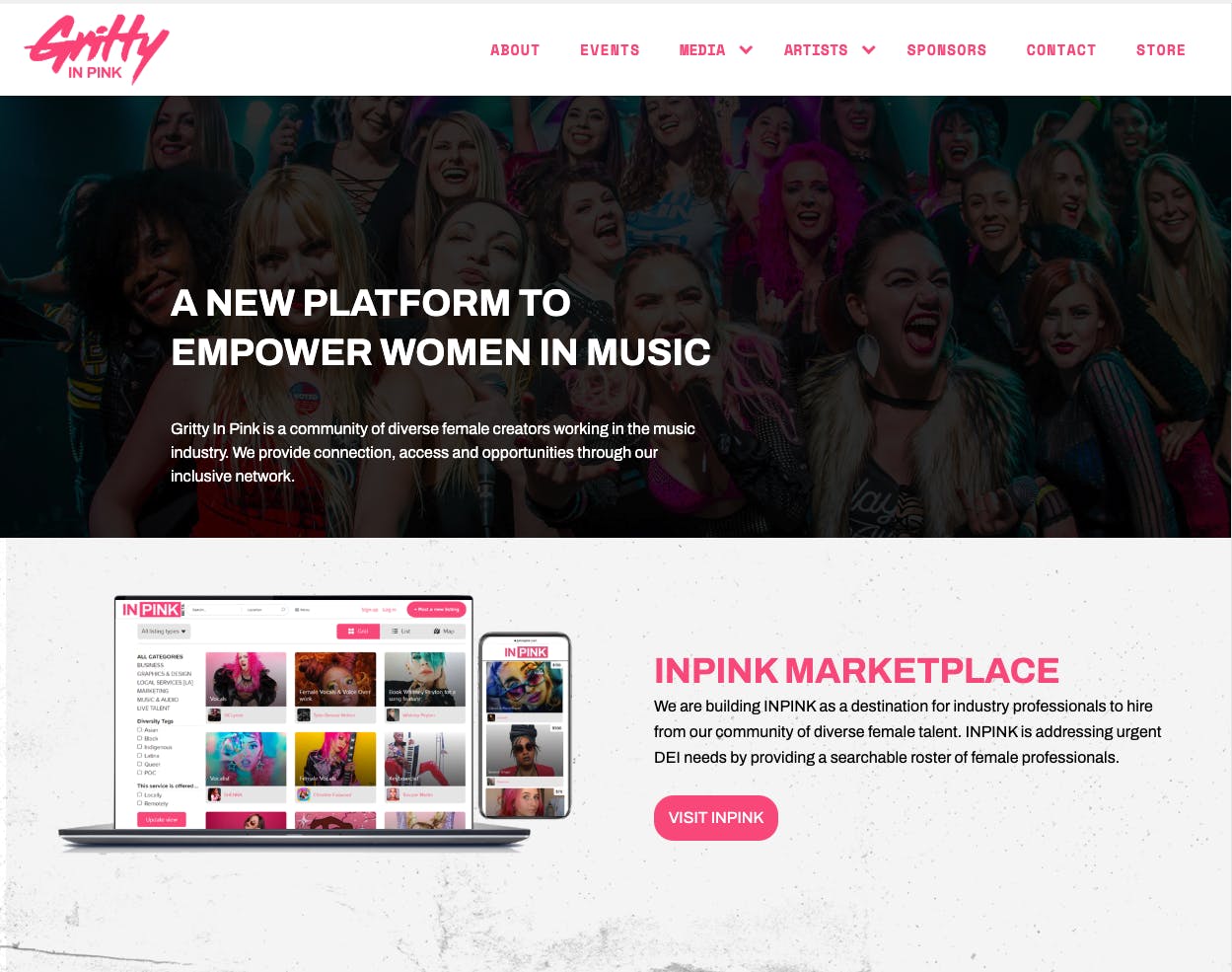
Gritty In Pink empowers women and non-binary musicians and music professionals by giving them visibility and direct access to gigs. By organizing around a shared identity and industry, they created trust and access that general talent platforms overlook. Read more about Gritty in Pink in Sharetribe's Founder Story.
The most successful path to building a website like Upwork is to start smaller, solve a clear problem, and validate demand before building complexity.
To recap the steps:
- Validate your niche with real user research.
- Define your transaction flow requirements.
- Launch an MVP quickly using tools that help you iterate. (Sharetribe is a great choice for this!)
- Grow through liquidity, trust, and repeat transactions.
- Add advanced features only after users need them.
Sharetribe is built exactly for this journey: a powerful no-code marketplace builder that you can extend infinitely with code as your business grows. It lets you validate and launch quickly, then scale without rewriting your platform.
For next steps, you should also explore Sharetribe’s guides on marketplace building and growth. Marketplace Academy has a ton of great information on launching and scaling marketplaces.
Upwork is a two-sided freelance service marketplace that connects customers who need work done with freelancers who can do it. It supports two transaction flows: a reverse flow where customers post projects and freelancers submit proposals, and a regular flow where freelancers create service listings and customers request quotes. The platform reduces risk and friction for both sides by facilitating discovery, scoping, negotiation, collaboration, and secure payments. In 2024, Upwork reported $770 million in revenue with over 800,000 active clients.
A freelance marketplace typically needs one or both of two core flows. The reverse marketplace flow lets customers post projects while freelancers submit proposals—ideal for projects requiring comparison and negotiation. The regular marketplace flow lets freelancers create service listings that customers browse and request quotes from—better for structured or repeatable services. Many niches benefit from supporting both flows. Following the initial match, the typical workflow includes negotiation, agreement, payment, messaging, delivery, optional revision, approval, and payout release.
Start by narrowing to a niche where customers have difficulty hiring and freelancers have difficulty getting discovered. Interview 10–15 people on each side from your existing networks—former colleagues, industry Slack and Discord groups, relevant subreddits, and local meetups. Ask about their most recent freelance hiring or job-seeking experience, what frustrated them, and what would make them switch platforms. Your goal is to understand the biggest pain points and whether they matter enough to justify switching to a new platform.
Core features include: listing types for both service and project listings, categories and search filters, freelancer profiles and project listings with structured requirements, a proposal/offer/negotiation system, milestone-based work delivery with revision capability, secure payments with delayed payouts and automated commission calculation, direct messaging, ratings and reviews, and an admin console for marketplace management. Sharetribe provides all these building blocks without coding, with the option to extend anything with custom code later.
The most successful freelance marketplaces don't replicate Upwork—they focus on a narrower problem. Dribbble evolved from a design community into a marketplace where companies evaluate design skill through portfolios. Catalant connects enterprises with vetted experts for specialized consulting. Gritty In Pink empowers women and non-binary musicians with visibility and gig access. The pattern is clear: start with a specific community, skill set, or industry; build workflows tailored to that niche; and expand only after proving traction.
Start your 14-day free trial
Create a marketplace today!
- Launch quickly, without coding
- Extend infinitely
- Scale to any size
No credit card required