Best marketplace software in 2026 (and how to choose the right one for you)
10 popular marketplace platforms and solutions compared for different marketplace types: C2C, B2C, B2B, rentals, services, products, and more.

The purpose of this guide is to give you one thing: absolute clarity on which marketplace software solution fits your idea and needs best.
The problem with most “best marketplace software” guides is that they:
- Compare dozens of options
- Feature a long list of features and criteria (many of which your idea may not need)
- Show you which solution ticks the most boxes
This isn’t the kind of advice founders need.
I know something about this topic: I built my first marketplace in 2008, and since 2014, I’ve been the co-founder and CEO of Sharetribe, where we’ve helped more than 10,000 founders launch their marketplaces. The most successful Sharetribe customers have scaled their marketplace to hundreds of thousands of users, processed millions in payments, and raised millions of dollars in funding.
What I’ve come to understand in the past decade is that there isn’t one “best” marketplace solution for everyone. A peer-to-peer rental marketplace, a B2B service platform, and a global B2C ecommerce marketplace have fundamentally different needs.
So, instead of just giving you a generic list of the top 10, 15, or 50 solutions you could potentially use, this guide helps you choose the right solution for you based on your marketplace type, stage, and goals. I will only discuss the 10 solutions that I would personally trust to power my marketplace next year: fully featured, reliable, and extensible platforms.
If I were choosing a software solution to power my marketplace next year, I would choose one of these 10 solutions:
- Sharetribe: best for rentals, services, any C2C marketplaces, certain product-selling marketplaces, and unique or complex concepts
- CS-Cart Cloud: great for B2C/B2B ecommerce marketplaces
- Dokan Cloud: lowest-cost way to test simple no-code marketplace ideas in B2C ecommerce
- Nautical Commerce: targeted at B2B ecommerce workflows
- Kreezalid: theme-based no-code builder for single or multi-type marketplace
- My Marketplace Builder: affordable white-label multi-type option, code customization for enterprises
- Mirakl: enterprise marketplace solution for retailers and brands
- Marketplacer: enterprise marketplace solution for retailers and brands
- Arcadier: enterprise marketplace with broader use cases
- Bubble: for founders willing to build everything themselves, visually
Which of them is the right solution for you? It heavily depends on the type of marketplace you're building. Other criteria include pricing, extensibility, and time-to-market.
Later in this article, I’ll offer my top 5 recommendations for different marketplace types. You can jump to those sections directly here:
- Best marketplace software for C2C product marketplaces
- Best marketplace software for B2C product marketplaces
- Best marketplace software for B2B product marketplaces
- Best marketplace software for enterprise e-commerce marketplaces
- Best marketplace software for rental marketplaces
- Best marketplace software for service marketplaces
- Best marketplace software for local delivery marketplaces
- Best marketplace software for mobile marketplaces
- Best marketplace software for other marketplace types
And if you want to compare the top solutions at a glance, jump to the best marketplace software 2026 comparison table.
But before I get to the comparison, I feel it’s worth finding an answer to a key question: is any marketplace software the right path for you?
Starting with marketplace software is the best choice for most founders because it’s the fastest and most affordable way to launch. But there are some situations where you should choose another approach.
There are three main approaches you can take when building your Minimum Viable Platform and scaling it:
1) Marketplace software solution
2) Concierge MVP
3) Custom development from scratch
In this article, we'll focus on the first approach, but it's worth discussing the other two briefly as well, so you can be certain you’re choosing the right approach for you.
Most successful marketplaces today start with marketplace software. It gives you the core functionality you need to launch and learn early: onboarding sellers, facilitating transactions, and managing the marketplace.
This gives marketplace software three major benefits over other approaches to building your platform:
- Much lower upfront costs. A software subscription costs you around $1,000–$4,000 per year, while building a platform from scratch usually requires a starting budget of $50,000 and up.
- Much faster time to market. The right software lets you launch in a matter of days (if not hours), instead of the several months required to build from scratch or with a combination of general-purpose tools.
- Work on what matters most. You can focus your time and energy on matching your supply and demand—that is, building your real business—instead of building infrastructure.
This path makes sense for most founders and for marketplace ideas, so I recommend it as the default primary approach. In fact, I can only think of two cases where you should not start with marketplace software:
- You can validate your idea well by doing everything manually
- Your technology itself is your unique value proposition.
In the first, you can choose an even lower-effort solution than marketplace software: a concierge MVP.
In the second, you need to put more effort into your technology from the start and custom-build everything.
Concierge MVP means you do things manually first, even if you plan to automate them later with software.
A concierge MVP can be as simple as an email address or an online form that customers can use to describe their needs. To make it work like a marketplace, you do a lot of manual work to find the right match and make the connection.
A concierge MVP can be enough to validate your marketplace concept if:
- You’re bringing a marketplace concept into a market where none exists yet.
- Your core value proposition is about matching, not necessarily about facilitating the transaction.
If it’s possible to validate your idea in this way, I always recommend it. It’s an even faster, lower-investment way than marketplace software to learn whether your idea works.
For example, Charles Armitage validated the need for Florence, a marketplace for nursing professionals, using nothing more than a Google Sheet and extensive manual work to connect supply and demand.
(Interestingly, the founders chose this approach after first attempting to outsource the development of a fully featured marketplace platform, a project which Charles calls “a bit of a disaster”.)
In most cases, though, a concierge MVP simply isn’t enough. You’ll need a more comprehensive marketplace platform from day one if your core value proposition isn’t simply about matching, but also about:
- facilitating the transaction
- processing the payments
- adding trust
- other aspects of the user experience.
In 2026, there’s much more marketplace competition than, say, ten years ago. Consumers’ expectations about user experience have increased. It seems to me that the role of the concierge MVP is diminishing, and founders need to find more sophisticated methods (like marketplace software) even for the initial validation.
There are a few situations where developing your marketplace from scratch is the right choice.
But far more often than many founders think, it’s not.
If there’s one mistake I’ve heard marketplace founders mention most often, it’s that they chose to custom-develop their marketplace from scratch instead of using marketplace software. The project always ends up costing more money and time than they anticipated, and often, the money runs out before the business gets enough traction for the next funding round. (This interview with Florence founder Charles Armitage is a great example.)
So, what are the situations in which you might want to make the heavy investment anyway?
There are three good reasons to build a marketplace from scratch:
- Your technology is your unique value proposition
- You’re looking to integrate marketplace functionality into your existing app
- You’re a developer with lots of time and little budget
Let’s examine these situations in more detail, and then discuss why I don’t recommend using vibecoding to build your marketplace (at least not yet).
If you’re building a completely unique user experience no one has ever built before (so no software solutions exist to give you what you need), you might have no choice but to build it from scratch. This makes your UX innovation, and the technology that powers it, your unique value proposition that sets you apart from other marketplaces in your industry.
For most marketplaces, this isn’t the case. Their unique value is the supply and demand they’ve accumulated and the trust they’ve built. Craigslist remains a billion-dollar business despite its website dating back to the 1990s. Even its key competitors didn’t first differentiate on technology—they differentiated by focusing on one of its niches, serving it better, and increasing trust.
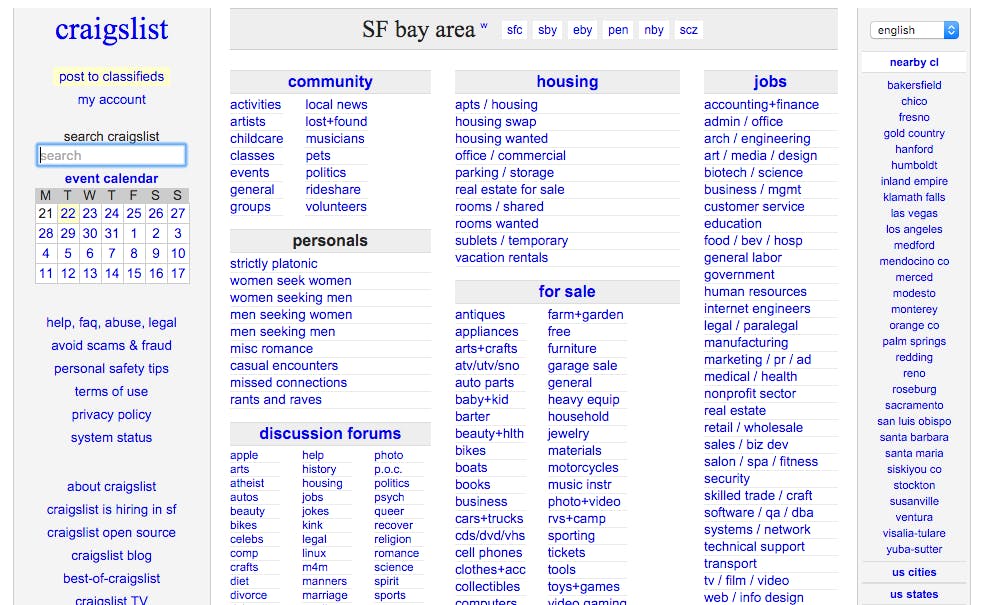
It’s possible that your marketplace concept has some unique UX features, but the rest of the marketplace flow works like a traditional two-sided marketplace.
In this case, I recommend using an existing software solution to power the standard functionality and custom-develop your unique features on top (more on solutions that support custom development here).
If you’re running a software-as-a-service business with an existing user base and now want to add marketplace functionality to it, you’re likely better off custom-developing the features you need.
This could be the case, for example, if you have a community of third-party developers creating add-ons to your SaaS solution and want to build an app store for them.
Headless marketplace SaaS solutions (like Sharetribe) can be integrated into existing SaaS apps, but in my experience, the effort is too great to justify. We’ve seen a few of these attempts at Sharetribe, and they rarely produce the desired results.
If you know how to code yourself and don’t mind spending hundreds of hours developing your platform (and even the few thousand dollars for an annual software subscription is too much for your budget) custom development is likely the right choice for you.
In 2026, a marketplace software guide would be seriously incomplete without discussing vibecoding.
Solutions like Base44, v0, Replit, Lovable, and Bolt all promise that they allow a non-technical founder to custom-develop a marketplace from scratch simply by prompting an AI, which will generate the code. If they worked, this would be a great alternative to marketplace software: all the flexibility of custom development at a fraction of the cost.
These solutions are indeed very powerful. Vibecoding solutions can be great for building prototypes of what you need or for internal tools for your team or personal use.
But I can’t recommend vibecoding for anyone who is looking to launch a live marketplace business that processes real payments between customers and sellers.
At Sharetribe, we’ve done several tests with these tools. We always get to a prototype impressively quickly, but lots of bugs are created in the process, and then fixing those bugs breaks the code in several other places.
Even if you did manage to get your vibecoded MVP working and launched, that’s only the first step. After that, you need to run and monitor your marketplace, handle failed payouts, refunds, and chargebacks, deal with attacks, scale up your infrastructure when traffic spikes, and more.
I have a developer background and have spent almost 20 years thinking about marketplace functionality, and I wouldn’t be confident enough to do all of the above myself. I definitely wouldn’t recommend a non-technical founder to do this on their own.
That said, AI can help good developers work much faster. At Sharetribe, we’re seeing our third-party developer experts getting significant productivity gains when they custom-develop features for our customers using Sharetribe’s developer platform.
So while AI isn’t yet able to allow non-technical founders to build, launch, and run live marketplaces on their own, it is definitely reducing the costs of custom development by making developers more productive.
Marketplace software provides the infrastructure for a multi-vendor platform where independent sellers or providers can offer their products or services to customers.
So unlike e-commerce or websites, marketplace software is built from the ground up for a business model with three parties involved:
- The sellers
- They buyers
- The marketplace operator.
This means that at minimum, marketplace software includes:
- Supplier onboarding: profiles, listings, availability, pricing
- Search, discovery, and matching: search, categories, relevant filters, and map
- Transaction workflows: booking, ordering, negotiating, or other ways people agree on the exchange
- Payment flows built for marketplace: commission models, delaying payouts/escrow payouts split between multiple parties, refunds, and dispute handling; possibly support for other business models like subscription and lead fees as well
- Interaction mechanisms: messaging or chat between users, email or SMS notifications
- Trust mechanisms: reviews, user verification, delaying payouts
- Admin tools for the marketplace operator: content moderation, transaction management, notifications
- Infrastructure and security: secure data handling, scalability, fraud and attack prevention, support
Different marketplace software providers specialize in different marketplace models, like C2C, rentals, services, B2C e-commerce, and so on. This is why choosing a solution that matches your specific type of marketplace matters so much.
But there are three universal criteria for choosing a provider that apply to every marketplace type.
For my list of the best marketplace software solutions, three main criteria were non-negotiable.
I do not recommend any marketplace software solution that:
- Is not a SaaS solution
- Is not a standalone marketplace solution (ie. it is a plugin for a non-marketplace solution like a website or e-commerce builder)
- Doesn’t offer a path to extend beyond MVP
Below, I'll examine why I think every founder choosing marketplace software shouldn’t compromise on these criteria.
Most marketplace software is sold as SaaS, which means you pay a monthly fee for access to the software and services.
There are other types of marketplace software solutions that sell a one-time licence, but I’m not able to recommend any of them. Typically, they’re positioned as “marketplace clone scripts”.
My main concern with these solutions is that when you pay a one-time fee and install the software on your own server, the script owner doesn’t have an incentive to help you succeed with your business. Instead, their incentive is to make their solution look great before the purchase.
In practice, this really often means that while the demo looks impressive, maintaining your live marketplace or extending it becomes much more difficult than you expected.
The benefit of the SaaS approach is that the SaaS provider becomes your partner: they only succeed financially if you succeed.
In general, my advice is to be wary of any solution that requires you to pay a lot of money up front, and instead favor solutions that get you started at a low price and allow you to upgrade your plan as your business grows.
For the same reason, I would caution against providers that offer “lifetime pricing” with unlimited hosting for a one-time fee. Running the infrastructure of a large marketplace is very expensive. An affordable lifetime fee is a sign that the vendor doesn’t expect you to reach a scale that would incur lots of costs for them.
Another group of software I can’t recommend are plugins built on CMS or ecommerce solutions that aren’t initially built for multi-vendor platforms.
Popular website and online store builders like WordPress, Shopify, Magento, Wix, Webflow, and Squarespace all have large ecosystems of third-party plugins built on their platforms. All of them offer some sort of “marketplace extensions” or “multi-vendor plugins,” or the like.
A core problem with all marketplace plugins is that if the core software wasn’t built to be multi-vendor, your platform gets difficult to build and maintain, and hits inherent limitations as you scale your business.
The makers of Dokan, the most popular WordPress marketplace plugin of all time, faced this exact limitation. In a thoughtful post, they shared why they decided to build a dedicated, non-WordPress marketplace SaaS solution after maintaining their plugin for 10 years:
"In my experience, beginners with no coding knowledge who use WordPress to create a marketplace struggle after a certain period. WordPress is wonderful no doubt. The platform is free and it provides the necessary built-in function to create a website. But you have to install several plugins to run your marketplace. That makes the learning curve steep. - - - Also, Dokan and WooCommerce provide extensions and modules that help add advanced functionalities to the marketplace. So the cost increases over time. - - - Ultimately, the process becomes complex and the journey becomes difficult to maintain the marketplace site. After a certain period, the marketplace becomes unmanageable and difficult to scale. With many plugins installed, the site may slow down and hinder performance. Then the users move away from WordPress completely and migrate to a third-party platform, mostly cloud platforms."
I haven't seen any large marketplaces powered by clone scripts or plugins. Meanwhile, I'm aware of many marketplaces that have scaled to a large size and raised significant funding using the SaaS solutions listed in this article.
Many marketplace SaaS solutions focus on providing an easy no-code setup.
The problem with some of them is extensibility. Most marketplaces need unique functionality when their growth takes off. If a marketplace solution doesn’t allow easy custom development, you’ll hit its limits at the worst possible time.
I know this from deep experience: extensibility used to be a problem with Sharetribe. For a few years, we offered a no-code builder (Sharetribe Go) and a developer platform (Sharetribe Flex) as separate products (neither of which is on the market anymore). When you hit the limits of our no-code builder, you had to do an expensive rebuild to move to the developer platform.
This completely killed the momentum of early-stage marketplaces. Usually, the need to switch to custom development happened exactly when they had found the right business model and were seeing growth, and needed to adapt quickly to increasing customer demand. Having to go through a six-month rebuild is the last thing you want in that situation.
This problem disappeared in January 2024, when we introduced Sharetribe’s current architecture (which is simply called Sharetribe). Now, you can continue custom development smoothly on top of your Sharetribe-powered no-code marketplace MVP without rebuilding anything.
After witnessing how impactful this new architecture has been for our customers, I would seriously advice against choosing a solution that doesn’t offer an easy way to expand your marketplace beyond the MVP stage.
To get a list of the truly best marketplace software solutions, I first narrowed it down based on the three key criteria discussed above. To reiterate, they are:
- It needs to be a SaaS solution
- It needs to be a standalone marketplace solution (not a plugin for a non-marketplace solution)
- It needs to offer a path to extend beyond MVP
In addition, I’ve looked at several other factors (and encourage you to do the same if you’re comparing solutions):
- Pricing
- Time to market (how much work is needed before you can launch your first version for live customers)
- Reviews on the most popular review sites
- Reference customers
- The rate at which the solution is improving, e.g. through a changelog or public roadmap
- Size of their ecosystem: development partners, freelancers, or agencies indicate that the developer experience is great and the solution is used enough to keep an ecosystem alive.
- Has the solution been alive for more than five years? Younger than that, the risk of going out of business while your business is growing and thriving is too high, in my experience.
These ten solutions pass all the above criteria. If I were choosing a software solution to power my marketplace in 2026, I would choose one of the 10 solutions below.
- Sharetribe
- CS-Cart Cloud
- Dokan Cloud
- Nautical Commerce
- Kreezalid
- My Marketplace Builder
- Mirakl
- Marketplacer
- Arcadier
- Bubble
Which of them should you choose? It heavily depends on the type of marketplace you're looking to build. No marketplace solution is the right fit for every situation.
Later in this article, I will offer my top 5 marketplace software solutions for every marketplace type.
Naturally, as the founder and CEO of Sharetribe, I'm biased to comment on the best marketplace software solutions. I recommend our product a lot because I obviously hold it in high regard. So take my recommendations with a grain of salt.
Still, I'll do my best to provide an objective assessment of the different solutions, and I'll be honest about the shortcomings of Sharetribe and when you should choose another solution instead.
First, let's look at all the solutions in a bit more detail.
Sharetribe’s key strength is its combination of no-code marketplace website builder and a headless developer platform. This makes it possible for anyone to launch a fully functional marketplace in one day and extend it infinitely with code.
Importantly, after you’ve built your marketplace with Sharetribe’s no-code builder, you can continue customizing it with code—without having to do a rebuild, and while Sharetribe’s backend still takes care of the heavy lifting. This means you don’t necessarily need your own full-stack development and DevOps team.
Sharetribe allows full customization of both the customer front-end and your seller interface, meaning you can develop unique tools and features for both sides of your audience. You can also continue making no-code changes to your marketplace even after you’ve done code customizations.
Sharetribe is best suited for:
- Rental marketplaces (like Airbnb or Turo)
- Service marketplaces (like Rover, Thumbtack, or Upwork)
- C2C product marketplaces (like Vinted, Etsy)
- Complex B2B marketplaces that require more complex flows than “add to cart and pay”
- Unique marketplace types that don’t deal with purchase transactions (e.g. bartering, matchmaking, free sharing, and more)
Sharetribe is not the strongest for:
- B2C/B2B marketplaces similar to Amazon or Alibaba
- Enterprise e-commerce
- Local delivery from A to B (e.g. Doordash, Uber)
CS-Cart has recently moved from a license approach to a SaaS approach with a full cloud solution, which makes it eligible for my top 10 marketplace software list.
CS-Cart’s SaaS solution is a no-code builder. If you want to customize your marketplace with code, you need to host everything on your own server. Importantly, you’ll also need to host the backend, which means you’re not benefitting from CS-Cart’s Cloud offering.
The upside is that when you host everything yourself, you’re free to make any changes to any part of the source code, including the seller portal and even the admin panel. With Sharetribe, due to the hosted backend, you’re currently limited in customization of the admin panel. (Though of course, you can always build your own admin panel on top of Sharetribe’s API. )
The downside is that, unlike with Sharetribe, hosting your entire marketplace means you’re responsible for maintaining it, scaling it, and guaranteeing its security. This means you need a full-stack development team and a dedicated DevOps team as you scale.
CS-Cart specializes in:
- B2C and B2B e-commerce marketplaces (ie. platforms like Amazon and Alibaba)
CS-Cart is not the strongest for:
- Rental marketplaces
- Service marketplaces
- C2C marketplaces
- Enterprise e-commerce
- Local delivery from A to B (e.g. Doordash, Uber)
Dokan Cloud is the new SaaS offering from the makers of the Dokan WordPress plugin.
Currently, it’s exclusively a no-code solution: you can’t add custom features with coding. The company says this functionality is in the plans, though no timeline is provided at this time.
Due to this limitation, I first considered leaving Dokan Cloud off this list entirely. I decided to include it because the no-code offering is very smooth and affordable, and I expect them to deliver on their promise to offer a path to extensibility eventually.
Still, if you’re considering starting with them, I encourage you to contact their support to get more information on how you can extend and grow your platform with them.
Dokan Cloud focuses on:
- B2C and B2B e-commerce marketplaces (ie. platforms like Amazon and Alibaba)
Dokan Cloud is not the strongest for:
- Any marketplace concept that requires custom functionality
- Rental marketplaces
- Service marketplaces
- C2C marketplaces
- Enterprise e-commerce
- Local delivery from A to B (e.g. Doordash, Uber)
Nautical Commerce is a headless marketplace solution that started as a premium offering geared towards enterprise customers. Recently, they introduced a no-code offering suitable for early-stage companies.
Similarly to Sharetribe, Nautical Commerce offers a marketplace template that can be edited. However, there are two key differences:
- Nautical Commerce’s template is not configurable without coding, so any changes to it must be made in code. If you start using the headless solution, you lose access to the no-code offering. With Sharetribe, you can continue using the no-code solution even after adding custom features with code.
- You can only customize the customer front-end, not the seller portal, as you can with Sharetribe.
This means that if you need extensive customization, you might run into issues at some point.
Nautical Commerce also has a geographic limitation: while most of the solutions on my list are available globally, Nautical Commerce is only available in the US and Canada.
Nautical commerce is best for:
- B2B e-commerce marketplaces (like Amazon Business)—this is where the founders have their roots
- B2C e-commerce marketplaces (like Amazon’s or Alibaba’s customer-facing offering)
Nautical commerce is not the strongest for:
- Rental marketplaces
- Service marketplaces
- C2C marketplaces
- Local delivery from A to B (e.g. Doordash, Uber)
Similarly to Sharetribe, Kreezalid supports multiple marketplace types: products, service bookings, and rentals, or the combination of several types in one marketplace.
Its main selling point is its theme store, which lets you choose from multiple different visual styles without touching code. It also lets you insert HTML and CSS into your site for additional visual enhancements.
Kreezalid’s offering is limited in terms of flexibility. It does offer an open API, but adding a new feature to your existing no-code Kreezalid marketplace won’t be possible.
Furthermore, unlike Sharetribe and CS-Cart, Kreezalid doesn't give you access to the source code of your marketplace. This means if you want to build features that Kreezalid doesn’t have, you might need to rebuild your entire marketplace front-end on top of their API, which will be costly.
Kreezalid is best suited for:
- Product marketplaces
- Service marketplaces
- Rental marketplaces
Kreezalid is not the strongest for
- Any marketplace concept that requires custom functionality
- Complex B2B marketplaces
- Unique marketplace concepts
- Enterprise e-commerce
- Local delivery from A to B (e.g. Doordash, Uber)
Like Kreezalid and Sharetribe, My Marketplace Builder supports multiple marketplace types: products, rentals, service bookings, and directories.
But their approach is slightly different: when you sign up to My Marketplace Builder, you’re first asked to choose a marketplace template between these four types. The downside is that you can’t choose a template that would combine multiple of these types.
So, if you’re building a marketplace that combines product-selling and rentals, or rentals and services, or similar, Sharetribe or Kreezalid will be a better option.
My Marketplace Builder has a premium offering that promises full extensibility. However, it doesn’t offer an open API and says any customization needs to be done by its team. The plan that allows for customization is labeled “enterprise,” and pricing isn’t disclosed, which suggests to me that code customization might not be accessible to founders with limited budgets.
However, compared to Sharetribe and Kreezalid, the no-code plan that lets you launch a white-label marketplace is slightly lower priced.
Unlike other marketplace software providers on my list, My Marketplace Builder doesn’t feature any customer examples on their site. This puzzles me. They’ve been around for more than 10 years, so I imagine they must have enough live customers to sustain themselves. If I were choosing a marketplace solution for my own business, one of the first things I’d look at is what the marketplaces the solution powers look like in action.
My Marketplace Builder is best suited for:
- Single-type marketplaces dealing with products, rentals, services, or directories.
My Marketplace Builder is not the strongest for:
- Any marketplace concept that requires custom functionality
- Marketplaces that combine multiple types
- Complex B2B marketplaces
- Unique marketplace concepts
- Local delivery from A to B (e.g. Doordash, Uber)
Mirakl is the leader in enterprise marketplace solutions. It typically works with large brands like Best Buy or Walmart that want to turn their e-commerce operations into full marketplaces, allowing third-party brands to sell on their sites.
Mirak's functionality is focused on this specific marketplace type, and it does it well. It has several large enterprise clients. Its pricing is also geared toward large existing enterprises, so it's not really a solution for a founding team looking to start a new business.
Mirakl is best suited for:
- Enterprise B2C and B2B ecommerce businesses looking to expand into marketplaces
Mirakl is not suited for:
- Founding teams starting a new business
- Rental marketplaces
- Service marketplaces
- Local delivery from A to B (e.g. Doordash, Uber)
Marketplacer is Mirakl's main competitor in the enterprise marketplace solution space, and similarly to Mirakl, it’s not targeted or ideally suited for founding teams building a new business. Its customers include multinationals like Woolworths.
As neither Mirakl's nor Marketplacer's solutions offer a free trial, it's difficult for me to assess their differences.
I must also admit that I'm not the best expert in this specific marketplace category, since at Sharetribe we focus on early-stage founders. Thus, if you're an enterprise considering a marketplace solution, I would look into both Mirakl and Marketplacer, and also Arcardier, which is next on my list.
Marketplacer is best suited for:
- Enterprise B2C and B2B ecommerce businesses looking to expand into marketplaces
Marketplacer is not suited for:
- Founding teams starting a new business
- Rental marketplaces
- Service marketplaces
- Local delivery from A to B (e.g. Doordash, Uber)
Arcadied started as an affordable marketplace solution focused on early-stage founders, but recently, it pivoted to serving enterprise customers exclusively. For a while, it made a separate "Arcadier Express" self-serve solution available for small businesses, but it's no longer available, and Arcadier now focuses fully on enterprise customers.
Historically, Arcadier's advantage over Mirakl and Marketplacer has been that it has also catered to other marketplace types than just B2C and B2B e-commerce where physical products are sold. It still discusses features for rental marketplaces and service marketplaces at least in its support documentation, so I would expect that a large enterprise looking to launch a rental or service marketplace might find Arcadier's offering more suitable than Mirakl's and Marketplacer's.
Arcadier is best suited for:
- Enterprise B2C and B2B ecommerce businesses looking to expand into marketplaces
- Enterprise customers launching a rental or service marketplace
Arcadier is not suited for:
- Founding teams starting a new business
- Local delivery from A to B (e.g. Doordash, Uber)
Bubble is the only SaaS solution on my list that is not focused specifically on marketplaces. Instead, it's a visual programming tool that allows you to build any kind of app without having to write code, using its "visual programming" tools.
While coding skills are not required to use Bubble, its visual development tools are comparable to custom coding.
That means you need to be prepared to spend a considerable amount of time learning how Bubble’s editor works. Just like with coding, it's possible to introduce bugs with Bubble's editor, and if you're not careful, you can run into performance challenges.
The most important difference between Bubble and other marketplace SaaS tools on this list is that marketplace software comes with extensive prebuilt functionality for buyers, sellers, and marketplace operators. With Bubble, you need to build even the most elemental marketplace features yourself.
In Bubble's 2022 marketplace guide, the company stated:
"Some of our [marketplace] founders have been able to release fully functional MVPs in as few as 100 hours after discovering Bubble."
If your idea is more complex, you may need significantly more time. In contrast, Sharetribe has customers who have launched their first site on the very same day they found Sharetribe.
It’s also possible that you need to add traditional code on top of your visually coded marketplace. To my knowledge, Bubble still doesn’t provide built-in marketplace-style payment flows, where the payment is split between the marketplace and the seller. A Stripe Connect plugin is available, though.
Another concern I have with Bubble is that, unlike popular coding languages and frameworks, its development environment is proprietary. This creates a strong lock-in: if you add custom-coded elements on top of Bubble, you can only use them if you run the app on Bubble’s infrastructure and pay its fees. In contrast, if you add custom code on top of Sharetribe, you can use the same code outside of Sharetribe’s ecosystem, without having a Sharetribe subscription.
Furthermore, the skills you acquire using Bubble are not transferable, whereas coding skills have a high general-purpose value.
Finally, the benefit of marketplace-specific solutions is that they typically help you with marketplace-specific challenges, like defending against the most common attacks against marketplaces, regulatory compliance, accessibility issues, and more. As Bubble is not focused on marketplaces, it can offer less help with any of these.
Bubble can be a great fit for founders who consider themselves somewhat technical (i.e. are happy to tinker with a visual development environment), have enough time at their disposal, and are confident to handle attacks and compliance issues by themselves. Bubble's pricing is relatively affordable—it's the cheapest of the 10 solutions after Dokan Cloud—so if you prefer to spend time rather than money, it's worth considering.
Bubble is best suited for:
- Budget-conscious makers who enjoy building and learning new tools and have enough technical skills to handle maintenance, scaling, compliance, and attacks themselves.
Bubble is not suited for:
- Non-technical founders
- Launching fast
As I’ve mentioned several times in this article, the right solution for you depends heavily on the type of marketplace you’re building.
Below, I’ll list my top 5 marketplace software for all the most common marketplace types.
If your marketplace is about individual sellers selling physical products that are either:
- Pre-owned (like on Vinted or Poshmark)
- Unique (art, custom-made products, etc)
- Self-made (like on Etsy)
Then your top 5 options are:
- Sharetribe
- My Marketplace Builder
- Kreezalid
- Arcadier
- Bubble
The top three, Sharetribe, My Marketplace Builder, and Kreezalid, are relatively similar when it comes to out-of-the-box no-code functionality.
What sets Sharetribe apart is the ability to add custom features yourself with custom code, without rebuilding the entire marketplace. In contrast,
- My Marketplace Builder allows this in its enterprise plan, whose price is not disclosed, and all customization must be done by their team.
- Kreezalid requires you to rebuild your entire marketplace frontend on top of their API before you can add custom features.
In terms of pricing,
- Sharetribe offers the lowest price for a live marketplace
- My Marketplace Builder offers the cheapest white-label plan
- Kreezalid is the most expensive option.
- Sharetribe also has an affordable “Build” plan for the pre-launch stage, while the others require you to subscribe to a Live plan immediately after the free trial.
Mirakl, Marketplacer, and Arcadier are strictly enterprise-focused. If you’re an enterprise customer building a peer-to-peer marketplace, I’d recommend looking into Arcadier, which I know offers peer-to-peer-specific functionality.
Bubble can be used for any marketplace type, but the issues are the same across use cases: no out-of-the-box functionality for marketplaces. That means there’s a lot to build and to learn before you get your marketplace out into the world.
I don’t recommend product-marketplace-focused software such as CS-Cart, Dokan Cloud, and Nautical Commerce for a C2C concept because their focus is primarily on B2C. That means, for example, that they price their products by the number of vendors you have on your platform. For building a peer-to-peer platform, this type of pricing is not optimal.
If your marketplace is about physical products and your sellers are brands that also have their own online (or even physical) stores (ie, your idea resembles Amazon), your top 5 options are:
- CS-Cart Cloud
- Nautical Commerce
- Dokan Cloud
- My Marketplace Builder
- Journeyhorizon eCommerce Marketplace (powered by Sharetribe)
For this use case, Sharetribe is not my top pick unless you have enough budget to afford Journeyhorizon's eCommerce Marketplace offering built on Sharetribe (this is a premium offering, mostly targeted at larger companies). Otherwise, Sharetribe lacks many of the standard features expected for these types of marketplaces.
In contrast, CS-Cart, Nautical Commerce, and Dokan Cloud all focus exclusively on this marketplace type and offer pricing that is accessible to early-stage founders.
While Dokan Cloud offers the best and simplest no-code setup, CS-Cart and Nautical Commerce win with a better path to extending your marketplace with custom code.
With Dokan Cloud, it’s currently not possible to add custom-developed features. That means you’ll need to rebuild your entire platform after the MVP phase. Meanwhile, it seems both CS-Cart and Nautical Commerce still need you to rebuild some of the no-code configuration when switching to custom-code mode, but at least you don’t need to build everything from scratch.
My Marketplace Builder offers a product marketplace theme that comes with a multi-vendor shopping cart and a shipping calculator. But it lacks features compared to the other three, and has a higher starting price.
B2B product marketplaces sometimes work just like B2C marketplaces, in which case my recommendations in the previous section apply.
However, if your B2B concept
- Deals with large wholesale orders
- Has complex flows with stages like negotiation and contract signing
Then my top 5 recommendations are slightly different. They are:
- Nautical Commerce
- CS-Cart Cloud
- Sharetribe
- Mirakl
- Arcadier
Nautical Commerce has its roots in B2B commerce, and it's a strong player if you're looking to build a platform similar to Alibaba. CS-Cart is also good with Alibaba-style platforms.
I would not choose Sharetribe to build a marketplace like Alibaba (unless you have the budget for Journeyhorizon's enterprise offering). But if you have a more complex case, where negotiation and contract signing are required, Sharetribe's flexible transaction engine gives it an edge over other solutions because it allows you to define your marketplace's purchase workflow freely.
Mirakl and Arcadier are strong at B2B commerce, but they require a more enterprise-grade budget.
If you’re a large enterprise looking to turn your current ecommerce operation into a marketplace model that allows brands to sell directly to consumers (similar to Walmart Marketplace), the top 5 marketplace solutions for you are:
- Mirakl
- Marketplacer
- Journeyhorizon eCommerce Marketplace (powered by Sharetribe)
- Arcadier
- Nautical Commerce
The reason Sharetribe isn’t at the top of my list is that it’s a self-serve solution and doesn’t focus on enterprise needs. However, Journeyhorizon (a member of Sharetribe’s Expert Network) has developed an eCommerce Marketplace on top of Sharetribe, targeted at enterprise customers. This solution is worth considering if you’re a large company.
Mirakl and Marketplace are the leading solutions providers in the enterprise marketplace space. Both have a long track record of serving enterprise customers. Even though they come at a premium, they would be my top picks for this marketplace type. Other solutions worth considering are Arcadier, which also exclusively focuses on the enterprise segment, and Nautical Commerce’s enterprise offering.
If your marketplace deals with rentals, be they C2C, B2C, or B2B (think Airbnb, Turo, or United Rentals), the top 5 marketplace software solutions are:
- Sharetribe
- Kreezalid
- My Marketplace Builder
- Arcadier
- Bubble
Rentals is one of Sharetribe’s strong segments. Its main advantage over Kreezalid and My Marketplace Builder is its extensibility. You can add any new feature or workflow change to your Sharetribe marketplace with code—without losing access to your no-code marketplace, the no-code marketplace builder, or the scalability provided by Sharetribe’s SaaS backend. This is the main reason why Sharetribe is my first pick.
Kreezalid's main advantage is its theme store, which allows more default visual styles out of the box than the alternatives.
In terms of pricing,
- Sharetribe is the most affordable during the process of building your marketplace.
- My Marketplace Builder has the most affordable live white-label no-code marketplace.
- Kreezalid is the most expensive of the top three solutions.
Arcadier can be considered if you can afford enterprise pricing, but it’s not suitable for most early-stage businesses. Bubble is affordable and flexible, but building a rental marketplace with the right availability, mapping, and payment integrations takes a long time, and the learning curve is steep.
If you're building a marketplace for services (think Urbansitter, Upwork, or Fiverr), the top five solutions for you are:
- Sharetribe
- Kreezalid
- My Marketplace Builder
- Arcadier
- Bubble
However, for this marketplace type, the type of booking flow you need matters a great deal. There are three main types of service marketplace booking flow:
- Well-defined and packaged services that can be purchased right away without a calendar (think Fiverr)
- Services that are booked from a calendar and purchased right away (think StyleSeat, Rover, or UrbanSitter)
- Complex services like knowledge work or home renovation that require a negotiation process and sometimes a reverse price negotiation flow (ie. the customers post jobs, providers submit offers) (think Upwork, Thumbtack, or Airtasker)
Sharetribe, Kreezalid, and My Marketplace Builder all allow a standard calendar-based booking flow. However, Sharetribe is currently the only option with a price negotiation flow that supports a concept like Upwork or Thumbtack.
Otherwise, the main differentiating factor is extensibility. Sharetribe is the only solution that lets you use both its no-code marketplace builder and developer platform. This means you can add custom functionality through code without losing the benefits of the no-code builder and Sharetribe’s SaaS backend.
Kreezalid’s advantage is its theme store, which allows more default visual styles out of the box than the alternatives. My Marketplace Builder’s main selling point is its most affordable white-label pricing plan.
Arcadier has good service marketplace functionality, but it is only targeted at enterprise customers. Bubble is extensible and affordable, but the learning curve is very steep. Especially for a more complex service marketplace concept, it could take you hundreds of hours of intense technical work to build the first version.
If the concept of your marketplace is to facilitate the local delivery of people (think of Uber or Lyft) or food (think of DoorDash or Instacart), none of the 10 SaaS solutions listed above are a good fit.
Instead, I’d recommend a closer look at these solutions:
However, I need to be honest that my knowledge of this field is limited, as we don’t focus on this marketplace type at all at Sharetribe.
Local delivery has unique requirements that make it very different from other marketplace types. It relies heavily on features related to delivering something from point A to point B:
- the routing algorithm that figures out the best route for the courier
- a pricing algorithm that figures out the price for the customer based on the length of the route
- the ability to track the location of the courier in real time
- and so on.
In the case of food delivery, you also need to account for three types of users involved in the transaction: the customer, the supplier, and the courier.
My top pick for this marketplace type is CoopCycle, which provides a software solution for local delivery cooperatives. CoopCycle's code is available in GitHub, but its license only permits use by cooperatives.
If you're not looking to set up a cooperative, you’ll need to consider the other three solutions. I don’t have experience with any of these platforms, so I’m not able to vouch for them the same way I can for the top 10 solutions on my list.
Furthermore, as this category is one where technology can play a significant role in creating your unique value proposition, your best bet might be to build your marketplace from scratch.
If your marketplace will first and foremost be a mobile app instead of a website, the top 5 solutions are:
- Sharetribe
- Bubble
- Kreezalid
- Nautical Commerce
- Arcadier
(That is, unless you’re building a local delivery marketplace, in which case see the previous section.)
Sharetribe is the strongest choice because it offers multiple ways to build a mobile app. You can either:
- Use Sharetribe’s Twinr integration to turn your mobile website into an app and get it to the app store starting from around $60/month (Twinr offers a 25% lifetime discount on all plans for Sharetribe users).
- Use a third-party mobile app template if you want a native app.
- Build a unique app and connect it with Sharetribe's backend.
With both of the first two approaches, you can use Sharetribe's no-code tools to modify your mobile app's user interface. And if none of the templates work because your idea is more unique, you can also custom-develop a unique mobile interface on top of Sharetribe's APIs. This, however, is a more costly option due to the amount of custom development work you’ll need to outsource if you’re not technical.
Bubble is the only other option that offers no-code tooling for building a mobile app. The usual challenge is the learning curve and the amount of time required to build any marketplace app with Bubble.
Kreezalid also provides an open API, so you can use it to build a mobile app faster than if you’d build it entirely from scratch. But, the same way as with Sharetribe, this is the costliest option due to the amount of development work needed, and Kreezalid doesn’t have integrations or templates like Sharetribe’s to make the work easier.
The same is true for Nautical Commerce, with the additional drawback that Nautical only supports the B2C and B2B product-selling marketplace types. Arcadier has an API as well, but in addition to the custom development required to build the app, there's Arcadier's enterprise price tag.Bubble is the only other option that offers no-code tooling for building a mobile app. The usual challenges are the learning curve and the time required to build great marketplace functionality with Bubble.
Kreezalid also provides an open API, so you can use it to build a mobile app faster than if you’d build it entirely from scratch, the same way as with Sharetribe. But, just like with Sharetribe, this is the costliest option due to the amount of development work required, and Kreezalid doesn’t have a pre-built template like Sharetribe’s to make the work easier and enable no-code customization.
The same is true for Nautical Commerce, with the additional drawback that Nautical only supports the B2C and B2B product-selling marketplace types. Arcadier has an API as well, but in addition to the custom development required to build the app, there's Arcadier's enterprise price tag.
Is your marketplace in none of the categories listed above? Then it could fall into one of these:
- Multi-type marketplaces that combine many types of workflows (such as finding everything you need for your wedding, from flowers to photography services to event venues)
- Locally-focused marketplaces for products and services within a small region
- Directories or a classifieds websites, where any types of listings can be added (think Craigslist)
- Match-making platforms (e.g. a platform for recruiters and candidates, or a dating app).
If one of these sounds like it describes how your idea works, the top software alternatives for you are:
- Sharetribe
- Kreezalid
- My Marketplace Builder
- Arcadier
- Bubble
No marketplace solution focuses specifically on these types. Sharetribe ranks at the top because it offers the most flexibility in combining and customizing marketplace workflow types.
Kreezalid makes second place over My Marketplace Builder because it supports multiple types in the same marketplace. However, My Marketplace Builder offers a directory template, which Kreezalid doesn’t. Sharetribe has both these advantages.
Arcadier and Bubble are the other solutions with more flexibility. Bubble’s challenge is that, because no marketplace functionality comes prebuilt, you’ll need to allocate much more time to learning and building than with the other solutions before your first version can launch. Arcadier is only available for enterprise customers.
In the table below, I'm comparing the top 10 marketplace software solutions by the four key attributes: supported marketplace types, pricing, extensibility, and time to market.
| Solution | Supported marketplace types | Pricing | Extensibility | Time to market |
|---|---|---|---|---|
| Sharetribe | Multiple | Medium | High | Fast |
| CS-Cart Cloud | BC2/B2B physical product sales | Medium | High | Fast |
| Dokan Cloud | B2C/B2B physical product sales | Low | Low | Fast |
| Nautical Commerce | B2C/B2B physical product sales | Medium | Medium | Fast |
| Kreezalid | Multiple | Medium | Medium | Fast |
| My Marketplace Builder | Multiple | Medium | Medium | Fast |
| Mirakl | BC2/B2B physical product sales | Enterprise | High | Medium |
| Marketplacer | B2C/B2B physical product sales | Enterprise | High | Medium |
| Arcadier | Multiple | Enterprise | High | Medium |
| Bubble | Multiple | Low | High | Slow |
No marketplace software solution is the perfect fit for every idea. My goal with this guide is to help you better understand the criteria to apply based on your specific requirements and to find the ideal solution to power your unique concept.
The three main approaches for building a marketplace are a concierge MVP, custom development, or using marketplace software.
Concierge MVP means an approach in which you do the manual work that the software would later handle. It's always a good idea to use it when possible, but today the situations where it works are relatively limited.
Custom development is the most expensive and time-consuming option, and it only makes sense if your idea depends on a completely unique workflow or another technology component that none of the existing software solutions offer.
In most cases, using a marketplace software solution as the base when building your marketplace is the best option. It speeds up your time to market and provides a lot of marketplace functionality out of the box, so you can start with a competitive user experience and focus on what makes your idea unique.
There are lots of marketplace software solutions out there, and none of them is the best fit for everyone.
When evaluating marketplace software solutions, I recommend you first apply three key criteria:
- Choose a SaaS solution (instead of a software you need to install on your own server)
- Choose a standalone solution (instead of a plugin to a non-marketplace solution like a CMS or ecommerce builder)
- Choose a solution that offers a smooth path to extending your platform with code.
This narrows your list to reliable software providers with an incentive to support your long-term success.
After that, let your marketplace type determine which of the good options is a great fit for your needs.
For example, Sharetribe is great for all other marketplace types than B2C and B2B product-selling e-commerce like Amazon. CS-Cart and Nautical Commerce, on the other hand, are great for this specific use case, and not the strongest for others. Mirakl, Marketplacer, and Arcadier are worth looking into for enterprise customers.
If in doubt, you can always reach out to Sharetribe’s support team for help evaluating our tool for your use case.
Best of luck with your marketplace business!
Marketplace software is a platform that provides the infrastructure for a multi-vendor marketplace where independent sellers or providers offer products or services to customers. Unlike standard e-commerce or website builders, marketplace software is built from the ground up for a three-party business model involving sellers, buyers, and the marketplace operator. At minimum, it includes supplier onboarding, search and discovery, transaction workflows, multi-party payment processing, messaging, reviews, admin tools, and security infrastructure.
For most founders, marketplace software is the best starting point. It costs around $1,000–$4,000 per year compared to $50,000+ for custom development, and lets you launch in days rather than months. Building from scratch only makes sense if your technology itself is your unique value proposition, you're integrating marketplace features into an existing app, or you're a developer with lots of time and limited budget. The most common mistake marketplace founders mention is choosing to build from scratch when marketplace software would have been sufficient.
Three criteria are non-negotiable: it should be a SaaS solution (so the provider handles reliability and scaling), a standalone marketplace solution (not a plugin for a CMS or e-commerce builder), and it should offer a path to extend beyond MVP with custom code. Beyond that, evaluate pricing, time to market, customer reviews, reference customers, ecosystem size (developer partners and agencies), and whether the solution has been alive for more than five years to reduce the risk of the provider going out of business.
WordPress marketplace plugins (like WooCommerce + Dokan) face inherent limitations because the core WordPress software wasn't built to be multi-vendor. As the marketplace scales, the platform becomes difficult to manage, plugins can conflict with each other, and performance degrades. The makers of Dokan themselves acknowledged this problem and built a dedicated non-WordPress SaaS solution after maintaining their plugin for 10 years. No large marketplaces are known to be powered by WordPress marketplace plugins.
While AI vibecoding tools like Bolt, Lovable, and Replit can produce impressive prototypes quickly, they are not recommended for building a live marketplace that processes real payments. These tools introduce bugs that are hard to fix without breaking other functionality. Even if you get an MVP working, running a live marketplace requires handling failed payouts, refunds, chargebacks, security attacks, and infrastructure scaling—tasks that require deep marketplace expertise. AI does make professional developers more productive, which reduces the cost of custom development on established platforms.
Start your 14-day free trial
Create a marketplace today!
- Launch quickly, without coding
- Extend infinitely
- Scale to any size
No credit card required