How to build a website like Trivago
Learn how Trivago's hotel comparison marketplace works, generates revenue through advertising, and how to build a similar travel booking platform. Includes business model analysis, key features, and development approaches.
Published: Mar 6, 2026
Last updated: Sep 11, 2026
Trivago turned hotel price comparison into a global business without ever taking a booking itself. Founded in 2005 by Rolf Schrömgens, Peter Vinnemeier, and Malte Siewert in Düsseldorf, the company built a meta-search engine that pulls rates from hundreds of booking sites and lets travelers compare them in one place. It now operates in more than 190 countries and generated about €549 million in revenue for 2025, almost entirely from advertising rather than transaction fees (trivago).
That distinction matters if you're studying Trivago as a model. It's not a booking platform in the way Airbnb or Booking.com are. It's a comparison layer that sits on top of other companies' inventory and monetizes clicks, not stays. Building "something like Trivago" usually means one of two things: a pure meta-search product that aggregates and redirects, or a niche booking marketplace that borrows Trivago's comparison-driven UX but actually processes the transaction itself. The second path is more defensible for a new entrant, and it's the one this guide focuses on building.
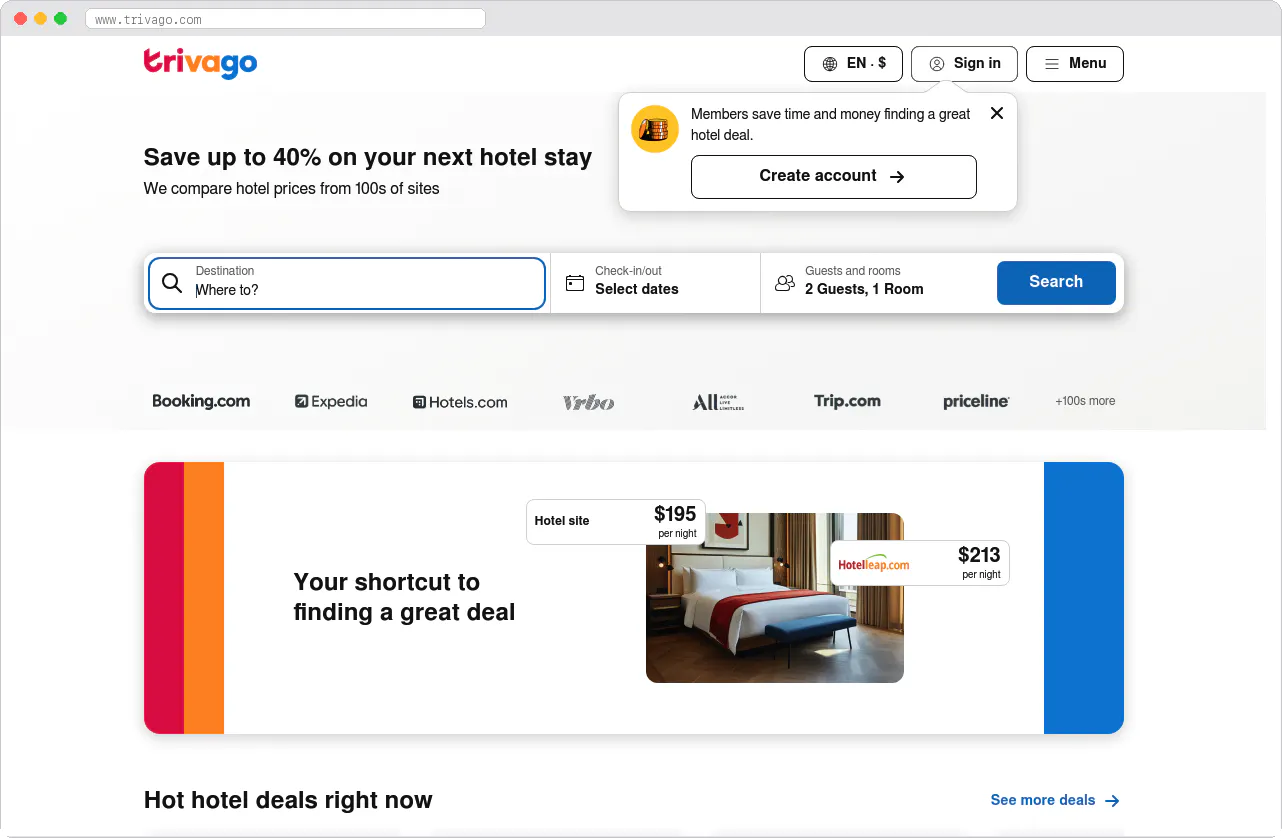
What is Trivago and how does it work?
Trivago is a three-sided marketplace connecting travelers, hotels, and booking platforms through a price comparison engine. It aggregates hotel rates from more than 400 booking sites, presents travelers with a side-by-side comparison, and earns money when users click through to a partner's site to complete a reservation. Trivago itself never touches payment, cancellation, or guest support for the actual stay.
The user flow is simple on the surface: a traveler searches by destination and dates, Trivago's backend queries partner rate feeds, and results appear ranked by price, rating, or relevance. Clicking a rate redirects the user to the partner booking site, where Trivago's involvement ends. Underneath that simplicity sits a hard technical problem: normalizing rate data across hundreds of partners with different currencies, tax treatments, and availability formats, refreshed continuously so a listed price doesn't go stale by the time a user clicks it.
How Trivago makes money
Trivago's primary revenue engine is cost-per-click (CPC) advertising. Booking platforms bid for placement and pay Trivago each time a user is redirected to their site, in an auction model similar to Google Ads but scoped to hotel search. CPC rates vary widely by destination and season, from under $1 in lower-demand markets to $3 or more per click in competitive, high-demand markets during peak periods (Foundry CRO).
A second layer of revenue comes from performance-based commissions: since September 2025, Trivago has phased out cost-per-click bidding entirely and now runs exclusively on a Cost-Per-Acquisition model, charging hotels a minimum 10% commission on completed bookings (Paraty Tech). This gives Trivago both immediate cash flow from clicks and a smaller tail of revenue tied to actual conversions. Trivago Business Studio, a subscription product sold to hotels for listing management and analytics, adds a third, smaller revenue stream, with pricing tailored to each property rather than a fixed public rate (trivago Hotel Manager Help Center).
This model is attractive because it avoids payment processing, chargebacks, and guest disputes entirely. It's also fragile: Trivago depends on partners continuing to value the traffic more than the cost of the click, and it competes directly with Google, which controls the search real estate Trivago's own traffic acquisition depends on.
What makes Trivago work: key features
Real-time rate aggregation. The core of the product is a system that continuously polls or receives feeds from hundreds of partner sites, normalizes currencies and fees, and serves comparable results in under a second. This is the single hardest engineering problem in the category and the one most clones underestimate.
Granular filtering and comparison UX. Star rating, guest score, cancellation flexibility, distance from a landmark, and amenities all need to be filterable in combination, because travelers are comparing dozens of near-identical options and small UX friction kills conversion.
A CPC auction system for partners. Booking platforms need a self-serve or managed way to bid on placement, monitor performance, and adjust spend. This is effectively a small ad-tech platform sitting inside the marketplace.
Partner integration management. Rate feeds break, partners change data formats, and availability data goes stale. Backend tooling to detect and flag these issues before they reach users is what separates a reliable comparison engine from an untrustworthy one.
Mobile-first search. Hotel search skews heavily mobile, and a comparison interface with dozens of filters has to compress into a thumb-friendly experience without losing functionality.
Localization at depth. Language, currency, and regional booking norms (Europeans tend to favor free cancellation, for instance) all shape both the interface and which partners matter in a given market.
The competitive landscape
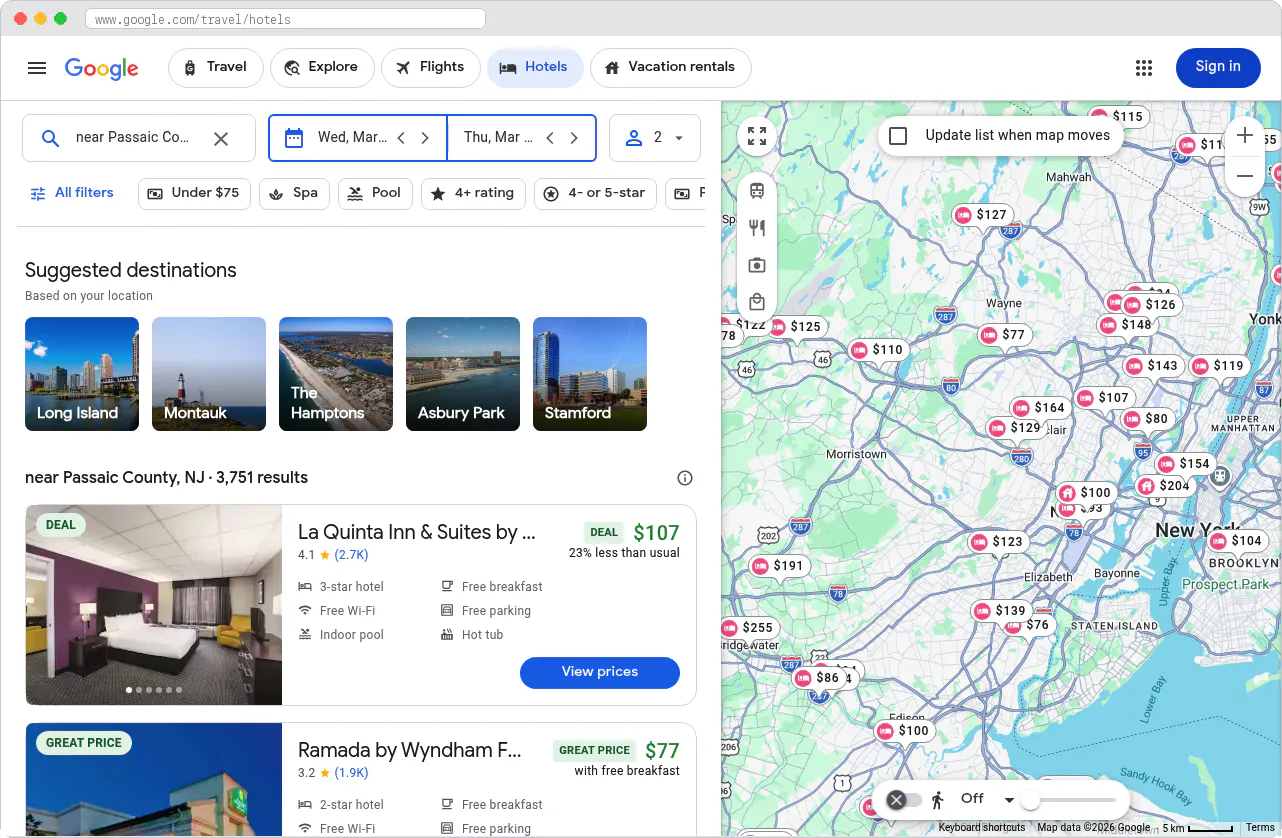
Google Hotel Ads is Trivago's largest threat because it intercepts demand before it ever reaches a dedicated comparison site. Google shows hotel price comparisons directly inside search and Google Maps, using its existing traffic dominance rather than having to earn a separate visit. Its weakness is that it's one feature inside a much larger product, not a purpose-built hotel search experience, which leaves room for platforms that go deeper on specialized filtering, curated inventory, or a specific travel niche Google doesn't optimize for.
Kayak, owned by Booking Holdings, compares flights, hotels, and rental cars rather than specializing in hotels alone. It adds trip-planning features like fare prediction and price alerts that Trivago doesn't offer, which makes it stickier for travelers planning a full trip rather than just a hotel stay. Its broader scope means hotel-specific search and filtering get less dedicated investment than a pure-play competitor.
Momondo, also part of Booking Holdings, leans into visual discovery and deal-finding rather than exhaustive comparison, and it markets heavily toward younger, price-sensitive travelers through social channels. It's effective at inspiring a trip a user hadn't already planned, but it carries a smaller share of the "I already know where I'm going, show me the best rate" search intent that Trivago captures.
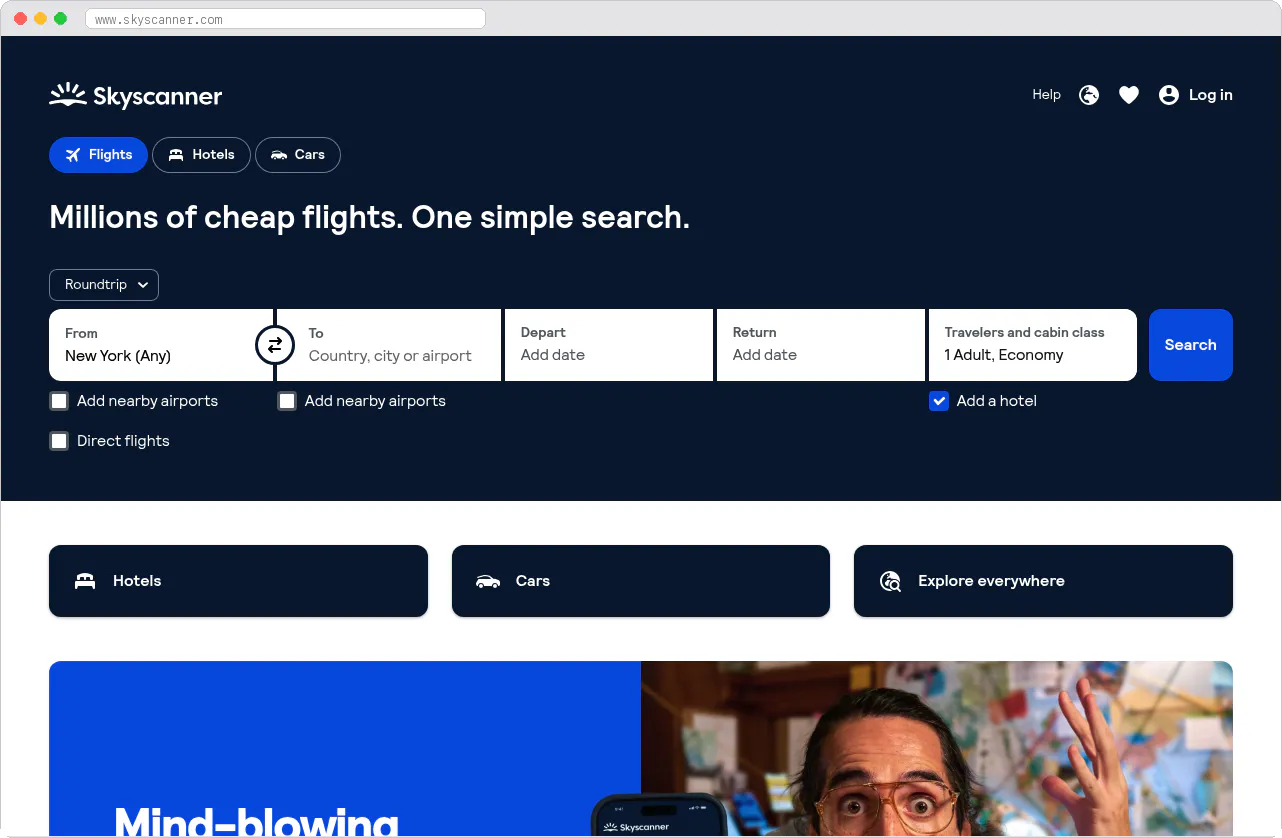
Skyscanner built its brand on flight comparison and has extended into hotels, but its hotel product is a secondary feature layered onto a flight-first platform. That leaves an opening for any competitor willing to go deeper on hotel-specific comparison, particularly in the Asian and European markets where Skyscanner has strong flight traffic but thinner hotel partner coverage.
HotelsCombined, another Booking Holdings property, is the closest structural match to Trivago, a pure hotel comparison engine with no other travel verticals. Its strength is a solid footprint in Australia and Southeast Asia, where it has invested in regional booking partnerships. Its weakness, shared with Trivago, is being one of several nearly interchangeable comparison products owned by the same handful of large travel conglomerates, which makes brand differentiation hard.
The common thread across all five: none of them owns the booking itself. That's the opening for a new entrant. A marketplace that combines comparison-style search with an actual bookable transaction, in a niche the giants underserve, doesn't have to win a CPC auction against Google. It can just take a commission on a stay it actually processes.
How to build a marketplace like Trivago
1. Define your niche within Trivago's category
You're not out-aggregating Trivago's 400+ partner integrations on day one, and trying to would be a mistake. Instead, pick a segment underserved by the big five: boutique and independent hotels that don't get CPC budget priority on Trivago or Google, extended-stay and monthly rentals, pet-friendly or accessible accommodations, business travel with corporate rate management, or a specific region where global platforms have thin local coverage. Regional and property-type specificity is what let smaller players like HotelsCombined carve out Southeast Asia rather than compete head-on everywhere.
2. Decide your business model: comparison or bookable marketplace
This decision shapes everything downstream. A pure comparison and redirect model requires partner API access, rate scraping infrastructure, and a CPC advertising system, none of which a marketplace operating system is built to support, since no money changes hands on your platform. A bookable marketplace, where independent hotels or hosts list directly and travelers book and pay through your platform, is a more defensible business (you earn a commission on every booking, not a fraction of a click) and it's the model that a platform like Sharetribe is actually built for. Most founders inspired by Trivago are better served by this second path.
3. Validate demand and secure supply-side commitments
Talk to property owners in your chosen niche before writing a line of code. Ask what they currently pay in commission to Booking.com or Expedia (often 15-25%), and whether a lower-commission, more targeted alternative would get them to list. Line up 15-25 committed listings before launch. Comparison platforms need broad partner coverage to be useful; bookable niche marketplaces need depth of trust in a narrow, well-curated set of listings instead.
4. Choose your development approach
Vibe coding from scratch. AI tools like Cursor, Lovable, and Bolt can produce a working booking-site prototype quickly, useful for testing a concept with early users. For launching a platform that handles real payments between strangers, they're not sufficient on their own. What vibe-coded outputs reliably don't produce is the infrastructure underneath: payment escrow, dispute resolution, fraud detection, and compliance. A documented Sharetribe experiment ran 60+ hours to reach demo quality but revealed a critical checkout exploit that would have allowed price manipulation via direct API call. It's a useful prototyping tool, not a cost-effective path to launch.
Custom development from scratch. Hiring developers gives you full control. A niche booking marketplace with reviews, host verification, secure payment holding, and a cancellation/dispute flow sits in the production-grade tier: $80,000-$200,000 over 16-28 weeks (Codica, RaftLabs). If you're building the pure meta-search version with real-time aggregation across hundreds of external partners, the data infrastructure alone can push costs toward $150,000-$350,000+, closer to Tier 3 complexity even without logistics or native apps. The low end of any range assumes offshore teams at $15-40/hr; US or Western European teams push toward the top. This route makes sense when your comparison logic or partner network is genuinely novel and no existing platform can support it.
Building on a marketplace operating system like Sharetribe. You start at roughly 90% done on the standard marketplace foundation: payments, user accounts, listing management, messaging, transaction flows, fraud detection, and compliance. Your time and budget go toward what makes your booking marketplace distinct.
- No-code builder. Configure property listings, availability calendars, pricing rules, and a full booking-and-payment flow from the Console without writing code. This gets a niche accommodation marketplace live and taking real bookings in weeks.
- AI-assisted development. Connect Claude Code, Cursor, or Codex to Sharetribe's open APIs and open-source template to build comparison-style filtering, a rate-transparency dashboard for hosts, or custom search ranking logic. Because Sharetribe handles the payment infrastructure, AI-assisted development on top of it carries much lower risk than building from scratch.
- Custom code. Build directly on the developer platform for deeper integrations (channel manager sync, dynamic pricing engines) or hire from Sharetribe's Expert Marketplace.
Most founders start with the no-code builder, then add features via AI or a developer as they learn what their hosts and travelers actually need.
5. Solve the cold start problem
A booking marketplace needs enough listings to make search worthwhile and enough traveler demand to make listing worthwhile, and neither shows up first on its own. Trivago sidestepped this by aggregating existing inventory from established booking sites rather than recruiting hotels directly, which let it launch with full coverage from day one. A new entrant building a bookable marketplace doesn't have that shortcut and needs to go supply-first: manually recruit 20-30 properties in one city or niche, personally onboard them with white-glove listing setup, and use your own network or targeted outreach to bring the first wave of bookers. Geographic or category focus (one city, one property type) beats trying to cover a country on launch day, because a traveler who searches your niche and finds five relevant, well-curated options converts better than one who finds fifty generic ones scattered too thin to trust.
6. Design your pricing and monetization
Decide your commission structure before launch, typically 8-15% from the host side for a niche marketplace undercutting the 15-25% charged by major OTAs, optionally with a small service fee from travelers. Build in Sharetribe's transaction flow to hold funds until check-in or a cancellation window passes, which protects both sides without you having to build escrow logic yourself.
7. Launch and iterate
Launch in one market or niche, get your first 20-30 completed bookings, and talk to both hosts and travelers about what's missing. Expand geography or category only once the core loop, search, book, pay, stay, review, is working reliably for a small group.
Do you need to build everything Trivago has?
No. Trivago's 400+ partner integrations, machine learning-based search ranking, and 33-language localization are the product of nearly two decades and hundreds of millions in investment, not a launch requirement. At launch, you need reliable search, clear listing information, a working booking and payment flow, and a way for hosts and travelers to communicate. Everything else, CPC auction systems, real-time rate scraping across hundreds of external sites, ML personalization, is either irrelevant to a bookable niche marketplace or a year-two problem at best.
The temptation to vibe-code a quick clone is understandable, but it solves the wrong problem. An AI tool can generate a search interface and a listing page in an afternoon. It won't generate a tested payment-holding system, a dispute resolution flow for a canceled stay, or fraud detection on new host accounts, and those are exactly the pieces that take the vibe-coded checkout exploit from theoretical to a real financial loss. Starting on Sharetribe's foundation is faster precisely because that infrastructure already exists and is already tested; your AI tokens and developer hours go toward your search experience and niche features instead of rebuilding a payment system from zero.
Trust and safety for a Trivago-type marketplace
A bookable accommodation marketplace carries different risks than a pure comparison site, because now you're handling real money and real stays. The main exposures are listing misrepresentation (photos or amenities that don't match reality), payment fraud, fake or manipulated reviews, and cancellation disputes where a guest and host disagree about a refund. In a pure comparison model, rate accuracy is the main trust issue: showing a price that isn't actually available when the user clicks through damages credibility fast.
Standard practice in the space includes verified host identity, property or business license checks for professional operators, review systems that only allow reviews from completed bookings, and a clear, published cancellation policy enforced consistently. Sharetribe provides payment escrow (funds held until a triggering event like check-in), user accounts with optional identity verification, and a structured transaction flow that enforces your cancellation and refund rules automatically. What you need to add is category-specific: a property verification workflow for new hosts, photo or listing audit for accuracy, and a dispute escalation path for the edge cases automation can't resolve on its own.
Running a marketplace like Trivago
At scale, Trivago manages hundreds of partner integrations, a real-time bidding system, and infrastructure processing millions of rate updates daily. A niche bookable marketplace built on Sharetribe doesn't carry that operational load. Your ongoing work centers on host recruitment and onboarding, listing quality checks, customer support for booking issues, and marketing to keep both sides of the marketplace growing.
Sharetribe handles the transaction mechanics automatically: payment processing and payout scheduling, booking calendar logic, automated notifications to hosts and guests, and the underlying compliance work tied to handling payments across regions. That leaves your team free to focus on the parts that actually differentiate your marketplace, curated inventory, a specific traveler audience, or a booking experience the big platforms don't bother to build for your niche.
Development costs and timeline
Three realistic scenarios:
Vibe coding from scratch: Free or very cheap to start, and a working booking-site prototype is buildable quickly with AI tools. What you can't get from here is a production-ready platform: tested payment escrow, cancellation and refund logic, fraud detection on new accounts, and a search system that doesn't break under real traffic all require work AI coding tools don't shortcut. A documented Sharetribe experiment logged 60+ hours to reach demo quality and found a critical payment vulnerability along the way. Useful as a proof of concept, not a cost-effective path to a live business.
Custom development from scratch: A niche bookable marketplace with reviews, host verification, escrow, and dispute handling sits in the production-grade tier, $80,000-$200,000 over 16-28 weeks (Codica, RaftLabs). A pure meta-search build with real-time aggregation across hundreds of external partner feeds pushes toward $150,000-$350,000+ due to the data infrastructure alone. The low end assumes offshore teams; US or Western European teams push toward the top of each range. Ongoing maintenance typically runs 15-25% of the original build cost per year. This route makes sense when your search or matching logic is genuinely novel.
Building on Sharetribe: Before you launch, the Sharetribe Build plan costs just $39/month. To open to real users, you need the Live plan, which costs $199/month billed yearly ($259/month billed monthly). Both plans include 1 million usage credits per month. Sharetribe covers payments, listings, booking calendars, messaging, and the transaction engine a niche accommodation marketplace needs out of the box. Most founders reach a live, bookable MVP in weeks rather than months, and custom features, like specialized filtering or a channel-manager integration, get added later via AI tools or a developer, scoped narrowly because the transaction engine is already built.
Why Sharetribe for building a marketplace like Trivago
Sharetribe's core strength is the transactional infrastructure Trivago itself deliberately avoided: a payment engine that can hold funds, release them on a trigger like check-in, and handle refunds according to rules you define. For a founder building a bookable niche accommodation marketplace, that's the exact foundation needed, plus availability calendars, structured listing data for amenities and property types, built-in messaging between host and guest, and identity verification for hosts. The Console lets you configure all of this without code, and the open API and template give you room to add comparison-style search, custom ranking, or filtering as your platform matures, without having to rebuild payments or compliance from scratch.
Frequently asked questions
How does Trivago make money if it's free to use?
Trivago earns money primarily through cost-per-click advertising, charging booking platforms each time a user is redirected to their site. It also collects performance-based commissions from some partners and subscription fees from hotels using its business analytics tools, rather than charging travelers directly.
What is Trivago's business model exactly?
Trivago operates as a three-sided marketplace connecting travelers, hotels, and booking platforms, aggregating rates from over 400 sites and monetizing through CPC advertising and referral commissions rather than processing bookings itself. It never takes payment for the actual stay.
How much does it cost to build a website like Trivago?
It depends heavily on which model you build. A niche bookable marketplace with reviews, verification, and payment escrow runs $80,000-$200,000 in custom development, while a pure meta-search comparison engine with real-time aggregation across hundreds of partners can exceed $150,000-$350,000 due to data infrastructure alone. Building on Sharetribe costs just $39/month on the Build plan after a 14-day free trial (the Live plan for running your marketplace is $199/month billed yearly) and gets a bookable niche marketplace live in weeks.
Why doesn't Trivago process bookings directly like other travel sites?
Trivago avoids the operational complexity of payment processing, guest support, and cancellation handling by focusing solely on comparison and referral. This keeps its margins high and its infrastructure simple, but it also means its revenue depends entirely on partners continuing to value referred clicks.
What are Trivago's main competitors in hotel price comparison?
Trivago's closest competitors are Google Hotel Ads, Kayak, Momondo, Skyscanner, and HotelsCombined. Google is the biggest structural threat because it captures search intent before users ever reach a dedicated comparison site, while the others compete through broader travel scope or regional specialization.
Can I build a Trivago-style comparison feature on Sharetribe?
Sharetribe is built for marketplaces where transactions happen on the platform, so it's better suited to a bookable niche marketplace than a pure redirect-based comparison engine. You can add comparison-style search and filtering on top of Sharetribe's foundation using its open APIs, but the CPC-arbitrage model itself would need to be built separately from the transaction engine.
Start your 14-day free trial
Create a marketplace today!
- Launch quickly, without coding
- Extend infinitely
- Scale to any size
No credit card required