How to build a website like Toptal
Toptal connects businesses with the top 3% of freelance talent through rigorous vetting. Learn how to build a similar exclusive talent marketplace, from MVP to scaling your platform.
Published: Mar 15, 2024
Last updated: Mar 19, 2026
What is Toptal and how does it work?
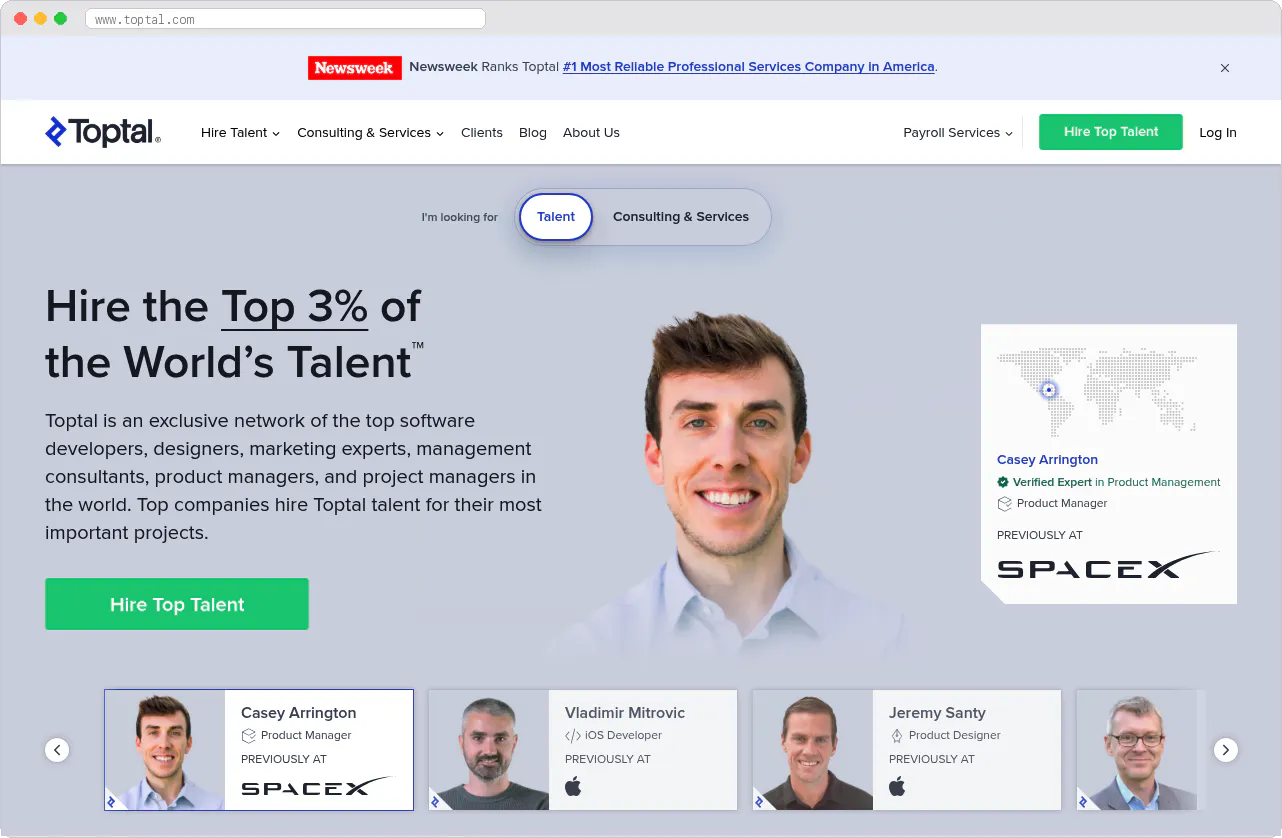
Toptal has transformed the freelancing industry by creating an exclusive network of elite talent. Founded in 2010 by Taso Du Val and Breanden Beneschott, the platform generated over $200 million in revenue by 2021 and connects more than 3,000 vetted freelancers with Fortune 500 companies and startups worldwide.
Unlike traditional job boards or broad freelancing platforms, Toptal operates as a curated talent marketplace. The company claims to accept only the top 3% of applicants through a multi-step screening process that includes language and personality assessments, skill reviews, test projects, and live screening calls. This rigorous vetting creates what Toptal calls an "exclusive network" of software developers, designers, finance experts, product managers, and project managers.
Toptal serves as a matchmaking service rather than a self-service platform. When businesses need talent, they work directly with Toptal's talent managers who hand-select candidates based on project requirements. Clients typically receive 2-3 pre-vetted candidates within 24-48 hours, significantly reducing the time and risk involved in hiring freelancers.
The platform focuses on high-value, complex projects that require specialized expertise. Average project values range from $10,000 to over $100,000, with many engagements lasting several months. This positions Toptal in the premium segment of the freelancing market, competing more with traditional consulting firms than with general freelancing platforms.
Toptal's business model and revenue streams
Toptal operates on a commission-based model, charging clients a markup on freelancer rates. The company typically adds a 40-100% margin on top of what freelancers receive, depending on the engagement type and duration. For example, if a developer charges $80 per hour, Toptal might bill the client $120-160 per hour.
This high-margin model works because Toptal provides significant value beyond simple matchmaking. The platform handles all administrative tasks including contracts, payments, project management support, and risk mitigation. Clients pay for the assurance that they're working with pre-validated talent and the convenience of a managed service.
Toptal also offers different engagement models to maximize revenue. These include hourly contracts, part-time arrangements (20 hours per week), and full-time engagements (40+ hours per week). Longer-term commitments often result in better rates for clients while providing more stable income for freelancers.
The company has expanded beyond pure talent matching into adjacent services like Toptal Projects, which provides end-to-end project delivery, and educational initiatives like Toptal Academy. These additional services create multiple revenue streams while strengthening the core platform's value proposition.
Essential features for a Toptal-like marketplace
Building a successful talent marketplace like Toptal requires specific functionality that supports both the curation model and the high-touch service approach.
Rigorous vetting system
The screening process is Toptal's core differentiator and the most complex feature to implement effectively. A comprehensive vetting system needs multiple assessment stages, each designed to evaluate different aspects of candidate quality. This includes automated skill assessments, portfolio reviews, live coding sessions for developers, and personality fit evaluations.
The system must track candidates through each stage, provide consistent evaluation criteria, and maintain detailed profiles of successful applicants. Building this functionality requires significant upfront investment in assessment tools, interviewer training, and quality control processes.
Client-freelancer matching algorithm
Unlike self-service platforms where clients browse profiles, Toptal uses human talent managers supported by matching algorithms to identify suitable candidates. The system needs to consider project requirements, freelancer availability, past performance data, client preferences, and geographic or timezone considerations.
This matching system requires sophisticated data modeling to capture the nuances of project fit beyond basic skill matching. It must account for industry experience, project complexity, communication styles, and cultural fit factors that impact project success.
Project management and collaboration tools
High-value projects require robust collaboration features. The platform needs integrated messaging systems, file sharing capabilities, progress tracking tools, and time management features. Many Toptal projects involve sensitive business information, so security and confidentiality controls are essential.
Clients expect visibility into project progress without micromanaging freelancers. This requires carefully designed dashboards that provide transparency while maintaining freelancer autonomy. The system should also support various project methodologies, from waterfall to agile approaches.
Secure payment processing with escrow
Toptal handles significant financial transactions, often involving tens of thousands of dollars per project. The payment system must support multiple currencies, handle complex invoicing scenarios, and provide secure escrow services that protect both parties.
The platform needs flexible payment terms to accommodate different project types. Some clients prefer milestone-based payments, while others use time-and-materials billing. The system must track work completion, automate payment releases, and handle dispute resolution.
Quality assurance and feedback systems
Maintaining platform quality requires ongoing monitoring of freelancer performance and client satisfaction. The system needs to collect detailed feedback after each engagement, track performance metrics over time, and identify potential quality issues before they impact client relationships.
This includes both quantitative metrics (on-time delivery, budget adherence) and qualitative assessments (communication quality, technical expertise, cultural fit). The platform must use this data to refine matching algorithms and potentially remove underperforming talent.
Client onboarding and consultation tools
Toptal's high-touch approach requires sophisticated client onboarding workflows. The system needs to capture detailed project requirements, facilitate discovery calls with talent managers, and guide clients through the engagement setup process.
This often involves custom questionnaires, requirement documentation tools, and integration with client project management systems. The platform must also support various engagement models, from short-term projects to long-term team augmentation.
Successful competitors and alternatives to Toptal
Understanding Toptal's competitive landscape helps identify opportunities for differentiation and reveals different approaches to talent marketplace design.
Upwork Pro
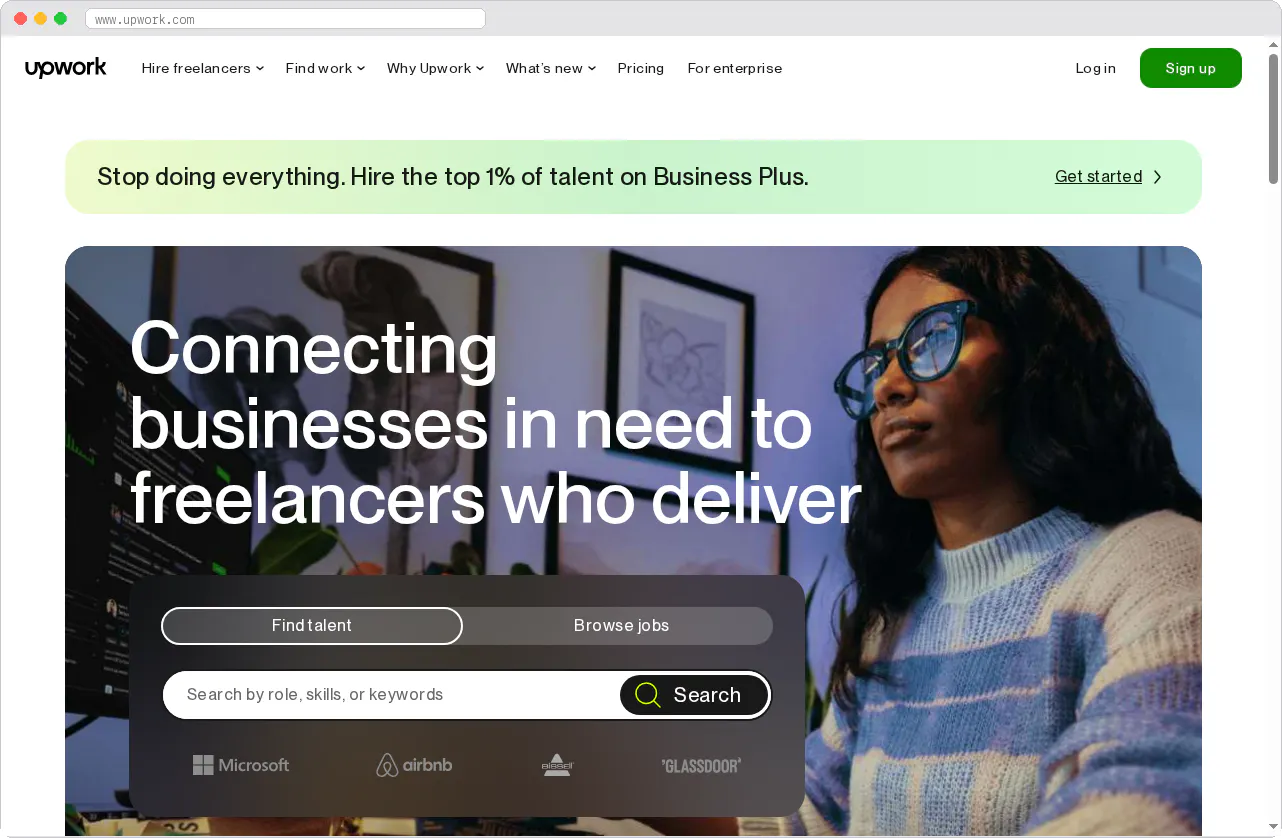
Upwork operates the world's largest freelancing platform but recognized the need for premium services through Upwork Pro (formerly Upwork Enterprise). This service provides dedicated account management and pre-vetted talent pools, competing directly with Toptal's approach.
Upwork Pro's advantage lies in its massive freelancer database and lower costs compared to Toptal. However, the vetting process is less rigorous, and the service lacks Toptal's exclusive positioning. Clients can access broader skill categories but may sacrifice some quality assurance.
Catalant (formerly HourlyNerd)
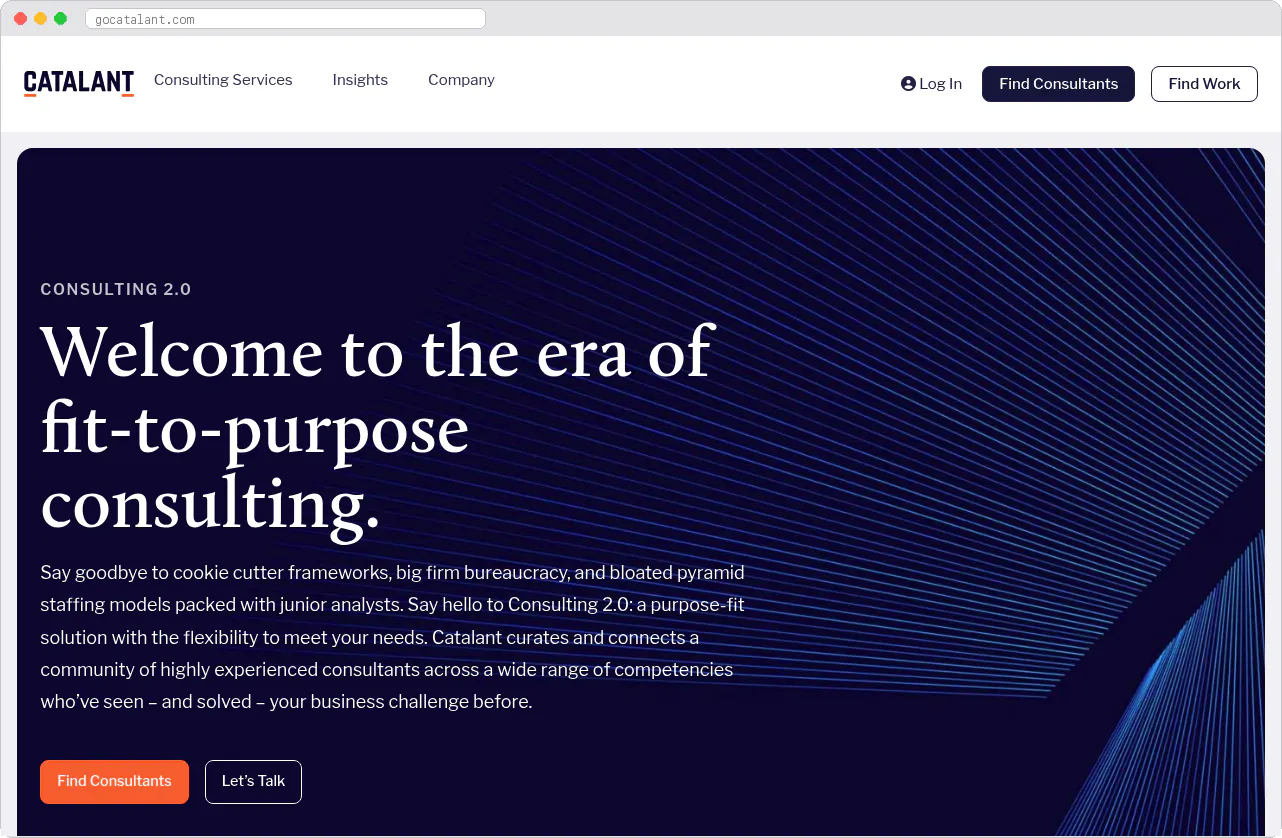
Catalant focuses specifically on business consulting and strategic projects, competing with Toptal's finance and business development segments. The platform emphasizes former consultants from top-tier firms like McKinsey, Bain, and BCG.
Catalant's differentiation comes from its consulting focus and emphasis on strategic rather than execution work. Projects typically involve market research, business strategy, and financial modeling rather than ongoing development or design work. This narrow focus allows for more specialized vetting but limits market size.
Gigster
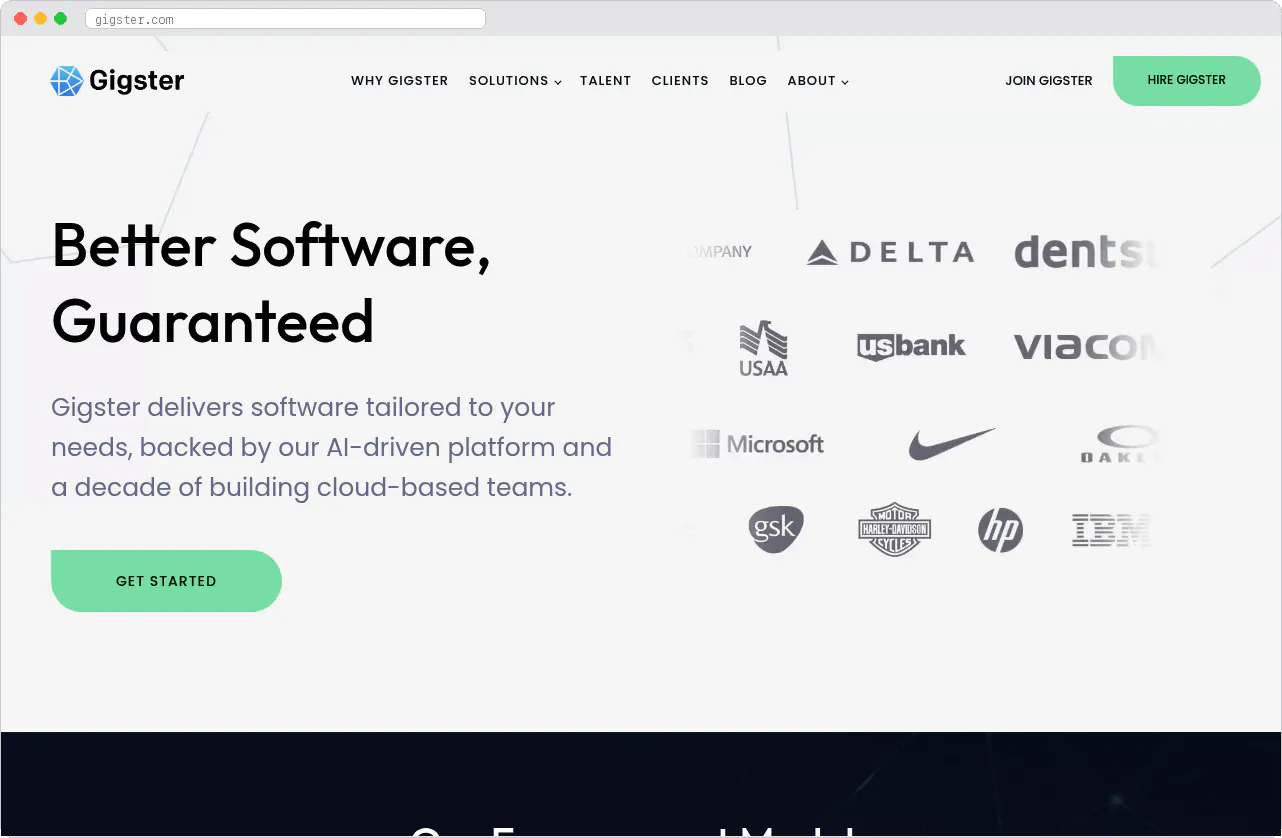
Gigster targets software development projects specifically, offering end-to-end project delivery rather than individual talent placement. The platform assembles full development teams and manages entire project lifecycles.
This model competes with Toptal's project-based engagements but operates more like a development agency than a talent marketplace. Gigster handles project management, quality assurance, and delivery risk, which appeals to clients who want complete outsourcing rather than team augmentation.
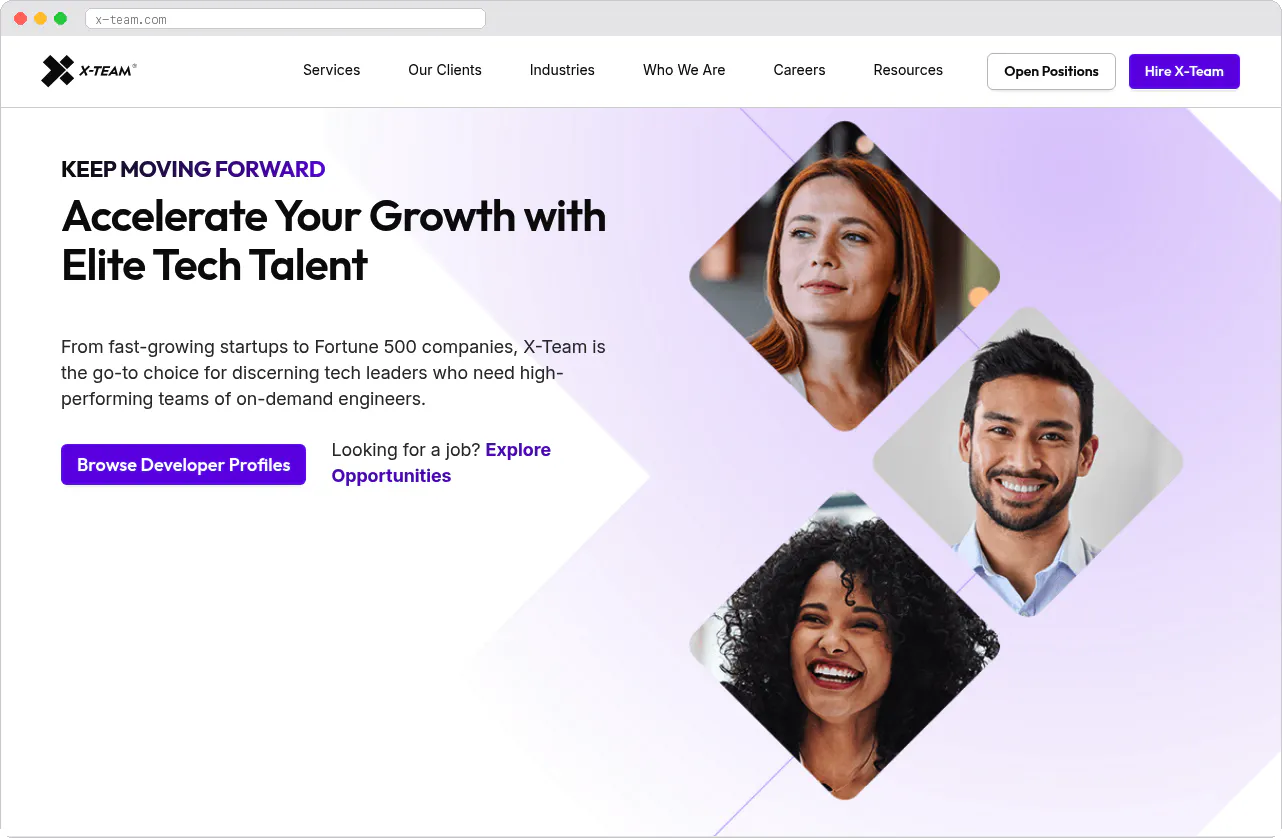
X-Team
X-Team positions itself as a developer community rather than a traditional marketplace, emphasizing long-term relationships and team integration. The company focuses exclusively on software development and maintains a smaller, highly curated network of developers.
X-Team's community approach creates strong freelancer loyalty and quality consistency. However, the model is less scalable than Toptal's broader marketplace approach and requires significant investment in community building and developer support.
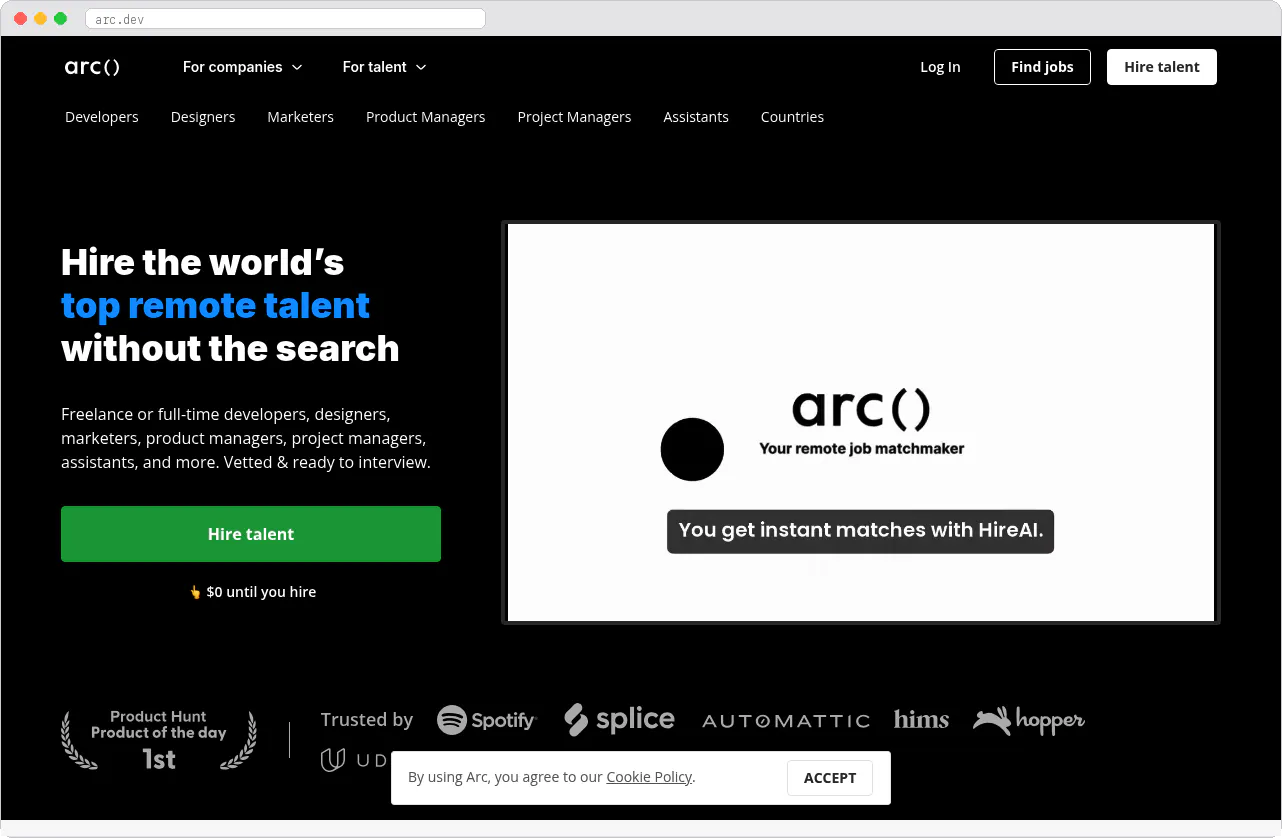
Arc (formerly CodementorX)
Arc specializes in connecting startups with senior developers and technical leaders. The platform emphasizes startup experience and the ability to work in fast-paced, resource-constrained environments.
Arc's startup focus allows for specialized vetting criteria and community building around entrepreneurial values. The platform offers both project-based and full-time hiring, competing with Toptal's team augmentation services while maintaining lower overhead and pricing.
How to build a marketplace like Toptal: 10-step process
Creating a successful talent marketplace requires careful planning, significant upfront investment, and a clear differentiation strategy. Here's the step-by-step approach that maximizes your chances of success.
Step 1: Define your niche and differentiation strategy
Toptal succeeded by focusing on premium talent in specific categories rather than trying to serve all freelancing needs. Your marketplace needs equally clear positioning to compete effectively.
Successful differentiation strategies include geographic specialization (serving specific regions or local markets), industry focus (healthcare, fintech, e-commerce), skill specialization (emerging technologies like AI or blockchain), or service model innovation (guaranteed outcomes, embedded teams, or consulting approaches).
Research your target market thoroughly before committing to a positioning strategy. Analyze existing solutions, talk to potential clients about unmet needs, and identify gaps in current offerings. The most successful marketplace niches combine underserved demand with your team's unique expertise or network advantages.
Step 2: Validate demand through pre-sales
Before building complex vetting systems or matching algorithms, validate that businesses will pay premium rates for your curated talent approach. This requires proving both sides of the marketplace equation: that high-quality freelancers want to work through your platform and that clients will pay for the additional service layer.
Start by manually recruiting a small group of exceptional freelancers in your target niche. Use your professional network, industry events, and direct outreach to identify candidates who meet your quality criteria. Focus on building relationships rather than processing large volumes.
Simultaneously, identify potential clients who struggle with current talent acquisition approaches. Many businesses experience frustration with existing platforms due to quality issues, time investment, or project failures. Position your approach as solving these specific pain points.
Conduct several manual placements before building automated systems. This validates your vetting criteria, tests your matching approach, and provides case studies for future marketing efforts. Manual processes also help you understand the operational complexity before investing in technology solutions.
Step 3: Design your vetting process
Toptal's success depends heavily on maintaining quality standards through rigorous screening. Your vetting process becomes a core competitive advantage and operational foundation.
Effective vetting combines multiple assessment methods to evaluate technical skills, communication abilities, cultural fit, and reliability. Technical assessments should reflect real-world challenges rather than abstract puzzles. Portfolio reviews need to verify actual contribution to showcased work. Live interviews should assess problem-solving approaches and communication skills under pressure.
Document your vetting criteria clearly and train evaluators consistently. Inconsistent screening leads to quality variations that damage client trust and platform reputation. Consider using multiple evaluators for final-stage candidates to reduce individual bias.
Plan for continuous refinement of your vetting process. Track the correlation between screening results and actual project performance. Candidates who pass screening but struggle in real engagements indicate gaps in your assessment approach.
Step 4: Build your minimum viable platform
A Toptal-style marketplace requires more sophisticated functionality than typical e-commerce platforms, but you can still launch with essential features and expand over time.
Your MVP should support basic talent profiles, client project posting, messaging between parties, and payment processing. The vetting system can initially be largely manual, using simple application forms and interview scheduling tools.
Prioritize security and professionalism in your initial design. Enterprise clients expect polished experiences that reflect the premium positioning. Invest in professional design, SSL certificates, comprehensive terms of service, and privacy compliance.
Consider starting with a single service category to reduce complexity. Toptal began with software development before expanding to design and other areas. This focused approach allows you to refine your vetting process and build case studies before tackling additional skill areas.
Step 5: Recruit your initial talent pool
Building supply requires different strategies than typical marketplace acquisition. You're targeting high-quality professionals who likely have successful careers and multiple opportunities.
Focus on relationship building rather than mass recruitment. Attend industry conferences, participate in professional communities, and use your team's existing networks. Personal referrals often yield the highest-quality candidates who align with your platform's values.
Offer compelling value propositions beyond just project access. This might include professional development opportunities, community membership, marketing support, or preferential project matching. Top freelancers have many options, so your platform must provide unique benefits.
Start with a small, exceptional group rather than trying to reach minimum viable supply quickly. Ten outstanding freelancers create more client value than fifty mediocre ones. Quality creates positive feedback loops that attract both better talent and higher-paying clients.
Step 6: Establish client acquisition channels
Enterprise clients require different acquisition strategies than consumer customers. Decision-making processes are longer, involve multiple stakeholders, and prioritize risk mitigation over cost savings.
Content marketing works particularly well for talent marketplaces. Create detailed case studies, industry reports, and thought leadership content that demonstrates your expertise and platform value. SEO-optimized content helps capture demand from businesses researching talent solutions.
Direct sales outreach often produces the highest-quality leads. Identify companies that match your target profile and reach out with specific value propositions. Personalized outreach based on their current challenges or growth initiatives yields better response rates than generic marketing messages.
Partnership channels can accelerate growth once you've proven your model. This might include referral programs with complementary service providers, integration partnerships with project management tools, or strategic alliances with consulting firms.
Step 7: Launch with a curated client base
Like Toptal, you should launch with hand-selected clients who understand your value proposition and provide ideal testing opportunities for your service. These initial clients become case studies, provide valuable feedback, and generate referrals.
Choose launch clients carefully based on project complexity, communication styles, and willingness to provide detailed feedback. Avoid clients with unrealistic expectations or those who prioritize cost over quality. Early negative experiences can damage freelancer retention and platform reputation.
Provide exceptional service during initial engagements. This might mean accepting lower margins to ensure project success or providing additional support that wouldn't be sustainable at scale. Early client success creates the foundation for future growth and premium positioning.
Step 8: Refine your matching and quality processes
Early client engagements provide crucial data for refining your talent matching algorithms and quality assurance processes. Track project outcomes, client satisfaction, and freelancer performance to identify improvement opportunities.
Develop clear performance metrics that predict project success. This might include technical assessment scores, communication ratings, past client feedback, or portfolio quality indicators. Use this data to improve your vetting process and matching accuracy.
Implement feedback loops that capture detailed information from both clients and freelancers after each engagement. Use structured surveys, follow-up calls, and performance reviews to gather actionable insights.
Step 9: Scale your operations
As demand grows, you'll need to systematize processes that were initially handled manually. This includes automating parts of the vetting process, developing self-service tools for routine client needs, and building scalable quality assurance systems.
Invest in talent management tools that help you maintain relationships with your freelancer network. This includes performance tracking, skill development opportunities, and community building initiatives that increase retention.
Consider geographic expansion carefully. Different markets have varying talent availability, client expectations, and competitive dynamics. Focus on markets where you can maintain quality standards while achieving sustainable unit economics.
Step 10: Expand service offerings
Successful talent marketplaces often expand beyond pure talent matching into adjacent services. This might include project management support, outcome guarantees, team assembly services, or consulting offerings.
Expansion should use your core competencies while addressing unmet client needs. Toptal's evolution into managed projects and educational services demonstrates how platforms can increase revenue per client while strengthening competitive moats.
Cost considerations for building a Toptal competitor
Building a professional talent marketplace requires significant upfront investment and ongoing operational costs that exceed typical marketplace development.
Development costs
A basic MVP for a Toptal-style platform typically costs $100,000-300,000 for custom development. This includes client and freelancer portals, basic matching functionality, payment processing, and administrative tools. More sophisticated features like automated screening tools, advanced matching algorithms, and enterprise integrations can double these costs.
Ongoing development represents a major expense category. Talent marketplaces require continuous feature development to remain competitive and serve evolving client needs. Budget 20-30% of initial development costs annually for platform improvements and maintenance.
Operational expenses
Vetting and quality assurance create substantial operational overhead. Screening high-quality candidates requires experienced evaluators, comprehensive assessment tools, and significant time investment. Plan for 10-20 hours of evaluation effort per accepted freelancer.
Talent management becomes increasingly expensive as your network grows. Maintaining relationships with hundreds of freelancers requires dedicated staff, regular communication, and ongoing support. Many platforms employ talent success managers who focus exclusively on freelancer retention and development.
Client success operations also require significant investment. Enterprise clients expect dedicated account management, regular check-ins, and proactive support. This high-touch approach necessitates experienced staff with strong communication and project management skills.
Marketing and acquisition costs
Acquiring enterprise clients typically costs $5,000-25,000 per customer due to long sales cycles and multiple touchpoints. Content marketing, conference participation, and direct sales efforts all require sustained investment before generating returns.
Talent acquisition costs vary significantly based on your target market and differentiation strategy. Recruiting senior developers or specialized consultants often requires competitive signing bonuses, professional development opportunities, or other incentives beyond project access.
Why Sharetribe works for talent marketplaces
Building a marketplace like Toptal involves complex technical requirements and significant operational overhead. Sharetribe addresses many of these challenges through purpose-built marketplace functionality and flexible customization options.
Rapid MVP development
Sharetribe enables launching a functional talent marketplace in weeks rather than months. The platform includes built-in user management, payment processing, messaging systems, and administrative tools that would typically require custom development.
This speed advantage allows you to validate your market positioning and refine your service approach before committing to major technical investments. You can test vetting processes, gather client feedback, and iterate on your value proposition while competitors are still building basic platform functionality.
Scalable payment processing
Talent marketplaces handle complex financial transactions involving multiple parties, various payment terms, and international transfers. Sharetribe's integration with Stripe Connect manages these complexities automatically, including tax reporting, dispute resolution, and regulatory compliance.
The platform supports various pricing models including hourly billing, milestone payments, and retainer arrangements. This flexibility allows you to accommodate different client preferences and project types without custom payment development.
Customization for premium positioning
While Sharetribe provides marketplace essentials out of the box, talent platforms often require custom features that reflect their premium positioning. The platform's API-first architecture enables adding sophisticated vetting tools, matching algorithms, and client management systems.
This hybrid approach combines fast time-to-market with unlimited customization potential. You can launch with standard features and gradually add differentiating functionality based on market feedback and business growth.
Enterprise-ready infrastructure
High-value talent marketplaces must meet enterprise security and reliability standards. Sharetribe provides SOC 2 compliance, GDPR compliance, and enterprise-grade hosting that would be expensive to implement independently.
The platform handles scaling challenges automatically, ensuring consistent performance whether you're managing dozens or thousands of active projects. This reliability is crucial for maintaining client trust and freelancer satisfaction.
Sharetribe's approach particularly benefits talent marketplace founders who want to focus on business development rather than technical infrastructure. The platform handles marketplace complexity while enabling the customization necessary for competitive differentiation.
Building marketplace liquidity like Toptal
The most challenging aspect of building any two-sided marketplace is achieving liquidity, the state where supply and demand are sufficiently balanced to create value for both sides. Toptal's approach offers specific lessons for overcoming this challenge.
Quality over quantity approach
Toptal deliberately constrains supply through rigorous vetting, creating scarcity that justifies premium pricing. This approach works because it solves a specific problem: enterprise clients struggling to find reliable, high-quality freelancers through existing platforms.
This strategy requires exceptional talent acquisition and retention. You must convince high-quality freelancers that your platform's selectivity benefits their careers through better projects, higher rates, and reduced competition. The exclusivity becomes part of the value proposition for both sides.
High-touch service model
Unlike self-service platforms, Toptal uses human intermediation to facilitate matches and manage relationships. This approach reduces friction for both clients and freelancers while providing opportunities to gather feedback and improve service quality.
The managed service approach also allows for premium pricing that supports higher operational costs. Clients pay for reduced risk and time investment, while freelancers benefit from better project fit and ongoing support.
Focus on successful outcomes
Toptal's reputation depends on project success rates rather than transaction volumes. This focus on outcomes rather than activity metrics influences every aspect of platform design and operations.
Measuring success requires sophisticated tracking of project completion rates, client satisfaction scores, and long-term relationship development. These metrics guide platform improvements and help identify potential issues before they impact reputation.
Legal and compliance considerations
Talent marketplaces face complex regulatory requirements that vary by jurisdiction and can significantly impact operational costs and platform design.
Employment classification
The distinction between employees and independent contractors affects tax obligations, benefits requirements, and liability exposure. Recent legislation in various jurisdictions has tightened criteria for contractor classification, requiring careful attention to platform design and client relationships.
Platforms must avoid creating employment relationships through excessive control over work methods, exclusive arrangements, or other factors that suggest employer-employee relationships. This affects feature design, contract terms, and client guidance.
International operations
Talent marketplaces often operate across multiple countries, creating complex tax and regulatory compliance requirements. This includes VAT handling, withholding tax obligations, and data privacy regulations like GDPR.
Payment processing becomes particularly complex when handling international transactions involving different currencies, tax jurisdictions, and banking systems. Professional tax and legal advice is essential for platforms operating internationally.
Data security and privacy
Enterprise clients often share sensitive business information through talent marketplaces, creating significant data protection obligations. Platforms must implement appropriate security measures, privacy controls, and breach notification procedures.
Compliance requirements often influence platform architecture decisions and increase development costs. However, meeting enterprise security standards becomes a competitive advantage when pursuing high-value clients.
Next steps: launching your Toptal competitor
Building a successful talent marketplace requires careful execution across multiple dimensions: market positioning, talent acquisition, client development, and operational excellence.
Start by identifying your specific competitive advantage. This might be geographic focus, industry specialization, service model innovation, or unique talent acquisition approaches. Clear differentiation is essential in a market with established players and significant entry barriers.
Validate your approach through direct market engagement before major platform investment. Conduct manual talent placements, gather detailed client feedback, and refine your service approach based on real project outcomes.
Consider using Sharetribe to accelerate your time to market while maintaining flexibility for future customization. The platform's marketplace-specific features and scalable architecture support both rapid validation and long-term growth.
Focus on building sustainable competitive advantages that extend beyond platform features. This includes network effects from talent community, proprietary data from successful placements, and operational excellence that creates superior outcomes for both clients and freelancers.
The talent marketplace opportunity remains significant despite existing competition. Businesses continue struggling with talent acquisition, while high-quality freelancers seek better opportunities and support. Success requires exceptional execution, but the rewards justify the investment for founders who can build and scale effective platforms.
Frequently asked questions
How much does it cost to build a marketplace like Toptal?
Building a Toptal-style marketplace typically costs $100,000-300,000 for custom development, plus significant ongoing operational costs for vetting and client management. Using marketplace software like Sharetribe plans start at $99/month, with first-year costs typically under $5,000 while providing the flexibility to add custom features as you scale.
What makes Toptal different from other freelancing platforms?
Toptal differentiates through rigorous vetting (accepting only the top 3% of applicants), human-managed matching rather than self-service browsing, and focus on high-value enterprise projects. This creates a premium marketplace with higher rates but better quality assurance than broad platforms like Upwork.
How does Toptal's vetting process work?
Toptal uses a multi-stage screening process including language assessment, personality evaluation, skill review, test projects, and live interviews. Only about 3% of applicants pass all stages, creating an exclusive network that justifies premium pricing to enterprise clients.
Can I compete with Toptal in the same market?
Direct competition with Toptal requires significant capital and operational expertise. More successful approaches focus on underserved niches like specific industries, geographic regions, emerging technologies, or alternative service models. Differentiation is crucial for competing against established players.
What features does a Toptal competitor need?
Essential features include rigorous vetting systems, talent-client matching algorithms, project management tools, secure payment processing with escrow, quality assurance systems, and client onboarding workflows. The vetting and matching systems are most critical for maintaining quality standards.
How long does it take to build a talent marketplace like Toptal?
Custom development typically takes 6-12 months for basic functionality, while using marketplace software like Sharetribe can launch an MVP in 2-4 weeks. However, building the operational processes for vetting and client management often takes longer than the technical development.
Start your 14-day free trial
Create a marketplace today!
- Launch quickly, without coding
- Extend infinitely
- Scale to any size
No credit card required