How to build a website like OLX
OLX's local classifieds model has created billions in transactions globally. This guide shows you how to build a similar marketplace platform, from essential features to launching your first version in weeks, not months.
Published: Aug 9, 2024
Last updated: Sep 11, 2026
What is OLX and how does it work?
OLX is a local classifieds marketplace that connects buyers and sellers within the same geographic area for everything from smartphones and furniture to cars and real estate. Founded in 2006 by Fabrice Grinda and Alec Oxenford, OLX Group, now a wholly-owned subsidiary of Prosus, has since refocused to seven core markets, Bulgaria, France, Poland, Portugal, Romania, South Africa, and Ukraine, after divesting former strongholds like India, Brazil, and Pakistan (OLX Group). The platform hosts nearly 64 million active listings daily across its markets and facilitates a large volume of underlying trade, most of which never touches OLX's own payment rails because the actual exchange of cash and goods happens offline, in person (OLX Group).
The mechanics are simple by design. A seller lists an item with photos, a price, and a location. Nearby buyers search or browse by category, message the seller through OLX's in-app chat, negotiate terms, and arrange a meetup. OLX facilitates discovery and communication; it doesn't process payment or handle logistics. That separation is exactly why the model scales so easily across markets with different payment habits, currencies, and trust norms. It also explains why "OLX it" became local shorthand for "just sell it" in several of its biggest markets, the way "Google it" did for search.
How OLX makes money
OLX runs a freemium model layered with advertising, not a transaction-fee model. Because it never touches the money that changes hands between buyer and seller, it can't take a commission the way Airbnb or Etsy does. Instead, listing is free, and OLX monetizes visibility and volume.
The largest revenue line is promoted or featured listings, where sellers pay a modest fee, priced differently in each market, to push their listing higher in search results or add it to a featured carousel for a set number of days. High-ticket categories, cars, motorbikes, real estate, generate outsized promotion revenue because sellers in those categories have more margin to spend on visibility and more urgency to sell fast. A second stream comes from display and banner advertising sold to local businesses (dealerships, insurance companies, retailers) targeting OLX's high-intent audience of people who are actively shopping. A third, smaller stream comes from subscription packages for professional and repeat sellers, such as dealers who need bulk upload tools, dashboard analytics, and dedicated account support.
This structure matters for anyone building a similar business: a free-to-list, pay-to-promote model only works once you have enough listing volume and buyer traffic that promotion actually produces faster sales. Before that point, promoted listings have no value to sellers, so most classifieds marketplaces delay monetization until liquidity is established, sometimes for a year or more.
What makes OLX work: key features
Hyperlocal, radius-based search. OLX's search isn't just keyword matching, it's keyword plus geography. Users set a location and a radius, and results are filtered and typically sorted with distance as a primary factor. This is the single feature that makes an in-person, cash-based model viable at all.
Category-specific structured fields. A car listing on OLX asks for make, model, year, mileage, and fuel type. A real estate listing asks for square footage, bedrooms, and furnishing status. A general "title, description, price" template would collapse under the weight of that many different product types, so OLX built dozens of category-specific listing templates instead.
Free-to-list, pay-to-promote economics. Zero-cost listing removes the biggest barrier to supply. Sellers have nothing to lose by trying OLX alongside other channels, which is exactly how OLX built listing density fast in new markets.
In-app messaging with contact masking. Buyers and sellers never need to exchange phone numbers or emails to start a conversation. This protects user privacy, reduces spam and cold-calling, and keeps a record of the conversation on-platform, which matters when disputes or scam reports come in.
Mobile-first listing creation. Most OLX sellers create a listing from their phone in a few minutes, using the camera directly. In markets where OLX is strongest, mobile web and app traffic dominates desktop by a wide margin, so the entire listing flow, from photo capture to publishing, is built around a phone-sized screen and a slow or intermittent connection.
Lightweight trust signals. Phone verification, account age, and response rate serve as OLX's main trust markers, since heavier identity verification would slow down a free, high-volume listing flow. This is a deliberate trade-off: light trust infrastructure in exchange for frictionless supply growth.
The competitive landscape
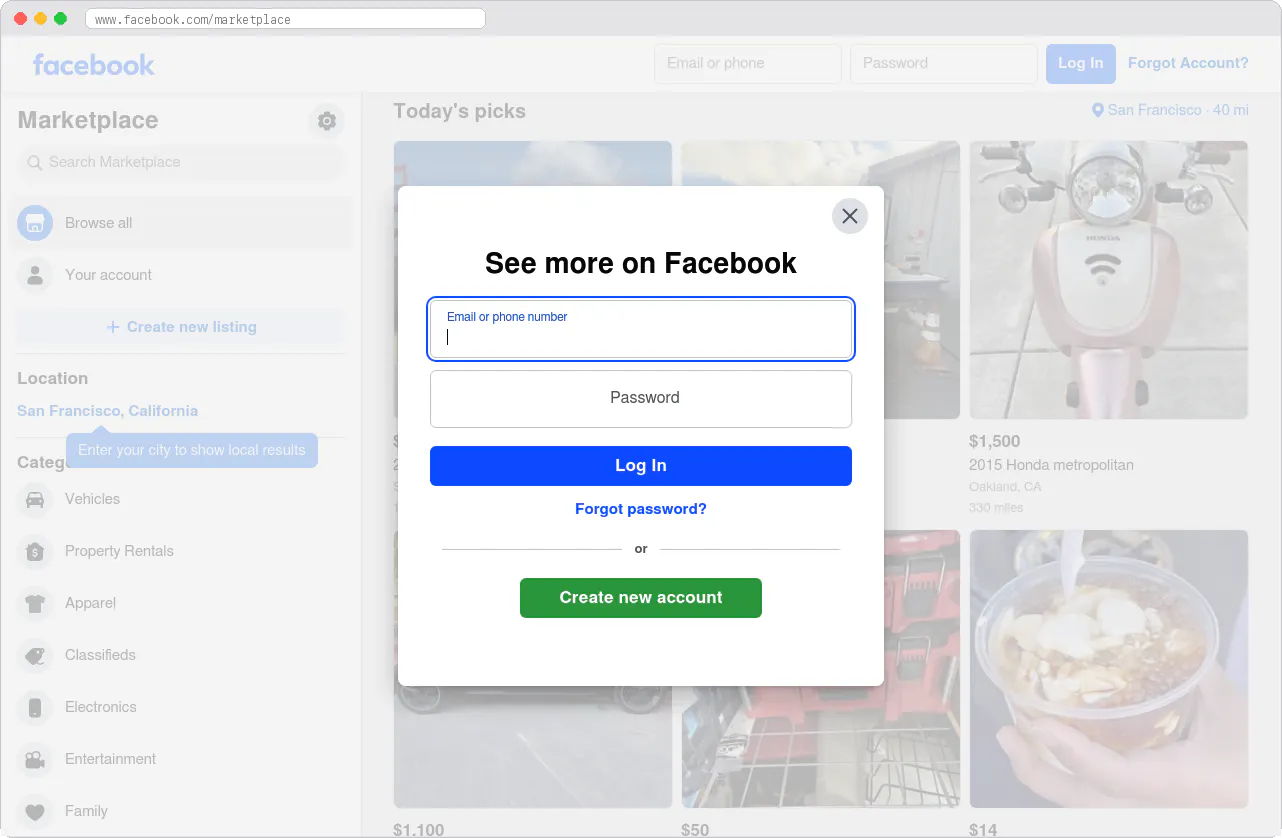
Facebook Marketplace uses existing social graphs (mutual friends, profile history, account age) as a built-in trust layer that OLX has to build from scratch. That social trust reduces fear of scams for a lot of casual users. But Marketplace is bolted onto a general social app, listings compete for attention with a news feed, and its algorithm doesn't reward the kind of structured, searchable browsing that dedicated classifieds users want. That gap is why category-specific or verification-heavy classifieds apps still find room to grow even where Marketplace dominates by volume.
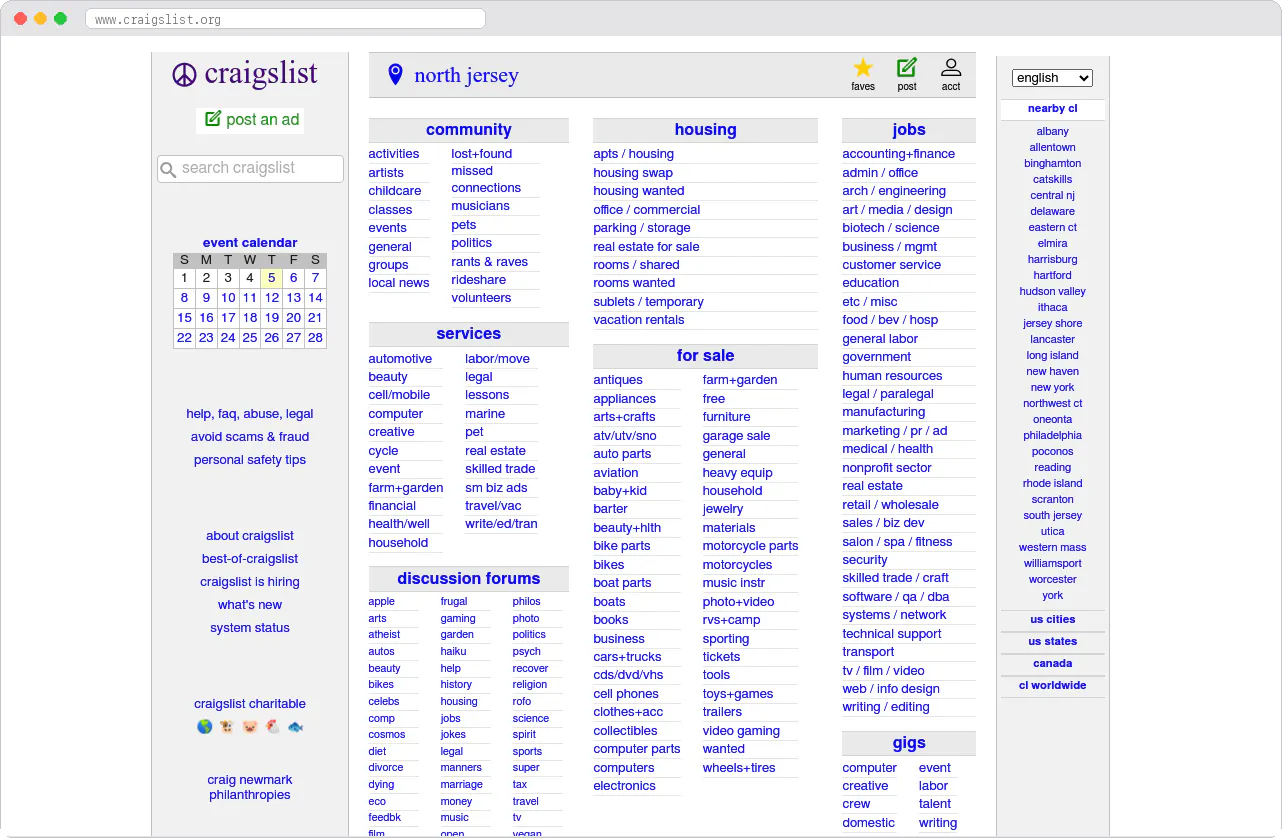
Craigslist still leads in many US metros purely on habit, simplicity, and zero-friction browsing without an account. It loads fast, works on any device, and has almost no monetization pressure, so listings feel unfiltered and abundant. Its weaknesses are equally well known: minimal photo support, no built-in messaging privacy, no verification, and a design that hasn't meaningfully changed in two decades. Fraud and low-effort spam are common complaints. That combination of high habit and low trust infrastructure is precisely the opening that mobile-first, verification-forward apps have used to peel off users city by city.
OfferUp built a mobile-native experience with in-app rating systems and a lightweight identity verification feature ("TruYou") aimed at reducing no-shows and scams for in-person meetups. It has strong traction in the US, particularly for cars and household items. Its venture-backed growth incentives, though, have pushed it toward more monetization (promoted listings, shipping options) faster than some local sellers want, and its footprint outside the US is limited, leaving most non-US local markets open.
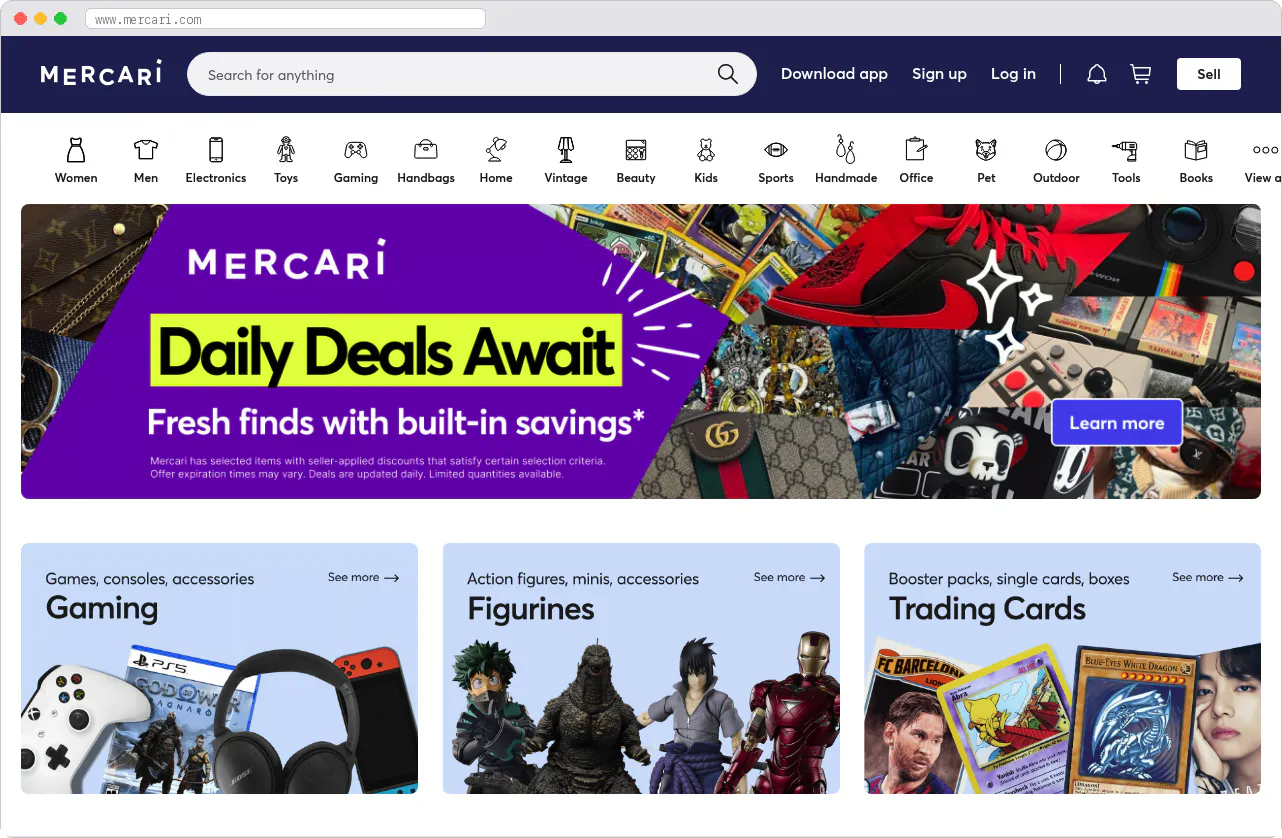
Mercari blends classifieds-style listing with built-in shipping and payment processing, which expands the buyer pool beyond a seller's own city and lets Mercari take an actual commission rather than relying on promoted-listing fees. That's a meaningfully different business model from OLX's local, cash-based approach. The tradeoff is that shipping adds packaging effort, cost, and wait time that many casual local sellers, the kind OLX serves, would rather avoid entirely.
Local Facebook Groups and neighborhood apps (Nextdoor, buy-nothing groups) represent informal but real competition. They benefit from tight community norms and organic moderation but lack dedicated search, filtering, or listing structure, meaning good items get buried in a chronological feed within days. A purpose-built local marketplace app can capture users who've outgrown the limits of a Facebook group but still want that neighborhood-level trust.
How to build a marketplace like OLX
1. Define your niche within OLX's category
OLX-style, general local classifieds is an extremely hard category to enter head-on today, because network effects favor whoever already has listing density in your city. The realistic opening is narrower: a specific category (used baby gear, farm equipment, industrial tools, luxury fashion resale), a specific geography (a mid-sized city or region that big platforms serve poorly), or a specific trust model (verified-only sellers, local pickup only, cash-free transactions). Pick one axis and be genuinely better on it, rather than trying to out-OLX OLX on breadth.
2. Validate demand before you build anything
Look at what people already use to buy and sell in your target niche or city, and where the friction shows up. Search Google Trends for "buy used [category] [city]" style queries, browse local Facebook groups for your category to see posting frequency and response speed, and talk to 15 to 20 potential sellers about what stops them from listing more often. If existing options already work well for your target users, you need a very specific wedge to justify a new platform.
3. Map your core transaction flow
Decide, concretely, what happens between "buyer finds listing" and "deal is done." Do you support in-app payment and escrow, or keep it fully offline and cash-based like OLX? Do you require any identity verification before someone can list or message? Do you support delivery or pickup only? These decisions shape everything downstream, from your trust and safety needs to your technology choice, so nail them before writing a line of code or picking a builder.
4. Choose your development approach
Vibe coding from scratch. AI tools like Cursor, Lovable, and Bolt can produce a working OLX-style prototype, complete with listing pages, search, and a basic chat UI, in a weekend. For pressure-testing a concept or showing early users a clickable demo, that's genuinely useful. For launching a platform that will eventually handle payment details, personal contact information, and in-person meetups between strangers, it's probably not sufficient on its own. What vibe-coded outputs reliably don't produce is the infrastructure underneath: payment escrow, dispute resolution, fraud detection, and compliance. A documented Sharetribe experiment ran 60+ hours to reach demo quality but revealed a critical checkout exploit that would have let any user manipulate transaction prices via a direct API call. Bringing that output to production standard takes significant additional time, testing, and a clear understanding of how the pieces of a web application fit together. Treat it as a prototyping tool, not a cost-effective path to launch.
Custom development from scratch. Hiring developers gives you full control over every feature. For an OLX-style classifieds marketplace, a simple MVP (listings, location search, messaging, no built-in payments) sits in the Tier 1 range: $30,000 to $80,000 over 8 to 20 weeks. Add reviews, identity verification, escrow-based payments, or a dispute flow, and you move into Tier 2: $80,000 to $200,000 over 16 to 28 weeks (Codica, RaftLabs). The low end of each range assumes offshore development teams at $15 to $40 an hour; US or Western European teams push you toward the top of the range or beyond. Custom development from scratch makes sense when your transaction model or trust requirements genuinely can't be met by existing marketplace software.
Building on a marketplace operating system like Sharetribe. You start at roughly 90% done on the standard marketplace foundation: user accounts, listing management, search, messaging, transaction flows, and payment infrastructure. Your time and budget go toward what makes your classifieds niche distinct. Three paths within this approach:
- No-code builder. Configure category-specific listing fields, location-based search, and your messaging and transaction flow entirely from the Console. This gets a classifieds-style marketplace, complete with custom categories and filters, live in days, not months.
- AI-assisted development. Connect Claude Code, Cursor, or Codex to Sharetribe's open APIs and open-source template to build things like custom category-specific search filters, an image-recognition-assisted listing flow, or a review system tailored to your niche. Because Sharetribe already handles payment infrastructure, this carries much lower risk than building the same features from scratch.
- Custom code. Build directly on the developer platform for deeper integrations (e.g., a verification API for high-value categories), or hire a specialist from Sharetribe's Expert Marketplace.
Most founders start with the no-code builder, launch, and add AI-assisted or developer-built features once real user behavior tells them what's actually missing.
5. Solve the cold start problem
A classifieds marketplace with no listings has nothing for buyers to find, and sellers won't list on a platform with no buyer traffic. OLX solved this early on by expanding into markets with weak or fragmented incumbent classifieds (often replacing print classifieds directly) and by keeping listing entirely free, which removed all downside for a seller trying the platform. New entrants have three practical tactics available. First, go supply-first: manually list items yourself, recruit friends and family, or partner with consignment shops, estate sale companies, or rental businesses with end-of-life inventory to seed real listings before any marketing to buyers. Second, concentrate geographically and by category rather than spreading thin. Fifty dense listings in one category in one neighborhood beat five listings each across ten categories citywide, because buyers judge a marketplace by whether they find what they want, not by total listing count. Third, consider manual matching in the earliest weeks: personally connect a buyer who asks about an item type with a seller you know has one, even if it means acting as a human recommendation engine before your search and filtering do that work automatically.
6. Launch to a tightly defined first market
Launch small on purpose. Pick one city, one neighborhood, or one category, and get it dense before expanding. Recruit your first fifty to one hundred sellers manually if you have to, through local Facebook groups, community boards, or direct outreach. Watch how real users create listings and message each other, and fix the friction you observe rather than the friction you assumed would exist. A tight, dense, working local market beats a thin national footprint every time in classifieds, because liquidity, not reach, is what makes a marketplace usable.
7. Layer in monetization once liquidity exists
Don't charge for listings or promotion until you have enough buyer traffic that promoted listings visibly produce faster sales. Introducing paid promotion too early, before you have real search volume, just tells sellers your platform doesn't work yet. Once you're seeing consistent repeat buyer traffic in your core categories, introduce promoted listings, then layer in advertising or professional seller subscriptions as volume grows.
Do you need to build everything OLX has?
No. OLX's current feature set, dozens of localized listing templates, in-house fraud detection models, dealer-specific dashboards, is the product of nearly two decades and dozens of country-specific teams. None of that is required to launch. What's essential at day one is a working listing flow, location-based search, and messaging, the same three functions OLX itself launched with in 2006.
The temptation to "just vibe-code a clone" deserves a direct answer: it's slower than it looks, not faster. AI tools can generate a convincing front end quickly, but a classifieds marketplace still needs to handle personal contact information, in-person meeting arrangements, and eventually payment or escrow features as you grow, all of which require security work that a generated prototype doesn't include by default. Starting on a marketplace operating system means your payment, account, and compliance foundation already exists and is already tested, so your AI usage or developer budget goes entirely toward the category-specific features that actually differentiate your marketplace, not toward rebuilding infrastructure OLX solved years ago.
Trust and safety for an OLX-type marketplace
Classifieds marketplaces carry a specific risk profile: strangers meeting in person to exchange cash for goods that were only seen in photos. The main risks are item misrepresentation (photos that don't match the actual condition), payment scams (fake cashier's checks, requests to pay before meeting), and physical safety during in-person meetups, plus lower-stakes issues like spam listings and duplicate posting.
Standard mitigations in this space include phone number verification before a user can list or message, contact masking so phone numbers and emails stay private until users choose to share them, in-app reporting on both listings and users, and public meetup location suggestions (police station parking lots, well-lit public spaces) that many classifieds apps now recommend directly in the app. Sharetribe provides the account and transaction infrastructure this sits on top of: user accounts with optional identity verification, secure messaging, and a transaction engine that can support escrow-style payment holds if you decide to process payment in-app rather than leaving it fully offline like OLX. What founders still need to add themselves are category-specific moderation rules (banned items, required disclosures for vehicles or real estate) and a clear, visible reporting and enforcement process, since no off-the-shelf system can predict exactly what fraud will look like in your specific niche.
Running a marketplace like OLX
Day-to-day operations for a classifieds marketplace center on content moderation (removing prohibited or fraudulent listings), customer support for disputes and reports, and ongoing category and search tuning as your listing mix evolves. At OLX's scale, this involves dedicated trust and safety teams, machine learning models that flag suspicious listings automatically, and localized policy teams per country. None of that is necessary at launch.
Sharetribe handles hosting, uptime, payment processing infrastructure, and platform-level security updates automatically, so your operational focus in the early months stays on moderation and support rather than infrastructure maintenance. As you grow past a few hundred active listings, budget for at least part-time human moderation and support; most founders find that a single dedicated person can manage this until the marketplace reaches several thousand active users.
Development costs and timeline
Three realistic scenarios:
Vibe coding from scratch: Free or very cheap to start. A working OLX-style prototype, listings, search, a chat UI, is buildable in a weekend with AI coding tools. What you can't get from here is a production-ready platform: secure payment handling, contact-masking that actually protects user privacy, fraud detection, and moderation tooling all require work that AI coding tools don't shortcut. A documented Sharetribe experiment logged 60+ hours to reach demo quality and still found a critical checkout exploit that would have let users manipulate prices directly through the API. Useful as a proof-of-concept tool, not a cost-effective path to a live business.
Custom development from scratch: A simple OLX-style MVP, listings, location search, messaging, no in-app payments, sits in Tier 1: $30,000 to $80,000 over 8 to 20 weeks. Add reviews, verified accounts, in-app escrow payments, and a formal dispute process, and you're in Tier 2: $80,000 to $200,000 over 16 to 28 weeks (Codica, RaftLabs). Classifieds rarely needs Tier 3 complexity (real-time logistics, native driver-matching) unless you're layering in delivery logistics on top of listings. The low end of each range assumes offshore teams; US or Western European agencies push costs toward the top or beyond. Ongoing maintenance typically runs 15% to 25% of the original build cost per year. This path makes sense once you have specific requirements, a proprietary matching algorithm, a novel payment model, that no existing platform supports.
Building on Sharetribe: Before you launch, the Sharetribe Build plan costs just $39/month. To open to real users, you need the Live plan, which costs $199/month billed yearly ($259/month billed monthly). Both plans include 1 million usage credits per month. Sharetribe covers hosting, security, payment infrastructure, user accounts, messaging, and the core transaction engine that an OLX-style marketplace needs, all of it pre-built and tested. Most founders reach a live MVP in weeks, not months, and category-specific features (custom listing fields, specialized filters, review systems) get added afterward via the no-code builder, AI-assisted development, or a developer, scoped narrowly because the foundation is already there.
Why Sharetribe for building a marketplace like OLX
Sharetribe's transaction engine already supports the core mechanics an OLX-style marketplace needs: location-aware search and filtering, customizable listing fields for different product categories, built-in messaging with privacy controls, and user accounts that support optional verification. The Console lets you configure category-specific listing templates without code, the same problem OLX solved by building dozens of localized listing forms. If you later want in-app payments instead of OLX's fully offline cash model, Sharetribe's payment infrastructure (built on Stripe) supports that without a separate integration project. And because the foundation is already built and tested, your development budget, whether that's a no-code setup, AI-assisted customization, or a developer engagement, goes toward the category focus and local market fit that will actually determine whether your marketplace succeeds.
Frequently asked questions
How much does it cost to build a website like OLX?
It depends on your approach. A no-code foundation on Sharetribe starts at $39/month on the Build plan ($199/month billed yearly on the Live plan once you go live), a simple custom-built MVP runs $30,000 to $80,000, and a production-grade build with verification and escrow payments runs $80,000 to $200,000 (Codica). Most classifieds marketplaces don't need the highest complexity tier since they typically skip real-time logistics.
What are the essential features for an OLX-style marketplace?
You need location-based search and filtering, user-generated listings with photo uploads, in-app messaging with contact privacy, category-specific listing fields, and basic trust and safety tools like reporting and phone verification. Everything else, dealer dashboards, advanced fraud models, image recognition, can wait until after launch.
How does OLX make money if listing is free?
OLX earns revenue through paid listing promotion, display advertising sold to local businesses, and subscription packages for high-volume professional sellers like car dealers. Free listing drives the volume that makes promoted listings and advertising valuable in the first place.
Can I compete with OLX or Facebook Marketplace in my local market?
Yes, but not by copying their breadth. Successful new entrants pick a specific category, geography, or trust model that incumbents serve poorly and build density there before considering any expansion. Niche focus beats broad coverage in classifieds because liquidity, having enough listings and buyers in one place, matters more than total platform size.
Should my classifieds marketplace handle payments, or keep it offline like OLX?
Offline cash payment, OLX's original model, removes payment processing complexity but limits trust and makes disputes harder to resolve. In-app payment with escrow adds friction and a small fee but gives you dispute resolution power and a natural revenue stream through transaction fees. Many category-specific classifieds marketplaces now choose in-app payment specifically because it lets them charge commission instead of relying on promoted listings.
How long does it take to launch a marketplace like OLX?
With a no-code foundation, a basic version can go live in a few weeks. Custom development from scratch typically takes 8 to 28 weeks depending on complexity. Regardless of approach, building real liquidity, enough listings and buyers that transactions happen consistently, usually takes 6 to 18 months of focused effort after launch.
Start your 14-day free trial
Create a marketplace today!
- Launch quickly, without coding
- Extend infinitely
- Scale to any size
No credit card required