How to build a website like Craigslist
Learn how Craigslist's simple classified ad model generates hundreds of millions in revenue, and discover the step-by-step process to build your own local marketplace platform.
Published: Mar 5, 2026
Last updated: Sep 11, 2026
Craigslist runs on one of the internet's most deliberately bare-bones designs and still generates hundreds of millions of dollars a year. Craig Newmark started it in 1995 as an email list of San Francisco events, and it grew into the dominant local classifieds platform in the US, though its traffic and revenue have declined steadily in recent years amid competition from Facebook Marketplace and other apps (AIM Group).
Its success doesn't come from clever features. It comes from solving one problem well: connecting local buyers and sellers with minimal friction. Most tech companies chase growth through added complexity. Craigslist did the opposite, and it worked. For founders, that's the real lesson: you don't need venture funding or a slick app to build a durable marketplace business. You need to solve a real, local problem for real people.
What is Craigslist and how does it work?
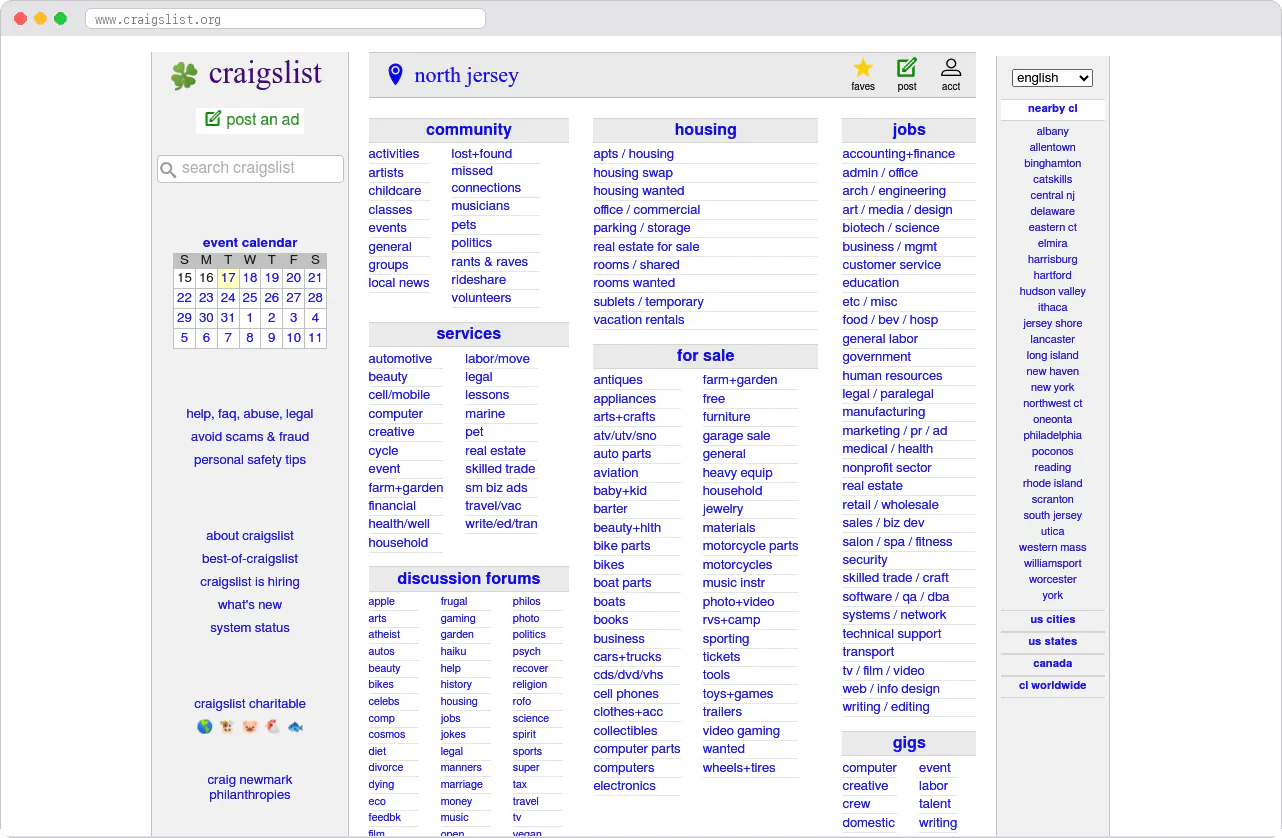
Craigslist is a two-sided classified advertising marketplace that connects local buyers and sellers across hundreds of geographic markets, from housing and jobs to used furniture and services. The platform helps people find and contact each other. It doesn't process payments, verify identities, or facilitate shipping. Everything after "first contact" happens off-platform, typically in cash, in person.
The user journey is intentionally minimal. Sellers post a free listing in a category-specific section. Buyers browse by location and category using basic search and filters. Contact happens through an anonymized email relay so neither party has to expose a real address until they choose to. The transaction itself, cash changing hands for a couch or a used bike, happens entirely off the platform.
Geography is the backbone of the business. Craigslist runs separate sites for more than 700 cities worldwide, and each one behaves like an independent local marketplace. A Chicago user sees Chicago listings by default. That hyperlocal segmentation is what gives Craigslist its defensibility: a competitor can't just build a better website, they have to win supply and demand city by city.
How Craigslist makes money
Craigslist earns most of its revenue from a small slice of paid listings while keeping the overwhelming majority of the platform free. Job postings are the main line: employers pay $75 to post in large metros like San Francisco, Los Angeles, and New York, and considerably less in smaller markets (OysterLink). Given the volume of job listings posted across hundreds of markets every month, this category makes up the largest share, about 35.6%, of Craigslist's roughly $302 million annual revenue (ResearchAndMarkets via Business Wire).
A second, smaller stream comes from apartment listings in New York City, where landlords and brokers pay $5 per rental posting, a fee unique to that market because of how competitive and broker-driven NYC rentals are. A handful of other categories, like certain therapeutic services listings in specific cities, also carry small fees, but these are minor relative to job postings.
Everything else, for sale items, most housing, services, community posts, remains free. That's deliberate. Free listings generate the inventory that draws buyers, and buyers are what make paid job postings valuable to employers. With fewer than 50 employees generating around $302 million a year, Craigslist is one of the most efficient businesses per employee in tech history, a direct result of avoiding payment processing, avoiding native apps, and running lean, low-maintenance infrastructure (ResearchAndMarkets, 2025 Craigslist Report).
What makes Craigslist work: key features
Hyperlocal market structure. Instead of one national listings pool, Craigslist runs a separate, self-contained site per city. This creates local network effects that are hard for a national competitor to break into all at once, because they need critical mass of both buyers and sellers in every single market.
Free-first posting. Nearly every listing category is free to post. That removes the biggest barrier to supply, sellers try it because it costs nothing, and the resulting inventory density is what pulls in buyers.
Deliberately minimal technology. Craigslist's plain HTML pages load fast, rarely break, and cost very little to run. That's not neglect, it's a strategic choice that keeps the company profitable while giving away most of its product for free.
Anonymous email relay. Buyers and sellers communicate through a masked email address, protecting privacy without requiring identity verification or a messaging app. It's a low-cost trust mechanism that fits a platform with no payment processing to protect.
Community self-moderation. Volunteer flagging and threshold-based removal handle a large share of spam and abuse, letting Craigslist run hundreds of markets without a large moderation staff.
Category structure that mirrors real life. Housing, jobs, for sale, services, community: the taxonomy has barely changed since the early 2000s because it maps directly onto how people already think about buying, selling, renting, and hiring.
Resistance to feature creep. No algorithmic feed, no native app for most of its history, no social layer. That restraint keeps the product simple to use and cheap to maintain, even as competitors pile on complexity.
The competitive landscape
Facebook Marketplace is Craigslist's biggest modern challenger. It uses Facebook's existing user base and real-name profiles to add a layer of social trust that Craigslist's anonymous model lacks, buyers can see mutual friends, profile history, and ratings. Its weakness is category coverage: Marketplace is built for physical goods and barely touches jobs, services, or housing, which leaves large parts of Craigslist's use case untouched. That gap is exactly where a focused classifieds competitor can still win, particularly in services or housing verticals Facebook has never prioritized.
OfferUp targets mobile-first local commerce with a more polished interface, in-app messaging, and ID-based verification. It also offers shipping for some categories, extending reach beyond local pickup. But OfferUp monetizes through promoted listings and fees, which makes it meaningfully more expensive for casual sellers than Craigslist's free model, an opening for any platform that keeps posting free and monetizes elsewhere.
Mercari focuses on nationwide shipping for used goods, with built-in payments and buyer protection, but charges a 10% seller fee plus payment processing. That fee structure works for small, shippable items but breaks down for anything bulky, local, or low-value, exactly the inventory that fills Craigslist's for-sale sections. It also does nothing for services, housing, or jobs.
Nextdoor verifies addresses and builds tight neighborhood networks, which creates more trust than Craigslist's anonymity but at the cost of scale, a Nextdoor marketplace only reaches your immediate neighborhood, not a full metro area. It's a strong model for hyperlocal trust, but a poor substitute for the inventory density Craigslist offers across an entire city.
Vertical specialists like Zillow (housing), Indeed (jobs), and AutoTrader (vehicles) out-execute Craigslist within a single category, offering richer search, professional listings, and better data. None of them replicate Craigslist's breadth, so users still juggle multiple apps to do what one Craigslist visit used to cover. That fragmentation is itself an opening: a well-run classifieds platform that's simply better organized than Craigslist within two or three adjacent categories, say, services and housing, can win users tired of switching apps.
How to build a marketplace like Craigslist
1. Define your niche within classifieds
You're not rebuilding Craigslist end to end. Pick the wedge: a single metro with weak local competition, a category Craigslist has never served well (skilled trades, pet services, equipment rental), or a community with its own norms (college towns, military bases, remote-work hubs). Trying to cover every category in every city on day one is how most classifieds clones die before they get traction.
2. Validate demand before you build
Look at what people already do to get around a classifieds gap: Facebook Groups, subreddits, WhatsApp chains, physical bulletin boards. Talk to local business owners who currently rely on word of mouth or paid ads. A simple landing page with a waitlist, or a manually run Google Form-based version of your idea, will tell you whether real supply and demand exist before you spend a dollar on development.
3. Choose your development approach
Vibe coding from scratch. AI tools like Cursor, Lovable, and Bolt can produce a working classifieds-style prototype quickly. For pressure-testing a concept or demonstrating it to early users, they're genuinely useful. For launching a platform that handles real contact information and, in many niches, real money between strangers, they're probably not sufficient. What vibe-coded outputs reliably don't produce is the infrastructure underneath: spam and fraud detection, dispute handling, content moderation workflows, and compliance around user data. A documented Sharetribe experiment ran 60+ hours to reach demo quality but revealed a critical checkout exploit that would have let any user manipulate prices via a direct API call. Bringing that kind of output to production standard takes real engineering time. A useful prototyping tool, not a cost-effective path to launch.
Custom development from scratch. Hiring developers gives you full control over every feature. For a classifieds-type marketplace, most builds land in the Tier 1 to Tier 2 range: a simple MVP with listings, search, and messaging runs $30,000–$80,000 over 8–20 weeks, while a version with reviews, identity verification, and dispute handling runs $80,000–$200,000 over 16–28 weeks (Codica, RaftLabs). Craigslist-style classifieds rarely need Tier 3 complexity (no real-time logistics or driver matching), unless you're adding shipping and in-app payments like Mercari or OfferUp, which pushes you toward escrow and identity verification and the higher end of Tier 2. The low end of each range assumes offshore teams at $15–40/hr; US or Western European teams push toward the top. Makes sense when your category has requirements no existing platform meets.
Building on a marketplace operating system like Sharetribe. You start at roughly 90% done on the standard marketplace foundation: user accounts, listing management, search, messaging, transaction flows, and payment infrastructure. Your time and budget go toward what makes your classifieds platform different from Craigslist. Three paths within this approach:
- No-code builder. Configure categories, location-based search, listing fields (mileage, square footage, job type), and posting flows directly in the Console, no code required. Most founders reach a live, local classifieds marketplace this way within weeks.
- AI-assisted development. Connect Claude Code, Cursor, or Codex to Sharetribe's open APIs and open-source template to build category-specific features Craigslist never had, like structured filters for services, saved search alerts, or a review layer for repeat sellers. Because Sharetribe already handles payments and compliance, this AI-assisted layer carries much lower risk than building the same feature from scratch.
- Custom code. Build directly on the developer platform for deeper integrations (shipping APIs, background check providers, custom moderation tooling), or hire from Sharetribe's Expert Marketplace.
Most founders start with the no-code builder, then add features via AI or a developer as they learn what their specific market actually needs.
4. Solve the cold start problem
Every classifieds marketplace faces the same chicken-and-egg problem: buyers won't show up to an empty listings page, and sellers won't post where there are no buyers. Craigslist solved this slowly, city by city, building word of mouth in the Bay Area for years before it expanded, and it never had to compete against an incumbent because none existed.
A new entrant today doesn't have that luxury of time, but has a sharper playbook. Seed supply manually before opening signups: personally recruit a few dozen sellers, landlords, or local service providers in your target city and post their listings yourself if needed. Focus on one narrow geography or niche community rather than launching broad, a single well-stocked neighborhood or college town beats a thin national footprint. Consider a supply-first incentive, free premium placement or featured listings for your first 100 sellers, to build inventory density fast enough that early buyers find something worth coming back for.
5. Build trust mechanisms Craigslist never needed
Craigslist survived for decades on anonymity and self-regulation, but that model carries real risk (scams, no-shows, unsafe meetups) that modern users are less tolerant of. Decide early what baseline trust features you'll offer: verified phone numbers, optional ID verification for higher-value categories, in-app messaging instead of raw email exchange, and a reporting flow that's actually monitored. You don't need Craigslist's tolerance for risk to compete with it.
6. Launch narrow and measure retention, not just signups
Open in one city or one category first. Track whether sellers who post once come back to post again, and whether buyers who browse once return within a week. High repeat usage in a small footprint is a far better signal than a large number of one-time visitors spread across five cities. Expand only once you see that local density and repeat behavior holding.
Do you need to build everything Craigslist has?
No. Craigslist's current footprint, hundreds of city sites, deep category coverage, decades of accumulated seller habits, took almost 30 years to build. At launch, you need a working version of the core loop: post a listing, browse listings, contact the other party. Search filters, saved alerts, promoted listings, and multi-market expansion can all come later, once you know which features your specific users actually want.
The instinct to "just vibe-code a Craigslist clone" is understandable given how fast AI tools can produce something that looks like a working marketplace. But looking like a marketplace and functioning safely as one are different problems. Starting on Sharetribe's foundation is faster even with AI tools in the mix, because the payment processing, user account system, and transaction logic are already built and tested. Your AI tokens go toward the categories, filters, and workflows that make your platform distinct, not toward reinventing checkout logic that a stranger could exploit.
Trust and safety for a Craigslist-type marketplace
Classifieds marketplaces carry a specific set of risks: scam listings, fake buyers who never show, unsafe in-person meetups, and (in categories like jobs or housing) outright fraud dressed up as a legitimate posting. Craigslist has historically handled almost none of this centrally, leaning on published safety guidance and community flagging instead. That approach kept costs near zero but also produced the platform's reputation for scams and, in rarer cases, real physical danger during in-person meetups.
A modern entrant can do meaningfully better without heavy overhead. Standard steps include phone verification at signup, optional government ID verification for higher-stakes categories like jobs or apartment rentals, in-app messaging that doesn't expose a personal number or email until both sides agree, and a reporting system that a real person actually reviews. Sharetribe provides user accounts with optional identity verification, secure payment flows with escrow-style holds, and structured transaction states out of the box, so you're not building fraud detection or payment security from a blank page. What you add on top is category-specific: ID checks for job postings, address verification for housing listings, or a review layer once repeat sellers show up.
Running a marketplace like Craigslist
Day-to-day operations for a classifieds platform center on three things: keeping listings fresh, keeping spam out, and keeping local supply and demand in rough balance. Craigslist manages this at massive scale with a tiny staff, largely through automation and community flagging built up over 30 years. You won't need that scale of infrastructure at launch, but you will need a working moderation queue, a way to expire stale listings, and a channel for users to report problems.
Sharetribe handles the technical backbone automatically: payments, listing storage, search indexing, messaging, and the underlying transaction states that track a listing from posted to sold. That leaves you free to focus on the operational work that actually differentiates a local marketplace: recruiting sellers, responding to reports quickly, and building the local reputation that makes people trust your platform over Craigslist out of habit.
Development costs and timeline
Three realistic scenarios:
Vibe coding from scratch: Free or very cheap to start. A working classifieds-style prototype, listings, search, a contact form, is buildable in a day or two with AI tools. What you can't get from here is a production-ready platform: spam and fraud filtering, secure messaging that doesn't leak contact details, moderation workflows, and payment security if you add any paid features. A documented Sharetribe experiment logged 60+ hours to reach demo quality and still turned up a critical checkout exploit. A useful proof-of-concept tool, not a cost-effective path to a live business.
Custom development from scratch: Cost depends on complexity tier. A simple classifieds MVP with listings, category browsing, and messaging runs $30,000–$80,000 over 8–20 weeks. Add reviews, ID verification, and dispute handling, likely if you introduce paid categories or in-app payments, and you're at $80,000–$200,000 over 16–28 weeks (Codica, RaftLabs). Real-time logistics or native apps at scale would push you into the $150,000–$350,000+ range, though most classifieds platforms don't need that tier. The low end assumes offshore teams; US or Western European teams push toward the top. Ongoing maintenance typically runs 15–25% of the original build cost per year. Makes sense once you have requirements no existing platform can meet.
Building on Sharetribe: Before you launch, the Sharetribe Build plan costs just $39/month. To open to real users, you need the Live plan, which costs $199/month billed yearly ($259/month billed monthly). Both plans include 1 million usage credits per month. Sharetribe covers the transaction engine, user accounts, listing management, messaging, and payment processing a classifieds marketplace needs from day one. Most founders reach a live MVP in weeks rather than months, then add category-specific features like advanced filters or promoted listings through the no-code builder, AI-assisted development, or a developer as demand justifies it.
Why Sharetribe for building a marketplace like Craigslist
Sharetribe's transaction engine already handles the core loop a classifieds platform needs: post a listing, get discovered through search and filters, message the other party, and (if you choose to add it) process a payment securely. The category and attribute system supports Craigslist-style structures like housing, jobs, for-sale, and services out of the box, with custom fields for things like mileage or square footage configurable without code. Location-based search and filtering, the backbone of any hyperlocal marketplace, is a native part of the platform rather than something you'd need to build. And because payments, fraud protection, and compliance already exist in the foundation, your first development dollars go toward the local trust features and category depth that actually differentiate you from Craigslist, not toward rebuilding infrastructure Craigslist itself took years to get right.
Frequently asked questions
How does Craigslist make money?
Craigslist earns much of its revenue from job posting fees, which now range from $10 to $75 depending on the metro area, plus a small $5 apartment listing fee in Boston, Chicago, and New York City (Craigslist). Nearly every other category, including most for-sale and housing listings, stays free to sustain the inventory that draws buyers. This freemium structure lets Craigslist generate substantial annual revenue while operating with a remarkably small staff.
What is the Craigslist business model?
Craigslist runs a local classifieds marketplace on a freemium model: almost all posting is free, which builds massive local inventory and network effects, while a small set of categories (mainly jobs, plus NYC apartments) carry fees. It doesn't process payments or handle shipping, so transactions happen off-platform, usually in cash and in person.
How much does it cost to build a Craigslist clone?
A full-featured custom build typically costs $80,000 to $200,000 and takes 16 to 28 weeks if you include reviews, verification, and dispute handling, or $30,000 to $80,000 for a simpler MVP (Codica, RaftLabs). Building on Sharetribe costs just $39/month on the Build plan after a 14-day free trial (the Live plan for running your marketplace is $199/month billed yearly), letting you launch core functionality in weeks and add custom features once you have paying users.
Why is Craigslist so successful despite its basic design?
Craigslist wins through hyperlocal focus, free-first posting that builds massive supply, and deliberately minimal technology that keeps costs near zero. Its first-mover advantage in individual city markets, decades ago, created network effects that are still hard for new entrants to break directly.
What are the main competitors to Craigslist?
Facebook Marketplace is the largest direct competitor, using social trust signals Craigslist lacks. OfferUp and Mercari compete on mobile-first design and shipping respectively, while vertical platforms like Zillow and Indeed compete within single categories rather than across all of Craigslist's sections.
Can you still build a successful classifieds marketplace today?
Yes, but not by copying Craigslist's exact footprint. Opportunities exist in underserved geographic markets, categories Craigslist handles poorly (like verified local services), or niche communities where existing platforms don't fit local norms. Success depends on picking a narrow wedge and building density there before expanding.
Start your 14-day free trial
Create a marketplace today!
- Launch quickly, without coding
- Extend infinitely
- Scale to any size
No credit card required