How to build a website like Nextdoor (2026 guide)
Learn how Nextdoor's hyperlocal community marketplace works, generates revenue through advertising and business services, and discover the step-by-step process to build your own neighborhood-focused platform.
Published: Feb 21, 2026
Last updated: Sep 11, 2026
Nextdoor turned neighborhood gossip, lost-pet flyers, and word-of-mouth recommendations into a public company. It did this by solving a problem too small for Facebook and too local for Craigslist: getting verified neighbors to talk to each other, recommend businesses, and trade items within a trusted geographic boundary. If you're considering a hyperlocal platform of your own, whether general-purpose or focused on a niche Nextdoor doesn't serve well, this guide covers how the platform works, why it succeeded, and the practical steps to build something similar.
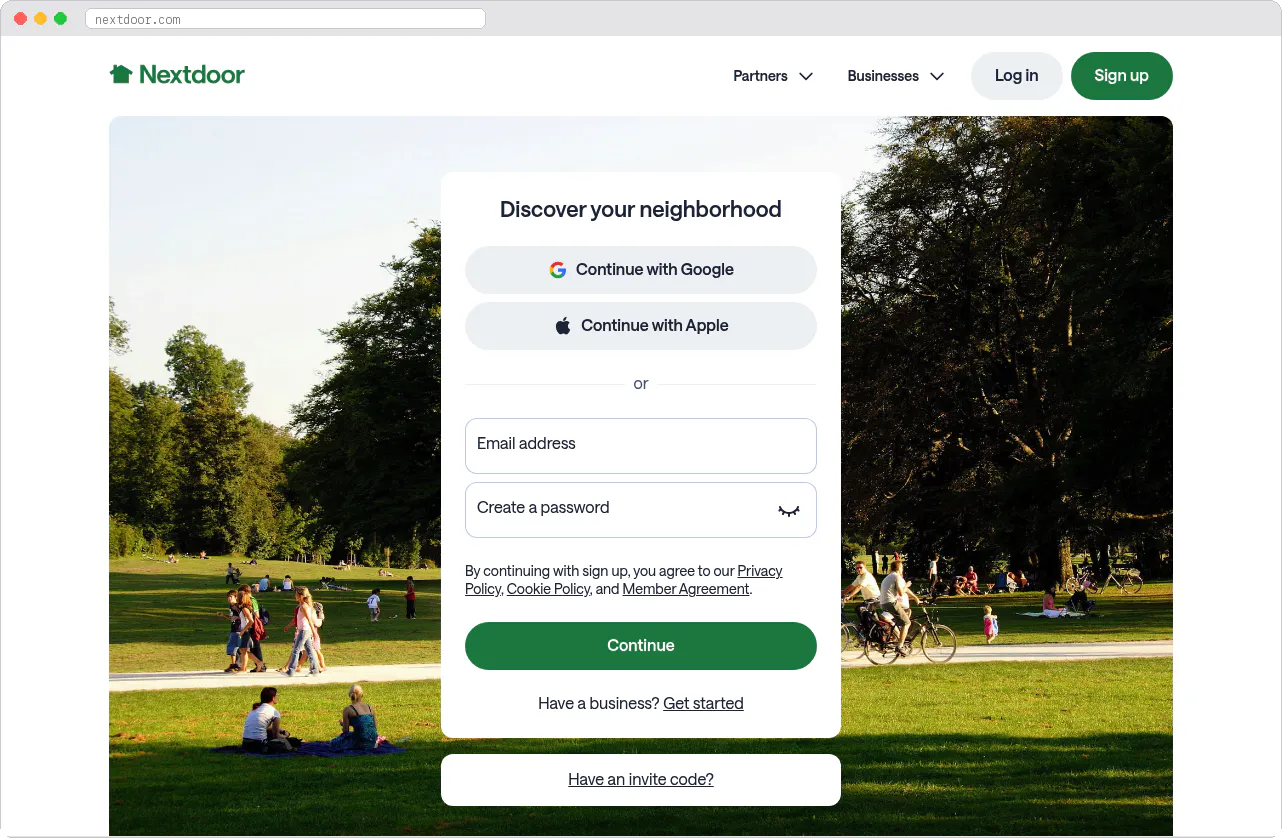
What is Nextdoor and how does it work?
Nextdoor is a hyperlocal social network that organizes users into private, address-verified neighborhood groups and layers marketplace, business discovery, and safety features on top. The platform operates in more than 315,000 neighborhoods across 11 countries and reported roughly 41.8 million weekly active users in the fourth quarter of its 2023 fiscal year (Nextdoor). It went public via SPAC merger in 2021 and now trades as a public company, giving outside observers unusually detailed visibility into its metrics compared to most social platforms.
The mechanics are simple but strict. A user signs up with their home address, verifies it through a mailed postcard, phone number match, or credit card billing address, and is placed into their specific neighborhood's private feed along with visibility into a handful of adjacent neighborhoods. From there, residents post recommendations, safety alerts, classifieds listings, and event invitations, while local businesses build profiles to get discovered by nearby customers. Unlike most marketplaces on this site, Nextdoor rarely touches money directly. It's a connection layer: the actual classifieds sale, the handyman booking, the babysitting arrangement, all happen offline, with cash, Venmo, or a separate booking tool. That distinction matters a lot for anyone planning to build something similar, and we'll come back to it.
How Nextdoor makes money
Nextdoor's revenue comes almost entirely from advertising and business subscriptions, not from taking a cut of transactions. The company reported $258 million in revenue for fiscal year 2025, up from $247.3 million in 2024, with the vast majority attributed to advertising products sold to small and medium businesses (Nextdoor). This is a meaningful structural choice: because Nextdoor doesn't process payments between users, it has no transaction volume to take a percentage of, so its entire business model had to be built around attention and local reach instead.
Local advertising is the primary line. Businesses, from national brands running geo-targeted campaigns to a local plumber promoting services within a five-mile radius, pay to appear in neighborhood feeds, either as sponsored posts or display placements. Nextdoor's pitch to advertisers is precision: an ad only reaches the specific neighborhoods where a business can realistically serve customers, which tends to produce better conversion than broad social or search advertising for hyperlocal service categories.
Nextdoor does not sell a single $30-$100 monthly subscription with lead management and analytics; instead, paid add-ons like Local Deals and Promoted Posts sit on top of the free Business Page, with realistic monthly spend running from about $100 to $300 for a small local campaign up to $500 to $1,500 or more for wider Promoted Posts reach, depending on features and market size (WilDi Maps). Sponsored content partnerships with larger brands (a home security company sponsoring safety-related posts, for example) round out the model, alongside smaller experiments in local deals and lead-generation fees for service categories like home improvement.
The absence of take-rate revenue is worth sitting with if you're modeling your own platform. Advertising models scale well once you have dense, engaged geographic coverage, but they require far more users per revenue dollar than a marketplace charging commission on transactions. If your hyperlocal idea includes actual bookings or payments (a local services marketplace, for instance), a commission or subscription model will likely get you to profitability with a much smaller user base than an ads-only approach.
What makes Nextdoor work: key features
Address verification as the trust foundation. Nextdoor's entire value proposition rests on knowing that the person posting a safety alert or recommending a contractor actually lives nearby. Verification through postcards, phone numbers, or billing addresses is deliberately multi-pronged, because any single method fails for some fraction of users (renters, new movers, apartment dwellers), and conversion depends on giving people more than one way through.
Geographic content boundaries with adjustable radius. Posts default to a tight neighborhood boundary, with an option to expand visibility to nearby areas. This keeps the feed relevant without making it claustrophobic, and it's core to why Nextdoor feels different from a Facebook Group, where geographic scope is loose or entirely absent.
Category-based posting. Safety alerts, classifieds, recommendations, lost-and-found, and general discussion are structurally separate, not just tagged. This matters because each category has different norms and different moderation needs; a lost-dog post and a for-sale couch post shouldn't compete for the same feed real estate.
Local business profiles with organic recommendation flow. Businesses don't just list themselves, they get recommended by neighbors inside ordinary posts, which carries far more weight than a star rating from a stranger. Nextdoor built formal business profiles around this organic behavior rather than replacing it.
Peer-to-peer classifieds inside a verified network. The for-sale-and-free section functions like Craigslist or Facebook Marketplace, but the address verification layer reduces no-shows and scam risk, since both parties know the other lives within a few miles.
Safety and moderation infrastructure. Given the personal nature of neighbor disputes, Nextdoor invests heavily in reporting tools, community guidelines enforcement, and (after well-documented controversy over racial profiling in early safety posts) explicit friction designed to slow down reactive, potentially discriminatory reports before they're published.
Daily-utility engagement loops. Recommendations, lost pets, package theft alerts, and local events give people a reason to open the app most days, not just when they have something to sell. This recurring utility is what separates Nextdoor's retention from typical classifieds apps, which see spiky, transaction-driven usage.
The competitive landscape
Nextdoor doesn't have a single direct clone competing for the same use case at scale, but it faces pressure from platforms that peel off specific slices of its behavior.
Ring Neighbors (Amazon) owns the safety and security use case, using Ring doorbell and camera footage to power crime and suspicious-activity alerts tied to a neighborhood map. It benefits from a huge existing hardware install base and real video evidence, which Nextdoor's text-based safety posts can't match. But Ring Neighbors doesn't attempt community discussion, classifieds, or business discovery, which leaves an opening for any platform that wants the fuller neighborhood-life use case rather than just security.
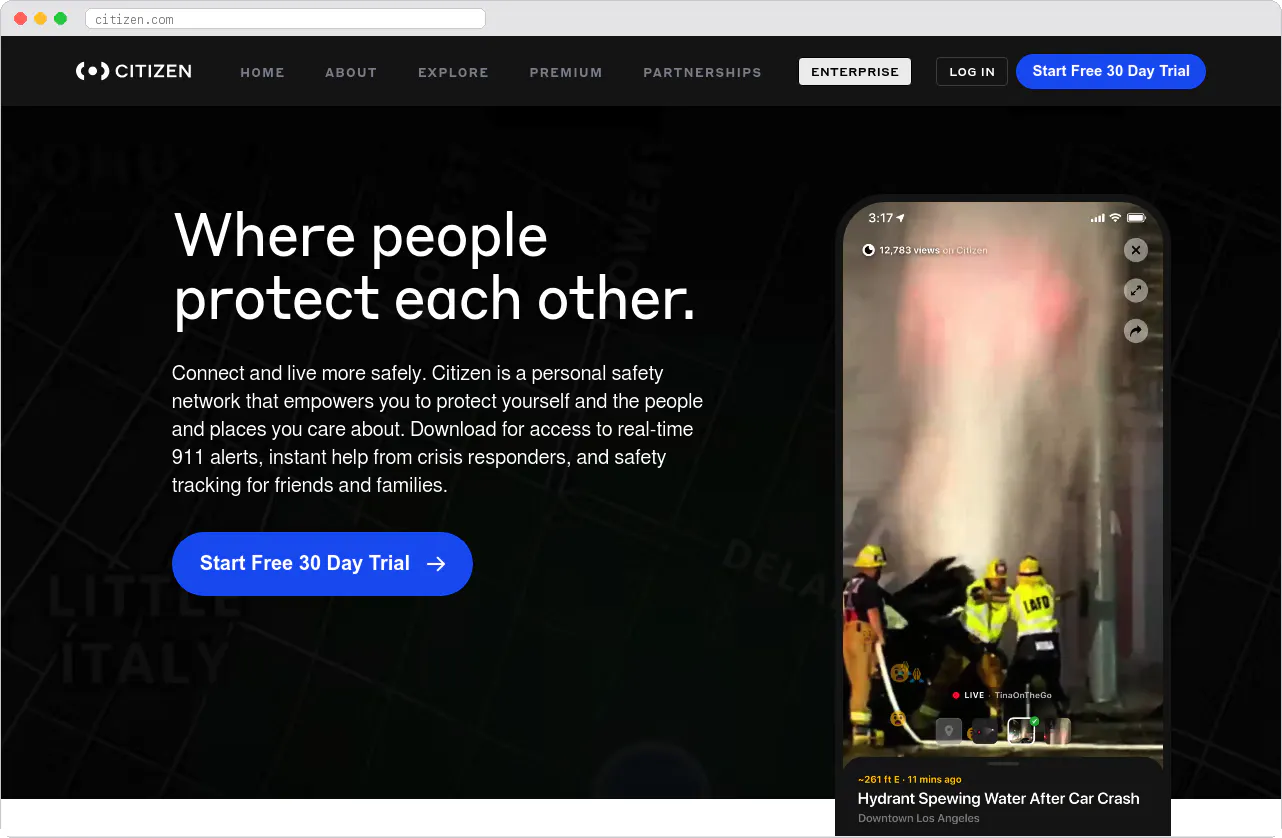
Citizen delivers real-time crime and emergency alerts sourced from 911 scanner data and user reports, with a focus on breaking incidents rather than ongoing community life. It's faster and more comprehensive on emergencies than Nextdoor, but it has no marketplace, no business directory, and no general discussion, so it functions as a narrow alert app rather than a community platform. A hyperlocal entrant that wants daily engagement beyond emergencies has room here.
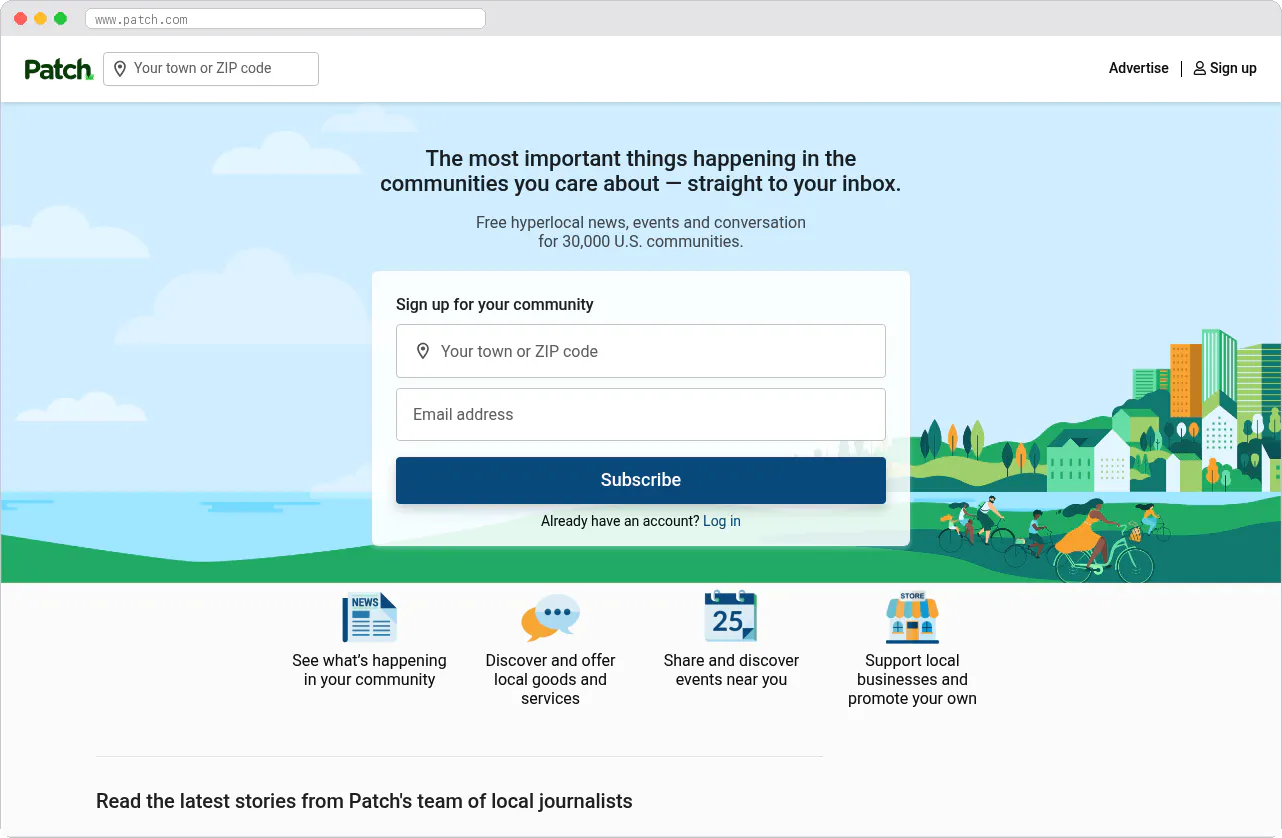
Patch runs local news and information sites for individual towns, staffed with some professional editorial content alongside community submissions. It predates Nextdoor's rise and has struggled with inconsistent local coverage and thinner community interaction, since it's structured more like a local newspaper than a peer network. Patch shows there's appetite for hyperlocal information, but its top-down editorial model hasn't produced the same engagement as Nextdoor's peer-to-peer format.
Facebook Groups and Marketplace offer neighborhood-adjacent functionality inside a much bigger platform, with local buy-and-sell groups and community pages that many people already use. The convenience of an existing account and network is real, but geographic boundaries in Facebook Groups are informal and easy to abuse (people join groups for towns they don't live in), and the broader Facebook feed constantly competes for attention. A platform with real address verification and no algorithmic noise can win users who are tired of loosely moderated Facebook groups.
WhatsApp and Telegram neighborhood groups are the low-tech default in many communities, offering privacy and immediacy without any platform overhead. They fall apart at scale, though: there's no structured search, no business directory, no classifieds workflow, and admin burden grows painfully as membership passes a few hundred people. This is arguably the most common "competitor" a new hyperlocal platform actually replaces, not Nextdoor itself.
Taken together, the opening isn't "build a better Nextdoor." It's building a focused hyperlocal platform for a use case Nextdoor serves loosely: a verified local services marketplace, a niche community (new parents, pet owners, sustainability-focused neighbors), or a platform for a region Nextdoor hasn't prioritized.
How to build a marketplace like Nextdoor
1. Define your niche within Nextdoor's category
Nextdoor tries to be the everything-app for a neighborhood: safety, classifieds, recommendations, events, all in one feed. That breadth is also its weakness, since none of those use cases get the depth a dedicated platform could give them. Pick one: a verified local services marketplace with actual booking and payment, a hyperlocal classifieds app for a specific city, a community platform for a narrow demographic (new homeowners, retirees, renters), or a niche vertical like local food swaps or tool lending. The narrower the focus, the easier the next several steps become.
2. Validate the local demand before building anything
Talk to actual residents in your target area before writing a spec. Find out how they currently coordinate: an active Facebook group, a defunct email listserv, a WhatsApp chain that's grown unwieldy. If a community already self-organizes around a specific need (tool sharing, babysitting co-ops, contractor recommendations), that's a strong signal and a ready-made seed audience. If there's no existing informal coordination at all, that's a warning sign that the need may not be strong enough to sustain a dedicated platform.
3. Decide whether transactions happen on-platform
This is the single biggest architectural decision, and it's specific to Nextdoor-style platforms. Nextdoor mostly facilitates connections and leaves payment offline, which simplifies compliance but caps monetization to advertising. If your niche involves actual bookings (a services marketplace, equipment rental, paid event tickets), you'll want built-in payments and a commission or subscription model, which changes your infrastructure needs substantially and points you toward a marketplace platform rather than a pure social app.
4. Choose your development approach
Vibe coding from scratch. AI tools like Cursor, Lovable, and Bolt can produce a working Nextdoor-style prototype quickly, complete with a feed, categories, and a basic map. For pressure-testing a concept or demoing it to a handful of neighbors, that's genuinely useful. For launching something that handles verified identities, private user data tied to home addresses, and potentially payments, it's probably not sufficient. What vibe-coded outputs reliably don't produce is the infrastructure underneath: secure verification workflows, fraud detection, dispute handling, and compliant data storage for location-tied personal information. A documented Sharetribe experiment ran 60+ hours to reach demo quality but revealed a critical checkout exploit that would have allowed price manipulation via a direct API call. Bringing the output to production standard takes significant additional time and a clear understanding of how the pieces fit together. It's a useful prototyping tool, not a cost-effective path to launch.
Custom development from scratch. Hiring developers, who will likely use AI heavily themselves, gives you full control over verification flows, moderation tooling, and data architecture. A Nextdoor-style platform with address verification, business profiles, reviews, and category-based discussion sits in the production-grade tier: $80,000 to $200,000 over 16 to 28 weeks (Codica, RaftLabs). If you add real transactions with escrow and dispute resolution, you're at the top of that range or beyond. The low end assumes offshore teams at $15 to $40 an hour; US or Western European teams push toward the top. This route makes sense if your verification requirements or community moderation model are genuinely unlike anything existing platforms support.
Building on a marketplace operating system like Sharetribe. You start at roughly 90% done on the standard foundation: user accounts, listing management, messaging, search, and (if your model needs it) built-in payments and transaction flows. Your time and budget go toward the Nextdoor-specific pieces: geographic boundaries, category structures, and business profile design.
- No-code builder. Configure listing types for classifieds and business profiles, set up geographic search and filtering, and launch a working local marketplace without writing code. This gets most founders to a live product fast.
- AI-assisted development. Connect Claude Code, Cursor, or Codex to Sharetribe's open APIs and open-source template to build custom features like address-based verification gating or neighborhood-boundary logic. Because Sharetribe already handles the payment infrastructure and core data flows, AI-assisted work on top of it carries far less risk than building the whole stack from scratch.
- Custom code. Build directly on the developer platform for deep custom logic (like postal-code-level verification tied to a third-party data provider), or hire a developer from Sharetribe's Expert Marketplace.
Most founders start with the no-code builder, launch in a single neighborhood or small city, and add verification and community features as they learn what residents actually use.
5. Solve the cold start problem
Hyperlocal platforms face a sharper version of the marketplace chicken-and-egg problem: a neighborhood feed with five people posting is useless, and nobody wants to be the first five. Nextdoor solved this in its early years with aggressive, unglamorous neighborhood-by-neighborhood seeding: their founding team and early employees personally recruited "neighborhood leads" in specific Bay Area zip codes, going door to door and running local events to get the first wave of verified users before opening up self-signup.
For a new entrant, three tactics work. First, go narrow: launch in a single neighborhood or apartment complex, not a whole city, so density is high enough to matter from day one. Second, recruit a handful of natural connectors first, homeowners' association board members, active parents, local business owners, and give them a reason to invite their existing networks. Third, seed content yourself before opening the doors: populate the feed with genuinely useful local information (permit rules, trash pickup schedules, nearby business hours) so the first real users don't arrive to an empty room. Launching small and tight beats launching broad and thin, because a hyperlocal platform's entire value proposition depends on density, not total reach.
6. Design verification and moderation before launch, not after
Decide your verification methods (postcard, phone, billing address) and your moderation escalation path before you have your first user, because retrofitting either after a conflict or fraud incident is far harder than building it in from the start. Draft community guidelines that explicitly address the categories most likely to cause friction: safety posts, business recommendations, and disputes between neighbors who will keep seeing each other in person.
7. Launch, iterate, and expand market by market
Treat each new neighborhood or city as its own launch, with its own seeding effort, not just a database entry. Track engagement density (posts per active user, not just total signups) as your key health metric, and hold off on expanding to a new area until your first one shows real daily usage. Geographic expansion for hyperlocal platforms is fundamentally a repeated go-to-market motion, not a technical toggle.
Do you need to build everything Nextdoor has?
No. Nextdoor's current feature set, safety alert categories, business lead management, sponsored content tools, and country-specific compliance across 11 markets, is the product of more than a decade and hundreds of millions of dollars in funding. At launch, you need address verification (even a simple version), a way to post and browse content by category, and basic messaging. Business profiles, formal review systems, and advertising tools can come after you've proven people actually want to use the platform daily.
The "I'll just vibe-code a clone" instinct is understandable given how capable AI tools have become, but it misunderstands where the real cost lives. The hard part of a Nextdoor-style platform isn't the feed UI, which AI tools handle reasonably well. It's the verification logic, the privacy-sensitive data handling around home addresses, and the moderation tooling for conflicts between people who live near each other. Starting on Sharetribe's foundation means that infrastructure work is already done, so your AI tokens and development time go toward the geographic and community features that actually differentiate your platform, not toward reproducing user accounts and messaging from zero.
Trust and safety for a Nextdoor-type marketplace
Address-tied identity is both the core trust mechanism and the core risk. Fake addresses, verification workarounds, and users who join neighborhoods they don't actually live in undermine the entire premise, so verification needs to be resistant to easy gaming while still being accessible to renters, new movers, and people in non-standard housing. Nextdoor's multi-method approach (postcard, phone, credit card) exists precisely because no single method clears everyone honestly.
Beyond identity, the biggest trust risk in this category is community conflict spilling into the platform: safety posts that veer into discrimination or profiling, disputes between neighbors that turn into harassment, and classifieds transactions gone wrong between people who now have to see each other at the mailbox. Sharetribe provides the account infrastructure, optional identity verification, messaging, and transaction flows (including payment escrow if your model includes actual bookings or sales) out of the box. What you'll need to add is the moderation policy layer specific to hyperlocal dynamics: clear guidelines on what counts as a legitimate safety post versus profiling, a reporting workflow that routes sensitive complaints to a human quickly, and, if you're operating at real scale, community moderators who understand local context rather than relying purely on automated filtering.
Running a marketplace like Nextdoor
Nextdoor's ongoing operations involve a large trust and safety team, per-market community management, advertiser sales and support, and continuous work on algorithmic feed ranking to keep content relevant without becoming noisy. That's a lot of headcount, and none of it is realistic for a founder launching their first neighborhood.
Early on, Sharetribe handles the operational load that would otherwise eat your time: payment processing and payouts (if you're running transactions), user account management, listing and search infrastructure, and the underlying security and compliance work. That leaves you free to focus on the parts only you can do: setting community norms, recruiting your first neighborhood leads, and deciding what content categories actually matter to your specific audience. As you grow past your first market, you'll add community moderation and local partnerships market by market, the same repeated motion Nextdoor used for its first decade.
Development costs and timeline
Three realistic scenarios:
Vibe coding from scratch: Free or very cheap to start. A working Nextdoor-style prototype, complete with a feed, categories, and basic maps, is buildable quickly with AI tools. What you can't get from here is a production-ready platform: secure address verification, privacy-compliant handling of location data tied to real identities, moderation tooling, and (if you add transactions) fraud-resistant payment flows all require work that AI coding tools don't shortcut. A documented Sharetribe experiment logged 60+ hours to reach demo quality and still found a critical payment vulnerability. A useful proof-of-concept tool, not a cost-effective path to a live business.
Custom development from scratch: Cost depends on complexity tier. A Nextdoor-style platform with address verification, categorized posting, business profiles, and a review system sits in the production-grade tier, $80,000 to $200,000 over 16 to 28 weeks (Codica, RaftLabs). Adding real payment transactions with escrow and dispute flows pushes toward the top of that range. The low end assumes offshore teams; US or Western European teams push toward the top. Ongoing maintenance typically runs 15 to 25% of the original build cost per year. This makes sense if your verification model or community structure is genuinely novel.
Building on Sharetribe: Before you launch, the Sharetribe Build plan costs just $39/month. To open to real users, you need the Live plan, which costs $199/month billed yearly ($259/month billed monthly). Both plans include 1 million usage credits per month. Sharetribe covers the standard marketplace foundation, user accounts, listings, messaging, search, and payments if your model needs them, so your build work focuses on geographic boundaries, category structures, and community-specific features. Most founders reach a live MVP in weeks rather than months, and custom features added via AI tools or a developer stay narrowly scoped because the core transaction and account engine is already built.
Why Sharetribe for building a marketplace like Nextdoor
Sharetribe's flexible data schema lets you define custom listing types for classifieds, business profiles, and service categories side by side, which matches Nextdoor's multi-category structure without forcing everything into a single generic listing template. Built-in messaging and user accounts cover the peer-to-peer communication that hyperlocal platforms depend on, while optional identity verification and payment flows give you a foundation for a services-and-payments model if you decide transactions should happen on-platform, unlike Nextdoor's mostly offline approach. Because the core infrastructure, payments, accounts, search, is already built and tested, your development effort concentrates on the geographic and community logic that actually makes your platform distinct.
Frequently asked questions
How does Nextdoor make money?
Nextdoor earns revenue almost entirely from advertising and business subscriptions rather than transaction fees, since most user-to-user interactions on the platform happen offline. Local businesses pay for Neighborhood Sponsorships and promoted deals, typically $32 to $150 or more a month depending on the zip code, while larger brands buy geo-targeted advertising placements in neighborhood feeds (Nextdoor advertising guide).
Can I build a Nextdoor-style app without coding?
Yes, for the core structure. A no-code marketplace platform like Sharetribe lets you set up geographic listings, categories, business profiles, and messaging without writing code, and you can launch in a single neighborhood within weeks. Advanced features like automated address verification against postal databases typically require some custom development or an AI-assisted build on top of the no-code foundation.
What's the difference between Nextdoor and Facebook Groups for neighborhoods?
Nextdoor enforces address verification and strict geographic boundaries, so users know they're interacting with actual nearby residents, while Facebook Groups for neighborhoods rely on self-reported location with no real verification. Nextdoor also structures content into dedicated categories (safety, classifieds, recommendations), whereas Facebook Groups mix everything into one chronological feed competing with the rest of the platform for attention.
How much does it cost to build a hyperlocal platform like Nextdoor?
A production-grade build with address verification, business profiles, and review systems typically costs $80,000 to $200,000 over 16 to 28 weeks if built from scratch (Codica). Building on a marketplace operating system like Sharetribe reduces upfront cost to a monthly subscription of $39/month while you build ($199/month billed yearly once you go live), with most founders reaching a live MVP in weeks.
How do you verify that users actually live in a neighborhood?
Common methods include mailed postcards with a verification code, phone number matching, and credit card billing address checks, and most platforms offer more than one method since no single approach works for every housing situation. Manual review is usually necessary for edge cases like apartment buildings, new developments, or shared addresses.
Is a hyperlocal social network a good business model?
It can be, but the economics differ sharply depending on whether transactions happen on-platform. Nextdoor's ad-and-subscription model requires very large user density to generate meaningful revenue, while a hyperlocal marketplace that processes actual bookings or sales can monetize through commissions with a much smaller, more engaged user base.
Start your 14-day free trial
Create a marketplace today!
- Launch quickly, without coding
- Extend infinitely
- Scale to any size
No credit card required