How to build a website like HelloTech
HelloTech connects customers with on-demand tech support professionals for device setup, troubleshooting, and installations. This guide shows you how to build a similar service marketplace, from validating your idea to launching and scaling your platform.
Published: Mar 22, 2024
Last updated: Mar 19, 2026
What is HelloTech and how does it work?
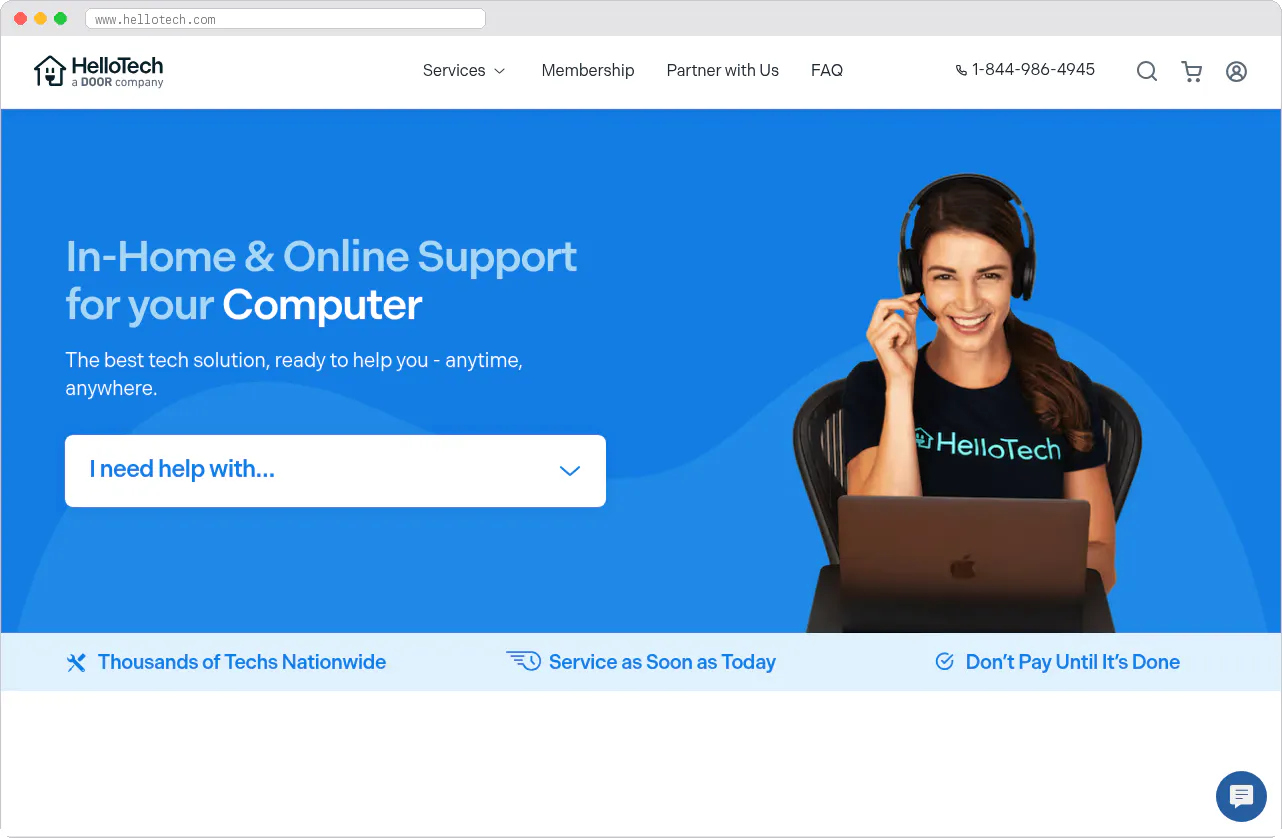
HelloTech is an on-demand service marketplace that connects customers with certified tech professionals who provide in-home technology support, installations, and troubleshooting. Founded in 2016 by Dan Tosca and previously known as HelloTech, the platform addresses a fundamental problem: while technology becomes increasingly complex, most people lack the technical expertise to set up, configure, or troubleshoot their devices effectively.
The marketplace serves both sides of the equation efficiently. For customers, HelloTech eliminates the frustration of technical difficulties by providing access to vetted professionals who can handle everything from smart home device installations to computer repairs, TV mounting, and Wi-Fi optimization. Customers book services through the platform, select their preferred time slot, and receive same-day or next-day service in most markets.
For service providers, HelloTech offers a consistent stream of customers without the overhead of traditional marketing. Technicians undergo background checks and skills assessments before joining the platform, and they handle a variety of technical services that can generate $50-150 per appointment depending on complexity and location.
HelloTech's success stems from solving a real pain point in the technology adoption cycle. As consumers increasingly invest in smart home devices, streaming services, and complex electronics, the gap between purchase and successful implementation has created a substantial market opportunity. The platform has processed hundreds of thousands of service requests across major metropolitan areas in the United States.
HelloTech's business model and revenue streams
HelloTech operates on a commission-based marketplace model, taking a percentage of each transaction between customers and service providers. The platform charges customers directly for services, with typical appointments ranging from $79 for basic troubleshooting to $300+ for complex installations involving multiple devices.
The company generates revenue through several channels. The primary stream comes from service fees, where HelloTech retains a portion of each booking while paying the remainder to the technician. Secondary revenue comes from partnerships with retailers and manufacturers who refer customers to HelloTech for post-purchase support, creating a recurring revenue stream from customers who purchase devices through partner channels.
HelloTech also benefits from the recurring nature of technology support. Many customers return for additional services as they acquire new devices or encounter new technical challenges. This repeat business pattern is particularly valuable because customer acquisition costs are amortized over multiple transactions.
The marketplace model allows HelloTech to scale without the overhead of employing technicians directly. Instead of managing payroll, benefits, and scheduling for hundreds of employees, the platform facilitates connections between independent contractors and customers, taking a commission for providing the infrastructure, vetting, insurance, and customer support.
Key features your tech support marketplace needs
Building a successful tech support marketplace like HelloTech requires specific functionality that addresses both the technical and trust challenges inherent in in-home service businesses. Unlike product marketplaces, service marketplaces must handle scheduling, location-based matching, skill verification, and safety concerns.
Service provider profiles and verification
Your marketplace needs comprehensive provider profiles that showcase skills, certifications, customer reviews, and background check status. HelloTech's success depends partly on customer confidence in the professionals entering their homes. Provider profiles should include photo identification, skill assessments, insurance verification, and detailed service histories. This information helps customers make informed decisions and builds trust in your platform.
Skill verification goes beyond simple self-reporting. Successful tech support marketplaces implement practical assessments where providers demonstrate competency with common devices and troubleshooting scenarios. Some platforms require industry certifications like CompTIA A+ or manufacturer-specific training credentials.
Location-based service matching
Unlike e-commerce platforms where products can ship anywhere, service marketplaces must match customers with providers in their geographic area. Your platform needs robust location-based search that considers factors like travel distance, provider availability, and service area coverage.
The matching algorithm should account for provider specializations as well as location. A customer needing smart home installation should connect with providers experienced in IoT devices, while someone with computer problems needs different expertise. Geographic boundaries are particularly important for service marketplaces because providers have limited daily capacity and travel time affects profitability.
Appointment scheduling and calendar management
Tech support services require precise scheduling coordination between customers and providers. Your marketplace needs real-time availability management that prevents double-bookings while offering customers convenient appointment slots.
Scheduling complexity increases when you consider service duration variability. A simple software installation might take 30 minutes, while a whole-home Wi-Fi setup could require 3-4 hours. Your platform should allow providers to block appropriate time slots based on service type and estimated duration.
Customers expect flexibility in scheduling, particularly for non-urgent services. Your platform should support same-day bookings for urgent issues while allowing advance scheduling for planned installations or upgrades.
In-app messaging and communication tools
Service marketplaces require more communication than product marketplaces because customers and providers must coordinate logistics, access requirements, and service specifications. Built-in messaging prevents communication from moving off-platform while creating a record of agreements and instructions.
Communication tools should support different message types including text, photos, and service confirmation details. Customers often need to share photos of their setup or error messages, while providers may need to send preparation instructions or arrival notifications.
Payment processing with escrow functionality
Tech support services typically require payment after completion, creating trust and quality concerns for both sides. Your marketplace needs payment processing that holds funds in escrow until service completion, protecting customers from poor service while ensuring providers get paid for completed work.
Escrow functionality becomes particularly important for higher-value services like whole-home installations that may cost several hundred dollars. Customers want assurance that payment won't be released until they're satisfied, while providers need confidence they'll be paid promptly for completed work.
Payment processing must also handle the complexity of service modifications. If a simple troubleshooting call escalates to hardware replacement, your platform needs mechanisms for adjusting charges and obtaining customer approval for additional work.
Review and rating systems
Two-way review systems are essential for service marketplaces because both service quality and customer behavior affect successful transactions. Customers review providers on technical competency, professionalism, and reliability, while providers can rate customers on communication, preparation, and payment promptness.
Review systems should capture specific aspects of service quality rather than just overall satisfaction. Categories might include technical expertise, communication, timeliness, and cleanliness. This granular feedback helps future customers understand provider strengths and helps providers improve their service delivery.
Insurance and liability management
In-home services create liability exposure that doesn't exist in product marketplaces. Your platform needs clear insurance requirements for providers, liability waivers for customers, and processes for handling property damage or injury claims.
Insurance verification should be automated where possible, with regular checks to ensure coverage remains active. Some marketplaces provide umbrella insurance policies that cover gaps in individual provider coverage, creating additional customer confidence.
Steps to build your tech support marketplace
Creating a successful service marketplace like HelloTech follows a specific sequence that balances speed to market with the complex trust and logistics requirements of in-home services.
1. Validate your market opportunity
Before building anything, validate that sufficient demand exists for tech support services in your target market. Research local competitors, survey potential customers about their technology pain points, and identify underserved niches within the broader tech support market.
Talk to both potential customers and service providers. Customers can tell you about frustrations with existing options, pricing sensitivity, and preferred service delivery methods. Service providers can explain current challenges in finding customers, pricing pressures, and operational pain points that your marketplace could solve.
Consider focusing on specific niches initially rather than trying to replicate HelloTech's full service range. Specializing in smart home installations, small business IT support, or senior-focused technology help can provide clearer positioning and easier provider recruitment.
2. Define your service offerings and pricing model
Decide which services your marketplace will support at launch. HelloTech offers dozens of service categories, but starting with 5-10 core services allows you to build expertise and refine your platform before expanding.
Common starting services include device setup, Wi-Fi troubleshooting, TV mounting, smart home installations, and computer maintenance. These services have clear scope boundaries, predictable duration, and strong customer demand across most markets.
Develop transparent pricing that customers can understand before booking. Fixed pricing for standard services reduces friction compared to hourly rates that create uncertainty about final costs. Consider offering service bundles that increase transaction value while providing customer value.
3. Build your minimum viable platform
Your initial platform needs core marketplace functionality without the complexity of advanced features you can add later. Focus on user registration, service provider profiles, basic scheduling, messaging, payment processing, and review systems.
Platforms like Sharetribe provide pre-built marketplace infrastructure that handles these essentials without custom development. You can launch a functional service marketplace in days rather than months, allowing you to test your concept with real users while iterating based on feedback.
Alternatively, you can combine no-code tools like booking software, payment processors, and communication platforms, though this approach requires more integration work and may create scalability challenges as you grow.
4. Recruit and vet your initial service providers
Service marketplace success depends on provider quality more than provider quantity. Start with a small group of highly qualified providers who can deliver exceptional service and generate positive reviews that attract additional customers.
Recruit providers through industry associations, competitor platforms, local electronics stores, and computer repair shops. Many technicians work part-time or freelance and are interested in additional customer sources.
Implement thorough vetting processes including background checks, skill assessments, reference checks, and insurance verification. Document these requirements clearly so providers understand expectations and customers feel confident about service quality.
5. Launch with a geographic focus
Launch in a single metropolitan area where you can provide dense provider coverage and responsive customer support. Geographic focus allows you to refine operations, build local brand recognition, and create network effects before expanding to new markets.
Choose your initial market based on demographics that align with tech support demand: higher household incomes, technology adoption rates, and populations comfortable with marketplace platforms. Suburban areas with many homeowners often provide strong demand for smart home and entertainment system installations.
6. Optimize operations based on real usage
Once you have regular bookings, analyze operational data to identify improvement opportunities. Common optimization areas include provider utilization rates, customer satisfaction scores, booking conversion rates, and repeat customer percentages.
Pay particular attention to service quality issues that could damage your marketplace reputation. In-home services create higher stakes than product purchases, so maintaining consistently positive experiences is critical for long-term success.
7. Scale to new services and markets
After achieving strong performance in your initial market and service categories, expand systematically to maintain service quality. Add new services that use your existing provider base, or enter new geographic markets with your proven service offerings.
Expansion requires maintaining the provider quality and customer experience that drove initial success. Rapid growth that compromises service quality can damage marketplace reputation and customer trust that takes months or years to rebuild.
Competitive landscape and market positioning
Understanding HelloTech's competitive environment helps identify market opportunities and positioning strategies for your own tech support marketplace.
Geek Squad represents the traditional tech support model with employed technicians working from physical retail locations. Best Buy's Geek Squad offers comprehensive device support but typically requires customers to bring devices to stores or schedule in-home visits at premium prices. The employed model provides consistent service quality but limits scheduling flexibility and increases costs compared to marketplace platforms.
TaskRabbit competes indirectly by offering tech support among dozens of other service categories. TaskRabbit's generalist approach means less specialized provider vetting and training compared to dedicated tech support platforms. Customers seeking complex technical services may prefer specialized platforms with providers who focus specifically on technology issues.
Puls operates a similar model to HelloTech, focusing on on-demand device repair and installation services. Puls emphasizes same-day service availability and operates in major metropolitan markets across the United States. The company differentiates through speed of service delivery rather than service breadth, positioning itself as the fastest option for urgent tech support needs.
Thumbtack provides a lead generation platform where customers post project details and receive bids from service providers. Thumbtack's model puts more effort on customers to evaluate proposals and manage provider communications compared to HelloTech's more curated experience. This approach works well for price-sensitive customers who want to compare multiple options.
Local computer repair shops remain significant competitors, particularly for complex troubleshooting and repair services. Many customers prefer established local businesses with physical locations, especially for valuable devices or sensitive data. However, local shops typically can't match marketplace platforms for convenience, scheduling flexibility, or service breadth.
Successful positioning against these competitors requires clear differentiation on factors like service quality, pricing, convenience, or specialization. HelloTech's focus on in-home service, vetted providers, and transparent pricing creates advantages over both traditional retailers and generalist marketplace platforms.
Technical implementation options
Building a service marketplace involves more complexity than simple e-commerce sites because of scheduling, location matching, and real-time communication requirements. Your implementation approach should balance development speed with scalability and customization needs.
Custom development provides maximum flexibility but requires significant time and budget investments. Full-stack marketplace development typically costs $50,000-200,000 depending on feature complexity and development team location. Custom development makes sense for well-funded startups with specific technical requirements that existing platforms don't support.
Custom development timelines typically span 4-8 months from initial planning to launch, not including ongoing maintenance and updates. This timeline assumes experienced developers familiar with marketplace architecture, payment processing, and mobile app development.
No-code marketplace platforms like Sharetribe provide pre-built marketplace infrastructure that handles core functionality without custom coding. This approach allows launching in weeks rather than months while maintaining professional appearance and functionality.
Sharetribe specifically supports service marketplace requirements including scheduling, location-based matching, escrow payments, and provider verification workflows. The platform handles complex payment processing through Stripe Connect, ensuring compliance with financial regulations while supporting commission-based revenue models.
No-code platforms provide customization options for branding, workflow modifications, and feature additions as your marketplace grows. You can add custom functionality through developer partners or internal technical resources when your business requirements exceed standard platform capabilities.
Hybrid approaches combine no-code foundations with custom development for specific features. This strategy provides faster initial launch while supporting unique functionality that differentiates your marketplace from competitors.
For example, you might launch with a standard marketplace platform and later add custom mobile apps, specialized scheduling algorithms, or integration with industry-specific tools that your service providers need.
Cost considerations and budget planning
Service marketplace costs extend beyond initial development to include ongoing operations, provider acquisition, and customer support that don't exist in product marketplaces.
Development costs vary significantly based on your technical approach. Custom development typically starts around $50,000 for basic functionality, while no-code platforms like Sharetribe allow launching for under $99-399/month. The cost difference reflects time-to-market and customization trade-offs rather than functional limitations.
No-code platforms include hosting, security, payments processing, and platform maintenance that would cost additional thousands monthly with custom development. When comparing options, consider total cost of ownership including ongoing technical maintenance.
Provider acquisition costs represent ongoing marketing investment to maintain adequate service capacity. Service marketplaces need active provider recruitment because individual providers have limited capacity compared to inventory-based businesses.
Budget for provider recruitment through online advertising, industry events, and referral programs. Successful service marketplaces typically spend 15-25% of revenue on provider acquisition and retention, higher than product marketplace customer acquisition costs.
Insurance and legal compliance create additional cost categories that don't exist in pure software businesses. General liability insurance, professional liability coverage, and legal compliance consulting add several thousand dollars annually to operating costs.
Some marketplace platforms provide insurance coordination or umbrella coverage that reduces individual provider insurance requirements. This service creates additional customer confidence while simplifying provider onboarding.
Customer support operations require more investment in service marketplaces because of scheduling coordination, service quality issues, and dispute resolution complexity. Budget for customer support staff who can handle booking modifications, provider communications, and service quality complaints.
Many service marketplace issues require real-time resolution rather than asynchronous email support. Consider support costs when planning your pricing model and commission structure.
How Sharetribe helps you build a tech support marketplace
Sharetribe addresses the specific challenges of building and operating service marketplaces through purpose-built functionality and integrations.
Pre-built service marketplace features include appointment scheduling, location-based provider matching, escrow payments, two-way messaging, and review systems. These features work together smoothly rather than requiring integration between multiple third-party tools.
Scheduling functionality supports variable service durations, provider availability management, and customer booking preferences. The system prevents double-bookings while maximizing provider utilization and customer satisfaction.
Payment processing integration through Stripe Connect handles the complexity of marketplace payments including commission collection, provider payouts, and escrow functionality. This integration ensures compliance with financial regulations while supporting your revenue model from day one.
Payment processing includes features specific to service marketplaces like tip handling, service modification billing, and dispute resolution workflows that are critical for customer and provider satisfaction.
Mobile-responsive design ensures your marketplace works effectively on smartphones and tablets, which many customers use for booking and communication. Service marketplaces particularly benefit from mobile optimization because customers often need services while away from computers.
Scalability and customization options allow adding custom functionality as your marketplace grows without rebuilding your entire platform. You can implement specialized provider verification processes, integration with scheduling tools, or custom mobile apps while maintaining your existing user base and data.
Sharetribe's developer platform supports custom feature development through APIs and webhooks, enabling integration with industry-specific tools or unique functionality that differentiates your marketplace.
Expert partner network provides access to experienced developers and agencies who specialize in marketplace customization. This resource helps you implement custom features or design modifications without hiring full-time technical staff.
Expert partners understand marketplace business models and can advise on feature prioritization, user experience optimization, and technical architecture decisions that affect long-term success.
Conclusion
Building a tech support marketplace like HelloTech addresses a growing market opportunity as technology complexity outpaces consumer technical expertise. Success requires balancing marketplace fundamentals like trust and quality control with service-specific challenges like scheduling and geographic logistics.
The most effective approach prioritizes speed to market over perfect functionality, allowing you to validate your concept and refine operations based on real customer and provider feedback. Platforms like Sharetribe enable launching quickly while maintaining the professional functionality needed for customer confidence and provider satisfaction.
Focus on service quality over service breadth initially, building reputation and operational expertise before expanding to new markets or service categories. The in-home service model creates higher customer expectations and lower tolerance for service issues compared to product marketplaces, making quality control your primary competitive advantage.
Remember that marketplace success comes from network effects between customers and providers rather than just platform functionality. Invest in provider recruitment and retention alongside customer acquisition, because provider capacity ultimately limits your marketplace growth potential.
Frequently asked questions
How much does it cost to build a website like HelloTech?
Costs vary by approach: no-code platforms like Sharetribe start at $99-399/month, while custom development typically costs $50,000-200,000. Consider ongoing costs for provider recruitment, insurance, and customer support when budgeting.
What features does a tech support marketplace need?
Essential features include provider profiles with verification, location-based matching, appointment scheduling, escrow payments, in-app messaging, and two-way review systems. Insurance integration and mobile optimization are also critical for success.
How do I find and vet tech support providers for my marketplace?
Recruit through industry associations, local computer shops, and competitor platforms. Implement background checks, skill assessments, insurance verification, and reference checks. Start with a small group of highly qualified providers to build reputation.
Can I compete with established players like HelloTech and Geek Squad?
Yes, by focusing on specific niches, geographic markets, or service improvements. Consider specializing in smart home installations, small business IT, or underserved demographics to differentiate from generalist competitors.
How long does it take to launch a tech support marketplace?
Timeline depends on your approach: no-code platforms allow launching in 1-2 weeks, while custom development takes 4-8 months. Focus on launching quickly with core features rather than building everything upfront.
What's the best business model for a tech support marketplace?
Commission-based models work best, taking 15-25% of each transaction. This aligns marketplace revenue with provider success while keeping barriers low for new providers. Consider fixed pricing for standard services to reduce customer uncertainty.
Start your 14-day free trial
Create a marketplace today!
- Launch quickly, without coding
- Extend infinitely
- Scale to any size
No credit card required