How to build a website like Getaround
Getaround transformed car sharing by connecting vehicle owners with renters through instant booking technology. This guide shows you how to build a similar peer-to-peer car rental marketplace, from validating your idea to launching a scalable platform.
Published: Mar 15, 2024
Last updated: Sep 18, 2026
What is Getaround and how does it work?
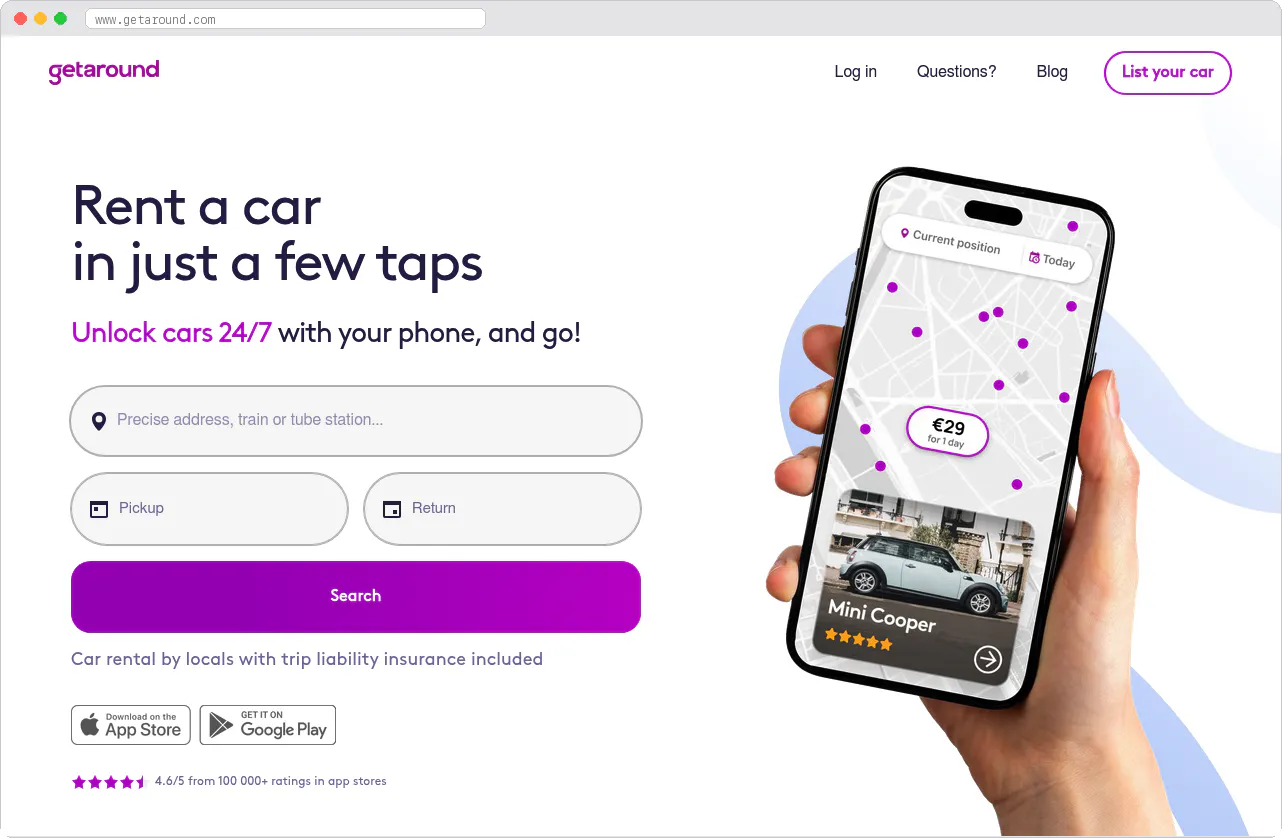
Getaround turns parked cars into rental income by connecting owners with nearby renters through a smartphone app. Sam Zaid, Jessica Scorpio, and Elliot Kroo founded the company in San Francisco in 2009, and its early breakthrough was "Getaround Connect," a hardware device that lets renters unlock and start a car without ever meeting the owner. That single innovation removed the biggest friction point in peer-to-peer car sharing: the awkward key handoff.
Getaround acquired Drivy, its French counterpart, in 2019, which gave it a foothold across several European markets. The company went public in December 2022 through a SPAC merger with InterPrivate II Acquisition Corp, but NYSE suspended and delisted its stock in mid-2024, and shares now trade over-the-counter under the ticker GETR (SEC filing). Getaround raised roughly $600 million in venture funding over its history, but the company shut down its U.S. car-sharing operations in February 2025 due to a liquidity crisis, later sold its European business, and is now being formally dissolved (TechCrunch).
The bigger opportunity Getaround points to is structural: a typical personal car sits parked and unused for roughly 95% of its life. Rising urban parking costs, growing environmental awareness, and shrinking car ownership among younger renters have all pushed the peer-to-peer car-sharing market toward wider adoption, and market researchers expect this global growth to continue over the next decade.
How Getaround makes money
Getaround's core revenue comes from commission on every rental. The platform charged a flat 40% commission on all trips regardless of length, not a tiered rate, and it wound down its U.S. car-sharing operations in February 2025, focusing now on Europe (Getaround investor release). That premium reflects what the fee actually covers: commercial insurance, the keyless hardware and connectivity, background checks, customer support, and payment processing for a transaction category with meaningfully higher risk than, say, a freelance gig or a rented power drill.
Beyond commission, Getaround layers on ancillary revenue: delivery fees when a host brings the car to the renter, late-return penalties, cleaning fees, and optional protection plan upgrades that renters can purchase for reduced liability. Hosts can also opt into "Getaround Connect" hardware installation, which the company subsidizes or charges for depending on the market.
The commission structure only works because Getaround absorbs the cost of underwriting risk at scale. A new entrant copying the same percentage without the same claims history, insurance partnerships, or fraud-detection systems will likely see a much worse loss ratio in year one. That's a real structural challenge worth planning around before you set your own take rate.
What makes Getaround work: key features
Keyless vehicle access. The Getaround Connect device is the platform's signature technology: GPS-enabled hardware installed in the host's car that lets a verified renter unlock and start the vehicle from the app, with no physical key exchange. It's expensive to build and install (hundreds of dollars per vehicle) but it's what makes instant, unattended bookings possible at scale.
Identity and driving record verification. Renters must submit a government ID, link a valid driver's license, and pass a driving record check going back several years before they can book. Getaround also uses selfie-based identity matching to confirm the person picking up the car is the verified account holder, not someone else using a shared login.
Bundled commercial insurance. Every trip is covered by primary commercial insurance arranged by Getaround, meaning claims are paid before the host's personal policy is ever touched. This single feature removes the biggest objection car owners have to listing a personal vehicle, and it's the piece a new entrant can least afford to skip or shortcut.
Location-based search and instant book. Renters search by proximity, vehicle type, and availability, and most listings support "instant book" so a renter doesn't have to wait for host approval. Search relevance and real-time availability accuracy directly affect conversion, since car sharing is often booked with short lead times.
Dynamic pricing guidance. Getaround suggests rates to hosts based on local demand, vehicle type, and competing listings nearby, similar in spirit to how short-term rental platforms guide host pricing. Hosts can accept the suggestion or override it.
Damage documentation workflows. Photos are captured before and after each trip, and Getaround uses automated comparison to flag new damage. This protects both parties and reduces the volume of disputed claims, which is critical in a category where the underlying asset is worth tens of thousands of dollars.
The competitive landscape
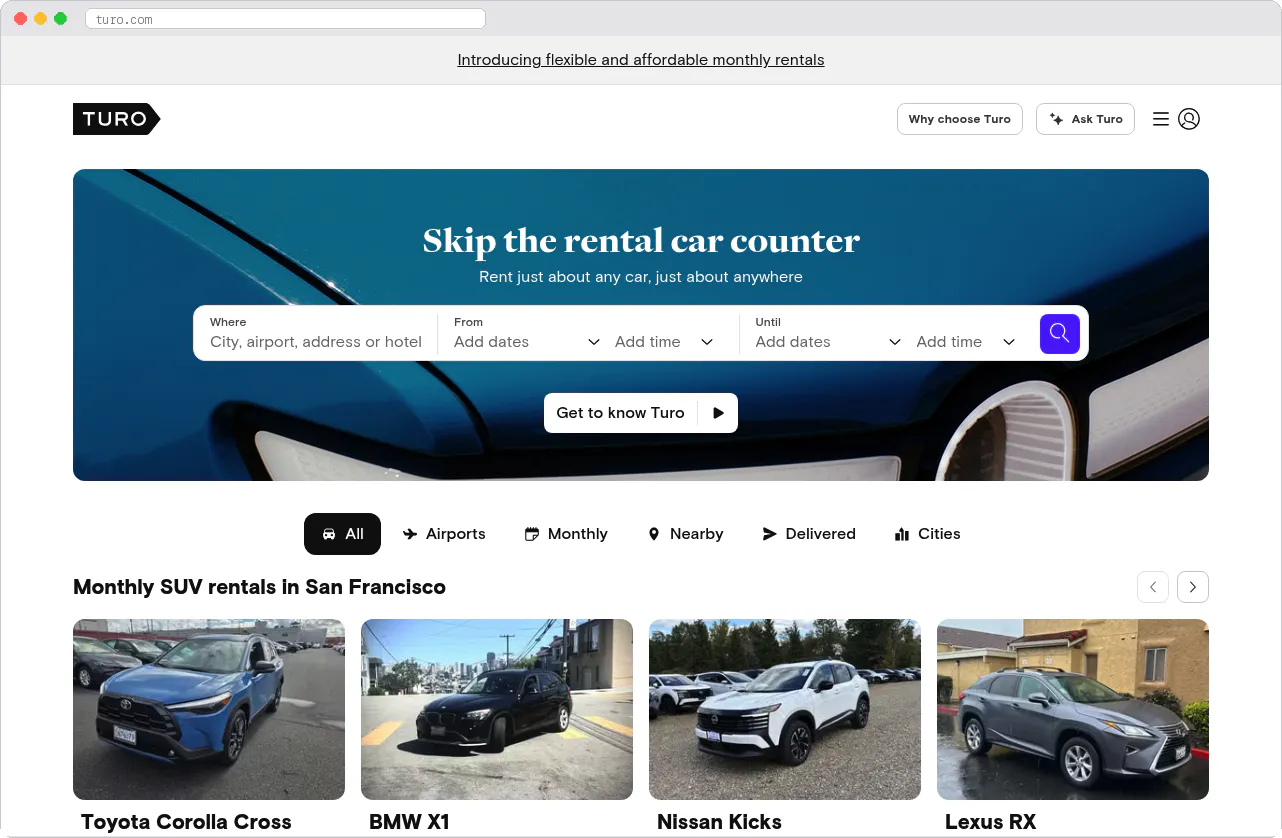
Turo is Getaround's closest direct competitor, but the two platforms have drifted toward different use cases. Turo skews toward multi-day trip rentals and positions itself as an alternative to airport car rental counters, with average bookings running three to four days versus Getaround's hourly, urban-utility focus (Turo). Turo has scaled further internationally, with a presence in the UK, Canada, Australia, and France, and filed for a US IPO in 2022 but withdrew those plans in February 2025, remaining private (TechCrunch). Turo's gap is the exact spot Getaround built its brand on: fast, keyless, hourly access for short local trips, which Turo still handles less smoothly in many markets since key exchange remains common there.
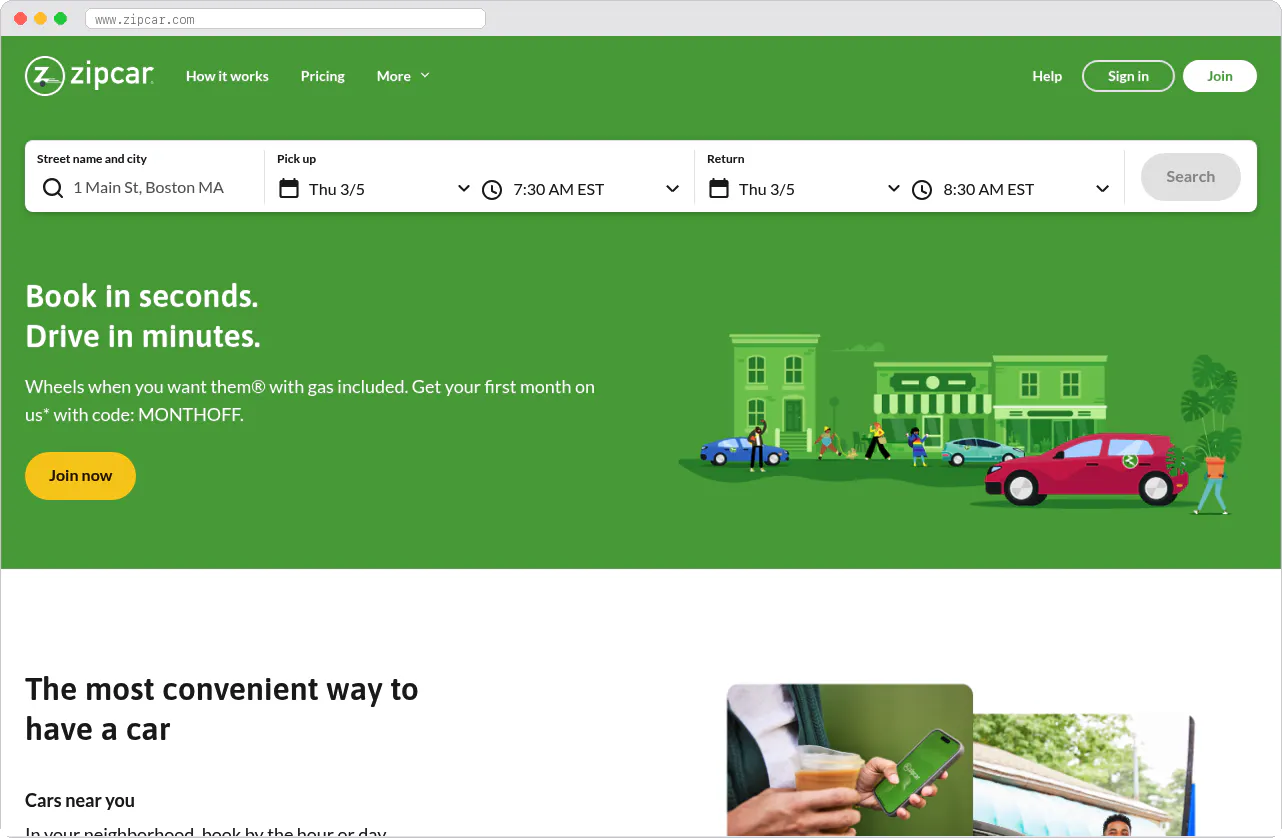
Zipcar, owned by Avis Budget Group, uses a completely different supply model: it owns or leases its own fleet and places cars in fixed spots around a city, charging membership plus hourly fees. This gives Zipcar predictable vehicle condition and availability, something peer-to-peer platforms can't fully promise, but it caps supply to whatever Zipcar itself can afford to buy and maintain, which limits how densely it can cover a market. That capital ceiling is exactly what opens space for peer-to-peer models: anyone with a spare car can add supply overnight, no fleet purchase required.
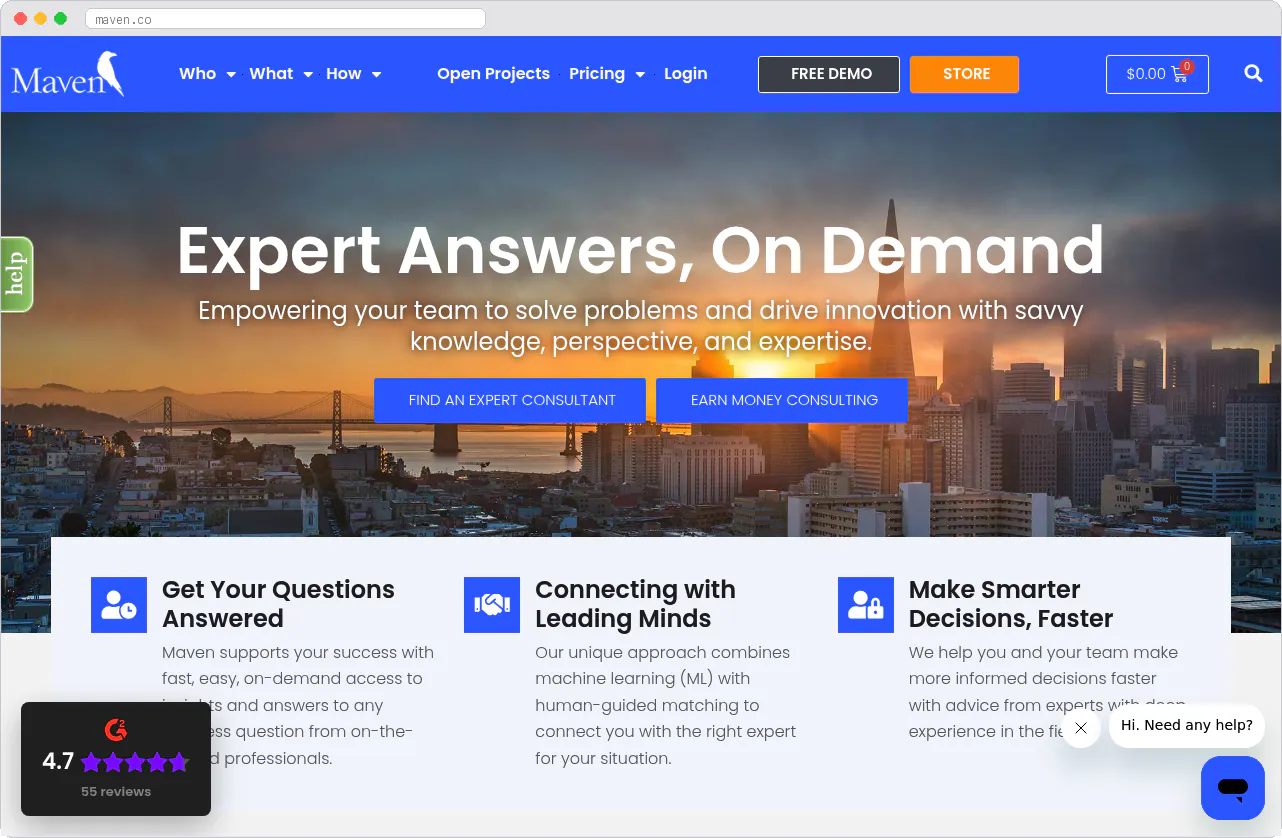
Maven, General Motors' fleet-based car-sharing service, launched in 2016 and shut down in 2020, unable to make the economics of owning and insuring a large fleet work at scale (CNBC). Maven's failure is a useful cautionary data point for anyone considering a company-owned fleet approach: high upfront vehicle cost plus insurance and depreciation is a tough combination to make profitable without extremely high utilization.
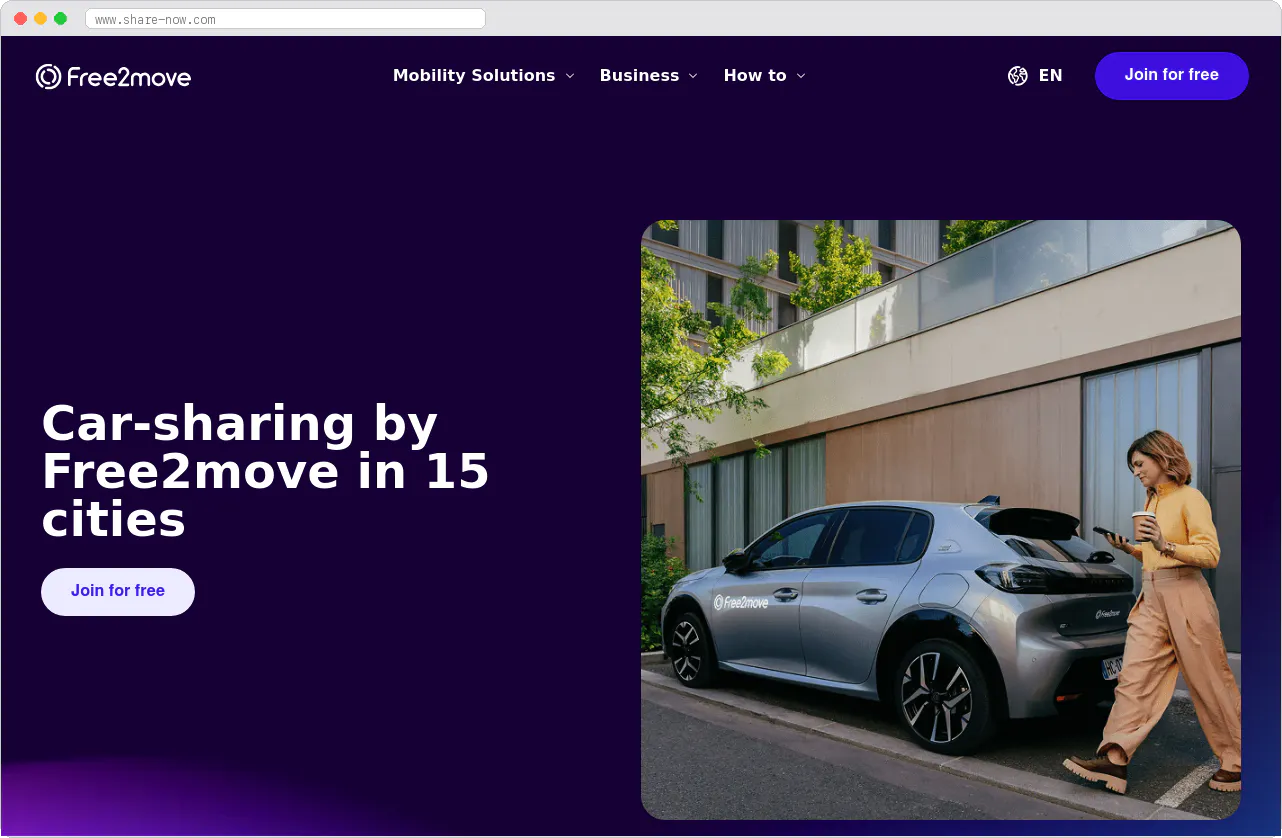
Car2Go, later rebranded SHARE NOW after merging with BMW's DriveNow, pioneered "free-floating" car sharing where renters could pick up and drop off anywhere inside a city zone rather than at fixed stations. That flexibility was popular for one-way trips, but it created constant redistribution headaches and parking conflicts, and the service (rebranded Share Now) exited North America in 2019; Share Now itself was folded into Stellantis's Free2Move platform in 2024, so the original brand no longer exists (electrive). The lesson for new entrants: flexibility that sounds great to users can quietly become an unsustainable operations cost if you don't design for it up front.
Traditional rental companies like Hertz, Enterprise, and Avis have all launched hourly or app-based rental products (Hertz 24/7, Enterprise CarShare) to compete on convenience. They bring existing fleets, insurance infrastructure, and airport locations, but they generally can't match peer-to-peer pricing or the hyperlocal supply density that comes from thousands of individual car owners listing their own vehicles.
How to build a marketplace like Getaround
1. Define your niche within Getaround's category
Getaround built a broad, general-purpose car-sharing marketplace across hundreds of cities, which took over a decade and hundreds of millions of dollars in capital. You don't need to compete on that footprint. Sharper starting points include a single metro area underserved by existing platforms, a specific vehicle category (electric vehicles, trucks and vans for moving jobs, luxury or classic cars), or a specific renter segment such as college students, gig workers who need a car for shifts, or short-term visitors to a tourist town. A tightly defined niche is easier to reach with marketing, easier to trust-build around, and easier to reach supply-demand balance in.
2. Validate your market and unit economics
Car sharing works best where parking is scarce, population density is high, public transit is strong, and car ownership costs are painfully visible. Interview both sides before writing a line of code or configuring a single listing: ask potential hosts what would make them list a car (offsetting a car payment, insurance costs, pure profit) and ask potential renters what's currently stopping them from skipping car ownership altogether.
Run the math early. Model your expected commission rate against your expected insurance cost per trip, your customer acquisition cost on both sides, and your expected utilization rate per vehicle. If a host vehicle only books a few hours a month, neither side makes meaningful money and the marketplace won't hold together, no matter how good the product feels.
3. Choose your development approach
Vibe coding from scratch. AI tools like Cursor, Lovable, and Bolt can produce a working Getaround-style prototype quickly, complete with a map, listings, and a mock checkout flow. That's genuinely useful for pressure-testing a concept with early users or investors. It's a different matter entirely when real money and a stranger's car are on the line. A documented Sharetribe experiment spent 60+ hours vibe-coding a marketplace to demo quality and still shipped a checkout exploit that would have let any user manipulate transaction prices through a direct API call. Getting that output to a standard where you can safely take payments and insure vehicles requires real engineering time. Useful for a demo, not a launch plan.
Custom development from scratch. Hiring developers, who will likely lean on AI tools themselves, gives you full control over the build. Car-sharing platforms typically land in the production-grade tier because they require identity verification, insurance integration, escrow-style payment holding, and dispute workflows from day one: expect $80,000–$200,000 over 16–28 weeks for the software alone (Codica, RaftLabs). If you're also building your own keyless-entry hardware integration or real-time GPS telematics rather than partnering for it, costs push toward the $150,000–$350,000+ tier, since that adds embedded systems and device management on top of the web platform. The low end of any range assumes an offshore team billing $15–40/hr; US or Western European teams push you toward the top. This route makes sense once you have vehicle-access or insurance requirements that no existing platform can accommodate.
Building on a marketplace operating system like Sharetribe. You start at roughly 90% done on the core marketplace foundation: payments, user accounts, listing management, messaging, transaction flows, fraud detection, and compliance groundwork. Your time and money go toward what makes a car-sharing platform distinct.
- No-code builder. Configure location-based search, availability calendars, booking flows, and Stripe Connect-based split payments from the Console, no code required. This gets most car-sharing founders to a live, bookable marketplace without needing a development team on day one.
- AI-assisted development. Connect Claude Code, Cursor, or Codex to Sharetribe's open APIs and open-source template to build car-specific features like custom vehicle attribute filters, integration with a third-party telematics or lockbox provider, or a driving-record verification step in the booking flow. Because Sharetribe already handles the payment and transaction infrastructure, AI-assisted work on top of it carries far lower risk than building the whole system from scratch.
- Custom code. Build directly on the developer platform for deeper integrations such as a keyless-entry hardware partner or an insurance API, or hire a specialist from Sharetribe's Expert Marketplace.
Most founders start with the no-code builder, launch, and add features with AI or a developer once they know exactly what their hosts and renters need.
4. Solve the cold start problem
Car sharing has a particularly sharp cold start problem: renters won't open the app if there aren't cars nearby, and owners won't bother listing a car if there's no rental demand yet. Getaround solved this early by launching in San Francisco's Mission District, a single dense neighborhood, rather than trying to cover the whole city at once, which let it get supply and demand tight enough in one small area to prove the model worked before expanding.
A few concrete tactics work well for new entrants:
- Supply-first, hyperlocal launch. Personally recruit 20 to 50 car owners in a few blocks or a single neighborhood before you spend a dollar on renter marketing. A handful of reliably available cars in a tight radius beats a thin scatter of listings across an entire city.
- Manual matching in the earliest days. Before your search and booking flow is fully automated, personally connect the first renters with the first hosts by text or email if it gets the first ten transactions done and gives you direct feedback.
- Seed around an existing community. A university, a co-working building, or an apartment complex with a shared parking problem gives you a built-in, trust-primed audience for both hosts and renters.
Launching small and tight, one zip code, one campus, one building, beats launching broad and thin. A marketplace with five reliably bookable cars in a two-mile radius will convert far better than fifty scattered across a metro area.
5. Build trust, safety, and insurance infrastructure
Insurance is the one piece of a car-sharing marketplace you cannot soft-launch without. Partner with a commercial insurer or a managing general agent (MGA) that specifically underwrites peer-to-peer car sharing before you take your first booking, not after. Pair that with ID verification, driving record checks, and a documented before/after photo process for every trip so damage disputes have a paper trail from day one.
6. Launch in one tight market
Ship your MVP with the smallest feature set that lets a real transaction happen: verified sign-up, listing creation, location search, booking, and payment. Decide early whether you'll require manual key handoff (lower cost, more friction) or invest in lockbox or keyless hardware later once volume justifies it. Track booking rate (percentage of listed hours actually booked) as your core health metric from week one.
7. Expand deliberately
Once your first market has stable, positive unit economics, expand city by city rather than all at once. Each new market means new regulatory research, new local insurance questions, and a fresh cold start problem, since supply and demand rarely transfer between cities automatically. Build a repeatable market-entry playbook, but expect to adapt it for local parking rules, insurance regulations, and renter behavior each time.
Do you need to build everything Getaround has?
No. Getaround spent over 15 years and hundreds of millions of dollars building custom keyless-entry hardware, a proprietary insurance program, and fleet-grade telematics. None of that is required to launch. At the MVP stage, you need verified accounts, listings, location search, booking and payment, and a trustworthy insurance partnership. Custom hardware, dynamic pricing algorithms, and delivery logistics can all come later, once you have enough transaction volume to justify the investment.
The temptation to "just vibe-code a Getaround clone" runs into the same wall every time: an AI tool can generate a convincing-looking app quickly, but it won't generate a tested payment escrow system, a compliant identity verification flow, or fraud protection against the checkout exploit described above. Starting on a foundation like Sharetribe is faster even with AI tools in your workflow, because the payment infrastructure, compliance groundwork, and transaction engine are already built and tested. Your AI usage goes toward the features that actually differentiate your marketplace, not toward rebuilding a checkout flow from zero.
Trust and safety for a Getaround-type marketplace
Car sharing carries risks that most marketplaces don't: physical safety, a high-value asset changing hands, and the possibility of fraud or identity misuse at the point of vehicle pickup. Standard practice in this category includes government ID verification, driving record checks going back several years, and a minimum age requirement (usually 18, sometimes 21 depending on the market). Photo documentation before and after every trip, combined with a clear damage claims process, protects both hosts and renters and reduces disputes that could otherwise end up as chargebacks or bad reviews.
Sharetribe gives you payment escrow (funds held until a transaction is confirmed complete), configurable transaction flows, and optional identity verification steps built into the user account system out of the box. What you'll need to add yourself for a car-sharing marketplace is the commercial insurance partnership (non-negotiable), a driving record verification integration, and, depending on how far you take the model, a keyless entry or lockbox solution for vehicle access. None of these are optional add-ons you can skip to launch faster: insurance and identity verification are the two things that make renting your car to a stranger feel safe enough to actually do.
Running a marketplace like Getaround
Day-to-day operations for a car-sharing marketplace involve customer support for booking issues, damage claim adjudication, host quality monitoring, and constant supply-demand balancing across whatever geography you operate in. At Getaround's scale, this also means managing hardware fleets, telematics uptime, and insurance claims processing across hundreds of cities, a genuinely large operational lift that took years of hiring and process-building to get right.
You won't need to replicate any of that on day one. Sharetribe automatically handles payment processing and payout splitting through Stripe Connect, booking calendar logic, messaging between hosts and renters, and the underlying transaction state machine, so your early operational focus can stay narrow: recruiting good hosts, verifying renters properly, and responding fast when something goes wrong on a trip.
Development costs and timeline
Three realistic scenarios:
Vibe coding from scratch: Free or very cheap to start, and a working Getaround-style prototype is buildable in days with AI tools. What you won't get from this path is a production-ready platform: tested payment escrow, insurance integration, identity verification, and fraud protection all require engineering work that AI coding tools don't shortcut. A documented Sharetribe experiment logged 60+ hours to reach demo quality and still surfaced a critical checkout exploit that would have allowed price manipulation. A useful proof-of-concept tool, not a cost-effective path to a live business handling real cars and real money.
Custom development from scratch: Car-sharing marketplaces land in the production-grade tier because of the insurance, identity verification, and dispute-resolution requirements baked into the category from day one: expect $80,000–$200,000 over 16–28 weeks for the software layer (Codica, RaftLabs). If you're also building custom keyless-entry hardware or real-time GPS telematics rather than partnering with an existing vendor, costs push toward $150,000–$350,000+ over 26–52+ weeks, since that adds embedded hardware and device-fleet management to the scope. The low end of each range assumes offshore development teams; US and Western European teams push toward the top. Ongoing maintenance typically runs 15–25% of the original build cost per year, on top of insurance and hosting.
Building on Sharetribe: Before you launch, the Sharetribe Build plan costs just $39/month. To open to real users, you need the Live plan, which costs $199/month billed yearly ($259/month billed monthly). Both plans include 1 million usage credits per month. Sharetribe covers the marketplace foundation: user accounts, listings, location-based search, booking calendars, messaging, and Stripe Connect payment processing with split payouts between host and platform. Most founders reach a live, bookable MVP in a matter of weeks rather than months, and car-sharing-specific features like driving record verification or lockbox integration get added afterward through AI-assisted development or a developer, scoped narrowly because the transaction engine is already in place.
Why Sharetribe for building a marketplace like Getaround
Sharetribe's built-in booking system already handles the availability-calendar complexity that car sharing needs: recurring availability, blocked-out maintenance windows, and prevention of double bookings. Location-based search works well out of the box for vehicle discovery by proximity, and Stripe Connect support handles the split-payment structure common to car-sharing commission models, holding funds until a trip completes and then distributing the host's share after fees. None of this requires custom infrastructure work, which means your first engineering effort can go toward what actually makes your car-sharing marketplace different, whether that's a niche vehicle category, a specific city's regulatory approach, or a driving record verification integration.
Frequently asked questions
How much does it cost to build a car-sharing platform like Getaround?
It depends on your path. Custom development for a production-grade platform with insurance, identity verification, and dispute handling runs $80,000–$200,000, rising toward $150,000–$350,000+ if you build custom vehicle-access hardware integration. Building on Sharetribe costs just $39/month on the Build plan after a 14-day free trial (the Live plan for running your marketplace is $199/month billed yearly), with most of your budget going toward insurance partnerships, hardware (if you use it), and marketing rather than core platform development.
How does Getaround make money?
Getaround shut down its U.S. car-sharing operations in February 2025 and later sold its European business to GoMore in 2026, so its old 40%/35% commission structure (TechCrunch) no longer applies to an active Getaround platform. It earns additional revenue from delivery fees, late-return charges, and optional protection plan upgrades.
What is the biggest challenge in building a car-sharing marketplace?
Insurance is the single biggest challenge: you need a commercial insurance partner willing to underwrite peer-to-peer car sharing before you can safely take your first booking. Beyond that, achieving balanced supply and demand in a specific geography, and navigating local regulations around vehicle rental and liability, are the next hardest problems.
Is Turo or Getaround a better model to copy?
Neither should be copied outright; the better move is picking whichever use case fits your target market. Turo's model fits multi-day trip rentals and vacation-style bookings, while Getaround's model fits short, hourly, urban trips enabled by keyless access. Choose based on how your target renters actually plan to use a rented car.
Do I need keyless entry hardware to launch a car-sharing marketplace?
No. Many successful car-sharing operators start with manual key exchange or lockbox systems, which cost far less and require no hardware installation. Keyless technology improves user experience and reduces friction at scale, but it's an upgrade you add once transaction volume justifies the investment, not a requirement for launch.
How long does it take to launch a car-sharing marketplace?
With Sharetribe's no-code builder, a basic bookable marketplace can go live in a few weeks, though securing an insurance partnership typically takes longer and should start in parallel. Custom development from scratch for a production-grade platform generally takes 16–28 weeks before launch.
Start your 14-day free trial
Create a marketplace today!
- Launch quickly, without coding
- Extend infinitely
- Scale to any size
No credit card required