How to build a website like Airtasker
Airtasker connects people who need tasks completed with skilled local service providers, generating about $50 million in annual revenue. Learn how to build a successful task marketplace using the same playbook, from validation to launch.
Published: Mar 15, 2024
Last updated: Sep 11, 2026
What is Airtasker and how does it work?
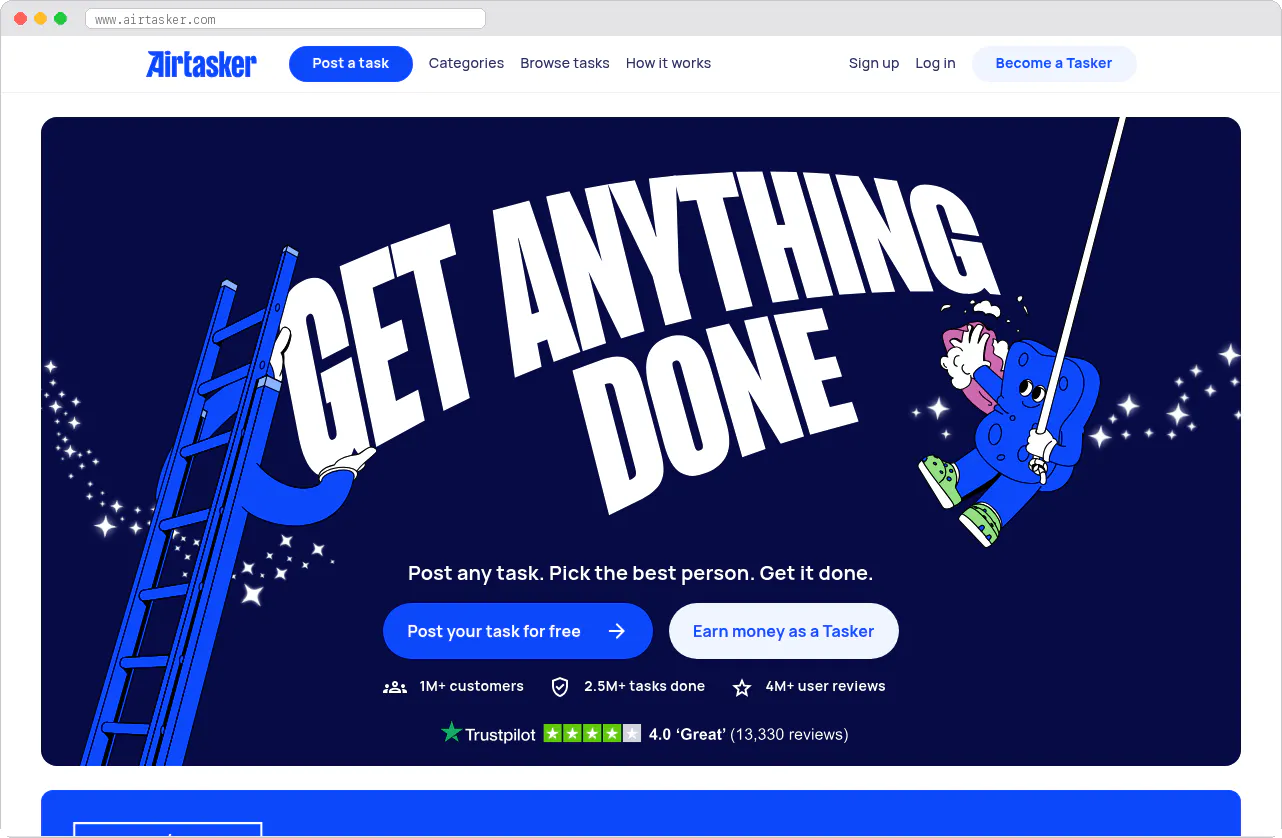
Airtasker is a location-based task marketplace that connects people who need everyday jobs done (called Posters) with people willing to do them for pay (called Taskers). Posters list tasks like furniture assembly, house cleaning, moving help, or handyman work with a suggested budget and location. Taskers browse nearby tasks and submit competitive bids, and the Poster picks who they want to hire. Founded in 2012 by Tim Fung and Jonathan Lui in Sydney, Airtasker listed on the Australian Securities Exchange in March 2021 and now operates across Australia, the UK, and Ireland, with FY2023 gross marketplace volume of about AUD $253 million and group revenue of about AUD $44 million (Airtasker).
The core mechanic that distinguishes Airtasker from a fixed-price service platform is the bidding auction. Instead of a set hourly rate, Taskers compete on price, availability, and pitch, which lets pricing flex with task complexity, urgency, and local supply. Payments run through the platform, with funds held until the Poster confirms the task is complete, and both sides leave a public review afterward. That combination of open bidding plus escrow and reputation is what makes strangers comfortable transacting for real-world, in-person work.
How Airtasker makes money
Airtasker charges fees on both sides of the transaction, though the exact split has shifted over time. Historically, Taskers paid a service fee of around 15-20% of the task value on their first transaction with a new client, dropping to as low as 1.9% for repeat clients, while Posters now pay a fixed connection fee based on task size rather than a percentage-based booking fee (Airtasker). This dual-sided model means revenue scales directly with completed task volume, not just listings or sign-ups, which keeps Airtasker's incentives aligned with actually getting jobs done rather than just generating bids.
Beyond core commissions, Airtasker has layered in ancillary revenue: Airtasker Business (a B2B product connecting companies with Taskers for facilities and support work), paid promotion for Taskers who want more visibility on task feeds, and insurance products bundled into certain task categories. The company has also experimented with subscription-style membership tiers that reduce fees for high-volume Taskers, which helps retain its most active supply-side users, the ones who complete a disproportionate share of total tasks.
The business is a useful case study in how a two-sided commission model needs both liquidity and category depth to work. Commoditized categories like cleaning and removals generate high task volume at lower price points, while specialized categories like web design or tutoring generate fewer tasks but at meaningfully higher average values. Balancing both is part of what has let Airtasker's established Australian marketplace post positive EBITDA and cash flow, even as the group as a whole keeps posting losses while it funds UK and US growth (Airtasker Q4 2025 results).
What makes Airtasker work: key features
Open bidding, not fixed pricing. Posters describe a task and suggest a budget, but the final price emerges from competing bids. This lets the market set prices in real time rather than forcing Airtasker to maintain rate cards across hundreds of categories and regions.
Location-first task discovery. Because almost every task requires someone to physically show up, Airtasker's search and matching logic is built around geography first, category second. Taskers see tasks near them; Posters see Taskers who service their postcode.
Escrow payments tied to completion. Posters pay upfront, but funds are not released to the Tasker until the Poster marks the task complete. This single mechanic solves the two biggest fears in a task marketplace: Posters worrying they'll pay and get nothing, and Taskers worrying they'll do the work and not get paid.
Two-way public reviews. Both Posters and Taskers rate each other after every task. This is what allows strangers to hire strangers for work inside their own homes, and it's a stronger trust signal than a resume or a bio.
Broad category coverage under one brand. Rather than launching a single-category app, Airtasker built enough scale to support dozens of categories, from IKEA assembly to graphic design, letting it capture both frequent low-cost tasks and occasional high-value ones under the same platform.
In-platform messaging. All negotiation over scope, timing, and price happens inside Airtasker's chat, which keeps disputes resolvable (support can see the full thread) and keeps both parties from disintermediating the platform after the first job.
The competitive landscape
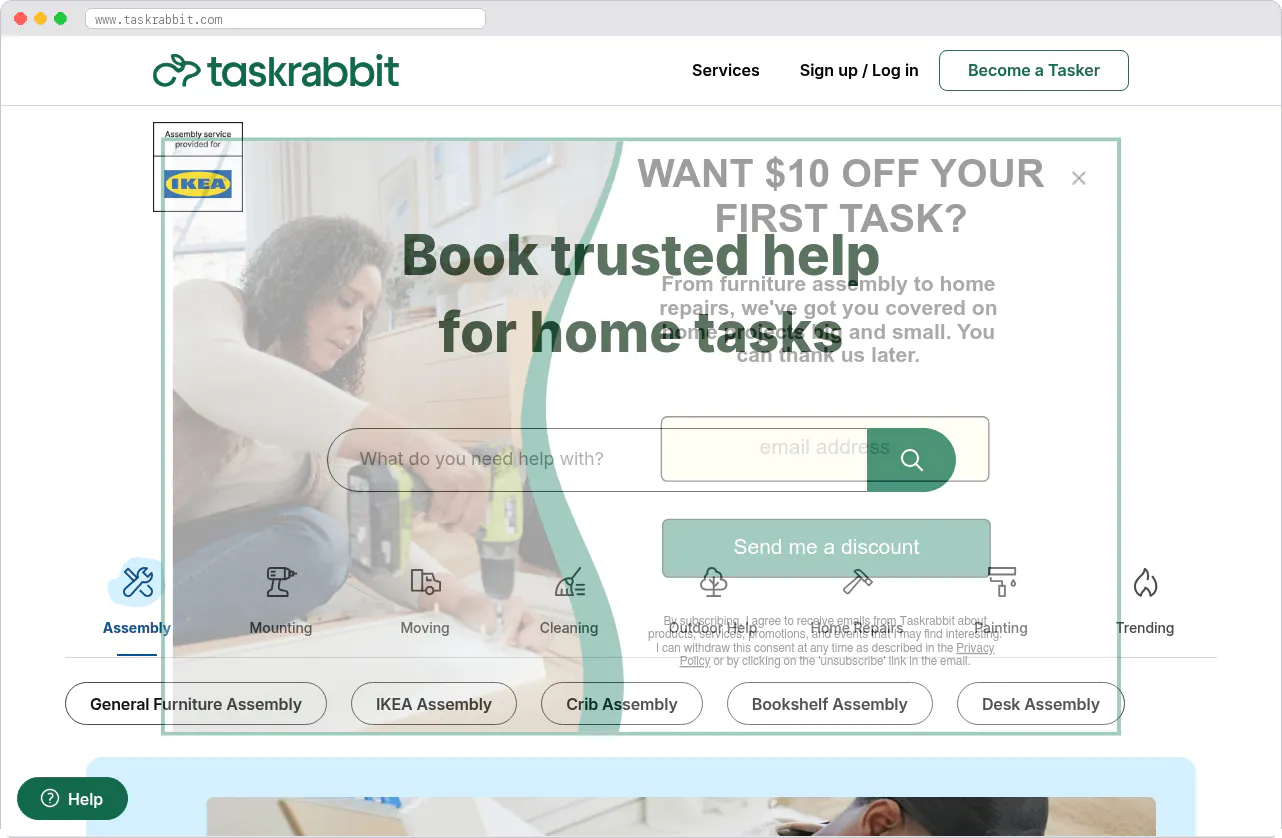
TaskRabbit owns the North American mental model for "get someone to assemble my furniture." Acquired by IKEA in 2017, it dropped the open-bidding model in favor of pre-vetted Taskers with transparent hourly rates, which lowers decision friction for customers who just want a number, not a negotiation. The tradeoff is that Taskers lose pricing flexibility, and TaskRabbit's category depth outside of home tasks (moving, assembly, minor repairs) is thin. That leaves room for a bidding-based or specialist alternative in categories TaskRabbit treats as secondary, like creative or admin work.
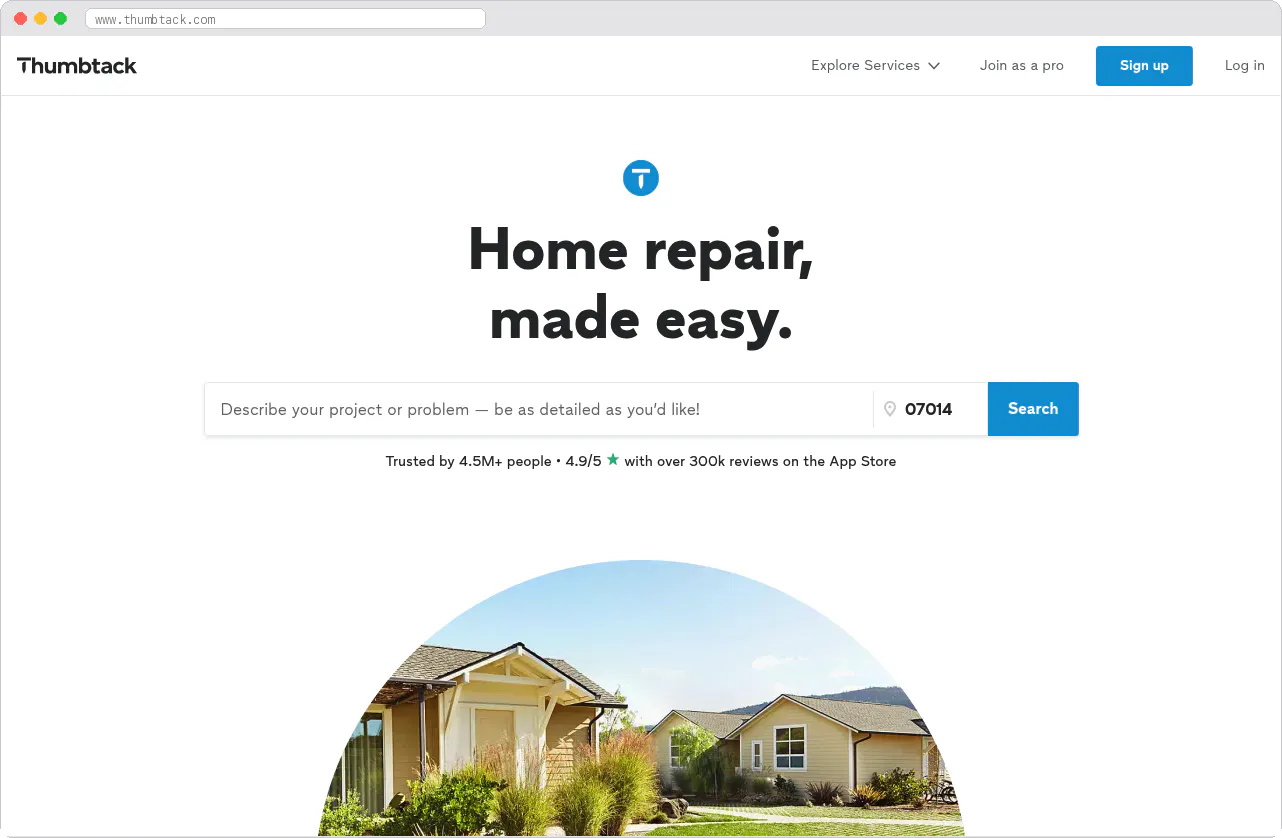
Thumbtack operates on a lead-generation model rather than facilitating full transactions: professionals pay for customer leads and then handle pricing, payment, and scheduling off-platform. This appeals to established contractors who don't want a marketplace taking a cut of every job, but it means Thumbtack offers customers less protection (no escrow, no guaranteed completion) and providers can pay for leads that never convert. A platform that actually processes payment and holds funds in escrow is a meaningfully different value proposition for customers who want that protection.
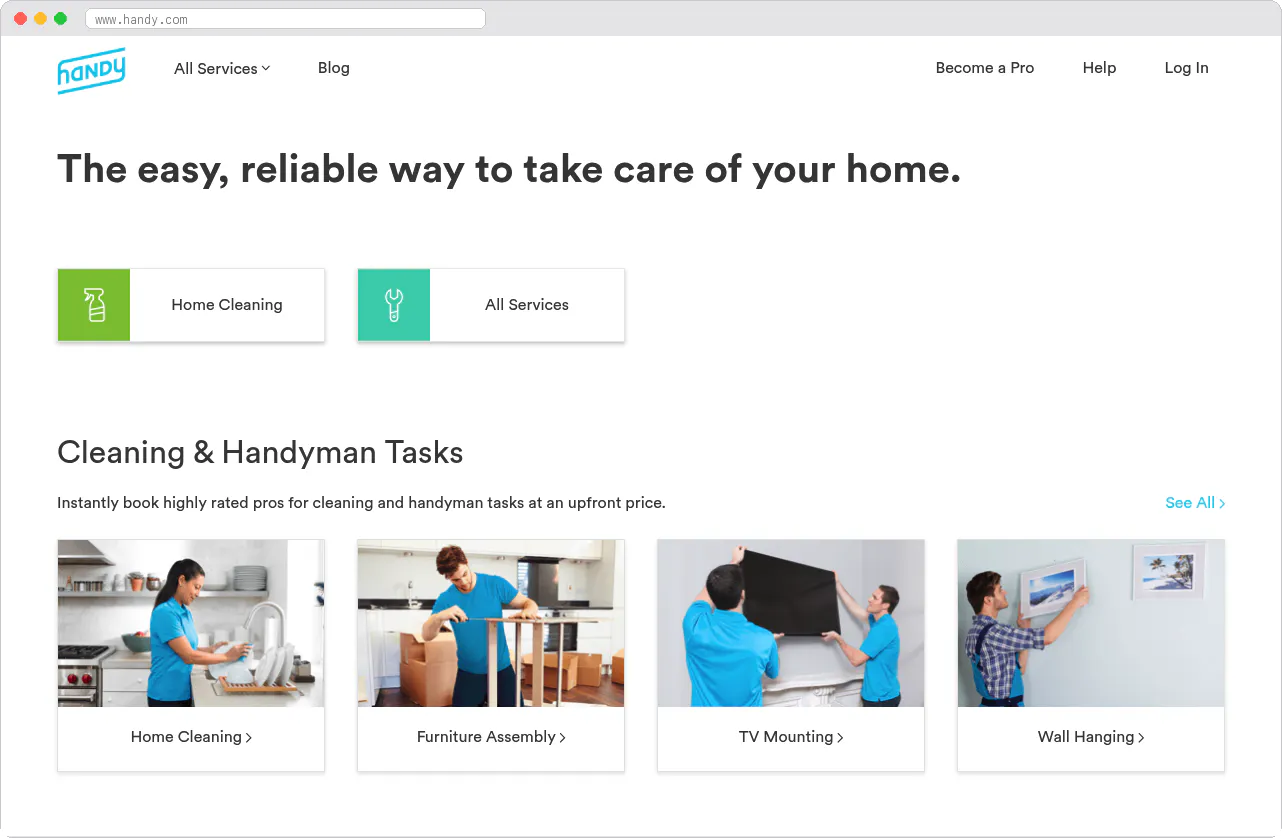
Handy, now folded into Angi, focuses narrowly on recurring home services like cleaning and handyman work, and it leans more toward a managed labor model than a pure marketplace, exercising more control over who can take jobs and how they're priced. That control improves consistency but caps flexibility and scalability compared to an open marketplace, and it limits Handy's reach into one-off or unusual task categories.
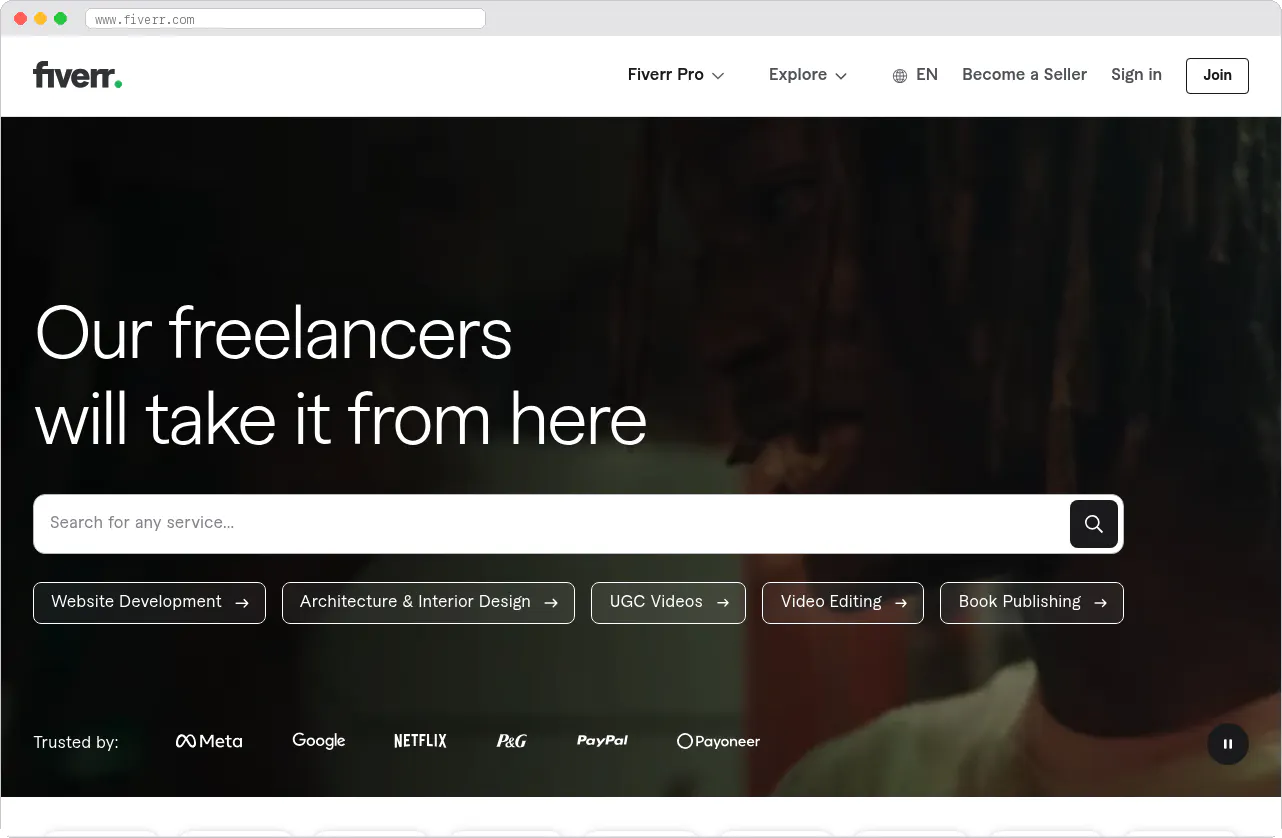
Fiverr is not a direct competitor for in-person tasks, but it captures a meaningful share of tasks that could be done locally and instead get done remotely, like logo design, video editing, or writing. Any task marketplace with a "creative services" or "digital help" category is competing with Fiverr for that segment even if it never markets itself that way.
Informal channels like Facebook Marketplace groups, Nextdoor, and word-of-mouth recommendations remain real competition, especially in smaller towns or tight-knit communities. They have zero platform fees and existing social trust, but no structured payments, no escrow, and no accountability if something goes wrong. A platform that offers the safety net of escrow and reviews without the informal channel's downsides has a real opening, particularly in categories like elder care or pet sitting where trust matters more than price.
How to build a marketplace like Airtasker
1. Define your niche within Airtasker's category
Airtasker's breadth (dozens of categories, national scale, publicly traded) took over a decade to build. You are not trying to replicate that on day one. Pick a wedge: a single vertical (moving help, pet care, elder care errands, small business admin support), a specific geography Airtasker or TaskRabbit hasn't prioritized, or a specific customer segment (property managers, small business owners, seniors) with recurring task needs. A tight niche gets you to marketplace liquidity, the point where there's reliably enough supply and demand meeting each other, much faster than a broad launch.
2. Validate demand manually before building anything
Before writing a spec or picking a platform, test the concept with almost no technology. Post in local Facebook groups or run a simple landing page offering to match a handful of customers with a handful of taskers by hand, over text or email. This tells you real pricing ranges, what objections customers raise, and what actually motivates your first Taskers to say yes, information that shapes your MVP far more usefully than assumptions.
3. Choose your development approach
Vibe coding from scratch. AI tools like Cursor, Lovable, and Bolt can produce a working Airtasker-style prototype quickly, complete with task listings, a bidding form, and basic messaging. For pressure-testing a concept or demonstrating it to early users, they're genuinely useful. For launching a platform that handles real money between strangers, they're probably not sufficient. What vibe-coded outputs reliably don't produce is the infrastructure underneath: payment escrow, dispute resolution, fraud detection, and compliance. A documented Sharetribe experiment ran 60+ hours to reach demo quality but revealed a critical checkout exploit that would have allowed price manipulation via direct API call. Bringing the output to production standard requires significant time, testing, and a clear understanding of how the different components of a web application fit together. A useful prototyping tool, not a cost-effective path to launch.
Custom development from scratch. Hiring developers (who will likely use AI heavily) gives you full control. An Airtasker-type marketplace with bidding, escrow, geolocation search, identity verification, and dispute handling lands in the production-grade tier: $80,000–$200,000 over 16–28 weeks (Codica, RaftLabs). A stripped-down single-category MVP without full verification could land in the $30,000–$80,000 range instead, but real-world task work (people entering strangers' homes) usually pushes founders toward the more robust tier fairly quickly. The low end of each range assumes offshore teams at $15–40/hr; US or Western European teams push toward the top. Makes sense when you have requirements no existing platform can meet.
Building on a marketplace operating system like Sharetribe. You start at roughly 90% done on the standard marketplace foundation: payments, user accounts, listing management, messaging, transaction flows, fraud detection, and compliance. Your time and budget go toward Airtasker-specific features like bidding logic and location-based matching. Three paths within this approach:
- No-code builder. Configure task listings, custom bidding-style transaction flows, location search, and Stripe Connect escrow payments from the Console, no code required. This gets most founders to a live, working task marketplace in days or weeks.
- AI-assisted development. Connect Claude Code, Cursor, or Codex to Sharetribe's open APIs and open-source template to build custom bidding logic, category-specific fields, or a map-based Tasker discovery view. Because Sharetribe handles the payment infrastructure, AI-assisted development on top of it carries much lower risk than building from scratch.
- Custom code. Build directly on the developer platform for deeper integrations (background check APIs, insurance partners, custom scheduling), or hire from Sharetribe's Expert Marketplace.
Most founders start with the no-code builder, then add features via AI or a developer as they learn what their users actually need.
4. Solve the cold start problem
A task marketplace is only useful if a Poster can find a nearby Tasker within hours, which means supply has to exist before demand shows up, or the platform feels empty and customers churn immediately. Airtasker solved this early by concentrating hard on Sydney and Melbourne before expanding, recruiting Taskers directly through word of mouth and local outreach rather than waiting for organic sign-ups.
For a new entrant, three tactics work well. First, go supply-first: personally recruit 20-50 quality Taskers in your niche or city before you spend a dollar on customer marketing, so the first Posters who show up see real options. Second, stay geographically tight, one neighborhood or city, not a country, so your limited supply looks abundant relative to demand rather than thin. Third, consider manual matching for your first dozen tasks: text a Poster's job directly to a Tasker you've vetted yourself. It doesn't scale, but it teaches you exactly what your matching algorithm eventually needs to do. Launching small and tight beats launching broad because liquidity, not reach, is what makes a two-sided marketplace feel alive to a new user.
5. Launch to customers with focused marketing
Once you have a base of reliable Taskers, start acquiring Posters through narrow, high-intent channels rather than broad advertising. Local SEO content ("how to find a reliable house cleaner in [city]"), partnerships with property managers or real estate agents, and community group posts tend to outperform paid social for early task marketplaces, because task-seekers are often actively searching, not scrolling.
6. Optimize based on completion rates, not just sign-ups
Track task completion rate, repeat Poster rate, and average Tasker earnings closely from week one. A marketplace with plenty of sign-ups but a low completion rate usually has a matching or trust problem, not a marketing problem. Fix friction in posting, bidding, and messaging before spending more on acquisition.
Do you need to build everything Airtasker has?
No. Airtasker's current feature set, dozens of categories, an Airtasker Business B2B product, insurance partnerships, and a decade of matching-algorithm refinement, reflects over ten years of iteration on top of a public company's balance sheet. At launch you need task posting, bidding or simple matching, in-platform messaging, escrow payments, and reviews. That's it. Verification tiers, category-specific insurance, and a dedicated business product are all things you add once you have proof that Posters and Taskers are transacting reliably.
The instinct to "just vibe-code a clone" is understandable given how capable AI tools look in a demo, but it usually costs more time than it saves. Building on Sharetribe's foundation is faster even with AI tools in your workflow, because the payment processing, escrow logic, user accounts, and compliance groundwork already exist and have been tested against real transactions. That means your AI coding budget goes toward the 10% that actually differentiates your marketplace, like a bidding UI or a location-matching algorithm, instead of getting spent (and re-spent) rebuilding a secure checkout flow from zero.
Trust and safety for an Airtasker-type marketplace
Task marketplaces carry a specific trust risk that product marketplaces don't: someone is entering a stranger's home or workplace to do physical work. That raises the stakes on identity verification, background checks for sensitive categories (childcare, elder care, cleaning), and clear insurance or liability policies well above what a marketplace for, say, secondhand goods needs. Payment disputes are the other major risk category: a Poster claiming work wasn't finished properly, or a Tasker claiming a Poster is withholding payment unfairly, which is exactly what escrow and a documented dispute process are designed to prevent.
Standard practice in this space includes ID verification at sign-up, optional or required background checks for higher-risk categories, public two-way reviews after every task, and a clear, published policy for what happens when a Poster and Tasker disagree about completion quality. Sharetribe provides the foundation out of the box: Stripe Connect-powered escrow that holds funds until a transaction is marked complete, built-in user accounts with fields you can extend for verification data, and a transaction flow you can configure to require confirmation before releasing payment. What founders need to add is category-specific: partnering with a background check provider, writing clear task-scope and cancellation policies, and deciding which categories require extra verification before a Tasker can even bid.
Running a marketplace like Airtasker
Day-to-day operations for a task marketplace center on three things: monitoring for disputes, keeping the Tasker pool healthy (enough active, well-reviewed providers per category and area), and watching for fraud patterns like fake reviews or off-platform payment attempts. At scale, Airtasker runs dedicated trust and safety teams, insurance partnerships, and a support operation handling thousands of disputes a month, none of which a new entrant needs on day one.
Sharetribe automatically handles the transaction plumbing underneath all of this: payment capture and release, transaction state (posted, bid accepted, in progress, completed, paid out), messaging history tied to each transaction, and the audit trail support teams need when a dispute actually happens. That leaves founders free to spend their operational time on the parts that are genuinely specific to their niche, like vetting Taskers in a sensitive category or building relationships with your first repeat customers, rather than reinventing payment infrastructure.
Development costs and timeline
Three realistic scenarios:
Vibe coding from scratch: Free or very cheap to start. A working Airtasker-style prototype, task posting, a bid form, basic profiles, is buildable in a weekend with AI tools. What you can't get from here is a production-ready platform: escrow payments that actually hold and release funds correctly, dispute handling, fraud detection on bids and messages, and compliance with payment regulations all require work that AI coding tools don't shortcut. A documented Sharetribe experiment logged 60+ hours to reach demo quality and found critical payment vulnerabilities, specifically a checkout exploit letting anyone alter a transaction price via a direct API call. A useful proof-of-concept tool, not a cost-effective path to a live business.
Custom development from scratch: Cost depends on complexity tier. A bare-bones, single-category MVP without verification could run $30,000–$80,000 over 8–20 weeks. A production-grade build with bidding, escrow, identity verification, and dispute flow, what Airtasker's category realistically requires given that Taskers enter customers' homes, runs $80,000–$200,000 over 16–28 weeks (Codica, RaftLabs). The low end of each range assumes offshore teams; US or Western European teams push toward the top. Ongoing maintenance typically runs 15–25% of the original build cost per year. Makes sense when you have requirements no existing platform can meet.
Building on Sharetribe: Before you launch, the Sharetribe Build plan costs just $39/month. To open to real users, you need the Live plan, which costs $199/month billed yearly ($259/month billed monthly). Both plans include 1 million usage credits per month. Sharetribe covers hosting, payment infrastructure with Stripe Connect escrow, user accounts, listing management, messaging, and search for an Airtasker-type marketplace, the entire foundation you'd otherwise pay $80,000+ to build from scratch. Most founders reach a live MVP in weeks rather than months. Custom features like a bidding UI or location-based Tasker discovery, added via AI tools or a developer, are scoped narrowly because the transaction engine is already there.
Why Sharetribe for building a marketplace like Airtasker
Sharetribe's transaction engine is built to support flexible pricing flows, which maps directly onto Airtasker's bid-and-accept model: you can configure a flow where a Poster creates a request, multiple Taskers respond with an offer, and the Poster accepts one, all with payment held until completion. Built-in Stripe Connect integration handles the escrow mechanic that makes strangers comfortable transacting for in-person work, without you writing payment-handling code. Location-based search and map views support the geography-first discovery that any task marketplace needs, and the customizable user profile schema lets you add the verification fields, skill tags, and portfolio photos that Taskers need to build trust. Because all of this is configurable through the no-code Console and extendable through open APIs, you can launch the core marketplace fast and layer in category-specific features, like a background-check integration for sensitive task types, as you grow.
Frequently asked questions
How much does it cost to build a website like Airtasker?
It depends on your approach. A no-code build on Sharetribe starts at $39/month on the Build plan ($199/month billed yearly on the Live plan once you go live) plus setup time, while custom development for a production-grade task marketplace with bidding, escrow, and verification runs $80,000–$200,000 (Codica). Vibe-coding tools can produce a free prototype but aren't safe for handling real payments without significant additional work.
What features does a task marketplace need to compete with Airtasker?
At minimum, you need task posting, a bidding or matching system, in-platform messaging, escrow payments, and two-way reviews. Location-based search is essential since almost all tasks happen in person. Identity verification and category-specific safeguards matter more as you add sensitive service categories like childcare or elder care.
How does Airtasker make money?
Airtasker charges Taskers a variable service fee of 12.5-20% of the task price based on their tier, while Posters pay a small fixed booking fee rather than a percentage commission (Airtasker Help Centre). It also earns revenue from Airtasker Business, promoted listings for Taskers, and bundled insurance products.
Should I copy Airtasker's bidding model or use fixed pricing like TaskRabbit?
Bidding works well when task scope and pricing vary a lot, like custom projects or specialized skills, because it lets the market set the price. Fixed hourly pricing, like TaskRabbit's, reduces friction for customers who just want a quick answer, but caps flexibility for providers. Test both with a small user group before committing, since the right choice often depends on your specific category.
How do I get my first Taskers and customers?
Recruit supply first: reach out directly to independent contractors and freelancers already doing this work informally, and offer them early access to customers with low or no commission for the first few months. Stay in one city or neighborhood until you have enough active Taskers that a new customer sees real options, then start marketing to customers through local content and partnerships.
Can I really build a marketplace like Airtasker without coding?
Yes, for the core functionality. Sharetribe's no-code builder handles listings, transaction flows, payments, messaging, and search without any code, which is enough to launch a functioning task marketplace. You'll likely want a developer or AI-assisted development later for category-specific features like custom bid ranking or a specialized background-check integration.
Start your 14-day free trial
Create a marketplace today!
- Launch quickly, without coding
- Extend infinitely
- Scale to any size
No credit card required