How to build a website like Flytographer
Flytographer connects travelers with local photographers for professional vacation shoots. Learn how to build a similar photography marketplace platform, from validating your idea to launching and scaling your business.
Published: Mar 15, 2024
Last updated: Mar 19, 2026
Why build a website like Flytographer?
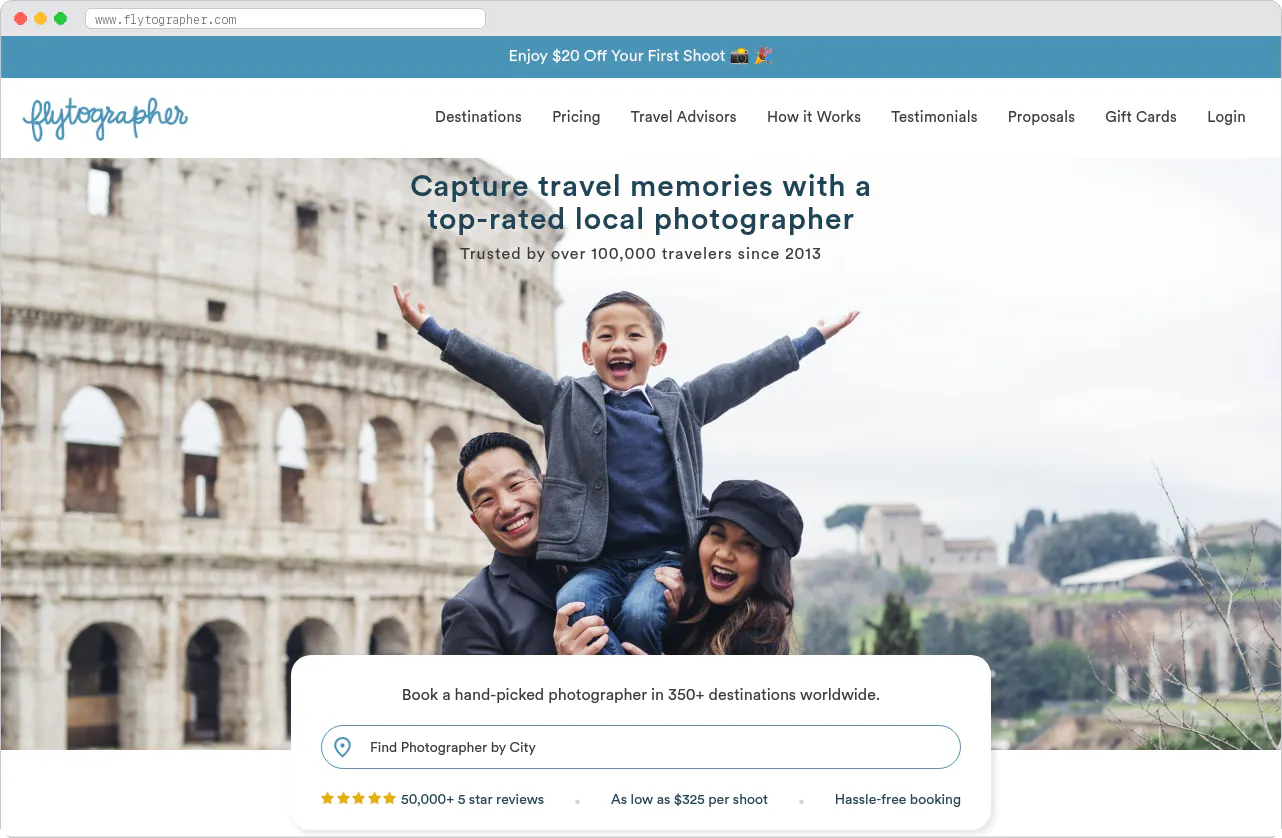
Flytographer transformed how people capture their travel memories by connecting travelers with skilled local photographers in over 350 destinations worldwide. Founded in 2013 by Nicole Smith in Vancouver, the platform emerged from a simple observation: vacation photos taken by strangers or selfie sticks rarely capture the magic of travel experiences. Smith's vision was to create a service that would allow travelers to step into their own photos while professional photographers documented their adventures.
The company has facilitated over 500,000 photo shoots across six continents, generating millions in revenue while building a network of more than 2,000 vetted photographers. What makes Flytographer particularly compelling as a business model is how it addresses multiple pain points simultaneously. Travelers get high-quality photos without the hassle of researching photographers, while photographers gain access to a steady stream of clients without spending time on marketing or client acquisition.
Flytographer's success stems from solving a universal problem with a localized solution. Every destination has talented photographers, but travelers typically lack the time, local knowledge, or language skills to find and book them independently. The platform bridges this gap while maintaining quality standards that ensure consistently excellent experiences.
The photography marketplace model offers unique advantages for entrepreneurs. Unlike inventory-based businesses, you don't need to hold stock or manage logistics. The service is highly scalable, adding new destinations requires recruiting photographers rather than establishing physical infrastructure. Most importantly, the emotional value of capturing life's special moments creates strong customer loyalty and word-of-mouth marketing.
Building a platform like Flytographer today is far more accessible than when Smith started. No-code marketplace builders and modern payment systems eliminate the technical barriers that once required large development teams and significant capital investment.
How does Flytographer work?
Flytographer operates as a trusted intermediary between travelers seeking professional photography and local photographers looking to expand their client base. The platform's success relies on creating smooth experiences for both sides of the marketplace while maintaining rigorous quality standards.
For travelers, the booking process begins with selecting a destination from Flytographer's extensive network. The platform displays available photographers with portfolio samples, pricing, and availability calendars. Customers choose from packages typically ranging from 30-minute shoots to multi-hour sessions, with prices varying by location and photographer experience level. Most shoots include 15-50 professionally edited photos delivered within 7-10 days.
The booking system handles scheduling, payment processing, and communication between clients and photographers. Flytographer provides shoot guidelines, suggests optimal times and locations, and offers customer support throughout the experience. This level of service reduces friction and builds confidence, particularly important when booking services in unfamiliar destinations.
Photographers apply to join Flytographer's network through a rigorous vetting process that evaluates technical skills, portfolio quality, communication abilities, and local knowledge. Accepted photographers receive training on the platform's standards, customer service expectations, and editing guidelines. They set their own schedules and can accept or decline shoot requests based on availability.
Flytographer handles all payment processing, customer communications, and dispute resolution. Photographers receive their earnings after successful shoot completion, minus Flytographer's commission. This arrangement allows photographers to focus on their craft while Flytographer manages the business operations, marketing, and quality assurance.
The platform maintains quality through several mechanisms: photographer screening, customer reviews, photo quality standards, and responsive customer service. Photographers who consistently receive poor reviews or submit substandard work face removal from the network. This quality control system protects the brand reputation and ensures customer satisfaction.
What makes Flytographer successful?
Flytographer's success combines several strategic elements that created a sustainable competitive advantage in the travel photography market. Understanding these factors provides valuable insights for anyone building a similar marketplace.
The platform solved a clear market gap by professionalizing vacation photography. Before Flytographer, travelers had limited options: ask strangers to take photos, attempt awkward selfies, or spend considerable time researching local photographers. Flytographer eliminated this friction while delivering consistently high-quality results.
Quality control became Flytographer's key differentiator. The company developed comprehensive photographer screening processes, including portfolio reviews, technical assessments, and trial shoots. This investment in vetting ensures customers receive professional results regardless of destination. Many competitors prioritize growth over quality, leading to inconsistent experiences that damage customer trust.
The local photographer model creates authentic value beyond just photography skills. Flytographer photographers often suggest unique locations, optimal timing for lighting conditions, and insider perspectives that enhance the overall experience. This local expertise transforms a simple photo shoot into destination discovery, justifying premium pricing.
Flytographer's customer service philosophy emphasizes experience over transactions. The platform provides detailed planning assistance, responds quickly to concerns, and actively solicits feedback for continuous improvement. This attention to customer experience generates strong word-of-mouth marketing and repeat bookings for anniversary trips or family vacations.
The business model's scalability enabled rapid geographic expansion without proportional cost increases. Adding new destinations requires recruiting and training photographers rather than establishing physical infrastructure. This asset-light approach allowed Flytographer to enter 350+ destinations while maintaining relatively low operational costs.
Strategic marketing partnerships amplified Flytographer's reach efficiently. Collaborations with travel blogs, wedding planners, and tourism boards provided targeted customer acquisition channels. The visual nature of the service makes it particularly effective for social media marketing, where satisfied customers naturally share results with their networks.
Essential features for a Flytographer-like marketplace
Building a successful photography marketplace requires specific functionality that addresses the unique needs of both photographers and clients. These features differ significantly from typical e-commerce platforms and require careful consideration of user workflows, trust mechanisms, and quality assurance.
A sophisticated photographer portfolio system forms the marketplace's foundation. Photographers need tools to showcase their work effectively, including high-resolution image galleries, categorization by shoot type, and detailed service descriptions. The portfolio interface should load quickly across devices and allow easy updates as photographers expand their portfolios. Integration with social media accounts can supplement portfolio content and demonstrate broader professional activity.
Location-based search and filtering capabilities are crucial for connecting travelers with photographers in specific destinations. The search system should support city, neighborhood, and landmark-based queries while offering filters for photography style, package pricing, availability dates, and photographer experience levels. Map integration helps visualize photographer locations relative to customer accommodations or preferred shoot locations.
Booking and scheduling functionality must handle complex availability management across multiple time zones. Photographers need calendar systems that integrate with their personal schedules, allow buffer time between shoots, and automatically update availability as bookings occur. The system should send automated confirmations, reminders, and follow-up communications to reduce no-shows and improve customer experience.
Secure payment processing with marketplace-specific features handles the financial complexity of three-party transactions. The system must collect payments from customers, hold funds during the service period, and distribute payments to photographers minus platform commissions. Integration with services like Stripe Connect ensures compliance with financial regulations while supporting multiple currencies and payment methods.
Communication tools facilitate coordination between photographers and clients while maintaining platform oversight. Built-in messaging systems allow planning discussions, location sharing, and schedule confirmations. The platform should maintain message histories for dispute resolution and quality assurance while providing translation services for international transactions.
Review and rating systems build trust and accountability within the marketplace community. Two-way review capabilities allow photographers and clients to evaluate each other, creating transparency and encouraging professional behavior. The review system should prevent fake reviews through verification requirements and display aggregate ratings prominently in search results.
Photo delivery and storage systems handle the digital product fulfillment that completes each transaction. Photographers need secure upload capabilities for high-resolution images, while clients require easy download access with sufficient storage duration. The system should support batch uploads, automatic compression for preview purposes, and integration with cloud storage services.
Quality assurance tools help maintain service standards across the photographer network. These might include photo approval workflows, customer satisfaction tracking, and automated alerts for concerning patterns in reviews or complaints. Administrative dashboards should provide platform managers with insights into photographer performance and customer satisfaction metrics.
Flytographer competitors and alternatives
Understanding the competitive landscape helps identify opportunities for differentiation and reveals different approaches to the photography marketplace model. The market includes direct competitors, adjacent services, and traditional alternatives that serve similar customer needs.
Snappr represents a broader photography marketplace that extends beyond travel photography into events, real estate, and corporate headshots. Their platform emphasizes speed and convenience, often offering same-day bookings with as little as two hours notice. While this flexibility appeals to spontaneous customers, it may compromise quality control compared to Flytographer's more curated approach. Snappr's pricing model typically costs less per session but may include fewer edited photos or shorter shoot durations.
Shoott differentiates itself through a unique "pay per photo" pricing structure rather than session-based packages. They offer free 30-minute shoots where customers only pay for photos they choose to download, typically ranging from $8-15 per image. This model appeals to budget-conscious customers but may limit photographer earnings and reduce incentives for extensive shooting. Shoott's geographic coverage focuses primarily on major US cities rather than international destinations.
Paparazzi Proposals specializes specifically in proposal photography, offering elaborate planning services beyond just photography. Their photographers coordinate with restaurants, venues, and other vendors to create comprehensive proposal experiences. This specialization allows premium pricing but limits market size compared to Flytographer's broader travel photography focus. The model demonstrates how niche positioning can command higher margins in specific use cases.
Localgrapher operates internationally with a similar model to Flytographer but emphasizes the cultural immersion aspect more heavily. Their photographers position themselves as local guides who provide photography services, often including location recommendations and cultural insights. This approach appeals to experience-focused travelers but may dilute the core photography value proposition.
SweetEscape focuses on vacation and special occasion photography across Asia-Pacific destinations, with particular strength in popular honeymoon locations like Bali and Thailand. Their photographer network tends to specialize in romantic photography styles, creating a distinct brand identity. The regional focus allows deeper local expertise but limits growth potential compared to global platforms.
Traditional alternatives include hiring local photographers independently through Instagram, Google searches, or tourism boards. While this approach potentially costs less and offers more customization, it requires significant time investment and carries higher risk of disappointing results. Many travelers lack the local knowledge to evaluate photographer quality or negotiate fair pricing in unfamiliar markets.
Hotel concierge services occasionally arrange photographer bookings but typically charge significant markups while offering limited photographer selection. The convenience appeals to luxury travelers but rarely provides the best value or quality outcomes.
DIY photography using smartphone cameras, tripods, and self-timers remains the most common approach but produces predictably amateur results. The rise of social media has increased quality expectations for travel photos, driving demand for professional alternatives.
How to build a photography marketplace like Flytographer
Creating a successful photography marketplace requires a systematic approach that balances rapid market entry with sustainable business development. The process involves validating demand, building core functionality, recruiting supply, and scaling operations while maintaining quality standards.
Validate your photography marketplace concept
Before building any technology, validate that sufficient demand exists for photography services in your target markets. Research popular travel destinations to identify gaps in existing photographer coverage or service quality. Survey potential customers about their photography needs, budget expectations, and booking preferences. This validation should extend beyond general interest to specific pricing and service level requirements.
Analyze competitor offerings to identify differentiation opportunities. Perhaps existing services lack coverage in specific destinations, fail to serve particular customer segments, or maintain inconsistent quality standards. Document these gaps as potential positioning strategies for your platform.
Conduct photographer interviews in target destinations to understand their current client acquisition methods, pricing structures, and pain points. Many talented photographers struggle with marketing and client management, making them receptive to platform solutions that provide steady booking flow.
Define your photography marketplace niche
Successful marketplaces often begin with focused positioning rather than attempting to serve all customer segments immediately. Consider specializing by geography, photography style, customer type, or occasion. A platform focused on family vacation photography in European cities offers clearer value proposition than a generic global photography marketplace.
Geographic specialization allows deeper local relationships and more effective quality control. Starting with 5-10 well-served destinations often produces better results than thin coverage across 50 cities. Photographer recruitment becomes more manageable, and customer satisfaction benefits from concentrated expertise.
Occasion-based specialization appeals to customers with specific needs like proposals, anniversaries, or business headshots. This focus enables targeted marketing and premium pricing while building expertise in particular photography styles and logistical requirements.
Build your minimum viable platform
Your initial platform should enable core marketplace functions without unnecessary complexity. Essential features include photographer profiles, booking calendars, payment processing, and basic communication tools. Avoid advanced features like AI matching or elaborate editing workflows until validating basic marketplace dynamics.
Design user flows that minimize friction for both photographers and customers. Photographers should easily create profiles and manage availability, while customers need intuitive search, booking, and payment experiences. Test these workflows extensively before launch to identify confusion points or technical issues.
Implement basic quality assurance from day one, including photographer application processes and customer review systems. While initial standards may be less rigorous than established platforms, maintaining minimum quality thresholds protects early brand reputation.
Recruit your initial photographer network
Building supply before demand typically succeeds better than the reverse approach. Customers expect photographer selection when visiting your platform, but photographers often join based on future booking potential rather than immediate volume.
Identify photographers through Instagram hashtags, Google searches, photography forums, and local arts communities. Reach out individually with personalized messages explaining your platform's value proposition and growth plans. Offer attractive initial terms to secure quality photographers who can serve as references for additional recruitment.
Develop clear photographer standards and application processes from the beginning. Even if you approve most early applicants, establishing professional expectations prevents quality issues as you scale. Create photographer onboarding materials that explain platform policies, customer service expectations, and photo delivery requirements.
Launch to early customers
Begin customer acquisition gradually to ensure you can deliver excellent experiences. Launch with friends, family, and personal networks before broader marketing efforts. These initial customers provide valuable feedback while being more forgiving of early platform limitations.
Monitor every early booking closely to identify process improvements and customer satisfaction issues. Personally follow up with initial customers to gather detailed feedback about their experience, photo quality, and suggestions for improvement.
Document successful bookings as case studies for future marketing efforts. High-quality photos from early shoots provide essential marketing content while demonstrating platform capabilities to prospective customers and photographers.
Scale operations and expand markets
Once initial market mechanics work effectively, begin systematic expansion to new destinations and customer segments. Expansion should follow proven processes rather than ad-hoc growth to maintain quality standards.
Develop standardized photographer recruitment and onboarding procedures that can be applied consistently across new markets. Create training materials, quality standards, and performance metrics that scale beyond personal management.
Invest in customer acquisition channels that demonstrate measurable returns. Photography marketplaces benefit from visual marketing through social media, travel blogs, and wedding websites. Track customer acquisition costs and lifetime values to optimize marketing spend allocation.
Development approaches for photography marketplaces
Building a photography marketplace involves several technical and strategic decisions that significantly impact cost, timeline, and scalability. Each development approach offers different trade-offs between customization, speed to market, and long-term flexibility.
Custom development from scratch
Building a photography marketplace from scratch provides maximum customization but requires substantial time and financial investment. Custom development typically costs $50,000-200,000 for a comprehensive platform with photographer portfolios, booking systems, payment processing, and mobile responsiveness.
Development timelines extend 6-12 months even with experienced teams, as photography marketplaces require complex features like image galleries, calendar integration, and multi-party payment processing. This timeline doesn't include ongoing maintenance, security updates, or feature additions that platforms require.
Custom development makes sense for well-funded teams with specific technical requirements that existing solutions cannot meet. However, most photography marketplace concepts succeed better with faster market entry followed by iterative improvement based on customer feedback.
No-code marketplace builders
No-code platforms like Sharetribe enable photography marketplace launches within days rather than months. These tools provide essential marketplace functionality including user profiles, booking systems, payment processing, and review mechanisms without requiring programming skills.
Sharetribe specifically includes features valuable for photography marketplaces: portfolio galleries, availability calendars, location-based search, and commission-based payment processing. The platform handles technical infrastructure, security compliance, and ongoing maintenance, allowing founders to focus on business development rather than technology management.
No-code approaches work particularly well for photography marketplaces because core functionality requirements align closely with standard marketplace features. Customization needs often involve design modifications and workflow adjustments rather than entirely new technical capabilities.
The main limitation involves advanced customization requirements that may emerge as platforms mature. However, Sharetribe addresses this through developer APIs that enable custom feature development on top of the no-code foundation.
Hybrid development approaches
Many successful photography marketplaces begin with no-code foundations and add custom development as specific needs emerge. This approach combines rapid market entry with long-term flexibility, optimizing both speed and customization potential.
Starting with a platform like Sharetribe allows immediate focus on customer acquisition and marketplace dynamics. As you understand your market better, you can identify which custom features provide competitive advantages worth development investment.
Common custom additions for photography marketplaces include advanced portfolio customization, specialized booking workflows for different photography types, integration with photography editing software, or mobile apps with enhanced functionality.
Cost considerations for photography marketplaces
Building and operating a photography marketplace involves several cost categories that vary significantly based on development approach and growth strategy. Understanding these costs helps plan budgets and evaluate different platform options.
Initial development costs
No-code marketplace development with Sharetribe requires minimal upfront investment beyond monthly subscription costs starting around $99-399 per month depending on features and transaction volume. This approach allows launching within weeks while keeping initial costs under $5,000 for the first year including design, content creation, and basic marketing.
Custom development costs typically range from $50,000-200,000 for comprehensive photography marketplace functionality. This includes photographer profile systems, advanced search capabilities, booking management, payment processing, photo delivery systems, and mobile responsiveness. Ongoing maintenance adds 15-20% annually to initial development costs.
Hybrid approaches beginning with no-code platforms and adding custom features cost $10,000-50,000 depending on customization extent. This option provides cost efficiency while enabling specific feature development that creates competitive advantages.
Ongoing operational costs
Payment processing fees typically consume 3-5% of transaction volume through services like Stripe Connect. Photography marketplaces often process higher average transaction values than other services, making payment costs significant revenue factors.
Photographer recruitment and onboarding requires dedicated time or staff resources. Successful platforms invest in relationship building, quality assurance, and ongoing photographer support to maintain service standards.
Customer acquisition costs for photography marketplaces average $25-75 per customer through digital marketing channels. Visual services benefit from social media marketing, which often provides better conversion rates than traditional advertising approaches.
Photo storage and delivery systems require cloud storage solutions that scale with platform growth. Costs typically remain under $99-399/month until reaching substantial transaction volumes.
Revenue model considerations
Most photography marketplaces charge 15-25% commissions on completed bookings, similar to other service marketplaces. This model aligns platform incentives with successful transactions while providing predictable revenue scaling.
Some platforms experiment with photographer membership fees or listing charges, but commission models typically produce higher photographer satisfaction and retention rates.
Premium service offerings like rush delivery, additional editing, or exclusive photographer access provide revenue enhancement opportunities beyond basic commission structures.
Why Sharetribe works well for photography marketplaces
Sharetribe's marketplace platform includes several features that align particularly well with photography marketplace requirements, enabling faster launches while supporting long-term growth and customization needs.
The platform's portfolio and profile systems accommodate the visual nature of photography services effectively. Photographers can upload high-resolution images, organize work by category, and create compelling profiles that help customers evaluate style and quality. The system optimizes image loading for fast browsing while maintaining quality for detailed viewing.
Location-based search functionality helps customers find photographers in specific destinations, neighborhoods, or venues. The search system supports map integration and filtering by proximity, which proves essential for location-dependent services like photography.
Availability management and booking systems handle the scheduling complexity inherent in photography services. Photographers can manage calendars, set availability windows, and automatically prevent double-bookings. The system sends automated confirmations and reminders that reduce no-shows and improve customer experience.
Payment processing through Stripe Connect manages the three-party financial relationships between customers, photographers, and the platform. Commission structures, delayed payouts, and international currency support address common photography marketplace requirements without custom development.
Built-in communication tools facilitate the planning discussions essential for successful photo shoots. Customers and photographers can coordinate locations, timing, and special requirements through secure messaging systems that maintain platform oversight for quality assurance.
Review systems build trust and accountability within the photographer community while providing valuable feedback for continuous improvement. Two-way reviews encourage professional behavior from both customers and photographers.
The platform's scalability supports growth from initial launch through substantial transaction volumes without requiring architecture changes. This eliminates the common problem of outgrowing initial platform choices as marketplaces succeed.
Sharetribe's developer APIs enable custom feature development when specific needs emerge that standard functionality doesn't address. This hybrid approach provides no-code speed with custom development flexibility, optimizing both market entry timing and long-term differentiation potential.
Marketing your photography marketplace
Successful photography marketplace marketing uses the visual nature of the service while building trust between customers and photographers. Marketing strategies should demonstrate quality through examples while addressing common concerns about booking unknown photographers in unfamiliar destinations.
Content marketing works particularly well for photography marketplaces because the service produces inherently shareable visual content. Customer photos serve as authentic testimonials while showcasing photographer skills and destination appeal. Developing content partnerships with travel blogs, wedding websites, and lifestyle publications provides targeted exposure to relevant audiences.
Social media marketing allows direct demonstration of service quality through before-and-after content, behind-the-scenes videos, and customer testimonials. Instagram and Pinterest prove particularly effective for visual services, while Facebook enables targeted advertising to travelers and event planners.
Partnership marketing with complementary businesses accelerates customer acquisition efficiently. Travel agencies, wedding planners, hotel concierges, and tourism boards often seek photography recommendations for clients. Developing referral relationships with these businesses provides qualified lead generation.
Influencer collaborations with travel bloggers, lifestyle personalities, and local celebrities create authentic service demonstrations while reaching engaged audiences. Providing complimentary shoots in exchange for social media coverage often produces positive return on investment.
Search engine optimization for location-based keywords helps capture customers actively seeking photography services in specific destinations. Creating destination guides, photographer features, and photography tips improves search visibility while providing valuable content for potential customers.
Next steps: Building your photography marketplace
Starting a photography marketplace like Flytographer requires balancing speed to market with sustainable business development. The most successful approach typically involves rapid initial launch followed by iterative improvement based on customer feedback and market learning.
Begin by validating demand in specific target markets through customer interviews and competitor analysis. Focus on 3-5 destinations where you can build deep photographer networks rather than attempting broad geographic coverage immediately.
Choose development approaches that optimize learning speed over feature completeness. Platforms like Sharetribe enable marketplace launch within days, allowing focus on customer acquisition and photographer recruitment rather than technical development.
Invest early in quality assurance processes that scale with growth. Photographer screening, customer service standards, and review systems protect brand reputation while building trust essential for marketplace success.
Plan expansion systematically based on proven processes rather than opportunistic growth. Successful photography marketplaces typically achieve strong performance in initial markets before expanding to new destinations or customer segments.
The photography marketplace opportunity continues expanding as social media increases demand for professional-quality travel and event photography. Platforms that combine quality service with convenient booking experiences while maintaining fair photographer relationships position themselves for substantial growth in this developing market.
Frequently asked questions
How much does it cost to build a photography marketplace like Flytographer?
Using A no-code marketplace platform costs $99-399 per month, bringing total first-year costs to roughly $2,000-5,000. Custom development typically ranges from $50,000-200,000 plus ongoing maintenance costs of 15-20% annually.
What features does a photography marketplace need?
Essential features include photographer portfolios, location-based search, booking calendars, secure payment processing, communication tools, review systems, and photo delivery capabilities. Quality assurance and mobile responsiveness are also crucial.
How do photography marketplaces make money?
Most photography marketplaces charge 15-25% commission on completed bookings. Some also offer premium services like rush delivery or exclusive photographer access for additional revenue beyond basic commission structures.
How long does it take to launch a photography marketplace?
Using no-code platforms like Sharetribe, you can launch in 1-2 weeks. Custom development typically takes 6-12 months. The key is starting with core functionality and improving based on user feedback.
How do I find photographers for my marketplace?
Recruit photographers through Instagram hashtags, Google searches, photography forums, and local arts communities. Reach out personally with clear value propositions and attractive initial terms to build your network.
What makes photography marketplaces successful?
Success factors include quality control through photographer screening, excellent customer service, strong visual marketing, local expertise, and trust-building through reviews and transparent processes.
Start your 14-day free trial
Create a marketplace today!
- Launch quickly, without coding
- Extend infinitely
- Scale to any size
No credit card required