How to build a boat rental marketplace
The boat rental market is worth billions globally, driven by growing demand for water experiences without boat ownership costs. Learn how to build a successful boat rental marketplace from idea validation to launch.
Published: Dec 19, 2023
Last updated: Sep 11, 2026
What is a boat rental marketplace?
A boat rental marketplace connects boat owners who want to monetize an idle asset with renters who want access to a boat without the cost of ownership. The platform handles discovery, booking, payment, and often insurance and safety verification, sitting between two parties who would otherwise have to find each other through classifieds, marina bulletin boards, or word of mouth.
It differs from general rental marketplaces in one important way: the asset being rented can cause serious harm if something goes wrong. A late delivery on a rented power tool is an inconvenience. A boat rented to someone without adequate experience, in an area they don't know, in worsening weather, is a safety incident waiting to happen. That risk profile shapes almost every product decision a boat rental marketplace makes, from listing requirements to insurance to who is even allowed to book a given vessel.
The category also sits at an unusual intersection of hospitality and equipment rental. Renters are often buying an experience (a day on the water, a fishing trip, a sunset cruise) rather than just access to a physical object, which means marketplaces in this space need both the trust infrastructure of home-sharing platforms and the equipment-specific detail of gear rental.
How the business model works
Commission is the primary revenue model, and the benchmarks are well established. GetMyBoat charges renters a service fee of up to 13% (16% for international transactions) and boat owners 11.5% (14.5% for international transactions) (GetMyBoat). Boatsetter takes a comparable commission from owners but layers mandatory insurance on top, which functions as a second revenue stream rather than a fee reduction. Click&Boat uses a lighter-touch model, keeping owner costs low to grow inventory and monetizing primarily through renter service fees and premium placement.
A reasonable blended take rate for a new boat rental marketplace is 12-18% combined across both sides of the transaction, which is higher than typical peer-to-peer marketplaces because transaction values are large enough to absorb it and because the trust and safety infrastructure the marketplace provides (insurance coordination, verification, dispute handling) has real cost.
Beyond commission, mature boat rental marketplaces layer in secondary revenue: mandatory or optional insurance products priced to reflect vessel value, captain referral fees ($300-800 per day of captain service), premium listing placement, and add-on services like fuel packages or delivery. A marketplace that only takes commission on the boat rental itself is leaving money on the table that owners and renters would happily pay for if it reduced their risk or hassle.
The competitive landscape
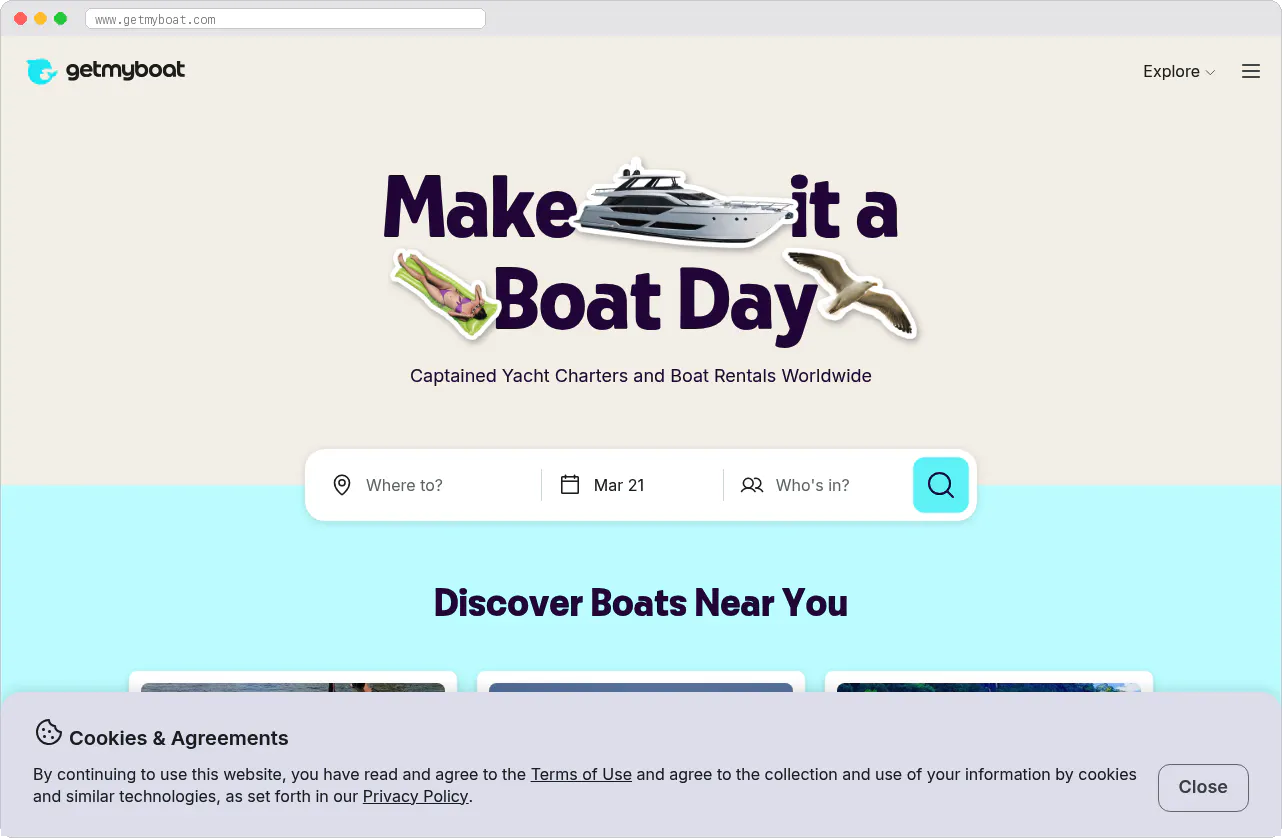
GetMyBoat launched in 2013 and grew to list over 150,000 boats across more than 9,300 destinations, and in December 2025 it merged with Boatsetter to form a combined marketplace (Getmyboat). It wins on breadth: jet skis, pontoons, sailboats, and superyachts all live on the same platform, in nearly every coastal or lake destination worth visiting. That breadth is also its weakness. A first-time renter searching for a simple pontoon rental for a birthday party sees the same interface as someone chartering a 60-foot yacht in Croatia, and the experience doesn't clearly differentiate between the two. A marketplace built around a specific use case (family day trips, fishing charters, sailing lessons) can offer a more focused, less intimidating experience than a generalist can.
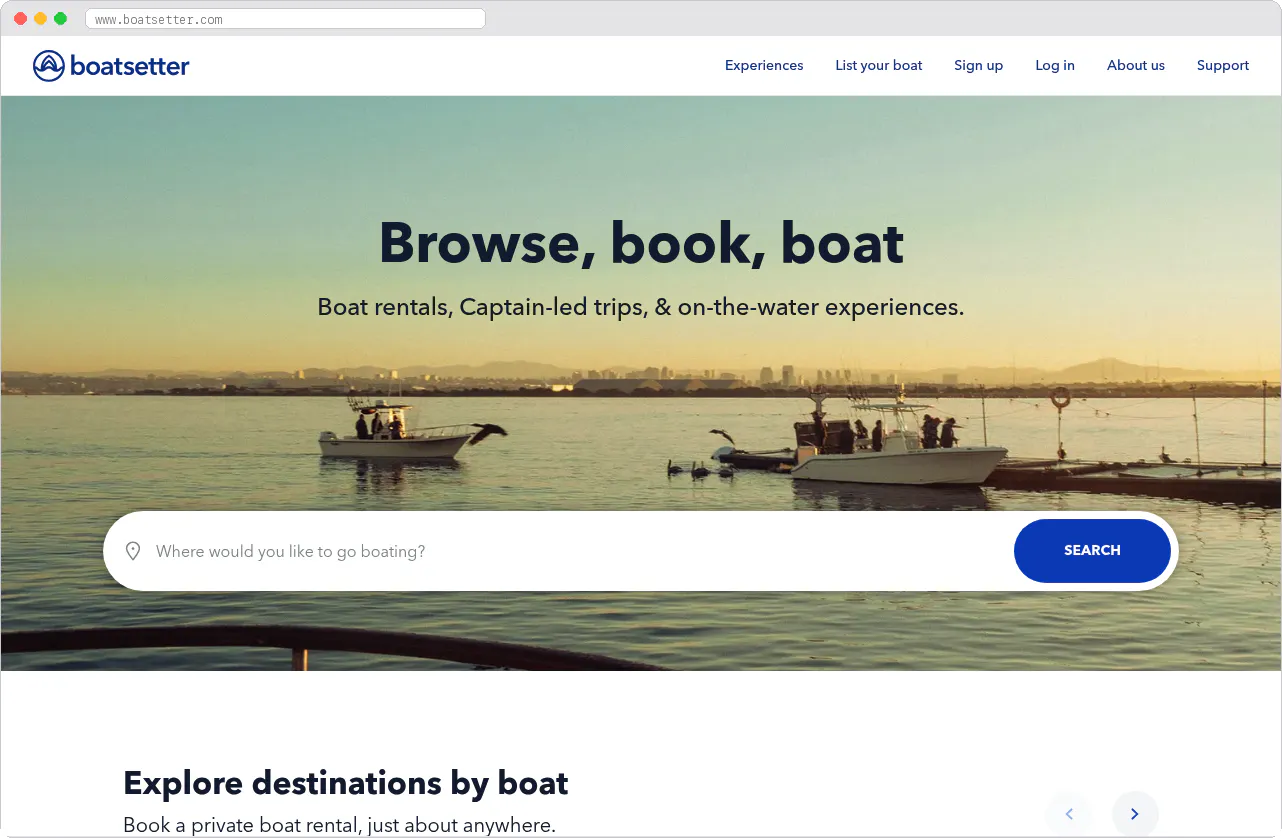
Boatsetter positions itself as the safety-first, full-service option. Insurance is mandatory on most bookings, and the platform pushes captain services heavily, which suits nervous first-timers and expensive vessels well. That same mandatory structure is friction for two experienced boaters who just want a simple peer-to-peer arrangement without paying for coverage and services they don't need. A leaner platform built for confident, experienced boat owners and renters has room to compete here.
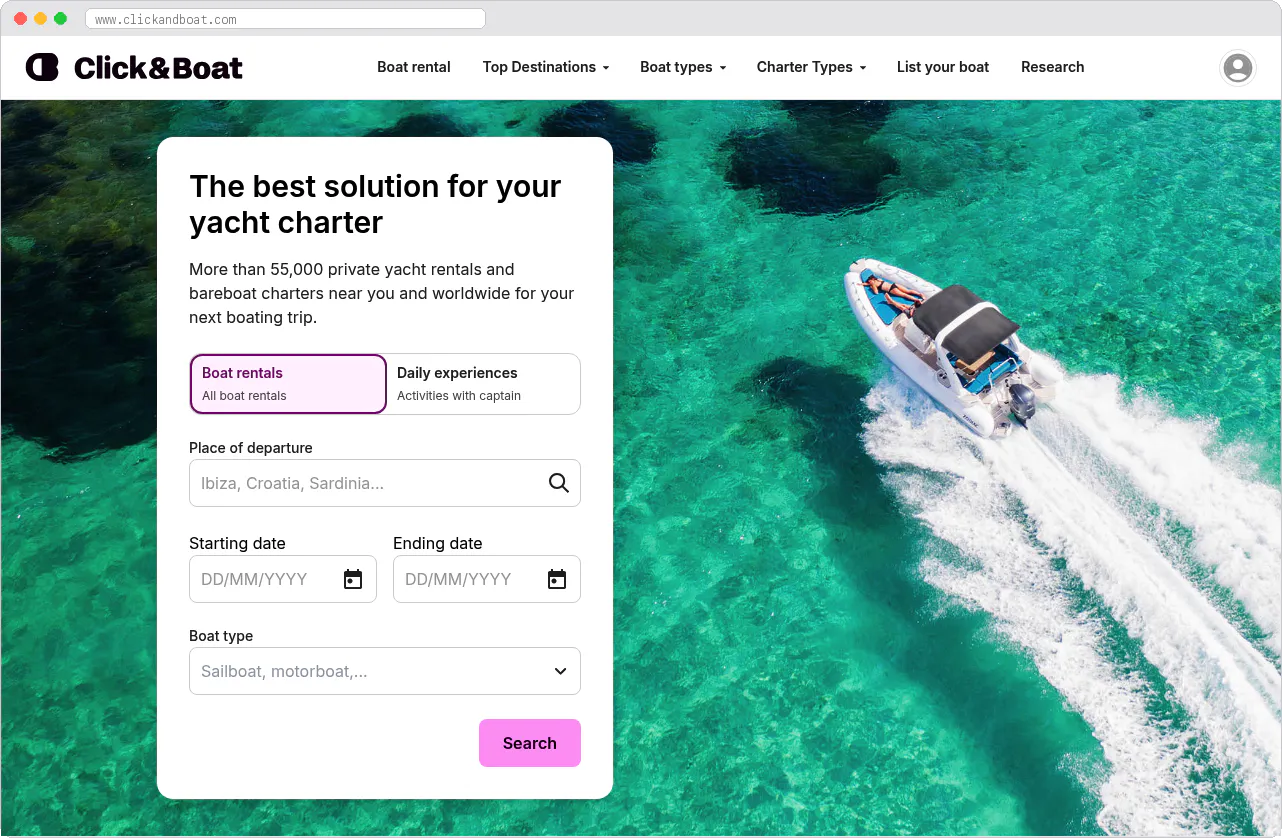
Click&Boat dominates the European and Mediterranean market with a freemium listing model that keeps owner costs low. Its geographic concentration is also its limitation: the platform has comparatively little presence in Asia-Pacific markets like Australia, Thailand, and Japan, where recreational boating is significant but marketplace infrastructure is thin. A regionally focused competitor could take meaningful share simply by showing up where Click&Boat hasn't.
Sailo takes the opposite approach to GetMyBoat's breadth: it focuses exclusively on sailing, offering skippered charters and sailing instruction rather than general powerboat inventory. It proves that narrow focus builds a stronger, more engaged community than trying to be everything to everyone, even at the cost of a smaller addressable market. Regional and category specialists like Nautal (Europe and Latin America), Float (Pacific Northwest), and Antlos (fishing charters) reinforce the same lesson: local knowledge of regulations, seasons, and boating culture beats a global platform's generic playbook in specific pockets.
The opening for a new entrant, across all these examples, is the same: generalist platforms serve the median case well but leave specific geographies, boat types, and use cases underserved. A founder who picks one of those gaps and builds for it deeply has a real shot.
Essential features for boat rental marketplaces
Use-case-driven search, not just location search. Renters usually know what experience they want (a fishing trip, a sunset cruise, a bareboat sail) before they know which specific boat they want. Filtering by boat type, capacity, experience level required, and captain-included status matters more than it does in most rental categories, where filtering is largely about price and dates.
Marine-specific listing detail. A boat listing needs to cover safety equipment (life jackets, flares, VHF radio), navigation tools (GPS, chart plotter, depth finder), fuel policy, cleaning protocol, and usage restrictions, in addition to standard photos and specs. Listings with 15-25 photos and a walkthrough video convert meaningfully better than sparse listings, because renters are trusting an unfamiliar vessel with their safety.
Weather-aware availability. A boat's calendar isn't just booked or free; it's booked, free, or weather-dependent. Surfacing forecasts, wind conditions, and sea state alongside availability, and giving owners an easy way to block dates for haul-outs or seasonal storage, prevents a large share of the disputes and cancellations that plague this category.
Insurance coordination. Most successful platforms either require or strongly encourage per-rental insurance, priced to vessel value, that activates only during the rental window. This needs to be built into the booking flow, not bolted on afterward, because it affects pricing, deposit amounts, and what happens when something goes wrong.
Captain and crew booking. A meaningful share of boat rentals, especially for larger vessels or inexperienced renters, involve a licensed captain. Supporting this turns the marketplace into a three-sided model: owners, renters, and captains, each with separate verification, availability, and payment needs.
Trip communication and planning tools. Boat rentals require more coordination detail than most rentals: pickup procedures, fuel expectations, local hazards, and emergency protocols. Messaging that supports this, plus lightweight route or anchorage suggestions, reduces no-shows and misunderstandings that otherwise turn into refund disputes.
Security deposits and delayed payouts. Damage claims are common enough in this category that holding funds until after the rental period, rather than paying owners out immediately, is close to mandatory. This protects both sides and gives the marketplace a mechanism to mediate disputes instead of being sidelined once money has already moved.
Two-way verified reviews. Because the assets are expensive and the safety stakes are real, renters need signal about an owner's boat and responsiveness, and owners need signal about a renter's experience level and care. Reviews tied to a completed, paid transaction carry far more weight than open reviews would.
How to build a boat rental marketplace
1. Define your niche and geography
Pick a specific region and, ideally, a specific use case before building anything. A marketplace for fishing charters in the Gulf Coast is a very different product from one for sailing instruction in the Pacific Northwest or pontoon rentals on a single large lake. Geographic density matters more here than in almost any other rental category, because a renter comparing three boats within twenty minutes of their launch point has a far better experience than one comparing three boats scattered across a state.
2. Validate demand before building
Talk to boat owners at marinas, boat shows, and sailing clubs about how they currently rent out (or wish they could rent out) their boats. Most are already doing this informally through classifieds or word of mouth, and their frustrations (finding trustworthy renters, handling payment, managing insurance) tell you exactly what a marketplace needs to solve. Talk to renters too: first-timers worry about safety and complexity, experienced boaters care mostly about selection and price, and your product needs to serve whichever group you're targeting first.
3. Choose your development approach
Vibe coding from scratch. AI tools like Cursor, Lovable, and Bolt can produce a working boat rental prototype quickly, complete with listings, a calendar, and a basic booking flow. That's genuinely useful for pressure-testing a concept with a few boat owners before you commit real money. It's a different question whether that output is ready to handle a security deposit and an insurance-backed transaction between two strangers. A documented Sharetribe experiment ran 60+ hours to reach demo quality but revealed a critical checkout exploit that would have allowed any user to manipulate transaction prices via a direct API call. For a category where the transaction values run into the thousands of dollars, that gap matters. Treat vibe coding as a prototyping tool, not a launch path.
Custom development from scratch. Hiring developers, who will likely use AI tools heavily themselves, gives you full control over every detail. For boat rentals, plan for the production-grade tier rather than a bare-bones MVP: insurance coordination, identity and license verification, escrow-style delayed payouts, and dispute handling push this into the $80,000-$200,000 range over 16-28 weeks (Codica, RaftLabs). A simpler version limited to listings, search, messaging, and basic payments could land at the $30,000-$80,000, 8-20 week tier, but few boat rental marketplaces can operate safely at that level of feature completeness given the liability involved. The low end of either range assumes an offshore team; a US or Western European team pushes toward the top. This path makes sense once you have requirements (a proprietary captain-matching algorithm, a deep marina management integration) that no existing platform can support.
Building on a marketplace operating system like Sharetribe. You start at roughly 90% done on the standard marketplace foundation: payments, user accounts, listing management, messaging, transaction flows, fraud detection, and compliance are already built. Your time and budget go toward what makes a boat rental marketplace specific: weather-aware availability, insurance flow, captain booking, and marine-specific listing fields. Three paths within this approach, which most founders combine:
- No-code builder. Configure boat listings with custom fields for vessel specs, safety equipment, and fuel policy, set up availability calendars with seasonal blocking, and launch a working, bookable marketplace from the Console in one to four weeks, without writing code.
- AI-assisted development. Connect Claude Code, Cursor, or Codex to Sharetribe's open APIs and open-source template to build weather API integration, captain-matching logic, or a custom insurance quote flow. Because Sharetribe handles the payment and compliance infrastructure underneath, AI-assisted development on top of it carries much lower risk than building the whole system from scratch.
- Custom code. Build directly on the developer platform for deeper integrations with marine insurance providers or marina management systems, or hire a specialist from Sharetribe's Expert Marketplace.
Most founders start with the no-code builder, launch, and then add features via AI tools or a developer once they know what their specific owners and renters actually need.
4. Solve the cold start problem
The cold start problem in boat rentals is sharper than in most categories because supply is scarce, seasonal, and geographically fixed. A boat in Miami is useless to a renter in Seattle, and a boat that's winterized in October doesn't exist as inventory again until spring. Two tactics work well here. First, go supply-first in a single tight geography: sign up 15-20 boat owners at one or two marinas before you spend a dollar on renter marketing, so the first renter who visits sees a real, bookable selection rather than an empty platform. Second, recruit from existing informal rental networks (classifieds, marina bulletin boards, boat club member lists) rather than trying to convert casual owners who've never rented before; owners who already rent understand the value exchange and need less persuasion.
Launching small and tight, one marina or one lake, beats launching broad across a whole coastline. A renter who finds five well-photographed, well-reviewed boats within a short drive trusts the platform more than one who finds fifty boats spread across a region with no depth in any one spot.
5. Launch with seasonally timed demand generation
Time your public launch to land just before peak boating season in your market, not mid-winter when demand is dormant. Content around local destinations, safety guidance, and boat-selection advice attracts organic search traffic from people actively researching a rental. Partnerships with waterfront restaurants, dive shops, fishing guides, and local tourism boards deliver warmer leads than generic paid search, because those partners already serve people who want to be on the water.
6. Scale features and geography once density is proven
Add insurance integration, captain booking, and weather notifications once you have consistent transaction volume to justify the operational overhead. Expand to a second geography only after your first market has real inventory depth and repeat bookings, since thin coverage across many markets creates a worse experience than strong coverage in one.
Trust and safety for boat rental marketplaces
Boat rentals carry higher physical and financial risk than almost any other peer-to-peer category. A renter with insufficient experience can damage a $150,000 asset or, worse, endanger themselves and others on the water. Weather can turn a routine outing into an emergency. And unlike a damaged power tool, a damaged boat often means an insurance claim, a police report, or a dispute over who was actually operating the vessel at the time of the incident.
Standard verification for this category includes identity verification for both owners and renters, boating license or experience-level confirmation where required by local law, and photo documentation of the vessel's condition before and after each rental. Liability waivers need to be jurisdiction-specific, since maritime and boating law varies significantly by state and country, and a waiver template written for Florida won't necessarily hold up in California or Ontario.
Sharetribe provides the foundation this category needs out of the box: secure payment processing with delayed payouts (useful for holding security deposits until after a damage-free return), user accounts with optional identity verification, structured transaction flows that can require confirmation steps before a booking finalizes, and two-way reviews tied to completed transactions. What founders need to add themselves is the marine-specific layer: insurance partnership integration, license or experience verification logic, and jurisdiction-specific waiver language, typically built through custom fields, transaction flow customization, or a developer-built integration with a marine insurance API.
Running your boat rental marketplace
Operations get more complex than a typical rental marketplace once you're live, mostly because of weather. Expect a meaningful share of bookings to require rescheduling or cancellation due to conditions, and build a clear, pre-communicated policy for how that's handled (credit, refund, rebooking) before your first weather event forces you to improvise. Customer service volume also runs higher than in dry-goods rental marketplaces, because questions about fuel, navigation, and safety come up mid-rental in ways that a rented camera or tool never prompts.
Sharetribe handles the transactional backbone automatically: payment capture and payout timing, messaging, booking confirmations, and review prompts don't require manual intervention as volume grows. AI agents layered on top can help with the parts that do scale with volume: drafting weather-related rebooking messages, flagging listings with incomplete safety information before they go live, and summarizing renter complaints for faster human triage. That leaves your team focused on the judgment calls (an actual damage dispute, a genuinely unsafe listing) that still need a person.
Development costs and timeline
Three realistic scenarios:
Vibe coding from scratch: Free or close to it to start, and a working boat rental prototype is buildable in days with tools like Lovable or Bolt. What you won't get from this path is a production-ready platform: secure escrow for security deposits, insurance flow, license verification, and dispute handling all require work AI coding tools don't shortcut. A documented Sharetribe experiment logged 60+ hours to reach demo quality and still turned up a critical payment vulnerability. Useful for testing whether owners and renters in your area are interested; not a sound foundation for handling real deposits and insurance-backed bookings.
Custom development from scratch: A simple boat rental MVP (listings, search, messaging, basic payments) runs $30,000-$80,000 and ships in 8-20 weeks. A production-grade build with reviews, identity and license verification, escrow-style payouts, and dispute flow runs $80,000-$200,000 over 16-28 weeks (Codica, RaftLabs). Boat rentals generally belong in the second tier because insurance coordination, deposit handling, and safety verification aren't optional extras here, they're baseline requirements for launching responsibly. The low end assumes an offshore team; a US or Western European team pushes toward the top of the range. Ongoing maintenance typically runs 15-25% of the build cost per year, and this path makes sense once you need integrations or workflows no existing platform supports.
Building on Sharetribe: Before you launch, the Sharetribe Build plan costs just $39/month. To open to real users, you need the Live plan, which costs $199/month billed yearly ($259/month billed monthly). Both plans include 1 million usage credits per month. Sharetribe covers the payment processing, booking and availability engine, user accounts, messaging, and compliance infrastructure that a boat rental marketplace needs as a baseline, so your build effort goes into marine-specific fields, weather integration, and insurance flow rather than rebuilding the transaction engine. Most founders reach a live, bookable marketplace in one to four weeks, then extend it with AI-assisted development or a developer as demand grows.
Why Sharetribe works for boat rental marketplaces
Sharetribe's built-in availability and booking system already handles the core scheduling logic a boat rental marketplace needs: multi-day bookings, calendar blocking for maintenance or storage, and commission-based payment splitting between owner and marketplace, with Stripe Connect handling payout compliance across jurisdictions. Two-way reviews and optional identity verification are available from day one, which matters in a category where trust between strangers renting an expensive, potentially dangerous asset is the whole product.
The parts that are genuinely unique to boat rentals (weather-aware availability, insurance partnership flows, captain booking as a third marketplace side) are exactly what the developer platform and AI-compatible architecture are built for. Because Sharetribe exposes open APIs and works with a standard web stack, a founder can point Claude Code or Cursor at the platform to build a captain-matching feature or a weather API integration without touching the payment and compliance layer underneath it. That division of labor, standard infrastructure handled, niche features built on top, is what lets a small team compete with platforms like GetMyBoat or Boatsetter on user experience without needing their engineering headcount.
Frequently asked questions
How much does it cost to build a boat rental marketplace?
Custom development for a production-grade platform typically runs $80,000-$200,000 and takes 16-28 weeks, given the insurance, verification, and dispute-handling requirements involved. Building on Sharetribe costs just $39/month on the Build plan after a 14-day free trial (the Live plan for running your marketplace is $199/month billed yearly), with most founders launching in one to four weeks. Add ongoing costs for insurance partnerships, legal compliance, and customer support regardless of which path you choose.
What features are essential for a boat rental marketplace?
Location and use-case-based search, marine-specific listing detail (safety equipment, fuel policy, usage restrictions), weather-aware availability, insurance coordination, and two-way verified reviews are the core set. Captain and crew booking becomes essential once you serve larger vessels or inexperienced renters.
How do boat rental marketplaces make money?
Most charge commission of roughly 6-15% combined across renters and owners, similar to GetMyBoat's and Boatsetter's structures. Additional revenue comes from mandatory or optional insurance products, captain referral fees, and premium listing placement.
Who are the main competitors in boat rental marketplaces?
GetMyBoat is the largest global platform with over 180,000 boats listed (Getmyboat), Boatsetter focuses on premium, insurance-included experiences, Click&Boat leads in Europe, and Sailo specializes in sailing. Regional players like Nautal and Float serve specific geographies well.
Do I need to require insurance on every rental?
Most successful platforms require it, given the value of the asset and the physical risk involved, and price it into the transaction rather than leaving it optional. Boatsetter makes insurance mandatory on nearly all bookings; a founder skipping this step should have a clear legal reason and strong waiver language in its place.
How do I find boat owners to list on my platform?
Start with marina partnerships, boat clubs, sailing associations, and owners already renting informally through classifieds or word of mouth. These owners already understand the operational and insurance realities of rentals, which makes them far easier to onboard than a casual owner who has never rented before.
Start your 14-day free trial
Create a marketplace today!
- Launch quickly, without coding
- Extend infinitely
- Scale to any size
No credit card required