How to build an event venue marketplace
Event venue marketplaces connect planners with unique spaces, from warehouses to rooftops. This guide covers the business model, essential features, development approaches, and costs to launch your own platform.
Published: Dec 19, 2023
Last updated: Sep 18, 2026
What is an event venue marketplace?
An event venue marketplace connects people who own or manage bookable spaces (warehouses, mansions, rooftops, galleries, backyards, conference rooms) with people who need a space for a specific occasion (weddings, corporate offsites, photo shoots, birthday parties, product launches). The platform handles discovery, availability, booking, and payment, and takes a cut of each transaction.
It differs from a general short-term rental marketplace in one important way: the unit of value isn't a night of sleep, it's a few hours or a full day of exclusive access to a space configured for a specific kind of event. Pricing, cancellation policies, capacity rules, and add-on services (catering, AV, setup crews) all revolve around that event-based use case rather than overnight stays. It also differs from a venue directory, which just lists contact information and leaves the negotiation and payment entirely offline.
The category has real commercial precedent. Peerspace has processed bookings across hundreds of cities since launching in 2014 (Peerspace). Splacer raised a fraction of that amount (roughly $8 to $10 million) and closed its service in 2025 (Splacer). Smaller, more focused players like VenueBook and Giggster show that the model works even without Peerspace-scale funding, as long as the niche is clearly defined.
How the business model works
Commission on booking value is the dominant revenue model. Peerspace charges venue hosts a 20% service fee, plus a separate processing fee charged to the guest (Peerspace); Splacer permanently closed in April 2025 and no longer operates. A blended take rate of 15-25% across both sides is a reasonable target range for a new venue marketplace, higher than typical product marketplaces because venue bookings involve more platform work: photography standards, availability management, insurance verification, and higher-touch customer support.
Secondary revenue streams matter more in this category than in many others. Featured or boosted listings let venue owners pay for visibility during competitive search results. Some platforms sell event insurance or damage protection as an add-on, taking a cut of the premium. A few, like Splacer, layer in curated services (catering partners, event planners, AV vendors) and earn referral commissions on top of the venue commission itself.
Average transaction values are high compared to most service marketplaces, often $500 to $10,000 per booking, which means a smaller number of monthly transactions can still generate meaningful revenue. That also raises the stakes on trust and payment security, since a single failed booking or double-booked date is a much bigger deal to your users than a failed $40 product order.
The competitive landscape
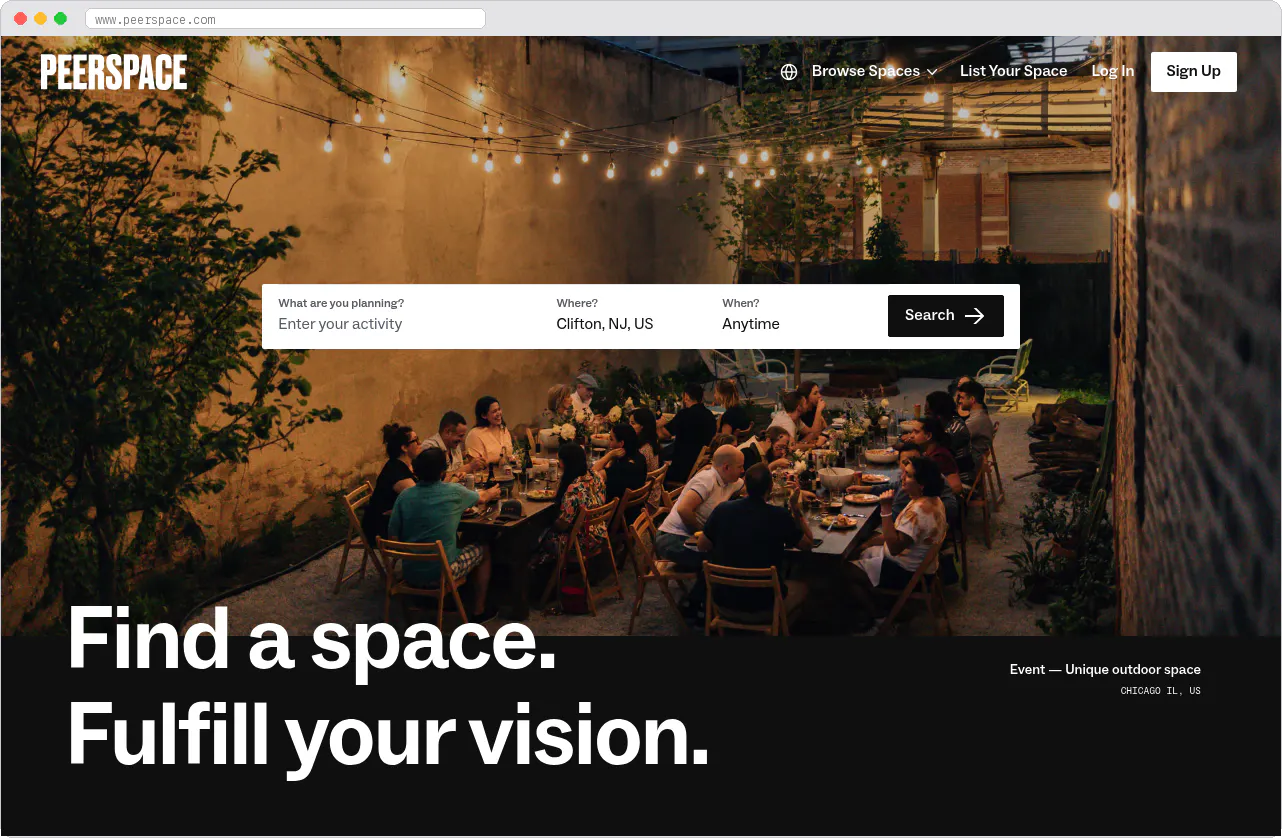
Peerspace is the category leader on inventory breadth. It built its base on unusual creative spaces for photo and video shoots, then expanded into corporate events, private parties, and meetings. Its advantages are scale (300+ cities), a professional photography program that raises listing quality, and an instant-booking system that reduces friction for smaller events. Where it falls short is depth in any single vertical: because it tries to serve creative shoots, weddings, and corporate meetings all at once, none of those segments gets the specialized fields (AV specs for corporate planners, floor plans for weddings) that a focused competitor could offer. That gap is the opening for niche venue marketplaces built around one event type or one city.
Splacer positions itself as the premium, design-forward alternative, with a heavier vetting process on both venues and events and a focus on corporate clients who'll pay more for a distinctive space. It has expanded internationally more aggressively than most competitors. Its trade-off is price and volume: the higher bar for entry means a smaller inventory than Peerspace, which limits options for planners with modest budgets or non-corporate events.
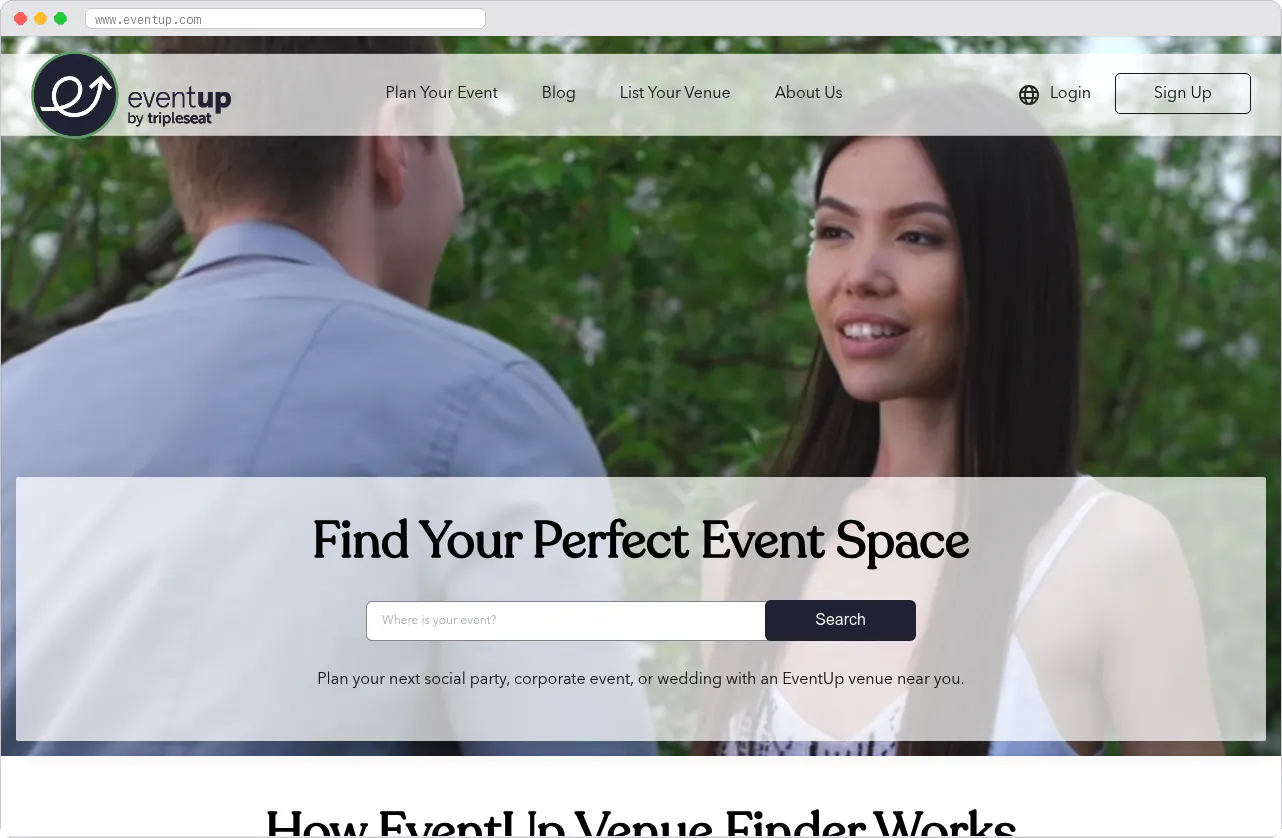
Eventup operates more like a lead-generation directory than a true marketplace. It connects planners to venues but leaves much of the negotiation, contracting, and payment offline. That works for complex events that need heavy customization, but it means Eventup never captures the transaction itself, which caps its revenue potential and leaves planners without the booking certainty a true marketplace provides.
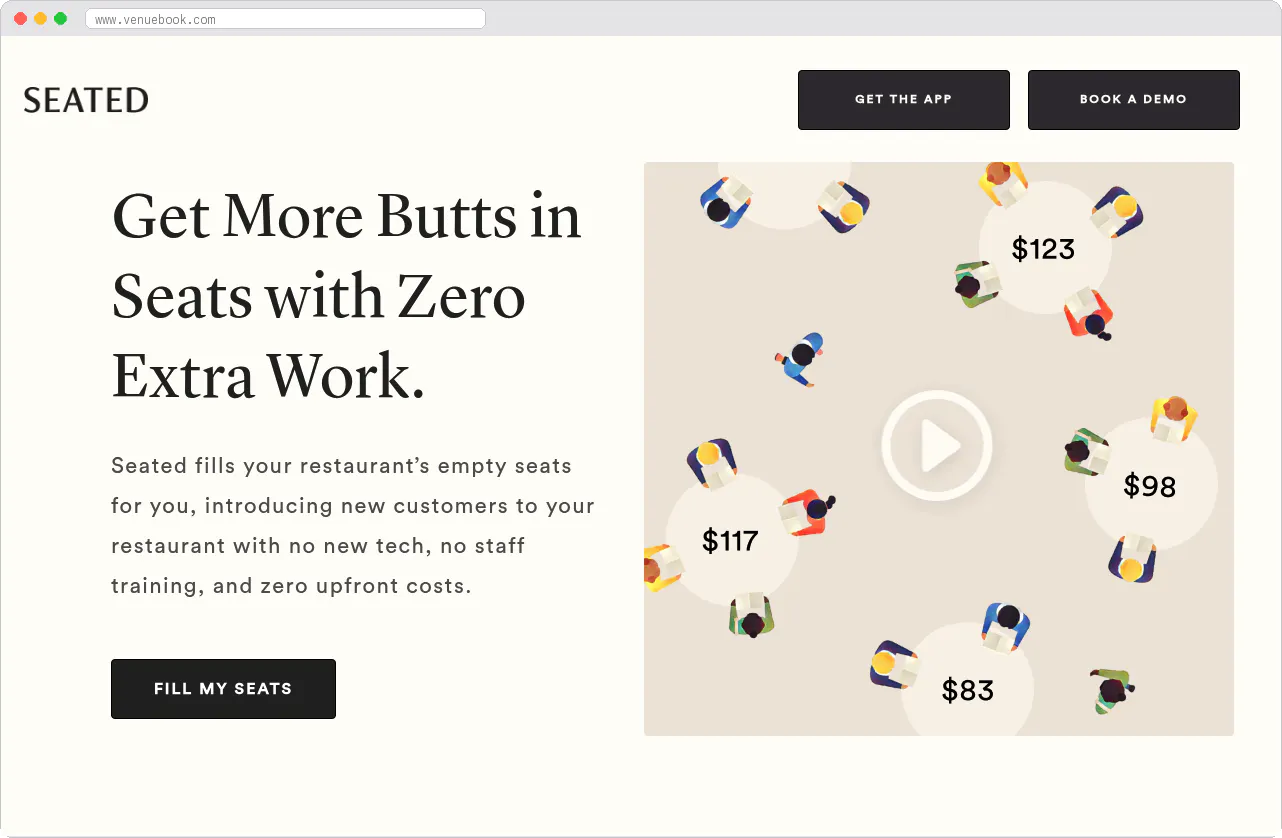
VenueBook focuses narrowly on meeting and conference spaces for corporate clients, with detailed fields for AV capability, catering options, and business amenities that generalist platforms don't prioritize. Its narrowness is also its ceiling: it doesn't serve weddings, parties, or creative shoots, so it can't capture demand outside corporate bookings.
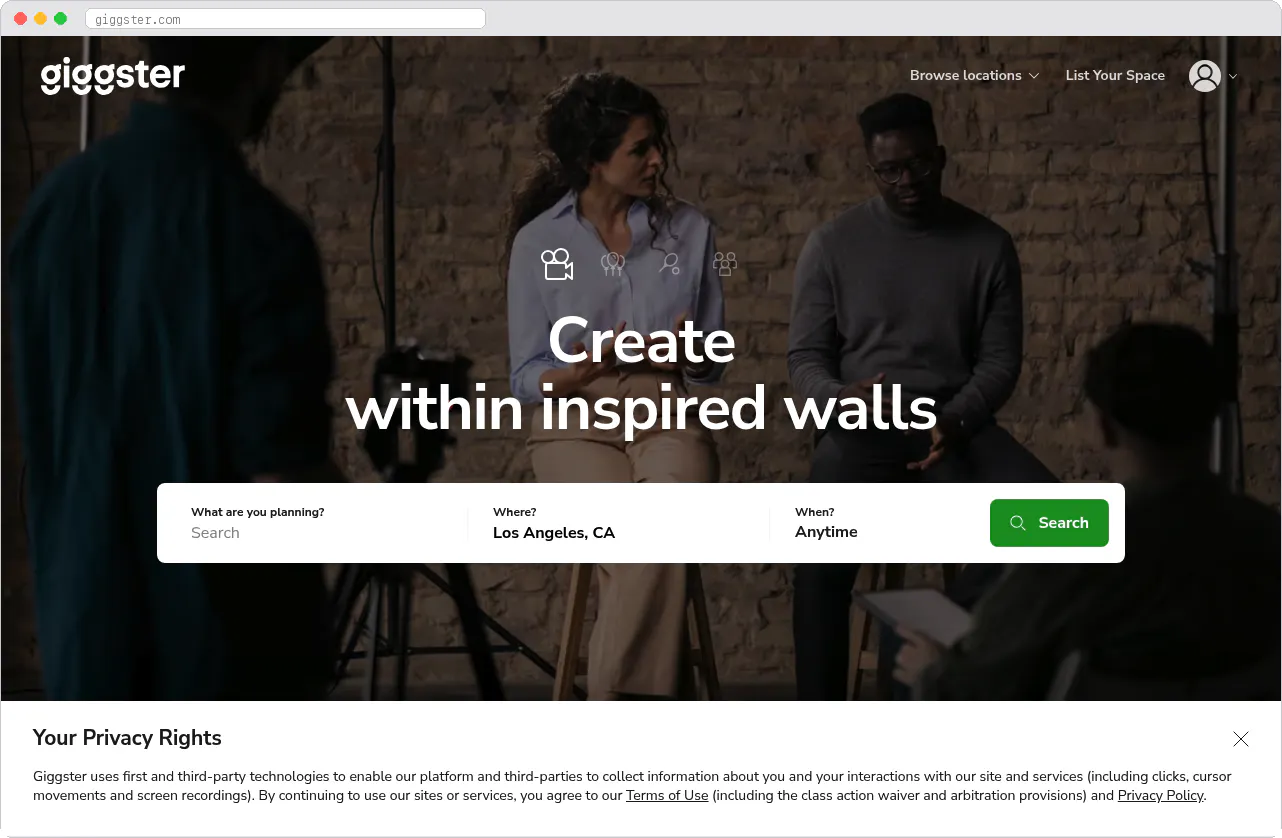
Giggster started in film and photo locations, where technical specs (power access, parking for crew, sound isolation) matter more than aesthetics alone, then expanded into general events. Its strength is depth of listing information for a specific professional use case; its challenge, like VenueBook's, is that broadening beyond that original niche means competing head-on with Peerspace's larger inventory.
Across all five, the pattern is clear: broad platforms win on inventory, focused platforms win on depth of information and vetting for one segment. If you can identify an event type, region, or venue style none of them serve well, there's a real opening.
Essential features for event venue marketplaces
Location and map-based search. Planners filter primarily by neighborhood, proximity to transit or parking, and travel distance for out-of-town guests, so search needs accurate geolocation and a map view, not just a list of results sorted by relevance.
Capacity and layout filtering. Unlike most rental categories, "how many people fit" changes based on event configuration (seated dinner vs. standing reception vs. theater-style meeting), so venue profiles need multiple capacity figures per layout type, not a single number.
Availability calendars with hold periods. Event bookings often need setup and breakdown time blocked around the event itself, plus the ability to place a tentative hold while a planner finalizes details, which is different from the instant-or-nothing booking logic in most product marketplaces.
Rich media: photos, floor plans, and virtual tours. Planners are booking a physical experience for their own guests sight unseen in most cases, so listing quality (professional photography, floor plans, 360-degree tours) has an outsized effect on booking conversion compared to text descriptions alone.
Flexible, tiered pricing. The same room might have a different rate for a corporate breakfast, an evening wedding reception, and a full-day film shoot, so the pricing engine needs to support multiple rate structures per listing, not one flat hourly or daily rate.
Inquiry-to-booking workflows. High-value, one-off bookings (a wedding, a product launch) usually need a back-and-forth before confirmation, so the platform needs both instant booking for simple, lower-value events and an inquiry/approval flow with messaging for complex ones.
Deposit and split payment handling. Because event bookings are often made months in advance, the payment flow needs to support a deposit at booking and a balance due closer to the event date, with funds held securely until the event is confirmed to have happened as agreed.
Insurance and damage deposit tracking. Given the risk of property damage at parties and large gatherings, listings need fields for required insurance documentation and a mechanism for collecting and, if necessary, returning a damage deposit.
Two-way reviews with context. A wedding reception and a corporate meeting create very different experiences in the same room, so reviews need to capture the event type booked, not just a generic star rating, so future planners can judge relevance.
How to build an event venue marketplace
1. Define your niche and geography
Decide upfront whether you're serving one event type (weddings, corporate offsites, photo shoots) or one metropolitan area with mixed event types. Peerspace succeeded by starting narrow (creative shoots) before broadening; VenueBook and Giggster stayed narrow and built defensible positions. Trying to be broad and multi-city on day one, with no funding behind you, spreads your venue acquisition effort too thin to reach a workable inventory in any single segment.
2. Validate demand with real conversations
Talk to venue owners about their current booking rate, their pain points with existing channels (word of mouth, Instagram DMs, Eventup-style directories), and what they'd pay for consistent, qualified leads. Talk to planners about how they currently find venues and what makes them hesitant to book somewhere new sight unseen. This should take two to four weeks and directly shapes which features you prioritize at launch.
3. Choose your development approach
Vibe coding from scratch. AI tools like Cursor, Lovable, and Bolt can produce a working venue-booking prototype quickly, useful for pressure-testing a concept or showing early venue owners what you have in mind. For a platform handling real deposits and damage protection between strangers, they're probably not sufficient on their own. What vibe-coded output reliably doesn't produce is the infrastructure underneath: payment escrow, dispute resolution, fraud detection, and compliance. A documented Sharetribe experiment ran 60+ hours to reach demo quality but revealed a critical checkout exploit that would have let any user manipulate transaction prices via a direct API call. Bringing that output to production standard takes significant additional time and a clear understanding of how the pieces fit together. A useful prototyping tool, not a cost-effective path to launch.
Custom development from scratch. Hiring developers gives you full control over the booking logic and design. For an event venue marketplace, a production-grade build (reviews, identity verification, escrow, deposit and damage-deposit handling, dispute flow) is the right tier given the transaction values and trust requirements involved: expect $80,000-$200,000 and 16-28 weeks (Codica, RaftLabs). The low end assumes offshore teams at $15-40/hr; US or Western European teams push toward the top. This makes sense once you have very specific requirements, such as a proprietary insurance integration, that no existing platform can support.
Building on a marketplace operating system like Sharetribe. You start at roughly 90% done on the standard marketplace foundation: payments, user accounts, listing management, messaging, transaction flows, fraud detection, and compliance. Your time and budget go toward venue-specific features instead of rebuilding the basics. Three paths within this approach, which most founders combine:
- No-code builder. Configure venue listing types with capacity fields per layout, availability calendars with buffer time, tiered pricing by event type, and inquiry-plus-instant booking flows, all from the Console. Gets you to a live, bookable marketplace in one to four weeks.
- AI-assisted development. Connect Claude Code, Cursor, or Codex to Sharetribe's open APIs and open-source template to build things like a floor-plan upload tool, a damage-deposit calculator, or a corporate-specific AV specification field. Because Sharetribe handles payment and compliance infrastructure underneath, this carries much lower risk than building the same features from scratch.
- Custom code. Build directly on the developer platform for deeper integrations (an insurance provider API, a CRM for high-volume corporate accounts), or hire from Sharetribe's Expert Marketplace.
Most founders start with the no-code builder, launch, and then add custom features via AI or a developer once they know what venue owners and planners actually need.
4. Solve the cold start problem
The chicken-and-egg problem here is acute: planners won't return to a platform with thin, low-quality inventory, and venue owners won't invest in good photos and profiles for a platform with no booking volume yet. The fix used by every successful venue marketplace, including Peerspace in its earliest days, is supply-first. Recruit 20-50 high-quality venues in a single city or niche before doing any real planner-facing marketing, so the first planners who find you see a genuinely attractive selection rather than three empty-looking listings.
Two tactics work well in practice. First, do manual, high-touch outreach to venue owners you'd want on the platform anyway, and offer to shoot professional photos yourself for the first cohort, since photo quality drives conversion more than almost any other factor in this category. Second, stay geographically and categorically tight: one city, one or two event types, rather than "everywhere, everything," so your limited early inventory still looks comprehensive to a planner searching within it.
5. Set pricing, policies, and trust rules
Decide your commission structure (a 15-20% host-side fee is a reasonable starting benchmark, in line with Peerspace and Splacer), your cancellation policy tiers, and your deposit/damage-deposit rules before you onboard your first venue, since these are much harder to change retroactively once owners have expectations set.
6. Launch, gather feedback, and expand deliberately
Track inquiry-to-booking conversion, response time from venue owners, and repeat booking rate from planners as your core early metrics. Expand to a new city or event category only once your first market shows healthy conversion and repeat usage, since spreading acquisition effort across markets before you've proven the model in one usually stalls growth in all of them.
Trust and safety for event venue marketplaces
Venue bookings carry higher financial and physical-safety stakes than most marketplace categories. A planner is trusting a space they've likely never visited in person to host dozens or hundreds of guests, sometimes with alcohol, amplified sound, or open flame involved. A venue owner is trusting a stranger not to damage a physical property that may be worth hundreds of thousands of dollars. Both sides need real reassurance before they'll transact.
Standard verification steps include confirming venue ownership or management authority before a listing goes live, requiring proof of general liability insurance (and event-specific coverage for larger gatherings), and collecting refundable damage deposits held separately from the booking payment. Two-way reviews that capture event type help future users judge relevance, since a venue that's great for a corporate breakfast may be a poor fit for a 200-guest wedding reception.
Sharetribe provides the transactional backbone this all sits on: secure payment processing and escrow through Stripe, user accounts with optional identity verification, structured transaction flows that can require a hold or deposit before confirming a booking, and messaging that keeps all communication auditable within the platform. What you add yourselves are the category-specific rules: insurance document collection, damage deposit logic, and your own policy on what happens when a venue is misrepresented or an event causes damage, since no software vendor can adjudicate those disputes for you.
Running your event venue marketplace
Once live, the operational load shifts from building to managing relationships on both sides. Venue owners expect fast responses to inquiries, since a slow reply on a time-sensitive event date loses the booking entirely; planners expect clear, reliable communication about what's confirmed versus tentative. Seasonal demand swings hard in this category too: wedding-focused venues peak in spring and summer, while corporate meeting spaces see steady weekday demand and near-empty weekends, so your marketing and venue mix should account for that rhythm rather than assume flat demand year-round.
Sharetribe automates the parts that would otherwise consume your team's time: booking confirmations, calendar blocking to prevent double-bookings, payment capture and payout scheduling, and automated reminder emails to both sides as an event date approaches. AI agents connected to your operations can go further, drafting personalized outreach to underperforming venue owners, flagging listings with stale photos or missing information, and summarizing planner feedback trends by event type, freeing your team to focus on relationship-building and quality control rather than repetitive admin work.
Development costs and timeline
Three realistic scenarios:
Vibe coding from scratch: Free or very cheap to start, and a working venue-browsing prototype is buildable in a few days with AI tools. What you can't get from here is a production-ready platform: escrow that actually holds deposit and balance payments correctly, damage-deposit refund logic, insurance document verification, and calendar systems that reliably prevent double-bookings all require work AI coding tools don't shortcut. A documented Sharetribe experiment logged 60+ hours to reach demo quality and still turned up a critical payment vulnerability. A useful proof-of-concept tool, not a cost-effective path to a live business.
Custom development from scratch: A simple venue-listing MVP (browsing, search, messaging, basic payments, no deposit or insurance logic) runs $30,000-$80,000 over 8-20 weeks. A production-grade build with reviews, identity verification, escrow, deposit handling, and dispute flow, which is the appropriate tier for a real venue marketplace given the transaction values involved, runs $80,000-$200,000 over 16-28 weeks (Codica, RaftLabs). The low end assumes offshore development teams; US and Western European teams push toward the top of the range. Ongoing maintenance typically runs 15-25% of the original build cost per year on top of hosting. This route makes sense once you need something no existing platform offers, such as a fully proprietary insurance underwriting integration.
Building on Sharetribe: Before you launch, the Sharetribe Build plan costs just $39/month. To open to real users, you need the Live plan, which costs $199/month billed yearly ($259/month billed monthly). Both plans include 1 million usage credits per month. Sharetribe covers the payment infrastructure, booking and calendar logic, user accounts, messaging, and review system that a venue marketplace needs from day one. Most founders reach a live, bookable marketplace in one to four weeks, then add venue-specific features like floor-plan uploads or damage-deposit workflows through AI-assisted development or a developer as they learn what their market actually needs.
Why Sharetribe works for event venue marketplaces
Sharetribe's marketplace operating system covers exactly the foundation this category needs without custom-building it: booking transaction flows that support deposits and inquiry-then-approval workflows, calendar-based availability to prevent double-bookings, Stripe-powered payment processing with the ability to hold funds until a booking is confirmed, and a flexible listing schema you can extend with venue-specific fields like capacity-per-layout or required insurance documentation. Two-way reviews and optional identity verification address the trust requirements this category demands.
Because the platform is built on open APIs and a standard web stack, it's also AI-compatible: you can connect Claude Code, Cursor, or Codex to build the venue-specific pieces (floor-plan tools, damage-deposit calculators, corporate AV spec fields) on top of a foundation that already handles payments and compliance correctly. That's a meaningfully different starting point than building the payment and booking logic yourself from zero, where a small mistake in escrow logic can be the difference between a working business and a checkout exploit.
Frequently asked questions
How much does it cost to build an event venue marketplace?
It depends on your approach. A Sharetribe-based marketplace costs $39/month on the Build plan ($199/month billed yearly on the Live plan once you go live) in subscription fees, with most founders spending $3,000-10,000 in the first year including design and marketing. A custom-built platform with the trust and payment features this category needs typically runs $80,000-$200,000 upfront, plus 15-25% of that per year in maintenance.
What features do event venue marketplaces need?
The essentials are location-based search with mapping, capacity filtering by event layout, availability calendars with setup/breakdown buffers, flexible per-event-type pricing, deposit-capable payments, insurance and damage-deposit tracking, and two-way reviews. High-quality photos and floor plans matter more here than in most rental categories since planners are booking sight unseen.
How do event venue marketplaces make money?
Most charge a commission of roughly 15-20% on the venue owner's side, sometimes with an additional fee to the person booking. Featured listings, insurance add-ons, and referral partnerships with catering or AV vendors are common secondary revenue sources.
How long does it take to build a venue marketplace?
A Sharetribe-based marketplace can launch in one to four weeks using the no-code builder. Custom development for a production-grade platform with escrow and identity verification typically takes 16-28 weeks, and vibe-coded prototypes, while fast to produce, aren't production-ready without significant additional work.
Who are the main competitors to Peerspace?
Splacer competes on premium, design-forward spaces for corporate and creative clients. VenueBook focuses specifically on corporate meeting and conference spaces. Eventup operates more like a venue directory with lead generation than a true booking marketplace, and Giggster started in film and photo locations before expanding into general events.
What's the biggest challenge in launching a venue marketplace?
Building enough high-quality supply before you market to planners is the hardest early problem, since a marketplace with thin, poorly photographed inventory loses planners' trust immediately. Most successful launches recruit 20-50 strong venues in one city or niche before doing broader marketing, prioritizing listing quality over listing count.
Start your 14-day free trial
Create a marketplace today!
- Launch quickly, without coding
- Extend infinitely
- Scale to any size
No credit card required