How to build an online counseling marketplace
The mental health market is experiencing unprecedented demand, creating opportunities for counseling marketplaces. This guide covers how to build a platform connecting therapists with clients, from essential features to launching your MVP and competing with established players like BetterHelp.
Published: Dec 21, 2023
Last updated: Sep 18, 2026
What is a counseling marketplace?
A counseling marketplace is a two-sided platform that connects people seeking mental health support with licensed therapists, matching them by need, specialty, and availability, then handling scheduling, secure communication, and payment inside the platform. It differs from a therapist directory in one crucial way: a directory hands over a phone number and steps aside, while a marketplace owns the relationship from first contact through recurring sessions, taking a cut of every transaction along the way.
The appointment-based, recurring nature of counseling sets it apart from most other service marketplaces. A single client might book weekly sessions with the same therapist for months or years, which means the platform isn't just facilitating a transaction, it's underwriting an ongoing relationship. That creates strong lifetime-value economics, but it also raises the compliance bar: mental health data is protected health information, therapists are licensed professionals bound by state law, and a bad match or a mishandled crisis has consequences a marketplace for dog walking or furniture never has to consider.
Adjacent categories matter here too. Telehealth platforms that connect patients with physicians solve a related but distinct problem (see our guide on building a website like Practo), and coaching marketplaces serve a similar audience with a lighter regulatory load (see how to build a life coaching marketplace). Counseling marketplaces sit at the intersection: they need the trust infrastructure of healthcare and the matching, discovery, and payment mechanics of a marketplace.
How the business model works
Most counseling marketplaces earn money by taking a cut of what clients pay for sessions, typically structured as a commission on the therapist side, a subscription on the client side, or both. BetterHelp uses a client-facing subscription model, charging around $260 to $400 per month for unlimited messaging plus scheduled live sessions, and pays therapists a set rate per session out of that pool (BetterHelp). Talkspace runs a similar subscription structure for direct-to-consumer clients but also bills insurance and employers directly for the majority of its revenue (Fierce Healthcare).
Commission-only models, where the platform takes a percentage of each session fee and the client pays per session rather than subscribing, are more common among smaller and niche platforms. Commission rates in the 20% to 30% range are typical for platforms that want to remain attractive to therapists building outside client bases, while rates approaching 50% appear on platforms that provide heavy client acquisition and administrative support in return. A blended take rate of 20% to 30% is a reasonable target for a new entrant: high enough to sustain the business, low enough that quality therapists don't feel squeezed out.
Beyond commissions and subscriptions, secondary revenue streams include client booking fees, premium matching or "priority access" tiers, employer and insurance partnership fees, and paid content or courses. Insurance billing integration, where the platform verifies benefits and processes claims on the client's behalf, is increasingly a differentiator rather than a nice-to-have, since out-of-pocket therapy costs remain a major barrier for many prospective clients.
The competitive landscape
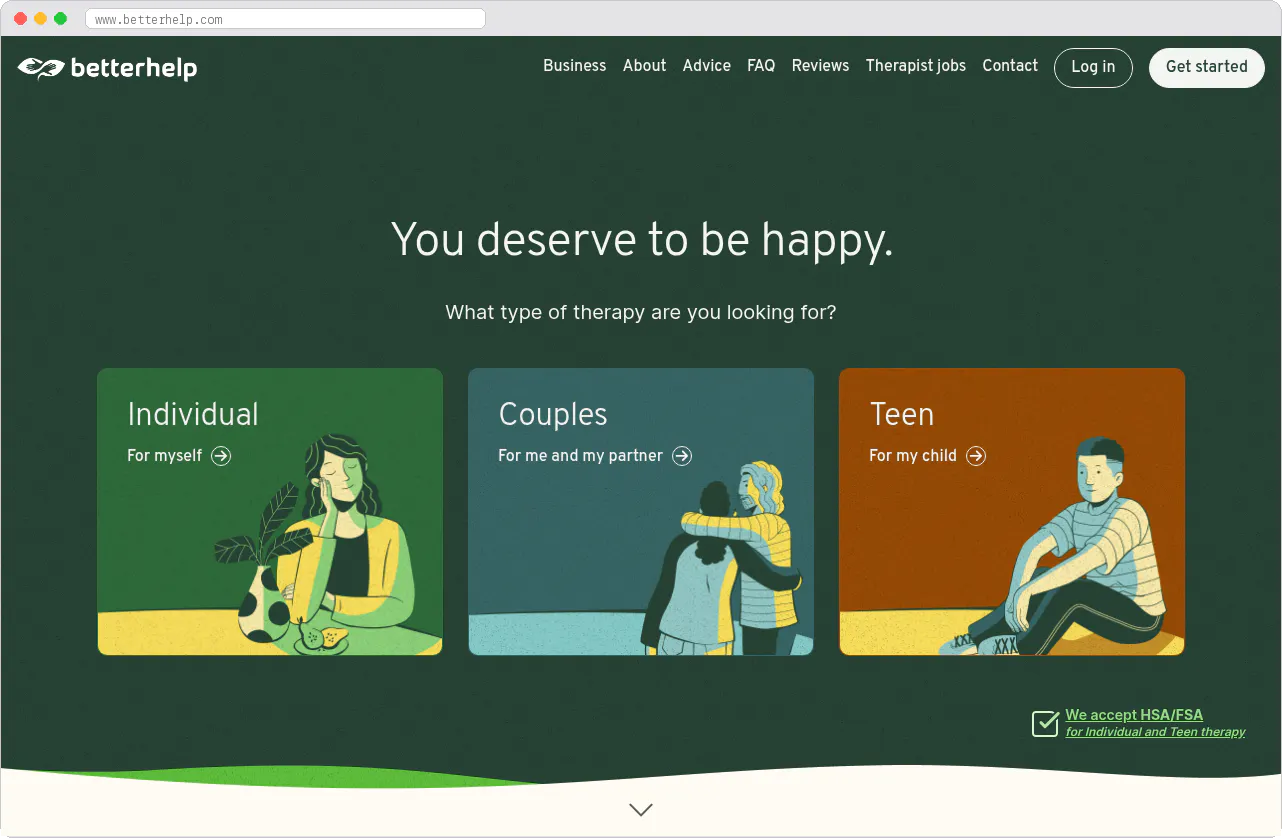
BetterHelp is the category's dominant player and the platform most people think of first when they hear "online therapy." Its subscription-for-unlimited-messaging model, backed by an advertising and marketing budget of $558.8 million in 2024, made online counseling mainstream (Teladoc Health 10-K). Its weakness is well documented among therapists: session pay is often lower than private-practice rates, and the platform's scale means matching sometimes favors speed over fit. That gap, between "fast and generic" and "slower but well-matched," is exactly where niche and quality-focused competitors find room to operate.
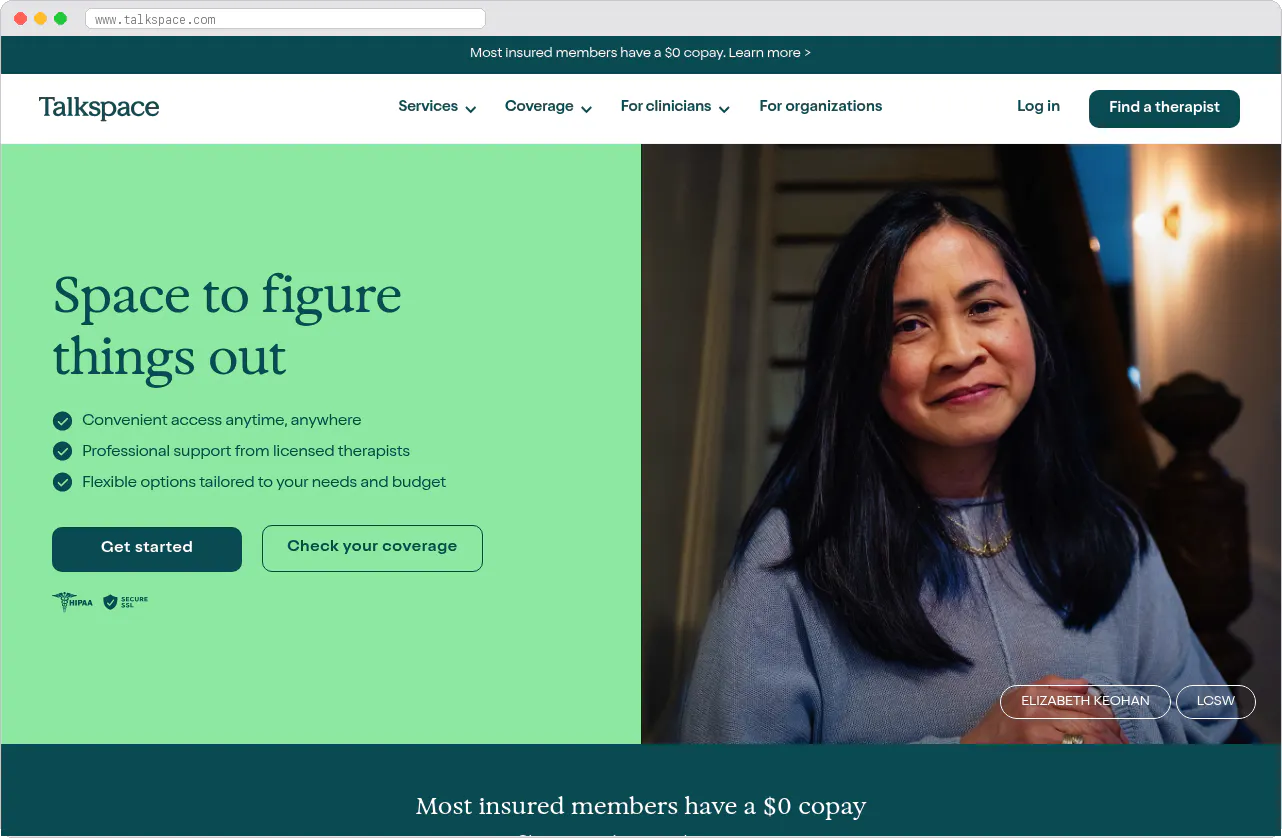
Talkspace differentiates through asynchronous, text-first therapy and deep corporate and insurance partnerships, letting therapists manage more clients per week than they could with live sessions alone. That scalability is the platform's strength and its limitation in the same breath: clients who want a real-time conversational relationship, rather than a message-and-wait cadence, often look elsewhere.
Psychology Today operates as a directory, not a marketplace: therapists list themselves, clients contact them directly, and all scheduling and payment happens off-platform. Its enormous database and search visibility make it the internet's default starting point for therapist discovery, but the lack of integrated booking, messaging, or payment means the entire experience after "I found someone" is left to the client and therapist to sort out manually. That's friction a true marketplace can remove.

7 Cups occupies a different tier of the market: free peer support from trained volunteers, with a paid tier for licensed counselor access. It demonstrates that "mental wellness" is a broader category than "clinical therapy," and that network effects (supporters who were once seeking support themselves) can drive growth, though revenue per user is thin compared to fee-for-service therapy platforms.
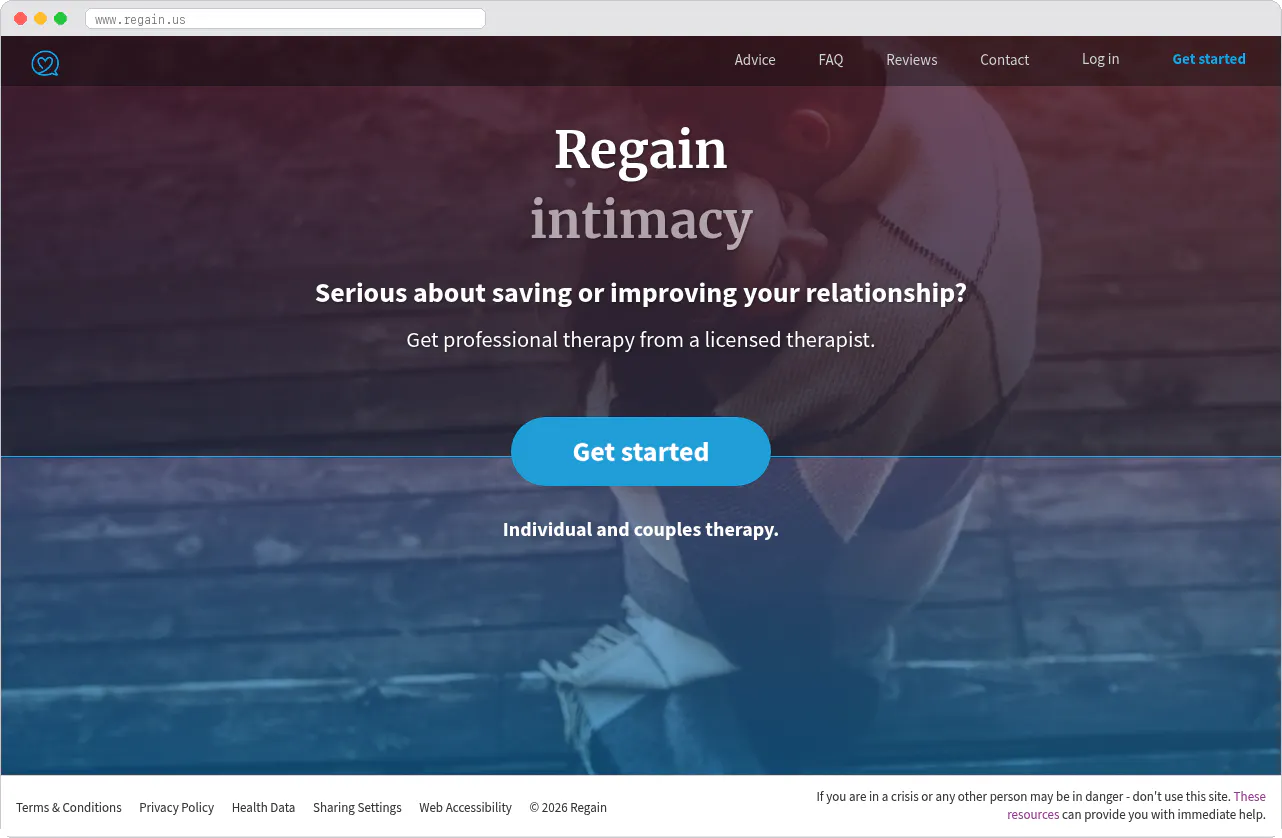
ReGain shows what focused positioning looks like in practice: it exists solely for couples and relationship counseling, letting it build deeper therapist expertise and more targeted marketing than a generalist platform could manage.
The pattern across all five: generalist platforms compete on scale and brand, and in doing so leave gaps in fit, specialty depth, and geographic or cultural nuance. Teen therapy, LGBTQ+-affirming counseling, culturally specific care, trauma specialists, and addiction recovery are all segments where a smaller, sharply positioned platform can out-compete a giant on relevance even without matching its marketing spend.
Essential features for counseling marketplaces
Verified therapist profiles. Every profile needs licensing details, education, specialties, treatment modalities, and a way to check that the license is real and current against a state database. This is the trust foundation of the entire platform; nothing else matters if a client can't be confident the person on the other end is actually licensed.
Compatibility-focused matching. Clients complete an intake form covering their concerns, preferred communication style, demographic preferences, and logistical constraints (location, language, insurance, schedule). The platform uses this to surface a short list of good-fit therapists rather than a directory of everyone in the area, which is the single biggest value-add over a listing site like Psychology Today.
Secure, compliant messaging and video. Sessions and messages need encryption in transit and at rest, audit trails, and infrastructure that gracefully handles a client's spotty home Wi-Fi mid-session without dropping the conversation entirely. Video quality failures are not a minor UX bug in this category, they can end a therapeutic relationship.
Flexible scheduling with sane cancellation policies. Recurring weekly or biweekly bookings need to be easy to set up once and then largely automatic, while cancellation windows (commonly 24 hours) need to protect therapist income without punishing clients for a legitimate emergency.
Integrated, compliant payments. The platform has to handle recurring billing, therapist payouts, and, increasingly, insurance verification and copay collection, all while producing records that satisfy both tax and healthcare documentation requirements.
Session and progress documentation. Therapists need a place to keep notes and treatment plans tied to a specific client relationship spanning months, not an isolated one-off transaction record like most marketplaces default to.
Review and feedback systems with privacy guardrails. Client reviews build trust for future clients, but they have to be moderated carefully so they don't reveal identifying details about what is, by definition, sensitive personal information.
Crisis escalation protocols. A message that indicates a client may be in danger needs a clear, fast, tested path to a human response, whether that's an automated risk flag routed to a therapist, a crisis hotline referral, or an emergency contact procedure. This is not optional infrastructure; it's a legal and ethical baseline.
Licensing and compliance: the structural issue this niche can't skip
Therapist licensing is jurisdiction-bound, which creates a real structural constraint that most marketplace categories don't face. A licensed therapist in California generally cannot legally treat a client physically located in New York unless they hold a New York license too, or a specific interstate compact applies. This means your matching algorithm needs to filter by the client's current location and the therapist's licensed jurisdictions, not just by preference, and your platform needs a system to track license status, renewal dates, and jurisdiction coverage for every provider on an ongoing basis, not just at signup.
HIPAA compliance is the second non-negotiable. Any platform that stores or transmits protected health information needs encryption, access controls, audit logging, breach notification procedures, and a signed Business Associate Agreement with every vendor that touches that data, including your hosting provider and any video or messaging tool you integrate. This isn't a feature you bolt on after launch; a compliance gap discovered post-launch usually means rebuilding core data flows, not patching a UI.
Insurance billing adds a third layer, since claims processing and benefits verification have their own technical and regulatory requirements distinct from HIPAA itself. Many successful niche platforms defer this entirely at launch, positioning as private-pay only, and add insurance integration once they've proven the core matching and retention model works.
How to build a counseling marketplace
1. Define your niche and geography
Decide who you serve and where before writing a line of product spec. A platform for teen anxiety counseling in three states needs a different therapist network, marketing channel, and compliance setup than a general adult-therapy platform aiming for national coverage on day one. Narrower is almost always better at launch: it's easier to recruit ten excellent trauma specialists than a hundred generalists, and it's easier to navigate licensing when you're only dealing with a handful of states.
2. Validate demand before building
Talk to both sides of the market before you commit development budget. Interview therapists about how they currently find clients and what frustrates them about existing platforms (commission rates, client fit, admin overhead), and talk to prospective clients about what stopped them from finding a therapist in the past. A waitlist landing page, a handful of manually matched pilot clients, or a simple Calendly-plus-Stripe setup can validate willingness to pay before any marketplace software exists.
3. Choose your development approach
Vibe coding from scratch. AI tools like Cursor, Lovable, and Bolt can produce a working counseling-platform prototype quickly, useful for pressure-testing a concept or demonstrating it to a handful of early therapists. For launching a platform that handles protected health information and real money between strangers, they're not sufficient on their own. What vibe-coded outputs reliably don't produce is the infrastructure underneath: payment escrow, HIPAA-grade access controls, dispute resolution, and fraud detection. A documented Sharetribe experiment ran 60+ hours to reach demo quality but revealed a critical checkout exploit that would have allowed price manipulation via a direct API call. Bringing that output to production standard, especially with healthcare compliance layered on top, requires significant additional time and expertise. A useful prototyping tool, not a cost-effective path to launch.
Custom development from scratch. Hiring developers, who will likely lean on AI tools themselves, gives you full control over compliance architecture and therapeutic workflows. Counseling marketplaces almost always land in the production-grade tier rather than a simple MVP tier, because HIPAA-compliant data handling, identity and license verification, secure video, and crisis escalation protocols push complexity up from the start. That means a realistic budget of $100,000 to $200,000+ over 16 to 28 weeks for a genuinely compliant build, sometimes climbing toward $350,000 if you add real-time insurance verification or native mobile apps (Codica, RaftLabs). The low end of that range assumes offshore teams at $15 to $40 per hour; US or Western European teams push toward the top. Custom development makes sense when your differentiation depends on proprietary matching algorithms, unique insurance integrations, or a specialized clinical workflow that no existing platform supports.
Building on a marketplace operating system like Sharetribe. You start at roughly 90% done on the standard marketplace foundation: payments, user accounts, listing management, messaging, transaction flows, fraud detection, and general compliance groundwork. Your time and budget go toward counseling-specific features rather than rebuilding the basics. Three paths within this approach, which most founders combine:
- No-code builder. Set up therapist profiles with custom fields for license number, state, and specialty, configure a booking flow for recurring sessions, and launch a searchable, filterable directory with integrated payments, all without writing code. Gets most founders to a live, testable marketplace in one to four weeks.
- AI-assisted development. Connect Claude Code, Cursor, or Codex to Sharetribe's open APIs and open-source template to build things the no-code builder doesn't cover out of the box, like a custom intake-based matching algorithm or a license-verification integration with a state database. Because Sharetribe handles the payment and core compliance infrastructure, AI-assisted development on top of it carries much lower risk than building from scratch.
- Custom code. Build directly on the developer platform for deeper integrations, such as HIPAA-compliant video providers or insurance claims APIs, or hire a specialist from Sharetribe's Expert Marketplace who has already solved these problems for other healthcare platforms.
Most founders start with the no-code builder to validate the model, then add compliance and matching depth via AI or a developer as they learn what their therapists and clients actually need.
4. Solve the cold start problem
Counseling marketplaces face an unusually acute cold start problem, because unlike a product marketplace, you can't stock a few dozen listings overnight. Every therapist takes weeks to recruit, vet, and onboard, and each one can only carry a limited caseload, so you cannot manufacture supply the way you might with inventory.
The fix is to recruit therapists before you have a single client. Reach out directly to therapists building their practices, ideally in one or two states and one or two specialties, and offer them something concrete: reduced client-acquisition cost compared to what they currently spend on marketing, or simply a steady trickle of well-matched referrals. Manually match the first handful of clients yourself if you have to, even by phone, rather than relying on an unproven algorithm; that manual matching often teaches you more about what "good fit" actually means than any dashboard will. Launching small and geographically tight, one state, one specialty, ten therapists, beats launching broad with thin coverage everywhere, because thin coverage produces bad matches, and a single bad early match in mental health does more reputational damage than a single bad experience on almost any other marketplace.
5. Recruit and vet therapists rigorously
Quality matters more than volume in this category. Verify licenses against state boards, confirm malpractice insurance, run reference or background checks, and consider a short trial period or interview before granting full platform access. Build in ongoing monitoring for license renewals and disciplinary actions, not just a one-time check at signup, since licenses lapse and complaints happen after onboarding too.
6. Launch and market to your specific niche
Go deep on content and community channels relevant to your niche rather than broad paid advertising, since mental health has both higher research intent and higher stigma sensitivity than most purchase categories. Educational content reviewed by licensed professionals (how to find a trauma therapist, what to expect from EMDR, how couples counseling actually works) builds both trust and search visibility. Partnerships with college counseling centers, employee assistance programs, or community organizations serving your specific audience often convert better than generic ads.
7. Scale thoughtfully
Expand into adjacent specialties, states, or service formats (group therapy, workshops) only once your current niche shows strong retention and therapist satisfaction. Rapid expansion that outpaces your ability to vet and support new therapists is the fastest way to erode the quality reputation you spent the early months building.
Trust and safety for counseling marketplaces
The trust risks in this category go beyond typical marketplace fraud. A fake or lapsed license, an unverified identity claiming to be a therapist, a mismatched client-therapist pairing that goes unaddressed, and a mishandled crisis situation are all failure modes with real human consequences, not just financial ones. Standard verification steps include license checks against state licensing boards, identity verification for both therapists and clients, malpractice insurance confirmation, and documented reference or background checks before a therapist goes live on the platform.
Sharetribe provides the general-purpose trust infrastructure out of the box: secure payment processing with Stripe Connect, user accounts with optional identity verification, structured transaction flows that keep money in escrow until a service is confirmed delivered, and messaging systems that keep a documented record of every exchange. What Sharetribe doesn't provide natively is the healthcare-specific layer: HIPAA-compliant video (you'll integrate a specialized provider), license-database verification, and crisis escalation workflows. Founders need to add these themselves, either through integrations with existing compliant tools or custom development, before handling real client data.
Crisis protocols deserve their own operational plan regardless of platform. Define clearly what happens when a message suggests a client may be in danger: who reviews flagged content, how fast, and what the escalation path to emergency services or a crisis line looks like. Document every intervention while protecting client confidentiality, and test the protocol before you have real clients depending on it, not after.
Running your counseling marketplace
Once you're live, the operational load shifts from building to maintaining trust and matching quality at scale. Sharetribe automates the mechanical parts, recurring billing, payout scheduling, booking confirmations, and cancellation policy enforcement, freeing you to focus on the parts that require human judgment: reviewing flagged messages, following up on client satisfaction, and monitoring which therapist-client pairings are working and which aren't.
AI agents increasingly handle the repetitive layer of this work: drafting first-pass responses to therapist support tickets, summarizing client intake forms for faster matching, flagging messages that contain crisis language for human review, and generating renewal reminders for therapist license documentation. None of this replaces human oversight of anything touching client safety or clinical judgment, but it does mean a small founding team can run day-to-day operations without hiring a large support staff early on.
Expect ongoing work in three areas specific to this niche: monitoring license renewals and compliance status across your therapist base, tracking retention and outcome signals (session frequency, treatment duration, client satisfaction) rather than pure transaction volume, and revisiting your commission and pricing structure as you learn what therapists will actually tolerate before leaving for private practice or a competitor.
Development costs and timeline
Three realistic scenarios:
Vibe coding from scratch. Free or very cheap to start, and a working counseling-platform prototype is buildable in days with AI tools. What you can't get from here is a production-ready platform: HIPAA-compliant data handling, license verification tied to state databases, secure payment escrow, and crisis escalation protocols all require work that AI coding tools don't shortcut. A documented Sharetribe experiment logged 60+ hours to reach demo quality and found critical payment vulnerabilities in the process. A useful proof-of-concept tool, not a cost-effective path to a live, compliant business.
Custom development from scratch. Because of the compliance load, counseling marketplaces almost always fall in the production-grade tier rather than a basic MVP tier. A build with HIPAA-compliant infrastructure, license and identity verification, secure video integration, escrow-based payments, and dispute handling runs $80,000 to $200,000 over 16 to 28 weeks, and adding native mobile apps or real-time insurance verification can push that past $250,000 (Codica, RaftLabs). The low end assumes offshore teams; US or Western European developers push toward the top of the range. Ongoing maintenance and compliance upkeep typically run 15% to 25% of the original build cost per year, on top of hosting. This route makes sense when your differentiation depends on features no existing platform offers.
Building on Sharetribe. Before you launch, the Sharetribe Build plan costs just $39/month. To open to real users, you need the Live plan, which costs $199/month billed yearly ($259/month billed monthly). Both plans include 1 million usage credits per month. Sharetribe covers the marketplace foundation, payments, listings, search, messaging, and transaction flows, so your build effort goes toward counseling-specific additions like custom intake forms, matching logic, and compliant video integration rather than the plumbing underneath it. Most founders reach a live, testable marketplace in one to four weeks, then add compliance and matching depth via AI-assisted development or a developer as the business grows.
Why Sharetribe works for counseling marketplaces
Sharetribe's marketplace operating system gives counseling founders the parts of the platform that are identical across every marketplace, payments, listings, search, messaging, transaction flows, so the actual development effort focuses on what's unique to mental health: license-based matching, treatment continuity, and compliant communication. The no-code builder lets you configure therapist profiles with custom fields for licensing detail and specialty, set up recurring booking flows, and launch fast enough to validate whether your specific niche and geography actually has demand before investing in a full compliance build-out.
As the business matures, Sharetribe's open APIs and AI-compatible architecture let you or a developer add the healthcare-specific layer without starting over: integrate a HIPAA-compliant video provider, build a license-verification workflow against state databases, or connect an insurance API. Because the core payment and transaction infrastructure is already handled, that additional development carries far lower technical and financial risk than building the whole system from zero, which matters in a category where compliance mistakes are expensive to fix after the fact.
Frequently asked questions
How much does it cost to build a counseling marketplace?
Costs range from $39/month while you build on Sharetribe and $199/month (billed yearly) once you go live, plus custom compliance features, to $80,000 to $200,000+ for a fully custom, HIPAA-compliant build from scratch. Ongoing maintenance and compliance upkeep for a custom build typically run 15% to 25% of the original cost per year. The right choice depends on how much of your platform depends on proprietary compliance or matching logic versus standard marketplace mechanics.
Do I need HIPAA compliance for a counseling marketplace?
Yes, if your platform stores or transmits protected health information, which almost any counseling marketplace does through intake forms, messages, or session notes. This requires encryption at rest and in transit, audit logging, access controls, breach notification procedures, and signed Business Associate Agreements with any vendor touching that data. Non-compliance carries real legal and financial risk, so build this in from the foundation rather than adding it after launch.
What licensing requirements do online therapists need?
Therapists generally must be licensed in the state where the client is physically located during the session, not just where the therapist is based. A small number of states participate in interstate compacts that simplify cross-state practice, but requirements vary and change over time. Your platform needs to verify licenses against state databases and filter matches by jurisdiction, not just by client preference.
How do counseling marketplaces make money?
Most charge therapists a commission per session, typically in the 20% to 50% range, charge clients a subscription for platform access, or combine both. Additional revenue comes from booking fees, premium matching tiers, and corporate or insurance partnerships. A blended take rate of 20% to 30% is a reasonable starting target that balances platform sustainability against therapist retention.
Can I compete with BetterHelp and Talkspace?
Yes, by focusing on a niche these generalist platforms serve poorly, such as a specific demographic, therapy type, or geography, rather than competing on scale or marketing budget. Teen therapy, culturally specific counseling, trauma specialization, and geographically focused platforms have all found room to operate profitably. Superior therapist experience and matching quality, not ad spend, is usually the actual differentiator.
What features does a counseling marketplace need at launch?
At minimum: verified therapist profiles, an intake-based matching flow, secure messaging and video, scheduling with sane cancellation policies, compliant payment processing, and a crisis escalation protocol. Treatment notes, progress tracking, and insurance integration can wait until after you've validated demand in your chosen niche. Building the compliance and trust layer well matters more at launch than building every feature.
Start your 14-day free trial
Create a marketplace today!
- Launch quickly, without coding
- Extend infinitely
- Scale to any size
No credit card required