What is a two-sided marketplace?

A two-sided marketplace is an online platform that connects two independent groups of users, typically buyers and sellers, and earns revenue by facilitating the transactions between them, without ever owning the inventory itself.
Well-known examples include Airbnb (hosts and guests), Uber (drivers and riders), and Etsy (creators and shoppers).
Also known as
| Term | What it means |
|---|---|
| Multi-sided platform | Same core idea, but usually implies three or more interdependent groups, not just two (e.g. Uber Eats: diners, restaurants, couriers). |
| Two-sided platform | Interchangeable with "two-sided marketplace"; more common in tech/business writing. |
| 2-sided marketplace | Informal spelling variant of "two-sided marketplace"; same meaning. |
| Two-sided market | The academic/economics term for the same concept, used in research on network effects and platform pricing (see Rochet & Tirole). |
These terms all describe the same core concept. Academics tend to say "two-sided market," while business and tech writing favors "two-sided marketplace" or "platform."
The other distinction is precision: "multi-sided" usually signals three or more groups instead of two.
By transaction type:
By audience:
- C2C / P2P (consumer-to-consumer)
- B2C (business-to-consumer)
- B2B (business-to-business)
A two-sided marketplace connects exactly two interdependent groups, usually buyers and sellers. A multi-sided marketplace adds a third group that is essential to making transactions happen.
Uber Eats is a good example: diners, restaurants, and couriers all have to show up for a single delivery to work.
| Two-sided | Multi-sided | |
|---|---|---|
| # of user groups | 2 (e.g. buyers & sellers) | 3+ (e.g. diners, restaurants, couriers) |
| Example | Airbnb, Etsy, Upwork | Uber Eats, Instacart, Postmates, (generally most delivery marketplaces), Honeybook |
| Complexity | Simpler: one supply/demand balance to manage | Harder: multiple interdependent groups to balance at once |
Don't design for three sides on day one if you only need two. Most successful marketplaces start two-sided and add a third side later, only once a specific operational need (like Uber Eats needing restaurants) forces it.
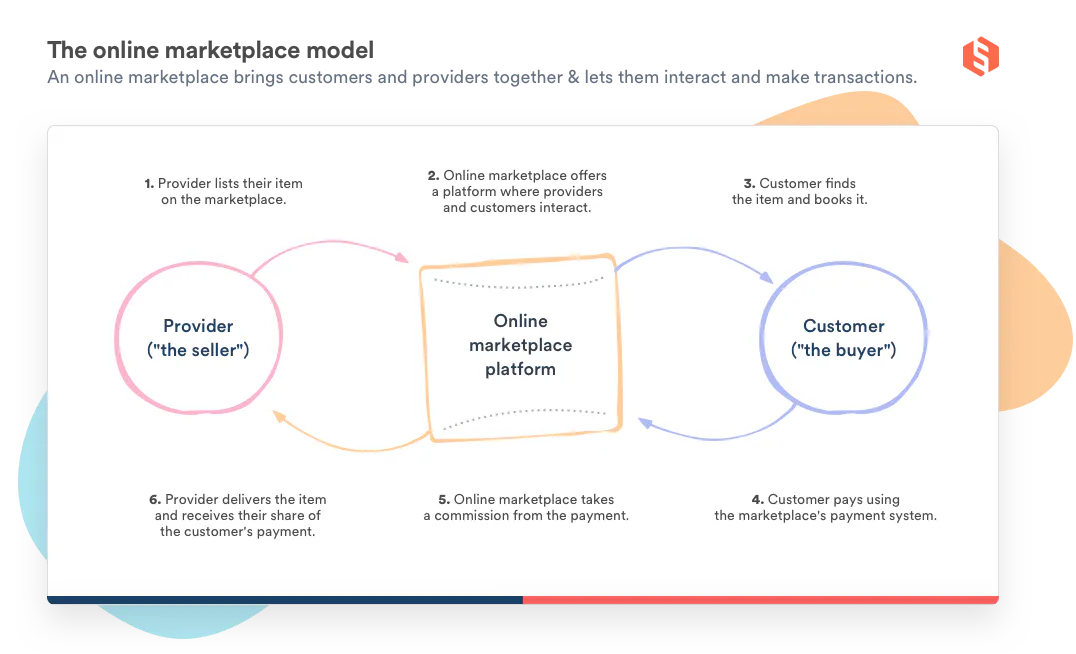
Here's what a typical transaction looks like: a seller lists an item or service on the marketplace, an interested buyer finds this item through the platform and pays through the platform's checkout, and the marketplace takes its commission before passing the rest on to the seller.
That commission is just one way marketplaces earn money. Here is how the most common models compare:
| Model | How it works | Best for |
|---|---|---|
| Commission | Platform takes a % of each transaction | Most marketplaces; scales with activity (Etsy: flat 6.5%; Upwork: variable 0-15%, ~10% typical — verify current rates before publishing, as these can change) |
| Listing fees | Sellers pay to list, regardless of sale | Marketplaces with high-value or high-visibility listings (e.g. real estate, job boards, classifieds) |
| Lead fees | Buyers submit requests; sellers pay for access | High-value, low-volume services (construction, consulting) |
| Subscriptions | Providers pay a recurring fee for access or features | Predictable revenue, frequent sellers, marketplace where repeating monogamous relationships appear between providers and buyers, e.g. cleaning services. |
| Paid advertising | Users pay for extra visibility (promoted listings, etc.) | Supplementary, once volume exists |
Commission is the default for most marketplaces because it charges users only after the platform has delivered value. It scales with activity and keeps your incentives aligned with theirs.
For example, a $500 project routed through Upwork's ~10% service fee earns the platform about $50 - nothing changes hands unless the transaction does.
You can combine models later, but when you're first building, stick to one so you can clearly test whether it works.
Learn more in our guide to marketplace business models.
Yes. Airbnb connects two independent groups (hosts and guests), takes a commission on each booking, and never owns the properties listed.
Yes. Uber connects drivers and riders and earns a percentage of each fare, without owning any vehicles.
Yes. Etsy connects independent sellers with shoppers and charges listing and transaction fees, without holding any inventory itself.
For the full guide to building your own two-sided marketplace, see our complete build guide.
Start your 14-day free trial
Create a marketplace today!
- Launch quickly, without coding
- Extend infinitely
- Scale to any size
No credit card required