C2C marketplace guide: How to launch, grow, and scale successfully
Learn how to build a C2C marketplace in 2026. This complete guide covers customer-to-customer software options, platform examples, business models, and more.

Summary
A C2C (customer-to-customer) marketplace is a platform that connects consumers who want to buy and sell products. The marketplace handles transactions, builds trust through reviews and secure payments, and typically earns revenue by taking a commission on each sale.
C2C marketplaces span second-hand fashion (Poshmark, Vinted, Depop), general classifieds (eBay, Facebook Marketplace), handmade goods (Etsy), and niche communities (vintage collectibles, sneakers, art). The global fashion resale market alone is projected to reach $367 billion by 2029, and the trend is spreading quickly into other segments.
A C2C platform is faster and more affordable to build than ever. No-code marketplace builders let founders launch and validate their ideas quickly.
Key takeaways
- What is a C2C marketplace: Customer-to-customer platforms connect individual sellers with individual buyers for product sales, especially second-hand, handmade, or niche items. Unlike B2C retail, the marketplace doesn't own inventory.
- Resale economy is exploding: The second-hand market will reach $350 billion by 2028, with major brands like Lego and Patagonia launching resale platforms. C2C marketplaces are at the center of this sustainable commerce trend.
- Choose the right C2C marketplace software: No-code platforms like Sharetribe let you launch in days and extend with custom code later without rebuilding. Today, most successful C2C marketplaces start this way.
- Beat the giants by focusing on a niche: You don't need (and likely, can't) win Etsy or Vinted at their own game. Instead, narrow down to a single category or location and build a unique experience that serves it better than any existing alternative.
- Trust drives C2C transactions: Buyers and sellers need to feel safe. Build trust through reviews, secure payments, seller verification, quality standards, and responsive dispute resolution from day one.
C2C (customer-to-customer) marketplaces are platforms where individual consumers buy and sell products directly with one another. Famous examples include eBay, Etsy, Poshmark, Vinted, and Facebook Marketplace.
Unlike in traditional retail, in C2C, the marketplace doesn't own inventory. Instead, it connects buyers and sellers and takes a commission on each transaction.
The resale economy is booming. The global second-hand apparel market alone is projected to reach $367 billion by 2029. A major driver is the Gen Z segment, for whom sustainability is a core value, and the trend is quickly reaching other areas of the consumer market. Even major brands like Lego, Zara, and Patagonia are launching their own resale platforms in response to growing interest in secondhand buying.
And even more great news for aspiring C2C marketplace founders: building a C2C marketplace has never been easier. Modern marketplace software (like ours at Sharetribe) lets non-technical founders launch in days, not months, with a fraction of the budget that trailblazers like eBay and Poshmark used to build their platforms.
This practical guide is based on 10+ years of experience helping founders build successful customer-to-customer platforms. We'll cover everything from choosing the right business model to attracting your first sellers and buyers.
A C2C (customer-to-customer) marketplace is a platform that connects consumers who want to buy and sell products. Famous examples include eBay (general classifieds), Poshmark (fashion resale), and Etsy (handmade goods).
Unlike traditional retail or e-commerce, where businesses sell to consumers, C2C marketplaces facilitate direct transactions between people. The C2C platform doesn't own inventory, manufacture products, or maintain warehouses. Instead, the marketplace's role is to help buyers and sellers find each other, transact safely, and build trust.
A C2C marketplace typically earns revenue by charging a commission on transactions or by collecting buyer protection fees, listing fees, or fees for additional services like sponsored placements or better seller tools. On mature, established platforms, several of these revenue streams are often used.
Almost any product category can work as a C2C marketplace. Sharetribe customers have built platforms for everything from vintage furniture, collectibles and memorabilia to second-hand children's clothing and handmade goods. The key is connecting private individuals who have products with people who want to buy them.
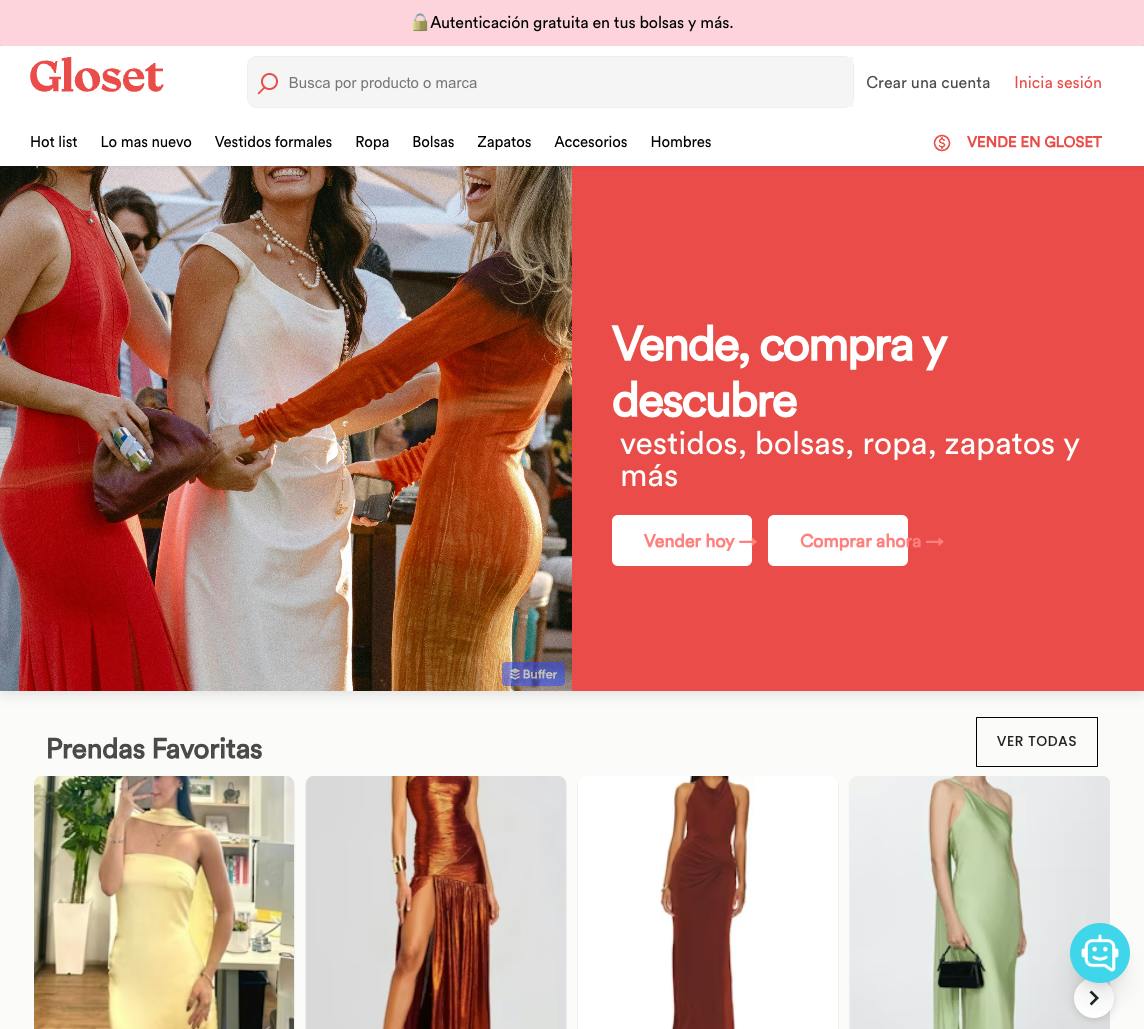
The C2C marketplace model has exploded in popularity in recent years, especially due to increased interest in second-hand fashion among younger audiences. Platforms like Poshmark, Vinted, and The Real Real, and have made thrifting mainstream—in 2025, Vinted became the largest fashion retailer in France.
However, the opportunities inherent in the C2C marketplace model also translate well to markets beyond fashion resale.
C2C marketplaces can succeed in many different markets and product categories. Here are some common C2C e-commerce concepts.
Second-hand marketplaces are probably the best-known in the C2C space. These online reselling platforms let consumers sell used items they no longer need to other consumers who want them at lower prices
Fashion resale leads this category. Platforms like Poshmark, Vinted, and Depop have built billion-dollar businesses around connecting people to buy and sell used clothing, shoes, and accessories.
ThredUp pioneered this model at scale and was valued at $1.3 billion in its 2021 IPO. Poshmark differentiates by focusing on social shopping and community—its “Posh parties” have been a feature since its early days. Vinted competes on selection and keeps listings free for sellers, charging buyers a protection fee instead. Depop targets Gen Z with an Instagram-like interface.
And today, these general platforms are facing increasing competition from more targeted players, for example The Real Real and Vestiaire Collective that focus exclusively on designer and luxury items.
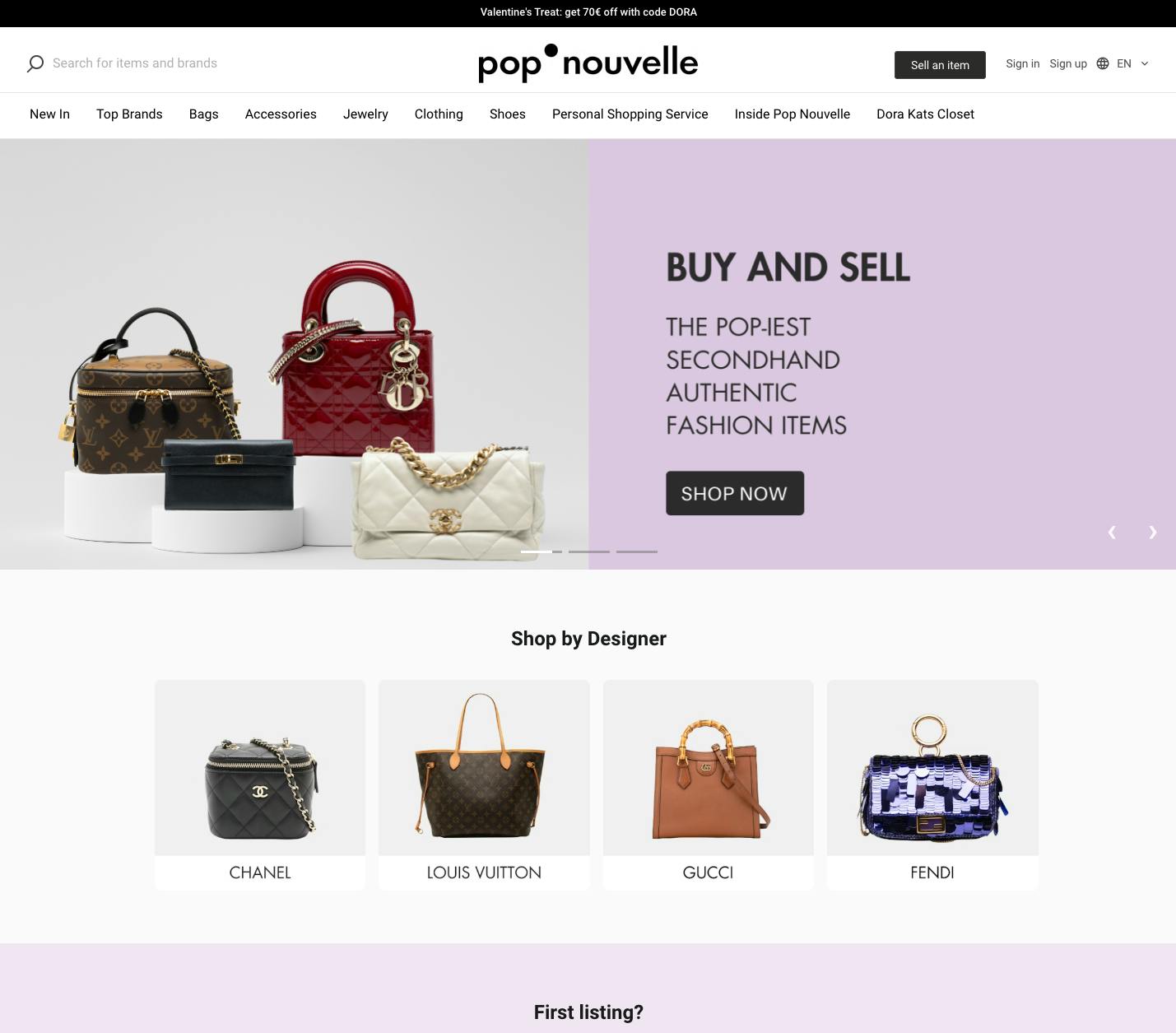
Among Sharetribe customers, this approach is exemplified by Pop Nouvelle, a C2C marketplace focusing exclusively on designer handbags, shoes, and accessories. Other interesting examples include Truzeau, which focuses on South Asian fashion, and Tutulist, which specializes in dancewear.
Electronics resale platforms like Swappa and Decluttr focus on phones, tablets, laptops, and gaming consoles. On these marketplaces, device condition standards, testing protocols, and buyer protection are critical.
Furniture and home goods resale often happens on generalist platforms like Facebook Marketplace and OfferUp, mostly because local pickup is critical in this category. This represents an opportunity for focused marketplaces to deliver a significant improvement in user experience, as evidenced by Sharetribe customers Refound and Used Icons.
The resale economy is expected to continue growing as younger consumers increasingly prefer buying used, and even established brands like Patagonia, Levi’s, and lululemon now run their own resale programs. Opportunities are ripe for founders who can offer an improved experience for their core audience compared with existing players.
Handmade marketplaces connect creators who make products with buyers who want unique, artisanal items.
Etsy dominates this space with millions of sellers offering handmade jewelry, home decor, art, clothing, and craft supplies. The platform succeeded by positioning handmade goods as special and personal alternatives to mass-produced goods.
However, as Etsy’s policies have changed under growth pressure to allow more manufactured goods, new entrants have found footing among sellers who feel Etsy has become too commercial. Sharetribe customer Handmade.com and local platforms like Folksy (UK), Made It Myself (Australia) and Aftcra (US-made only) serve similar marketers but differentiate through stricter handmade standards.
Handmade marketplaces work because they solve a discovery problem. Crafters lack distribution channels, and buyers struggle to find unique items. In a similar way to fashion resale, these marketplaces also benefit form the emphasis younger consumers have to ethical and personal items over mass-production.
General classifieds platforms let people buy and sell almost anything. No category focus, no curation, no special filters or other market-specific UX features: just a place to list and buy.
eBay pioneered this model and remains the largest general C2C marketplace globally. In the early stage it supported only auction-style transactions but has since introduced fixed-price “Buy It Now” listings. Craigslist operates as a bare-bones classified ads service that also features listings for rentals, services, jobs, and pretty much anything.
In the last decade, Facebook Marketplace has grown in importance as a reselling platform. Its massive user base gives it natural advantages.
However, all the large classifieds sites face the same challenge: a lack of specialization may mean a huge potential market to tap into, but as online C2C commerce and reselling continues to expand, users begin to have higher expectations for user experience, quality, and trust. This creates opportunities for new entrants to specialise in just one or two of Craigslist’s categories and delight its users with a tailored experience.
The most interesting C2C marketplaces focus on specific product categories or communities and serve it better than generalist platforms.
It’s important to note that “niche”, here, doesn’t mean necessarily “small”: Reverb, a marketplace for musical gear, reached $1.3 billion in GMV in 2024. StockX focuses primarily on sneakers and streetwear and was valued at $3.8 billion in 2021.
Examples of niche concepts from Sharetribe's customers include:
- Analogr: a marketplace for rare music studio gear and memorabilia
- Secondhand Geek: tabletop games and miniature marketplace
- Perfumee: perfumes resale
- The Pickleball Swap: buying and selling pickleball gear
- Smarter Uniforms: second-hand school uniforms
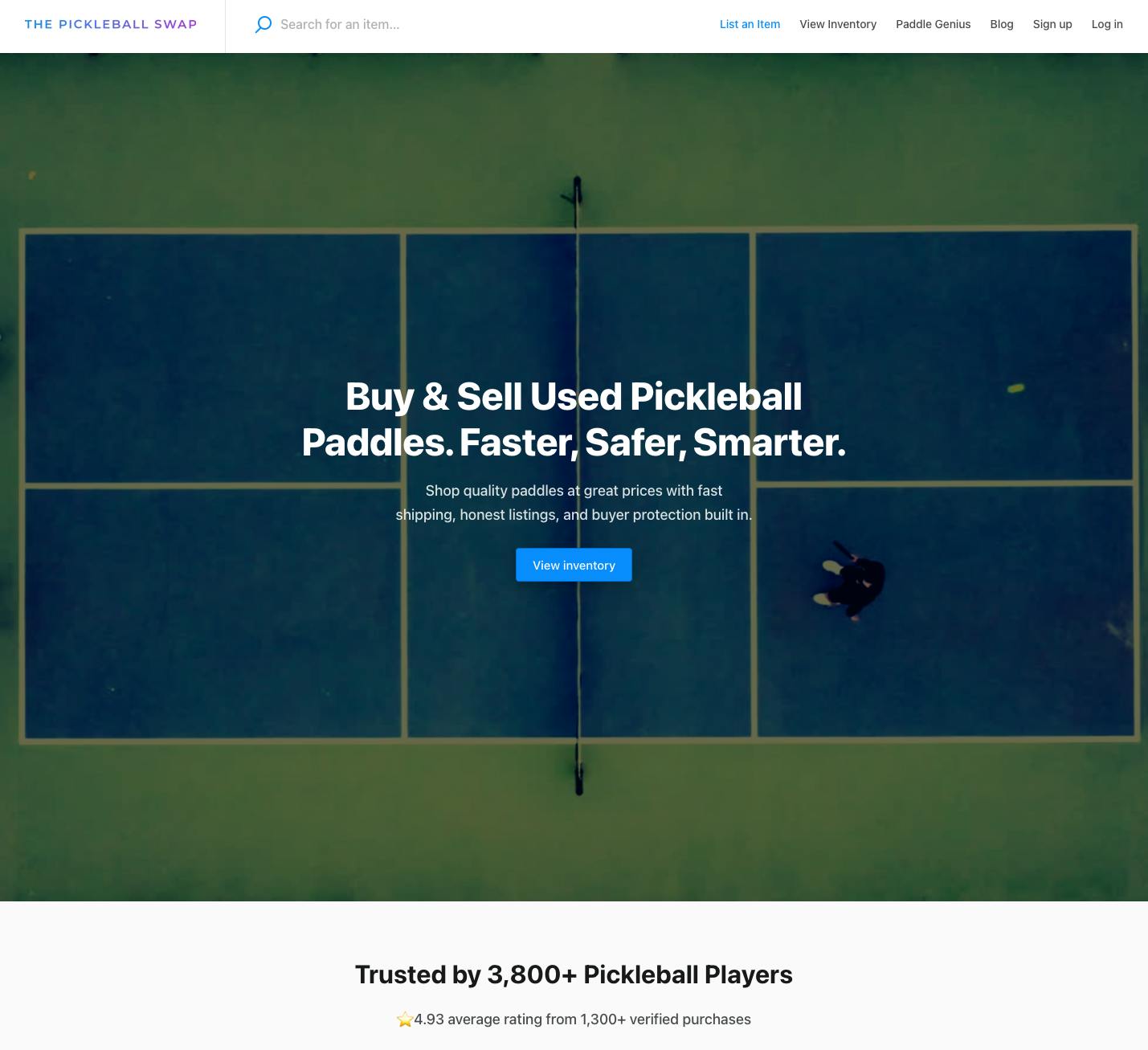
Niche marketplaces work because the founders often understand their category deeply. They offer specific features that generalists don’t and speak the community’s language. To compete against the crude scale of the giants, they can offer something much more valuable: a targeted audience, higher pricing (because the audience understands the value of the niche goods), a tailored UX, a high level of trust, and a sense of community and belonging.
Visit the Sharetribe Customer Gallery for more inspiring examples.
Customer-to-customer (C2C) marketplaces are one of several marketplace business models. The distinction between C2C, B2C, and B2B is crucial to understand because the audience type often means significant differences in feature requirements and marketing strategies.
| Marketplace type | Who sells | Who buys | Examples | Typical use case |
| C2C (Customer-to-Customer) | Individual consumers | Individual consumers | eBay, Poshmark, Vinted, Depop | Second-hand products, handmade items, peer sales |
| P2P (Peer-to-Peer) | Individual consumers | Individual consumers | Airbnb, Turo, Uber, TaskRabbit | Rentals, services, sharing economy (often used interchangeably with C2C) |
| B2C (Business-to-Consumer) | Businesses | Individual consumers | Amazon, Walmart, Target | New products from brands/retailers; service and rental businesses targeting consumers |
| B2B (Business-to-Business) | Businesses | Other businesses | Alibaba, Amazon Business, Faire | Wholesale, bulk orders, professional services and rentals |
You might hear C2C marketplaces referred to as peer-to-peer (P2P) marketplaces. In practice, these terms mean the same thing: both describe platforms where private individuals exchange value with each other.
Some people make a distinction: using "C2C" for product sales (especially second-hand goods like clothing and electronics) and "P2P" for rentals and services (like Airbnb or TaskRabbit), and that’s the distinction we’re making for the purposes of this article, which specifically focuses on C2C product-selling marketplace concepts.
For a comprehensive guide covering peer-to-peer rentals and services as well as C2C product marketplaces, see our peer-to-peer marketplace guide.
The distinction between a C2C marketplace and a B2C marketplace is particularly important to understand because it significantly impacts your business's feature requirements and user acquisition tactics.
We often see founders describe their concept as “a platform like Amazon”, when in reality, they’re building a marketplace that solely focuses on facilitating C2C transactions. Unfortunately, this confusion often leads them to select the wrong marketplace software or focus on building the wrong key features for their platform.
The main difference between C2C and B2C marketplaces is who owns the inventory and who's selling:
In B2C marketplaces, businesses (brands, retailers) own inventory and sell products to individual consumers. Amazon is the classic example. Even though Amazon hosts third-party sellers, those sellers are typically small businesses, not individual consumers. B2C marketplaces focus on new products, reliable fulfillment, and brand trust, and need to offer their robust seller features for professionals to manage their retail business.
In C2C marketplaces, individual people sell to other individual people. Third-party sellers usually don’t hold massive inventories of the same good. Instead, they want to get rid of items they no longer use or create small batches of unique items. C2C platforms typically focus on second-hand goods, unique items, or products that don't fit traditional retail channels. Trust mechanisms like reviews and buyer protection are critical because you're buying from strangers, not established businesses.
B2B marketplaces connect businesses buying from other businesses, typically for wholesale, bulk orders, or professional services. Alibaba is a famous example where manufacturers and wholesalers sell to retailers or other businesses. Another example is Upwork, which connects service professionals with companies in the market for freelance talent.
C2C marketplaces are retail-focused, with individuals buying and selling consumer products at retail prices. Transaction sizes are smaller, purchases are for personal use (not resale), and the buying process is simpler.
The business models differ significantly, which means significant differences in the required tech: B2B marketplaces often handle complex negotiations, bulk pricing, and credit terms, while C2C platforms focus on simple, instant transactions with secure payment processing and trust mechanisms.
Building a C2C marketplace can be summarized into five key steps:
- Validate your marketplace idea
- Choose your business model and revenue strategy
- Build your marketplace platform, starting with an MVP
- Recruit your initial users and solve the chicken-and-egg problem
- Grow and scale your marketplace
This process works whether you're launching a fashion resale platform, a niche collectibles marketplace, or a general classifieds site.
Next, we’ll look at what’s involved at each step from the perspective of a C2C marketplace. For a more detailed step-by-step process, visit our complete guide to building a marketplace.
Most marketplace ideas fail because founders build something nobody wants. Validation prevents this by testing demand before investing in development.
Start by identifying a specific problem. A great marketplace idea is the result of four factors:
- It solves a real problem for both sides of your marketplace (supply and demand).
- It targets a large enough market that meets your business goals.
- The market is fragmented (many suppliers and customers).
- There’s potential for frequent usage (repeat purchases).
Successful C2C marketplaces solve focused problems: "Parents struggle to find high-quality used children's clothing" or "Sneaker collectors can't trust authentication on general marketplaces." It’s intuitive to think that the broader your marketplace’s focus and the bigger the market, the faster your platform will grow. But in reality, the opposite is true: almost every single one of today’s most successful marketplaces initially constrained their offering.
Once your idea is shaped, talk to potential users in both sides of your marketplace. Interview at least 10–15 potential sellers and 10–15 potential buyers. Ask them open-ended questions about their current behavior:
- Where do they sell now?
- What frustrates them?
- How much does it cost them?
- What would make them switch platforms?
After that, pitch a prototype of your idea, listen to the feedback you get, and iterate and validate again as needed.
C2C marketplaces make money in several ways. Your business model choice affects everything from product design to user acquisition strategy.
- Commission on transactions is the most common model. The marketplace takes a percentage of each sale, either from sellers, from buyers, or from both.
- Subscription plans charge monthly fees for access to the platform or for features such as unlimited listings or reduced commission rates.
- Listing fees charge sellers to post items.
- Freemium models don’t charge for access or transactions, but may layer on additional services like authentication, shipping, insurance, or better seller tools
- Featured listings charge for premium visibility for their sellers’ listings.
At Sharetribe, we’ve studied how the top one hundred marketplaces in the world monetize. Commission (also known as transaction fee, take rate, or rake) is the most common marketplace revenue model, and especially prominent among marketplaces selling physical goods.
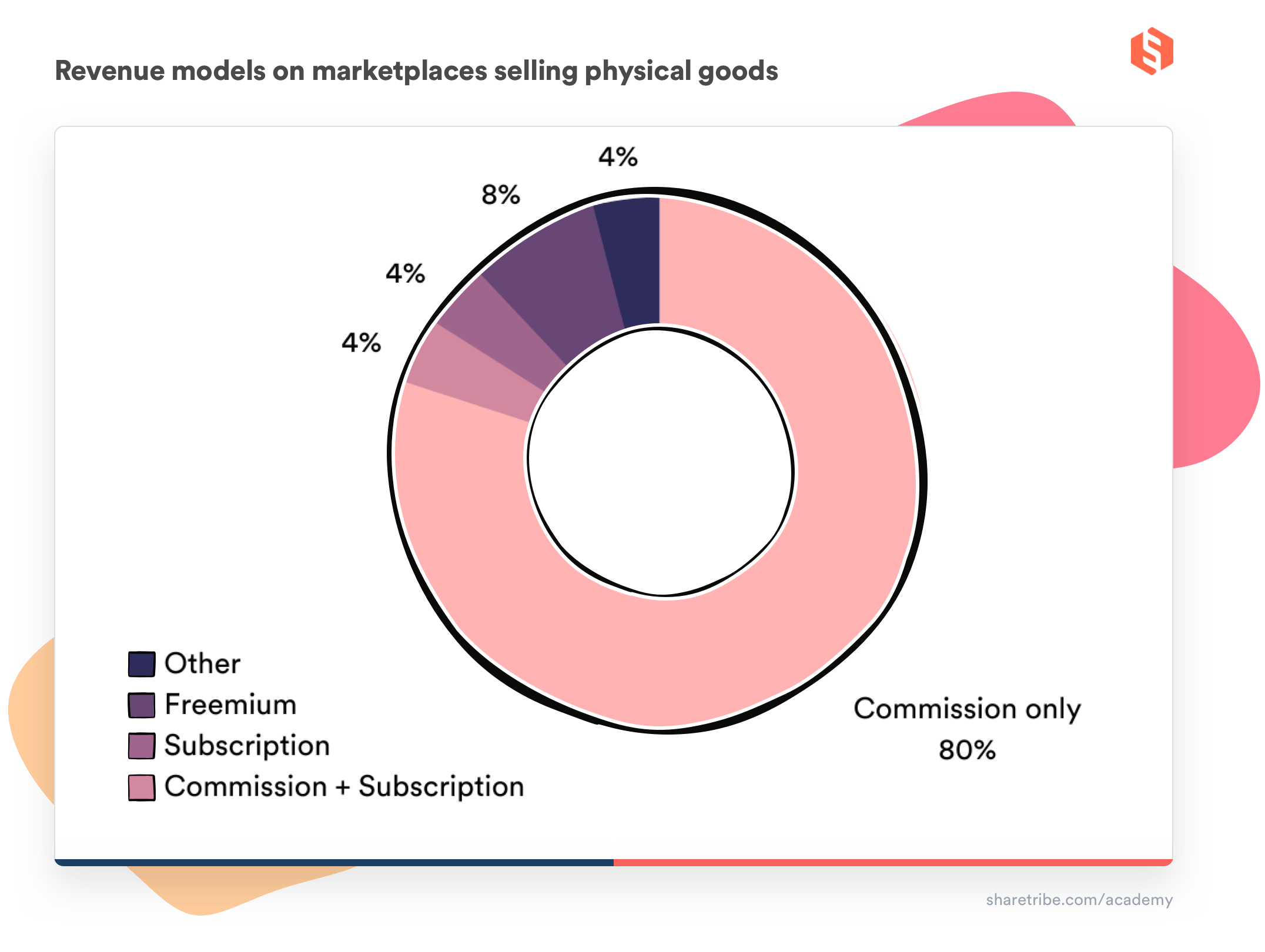
The reason so many customer-to-customer platforms thrive on commission is that it has a low barrier to entry for users: use of the platform is free until you get value yourself (find what you’re looking for or make a sale.
Commission is usually the most lucrative model because the marketplace gets a piece of all the value that passes through the marketplace.
If you choose commission, you’ll also need to determine which side you’ll charge it from, how big your commission will be, and how you prevent users from circumventing your payments.
Remember also that you can iterate on your business model and pricing: often, the best approach is to offer a simple and low-enough pricing structure in the beginning and add or increase fees as the value you offer users grows.
Once your idea is validated and you know how you plan to monetize it, it’s time to build the first version of your platform.
First, you’ll need to understand the requirements for your first version: your Minimum Viable Platform (MVP). Then, you need to choose your approach to building it.
The first version of your platform can be extremely simple. It only needs to do two things really well:
- Solve your suppliers’ core problem.
- Solve your customers’ core problem.
This version is called the Minimum Viable Platform, or MVP.
In the MVP stage, it’s okay to do things manually—even if you plan to automate them later. At the same time, the quality bar for today’s users is high. You need to offer them a great experience from day one.
Here’s a list of key features many C2C platforms need from day one:
- User registration and profiles
- Listing creation with photos, descriptions, pricing, and shipping details
- Search and filters by category, price, location, condition, or other criteria relevant in your niche
- Messaging between buyers and sellers
- Payment processing with escrow or delayed payouts
- Review and rating system for both buyers and sellers
- Admin features for monitoring, moderation, and user management
- Mobile-responsive design or native apps
Additional features you might add from day one or as your business grows (depending on your market and competitive landscape):
- Identity verification
- Integrated maps if you’re a local marketplace and users interact face-to-face
- Shipping integration with shipping label generation and tracking
- Seller dashboards for sellers to track their success
- Unique, niche-specific features that make you stand out from the competition
Knowing where to invest and where to scale down pays off: you get to launch your idea quickly and affordably and learn what works. Then gather user feedback and add features iteratively, based on what users actually need and what can provide clear ROI.
You have three main options for building a C2C marketplace, each with different trade-offs.
Option 1: Use marketplace software like Sharetribe
C2C marketplace software provides core features pre-built so you can launch quickly.
For example, Sharetribe combines no-code tools with developer flexibility. Launch your marketplace in days using the visual builder, then customize with code when you need unique features. Core features come included: user profiles, listings, search, messaging, reviews, payments, and escrow.
- Pros: Launch in days, not months. Core features built by marketplace experts. Security and compliance handled. Scales automatically as you grow. Customize with code when needed (without rebuilding). Much lower cost than building from scratch.
- Cons: Platform fee on top of transaction revenue. Some design limitations without custom code. Must work within platform architecture (though very flexible).
- When to choose this: You want to launch quickly and validate market demand without sacrificing future scalability. You're a non-technical founder or small team. You need marketplace-specific features like escrow and reviews. You want to focus on growth, not technical infrastructure.
How to choose the right C2C marketplace software? Here’s our complete guide on the best marketplace solutions in 2026.
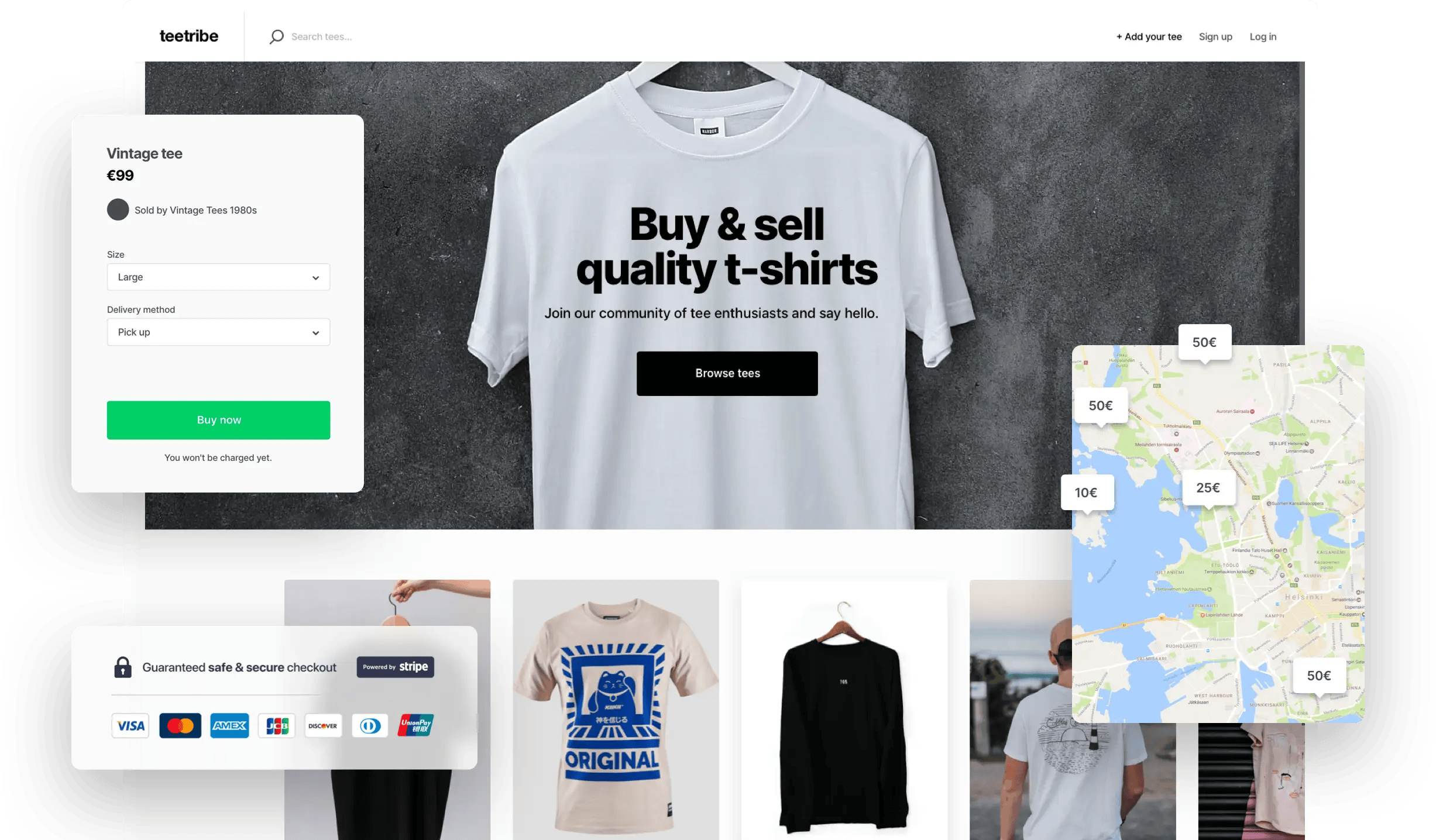
Option 2: Use general no-code tools
It’s possible to build a functioning marketplace using generic no-code tools. Popular options are:
- Visual coding tools like Bubble
- Using a generic website or e-commerce builder with multi-vendor or marketplace plugins (e.g. Shopify, WordPress)
- Building with a combination of no-code tools (e.g. Webflow + Airtable + Typeform + Calendly + MailChimp + Zapier)
The pros and cons between these approaches vary, but generally:
- Pros: Low-to-medium cost to start. No coding required.
- Cons: Slower than dedicated marketplace software. Limited marketplace features. Difficult to implement escrow payments. Possible challenge with adding unique features, scaling, and security.
- When to choose this: You're testing a very simple marketplace idea. You have extremely limited budget. You don't need payments initially. You plan to rebuild on proper infrastructure once validated. You’re a builder who enjoys using Bubble or experimenting with a combination of tools.
Option 3: Build from scratch with custom code
This approach gives you complete control but requires significant resources.
- Pros: Unlimited customization. Own your code completely. No platform fees or restrictions. Can build unique features that competitors don't have.
- Cons: Requires 6–12+ months of development. Need experienced developers who understand marketplace architecture. Budget $50,000–$500,000+ for MVP. Ongoing maintenance and security updates. You handle all technical infrastructure, security, and scaling.
- When to choose this: You have unique requirements that existing solutions can't handle, significant funding, or a technical co-founder or an in-house development team.
For most C2C marketplaces, marketplace software like Sharetribe offers the best balance. You get speed, lower cost, and marketplace expertise without sacrificing ability to customize. Custom development makes sense only when you have specific requirements you can’t get from marketplace solutions, combined with significant capital and technical resources.
Every marketplace faces the same challenge: you need sellers to attract buyers, but you need buyers to attract sellers. This is called the chicken-and-egg problem.
C2C marketplaces can have a unique advantage: many users are both buyers and sellers. This dynamic is particularly dominant in fashion resale, whereas in areas like handmade items, collectibles, or second-hand electronics, audiences could be more separated.
However, even in high-overlap categories, customers will often review a new marketplace based on its supply. If they don’t find anything that interests them, they leave and never return. Sellers, on the other hand, are more likely to wait around for customers to show up.
That’s why in most cases, the best approach to building your initial audience is to focus first on building supply.
Go where your target sellers already are: online forums and groups, local meetups and events, existing platforms. Have a pitch ready explaining why your solution is better and what you offer early adopters. Consider onboarding them manually to make sure they have a great experience and publish a high-quality listing that reflects the value of your marketplace to customers.
Once your initial supply is in place, bring in just enough demand to meet it. While it can be tempting at this stage to launch on a large scale and aim for the highest number of new users, it’s far more important that supply and demand are in balance. Most new customers should find enough supply and selection to make a purchase; most sellers should get a sale.
This way, your first users walk out happy, and you get a chance to properly see what works and what doesn’t. 50 happy users is a far better foundation for growing your business than thousands of visitors who left without engaging.
Once you've proven your marketplace works with initial users, think of growth in three stages:
- Reaching problem-solution fit
- Reaching product-market fit
- Scaling into new markets.
Problem-solution fit means you see promising signals that your marketplace can become profitable: you consistently facilitate transactions and collect revenue from them.
Reaching problem-solution fit often requires some iterating. If transactions aren’t happening, your supply and demand might be off balance, your matching process might need finetuning, your transaction flow or pricing might be off, or you could communicate your value proposition better.
Only start thinking about more ambitious growth once problem-solution fit is there—otherwise, added volume only amplifies your problems.
The next step is reaching product-market fit: proving your marketplace is in a good market with a product that can satisfy that market, with a clear path to profitability.
You can track whether you’ve reached product-market fit by paying close attention to key marketplace metrics, such as:
- Liquidity: The likelihood that sellers sell their items and buyers find what they want
- Repeat-purchase rate: Do buyers return to your marketplace?
- GMV retention: Are users transacting more over time?
- Unit economics: Customer acquisition costs vs. customer lifetime value
At this stage, you probably need to build a growth engine to gradually increase your user base and build the foundation for network effects.
You'll likely also need to invest in developing your platform further. This is where your choice of marketplace technology matters significantly. If you built on marketplace software like Sharetribe, adding features and scaling infrastructure happens smoothly as your business grows. If you built from scratch or used general no-code tools, this stage often requires expensive rebuilds that slow momentum at the worst possible time.
Only after reaching product-market fit is the time to consider scaling into new markets. The best approach is to add one market at a time, reaching product-market fit before expanding further.
Sharetribe has powered thousands of marketplace across different types, categories, and markets. Here are examples that demonstrate how focused C2C platforms serve specific communities.
Handmade.com focuses exclusively on authentic, handmade artisan goods. It’s operated by Novica, a B-corporation that has worked with global artisan sales since 1999.
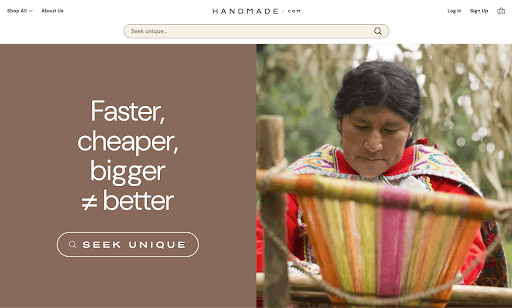
The platform has a strong commitment to the principles of handmade and to supporting artisans. It requires all sellers to take an ethically-made pledge and strictly prohibits mass-produced goods.
It also has a structure in place to oversee the platform’s growth and make sure it stays true to its mission. The Village Council is a 15-person elected body comprising master artisans from diverse geographic regions worldwide, two Handmade.com representatives, and one member from an international arts organization. Artisan sellers elect council members to make decisions about policies, categories, and what qualifies as handmade.
A strict, structurally backed focus on serving the handmade community matters even more as the leading player in the space, Etsy, has relaxed its policies for what counts as handmade and caused outrage in the seller community.
Handmade.com proves that clear values can be a competitive moat. When your marketplace stands for something beyond transactions, you attract users who share those beliefs. This creates a community around your marketplace and builds defensibility against better-funded competitors who can offer lower prices but a more commercial, impersonal experience.
Analogr serves collectors of rare studio gear and music memorabilia: vintage microphones, studio equipment, instruments, and items owned by famous musicians.
The items listed are one-of-a-kind: items like Tupac's handwritten lyrics (estimated $45,000–$75,000), Taylor Swift's 1954 Fender Telecaster (estimated $25,000–$150,000), and studio gear used on famous albums. Many listings include detailed provenance, authentication, and estimation ranges.
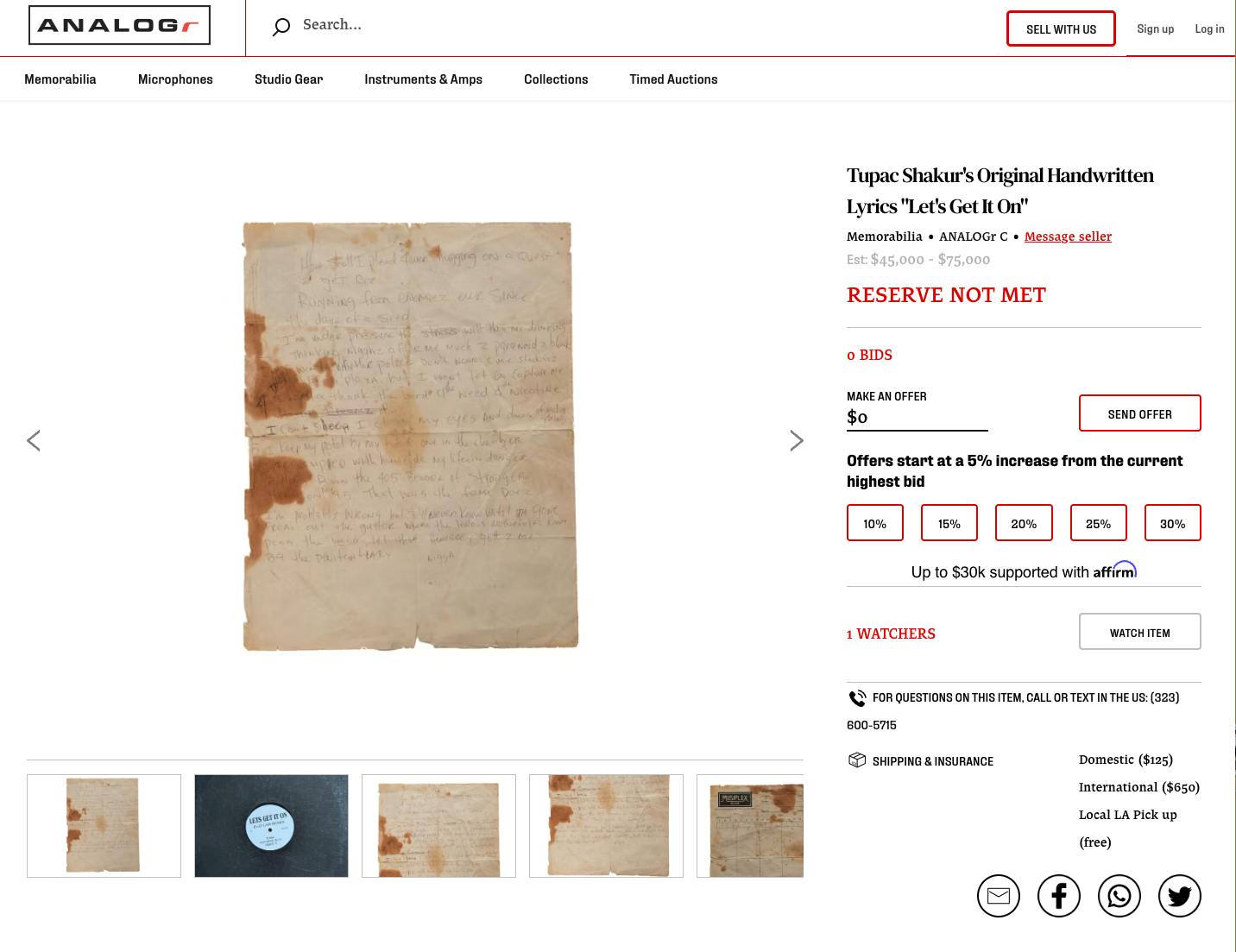
General marketplaces like eBay also handle studio gear, but Analogr serves collectors who understand why a 1969 Marshall Super Bass used on System of a Down albums has a value in the $10,000–$20,000 range, or why specific vintage microphones matter to audio professionals.
This example shows that a strict niche focus enables creating specialized features that improve the user experience and increase trust. Analogr has implemented features and services that help it serve music memorabilia collectibles trading specifically, including:
- Timed, public, or private auctions for high-value items
- Offers and bids
- Ability to include documentation and authenticity information in listing description
- Consignment services for legacy estates
- Private sales for approved members
Of course, music gear collecting is a small market compared to global fashion resale. But what Analogr loses in transaction frequency it can make up in average order value. To fulfill its value proposition, it doesn’t need millions of users. What’s vital is that collectors, producers, and musicians who value authentic provenance—and are willing to pay for it—know and trust they can find it on Analogr.
The Octopus Club was founded by Ana Rachel Estrougo in 2020 to solve a problem she experienced as a new parent: finding quality second-hand items for children. While she had always bought her own clothes and furniture preloved, she couldn't find a trustworthy place to do the same for her six-month-old.
The marketplace exclusively served parents buying and selling high-quality children's clothing, toys, and accessories. The narrow focus on quality and trust built a strong community around the platform and helped establish The Octopus Club as a place parents could rely on to both find new items and find new owners for things their children had outgrown.
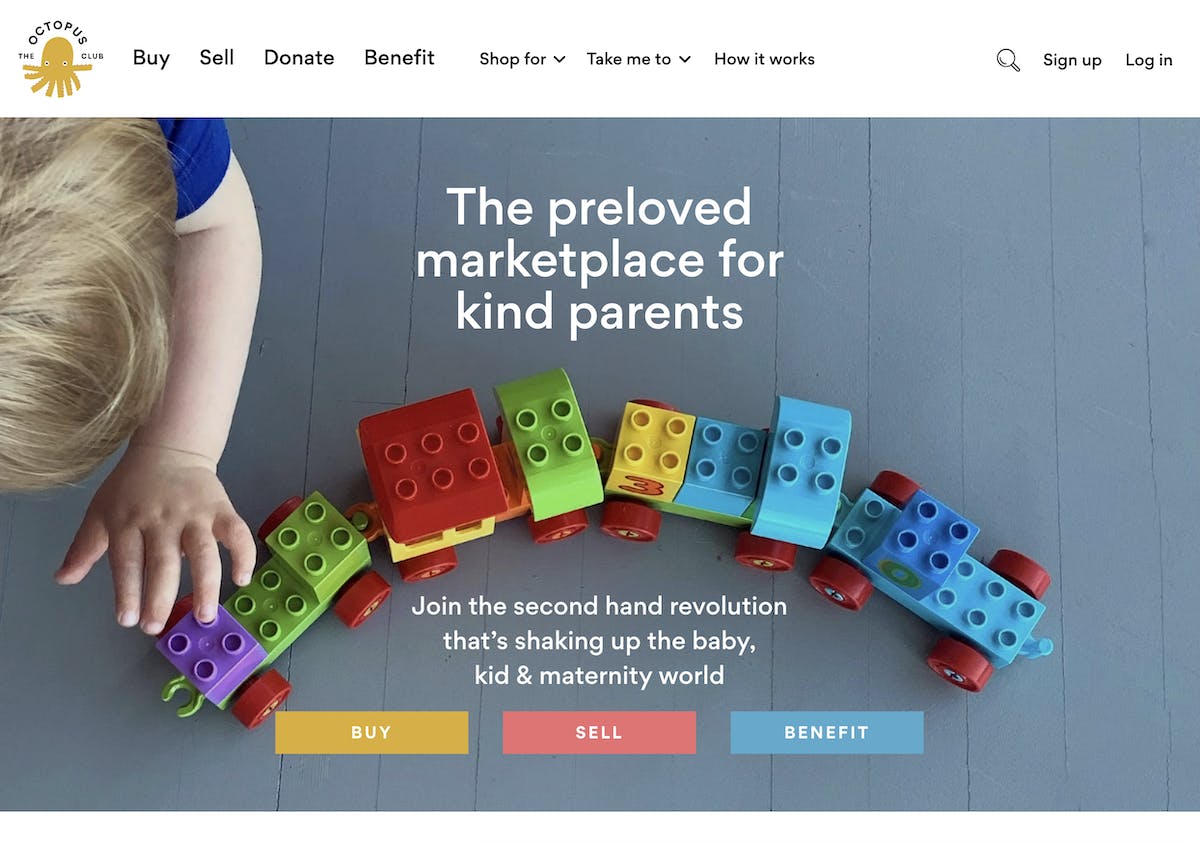
During its four-year run (2020–2025), The Octopus Club successfully re-homed over 45,000 items and built a community of over 25,000 registered users. The marketplace earned press coverage from BBC, The Times, Vogue, and The Guardian, and was named a Blue Earth company for its contributions to the fight against climate change and ranked #2 in GreenTech Europe.
Ana chose Sharetribe specifically to "launch quickly, get feedback, and make the platform better" rather than spend months building from scratch. "Launching felt like rapid fire compared to building from scratch," she said. This let her test assumptions with real users. The moment "people I didn't know started buying and selling from each other" validated the concept before significant investment.
C2C marketplaces offer tremendous business potential. The second-hand economy alone is projected to reach $350 billion by 2028, and new opportunities emerge constantly as consumer preferences shift toward sustainability, unique items, and peer-to-peer transactions.
The most successful C2C marketplaces share common patterns:
- They start focused. Poshmark began with women's fashion in specific cities. StockX started with sneakers, eBay with auctions for collectibles. Narrow focus creates density, which creates liquidity, which creates growth.
- They solve real trust problems. StockX built authentication infrastructure. Vinted eliminated seller fees to maximize inventory. Handmade.com created artisan governance. Identify what stops transactions in your category and build your competitive advantage around solving it.
- They launch quickly and iterate. The best marketplace founders validate demand with real users before perfecting technology. Launch with core features, learn what matters to your community, then customize strategically.
- They build community, not just transactions. Technology connects people, but shared values and belonging keep them engaged. The most defensible marketplaces serve communities where users care about more than just prices.
The barriers to launching a C2C marketplace have never been lower. Modern marketplace software lets you launch in days, validate your concept with real users, and scale when ready—without the months of development and hundreds of thousands of dollars that building from scratch requires.
Ready to build your C2C marketplace? Start your free trial with Sharetribe and launch your marketplace today.
A C2C (customer-to-customer) marketplace is a platform that connects individual consumers who want to sell products with other consumers who want to buy them. Unlike traditional retail where businesses sell to consumers, C2C marketplaces facilitate transactions between peers.
Common examples include eBay (general products), Poshmark (fashion), Etsy (handmade goods), and StockX (sneakers and streetwear). The marketplace provides the platform, handles payments, and often offers trust mechanisms like reviews and buyer protection, while individual sellers provide the inventory.
C2C (customer-to-customer) and P2P (peer-to-peer) are often used interchangeably, and there's significant overlap. Both connect individuals rather than businesses.
The distinction, when made, typically comes down to transaction type:
- C2C usually refers to product sales, especially resale platforms for second-hand items (Poshmark, Vinted, eBay).
- P2P often describes rentals or services (Airbnb, Turo, TaskRabbit).
In practice, many marketplaces blur these lines. The key similarity is that both models connect individuals directly, with the platform facilitating transactions but not owning inventory.
C2C marketplaces typically use one or more of these revenue models:
- Transaction commission: Taking a percentage of each sale (5-20% is common). Commission can be charged either from sellers (often called something like “sales fee”), from buyers (e.g. as a “service fee” or “buyer protection fee”), or both.
- Subscription plans charge monthly fees for access to the platform or for features such as unlimited listings or reduced commission rates.
- Listing fees charge sellers to post items.
- Freemium models don’t charge for access or transactions, but may layer on additional services like authentication, shipping, insurance, or better seller tools
- Featured listings charge for premium visibility for their sellers’ listings.
Many successful C2C marketplaces combine multiple revenue streams as they mature to diversify income and capture value from different user behaviors. For early-stage platforms, a simple and affordable commission structure usually works best.
You have three main approaches for building a C2C marketplace:
Use marketplace software like Sharetribe. Launch quickly with core features pre-built (listings, payments, reviews, messaging, escrow), then customize with code as you grow. This approach balances speed, cost, and flexibility. For most founders, this is the fastest and most cost-effective choice.
Build from scratch with custom code. This gives complete control but requires 6-12+ months, experienced developers, and $50,000–$500,000+ budget. Choose this only if you have unique requirements that existing solutions can't handle and significant technical resources.
Use general no-code tools like Bubble, website builders with plugins, or integrating several no-code tools. Works for very simple MVPs but struggles with marketplace-specific features like escrow payments, two-sided reviews, and scaling. Bubble is approaching custom-development in flexibility, but has a strong lock-in and requires lots of time and skill.
As a rule of thumb, the best approach is one that gets your site up and running the fastest. For a marketplace, getting the business side of things up and running is much more important, and much more challenging, that building the tech.
The best marketplace software depends on your specific category, technical requirements, and customization needs.
Sharetribe is purpose-built for C2C marketplaces. It provides core marketplace features out of the box (user profiles, listings, search, payments with escrow, messaging, reviews) with the flexibility to customize through code when needed. Thousands of C2C marketplaces run on Sharetribe, from fashion resale to collectibles to handmade goods.
Other options for this use case include My Marketplace Builder, Kreezalid, and Arcadier. Their no-code builders pretty closely match Sharetribe’s, but only Sharetribe lets you add custom features yourself with custom code, without rebuilding the entire marketplace.
For a comprehensive comparison of marketplace platforms, see our complete guide to the best marketplace software.
Legal requirements vary by region but typically include:
- Payment compliance: Working with payment processors that handle tax reporting (1099-K in the US, DAC7 in Europe). Using platforms like Stripe Connect simplifies this significantly.
- Data protection: Compliance with GDPR (Europe), CCPA (California), and similar privacy regulations. This includes user consent mechanisms, data handling practices, and deletion capabilities.
- Consumer protection: Clear policies for returns, refunds, and dispute resolution. Requirements vary by jurisdiction.
- Content moderation: Removing prohibited items, counterfeit goods, and illegal content. Marketplaces are often held responsible for what's sold on their platforms.
- Tax collection: Some regions require marketplaces to collect and remit sales tax on behalf of sellers.
If you build on marketplace software like Sharetribe, many infrastructure-level compliance requirements (data security, payment processing) are handled by the platform. However, you're still responsible for policies, content moderation, and legal compliance in your specific markets.
Consult with legal experts familiar with marketplace regulations in your target regions before launching.
Don't try to beat giants like eBay or Poshmark at their own game. Instead, serve a specific niche better than they can.
- Focus on a specific category or community: StockX dominates sneaker authentication despite eBay existing. Narrow focus lets you build features and community that generalists can't match.
- Solve the biggest pain point in your category: StockX solved counterfeits with authentication. Vinted solved seller friction with zero fees. Find what stops transactions in your niche and build your moat around solving it.
- Start local or category-specific, expand later: Poshmark began with women's fashion in San Francisco, Vinted started in Lithuania. eBay originally focused on auctions for collectibles. Focus creates density, which creates liquidity, which creates sustainable growth.
- Build community, not just features: Users stay for community and shared values, not just technology. The Octopus Club, Handmade.com, and Analogr all serve passionate communities where belonging matters as much as transactions.
Start your 14-day free trial
Create a marketplace today!
- Launch quickly, without coding
- Extend infinitely
- Scale to any size
No credit card required