How to build a website like YourMechanic
YourMechanic brings certified mechanics directly to customers' locations, revolutionizing car maintenance with mobile service. Learn how to build a similar on-demand automotive service marketplace with the right features, business model, and technical approach.
Published: Mar 22, 2024
Last updated: Sep 11, 2026
What is YourMechanic and how does it work?
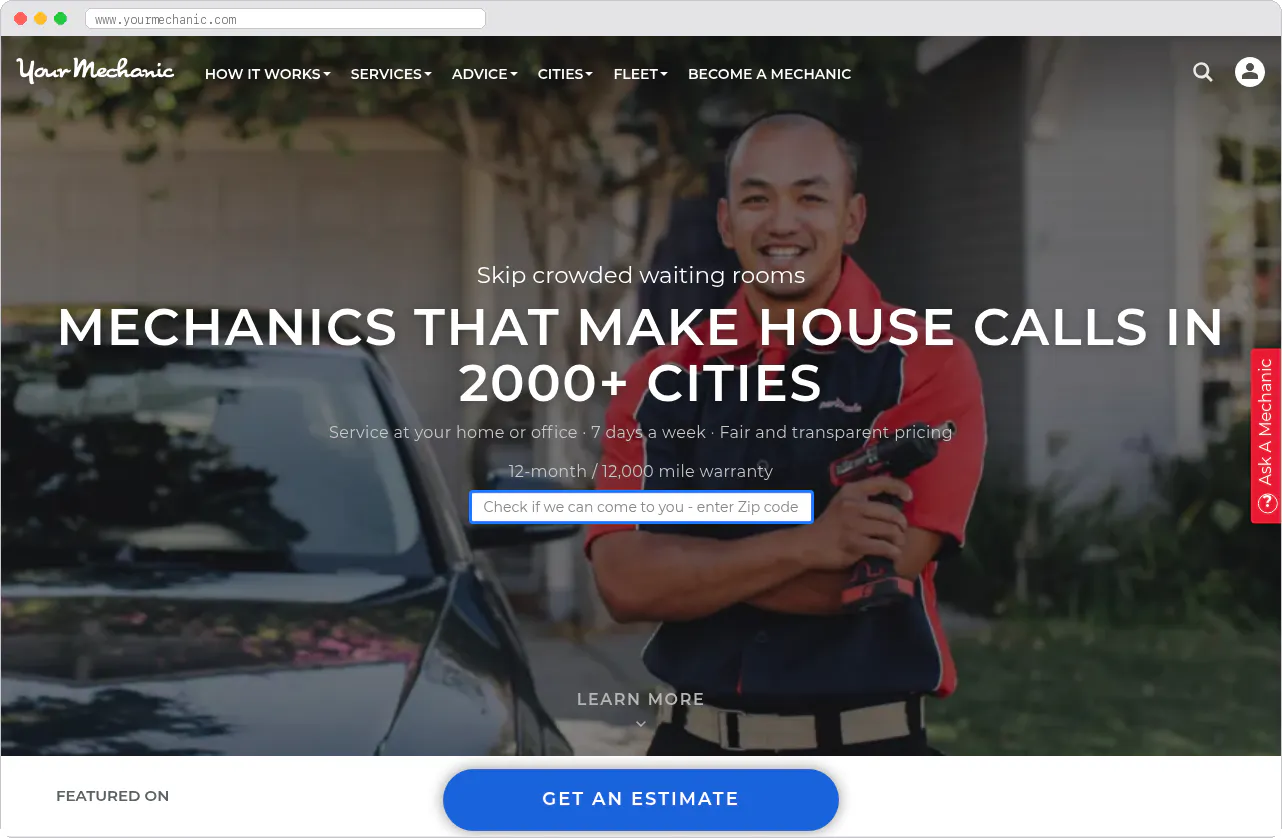
YourMechanic connects car owners with independent, certified mechanics who perform repairs and maintenance at the customer's home, office, or curbside. Founded in 2012 by Art Agrawal and Dongyi Liao, the platform now operates in more than 2,000 cities across the United States and has served over 1.5 million vehicles (YourMechanic). Customers enter their vehicle's year, make, and model, select a service, get an upfront quote, and book a mechanic who arrives with tools and parts to do the job on-site.
The three-sided model puts YourMechanic in the middle of every transaction: it recruits and vets mechanics, sets pricing, processes payment, and handles customer support and warranty claims. Mechanics work as independent contractors, choosing their own hours and accepting jobs that fit their schedule and expertise. This structure let YourMechanic scale nationally without owning a single shop or hiring a single technician as an employee, a capital-light model that made it attractive to venture investors and, later, to Wrench, the mobile mechanic company that acquired YourMechanic in June 2022 (PR Newswire).
How YourMechanic makes money
YourMechanic runs on a spread model rather than a visible commission. Customers pay the full quoted price upfront, calculated from a combination of standardized labor rates, parts costs, and local market adjustments. YourMechanic then pays mechanics a set rate for their labor, keeping the difference between what the customer paid and what the mechanic earned. Because the split isn't published as a percentage, it functions more like a wholesale-retail spread than a marketplace take rate, and the spread can be substantial on certain jobs.
Parts add a second revenue layer. YourMechanic can source and mark up parts directly, or let mechanics buy parts independently, depending on the job. Either way, the platform captures margin on top of labor. Beyond individual bookings, YourMechanic has expanded into B2B channels: fleet maintenance contracts for delivery and rideshare companies, and partnerships with insurers for claims-related repair work. These channels bring higher average order values and more predictable volume than one-off consumer bookings, and they're a common playbook for any two-sided service marketplace looking to smooth out demand variability.
What makes YourMechanic work: key features
Upfront, itemized pricing. Customers see a quote broken into parts and labor before they book, which removes the classic auto-repair anxiety of an open-ended bill. This requires a pricing engine that can price thousands of vehicle and service combinations accurately, not a flat rate card.
Vehicle-specific service matching. The platform asks for exact year, make, model, and sometimes engine variant before showing services, because a brake job on a 2015 Honda Civic and a 2015 BMW 5 Series involve different parts, tools, and time. Getting this wrong means a mechanic shows up without the right part.
Mechanic vetting and credentialing. ASE certification, background checks, and proof of commercial insurance are prerequisites to join, and these credentials are surfaced to customers before booking. In a business built on letting a stranger work on your car in your driveway, this is the trust layer the entire model depends on.
Mobile-first service delivery logistics. Mechanics need routing, appointment windows, and the ability to reschedule or flag a job as requiring additional parts, all from the field. This is closer to a field-service dispatch problem than a typical marketplace booking flow.
Photo documentation and mid-job approval. When a mechanic finds an additional issue mid-repair, the platform supports photo evidence and a customer approval step before the price changes. This single feature does a lot of work in preventing billing disputes, which are the number one trust killer in home-service marketplaces.
Warranty tracking across parts and labor. Because parts warranties and labor warranties come from different sources and run on different terms, the platform needs a system to track claims and route them correctly, something most generic marketplace templates don't handle out of the box.
The competitive landscape
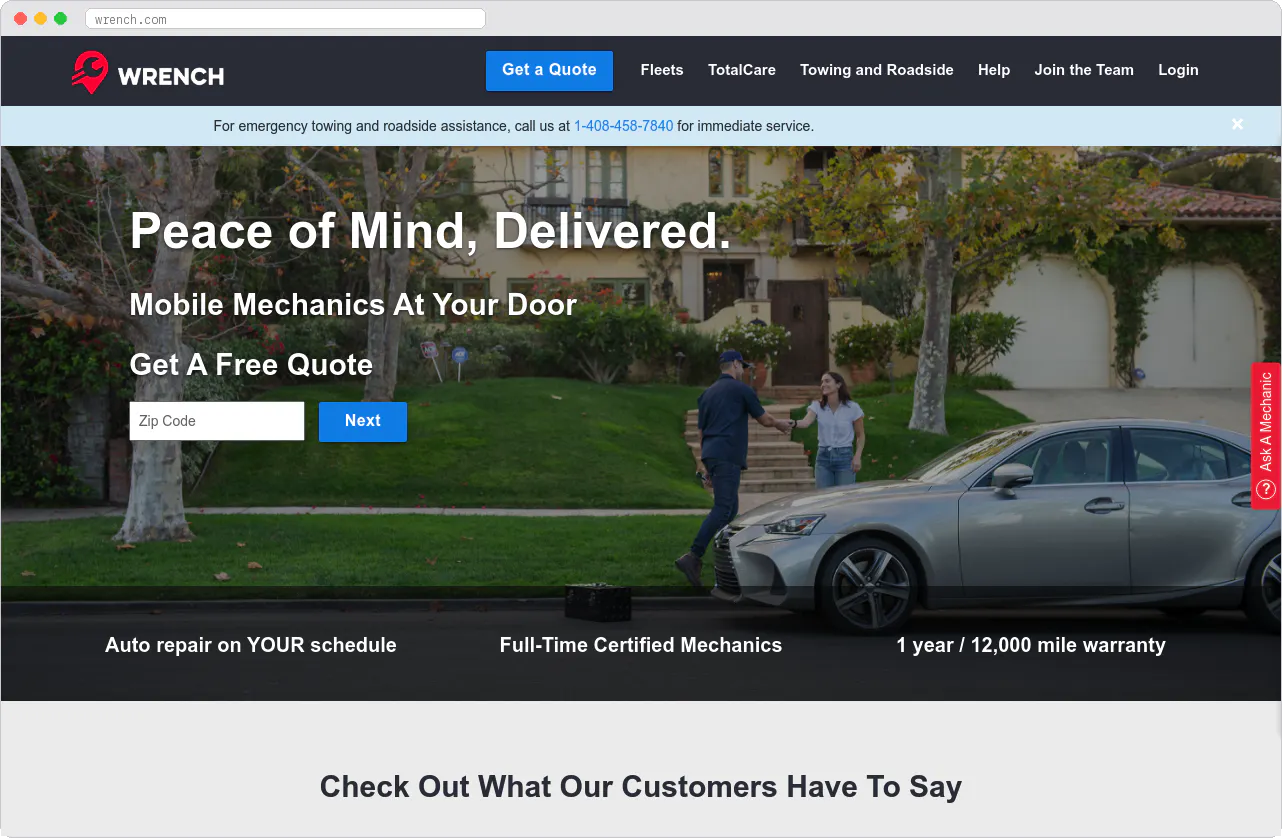
Wrench is YourMechanic's closest direct competitor and positions itself as the premium option. It employs some mechanics directly rather than relying solely on independent contractors, which gives it tighter quality control but higher fixed costs, and it operates in fewer metro areas as a result. The opening this creates: a new entrant can compete on trust and consistency in mid-size markets Wrench hasn't prioritized, without needing Wrench's staffing overhead.
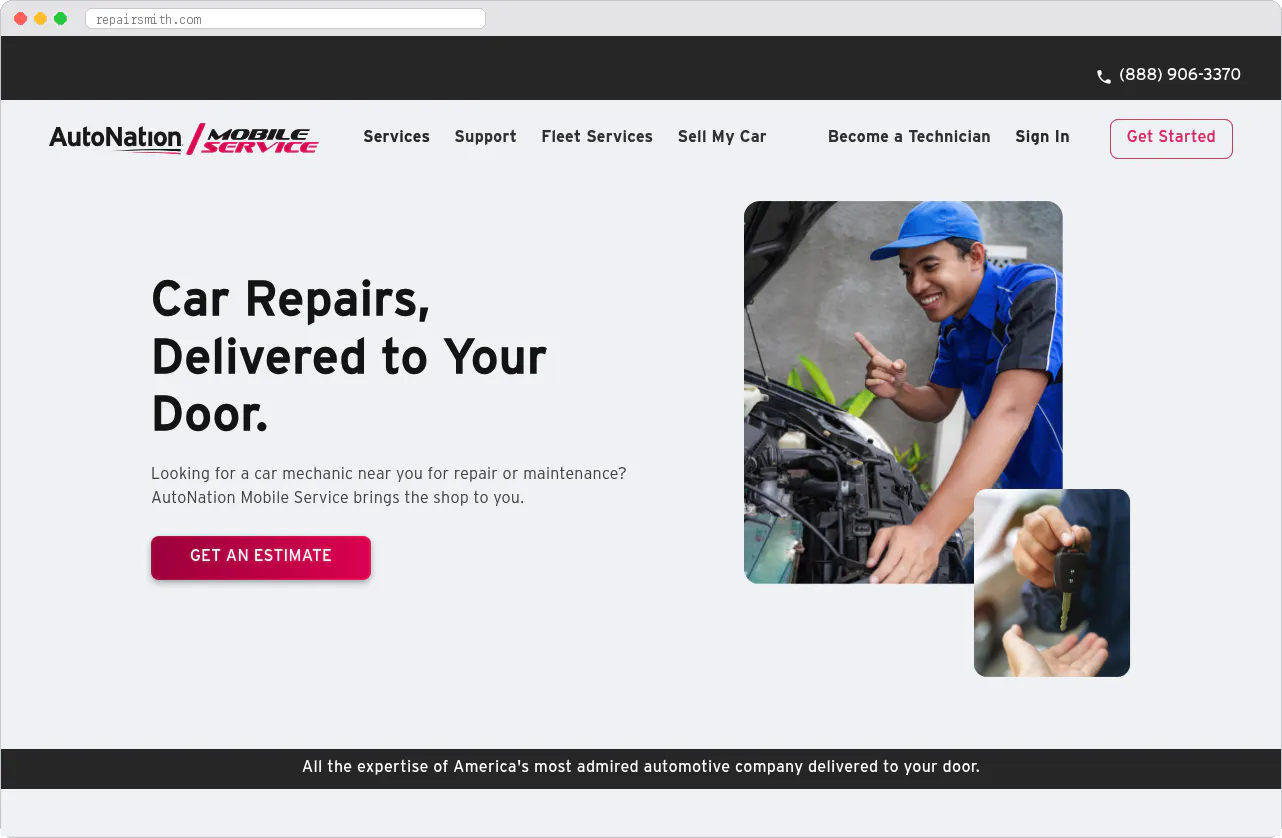
RepairSmith blends mobile service with a fleet of branded vans and a more corporate look, plus the option to route more complex jobs to a shop when mobile service isn't feasible. That hybrid model is a real strength for customer trust, but it's also expensive to run and kept the company concentrated in western and southern U.S. markets before AutoNation acquired RepairSmith in 2023 and rebranded it as AutoNation Mobile Service (AutoNation). A leaner entrant that only handles mobile-friendly jobs, and is upfront about that limit, can undercut RepairSmith on both price and geographic reach.
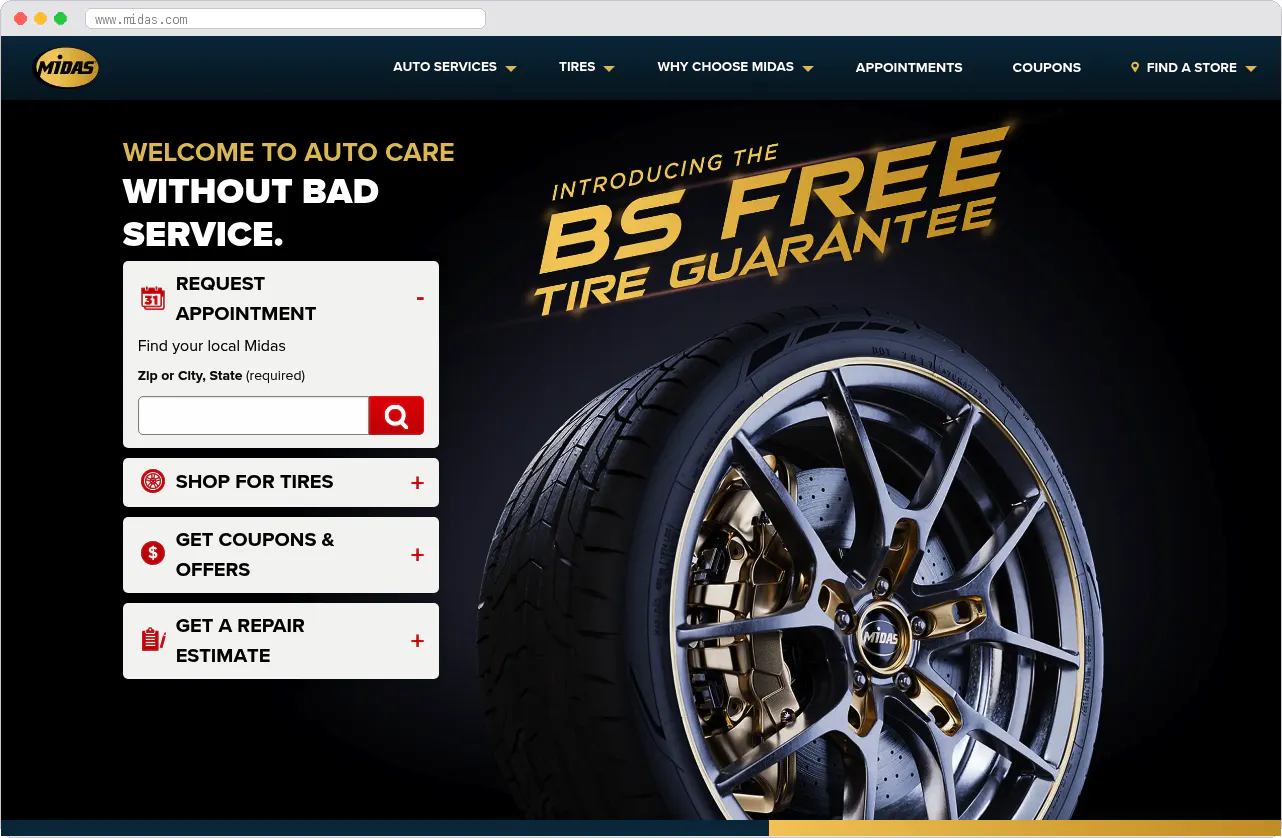
Midas, through its Midas On-Site program, brings decades of brand trust and an existing parts and shop network to mobile repair. What it lacks is the software experience: booking, quoting, and communication feel like an add-on to a legacy business rather than a product built mobile-first. A digitally native competitor can win customers who like the idea of a known brand but want an app-first experience Midas hasn't built.
Local independent mobile mechanics compete on price and personal relationships, particularly in suburban and rural areas where none of the platforms above have dense coverage. They lack branded insurance guarantees and consistent availability, which is exactly the gap a well-run regional platform can fill by formalizing what independents already do informally.
Traditional repair shops with pickup/delivery add-ons remain the default for many customers simply through habit and existing relationships. They rarely match the pricing transparency or scheduling convenience of app-based competitors, which is the core wedge every marketplace in this category is pushing on.
How to build a marketplace like YourMechanic
1. Define your niche within YourMechanic's category
Don't try to out-YourMechanic YourMechanic on national scale. Pick a specific vehicle segment (EVs, luxury imports, diesel trucks, motorcycles) where specialized knowledge is a real barrier to entry, or pick a geography YourMechanic and Wrench have thin coverage in, such as mid-size metro areas or rural counties. Fleet operators, rideshare and delivery drivers, and independent car dealerships are B2B niches with recurring demand and different buying behavior than one-off consumer repairs.
2. Validate demand and unit economics
Talk to 20-30 potential customers in your target segment about how they currently get their car serviced and where the friction is. Talk to mechanics too: what would make them choose your platform over working independently or for a shop. Model your unit economics before writing a line of code: average job value, your take (whether spread or commission), mechanic acquisition cost, and how many jobs a single mechanic needs to complete monthly to make the platform worth their time.
3. Define your service catalog and pricing model
Decide early which services are mobile-appropriate. Jobs needing a lift, specialized diagnostic rigs, or hazardous-material disposal usually don't work in a driveway or parking lot. Build your initial catalog around high-frequency, portable-tool-friendly jobs like brake pads, batteries, alternators, starters, and routine maintenance, and treat anything requiring a shop as a referral rather than a core offering. Decide how you'll price: flat rates by service and vehicle class, or dynamic quotes calculated per job.
4. Choose your development approach
Vibe coding from scratch. AI tools like Cursor, Lovable, and Bolt can produce a working YourMechanic-style prototype quickly, complete with a booking form and a mechanic dashboard. For pressure-testing a concept or demonstrating it to early users, they're genuinely useful. For launching a platform that handles real money between strangers, they're probably not sufficient. What vibe-coded outputs reliably don't produce is the infrastructure underneath: payment escrow, dispute resolution, fraud detection, and compliance. A documented Sharetribe experiment ran 60+ hours to reach demo quality but revealed a critical checkout exploit that would have allowed price manipulation via direct API call. Bringing the output to production standard requires significant time, testing, and a clear understanding of how the different components of a web application fit together. A useful prototyping tool, not a cost-effective path to launch.
Custom development from scratch. Hiring developers (who will likely use AI heavily) gives you full control. For a YourMechanic-type marketplace, most founders land in the production-grade tier, not the simple MVP tier, because mechanic verification, insurance tracking, warranty management, and mid-job payment adjustments push past basic booking and messaging. That build runs $80,000–$200,000 over 16–28 weeks. A stripped-down version limited to a single service category and manual mechanic vetting could fit the simple MVP tier at $30,000–$80,000 over 8–20 weeks (Codica, RaftLabs). The low end of each range assumes offshore teams at $15–40/hr; US or Western European teams push toward the top. Makes sense when you have requirements no existing platform can meet.
Building on a marketplace operating system like Sharetribe. You start at roughly 90% done on the standard marketplace foundation: payments, user accounts, listing management, messaging, transaction flows, fraud detection, and compliance. Your time and budget go toward the automotive-specific pieces: vehicle data capture, service-specific pricing, and mechanic credential fields. Three paths within this approach:
- No-code builder. Configure vehicle intake forms, a service catalog with variable pricing, mechanic profiles with credential fields, and a commission-based booking flow, all from the Console, without writing code. This gets most founders to a live, bookable marketplace in weeks.
- AI-assisted development. Connect Claude Code, Cursor, or Codex to Sharetribe's open APIs and open-source template to build things like a photo-approval workflow for mid-job scope changes, a vehicle database integration, or a fleet-account dashboard. Because Sharetribe handles the payment infrastructure, AI-assisted development on top of it carries much lower risk than building from scratch.
- Custom code. Build directly on the developer platform for deeper integrations (parts supplier APIs, diagnostic tool connections, insurance claim systems), or hire from Sharetribe's Expert Marketplace.
Most founders start with the no-code builder, then add features via AI or a developer as they learn what their users actually need.
5. Solve the cold start problem
Every service marketplace faces the same chicken-and-egg problem: customers won't book if there aren't enough mechanics nearby, and mechanics won't join a platform with no bookings. YourMechanic solved this by launching narrowly in Silicon Valley, where it could recruit a small, dense pool of mechanics before expanding city by city, only entering a new market once it had enough supply to guarantee reasonable response times.
For a new entrant, three tactics work well. First, go supply-first: recruit five to ten qualified mechanics in a single metro area before you spend a dollar on customer marketing, so the first customer who books gets a good experience. Second, go geographically tight rather than broad: pick one zip code cluster or one mid-size city and dominate it before expanding, rather than listing "nationwide" coverage with thin supply everywhere. Third, consider manual matching in the earliest days, personally calling mechanics to fill the first dozen bookings, even if that doesn't scale, because it buys you the reviews and word of mouth that make automated matching credible later. Launching small and tight beats launching broad because a marketplace with five happy customers and five busy mechanics in one city beats one with fifty scattered, half-served customers across the country.
6. Recruit and onboard mechanics
Target training programs, community colleges with automotive tech certificates, and mechanics looking for schedule flexibility outside a shop job. Make the value proposition concrete: steady customer flow without the overhead of running their own shop or storefront. Build an onboarding flow that verifies ASE certification, insurance, and background checks before a mechanic can accept their first job, since this is the trust layer customers are paying for.
7. Launch and acquire your first customers
Market to a specific, easy-to-reach segment first, such as busy professionals in a defined area, rather than broad brand awareness. Partner with complementary local businesses (parts stores, car washes, parking garages) for co-marketing, and build a referral incentive for both customers and mechanics from day one, since word of mouth carries outsized weight in a category built on trust.
8. Monitor operations and expand deliberately
Track booking-to-completion rate, mechanic utilization, and customer satisfaction weekly in the first few months. Expand your service catalog and geography only when your current mechanics are near capacity and satisfaction scores are holding steady, not before.
Do you need to build everything YourMechanic has?
No. YourMechanic's current feature set, fleet dashboards, insurance-claim integrations, a proprietary vehicle database covering nearly every model sold in the US, took over a decade and outside funding to build. At launch, you need vehicle intake, a working service catalog, mechanic verification, booking, messaging, and payment. Warranty automation, fleet accounts, and parts-supplier integrations are things to add once you have real transaction volume telling you they're worth building.
The instinct to "just vibe-code a clone" misses what actually takes time in this category. An AI tool can generate a booking form and a mechanic list in an afternoon. It won't generate a payment flow that correctly handles a deposit, a mid-job price change, and a final reconciliation without a security hole, and it won't generate the compliance groundwork that protects you when a mechanic's insurance lapses or a customer disputes a charge. Starting on Sharetribe's foundation is faster even with AI tools in the loop, because the payment and compliance infrastructure is already built and tested. Your AI tokens go toward the vehicle-specific and mechanic-specific features that actually differentiate your platform, not toward reinventing checkout security from zero.
Trust and safety for a YourMechanic-type marketplace
The trust risks in mobile auto repair are physical, financial, and reputational at once. A stranger works on a customer's car, often in their driveway, sometimes while they're not home. Payment disputes arise when a job's scope changes mid-repair. Fraudulent credentials or uninsured mechanics create real liability exposure if something goes wrong on the job.
Standard verification in this space includes ASE certification checks, criminal background checks, proof of active commercial auto and liability insurance, and identity verification tied to the mechanic's payout account. Sharetribe provides the transaction backbone this sits on top of: user accounts with optional identity verification, secure payment processing with the ability to hold funds until a job is marked complete, and a structured transaction flow that can require approval steps before a charge is finalized. What founders need to add is category-specific: integrating a credential verification service (or building a manual review step for launch), a photo-approval step for scope changes, and clear written policies on what happens when a job goes wrong, published before your first booking, not written reactively after a dispute.
Running a marketplace like YourMechanic
Day-to-day operations center on three things: keeping supply (mechanics) available where demand is, handling the inevitable mid-job complications (a part not fitting, a job taking longer than quoted), and resolving disputes quickly enough that a bad experience doesn't become a bad review. At YourMechanic's scale, this means a dedicated support team, an internal parts supply chain, and data science tuning pricing across thousands of vehicle-service combinations. None of that is necessary at launch.
Sharetribe handles user accounts, listings, messaging, payment processing, and the underlying transaction logic automatically, which removes most of the infrastructure burden from day one. What you manage directly in the early days is mechanic recruitment, quality control, and customer support, the parts of the business that are genuinely specific to your market and can't be templated.
Development costs and timeline
Three realistic scenarios:
Vibe coding from scratch: Free or very cheap to start. A working YourMechanic-style prototype, a booking form, a mechanic list, a basic quote calculator, is buildable in a weekend with AI tools. What you can't get from here is a production-ready platform: secure payment handling for deposits and scope changes, mechanic credential verification workflows, dispute resolution, and insurance compliance all require work that AI coding tools don't shortcut. A documented Sharetribe experiment logged 60+ hours to reach demo quality and found critical payment vulnerabilities. A useful proof-of-concept tool, not a cost-effective path to a live business.
Custom development from scratch: Cost depends on complexity tier. A stripped-down single-service MVP with manual mechanic vetting can fit the simple tier at $30,000–$80,000 over 8–20 weeks. Most realistic YourMechanic-style builds, with mechanic credential tracking, warranty management, and mid-job scope-change approval, land in the production-grade tier at $80,000–$200,000 over 16–28 weeks (Codica, RaftLabs). The low end assumes offshore teams; US or Western European teams push toward the top. Ongoing maintenance typically runs 15–25% of the original build cost per year. Makes sense when you have requirements no existing platform can meet.
Building on Sharetribe: Before you launch, the Sharetribe Build plan costs just $39/month. To open to real users, you need the Live plan, which costs $199/month billed yearly ($259/month billed monthly). Both plans include 1 million usage credits per month. Sharetribe covers the transaction engine, payments, user accounts, listings, messaging, and search that a YourMechanic-style marketplace needs as its foundation. Most founders reach a live MVP in weeks rather than months. Custom features like vehicle database integrations or fleet dashboards, added via AI tools or a developer, are scoped narrowly because the transaction engine is already there.
Why Sharetribe for building a marketplace like YourMechanic
Sharetribe's transaction flow engine maps directly onto YourMechanic's core mechanic: a customer requests a service, a provider accepts and delivers it, and payment moves through the platform with a commission taken automatically. Custom listing fields let you capture vehicle year, make, model, and service type without custom code. Built-in messaging supports the customer-mechanic communication a job in progress requires, and Sharetribe's payment infrastructure supports holding funds until a job is confirmed complete, which is the closest built-in equivalent to the deposit-and-reconciliation flow automotive service demands. Because the foundation is already handled, your development effort, whether no-code configuration, AI-assisted extensions, or custom code, goes toward what's actually specific to mobile mechanic services.
Frequently asked questions
How much does it cost to build a website like YourMechanic?
It depends on the path. A no-code build on Sharetribe starts at $39/month on the Build plan ($199/month billed yearly on the Live plan once you go live). Custom development for a production-grade platform with mechanic verification and warranty tracking runs $80,000–$200,000 over 16–28 weeks (Codica). Vibe-coding a prototype is nearly free but isn't safe to launch with real payments.
What are the key features needed for an automotive service marketplace?
You need vehicle-specific intake, a service catalog with accurate pricing, mechanic credential verification, appointment booking, in-app communication, commission-based payment processing, and warranty tracking. Most of these except the automotive-specific pricing logic and vehicle database come built into a marketplace platform like Sharetribe.
How do automotive service marketplaces make money?
Most take a spread or commission between what the customer pays and what the mechanic earns, often in the 15-30% range, plus markup on parts sold through the platform. Some add subscription maintenance plans or B2B fleet contracts as secondary revenue.
What makes YourMechanic successful compared to competitors?
YourMechanic combined rigorous mechanic vetting, upfront transparent pricing, and early-mover geographic expansion into a national network. It focused first on one metro area, refined operations, then scaled city by city rather than launching broadly and thinly.
How do I find mechanics for my automotive service platform?
Recruit through automotive trade schools, community college certificate programs, and mechanics currently working shop jobs who want flexible hours. Lead with concrete benefits: no overhead, no lease, access to a customer base they couldn't reach solo.
Can I start an automotive service marketplace without technical skills?
Yes. A no-code platform like Sharetribe lets a non-technical founder configure vehicle intake, service listings, mechanic profiles, and payment flows without writing code. You can add AI-assisted or custom features later, once real bookings tell you what's worth building next.
Start your 14-day free trial
Create a marketplace today!
- Launch quickly, without coding
- Extend infinitely
- Scale to any size
No credit card required