How to build a website like LawnStarter
LawnStarter connects homeowners with lawn care professionals, generating $50+ million in annual revenue. Learn how to build your own home services marketplace with the right features, business model, and technical approach.
Published: Jan 18, 2024
Last updated: Mar 19, 2026
What is LawnStarter and why build a similar marketplace?
LawnStarter is an on-demand home services marketplace that connects homeowners with lawn care professionals across the United States. Founded in 2013 by Steven Corcoran in Austin, Texas, the platform has grown to serve over 120 cities and generates around more than $50 million in annual revenue.
The company started when Corcoran, frustrated with the difficulty of finding reliable lawn care, decided to create a platform that would make booking yard services as easy as ordering a ride. What began as a simple booking website has evolved into a comprehensive platform that handles everything from one-time lawn mowing to recurring maintenance contracts, seasonal cleanups, and landscaping projects.
LawnStarter's success stems from solving a genuine pain point in the home services industry. Traditional lawn care businesses often rely on word-of-mouth referrals, phone calls, and paper-based scheduling systems. Homeowners struggle to find reliable providers, compare prices, or manage recurring services. The platform digitizes this fragmented market, creating transparency and convenience for both sides.
The home services market represents a massive opportunity. Americans spend over $60 billion annually on lawn care and landscaping services, with the average homeowner spending $500-1,500 per year on yard maintenance. Unlike many gig economy platforms, lawn care naturally creates recurring revenue relationships, as customers typically need weekly or bi-weekly service throughout the growing season.
Building a marketplace like LawnStarter makes sense for several reasons. First, the service is location-dependent, creating natural barriers to entry that protect local market leaders. Second, the recurring nature of lawn care creates predictable revenue streams and higher customer lifetime values compared to one-time services. Third, the industry remains largely offline in many markets, leaving room for digital disruption.
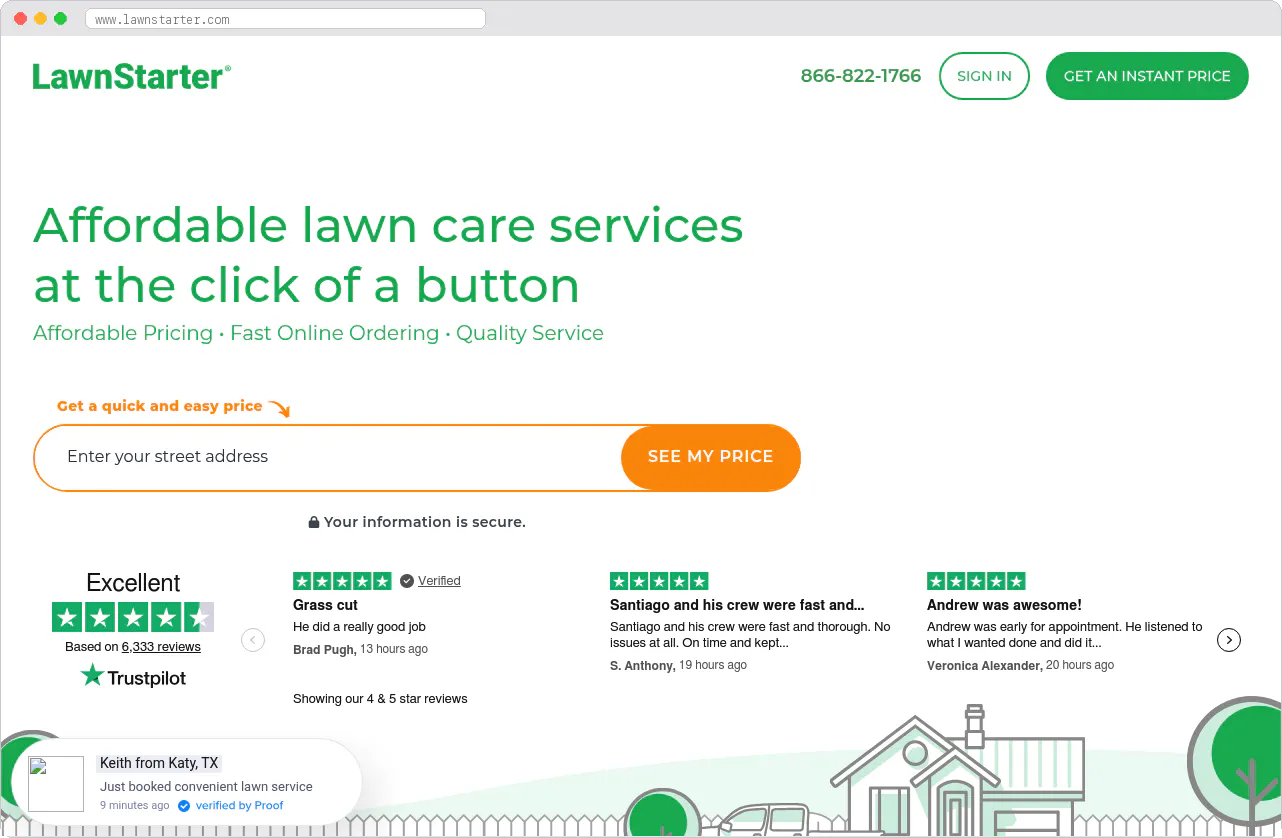
How does LawnStarter work?
LawnStarter operates as a commission-based marketplace connecting homeowners with independent lawn care professionals and landscaping companies. The platform handles the entire transaction process, from initial booking to payment processing, while providing tools that help both customers and service providers manage their relationships efficiently.
For homeowners, the process begins with entering their address and property details through LawnStarter's website or mobile app. The platform uses property data and satellite imagery to provide instant pricing estimates for common services like mowing, edging, and trimming. Customers can book one-time services or set up recurring maintenance schedules, with options for weekly, bi-weekly, or monthly service depending on their needs and budget.
The booking process includes detailed service specifications. Customers can request additional services like leaf removal, fertilization, or hedge trimming, and they can leave specific instructions about pet accommodations, gate codes, or areas to avoid. The platform's scheduling system automatically matches customers with available providers in their area based on service requirements, timing preferences, and provider ratings.
For lawn care professionals, LawnStarter provides a steady stream of customers without the marketing costs typically associated with acquiring new business. Providers create profiles that showcase their experience, equipment, and service areas. The platform's algorithm matches them with suitable jobs based on their location, availability, and service capabilities.
Providers receive job notifications through the mobile app and can accept or decline work based on their schedule and preferences. Once they accept a job, they have access to customer contact information, property details, and any special instructions. After completing the service, providers submit before-and-after photos and mark the job as complete, triggering automatic payment processing.
LawnStarter's business model and revenue streams
LawnStarter generates revenue primarily through commission fees charged to service providers. The platform typically takes 15-20% of each transaction, though the exact percentage varies based on service type, provider volume, and market conditions. This commission covers payment processing, customer acquisition, platform maintenance, and customer support.
The commission model works well for lawn care marketplaces because it aligns the platform's interests with provider success. LawnStarter only makes money when providers complete paid work, creating incentives for the platform to send high-quality leads and retain satisfied customers. The recurring nature of lawn care also means that a single customer acquisition can generate commission revenue for months or years.
Beyond transaction fees, LawnStarter has explored additional revenue streams. These include premium provider subscriptions that offer enhanced visibility in search results, lead generation services for larger landscaping companies, and partnerships with lawn care product manufacturers. However, transaction commissions remain the core revenue driver.
The platform's unit economics benefit from the recurring nature of lawn care services. While customer acquisition costs can be substantial in competitive markets, the average customer lifetime value often exceeds $500-1,500, providing healthy margins even after accounting for commission splits and operational expenses.
Key features that make LawnStarter successful
LawnStarter's platform includes several features specifically designed for the home services industry that differentiate it from generic marketplace platforms.
Instant pricing and property intelligence form the foundation of LawnStarter's user experience. The platform uses satellite imagery, property records, and machine learning algorithms to provide immediate price quotes without requiring lengthy forms or on-site estimates. This removes a major friction point in traditional lawn care booking, where customers often wait days for quotes and struggle to compare pricing across multiple providers.
Recurring service management handles the complexity of ongoing maintenance relationships. Customers can set up weekly or bi-weekly mowing schedules that automatically book future appointments, adjust service frequency seasonally, and modify or pause service as needed. The platform sends automatic reminders before each service and handles billing for recurring customers.
Photo verification and job tracking build trust and accountability between customers and providers. Providers submit before-and-after photos for each completed service, creating a visual record of work performed. Customers receive these photos along with completion notifications, providing transparency about service quality and timing.
Weather-aware scheduling automatically adjusts service schedules based on local weather conditions. The platform can delay mowing services during rainy periods and reschedule automatically when conditions improve. This feature reduces customer service inquiries and helps providers manage their schedules more efficiently.
Provider vetting and quality management ensure service reliability through background checks, insurance verification, and performance monitoring. LawnStarter requires providers to carry liability insurance and uses customer feedback to identify and address quality issues. Providers with consistently poor ratings may be removed from the platform.
Seasonal service expansion allows the platform to generate revenue year-round by offering complementary services like leaf removal, snow removal (in applicable markets), and holiday lighting installation. This diversification helps retain both customers and providers during off-season periods when lawn mowing demand decreases.
Building a successful LawnStarter alternative
Creating a competitive home services marketplace requires understanding both the technical requirements and the business challenges inherent in two-sided platforms. Success depends on executing a focused launch strategy, building the right feature set, and establishing sustainable unit economics before attempting to scale.
Finding your market opportunity
The most successful LawnStarter alternatives focus on specific geographic markets or service niches rather than attempting to compete head-to-head with established players in major metropolitan areas. LawnStarter's presence in over 120 cities means that direct competition in markets like Austin, Dallas, or Atlanta requires significant capital and customer acquisition resources.
However, opportunities exist in mid-sized cities where LawnStarter doesn't operate, in regions with unique service needs (like drought-resistant landscaping in arid climates), or in adjacent service categories like pool maintenance, pest control, or outdoor lighting. Some successful marketplace founders have built regional dominance in specific service verticals before expanding into broader home services.
Another approach involves targeting underserved customer segments. LawnStarter primarily focuses on suburban homeowners with traditional grass lawns, leaving opportunities for platforms that specialize in commercial properties, organic lawn care, native plant landscaping, or luxury landscaping services. Each of these segments has different pricing models, service requirements, and customer expectations.
Local market knowledge provides significant advantages in the home services industry. Understanding seasonal patterns, regulatory requirements, common property types, and local competitive dynamics helps new marketplace founders make better decisions about pricing, provider requirements, and service offerings.
Validating demand before building
Before investing in platform development, validate demand through direct customer research and manual service delivery. The home services industry offers unique opportunities for founders to test their ideas by actually providing services themselves or partnering with existing providers to understand operational requirements.
Start by identifying 20-30 potential customers in your target market and conducting detailed interviews about their current lawn care arrangements. Ask about their pain points with existing providers, how they currently find and hire service providers, what they pay for services, and what would make them switch to a new platform. This research helps identify the specific value proposition that will differentiate your platform.
Consider launching a manual version of your marketplace before building the full platform. Create a simple website that collects customer requests, manually match them with local providers, and handle payment processing through existing tools. This approach, sometimes called "concierge MVP," allows you to test your business model and understand operational challenges without significant upfront development costs.
For example, you might create a basic booking form that collects customer information and service requests, then personally contact local lawn care providers to fulfill these requests. While not scalable, this manual approach helps you understand customer needs, provider capabilities, and the logistics of coordinating home services.
Essential features for a lawn care marketplace
A successful home services marketplace requires features that address the specific needs of location-based, recurring services. Unlike product marketplaces or one-time service platforms, lawn care marketplaces must handle scheduling complexity, weather dependencies, and ongoing customer relationships.
Property-based pricing and booking represents the most critical feature set for lawn care marketplaces. Customers need to specify their property size, terrain complexity, and service requirements to receive accurate pricing. The platform should support address-based property lookup, lot size estimation, and customizable service packages. Integration with mapping services and property databases can automate much of this process.
Provider availability and territory management helps service providers define their service areas, set their availability, and manage their booking capacity. Providers need tools to specify which ZIP codes or neighborhoods they serve, set different pricing for different areas, and block out time for existing customers or personal commitments.
Recurring service scheduling handles the complexity of ongoing maintenance contracts. The platform must support weekly, bi-weekly, or monthly service schedules, automatic billing for recurring customers, and tools for customers to modify or pause their service. Seasonal adjustments are particularly important, as lawn care frequency typically decreases in winter months.
Weather integration and rescheduling automatically adjusts service schedules based on local weather conditions. The platform should integrate with weather APIs to delay services during rain or snow and automatically reschedule when conditions improve. This feature reduces customer service burden and helps providers manage their schedules more effectively.
Communication and update systems keep customers informed about service status, provider arrival times, and completion confirmations. Push notifications, SMS messages, and email updates help manage customer expectations and reduce anxiety about service timing. Before-and-after photos provide visual confirmation of completed work.
Payment processing and provider payouts must handle both one-time services and recurring billing arrangements. The platform needs to process customer payments, hold funds during service delivery, and automatically pay providers after completion. Support for various payment methods, automatic retry for failed payments, and clear invoicing helps maintain smooth cash flow.
Technology and platform considerations
Building a lawn care marketplace involves several technical challenges specific to location-based, recurring services. The platform must handle real-time scheduling, weather data integration, recurring billing, and mobile-first user experiences for field workers.
Mobile functionality is particularly critical since lawn care providers typically work outdoors and need to manage their schedules, communicate with customers, and submit completion photos from their phones. The provider mobile app should work reliably in areas with limited cellular coverage and support offline functionality for essential features.
Integration with external services enhances platform functionality without requiring custom development. Weather APIs provide automatic rescheduling capabilities, mapping services enable territory management and routing optimization, and property databases support automatic lot size estimation and pricing.
Real-time communication systems help coordinate between customers and providers when unexpected issues arise. Features like GPS tracking for provider location, real-time messaging for service updates, and photo sharing for completion verification improve the service experience and reduce customer service inquiries.
Competitive landscape: LawnStarter alternatives
Understanding the competitive landscape helps founders identify opportunities for differentiation and avoid head-to-head competition with well-funded incumbents. The home services marketplace space includes several established players with different approaches to market coverage, service offerings, and business models.
TaskEasy operates primarily in Texas and focuses on standardized pricing based on property size rather than custom quotes. The platform emphasizes predictable pricing and service consistency, targeting customers who prefer simple, no-surprise billing. TaskEasy differentiates itself through aggressive pricing and a satisfaction guarantee that promises to re-service properties if customers aren't satisfied.
GreenPal describes itself as the "Uber for lawn care" and focuses on connecting customers with individual lawn care professionals rather than established companies. The platform emphasizes lower prices by working with independent providers who have lower overhead costs than traditional landscaping businesses. GreenPal operates in over 300 cities but with varying service density.
Lawn Love combines marketplace functionality with direct service provision, operating both as a platform and as a service provider in select markets. This hybrid approach allows them to maintain service quality and availability while building marketplace density. Lawn Love focuses on premium service markets and emphasizes professional crews over individual providers.
Plowz & Mowz expands beyond lawn care to include snow removal, leaf removal, and seasonal services. The platform targets customers who want year-round outdoor maintenance from a single provider. Real-time GPS tracking and completion photos provide transparency about service timing and quality.
Local and regional competitors often provide the strongest competition for new marketplaces. Many cities have established local platforms or booking systems that serve their specific markets effectively. These competitors typically have strong relationships with local providers and deep knowledge of regional service requirements.
The competitive dynamics in home services marketplaces favor platforms that can achieve local market density quickly. Network effects are primarily local rather than national, meaning that success in one city doesn't necessarily translate to advantages in other markets. This creates opportunities for focused regional platforms to compete effectively against national players.
Building your lawn care marketplace: a step-by-step approach
Launching a successful home services marketplace requires a structured approach that prioritizes learning and iteration over perfect initial execution. The following process helps founders validate their ideas, build essential functionality, and scale sustainably.
Step 1: Research and validate your specific market
Begin by conducting thorough research on your target market's current lawn care landscape. Identify existing providers, understand their pricing models, and analyze customer satisfaction with current options. This research should include both online investigation and direct conversations with homeowners and service providers in your area.
Create detailed customer personas that go beyond basic demographics. Understand how different customer segments currently find and hire lawn care providers, what they pay for various services, and what frustrations they experience. Property size, household income, and lifestyle factors all influence lawn care purchasing decisions.
Analyze the supply side equally thoroughly. Interview local lawn care professionals about their business challenges, customer acquisition costs, and operational constraints. Understanding provider economics helps design a platform that attracts quality service providers and maintains competitive pricing.
Step 2: Define your minimum viable platform
Your first platform version should include only the features essential for facilitating basic transactions between customers and providers. Focus on core booking functionality, basic provider profiles, and simple payment processing rather than advanced features like automatic scheduling or weather integration.
The MVP should demonstrate your core value proposition clearly. If your differentiation is faster booking, ensure the booking process is notably simpler than existing alternatives. If your advantage is better pricing transparency, make prices visible immediately without requiring lengthy forms or phone calls.
Plan for manual operations in your initial version. Handle provider matching, scheduling coordination, and customer service personally while building your platform's automated systems. This manual approach provides valuable insights into operational requirements and customer needs.
Step 3: Build your initial provider network
Recruiting quality service providers is typically more challenging than attracting customers, making supply-side acquisition your first priority. Start by identifying successful local lawn care providers who might benefit from additional customers and digital tools.
Target providers who are already established but looking to grow their customer base. Avoid providers who are struggling with basic business operations, as they're unlikely to deliver the service quality necessary for marketplace success. Look for providers with proper licensing, insurance, and professional equipment.
Offer compelling value propositions for early providers. This might include reduced commission rates, guaranteed minimum booking volumes, or marketing support. Remember that providers are taking a risk by working with an unproven platform, so the initial offer must compensate for this uncertainty.
Step 4: Launch with focused geographic targeting
Launch in a specific geographic area where you can achieve meaningful market density quickly. Choose an area small enough that you can personally manage customer service and provider relationships during the initial months. A few ZIP codes or neighborhoods provide a better foundation than trying to serve an entire metropolitan area.
Focus your marketing efforts on this specific area to achieve local awareness and word-of-mouth referrals. Participate in local community events, partner with real estate agents, and consider direct mail campaigns in your target neighborhoods. Local market presence builds credibility more effectively than digital advertising in the early stages.
Monitor your early transactions closely and gather feedback from both customers and providers. Use this feedback to refine your service delivery process and identify the most important features for your next development cycle.
Step 5: Achieve local market liquidity
Marketplace success depends on achieving liquidity, the point where customers can reliably find available providers and providers receive consistent booking volume. This typically requires balancing supply and demand within your target market until both sides find the platform valuable.
Track key metrics that indicate increasing liquidity: average time from booking to service completion, percentage of customer requests successfully fulfilled, average provider utilization rates, and repeat customer percentages. These metrics provide better insights than total user counts or gross revenue during the early growth phase.
Address supply and demand imbalances quickly. If you have too many customers and not enough providers, focus on provider recruitment. If providers aren't receiving enough bookings, increase customer acquisition efforts or expand your service area carefully.
Step 6: Scale systematically
Once you've achieved stable operations in your initial market, expand systematically rather than attempting rapid geographic scaling. Adjacent neighborhoods or nearby cities provide natural expansion opportunities that use your existing provider network and operational knowledge.
Develop standardized processes for entering new markets, including provider recruitment strategies, local marketing approaches, and operational procedures. Document what worked in your initial market and adapt these strategies for new locations rather than starting from scratch each time.
Consider service expansion opportunities once you've established market presence. Seasonal services like leaf removal or holiday lighting provide additional revenue during slower lawn care periods. However, avoid expanding service offerings until you've mastered core lawn care operations.
Technical options for building your platform
Choosing the right technical approach depends on your budget, timeline, technical skills, and long-term scalability requirements. Home services marketplaces have specific technical requirements that influence platform architecture decisions.
Custom development approach
Building a custom platform provides maximum flexibility and control but requires significant time and financial investment. Custom development makes sense for founders with substantial funding, technical expertise, or unique feature requirements that existing platforms can't accommodate.
Custom development for a lawn care marketplace typically requires 6-12 months and costs $50,000-200,000 depending on feature complexity and development team location. This investment covers basic marketplace functionality but doesn't include ongoing maintenance, hosting, security updates, or feature additions.
The main advantage of custom development is complete control over feature prioritization, user experience design, and technical architecture. This approach allows for unique innovations that can provide competitive advantages, such as proprietary pricing algorithms or advanced scheduling optimization.
However, the opportunity cost of custom development is substantial. Months spent on technical development delay market entry, customer feedback collection, and business model validation. Many successful marketplace founders recommend focusing on business development rather than technical perfectionism during the early stages.
No-code marketplace builders
No-code platforms like Sharetribe enable rapid marketplace launch without programming requirements. These platforms provide essential marketplace functionality out of the box, allowing founders to focus on business development rather than technical implementation.
Sharetribe includes features specifically relevant for home services marketplaces: location-based search, recurring booking management, provider availability calendars, photo sharing for completed work, and commission-based payment processing. The platform handles hosting, security, and maintenance automatically, reducing operational complexity.
The main limitation of no-code approaches is reduced customization compared to custom development. However, Sharetribe addresses this through its hybrid approach, allowing custom development on top of the no-code foundation. This provides rapid initial launch capabilities with long-term scalability options.
For lawn care marketplaces, no-code platforms offer significant advantages during the validation and early growth phases. Founders can launch in weeks rather than months, test their business model with real customers, and gather feedback that guides future development priorities.
Hybrid development strategies
Many successful marketplace founders start with no-code platforms and add custom functionality as their business grows and specific needs emerge. This hybrid approach provides rapid initial validation while maintaining long-term flexibility.
With Sharetribe, founders can launch quickly using built-in features, then add custom integrations, unique user interfaces, or specialized functionality through the platform's API and development framework. This approach allows for iterative development based on real user feedback rather than theoretical requirements.
Hybrid strategies work particularly well for home services marketplaces because core functionality requirements are well-established while competitive differentiation often comes from operational excellence and market-specific features rather than technical innovation.
Cost considerations and budget planning
Building and operating a lawn care marketplace involves various cost categories that founders should understand when planning their launch strategy and funding requirements.
Development and launch costs
No-code marketplace development using Sharetribe costs significantly less than custom development. The first year typically includes platform subscription costs ($2,000-4,000 annually), domain registration, basic branding and design work, and initial marketing expenses. Total first-year costs often range from $5,000-15,000 depending on marketing investment and customization requirements.
Custom development requires substantially higher upfront investment. Basic marketplace functionality typically costs $50,000-$90,000, while comprehensive platforms with advanced features can cost $100,000-300,000 or more. These costs don't include ongoing hosting, maintenance, and development expenses.
Additional launch costs include legal expenses for terms of service and provider agreements, insurance for platform operations, customer service systems, and initial marketing campaigns. Budget $5,000-20,000 for these supporting expenses regardless of development approach.
Operating and scaling costs
Ongoing operational costs include platform hosting and maintenance, customer service personnel, marketing and customer acquisition, provider recruitment, and transaction processing fees. These costs scale with business volume but represent ongoing commitments that impact long-term profitability.
Customer acquisition costs vary significantly by market and competition level. Digital marketing channels like Google Ads and Facebook advertising typically cost $50-200 per acquired customer in competitive markets. Local marketing approaches like community events or direct mail may provide better cost efficiency but require more time investment.
Provider acquisition often requires personal relationship building and may include reduced commission rates or guaranteed booking volumes for initial providers. Budget for higher customer acquisition costs during the first 12-18 months as you establish market presence and word-of-mouth referrals.
Revenue and profitability projections
Lawn care marketplaces typically achieve profitability within 18-36 months if they successfully achieve local market liquidity. Commission rates of 15-20% provide sufficient gross margins to cover operational costs once transaction volume reaches sustainable levels.
Average customer lifetime values in lawn care range from $500-2,000 depending on service frequency and seasonal patterns. Recurring customers provide more predictable revenue than one-time services, making customer retention a key profitability driver.
Breakeven analysis should consider seasonal variations in lawn care demand. Most markets experience peak demand from April through October, with significantly reduced activity during winter months. Plan cash flow management and provider relationships around these seasonal patterns.
Marketing and growth strategies
Successful lawn care marketplaces combine digital marketing with local community engagement to build awareness and credibility. The location-specific nature of home services requires targeted approaches that differ from national marketplace marketing strategies.
Local market penetration
Community involvement provides credible marketing opportunities that build trust with potential customers. Consider sponsoring local events, partnering with real estate agents, or participating in home and garden shows. These activities provide face-to-face interaction opportunities that digital marketing can't replicate.
Content marketing tailored to local conditions helps establish expertise and search engine visibility. Create blogs or resources about lawn care specific to your climate, common grass types, seasonal timing, and local regulations. This content attracts organic search traffic while demonstrating platform knowledge and reliability.
Partnership marketing with complementary local businesses creates mutual referral opportunities. Home improvement stores, real estate agents, property managers, and landscaping suppliers all serve similar customer bases and may welcome partnership arrangements.
Digital marketing optimization
Search engine optimization becomes increasingly important as your marketplace grows. Target keywords related to lawn care services in your specific market area. Long-tail keywords like "weekly lawn mowing service in [city name]" typically provide better conversion rates than broad terms like "lawn care."
Paid advertising requires careful budget management and targeting precision. Google Ads and Facebook advertising can provide qualified leads, but cost-per-click rates in home services categories are typically high. Start with small budgets and optimize based on actual conversion rates rather than theoretical projections.
Email marketing helps maintain relationships with both customers and providers. Seasonal reminders about lawn care timing, service promotions, and platform updates keep your marketplace top-of-mind during decision-making periods.
Key success factors and common challenges
Lawn care marketplace success depends on several factors that distinguish successful platforms from failed ventures. Understanding these success factors helps founders prioritize their efforts and avoid common pitfalls.
Quality control and service standards
Maintaining consistent service quality across multiple independent providers requires systematic quality management processes. Customer reviews provide important feedback, but proactive quality management prevents problems before they impact customer satisfaction.
Provider screening and ongoing performance monitoring help maintain service standards. Background checks, insurance verification, and reference checking establish minimum qualification standards. Regular performance reviews based on customer feedback, completion rates, and dispute resolution help identify providers who may need additional support or removal from the platform.
Clear service specifications and expectations reduce disputes and improve customer satisfaction. Detailed service descriptions, completion criteria, and communication requirements help ensure that customers and providers have aligned expectations about service delivery.
Building trust between customers and providers
Home services involve strangers accessing private property, making trust a critical platform requirement. Multiple trust-building mechanisms work together to create confidence among platform users.
Provider verification processes including background checks, insurance confirmation, and reference verification provide baseline credibility. Customer reviews and ratings create transparency about provider performance, while photo documentation of completed work provides accountability for service quality.
Dispute resolution systems handle conflicts between customers and providers fairly and efficiently. Clear policies about refunds, service guarantees, and conflict mediation help maintain trust when problems occur.
Seasonal demand management
Lawn care demand varies significantly throughout the year, creating challenges for provider retention and cash flow management during slower periods. Successful marketplaces develop strategies to maintain provider engagement year-round.
Seasonal service expansion into leaf removal, snow clearing, or holiday decorations provides additional revenue during traditional lawn care off-seasons. However, these services may require different equipment, skills, and operational procedures.
Provider communication and support during slow periods help maintain relationships for busy season resumption. Consider offering reduced commission rates, guaranteed minimum payments, or marketing support to retain quality providers during winter months.
Why Sharetribe works well for lawn care marketplaces
Sharetribe's platform includes several features that specifically address the needs of location-based home services marketplaces. The platform's design reflects years of experience working with successful marketplace founders in various service categories.
Built-in availability management allows providers to specify their service areas, working hours, and booking availability. Customers can only book services from available providers in their area, reducing conflicts and improving completion rates. The system automatically handles time zone differences and seasonal availability changes.
Recurring booking functionality supports the subscription-like nature of lawn care services. Customers can set up weekly or bi-weekly service schedules that automatically create future bookings and process payments. Providers receive consistent work schedules while customers enjoy hassle-free ongoing service.
Commission-based payment processing handles the complexity of marketplace transactions while ensuring compliance with financial regulations. Sharetribe automatically splits payments between the platform and providers, manages tax reporting requirements, and provides transparent financial reporting for both parties.
Location-based search and territory management help customers find nearby providers while allowing providers to define their service areas precisely. The platform supports both exact address matching and broader geographic territories, accommodating different provider business models.
However, Sharetribe isn't the only viable option for building a lawn care marketplace. Custom development provides maximum flexibility for founders with specific technical requirements and sufficient budgets. Other no-code platforms may offer different feature sets or pricing models that better match particular business models.
The decision depends on your specific requirements, timeline, and growth plans. Sharetribe works best for founders who want to launch quickly, validate their business model with real customers, and retain the option to add custom functionality as their business grows.
Getting started with your lawn care marketplace
Building a successful home services marketplace requires balancing technical development with business fundamentals. The most important first step is validating demand in your target market through direct customer research and manual service delivery testing.
Start by choosing a specific geographic area and service focus rather than attempting to build a comprehensive platform immediately. Understanding one market deeply provides better insights than surface-level knowledge of multiple markets. Talk to potential customers about their current pain points and willingness to try new service platforms.
Once you've validated demand, focus on building your initial provider network before investing heavily in platform development. Quality providers are typically the constraining factor in marketplace success, and recruiting them requires personal relationship building and compelling value propositions.
Choose a technical approach that allows rapid iteration and learning rather than perfect initial execution. Whether you use Sharetribe, custom development, or another platform, prioritize getting real customers using your service over technical sophistication. Customer feedback provides better guidance for platform development than theoretical feature planning.
Remember that marketplace success comes from solving real problems for both customers and providers rather than from technical innovation alone. Focus on creating genuine value through better service quality, pricing transparency, scheduling convenience, or other operational improvements that existing solutions don't provide.
The home services industry offers substantial opportunities for founders who understand local market dynamics and execute systematically. Start small, learn quickly, and scale based on proven success rather than ambitious projections.
Frequently asked questions
How much does it cost to build a website like LawnStarter?
A A no-code marketplace platform costs $99-399 per month, bringing total first-year costs to roughly $2,000-5,000.
What features does a lawn care marketplace need?
Essential features include property-based pricing, recurring service scheduling, provider availability management, weather integration, photo verification, and commission-based payment processing.
How does LawnStarter make money?
LawnStarter charges service providers a commission of 15-20% per transaction. The platform only makes money when providers complete paid work, aligning interests with provider success.
Who are LawnStarter's main competitors?
Major competitors include TaskEasy (Texas-focused), GreenPal (nationwide individual providers), Lawn Love (hybrid marketplace/service provider), and Plowz & Mowz (seasonal services).
How long does it take to launch a lawn care marketplace?
With no-code platforms like Sharetribe, you can launch in 2-4 weeks. Custom development typically requires 6-12 months before going live with customers.
What makes lawn care marketplaces successful?
Success depends on achieving local market density, maintaining service quality through provider screening, handling seasonal demand variations, and building trust between customers and providers.
Start your 14-day free trial
Create a marketplace today!
- Launch quickly, without coding
- Extend infinitely
- Scale to any size
No credit card required