How to build a website like Havenly
Havenly transformed interior design by connecting homeowners with professional designers online. This guide shows you how to build, launch, and scale a similar design marketplace, without a massive budget or coding skills.
Published: Jan 18, 2024
Last updated: Mar 19, 2026
How Havenly transformed interior design services
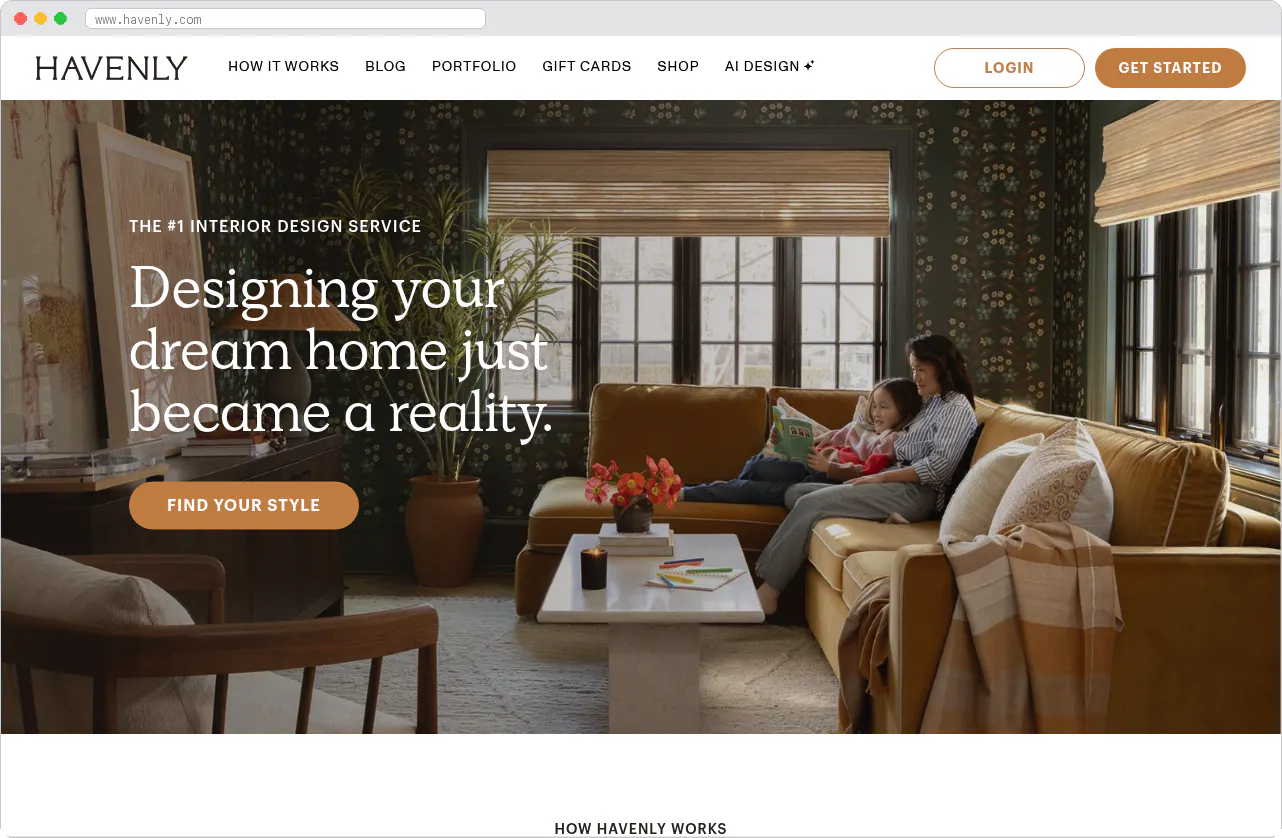
Havenly revolutionized the interior design industry by making professional design services accessible to everyday homeowners. Founded in 2014 by Emily Motayed and Lee Mayer, the platform started with a simple premise: most people want beautifully designed homes but find traditional interior design too expensive, intimidating, or time-consuming.
The founders identified a clear market gap. Traditional interior designers typically charged $100-200 per hour with minimum project commitments of $10,000 or more. Meanwhile, millions of homeowners struggled with DIY design decisions, often making costly mistakes or living with spaces they didn't love.
Havenly's solution was elegant. The platform offers flat-rate design packages starting at $199 for a room design, connecting customers with vetted interior designers who work entirely online. Customers complete a style quiz, share photos of their space, and collaborate with their assigned designer through Havenly's platform to receive a personalized design plan, complete with shoppable product recommendations.
Since launching, Havenly has completed over 100,000 room designs and raised more than $30 million in funding. The company has expanded beyond basic room designs to offer full-service design packages, furniture sourcing, and even white-label services for furniture retailers. Their success demonstrates the massive opportunity in democratizing professional services through marketplace technology.
How does Havenly work?
Havenly operates as a managed marketplace that carefully orchestrates the entire design experience. Unlike open marketplaces where customers browse and choose their own service providers, Havenly controls the matching process to ensure quality and consistency.
For customers, the experience begins with a detailed style assessment. The platform's proprietary quiz evaluates aesthetic preferences, lifestyle needs, budget constraints, and project goals. Customers upload photos of their space and describe their vision, challenges, and must-have elements.
Havenly's algorithm then matches each customer with a designer from their vetted network. This matching process considers the designer's style expertise, availability, customer ratings, and project type specialization. The company maintains strict quality standards, accepting only about 3% of designer applicants after a rigorous review process that evaluates portfolios, design education, professional experience, and communication skills.
Once matched, customers and designers collaborate through Havenly's proprietary platform. Designers create mood boards, floor plans, and detailed product recommendations tailored to the customer's space, style, and budget. The platform includes built-in communication tools, project timelines, and revision management to keep projects on track.
For designers, Havenly provides a steady stream of pre-qualified customers, handling all marketing, customer acquisition, and payment processing. Designers can work flexible schedules from anywhere, focusing on creative work rather than business development. The platform's standardized processes and tools help designers work more efficiently, potentially serving more clients than traditional in-person design practices.
Havenly also facilitates product procurement. Their design platform integrates with major furniture and home decor retailers, allowing customers to purchase recommended items directly through the platform. This creates a smooth experience from design concept to final purchase while generating additional revenue for Havenly through affiliate commissions.
Havenly's business model and revenue streams
Havenly operates on a multi-revenue model that monetizes both the design service and product sales. Their primary revenue streams include design service fees, product commissions, and enterprise partnerships.
Design services generate revenue through flat-rate packages. Their basic "Refresh" package costs $199 and includes a mood board, floor plan, and shoppable product list. The "Full Design" package at $449 adds multiple design concepts, detailed layouts, and one-on-one designer consultations. Premium packages can reach $1,299 for complex projects requiring 3D renderings and extensive customization.
Product commissions represent a significant revenue source. When customers purchase recommended furniture and decor through Havenly's platform, the company earns affiliate commissions typically ranging from 5-15% depending on the retailer partnership. This model aligns Havenly's interests with customer satisfaction since successful design implementations drive product sales.
The company has also developed enterprise partnerships, providing white-label design services to furniture retailers and home improvement companies. These B2B relationships allow other businesses to offer professional design services to their customers while Havenly handles the designer network and platform operations.
This diversified approach creates multiple touchpoints for revenue generation from each customer relationship. A typical customer might pay $449 for a design service, then spend $3,000-8,000 on recommended products, generating combined revenue of $600-1,200 per project for Havenly.
Essential features for a design marketplace like Havenly
Building a successful design marketplace requires sophisticated functionality that goes far beyond basic service booking platforms. The core challenge is facilitating complex creative collaboration between customers and designers while maintaining quality control and project management oversight.
The foundation starts with customer onboarding and assessment tools. Effective style questionnaires must capture aesthetic preferences, functional requirements, lifestyle considerations, and budget parameters. Havenly's quiz includes questions about color preferences, furniture styles, entertaining habits, family composition, and design priorities. This data feeds matching algorithms and provides designers with comprehensive customer insights.
Designer matching and management systems require careful consideration. Unlike marketplaces where customers choose their own service providers, managed design marketplaces typically use algorithmic matching based on style compatibility, designer availability, project type, and customer preferences. The platform must track designer portfolios, specializations, performance metrics, and capacity to optimize matches.
Project collaboration tools form the heart of the platform. Designers need capabilities to create mood boards, share inspiration images, develop floor plans, and present product recommendations. Communication features must support real-time messaging, scheduled video calls, file sharing, and project updates. Version control becomes crucial as designs iterate through multiple revisions based on customer feedback.
Product integration and shopping functionality enable smooth transitions from design concepts to actual purchases. This requires robust catalog management, real-time pricing updates, inventory tracking, and affiliate link management across multiple retailer partnerships. The platform must handle complex product matching when designers recommend specific items that may be out of stock or discontinued.
Quality assurance and project management features help maintain service standards at scale. This includes milestone tracking, revision management, deadline monitoring, and customer satisfaction surveys. Automated workflows can flag projects requiring attention while performance analytics help identify top-performing designers and successful project patterns.
Payment processing must accommodate complex scenarios including split payments (design fees plus product purchases), designer payouts with different commission structures, refund handling, and international transactions. The system needs transparency for all parties while maintaining security and regulatory compliance.
Mobile responsiveness is essential since customers frequently browse inspiration, review designs, and communicate with designers from their phones. The visual nature of design work demands high-quality image display and intuitive navigation across devices.
Steps to build your design marketplace
Creating a successful design marketplace like Havenly requires systematic execution across business development, technology implementation, and community building. The process involves ten key steps that build upon each other to create sustainable marketplace liquidity.
1. Define your design niche and target market
The interior design market is vast and varied, making niche focus essential for initial traction. Havenly succeeded by targeting middle-market homeowners seeking affordable professional design services. Your opportunity might lie in underserved segments like small apartment dwellers, vacation rental owners, commercial spaces, or specific design styles like sustainable or accessible design.
Market research should identify customer pain points that existing solutions don't address. Perhaps traditional designers don't serve your geographic region, or existing online platforms don't cater to specific lifestyle needs like pet-friendly design or multigenerational living. Understanding these gaps helps define your unique value proposition.
Target customer personas need detailed development. Consider demographics (age, income, location), psychographics (style preferences, shopping behavior), and situational factors (home ownership status, life stage, project triggers). Havenly initially focused on millennial homeowners with disposable income but limited design experience, which influenced everything from pricing to communication style.
2. Research and validate demand
Before building technology, validate that enough customers face the problems you've identified and would pay for your solution. This research phase prevents costly mistakes and helps refine your concept based on real market feedback.
Conduct customer interviews with potential users in your target demographic. Ask open-ended questions about their current design challenges, previous experiences with interior design services, budget considerations, and decision-making processes. Focus on understanding their jobs-to-be-done rather than validating specific feature ideas.
Analyze competitor offerings and customer reviews to identify service gaps. What complaints appear repeatedly in reviews of existing design services? Where do customers express frustration with current options? These insights often reveal improvement opportunities for new market entrants.
Test demand through lightweight validation experiments. Create a landing page describing your concept and measure interest through email signups. Run targeted social media ads to gauge engagement with your value proposition. Consider offering manual design consultations to understand the service delivery experience before building technology.
3. Build your designer network
Quality designers are the foundation of any design marketplace success. Unlike products that can be easily standardized, design services depend entirely on individual talent and customer chemistry. Building a strong designer network requires careful recruitment, thorough vetting, and ongoing relationship management.
Designer recruitment should target professionals who align with your market positioning and service model. Recent design school graduates may offer enthusiasm and competitive pricing but lack portfolio depth. Experienced designers bring credibility and skills but may resist platform constraints or commission structures. Consider the trade-offs based on your target customer expectations.
Vetting processes must evaluate both technical design skills and communication abilities. Portfolio reviews assess aesthetic quality and style range, but customer service skills matter equally in online collaboration environments. Havenly's rigorous screening process includes design challenges, communication assessments, and background checks to maintain quality standards.
Designer onboarding should establish clear expectations about service standards, communication protocols, project timelines, and quality requirements. Provide training on your platform tools, customer interaction guidelines, and brand standards. Consider creating design brief templates and style guides to help designers deliver consistent experiences.
Ongoing designer relationship management includes performance tracking, feedback collection, professional development opportunities, and community building. Top-performing designers should receive priority project assignments, featured placement, or bonus compensation to encourage retention and high-quality work.
4. Choose your technology approach
Design marketplace platforms require sophisticated functionality but can be built using various approaches depending on your technical skills, budget, and timeline requirements. The right choice balances speed to market with long-term scalability and customization needs.
No-code marketplace builders like Sharetribe offer the fastest path to launch with built-in features for service bookings, designer profiles, customer matching, payment processing, and communication tools. These platforms handle technical infrastructure, security, and compliance while allowing customization through templates and configuration options.
Custom development provides maximum flexibility but requires significant time and financial investment. Building from scratch allows complete control over user experience and feature development but typically costs $100,000+ and takes 6-12 months for initial launch. This approach makes sense only for well-funded ventures with specific technical requirements that existing platforms cannot meet.
Hybrid approaches combine no-code foundations with custom development for unique features. Platforms like Sharetribe's developer tools allow starting with proven marketplace functionality then adding custom integrations, specialized workflows, or proprietary algorithms as needed. This approach balances speed and flexibility while controlling costs.
5. Design the customer experience
Customer experience design determines whether users successfully complete projects and recommend your service to others. Design marketplaces face unique UX challenges around creative collaboration, expectation management, and complex decision-making processes.
Customer onboarding must efficiently capture preferences while remaining engaging and non-intimidating. Havenly's style quiz succeeds because it feels like a fun personality assessment rather than a tedious form. Visual examples, interactive elements, and progress indicators help users complete detailed assessments that provide designers with valuable project insights.
Project collaboration interfaces should facilitate creative communication without overwhelming non-design customers. Mood boards need intuitive creation tools, commenting systems for feedback collection, and clear version tracking as designs evolve. Consider how customers will view and interact with designs on mobile devices where screen space is limited.
Expectation setting prevents customer dissatisfaction by clearly communicating project timelines, revision policies, designer responsibilities, and outcome possibilities. Use progress indicators, milestone notifications, and proactive communication to keep customers informed throughout the design process.
6. Launch with a small market
Focusing on a specific geographic area or customer segment allows deeper market penetration and faster feedback cycles. Havenly began by concentrating on specific metropolitan areas before expanding nationwide, enabling more personalized customer service and localized designer recruiting.
Choose your initial market based on customer concentration, designer availability, and competitive landscape. Urban areas typically offer more potential customers and designers but face greater competition. Suburban or underserved markets might provide easier initial traction with room for growth.
Launch strategy should prioritize learning over scale. Track customer acquisition costs, project completion rates, customer satisfaction scores, and designer performance metrics. These early insights inform expansion decisions and operational improvements.
7. Establish quality control processes
Maintaining service quality at scale requires systematic processes for monitoring designer performance, managing customer expectations, and handling issues when they arise. Quality control becomes more challenging as marketplaces grow beyond founder oversight.
Performance measurement should track both quantitative metrics (project completion time, revision requests, customer ratings) and qualitative factors (communication quality, design creativity, problem-solving ability). Regular performance reviews help identify top performers for recognition and underperformers for additional training or removal.
Customer feedback collection through post-project surveys, ongoing communication monitoring, and proactive outreach helps identify issues before they escalate. Consider implementing quality checkpoints throughout projects rather than waiting for final completion.
Issue resolution procedures should address common problems like communication breakdowns, design dissatisfaction, timeline delays, or billing disputes. Clear escalation paths and resolution authority help maintain customer trust while protecting designer interests.
8. Build product partnerships
Revenue diversification through product sales requires strategic partnerships with furniture and home decor retailers. These relationships generate additional income while providing customers with smooth purchasing experiences for design recommendations.
Retailer partnerships should align with your customer demographics and design aesthetic. Mass market retailers like Wayfair offer broad selection and competitive pricing while specialty vendors provide unique products that differentiate your recommendations. Consider both online and local retailers depending on customer preferences.
Technical integration requires product catalog synchronization, real-time inventory updates, pricing management, and affiliate tracking. These systems must handle product discontinuations, price changes, and inventory fluctuations without disrupting customer experiences.
Commission negotiations balance revenue generation with customer value. Higher commission rates improve marketplace economics but may lead to product recommendations driven by profit rather than design quality. Maintain transparency with customers about affiliate relationships to preserve trust.
9. Scale your operations
Growth requires systematic scaling of designer recruitment, customer acquisition, quality control, and technology infrastructure. Each element must expand in coordination to maintain service levels while improving unit economics.
Designer scaling involves expanding recruitment channels, streamlining onboarding processes, and developing training programs that maintain quality standards. Consider tiered designer levels with different service offerings and pricing to accommodate varying skill levels and customer budgets.
Customer acquisition should diversify beyond founder networks and early marketing channels. Content marketing through design inspiration, before-and-after showcases, and expert advice helps establish thought leadership while driving organic traffic. Paid advertising, influencer partnerships, and referral programs can accelerate growth when unit economics support increased acquisition spending.
Operational efficiency improvements through automation, standardized processes, and technology upgrades help maintain margins as volume increases. Customer service, project management, and quality assurance systems must scale without proportional cost increases.
10. Expand into new markets or services
Successful expansion requires careful market selection, operational adaptation, and resource allocation. Geographic expansion, new customer segments, or additional service offerings each present different challenges and opportunities.
Geographic expansion should consider local design preferences, competitive landscapes, designer availability, and regulatory requirements. What works in urban markets may not translate to rural areas or different cultural contexts.
Service line expansion might include adjacent markets like outdoor design, renovation consultation, or commercial spaces. Each new service requires specialized designer expertise, different customer acquisition strategies, and modified operational processes.
Competitors and alternatives in the design marketplace space
The online interior design market has evolved significantly since Havenly's launch, with numerous competitors offering different approaches to connecting customers with design services. Understanding this competitive landscape helps founders identify positioning opportunities and learn from others' successes and failures.
Modsy emerged as Havenly's primary competitor with a technology-focused approach emphasizing 3D visualization and augmented reality. Founded in 2015, Modsy allows customers to upload photos of their rooms and receive photorealistic 3D renderings showing how recommended furniture and decor would look in their actual space. This visual approach appeals to customers who struggle to imagine design concepts, though it requires more complex technology infrastructure and higher service delivery costs.
Decorist positioned itself as a premium alternative offering multiple design concepts from different designers for each project. Customers can choose from several design directions before committing to implementation, providing more creative options but potentially complicating decision-making. Decorist's higher price points target affluent customers willing to pay for additional designer time and multiple concepts.
Homepolish attempted to bridge online and offline design services by offering in-person consultations alongside digital collaboration. The company raised significant funding and expanded rapidly but struggled with unit economics and operational complexity. Homepolish's eventual shutdown in 2019 demonstrated the challenges of scaling hybrid service models that combine digital efficiency with high-touch personal interactions.
Laurel & Wolf focused on fast turnaround times and streamlined processes, promising design concepts within 3-5 business days compared to Havenly's typical 7-10 day timeline. Their efficiency-focused approach appealed to time-sensitive customers but potentially limited design depth and customization options.
Decorilla differentiated through designer choice, allowing customers to browse designer portfolios and select their preferred professional rather than relying on algorithmic matching. This approach provides customers with more control but requires them to evaluate designer capabilities independently, potentially overwhelming non-expert buyers.
Spacejoy entered the market with aggressive pricing and quick delivery promises, offering room designs starting at $69 with 24-48 hour turnaround times. Their low-cost model attracted price-sensitive customers but raised questions about design quality and designer compensation sustainability.
The competitive landscape reveals several key strategic choices that define market positioning. Managed versus open marketplace models determine whether customers choose their own designers or rely on platform matching. Premium versus accessible pricing affects target customer demographics and service depth. Technology emphasis varies from basic communication tools to advanced visualization capabilities. Service scope ranges from design-only consulting to full-service implementation including product sourcing and installation coordination.
These competitive dynamics suggest opportunities for new entrants focused on underserved niches like sustainable design, accessibility-focused spaces, small apartments, vacation rentals, or specific cultural aesthetics. The market remains fragmented enough to support multiple successful approaches, particularly for founders who can identify and serve specific customer needs better than existing generalist platforms.
Building with Sharetribe: faster time to market
Sharetribe provides marketplace builders with pre-built functionality specifically designed for service marketplaces like Havenly, enabling faster launches without compromising on essential features. The platform addresses common technical challenges while remaining flexible enough for customization as businesses grow.
The no-code builder includes customer onboarding tools that can capture detailed preferences through customizable forms and questionnaires. Service providers can create rich profiles showcasing portfolios, specializations, and experience levels. Built-in search and filtering help customers find relevant services while messaging systems facilitate project collaboration.
Payment processing through Stripe Connect handles complex scenarios including service fees, designer payouts, and commission structures. The system supports various pricing models from flat rates to hourly billing, with automatic fee calculation and transparent transaction tracking for all parties.
Project management features help track service delivery through customizable booking flows, milestone management, and customer feedback collection. These tools provide structure for complex creative projects while maintaining flexibility for different service approaches.
Mobile-responsive design ensures optimal experiences across devices, crucial for visual-heavy design services where customers frequently browse inspiration and review concepts on smartphones and tablets. The platform's templates are specifically optimized for service-based marketplaces rather than generic website builders.
As businesses grow beyond no-code limitations, Sharetribe's developer platform allows custom feature development on top of proven marketplace foundations. This hybrid approach provides speed to market initially while supporting long-term customization needs without complete platform migrations.
For design marketplace founders, this means launching in weeks rather than months, testing market fit with real customers, and iterating based on actual usage data rather than theoretical requirements. The platform handles technical infrastructure, security compliance, and routine maintenance, allowing founders to focus on customer acquisition, designer relationships, and service quality.
However, founders should consider potential limitations. Highly specialized design tools, proprietary matching algorithms, or unique workflow requirements may eventually require custom development. Advanced visualization features like 3D rendering or augmented reality typically need specialized integrations or custom builds. The key is starting with proven functionality and adding unique capabilities as market validation and revenue support additional investment.
Cost considerations for building a design marketplace
Building a design marketplace involves various cost structures depending on the chosen development approach, feature complexity, and growth timeline. Understanding these costs helps founders make informed decisions about resource allocation and funding requirements.
No-code marketplace platforms like Sharetribe offer the most cost-effective launch approach. Monthly subscription costs typically range from $39-399 depending on features and transaction volume, with additional transaction fees of 1-3% for payment processing. First-year costs often total under $5,000 including domain registration, basic branding, and marketing automation tools.
Custom development costs vary significantly based on feature scope and developer rates. Basic design marketplace functionality typically requires 3-6 months of development time, translating to $50,000-200,000 for professional development teams. Additional costs include hosting infrastructure ($500-2,000 monthly), third-party service integrations ($200-1,000 monthly), and ongoing maintenance (15-20% of initial development costs annually).
Hybrid approaches using no-code foundations with custom additions offer middle-ground cost structures. Initial launch costs remain low while custom development can be added incrementally as revenue grows. This approach might cost $10,000-50,000 in the first year depending on customization extent.
Operational costs beyond technology include designer recruitment and management, customer acquisition, quality control, and customer service. These costs scale with transaction volume but typically represent larger expenses than technology infrastructure once businesses achieve meaningful traction.
Designer acquisition costs vary by market competition and compensation structures. Initial recruiting might require attending design events, advertising on professional networks, or offering referral bonuses to attract quality talent. Ongoing designer relationship management includes performance bonuses, training programs, and community building activities.
Customer acquisition costs depend heavily on market competition and customer lifetime value. Design services typically support higher acquisition costs than product sales due to larger transaction values and potential repeat business. Early-stage acquisition through content marketing, social media, and referral programs can remain relatively affordable while paid advertising costs scale with market competition.
Quality control and customer service costs increase with scale but can be partially automated through systematic processes and technology tools. Consider budgeting for dedicated customer success roles once monthly transaction volume reaches sustainable levels.
The most successful approach balances initial cost control with scalability planning. Start with minimal viable functionality to test market fit, then reinvest early revenue into the areas that drive the most customer satisfaction and business growth. This typically means improving core service quality before adding advanced features or expanding into new markets.
Next steps for aspiring design marketplace founders
Building a successful design marketplace requires systematic execution, continuous learning, and persistent refinement based on real customer feedback. The most important factor is starting quickly with a focused concept rather than waiting for perfect planning or complete feature sets.
Begin by validating your specific market niche through direct customer conversations and competitive analysis. Identify the particular customer segment and design needs that existing solutions don't serve effectively. This might be geographic underservice, demographic focus, style specialization, or service model innovation.
Define your minimum viable platform features based on customer research rather than competitor feature matching. Essential functionality typically includes customer onboarding, designer matching or browsing, project collaboration tools, and payment processing. Additional features can be added based on actual usage patterns and customer feedback.
Choose a development approach that prioritizes speed to market while supporting future growth. No-code platforms offer the fastest validation path, while custom development provides ultimate flexibility at higher cost and longer timelines. Consider your technical skills, available resources, and market timing when making this decision.
Launch in a focused market segment where you can achieve meaningful penetration and gather concentrated feedback. Geographic focus, customer demographic targeting, or service specialization help create initial traction more effectively than broad market approaches.
Establish systematic processes for customer feedback collection, designer performance management, and quality control from the beginning. These systems become much harder to implement after marketplace complexity increases with scale.
Plan for sustainable growth by developing unit economics models that account for all costs including customer acquisition, designer management, platform development, and customer service. Understanding these metrics early helps make informed decisions about pricing, marketing investment, and expansion timing.
The interior design marketplace opportunity remains significant despite existing competition. Customer demand continues growing as home design importance increases, while traditional design services remain expensive and inaccessible for many consumers. Success comes from identifying specific customer needs and delivering superior experiences rather than competing on generic marketplace features.
Founders who combine market insight, execution speed, and continuous learning have strong opportunities to build valuable businesses in this space. The key is starting with real customer problems and iterating toward solutions that create lasting value for both customers and designers.
Frequently asked questions
How much does it cost to build a marketplace like Havenly?
Costs vary by approach: Total first-year costs with a no-code marketplace platform typically run $2,000-5,000. Most founders start with no-code solutions to validate demand before investing in custom features.
What features does a design marketplace need?
Essential features include customer style assessments, designer profiles and portfolios, project collaboration tools, messaging systems, payment processing with designer payouts, and mobile-responsive design. Advanced features like 3D visualization can be added later based on customer demand.
How do design marketplaces like Havenly make money?
Revenue comes from design service fees (typically $199-1,299 per project), product affiliate commissions (5-15% of purchases), and sometimes subscription fees. The best models combine service revenue with product sales for diversified income streams.
Who are Havenly's main competitors?
Major competitors include Modsy (3D visualization focus), Decorist (premium positioning), Spacejoy (budget pricing), and Decorilla (designer choice model). Each differentiates through pricing, service approach, or technology features.
How long does it take to launch a design marketplace?
Timeline depends on complexity: no-code platforms enable launch in 2-4 weeks, custom development takes 6-12 months. Most successful founders start with basic functionality to test market demand before adding advanced features.
How do I find designers for my marketplace?
Recruit through design schools, professional networks, social media, and industry events. Focus on vetting both design skills and communication abilities since online collaboration requires different skills than traditional in-person design services.
Start your 14-day free trial
Create a marketplace today!
- Launch quickly, without coding
- Extend infinitely
- Scale to any size
No credit card required